
Why Choosing the Right Retaining Wall Installation Contractors Matters
Retaining wall installation contractors are licensed, experienced professionals who design, engineer, and build walls that hold back soil, prevent erosion, and turn sloped or uneven land into usable outdoor space. In the rugged terrain of Massachusetts’ North Shore, from the rocky coasts of Gloucester to the rolling hills of Boxford, these structures are not just decorative—they are essential for property preservation.
If you need a quick answer, here’s what to look for:
- Licensed and insured – Always verify a contractor holds a valid Massachusetts Home Improvement Contractor (HIC) license and liability insurance.
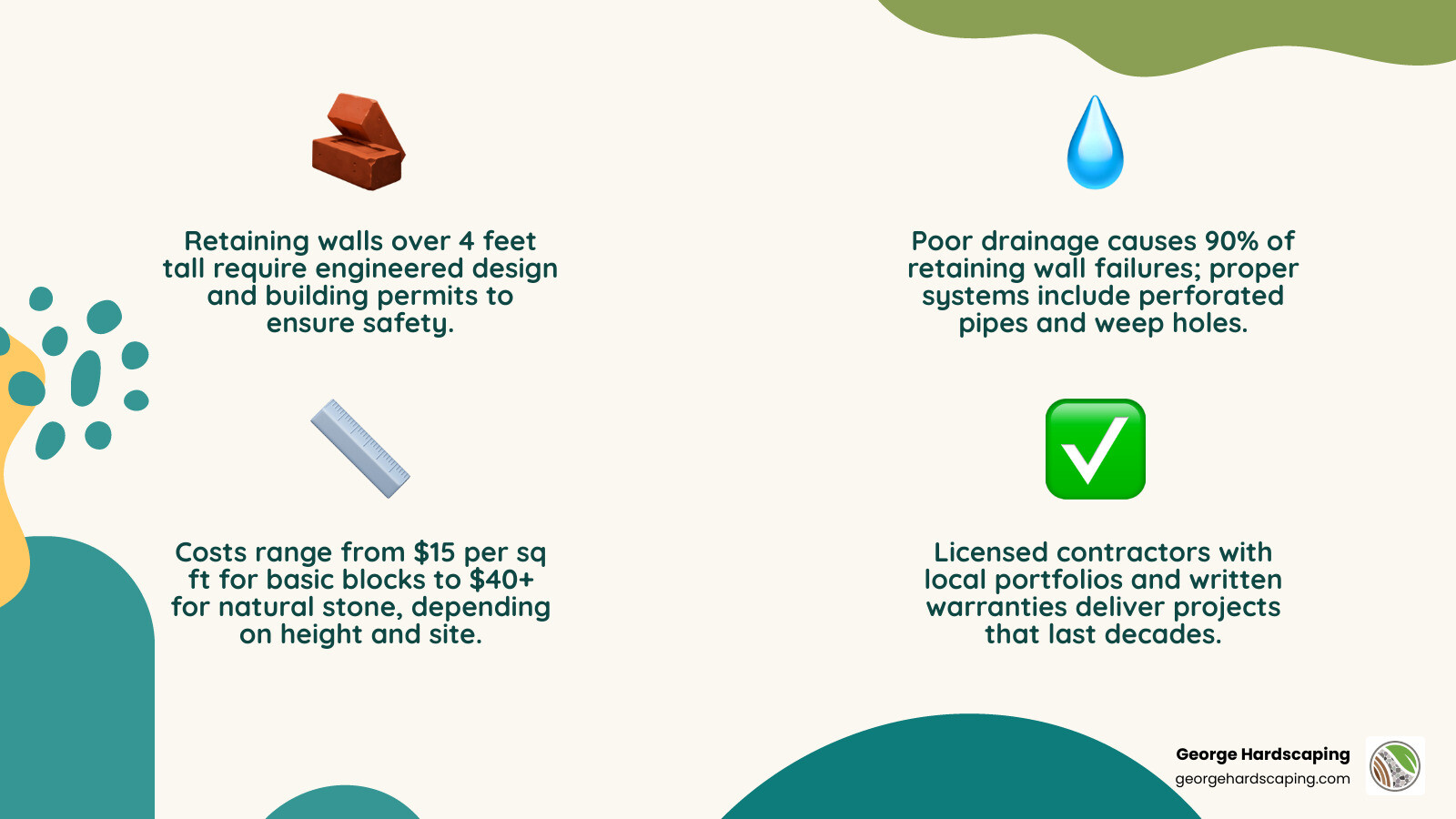
- Engineering experience – Walls over 4 feet typically require a licensed engineer and municipal permits.
- Drainage knowledge – Poor drainage is the #1 cause of wall failure; pros know how to prevent hydrostatic pressure buildup.
- Portfolio of local work – Look for completed projects in your area (Essex County, North Shore MA).
- Written estimates – Get at least two or three quotes before committing to a major project.
- Clear warranty – Reputable contractors back their work with a written guarantee against structural failure.
Pricing varies widely based on site conditions and material choices. Based on average internet data (not actual George Hardscaping pricing), homeowners typically spend anywhere from $100 on the low end for minor repairs to $750 or more on the high end for complex builds, depending on materials, wall height, and site complexity. Per square foot, costs range roughly from $15 for timber or basic block to $40+ for poured concrete or natural stone.
A slope in your backyard might look harmless during a dry summer. But without a properly built retaining wall, heavy New England rain can wash away topsoil, undermine your home’s foundation, and turn a beautiful yard into a muddy, expensive problem. This is especially true here on the North Shore, where seasonal rain and intense freeze-thaw cycles put immense pressure on the ground around your home. According to the American Society of Landscape Architects, professional site grading and wall construction are the most effective ways to manage these environmental stressors.
The good news? The right contractor makes the whole process straightforward—from pulling permits at the local town hall to the final placement of the capstone. This guide walks you through everything you need to know to find, vet, and hire the best professional for your project.
Retaining wall installation contractors basics:
Understanding the Role of Retaining Wall Installation Contractors
When you look at a wall in a neighbor’s yard, you might just see a stack of stones. However, beneath the surface, a battle is being fought against physics. Soil retention is a complex science involving the management of hydrostatic pressure—the force exerted by water trapped in the soil behind the wall. Without proper management, this pressure can easily topple thousands of pounds of masonry. Expert retaining wall installation contractors do more than just stack blocks; they act as site grading specialists and structural guardians.
By utilizing professional retaining wall construction services, homeowners ensure that their landscape architecture is built on a foundation of structural integrity. These pros analyze the soil type—whether it is the heavy clay found in some parts of Peabody or the sandy glacial till of Ipswich—and calculate the weight of the earth being held back. They design drainage management systems that allow water to escape safely, preventing the wall from bowing or collapsing under the weight of saturated soil. For technical standards on soil pressure, many pros refer to the National Concrete Masonry Association guidelines.
Essential Functions of Modern Retaining Walls
A well-constructed wall serves several critical purposes for your property:
- Erosion Prevention: In hilly areas like Beverly or Marblehead, heavy rains can strip away topsoil. A wall keeps your land where it belongs, protecting your investment.
- Creating Usable Space: By leveling off a slope, you can turn a “dead” hill into a functional patio, garden, or play area. This effectively increases the square footage of your usable outdoor living space.
- Foundation Protection: If your home is situated at the bottom of a slope, landscape retaining walls act as a barrier against mudslides and water runoff that could compromise your foundation’s stability.
- Aesthetic Enhancement: Beyond function, a wall adds vertical interest and texture to a flat landscape, defining different “rooms” in your outdoor environment.
Why Hire Professional Retaining Wall Installation Contractors?
While a small garden border might be a fun weekend DIY project, structural walls require retaining wall installation services for several reasons. First is engineering compliance. In many Massachusetts towns, any wall over 4 feet tall is legally required to be designed by a licensed structural engineer. This ensures the wall can withstand the specific “surcharge loads” of your property, such as a nearby driveway or swimming pool.
Secondly, the sheer physical demand is immense. Building a 15-foot long, 4-foot high wall involves moving tons of material. Professionals use heavy equipment like skid steers and mini-excavators to ensure the base is dug to the correct depth and the soil is properly compacted. Without professional-grade compaction, the wall will settle unevenly, leading to cracks and failure within just a few seasons. Safety is also a major factor; contractors follow OSHA trenching and excavation safety standards to prevent site accidents during the deep digging required for a proper footer.
Popular Materials and Design Options for Your Property
Choosing the right material is a balance of aesthetics, budget, and durability. Whether you are looking for a sleek modern look or a rugged, natural feel, the retaining wall block options available today are more diverse than ever. High-quality manufacturers like Belgard Commercial offer systems that mimic the look of natural stone while providing the structural consistency of engineered concrete.
Segmental Retaining Walls and Concrete Blocks
Segmental Retaining Walls (SRW) are the workhorses of the industry. These consist of interlocking units that fit together without the need for mortar. This modular design is particularly effective in our North Shore climate because it allows the wall to “breathe” and shift slightly during the freeze-thaw cycles without cracking. When performing block retaining wall construction, contractors rely on the weight and the setback (the slight backward lean) of the blocks to provide stability. These systems are often tested against ASTM International standards for compressive strength and water absorption.
Natural Stone and Masonry Excellence
For homeowners in historic areas like Salem or Ipswich, nothing beats the timeless look of natural stone retaining walls. Whether it’s rugged fieldstone or precisely cut granite, stone retaining wall stones offer a level of character that manufactured products can’t quite replicate. These can be built as “dry stack” walls (no mortar) for a rustic look or as mortared masonry walls for a more formal, polished appearance. Natural stone is incredibly durable, often lasting over a century if installed with a proper foundation.
Eco-Friendly and Sustainable Alternatives
Sustainability is becoming a major focus in hardscaping. Some innovative contractors specialize in using recycled concrete—reclaiming old sidewalks or foundations and processing them into “new” wall materials. This reduces landfill waste and provides a unique, weathered aesthetic. Another option is the “living wall,” which uses specialized eco-friendly retaining wall solutions to allow plants to grow directly within the structure, helping with carbon sequestration and local biodiversity. These green walls can also help manage stormwater runoff, a key goal of the Environmental Protection Agency for residential developments.
| Material Type | Durability | Aesthetic Style | Relative Cost |
|---|---|---|---|
| Interlocking Block | High | Modern/Clean | Moderate |
| Natural Stone | Very High | Rustic/Classic | High |
| Pressure-Treated Timber | Moderate | Natural/Soft | Low |
| Poured Concrete | High | Industrial/Minimalist | Moderate-High |
| Gabion (Wire/Rock) | High | Industrial/Modern | Moderate |
The Professional Installation Process: From Engineering to Completion
A successful wall is 90% preparation and 10% stacking. If you skip the groundwork, the most beautiful stones in the world won’t stay upright. Following a retaining wall install guide is essential for understanding the complexity involved in a professional-grade build.
Site Assessment and Engineering Requirements
Before a single shovel hits the dirt, we conduct a thorough site assessment. This includes identifying soil types—clay holds water and expands, while sandy soil drains well but needs more reinforcement. For any project involving significant height or “surcharge loads” (like a driveway sitting at the top of the wall), we work with retaining wall design experts to ensure the plan meets local building codes and safety standards. We also check for underground utilities to ensure no gas or water lines are disturbed during excavation.
Building a Solid Foundation and Drainage System
The most important part of the wall is the part you never see. We excavate a deep trench, typically 6 to 12 inches deep depending on the wall height, and fill it with a retaining wall drainage system consisting of compacted angular gravel. This base provides a level, non-shifting platform that resists the heaving effects of frost. Behind the wall, we install a perforated pipe wrapped in landscape fabric to channel water away to a safe exit point. This prevents the buildup of water pressure, which is the leading cause of wall failure. For more details, you can consult our retaining wall drainage guide.
Expert Execution by Retaining Wall Installation Contractors
Once the base is set, the first course of blocks is laid. This is the most time-consuming step, as every single block must be perfectly level in both directions. We then proceed by staggering joints—much like a brick wall—to ensure maximum strength. When we install a retaining wall on a slope, we use a “stepping” technique to follow the grade of the land. For taller walls, we may incorporate retaining wall anchors or geogrid (a high-strength synthetic mesh) to tie the wall into the soil behind it, creating a massive reinforced soil mass that is nearly impossible to move.
| Wall Height | Estimated Construction Time | Complexity Level |
|---|---|---|
| 1-2 Feet | 1-2 Days | Low (Garden/Border) |
| 3-4 Feet | 3-5 Days | Moderate (Gravity Wall) |
| 5+ Feet | 7+ Days | High (Engineered/Reinforced) |
Note: Timelines are averages and can vary based on weather, site access, and material availability.
Cost Factors and Budgeting for Your Project
Understanding the retaining wall construction cost is vital for any homeowner planning a landscape renovation. The total price isn’t just about the blocks; it includes excavation, hauling away old soil, importing tons of gravel, and the specialized labor required for a lasting build. When asking how much for retaining wall installation, site accessibility plays a huge role. If a contractor has to move materials by hand because a machine can’t fit through a narrow gate, labor costs will naturally rise.
Estimating Your Investment
When calculating your retaining wall cost guide, expect to see variations based on square footage and wall height. A wall that is 4 feet tall requires significantly more “beefy” engineering and material volume than a 2-foot garden wall.
- Averages (Internet Data): $15 to $40+ per square foot of wall face.
- Low End: $100 – $500 for very small, DIY-style repairs or short timber borders.
- Median: $3,500 – $8,500 for standard residential garden walls and leveling projects.
- High End: $15,000 to $50,000+ for large, engineered structural walls that support driveways or pools.
Long-Term Value vs. Upfront Savings
It can be tempting to go with the lowest bidder, but in masonry, you usually get what you pay for. Choosing affordable retaining wall solutions shouldn’t mean sacrificing quality. A wall built with cheap timber might save you money today, but if it rots in seven years, you’ll pay double to replace it. Investing in stone or high-grade concrete blocks provides a lifespan of 50+ years, significantly increasing your property’s resale value and curb appeal. Furthermore, a well-built wall prevents costly foundation repairs that can arise from uncontrolled erosion.
Call to Action: Start Your Transformation
Don’t let your landscape wash away! Our team is ready to help you reclaim your yard with a structure that is as beautiful as it is strong. We provide detailed, transparent quotes so you know exactly where your investment is going.
Request a professional estimate for your hardscaping project today
How to Vet and Hire the Right Retaining Wall Installation Contractors
Finding a retaining wall builder you can trust is the most important step in the journey. You aren’t just looking for someone with a truck; you need a craftsman who understands the local geology of the North Shore. Start by reading 5-star contractor reviews to see how they handle challenges and communicate with clients. A contractor’s reputation in towns like Danvers or Peabody is a strong indicator of their reliability.
Essential Credentials for Retaining Wall Installation Contractors
A professional retaining-wall-contractor should be able to provide the following without hesitation:
- Liability Insurance and Workers’ Comp: This protects you if an accident happens on your property. Never hire a contractor who cannot produce a current insurance certificate.
- Bonding: This ensures the project will be completed as agreed, providing an extra layer of financial security for the homeowner.
- Certifications: Look for contractors certified by organizations like the Interlocking Concrete Pavement Institute (ICPI) or specific manufacturers like Belgard or Unilock.
- Local Experience: Someone who has worked in Newburyport or Gloucester knows how our coastal air and specific soil types behave. They will also be familiar with local building inspectors and permit requirements.
Red Flags and Common Mistakes to Avoid
Be wary of any contractor who suggests skipping the drainage pipe or tells you that permits aren’t necessary for a tall wall. These are shortcuts that lead to disaster. If you are dealing with an existing wall that is failing, check out our retaining wall repair complete guide to see if it can be saved. Often, homeowners wait too long, and a simple fix turns into a massive stone retaining wall repair cost guide situation. A reputable contractor will always prioritize structural safety over a quick, cheap fix.
Maintenance, Repairs, and Longevity
Even the best-built wall needs a little love. Seasonal inspections are the key to longevity, especially after the harsh winters we experience in Massachusetts. After a heavy winter, walk along your wall and look for any new cracks, signs of shifting, or “efflorescence” (a white, powdery salt deposit). If you know how to repair a stone retaining wall, minor mortar touch-ups are easy. However, if the wall is bulging, the cost of repairing retaining wall can escalate quickly if the core structure is compromised.
Signs Your Wall Needs Professional Attention
If you notice any of these signs, call a pro immediately to prevent a total collapse:
- Leaning or Bulging: This indicates that the soil pressure behind the wall is winning the battle, often due to clogged drainage.
- Cracked Blocks: This suggests uneven settling in the foundation or that the wall is being asked to hold more weight than it was designed for.
- Water Pooling: If water is coming over the top of the wall instead of through the drainage system, your pipes are likely clogged or were never installed correctly.
- Complete Collapse: If you are facing a collapsed stone retaining wall, do not attempt to move the stones yourself, as the remaining soil could be unstable and dangerous.
Extending the Life of Your Hardscape
To keep your wall in top shape for decades:
- Manage Vegetation: Don’t let large trees grow too close to the wall, as their roots can exert thousands of pounds of pressure and push through the structure.
- Clear Drainage: Ensure weep holes are free of debris so water can escape freely. Check these after major storms.
- Professional Check-ups: If you’re searching for retaining wall repair near me, having an expert look at your wall every few years can catch small issues before they become five-figure problems. Regular maintenance is far cheaper than a total rebuild.
Frequently Asked Questions about Retaining Walls
Do I need a permit for a retaining wall?
In most North Shore communities, including Peabody, Danvers, and Salem, walls under 4 feet typically do not require a building permit. However, anything 4 feet or taller almost always requires an engineered plan and a permit from the local building department. If the wall is near a wetland or coastal zone, you may also need approval from the local Conservation Commission.
How long does a typical installation take?
For a standard residential project (about 30-40 feet long and 3 feet high), you can expect the crew to be on-site for about 3 to 5 days. This includes excavation, base preparation, stacking, and backfilling. Larger, engineered walls can take two weeks or more depending on the complexity of the reinforcement.
What is the best material for a sloped backyard?
For steep slopes, we generally recommend Segmental Retaining Wall (SRW) blocks. Their interlocking design and ability to be reinforced with geogrid make them incredibly strong for high-pressure situations. They are also more cost-effective than poured concrete for most residential applications.
Can I build a retaining wall myself?
While small garden borders (under 2 feet) are manageable for a handy DIYer, any wall that is holding back a significant amount of earth should be handled by professionals. The risk of failure and the physical labor involved make it a high-stakes project for an amateur.
Conclusion
At George Hardscaping, we believe that a retaining wall should be more than just a functional necessity—it should be a centerpiece of your outdoor living area. As a premier Essex County masonry specialist, we take pride in our North Shore craftsmanship. Whether you are in Salem, Marblehead, or Topsfield, we bring decades of experience to every project, ensuring your landscape is both beautiful and structurally sound.
Our comprehensive hardscaping and masonry services go beyond just walls. We can integrate your new structure with custom patio design and installation or beautiful walkways and stairs to create a seamless, multi-level retreat. From the first consultation to the final stone, we focus on quality that stands the test of time.
Call to Action: Enhance Your Outdoor Living Space
Ready to transform your sloped yard into a functional masterpiece? Our experts are standing by to help you design and build a wall that lasts a lifetime. Don’t wait for the next big storm to cause erosion issues on your property.
Contact our expert team to design your custom retaining wall today
