
Retaining Wall Install: Top 5 Successful Steps
Transform Your Outdoor Space with a Professional Retaining Wall Install
A retaining wall install is more than just stacking blocks—it’s a strategic landscaping solution that prevents soil erosion, creates usable outdoor space, and adds significant curb appeal to your property. Whether you’re dealing with a sloped yard on the North Shore or looking to define garden beds in Essex County, MA, understanding the installation process ensures a durable, functional wall that lasts for decades.
Quick Overview: Key Steps for a Retaining Wall Install
- Planning & Permits – Assess your site, check local codes, and call 811 before digging.
- Choose Materials – Select from interlocking blocks, poured concrete, natural stone, or timber.
- Excavate & Prepare – Dig a trench for the base, ensuring proper depth.
- Build the Base – Compact gravel and ensure the first course is perfectly level.
- Stack & Stagger – Add courses with staggered joints and proper setback.
- Install Drainage – Place perforated pipe and backfill with gravel to prevent water pressure.
- Finish & Cap – Secure capstones and grade soil away from the wall.
According to industry data, the national average cost for a retaining wall install ranges from $3,500 to $9,400. While some DIY projects can be done for less, professional installation ensures structural integrity—especially critical for walls over 4 feet tall. A properly installed retaining wall can increase your home’s value while solving practical problems like erosion control.
The key to longevity lies in three critical elements: a solid foundation, proper drainage, and choosing the right materials. For homeowners in Essex County, where soil conditions vary, professional expertise matters. Poor installation—particularly an inadequate base or drainage—is the leading cause of wall failure. Whether you’re building raised garden beds or managing a hillside, understanding the full process helps you make informed decisions about your retaining wall construction project.
Terms related to retaining wall install:
Planning and Preparation: The Foundation of a Lasting Wall
Before moving any dirt, meticulous planning is the cornerstone of a successful retaining wall install. This phase ensures your project is structurally sound, compliant with local regulations, and built to last.
Key Considerations for Your Retaining Wall Install Project
Every successful project begins with a thorough site assessment and clear goals. Here are the crucial details to consider:
- Site Assessment: We carefully check your soil type, yard’s slope gradient, and existing water drainage patterns. Understanding how water moves is critical, as hydrostatic pressure from water buildup is the primary force a retaining wall must withstand. In areas like Essex County and the North Shore, we encounter a wide range of soil conditions, from sandy loam to dense marine clay. Clay soils expand when wet and shrink when dry, exerting immense pressure on a wall, while sandy soils drain well but can be less stable. A professional site assessment identifies your specific soil composition, which directly informs the required foundation depth, drainage strategy, and whether soil amendments or special reinforcement are necessary for a long-lasting retaining wall install.
- Call 811: Before any digging, this free service marks underground utility lines. Hitting a gas, water, or electrical line is dangerous and costly.
- Local Regulations and Permits: Many towns on the North Shore require permits for a retaining wall install, particularly for walls over 3-4 feet. We always check local building codes and HOA restrictions to ensure compliance.
- Project Scale & Design: The size and complexity of your project influence materials and engineering needs. Your functional goals—be it erosion control or creating usable space—will guide the wall’s layout and material choices. For walls exceeding 4 feet in height, a simple gravity design is often insufficient. These structures require an engineered plan that may incorporate geogrid reinforcement—a synthetic mesh laid between block courses that extends back into the soil, effectively anchoring the wall to the earth behind it. This creates a reinforced soil mass that works with the wall to resist pressure. Neglecting this step for taller walls is a primary cause of catastrophic failure. Explore creative ideas by looking at more info about retaining wall design.
Choosing Your Retaining Wall Materials
The material you select impacts appearance, durability, lifespan, and cost. Here’s a comparison of common choices:
| Material | Cost per Sq. Ft. (Avg.) | Lifespan (Avg.) | Durability | DIY-Friendliness | Pros | Cons |
|---|---|---|---|---|---|---|
| Interlocking Concrete Blocks | $15 – $60 | 30-75 years | High | High | Easy to install, variety of colors/textures, good for DIY. | Can look uniform; larger walls may need engineering. |
| Poured Concrete | $20 – $40 | Up to 100 years | Very High | Low | Most durable, versatile design, strongest for heavy loads. | Requires professional installation, complex forms, longer cure time. More info about concrete retaining wall construction. |
| Natural Stone | $20 – $90 | 40-100 years | High | Medium | Natural aesthetic, highly durable, unique look. More info about retaining wall stone. | More expensive, requires skilled masonry work, heavy to lift. |
| Wood/Timber (Treated) | $13 – $35 | 20-40 years | Medium | Medium | Rustic look, relatively affordable. | Shorter lifespan, prone to rot/insect damage, requires maintenance. |
| Railroad Ties | $18 – $25 | 20-40 years | Medium | Medium | Rustic, readily available. | Contain creosote (toxic), banned in some areas, shorter lifespan. |
| Vinyl | $10 – $15 | 50 years | Medium | High | Affordable, lightweight, low maintenance. | Limited aesthetic options, best for shorter walls. |
For many DIY projects, interlocking concrete blocks are a popular choice. At George Hardscaping, we also offer professional block retaining wall construction for lasting results. For maximum durability, poured concrete is often the best bet, while natural stone walls provide stunning, timeless aesthetics.
Essential Tools and Supplies
Having the right tools and materials on hand makes your retaining wall install smoother and safer.
Essential Tools:
- Shovel and Wheelbarrow
- Tape Measure
- 4-foot Level and Torpedo Level
- Rubber Mallet
- Hand Tamper or Plate Compactor
- Circular Saw with Masonry Blade or Angle Grinder
- Safety Glasses, Gloves, and Dust Mask
- String Line and Stakes
- Utility Knife
Key Materials:
- Wall Blocks: Purchase 10% extra for cuts and breakage.
- Capstones: For a finished look.
- Crushed Gravel (3/4-inch clean): For the base and drainage.
- Paver Base or Coarse Sand: For leveling the base course.
- Perforated Drain Pipe: With a drain sleeve to prevent clogging.
- Landscape Fabric (Geotextile): To separate drainage gravel from soil.
- Construction Adhesive: To secure capstones.
The Step-by-Step Retaining Wall Install Process
With planning complete, it’s time to build your retaining wall. This guide walks you through each step to create a sturdy, beautiful structure.
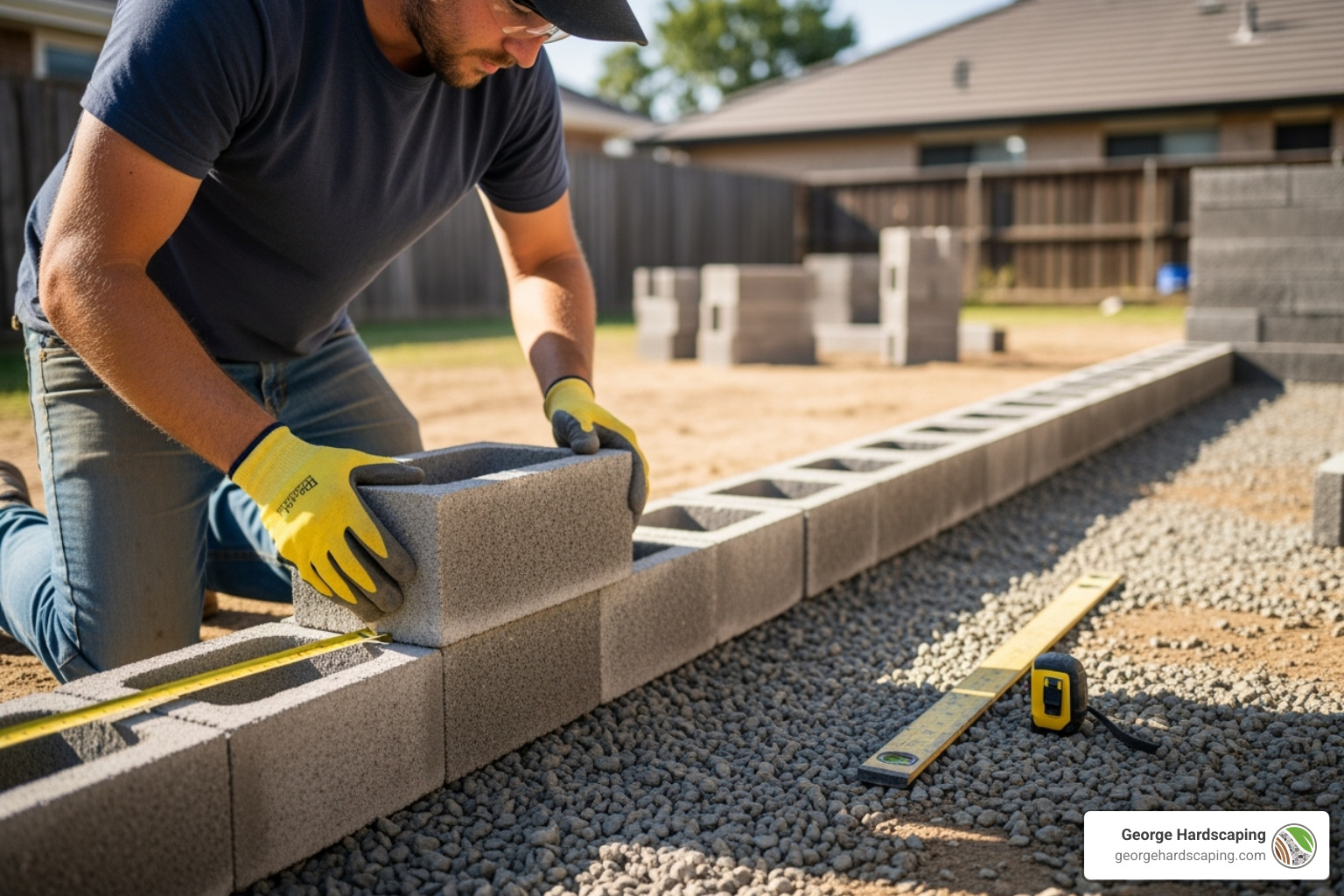
Step 1: Excavation and Foundation Preparation
A strong foundation is absolutely critical. An improper base is the leading cause of wall failure.
First, mark the layout using stakes and a string line or spray paint. Next, dig the trench. The trench depth should be a minimum of 6 inches, plus 1 inch for every foot of the wall’s exposed height. The trench width should be about twice the width of your block to allow for backfill. We recommend burying the first course of blocks—at least half the block’s height—to anchor the wall.
Once dug, create a level base. Clear out loose soil and roots. Add 3 to 6 inches of paver base or crushed gravel and compact it thoroughly with a hand tamper or plate compactor. A well-compacted base is your best defense against settling. During excavation, be prepared for surprises. You may encounter large rocks, dense tree roots, or unexpected utility lines that weren’t marked. Large rocks may need to be broken up and removed or incorporated into the backfill.
Major tree roots should be cut cleanly to prevent future growth from disturbing the wall’s foundation. This is another area where professional experience proves invaluable, as we have the equipment and knowledge to handle these common obstacles without compromising the project timeline or structural integrity. For more details, check our guide on retaining wall construction detail.
Step 2: Laying a Level Base Course
This first course must be perfectly level, as it sets the stage for the entire wall.
Start at the lowest point of your wall’s layout. Place the first block and use a 4-foot level to check it from front-to-back and side-to-side. Use a rubber mallet to tap blocks into place or add a sprinkle of paver base to adjust the height. Use a string line for alignment to ensure a straight or smoothly curved line. Once the first course is laid, backfill in front of the base course with soil and compact it to prevent shifting.
Step 3: Building Subsequent Courses and Staggering Blocks
As you build upwards, the wall’s structure takes shape.
It is crucial to stagger the joints in a running bond pattern, so vertical joints don’t line up. This distributes weight and prevents weak points. You will likely need to cut blocks for staggering at the ends of courses using a masonry saw. Always wear safety glasses and a dust mask.
Many blocks have interlocking mechanisms like lips or pins; ensure they are properly engaged. This creates the correct setback, giving the wall a slight backward lean for stability. When creating curves, minor adjustments on each block will create a smooth radius. For tighter curves, you may need to use a masonry chisel or saw to trim the back ‘wings’ of the interlocking blocks to allow them to fit together snugly.
Always follow the manufacturer’s guidelines for the minimum radius achievable with your chosen block system. A common mistake is forcing blocks into a curve that is too tight, which creates gaps and weakens the wall’s structure. Before laying a new course, sweep each course clean of debris. Finally, keep checking for level on every course to avoid cumulative errors. For larger projects, our team is skilled in large retaining wall construction.
Step 4: Incorporating Drainage and Backfill
Proper drainage is the unsung hero of a long-lasting wall. It prevents hydrostatic pressure—the force of water-saturated soil—from pushing against and damaging your wall. You can view a large-scale retaining wall project from Redi-Rock International to see how professionals manage these forces.
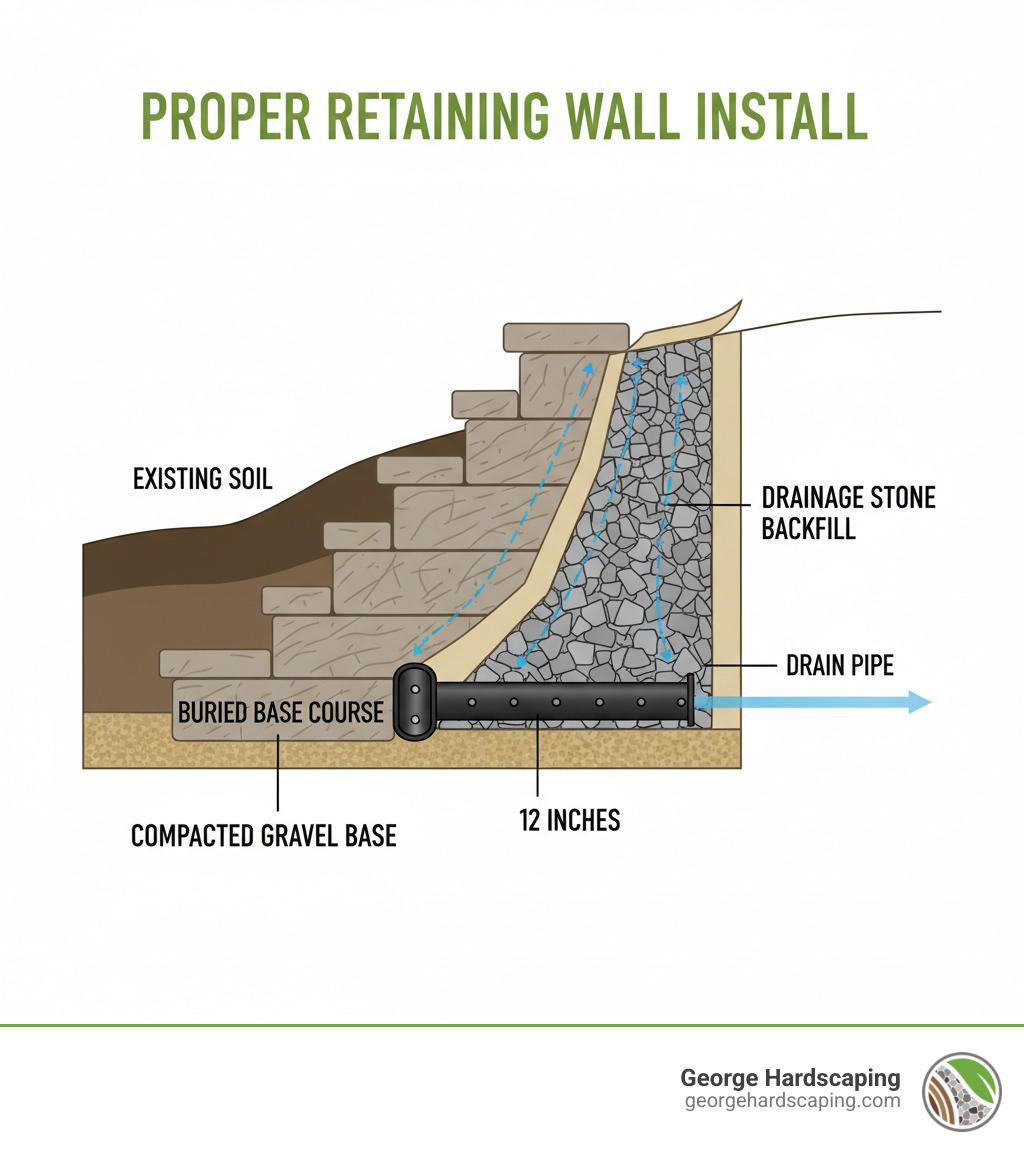
- Place a perforated drain pipe behind the first course of blocks, with the holes facing down.
- Slope the pipe for runoff (about 1 inch per 4 feet) to direct water away safely.
- Use a drain sleeve to prevent the pipe from clogging with soil.
- Backfill with 3/4-inch clean gravel in the 12-inch space behind the wall as you build each course. The term ‘3/4-inch clean gravel’ is specific and crucial. This refers to angular, crushed stone with minimal ‘fines’ (small particles and dust). Unlike pea gravel (which is rounded and can shift like marbles) or crusher run (which contains fines that compact and impede drainage), clean gravel creates a network of voids. These voids allow water to flow freely down to the perforated pipe, relieving hydrostatic pressure. This drainage column should extend at least 12 inches behind the wall and from the footing to just below the capstones.
- Compact the backfill in lifts of 6-8 inches at a time.
- Use landscape fabric to separate the drainage gravel from the native soil, preventing clogs.
For a deep dive into this vital aspect, explore our section on retaining wall drainage systems.
Step 5: Finishing with Capstones and Landscaping
The final touches provide a beautiful aesthetic and long-term protection.
First, clean the top course of any debris. Then, apply construction adhesive in two 1/4-inch beads. Set the capstones carefully, ensuring they are level and aligned. Many caps are designed with a 1 to 1.5-inch overhang for a finished look.
Finally, grade the soil away from the wall on both sides to direct surface water away. Planting vegetation can also help stabilize the soil and reduce erosion. For more ideas, see our insights on landscape retaining walls or watch a step-by-step video on building a garden retaining wall.
Design, Costs, and Common Pitfalls
A functional retaining wall is an asset, but it’s wise to consider design possibilities, real costs, and common mistakes before you begin. Understanding these nuances can save you time and money.
Creative Retaining Wall Design Ideas
Your retaining wall can be a transformative feature in your outdoor living space. Our team at George Hardscaping loves helping homeowners in Essex County, MA, bring creative visions to life.
- Curved Walls: Add an neat, organic flow to your landscape, breaking up rigid lines.
- Tiered Walls: Instead of one tall wall, use several shorter walls to create distinct levels perfect for a garden retaining wall.
- Integrated Features: Incorporate seating for a built-in relaxation spot or add planters to showcase flowers and herbs.
- Stairs and Walkways: Seamlessly connect different elevations by integrating walls with stairs or walkways for a cohesive, polished look.
For more inspiration, dive into our guides on modern retaining wall designs or explore ideas for walkways and retaining walls.
DIY vs. Professional Retaining Wall Install Costs
Should you tackle this retaining wall install yourself or call in the pros? The decision often depends on budget, project complexity, and your comfort with significant labor.
Disclaimer: These are national average costs based on internet data and are NOT George Hardscaping’s actual costs.
- Professional Install: The national average is around $6,300, with a typical range of $3,500 to $9,400. Per square foot, this is about $20 to $53.
- DIY Install: Material costs alone are lower, usually $4 to $20 per square foot, but this excludes your time, tool rentals, and potential mistakes.
Factors Affecting Cost:
- Materials: Natural stone and poured concrete are pricier than blocks or timber.
- Wall Size: Taller and longer walls require more materials, labor, and sometimes engineering.
- Site Access & Soil Type: Difficult sites or challenging soil conditions increase labor and preparation costs.
- Drainage & Permits: A robust drainage system and building permits add to the total cost.
When to Hire a Professional:
- Walls over 4 feet tall.
- Complex sites with steep slopes or poor soil.
- Walls supporting heavy loads like a driveway or pool.
- If you lack the time, tools, or expertise for a labor-intensive project.
For homeowners in Essex County and the North Shore, our team at George Hardscaping offers expert guidance and top-notch installation. To understand what your project might entail, get more info on how much a retaining wall costs to install.
The complexities of site assessment, engineering requirements, and proper construction can be daunting. If you’re weighing your options and want to ensure your investment is built to last, let the experts handle it. Contact George Hardscaping today for a professional consultation and a detailed estimate for your project.
Maintaining Your Retaining Wall for Longevity
While a professionally installed retaining wall is a low-maintenance feature, periodic checks can extend its life even further.
- Inspect for Issues: At least once a year, walk the length of your wall. Look for any signs of bulging, leaning, or cracking. Check the capstones to ensure they are still secure.
- Monitor Drainage: Ensure the drainage outlets (the ends of your perforated pipe) are clear of leaves, debris, and soil. Check the area above the wall to make sure surface water is still grading away and not pooling.
- Manage Vegetation: Trim back any large shrubs or trees that are growing too close to the wall, as their roots can exert pressure over time. Pull weeds from the joints to prevent them from dislodging blocks.
- Clean the Surface: For concrete block or natural stone walls, occasional cleaning with a pressure washer on a low setting can remove dirt, moss, or efflorescence (a white, powdery deposit), keeping your wall looking its best.
Addressing minor issues early, like a clogged drain or a loose capstone, can prevent them from becoming major, costly repairs. If you notice any significant shifting or cracking, it’s crucial to consult a professional immediately to assess the wall’s structural integrity. You can find more info about repairing retaining walls.
Top 5 Mistakes to Avoid
Avoiding these common pitfalls is the secret to a successful, long-lasting project.
- Improper Foundation: The #1 cause of wall failure. A base that isn’t deep, level, and compacted will cause the wall to settle, shift, and collapse.
- Inadequate Drainage: Hydrostatic pressure from trapped water will destroy a wall. Always install a proper drainage system with gravel and a perforated pipe.
- Not Accounting for Soil Pressure: Taller walls need proper engineering, including setback and sometimes geo-grid reinforcement, to withstand the immense force of the soil.
- Incorrect Backfilling: Backfill must be the right material (gravel, not organic soil) and compacted in thin layers, or “lifts.”
- Ignoring Local Codes and Permits: This can lead to fines or a forced tear-down. Always check with your local municipality before starting.
Frequently Asked Questions about Retaining Wall Installation
Here are some of the most common questions our team at George Hardscaping hears, with straightforward answers to help you plan.
How high can I build a retaining wall myself?
For a DIY retaining wall install, it’s best to stick to heights of 3 to 4 feet. Most interlocking block systems are designed for this range and are suitable for garden beds or gentle slopes.
Walls taller than 4 feet, those on steep slopes, or walls supporting heavy loads (like a driveway) require professional engineering and construction to manage soil pressure and ensure safety. Always check with your local building department, as permits are often required for walls over 36 or 48 inches. It’s always better to be safe and compliant.
What is the most critical step in a retaining wall install?
The single most critical step is creating a proper foundation. Without a solid base, the rest of the installation doesn’t matter.
This involves digging a trench to the correct depth and width, then laying and thoroughly compacting a level base of granular fill (like crushed gravel). An unlevel or poorly compacted base is the number one reason retaining walls fail, leading to leaning, bulging, and eventual collapse. A solid foundation is the bedrock of a long-lasting wall.
How long does a properly installed retaining wall last?
The lifespan of your wall depends on the material and the quality of the installation. A well-built wall with proper drainage can last for decades.
- Poured Concrete or Natural Stone: 50 to 100+ years.
- Interlocking Concrete Blocks: 30 to 75 years.
- Treated Timber: 20 to 40 years.
- Vinyl: Around 50 years.
Regardless of the material, proper drainage is the golden rule for maximizing lifespan. Preventing water buildup behind the wall is the most important factor in ensuring your retaining wall install stands strong for years to come.
What is geogrid and when do I need it?
Geogrid is a high-strength synthetic mesh that is used to reinforce the soil behind a retaining wall. It is laid horizontally between certain courses of blocks and extends several feet back into the soil. As the backfill is compacted over it, the geogrid interlocks with the soil, creating a stable, unified mass that works with the wall to resist pressure. You absolutely need geogrid for most walls over 4 feet tall, on sites with poor soil, or when the wall is supporting a heavy load (a ‘surcharge’) like a driveway or patio. An engineer will specify the type, length, and placement of the geogrid required for your specific project.
Can a retaining wall be built on a slope?
Yes, in fact, that’s one of their primary purposes! Building on a slope requires careful planning. The base of the wall must be perfectly level, which means you’ll need to ‘step up’ the foundation as the slope rises. This is done by creating level sections of trench and base, with the first course of each new, higher section overlapping the last block of the lower section. This creates a tiered foundation that follows the contour of the land. For steep slopes, a series of shorter, tiered walls is often a better and more stable solution than one single, tall wall. This is a complex process that is best handled by experienced professionals to ensure stability.
Conclusion: Achieve Your Perfect Landscape with an Expert Installation
A retaining wall install is a significant investment that adds beauty, function, and value to your property. By preventing erosion and creating usable, multi-level spaces, the benefits are clear.
While a DIY approach is tempting for small projects, the structural integrity of larger or more complex walls demands professional expertise. For homeowners in Essex County, MA, trusting a seasoned professional is the best way to ensure your project is built to last, especially given the region’s unique soil conditions and landscape challenges.
At George Hardscaping, we bring years of experience to every retaining wall construction project. Our goal is to deliver a beautiful, durable result that improves your home for decades.
Ready to transform your outdoor space? Don’t leave your landscape to chance. Let our expertise in hardscaping and masonry turn your vision into a reality.
Contact us today for a professional estimate and let’s build something amazing together!
