
How to repair a collapsed stone retaining wall: 1 Expert Guide
Understanding the Challenge: When Stone Walls Give Way
Learning how to repair a collapsed stone retaining wall begins with a clear plan to fix the problem permanently. A collapsed wall is more than an eyesore; it’s a safety hazard that can cause soil erosion and property damage if ignored.
Quick Answer: Essential Steps to Repair a Collapsed Stone Retaining Wall
- Safety First: Clear the area and assess any risks.
- Document & Dismantle: Photograph the wall, then carefully remove stones from the top down, saving usable ones.
- Excavate & Prepare: Dig out the failed backfill to create a proper foundation trench.
- Install Drainage: Add a perforated pipe and use gravel for backfill to manage water.
- Rebuild with Batter: Stack stones with a slight backward lean for stability.
- Backfill Properly: Use angular gravel, not soil, directly behind the wall as you build.
Most retaining wall failures are not sudden. They happen gradually as hydrostatic pressure—the force of water-saturated soil—builds up behind the wall. The most common cause is poor drainage. In areas like Essex County, MA, clay soils that expand when wet worsen the problem.
The good news is that most collapsed stone walls can be rebuilt to last. The process requires an understanding of soil, drainage, and proper foundation construction.
Cost considerations vary. A small DIY repair might cost $100-$200 in materials, while professional repairs can range from $4,000 to over $20,000 for extensive projects. These are internet research averages and not specific quotes from George Hardscaping. For walls over 4 feet high or those supporting driveways, professional help is strongly recommended due to the engineering and liability involved.
Easy how to repair a collapsed stone retaining wall glossary:
Why Stone Retaining Walls Fail: Identifying the Root Cause
Before you learn how to repair a collapsed stone retaining wall, you must play detective to find out what went wrong. The stones themselves rarely fail; the real culprits are the invisible forces at work behind the wall. Understanding these is key to a lasting repair.
The Main Culprits of Wall Failure
- Hydrostatic Pressure: This is the undisputed number one villain. Soil on its own is heavy, but when it becomes saturated with water, its weight increases dramatically, and it begins to behave like a fluid. This water-logged soil exerts immense, relentless outward force against the wall, known as hydrostatic pressure. A single cubic foot of water weighs over 62 pounds, and when trapped in soil, this pressure multiplies across the entire surface area of the wall. Poor drainage is its essential partner in crime, as it allows water from rainfall and runoff to accumulate instead of harmlessly flowing away.
- Frost Heave: In cold climates like Essex County, MA, this water pressure becomes even more destructive. When trapped water within the soil freezes, it expands by about 9% with incredible force—enough to lift pavement and crack foundations. This phenomenon, called frost heave, pushes the wall outward. When the ice thaws, the soil settles, but often not back to its original position. This cyclical pushing and relaxing, winter after winter, ratchets the wall apart, dislodging stones and compromising its structural integrity.
- Improper Foundation: A wall is only as strong as its base. A shallow or unstable foundation cannot support the weight above it, leading to settling and failure. As engineer Jakob Walter of Haushepherd notes, a proper foundation may need to be twice as deep as the visible wall height.
- Surcharge Loads: A retaining wall is engineered to hold back a specific, calculated load of soil. When you add extra weight on top of the soil behind the wall, this is called a “surcharge.” Common examples include parking a car, building a shed or patio, or even piling up landscaping materials or snow too close to the edge. This additional weight translates directly into increased lateral pressure on the wall, often exceeding its design capacity and accelerating failure.
- Other Factors: Over time, tree root growth can push walls apart, and material deterioration can weaken mortar joints, compromising the wall’s integrity. For more on building durable walls, see our guide on stone retaining walls.
Telltale Signs of a Failing Wall
Catching problems early can prevent a total collapse. As Hayden Slack of G.L. Hunt Foundation Repair advises, “catching problems early is the best-case scenario.” Look for these warning signs:
- Leaning or Tilting: The most obvious sign of stress.
- Bulging Sections: A convex curve in the wall face indicates intense pressure from behind.
- Cracks: Significant cracks in stone or mortar, especially stair-step cracks in brick, signal foundation movement or pressure.
- Water Issues: Water pooling at the base or clogged weep holes are clear signs of drainage failure.
- Separation: Gaps opening between the wall and the soil it’s retaining.
Water management is the most critical factor. The soil behind your wall, especially expansive clay soil which can swell dramatically when wet, becomes a heavy, fluid-like mass when saturated. Other soils like silt are also problematic as they retain water and are prone to frost heave. This is why proper backfill—using free-draining angular gravel instead of native soil—is non-negotiable. It allows water to drain away instead of building pressure. For a deep dive into proper construction, see our retaining wall construction detail guide. Understanding soil is also key; you can explore more on our webpage About Soils for general information.
Preparing for the Repair: Tools, Materials, and Site Prep
Proper preparation is the key to a smooth and successful repair. Approaching this like a small construction project—because it is—and organizing your tools and materials beforehand will save you from frustration later. For a broader look at outdoor repairs, see our guide to hardscape repair near me.
Essential Tools and Safety Gear
Working with heavy stones requires a focus on safety. Personal protective equipment (PPE) is not optional.
- Safety Gear: Always wear steel-toed boots, heavy-duty gloves, and safety glasses.
- Excavation & Transport: You’ll need round-point and square-point shovels for digging and moving material, a heavy-duty wheelbarrow for transport, and a long, sturdy pry bar or digging bar. The pry bar is invaluable for dislodging stubborn stones and breaking up compacted soil.
- Shaping & Demolition: A small sledgehammer (4-6 lbs) provides controlled force for breaking old mortar and settling stones. A mason’s hammer is essential for splitting stones cleanly, and a set of cold chisels will help you make more precise adjustments to stone shapes.
- Measurement & Layout: A long level, measuring tape, and string lines are crucial for ensuring your wall is stable and straight.
- Compaction: A hand tamp (a heavy flat plate on a long handle) is the minimum requirement for compacting the gravel base. For larger projects, renting a mechanical plate compactor for a few hours is a wise investment. It achieves far better compaction, which is critical for a stable foundation, and saves your back.
Materials for a Durable Repair
Choosing the right materials is critical for a long-lasting repair. The goal is to build a stable, well-draining structure.
- Stone: Clean and reuse as many of the original stones as possible for aesthetic consistency. Match any replacement stones in type, size, and color.
- Foundation & Drainage: The success of your wall hinges on these materials. Use 3/4-inch angular crushed gravel (also called “clean stone” or #57 stone) for the foundation base and the entire drainage column behind the wall. Its sharp, irregular edges lock together to form a stable, load-bearing mass that won’t shift over time. This interlocking nature also creates large voids, allowing water to pass through freely. This is why you must avoid rounded pea gravel or river rock, as the smooth stones act like marbles under pressure and will shift, compromising your wall. You will also need a 4-inch perforated PVC or flexible corrugated drain pipe (with the holes facing down upon installation) and a roll of high-quality, non-woven geotextile landscape fabric. The fabric is your filter, and it’s crucial not to use standard plastic sheeting, which blocks water entirely, or cheap weed barrier, which will quickly tear and clog. For more on material choices, see our guide to retaining wall block options.
- Mortar: If rebuilding a mortared wall, choose a mortar mix that is slightly weaker than the stones to prevent damage to the stone itself over time.
Site Preparation and Safety Precautions
Thorough site prep prevents common project pitfalls.
- Define the Work Area: Mark a zone that extends at least a foot or two beyond the visible damage on all sides.
- Clear the Zone: Remove all plants, debris, and obstacles to create a safe, level workspace. Use tarps to protect the surrounding landscape.
- Organize Stones: As you dismantle the wall, create a staging area for salvaged stones, grouping them by size and shape.
- Call 811 Before You Dig: This is a non-negotiable safety step. Before your shovel ever touches the ground, you must contact your local utility locating service. Simply Call 811 or visit their website a few days before you plan to excavate. They will send professionals to mark the approximate location of any buried utility lines (gas, electric, water, communications) on your property for free. Accidentally striking one of these lines can lead to severe injury, costly repairs, and significant legal liability. Protect yourself and your property by making this call first.
How to Repair a Collapsed Stone Retaining Wall: A Step-by-Step Guide
This is the hands-on guide to rebuilding your wall. It’s not just about stacking stones; it’s about creating a stable structure that will last. For a general overview of wall building, see our guide on how to install retaining wall.
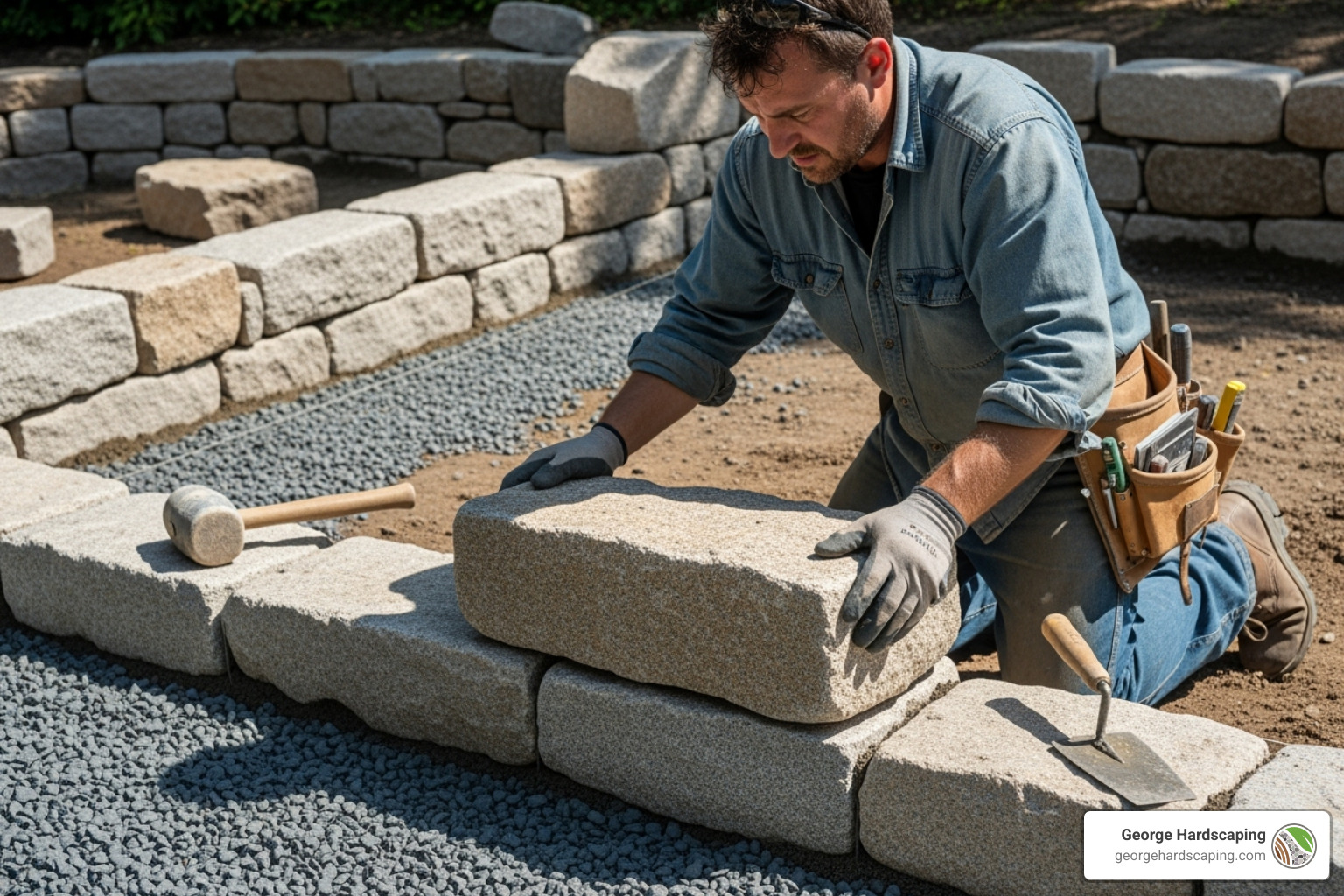
Step 1: Carefully Dismantle the Damaged Section
Approach this step with care to preserve materials and guide your rebuild.
- Document and Plan: Take photos of the damaged wall from multiple angles to use as a reference. If the pattern is complex, consider numbering stones with chalk as you remove them.
- Work from Top to Bottom: Always start by removing the capstones, then work your way down the wall. This is the safest method.
- Salvage and Clean: Set aside clean, intact stones for reuse. Use a hammer and chisel to chip away old, loose mortar.
Step 2: Excavate and Prepare a Solid Foundation
A faulty foundation is a primary cause of failure. Don’t skip this step.
- Dig Out Failed Backfill: Remove all the old, saturated soil from behind the wall, digging back at least 12-14 inches.
- Excavate the Trench: Dig a trench for the new base. The rule of thumb is that the trench depth should be about one-eighth of the wall’s total height, plus an additional 6-8 inches for the gravel base. However, in cold climates like Massachusetts, the trench bottom must be below the local frost line (typically 36-48 inches deep) to prevent frost heave from lifting your wall from below. The trench should be wide enough to accommodate the full width of your base stones plus the 12-inch gravel drainage zone behind them. For more on this, see our guide on gravity retaining wall construction.
- Level the Trench: Use a long level to ensure the bottom of the trench is perfectly flat. Instability here will compromise the entire wall.
Step 3: Lay the Gravel Base and First Course
This is where you start building back stronger.
- Add and Compact Gravel: Fill the trench with a 6-8 inch layer of 3/4-inch crushed angular gravel. Compact it thoroughly with a hand tamp until solid.
- Lay the Base Course: Select your largest, flattest stones for the first course. Place them firmly on the compacted gravel.
- Level and Set: Use your long level to ensure this first course is perfectly level, both front-to-back and side-to-side. A mistake here will be magnified with every subsequent course. This is also where you establish the “batter,” or backward lean, of the wall. A good rule of thumb is to set the wall back 1 to 2 inches for every foot of vertical height. This lean uses gravity to its advantage, helping the wall resist the forward pressure of the soil.
Step 4: Rebuild and Backfill Simultaneously
Build the wall course by course, integrating drainage as you go.
- Lay Subsequent Courses: Continue stacking stones, always following the “one-over-two” and “two-over-one” principle, meaning each stone should span the joint between the two stones below it. This staggering of vertical joints is what gives the wall its strength, just like in a brick wall. Avoid long, continuous vertical seams, as these are major weak points. Fit stones as tightly as possible, using your hammer and chisel to knock off high points. Use smaller, thinner stones (shims or chinks) to fill any remaining gaps and prevent larger stones from rocking. A stable wall has minimal wobble.
- Backfill as You Go: This is a critical step that cannot be skipped. After completing each course and checking it for level and batter, immediately backfill the 12-inch space behind it with your 3/4-inch crushed gravel. Do this in “lifts” of 6-8 inches, and lightly tamp each lift with a hand tamp or a 2×4. This ensures the gravel is well-settled and provides immediate support to the course you just laid. Waiting to backfill until the end creates a massive, unsupported structure that is vulnerable to collapse during the build itself and prevents proper compaction of the drainage material. This technique is key to durable natural stone retaining walls.
Step 5: Install the Final Drainage System
This system is your wall’s insurance policy against future failure.
- Place the Drain Pipe: At the base of the wall, behind the first course, lay a 4-inch perforated drain pipe on top of the gravel base. Ensure it slopes slightly toward an outlet point away from the wall.
- Cover with Gravel: Completely surround the pipe with more crushed gravel.
- Add Landscape Fabric: Before adding topsoil, line the back of the gravel column with geotextile landscape fabric. This filter lets water in but keeps out soil particles that would clog the system.
- Check Weep Holes: If your design includes weep holes (gaps at the base), ensure they remain clear and unblocked.
The Key to Longevity: Ensuring Proper Retaining Wall Drainage
You can build the most beautiful stone wall in Essex County, but it will fail without proper drainage. Water is the silent destroyer of retaining walls. When it seeps into the soil and has nowhere to go, it builds immense pressure that can topple any structure. A well-designed retaining wall drainage system is not a feature—it’s a necessity.
The Backfill and Fabric System
The magic happens in the hidden layer behind your wall. Instead of backfilling with native soil, which holds water, you must use a column of clean, 3/4-inch angular crushed gravel. The gaps between the angular stones create a clear path for water to flow down, taking the path of least resistance and relieving pressure against the wall.
However, gravel alone isn’t enough. Geotextile fabric is the unsung hero. This special fabric is placed between the gravel backfill and the native soil, essentially creating a burrito wrap around your drainage gravel. When installing it, ensure you have enough fabric to cover the back and sides of the gravel column, with extra to fold over the top before adding the final layer of topsoil. If you need multiple pieces, overlap the seams by at least 12 inches to prevent soil from seeping through.
It acts as a filter, allowing water to pass through into the gravel but blocking the fine silt and clay particles that would otherwise migrate into your drainage zone and clog it. Without this fabric barrier, your drainage layer would eventually clog with mud, rendering it useless. This simple addition is the difference between a repair that lasts for decades and one that fails in a few years.
Weep Holes and French Drains
Finally, the collected water needs an escape route. For dry-stacked stone walls, the natural gaps between stones act as weep holes, allowing water to escape. For mortared walls, weep holes are small pipes or gaps intentionally left in the lowest course.
The most effective component is the perforated drain pipe (or French drain) running along the base of the wall. This pipe collects all the water that filters down through the gravel and carries it away to a safe discharge point. This “daylight” outlet must be located in a lower area of your property, far from any foundations, or be properly connected to a larger storm drain system.
Ensure the end of the pipe is covered with a grate to prevent animals from nesting inside and creating a blockage. This system actively prevents water from ever saturating the soil behind the wall. It’s a 24/7 insurance policy that protects your investment and ensures you won’t have to tackle this project ever again.
DIY vs. Professional Repair: Knowing When to Call for Help
Deciding whether to tackle how to repair a collapsed stone retaining wall yourself or hire a professional is a critical choice. While a DIY repair can be rewarding, some situations are too complex or dangerous to handle without expert help. In Essex County, where varied soil conditions and harsh freeze-thaw cycles create unique challenges, making the right call is even more important.

When DIY is Feasible
A DIY approach can work for smaller, less critical projects if you have the right skills and physical ability.
- Small, Low Walls: Walls under 4 feet high are generally manageable. They face less soil pressure and are more forgiving of minor mistakes.
- Minor, Localized Collapses: If only a small section has failed and the rest of the wall is stable, a DIY repair is often possible.
- Dry-Stack Walls: Rebuilding a wall without mortar is much more DIY-friendly, as it doesn’t require specialized masonry skills.
- Cost & Time: A small DIY repair may only cost $100-$200 in materials and take a dedicated weekend (4-8 hours of work). Be realistic about the physical demands of moving heavy stones.
When to Hire a Professional Retaining Wall Contractor
There are clear red flags that indicate a project is beyond DIY territory. Ignoring them can lead to costly and dangerous outcomes.
- Walls Over 4 Feet High: The engineering and soil pressure for taller walls increase exponentially. They often require permits and engineered designs.
- Complete or Major Collapse: If the entire wall has failed or is severely unstable, a full rebuild by a professional crew with heavy equipment is necessary.
- Walls Supporting Critical Structures: If the wall supports a driveway, patio, or your home’s foundation, the risk is too high for a DIY attempt.
- Severe Leaning or Bulging: These are signs of major structural failure that may require advanced solutions like tie-back anchors.
- Historic Properties: In towns like Marblehead or Newburyport, proper restoration requires knowledge of historic materials and techniques.
Professional repair costs reflect the complexity, equipment, and expertise required. While quotes may range from $4,000 to $20,000+, this price includes proper engineering, liability insurance, and a warranty on the work. For a detailed breakdown, see our guide on the cost to repair retaining wall.
If your project involves any of these complexities, the safest and most effective solution is to bring in an expert. Contact George Hardscaping for a professional assessment to ensure the job is done right.
Frequently Asked Questions about Collapsed Stone Wall Repair
When a retaining wall fails, homeowners understandably have a lot of questions. Here are concise answers to the most common concerns we hear from clients across Essex County, MA.
Does homeowners’ insurance cover a retaining wall collapse?
Unfortunately, the answer is typically no. Most insurance policies exclude damage from “earth movement” or consider a collapse to be a result of gradual wear and tear. As Nick Schrader of Texas General Insurance notes, “they consider it normal wear and tear or classify it as ‘earth movement,’ thus, it is excluded.” There can be exceptions if the collapse was caused by a specific covered event, like a tree falling on it or a vehicle impact. Always review your specific policy, but it’s wise to budget for the repair yourself.
How long does it take to repair a section of a stone retaining wall?
The timeline depends on the project’s scale and complexity.
- DIY Repair: A skilled homeowner can often repair a small section (e.g., 4 feet wide by 3 feet high) in 4 to 8 hours over a weekend. This assumes you have all materials on hand and don’t run into major issues.
- Professional Repair: An experienced crew can fix a small section in less than a day. However, larger projects involving significant excavation and rebuilding can take anywhere from several days to a week or more.
Do I need a permit to repair my retaining wall?
It depends on your local municipality. Rules vary from town to town, even within Essex County.
- Height is the key factor. Most towns require a permit for any new construction or major repair of a retaining wall over a certain height, typically between 3 and 5 feet.
- Scope also matters. Rebuilding a significant section is more likely to require a permit than patching a few loose stones.
Our strongest advice: Always call your local building department before you start work. A quick phone call can save you from potential fines, stop-work orders, and future legal headaches. It is always better to be safe than sorry.
Can I just reuse the old soil for backfill?
Absolutely not. This is one of the most common and critical mistakes in a DIY repair. The original soil is what failed in the first place, likely because it was clay-based or silty, holding water and creating immense hydrostatic pressure. Reusing it guarantees that your newly rebuilt wall will fail again for the exact same reason. You must excavate and remove this water-retaining soil from behind the wall and replace it with a proper drainage column of 3/4-inch angular crushed gravel, as detailed in the guide. The only place for soil is the final few inches at the very top, above the landscape fabric, if you plan to plant grass or shallow-rooted plants.
What is “batter” and why is it so important?
“Batter” is an engineering term for the intentional backward lean or slope of a retaining wall. Instead of being perfectly vertical (plumb), a battered wall is built to lean back into the hillside it is retaining. A typical batter is a setback of 1 to 2 inches for every 12 inches of vertical height. This slight incline is critically important for stability. It allows the wall to use the force of gravity to its advantage, actively pushing back against the lateral pressure of the soil. A perfectly vertical gravity wall is much easier to push over than one that is leaning into the force it’s resisting.
Conclusion
Learning how to repair a collapsed stone retaining wall is about more than just stacking stones—it’s about protecting your property and making a lasting investment in its safety and beauty. We’ve seen that the primary culprit behind most failures is uncontrolled water, which is why a proper foundation and a robust drainage system are not just suggestions, but necessities.
The key steps—dismantling safely, excavating below the frost line, rebuilding with a slight backward batter, and integrating a gravel-and-pipe drainage system—are the formula for a successful, long-term repair.
We’ve also highlighted the importance of knowing your limits. While a small, low garden wall can be a rewarding DIY project, walls that are tall, severely damaged, or supporting critical structures demand professional expertise. The forces involved are immense, and a failed repair can be far more costly and dangerous than the original collapse.
For homeowners in Essex County, MA, facing a complex wall collapse, George Hardscaping offers the professional solution. We bring years of experience in specialized hardscape construction services, from Beverly to Newburyport. We understand our local soil and climate, and we build walls designed to withstand them.
Don’t let a collapsed wall be a source of stress. It’s an opportunity to rebuild stronger and better than before.
Ready to turn your retaining wall problem into a permanent solution? Contact George Hardscaping today for a comprehensive assessment and a detailed estimate on your retaining wall project. We’re here to help you rebuild with confidence.
