
How to install a retaining wall on a slope: 3 Essential Steps
Why a Retaining Wall on a Slope Changes Everything
Dealing with a sloped yard can feel like an uphill battle, limiting usable space and causing constant erosion. A well-built retaining wall transforms that challenging hillside into functional, beautiful areas like terraced gardens or level patios, all while protecting your property from soil loss and water damage.
Learning how to install a retaining wall on a slope is about more than just stacking blocks; it’s about engineering a structure to hold back tons of soil. Success hinges on careful planning, proper excavation, a solid base, robust drainage, and correct reinforcement. Unfortunately, many DIY retaining walls fail due to common mistakes. The primary culprits are almost always hydrostatic pressure from poor drainage, an inadequate foundation that shifts with frost, and a lack of reinforcement to support the immense weight of the earth.
A properly designed and installed retaining wall can last for decades and significantly increase your property value. A poorly built one can collapse within a few years, costing far more in repairs than it would have to do it right the first time. For homeowners in Essex County, MA, and the North Shore, where sloped properties are common, a retaining wall is often a structural necessity that protects your investment and creates the outdoor living spaces you’ve always wanted.
Before You Dig: Planning Your Sloped Retaining Wall
Before a shovel hits the dirt, meticulous planning is the cornerstone of a successful retaining wall project, especially on a slope. This phase is about understanding your site, navigating regulations, and making crucial material decisions.
First, conduct a thorough site assessment. Evaluate the steepness of your slope, identify the soil type (clay retains water, while sandy soil drains easily), and map existing drainage patterns. Walk the slope after a rain to see where water concentrates and where it exits. For complex slopes, professional Hardscape Design Services can provide invaluable insight and a buildable plan.
Next, understand local building codes and permit requirements in Essex County, MA. Many municipalities require permits for walls over 3 to 4 feet high. Also, remember to call 811 a few days before you dig to have underground utilities marked. The International Code Council has general guidance for Retaining Walls, but your local building department is the authority having jurisdiction.
Choosing Your Retaining Wall Material
The material you choose impacts your wall’s appearance, durability, cost, and installation difficulty.
- Interlocking Concrete Blocks: A popular choice for their durability, versatility, and ease of installation. Many systems feature interlocking lips or pins that simplify the process and add strength. Learn more about Block Retaining Wall Construction.
- Natural Stone: For a timeless, high-end look, nothing beats natural stone. These walls are incredibly durable and can last for generations. However, building with stone requires significant skill and labor, making it a job best left to specialists in Natural Stone Retaining Walls.
- Timber: A budget-friendly option that offers a rustic aesthetic. Pressure-treated wood designed for ground contact is essential, but even then, its lifespan is typically 10-20 years, shorter than stone or concrete.
When to Call an Engineer
While a small wall can be a DIY project, certain situations demand a professional engineer’s expertise to prevent structural failure.
- Wall Height: If your wall will be over 3-4 feet tall (including the buried portion), an engineered design is almost always required by code.
- Complex Conditions: Poor soil (like expansive clay), high water tables, slopes steeper than 3:1, or significant surcharge loads (driveways, pools) necessitate an engineer’s analysis.
- Tiered Walls: Multi-level walls are more complex than they appear, as the upper walls exert pressure on the lower ones.
At George Hardscaping, we often collaborate with engineers on Large Retaining Wall Construction projects to guarantee the highest standards of safety and longevity.
The Foundation of Success: Preparing the Base on a Slope
A retaining wall is only as strong as its foundation. On a slope, this is even more critical, as the base must resist both gravity and soil pressure.
The “Stepping-Up” Method
Because you cannot build on an angle, the key to a sloped installation is the “stepping-up” method. This involves creating a series of level, terraced trenches that follow the contour of the hill.
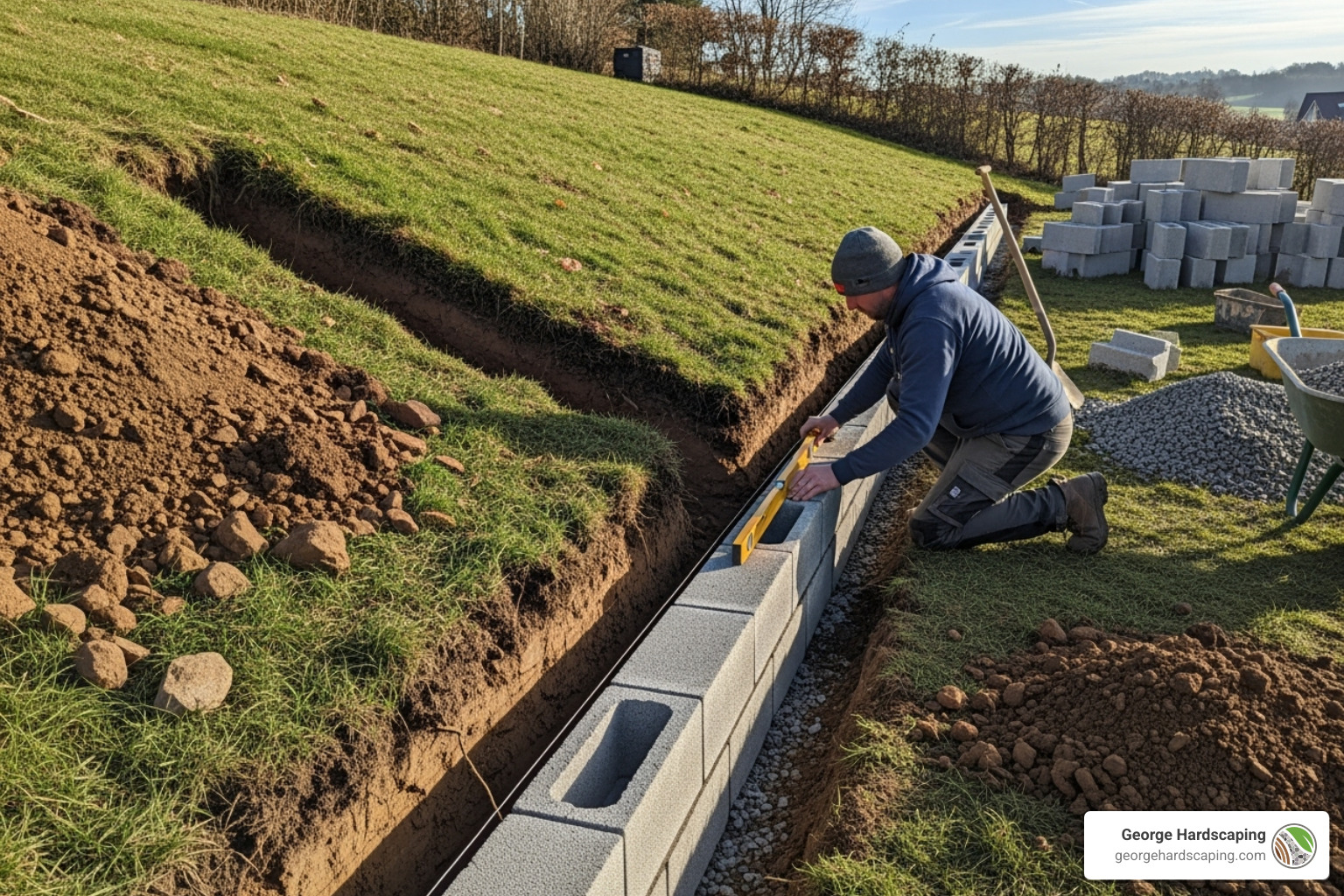
Here’s how it works:
- Start at the Lowest Point: Always begin excavation at the bottom of the slope and work your way up.
- Dig Level Steps: Excavate a series of horizontal trenches. Each trench must be perfectly level, both front-to-back and side-to-side.
- Bury the First Block of Each Step: At each step-up, the first block of the new, higher level must be completely buried in the ground. This anchors the transition and prevents erosion from undermining the foundation.
Creating a Solid Base
Once your trenches are dug, creating the base is a process of precision.
- Trench Dimensions: The trench should be wide enough for the block plus at least 12 inches of drainage gravel behind it. The depth must accommodate a minimum of 6 inches of compacted base material, plus enough depth to bury at least half of the first course of blocks.
- Base Material: Use a 3/4″ crushed stone or paver base. Clean, angular stone compacts well and drains water.
- Leveling and Compacting: Add the base material in 2-inch lifts, compacting each layer thoroughly with a plate compactor. Use a level to ensure the entire base is flat. This meticulous process is a non-negotiable part of professional Retaining Wall Construction.
If your plan includes access routes or steps, coordinate those elevations now so your wall can seamlessly incorporate Walkways & Stairs.
The Step-by-Step Guide: How to Install a Retaining Wall on a Slope
With a solid, stepped foundation in place, you can begin building the wall itself. Precision and attention to detail at this stage will ensure your wall is strong, straight, and looks professional.
- Laying the First Course: The first course is the most important, as it dictates the alignment for the rest of the wall. Start at the lowest point of your foundation. Place each block, using a level to check it from front-to-back and side-to-side. Use a rubber mallet to make minor adjustments and tap the blocks firmly into the base material. Check a string line along the front face to maintain a straight run. Once the first course is complete, backfill in front of the blocks with soil to hold them securely in place and provide toe support.
- Stacking Subsequent Courses and Backfilling: To build a strong wall, you must stagger the vertical joints between blocks, similar to a brick pattern. Start the second course with a half-block to create this offset. As you build, check that each course is level and the wall face is plumb (or set to the manufacturer’s specified batter). Maintain clean, consistent joints by brushing off chips or debris before placing the next block.
Crucially, you must backfill as you go. Do not wait until the wall is finished. After each course is laid, fill the space behind it with 3/4″ clear gravel to create a drainage zone at least 12 inches deep. Add the gravel in 6–8 inch layers and compact each one thoroughly with a hand tamper. This prevents future settlement and provides immediate support. Use a strip of permeable geotextile between the gravel zone and native soil to keep fines from migrating into the drain area.
Depending on height and loading, integrate geogrid per the block system’s engineering (see Reinforcement below). The top 6–12 inches can be finished with topsoil for planting, graded away from the wall to shed water. For inspiration, see our Garden Retaining Wall Ideas.
- Cutting and Capping: You will likely need to cut blocks for ends or curves. A masonry saw with a diamond blade provides the cleanest cuts (always wear safety glasses and a respirator for silica dust). The final step is to secure the capstones. These provide a finished look and protect the wall core from water. Apply a generous bead of construction adhesive to the top course and set the caps in place, ensuring they are level. An overhang of 1–1.5 inches is recommended to direct rainwater away from the wall’s face. This final touch completes your Hardscaping Services project with a professional polish. For a more detailed overview, see our guide on How to Install a Retaining Wall.
Safety note: If your trench exceeds 4 feet deep, follow OSHA safe trenching practices and never enter unsupported, vertical-walled excavations. See OSHA’s guidance on Trenching and Excavation Safety.
Preventing Failure: Drainage and Reinforcement Essentials
Many retaining walls fail prematurely, and the culprits are almost always preventable: poor drainage and inadequate reinforcement. Understanding how to manage water and soil pressure is the key to building a wall that lasts for decades. At George Hardscaping, our Retaining Wall Installation Services are built on these foundational principles.
Best Practices for Drainage Behind and Beneath a Retaining Wall
Water is the number one enemy of a retaining wall. Saturated soil is incredibly heavy and exerts immense hydrostatic pressure, which can bow, crack, or completely topple a wall.
Here’s how to ensure your wall can breathe and relieve that pressure:
- Gravel Backfill: Create a drainage zone by backfilling with at least 8-12 inches of 3/4″ clear gravel directly behind the wall.
- Filter Fabric: Separate the gravel from the native soil with a layer of permeable geotextile filter fabric.
- Perforated Drain Pipe: At the bottom of the gravel backfill, place a 4-inch perforated drain pipe to collect water and carry it away.
- Daylight the Pipe: The pipe must have an outlet, known as “daylighting.” It should slope gently downwards and emerge at the end of the wall or connect to another drainage system. For more details, explore our guide to a proper Retaining Wall Drainage System.
When and How to Use Geogrid and Tiebacks
For taller walls or those supporting extra weight (surcharge), drainage alone isn’t enough. Reinforcement is needed to mechanically tie the wall to the earth behind it.
- Geogrid Reinforcement: For most segmental block walls over 3-4 feet high, geogrid is a necessity. This high-strength polymer mesh is laid horizontally between courses of blocks and extends several feet back into the soil.
- Timber Wall Reinforcement: Timber walls use a different system of tiebacks and deadmen. These Retaining Wall Anchors are a critical structural component, not an optional add-on.
Long-Term Maintenance and Professional Solutions
Your retaining wall is a significant investment, and a little ongoing care will ensure it lasts for decades. Regular inspections can help you catch small problems before they become big, expensive ones. If you’re looking for expert help with any aspect of your outdoor space, quality Hardscape Installation Near Me ensures lasting results.
Common Issues and How to Fix Them
Even well-built walls can show signs of stress over time. Here’s what to look for:
- Bulging, Cracking, or Leaning: These are signs of excessive pressure, often from poor drainage or a shifting base. Minor hairline cracks can sometimes be sealed with a quality masonry caulk. However, any noticeable bulge, lean, or cracks wider than 1/8 inch are serious structural issues that require professional assessment.
- Clogged Drains and Erosion: Periodically check that your drain pipe outlets are clear of leaves and debris.
- Settlement at the Top: If soil or pavers settle behind the wall, backfill voids promptly with compacted gravel.
When Your Project Needs a Pro
Building a retaining wall on a slope is a technical job that requires an understanding of soil mechanics, water management, and structural engineering. Professional help is non-negotiable if your wall will be over four feet tall, will support a surcharge like a driveway or pool, is being built on steep slopes or with difficult soil, or involves a tiered design.
Hiring an expert provides peace of mind. At George Hardscaping, we specialize in changing challenging landscapes in Essex County, MA, into stunning, functional outdoor spaces. From concept through construction, we coordinate engineering, drainage, and finishes through our comprehensive Retaining Wall Installation Services and broader Hardscaping Services.
Ready to have a pro evaluate your slope, drainage, and design options? Contact our Retaining Walls Contractor team for a site visit and a clear, written plan.
Frequently Asked Questions about Installing a Retaining Wall on a Slope
How high can I build a retaining wall on a slope without an engineer?
Most local building codes require an engineer for retaining walls over 3 to 4 feet in height, including the buried portion. This height limit can be even lower for walls on steep slopes or those supporting surcharge loads like a driveway. Always check with your local municipality before starting any project. This ensures compliance and, more importantly, the safety and stability of your structure. For reference, the International Code Council provides guidelines on Retaining Walls.
How do I choose between natural stone, concrete block, and timber?
Balance aesthetics, lifespan, maintenance, and budget. Natural stone is premium and long-lasting but labor-intensive. Segmental concrete blocks are engineered, modular, and relatively DIY-friendly for small projects. Timber has the lowest upfront cost but a shorter service life and requires robust tiebacks. Our pages on Natural Stone Retaining Walls and Block Retaining Wall Construction compare these options in more detail.
Do tiered retaining walls reduce engineering needs?
Not necessarily. Upper walls can add pressure to lower walls if placed too close. A general rule of thumb is to set the upper wall back at least twice the height of the lower wall to minimize interaction, but actual design spacing depends on soils and loads. Tiered systems often still require engineering. For larger, complex systems, see our experience with Large Retaining Wall Construction.
What is the most common reason retaining walls fail?
The number one cause of retaining wall failure is poor drainage. When water accumulates in the soil behind the wall, it creates immense hydrostatic pressure, which can push the wall outwards, causing it to bulge, crack, and eventually collapse. This is why a proper drainage system—including adequate gravel backfill, filter fabric, a perforated drain pipe, and a clear drain outlet—is not optional; it’s absolutely essential for the longevity and stability of any retaining wall. For additional fundamentals, see NC State Extension’s Retaining Walls.
Do I really need a drainage pipe for a small, two-foot-tall wall?
Yes, absolutely. Even a small wall is holding back a significant amount of soil, which becomes much heavier when saturated with water. Without a drainage pipe and gravel backfill to relieve this pressure, a two-foot wall can easily fail over time, especially on a slope where water runoff is naturally greater. Investing in proper drainage for even the smallest walls will save you from costly repairs or a complete rebuild.
Should the drain pipe holes face up or down?
Most manufacturers and engineering guides recommend orienting perforations down when the pipe is fully embedded in a gravel envelope—water filters down through the stone and enters from below. Wrap the pipe with a filter sock where soils are silty to prevent clogging.
How far back does geogrid need to extend?
Grid length depends on wall height, soil type, and surcharge, but a common starting point is 0.6–1.0 times the wall height. Grid is typically installed every 2–3 courses. Always follow the block system’s engineering and NCMA/FHWA guidance. See NCMA Best Practices and FHWA’s MSE Walls Manual.
Are there best practices for compaction?
Yes—build in thin lifts (typically 6–8 inches loose), compact each lift, and avoid running heavy equipment right up against the wall face. Maintain moisture content within an optimal range for your soil or use open-graded stone where specified. Poor compaction is a leading cause of settlement and wall distress.
How do I manage downspouts and surface runoff?
Keep roof water out of the backfill. Extend downspouts away from the wall and intercept hillside runoff with swales or drains before it reaches the wall. NOAA’s precipitation data can help you understand design rainfall in your area; see NOAA Atlas 14 Precipitation Frequency Data. We design wall drainage holistically via our Retaining Wall Drainage System approach.
What’s a realistic timeline for a sloped retaining wall?
Small, uncomplicated walls (2–3 feet high and up to 25 feet long) can often be completed in 2–4 days. Larger or engineered walls with geogrid, complex steps, curves, or drainage work can take 1–3 weeks, depending on weather, access, and inspections. Early planning and material ordering reduce delays.
Can I build a retaining wall in winter?
You can, but it’s harder to achieve proper compaction in frozen or saturated soils, and adhesives and mortars have temperature limits. Plan for weather windows, protect materials, and heat or tent small areas if necessary. When in doubt, schedule construction during milder seasons.
What are safe digging practices for deeper trenches?
Never enter an unsupported trench with vertical sides over 5 feet deep. Use sloping, shoring, or shielding as required and keep spoils and equipment at least 2 feet from the edge. See OSHA’s Trenching and Excavation Safety for requirements.
Can you integrate stairs, terraces, or a patio with the wall?
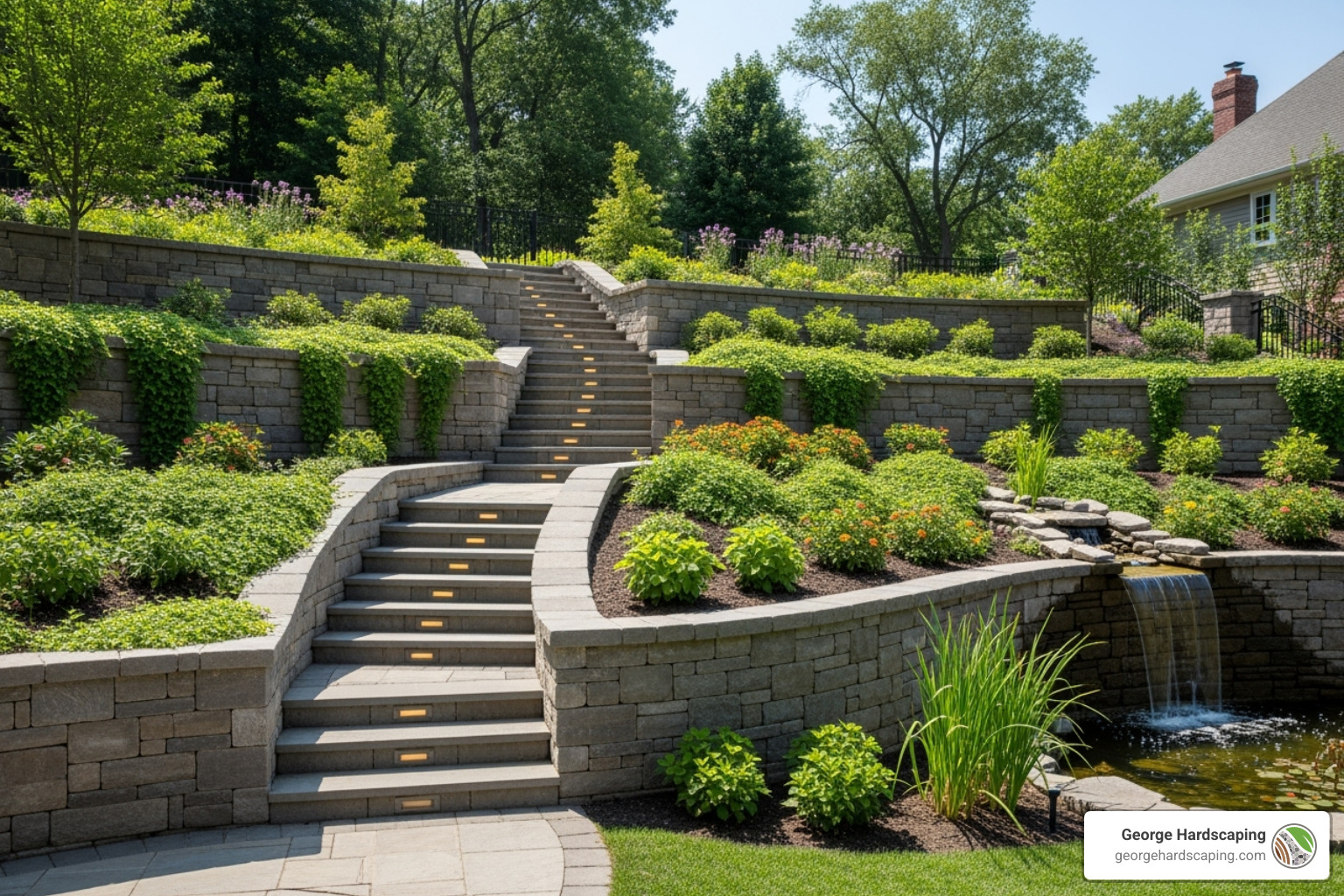
Absolutely. Walls on slopes are ideal for terracing and creating level pads for patios, play areas, or planting beds. Our team coordinates elevations and drainage so features like Walkways & Stairs and patios blend seamlessly into your wall project. Explore our Gallery for ideas.
I’m not sure where to start—can you scope and price the whole job?
Yes. We provide site assessments, options, and a clear, line-item estimate. From design through construction, we manage permits, inspections, and coordination with other features via our full suite of Hardscaping Services. Get in touch through our Retaining Walls Contractor page for a prompt, professional proposal.
Conclusion
Changing a sloped yard with a retaining wall is more than a landscaping project—it’s an investment in your property’s value, safety, and usability. As we’ve covered, learning how to install a retaining wall on a slope successfully hinges on three non-negotiable fundamentals: a properly stepped foundation, a comprehensive drainage system, and appropriate reinforcement for the load it will bear.
While a small, 2-3 foot garden wall can be a rewarding DIY project, the forces of nature are unforgiving. A wall that looks fine today can fail spectacularly in a few years if the base, drainage, or reinforcement isn’t perfect. The immense pressure from soil and water requires precision and expertise.
If your project involves a wall over four feet, supports a driveway, sits on challenging soil, or if you simply want the peace of mind that comes from a job done right, professional expertise is essential. At George Hardscaping, we’ve built our reputation on constructing retaining walls in Essex County that are engineered to last. From the initial design to the final capstone, we handle every detail with the craftsmanship required to ensure your wall stands strong for decades.
Explore our gallery of completed hardscaping projects to see how we’ve helped homeowners across the North Shore turn challenging slopes into stunning, functional outdoor spaces.
Ready to reclaim your sloped yard and add lasting value to your property? Contact George Hardscaping today for a free, no-obligation estimate on your retaining wall project! Let us show you how proper planning and expert installation create walls that don’t just survive—they thrive.
Permits, Budget, and Next Steps
Installing a retaining wall on a slope blends engineering, craftsmanship, and water management. Getting permits in order, setting a realistic budget, and sequencing the work properly ensure a smooth project.
- Permits and Inspections: Walls at or above local thresholds (often 3–4 feet, including buried depth) typically require permits and, sometimes, design by a licensed engineer. If drainage outlets cross property lines or tie into municipal systems, additional approvals may be needed. The ICC’s Retaining Walls guidance is a useful reference; your local building department is the final authority.
- Budget Ranges: Costs vary by height, length, access, material (block, stone, timber), and whether geogrid, stairs, or complex drainage is required. Site conditions—bedrock, ledge, large roots, and difficult access—can increase labor. We provide transparent pricing and alternatives so you can choose the best value.
- Timeline and Logistics: Expect lead time for materials and, if applicable, engineering. Factor weather into your schedule—heavy rain can delay excavation and compaction on sloped sites.
Your next steps:
1) Define scope, preferred material, and aesthetic.
2) Confirm property lines, utilities, and drainage paths.
3) Request a site evaluation and estimate.
Two strong CTAs, as requested:
- Ready to move forward? Get a precise plan and price from our expert team. Contact George Hardscaping for a free, no-obligation retaining wall estimate.
- Want design options and build sequencing from pros who do this every day? Explore our full Hardscaping Services and see what’s possible in our Gallery.
By combining a stepped foundation, robust drainage, and the right reinforcement strategy, your sloped retaining wall will be built to endure. When you’re ready to transform your hillside into safe, usable space, we’re ready to help—start with our Retaining Wall Installation Services and let’s build it right the first time.
Permits, Budget, and Next Steps
Installing a retaining wall on a slope blends engineering, craftsmanship, and water management. Getting permits in order, setting a realistic budget, and sequencing the work properly ensure a smooth project.
- Permits and Inspections: Walls at or above local thresholds (often 3–4 feet, including buried depth) typically require permits and, sometimes, design by a licensed engineer. If drainage outlets cross property lines or tie into municipal systems, additional approvals may be needed. The ICC’s Retaining Walls guidance is a useful reference; your local building department is the final authority.
- Budget Ranges: Costs vary by height, length, access, material (block, stone, timber), and whether geogrid, stairs, or complex drainage is required. Site conditions—bedrock, ledge, large roots, and difficult access—can increase labor. We provide transparent pricing and alternatives so you can choose the best value.
- Timeline and Logistics: Expect lead time for materials and, if applicable, engineering. Factor weather into your schedule—heavy rain can delay excavation and compaction on sloped sites.
Your next steps:
1) Define scope, preferred material, and aesthetic.
2) Confirm property lines, utilities, and drainage paths.
3) Request a site evaluation and estimate.
Two strong CTAs, as requested:
- Ready to move forward? Get a precise plan and price from our expert team. Contact George Hardscaping for a free, no-obligation retaining wall estimate.
- Want design options and build sequencing from pros who do this every day? Explore our full Hardscaping Services and see what’s possible in our Gallery.
By combining a stepped foundation, robust drainage, and the right reinforcement strategy, your sloped retaining wall will be built to endure. When you’re ready to transform your hillside into safe, usable space, we’re ready to help—start with our Retaining Wall Installation Services and let’s build it right the first time.
