
Stone Retaining Wall Repair Cost: 3 Smart Ways to Save
Understanding Stone Retaining Wall Repair Costs: What Every Homeowner Should Know
That beautiful stone wall holding back your hillside garden is more than a landscape feature—it’s a critical structural element protecting your property from the relentless forces of gravity and water. When you spot the first crack, a subtle lean, or crumbling mortar, your mind likely jumps to one question: “How much will this cost to fix?” A failing wall isn’t just an aesthetic problem; it can lead to soil erosion that undermines your home’s foundation, create dangerous landslide conditions, and become a significant legal liability.
The stone retaining wall repair cost can range from a few hundred dollars for minor fixes to well over $5,000 for major structural work, with complete replacements often exceeding $10,000. The final price depends on factors you might not expect. A simple mortar touch-up is a minor expense, but a wall that’s bowing outward due to immense hydrostatic pressure could require thousands in engineered structural repairs. The key is often catching problems early—before water, soil, and gravity take over. According to the National Concrete Masonry Association, regular inspection and proactive maintenance can prevent up to 90% of major retaining wall failures, saving homeowners from catastrophic expenses.
Quick Cost Breakdown:
- Minor repairs (small cracks, cleaning, minor repointing): $250–$750. This covers cosmetic issues that don’t compromise the wall’s structural integrity.
- Moderate repairs (localized leaning, basic drainage fixes, significant repointing): $800–$2,500. These repairs address contained issues before they spread, such as resetting a small section or adding a simple French drain.
- Major repairs (structural reinforcement, partial rebuilds, extensive drainage systems): $2,500–$8,000+. This involves significant excavation, installing helical anchors, or rebuilding large failed sections.
- Complete replacement: $8,000–$20,000+. When the foundation is compromised or failure is widespread, a full demolition and new build is the only safe option.
Note: These are average costs based on internet data and not actual costs for George Hardscaping. Costs can vary based on specific site conditions.
Why costs vary so widely:
- Scope and severity: Localized cosmetic work is inexpensive. In contrast, structural stabilization, such as installing helical anchors to tie the wall back into stable soil, involves engineering, heavy equipment, and highly skilled labor, driving costs up significantly.
- Access and logistics: A wall on a flat, open lawn is straightforward. A wall on a steep, wooded slope or in a tight backyard with no machine access requires manual labor, specialized equipment, and more time, all of which increase the price.
- Drainage remediation: Most wall failures stem from water pressure. Installing a proper drainage system—including excavation, geotextile fabric, clean gravel backfill, and perforated pipe—adds material and labor costs but is the most critical investment for the wall’s longevity. For an overview of prevention and long-term fixes, see our Retaining Wall Solutions: Complete Guide at https://georgehardscaping.com/retaining-wall-solutions-complete-guide/.
What’s in a professional repair estimate:
- Assessment/Diagnostics: The initial site visit to determine the root cause of failure.
- Site Prep: Includes protecting surrounding landscape, setting up erosion control, and staging materials.
- Demolition and Debris Disposal: If sections need to be rebuilt, this covers the labor and fees for removing and hauling away old material.
- Materials: The cost of stone, mortar, gravel, geotextile fabric, drainage pipe, and any reinforcement materials.
- Equipment Time: Billable hours for excavators, compactors, concrete saws, and other machinery.
- Labor and Project Management: The cost of the skilled masons and laborers, plus oversight of the project.
- Engineering: Fees for a structural engineer’s analysis and design, required for tall or complex walls.
- Permits and Inspections: The cost of filing for and closing out municipal permits.
A failing retaining wall is a problem that only gets worse—and more expensive—with time. Understanding these costs and the factors that drive them is the first step toward making an informed decision to protect your property.
Strong CTA: Ready for a clear price and a plan? Request a professional site assessment now at https://georgehardscaping.com/request-estimate/.
Common Problems and Signs Your Stone Wall Needs Repair
Your stone retaining wall faces a constant, silent battle against water and gravity. These forces work around the clock, exploiting any weakness in your wall’s design and construction. The good news is that most failures are not sudden; they follow predictable patterns and give off clear warning signs. If you know what to look for, you can catch problems while they’re still manageable and before your stone retaining wall repair cost spirals out of control.
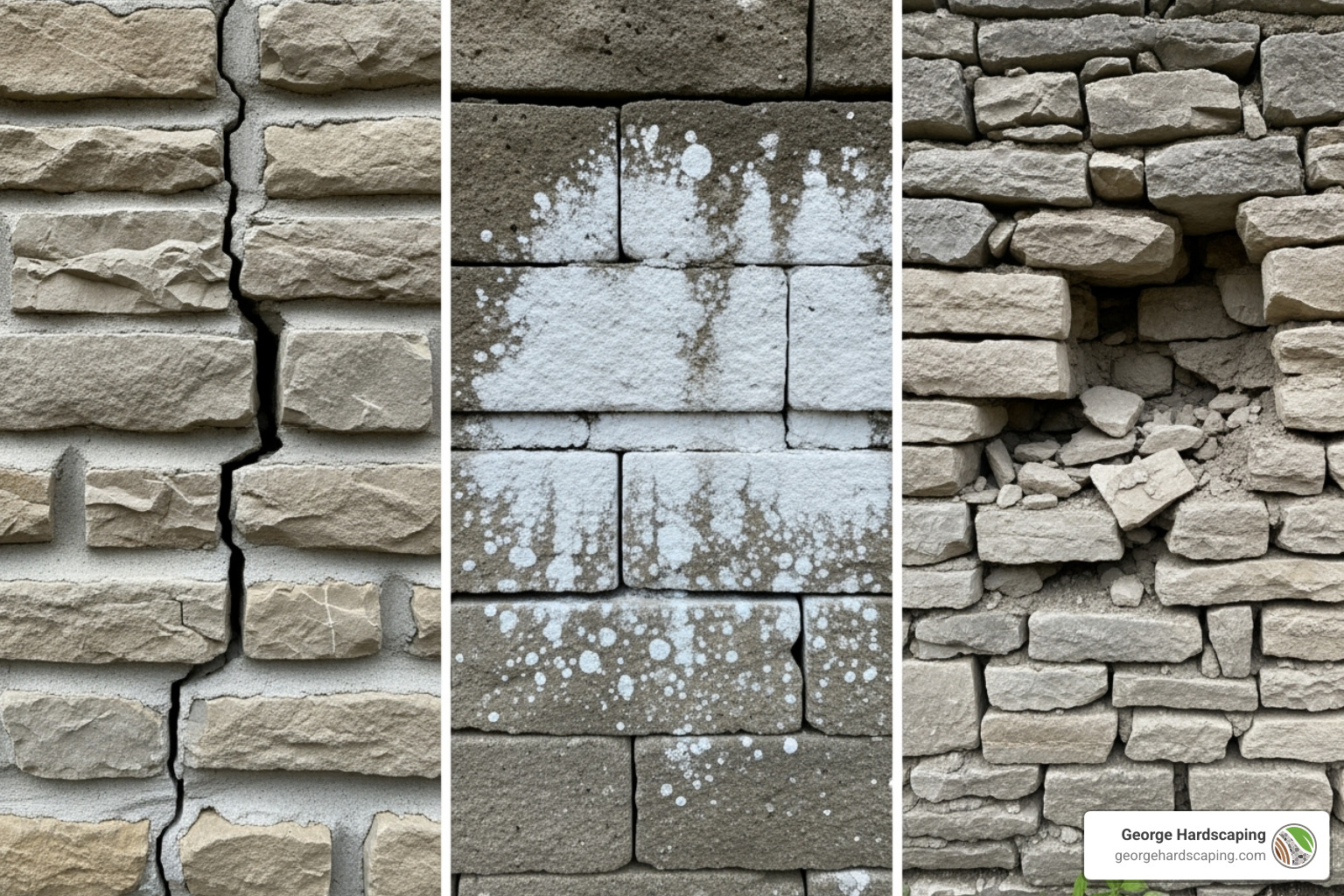
Hydrostatic pressure is the number one enemy of retaining walls. When soil behind the wall becomes saturated with rainwater or runoff, it becomes exponentially heavier and exerts immense, liquid-like force. This is why poor drainage is the villain behind nearly every major wall failure. Without a properly designed system—including gravel backfill, filter fabric, weep holes, or a French drain—water gets trapped. This pressure can easily exceed thousands of pounds per square foot, causing even the most robust-looking wall to bow, shift, or collapse. For a deep dive into long-term fixes, see our Retaining Wall Drainage System overview at https://georgehardscaping.com/retaining-wall-drainage-system/.
Other common culprits include:
- Foundation Settlement: A wall is only as strong as its base. An improperly prepared or undersized footing will cause the wall to sink and shift unevenly over time, leading to cracks and tilting. Taller walls demand deep, compacted gravel footings or concrete foundations to distribute the load.
- Freeze–Thaw Cycles: In Massachusetts, this is a primary cause of deterioration. Water seeps into tiny pores and cracks in the stone and mortar. When it freezes, it expands with incredible force (up to 30,000 psi), widening the crack. This process repeats all winter, turning microscopic flaws into major structural damage. Learn the science behind this powerful force, known as frost wedging, from the U.S. Geological Survey at https://www.usgs.gov/media/images/frost-wedging.
- Soil Type and Saturation: The type of soil behind your wall matters immensely. Dense, heavy clay soils hold water and expand significantly, creating far more pressure than sandy or gravelly soils that drain quickly. Understanding your local soil is key to proper wall design. For a primer on soil texture, see the USDA NRCS guide at https://www.nrcs.usda.gov/resources/education-and-teaching-materials/soil-texture.
- Surcharge Loads: Any extra weight placed on the soil behind the wall—such as a driveway, a patio, a hot tub, or even a large pile of firewood—is called a surcharge. This added load dramatically increases the lateral pressure on the wall and can push it beyond its design limits, causing premature failure.
- Erosion and Undermining: Water runoff that scours the base of the wall (the “toe”) can wash away the supporting soil. This undermining removes the wall’s foundational support, leading to sudden leaning or collapse.
Be on the lookout for these visual warning signs:
- Leaning or Bowing: Any forward tilt or outward bulge is a red alert for structural stress. A slight, uniform backward lean (called “batter”) is often intentional, but any forward movement is a sign of failure.
- Cracking: The type of crack tells a story. Thin, vertical cracks may indicate minor settlement or thermal expansion. However, horizontal cracks, or cracks that follow the mortar joints in a stair-step pattern, are classic signs of severe structural stress from soil pressure or foundation issues.
- Crumbling Stones or Mortar: This indicates material failure, often caused by prolonged water exposure, salt damage, or repeated freeze–thaw cycles. The mortar is the glue holding the wall together; if it’s turning to sand, the wall is losing its strength.
- Water Seepage and Staining: Active leaks through the face of the wall, dark wet patches that never dry, or algae/moss growth are definitive proof that water is trapped behind the wall and the drainage system has failed.
- Efflorescence: A chalky white powder on the wall’s surface. This occurs when water moves through the masonry, dissolves natural salts, and deposits them on the surface as it evaporates. It’s a clear indicator of unwanted moisture movement.
- Gaps or Separation: If the wall is pulling away from an adjacent patio, staircase, or fence, it’s a sign that the entire structure is moving.
Simple homeowner checks:
- The String Line Test: Tie a string from one end of the wall to the other, pulling it taut. This creates a perfectly straight line that will make any bowing or bulging immediately obvious.
- The Level Test: Place a 4-foot level vertically against the face of the wall in several spots. Any deviation from a plumb (perfectly vertical) or intended battered position deserves professional attention.
- Post-Rain Inspection: After a heavy storm, walk the length of the wall. Look for standing water at the base, new or worsening cracks, and any areas where water is actively seeping through the face.
Catching these signs early is the key to managing your stone retaining wall repair cost. For preventive design and construction best practices, see our Retaining Wall Solutions: Complete Guide at https://georgehardscaping.com/retaining-wall-solutions-complete-guide/.
Key Factors Influencing Stone Retaining Wall Repair Cost
When you receive a quote for a retaining wall fix, the price can seem complex. The stone retaining wall repair cost isn’t a simple flat rate; it’s a detailed calculation based on your wall’s specific material, size, failure mode, and location. Understanding these factors will empower you to have a more informed conversation with your contractor and see precisely what’s driving the final price.
How Wall Material and Type Affects Repair Expenses
The type of stone and the method of construction are major cost drivers. Each style presents unique challenges and requires different skills, tools, and time commitments.
- Boulder Wall Repair: These walls are built with large, irregular boulders. Repairing a failing section often requires heavy equipment like a mini-excavator with a grapple to lift and reset stones that can weigh hundreds or thousands of pounds. The skill lies in interlocking the boulders for maximum stability. Limited site access that prevents machine use can dramatically increase labor costs.
- Dry-Stack Wall Repair: These mortar-free walls are a true art form, relying on the careful interlocking of stones and the force of gravity. Repairs are labor-intensive, often requiring a skilled mason to dismantle a significant section, address the underlying base or drainage issue, and then meticulously re-stack the stones, ensuring each one has solid bearing.
- Mortared Stone Wall Repair: Costs here depend on the mortar’s condition. If the issue is localized crumbling, a mason can perform repointing—grinding out the old, failed mortar and replacing it. This is meticulous, time-consuming work. If the wall itself is failing, the mortar joints can make disassembly for a structural repair more difficult and costly than a dry-stack wall.
- Gabion Wall Repair: These are wire baskets filled with stone. Failures usually involve corrosion of the wire cage or deformation due to pressure. Repairs might involve replacing entire basket sections, which means emptying, removing, and replacing the cage, then refilling it with stone, all while tying it into the adjacent sections.
- Stone Veneer Over a Structural Wall: Sometimes what looks like a stone wall is actually a thin stone veneer applied to a concrete block (CMU) or poured concrete structural wall. If the veneer is cracking or falling off, the repair could be cosmetic. However, if those cracks reflect a failure in the structural wall behind it, the cost escalates significantly as both layers must be addressed.
For insights into selecting the right wall type for new construction, explore our guide on Natural Stone Retaining Walls at https://georgehardscaping.com/natural-stone-retaining-walls/.
The Impact of Wall Size, Loads, and Site Accessibility
- Wall Size (Height and Length): The physics of retaining walls are unforgiving. As the height of a wall doubles, the pressure on it can quadruple. This is why walls over 4 feet tall almost always require an engineered design, permits, and more robust construction methods (like geogrid reinforcement or a deeper base), all of which increase cost. The length of the repair also directly impacts the total material and labor required.
- Surcharge Loads: As mentioned, driveways, patios, or even steep slopes above the wall add significant weight. Repairing a wall that supports a driveway is far more complex and expensive than one holding back a simple garden bed, as the repair must be engineered to handle immense, dynamic loads.
- Site Accessibility: This is a huge variable. A repair on a flat, open lawn where an excavator can easily operate is far cheaper than the same repair on a steep hill or in a tight backyard. Limited access may necessitate using smaller, less efficient machines, or even performing all excavation and material transport by hand with wheelbarrows, drastically increasing labor hours.
- Excavation Needs: Most structural repairs require digging out the soil behind the wall to relieve pressure and fix the root cause—usually drainage. The volume of soil to be moved, the type of soil (e.g., rocky vs. soft), and the logistics of hauling it away and bringing in proper gravel backfill are all significant cost factors.
- Utilities and Constraints: Professional contractors must locate and work around underground utilities like gas lines, water pipes, and electrical conduits. In Massachusetts, a call to Mass811 is mandatory before any digging: https://www.mass811.com/homeowners/. Working in a complex utility corridor requires extreme care and can slow down the project.
Engineering, Permits, and Codes
For any substantial repair, especially on walls over 4 feet, most municipalities will require a building permit and inspections. This ensures the repair meets safety standards outlined in codes like the International Building Code (see IBC Chapter 18 on Soils and Foundations: https://codes.iccsafe.org/content/IBC2021P2/chapter-18-soils-and-foundations). If the failure is severe, a licensed structural engineer may need to be hired to design the repair solution, adding a professional fee but guaranteeing a safe, effective, and code-compliant outcome. For an authoritative overview of these principles, see the Federal Highway Administration’s manual on earth retaining structures: https://www.fhwa.dot.gov/engineering/geotech/pubs/nhi09007/nhi09007.pdf.
For large or complex projects, our Large Retaining Wall Construction experience ensures safe, efficient execution: https://georgehardscaping.com/large-retaining-wall-construction/.
Average Repair Costs for Specific Stone Wall Damage
When your stone wall shows signs of distress, the big question is what it will cost to fix. The stone retaining wall repair cost is not one-size-fits-all; it’s directly tied to the specific problem and the complexity of its solution. Think of it like car repairs: fixing a scratch is much cheaper than rebuilding a failed transmission. The same principle applies to your wall.
Note: These are average costs based on internet data and not actual costs for George Hardscaping. Your specific situation in Essex County could vary significantly based on site conditions.
Leaning, Bowing, or Shifting Walls
A leaning or bowing wall is a critical structural emergency. It is a clear sign the wall is actively failing against the pressure of the soil and water behind it. This is not a cosmetic issue; it requires immediate professional intervention to prevent a potentially catastrophic collapse.
Stabilization Methods:
- Tiebacks and Helical Anchors: These are engineered solutions to actively pull the wall back and stabilize it. Helical anchors, like giant steel screws, are drilled deep into the stable soil behind the wall. A steel plate is fixed to the wall face, and the anchor is tensioned to counteract the external pressure. This is a highly effective but technical repair. Learn how these systems work in our guide: https://georgehardscaping.com/helical-anchors-retaining-wall-repair/.
- Drainage Retrofits: Since water is the usual culprit, the most common major repair involves excavating behind the wall to install a proper drainage system. This creates a path for water to escape, relieving the hydrostatic pressure.
- Partial Rebuilding: In cases where the base has failed or stones have shifted too far, the only option is to carefully dismantle the failing section and rebuild it on a new, properly prepared foundation.
Typical Ranges:
- Stabilization (minor lean): $500–$2,500 for localized corrections that may involve some excavation and resetting of stones.
- Anchors/Tiebacks: $70–$120 per linear foot (LF) of wall, plus engineering fees. A 30-foot wall could cost $2,100–$3,600+ for anchoring alone.
- Foundation/Base Remediation with Rebuild: $50–$95 per square foot (SF) of wall face for dismantling and rebuilding a section on a new footing.
For background on anchored systems, see the FHWA Earth Retaining Structures manual: https://www.fhwa.dot.gov/engineering/geotech/pubs/nhi09007/nhi09007.pdf.
Cracks, Crumbling, and Leaks
These are the yellow flags of wall health. Addressing them early is relatively inexpensive and can prevent the development of major structural failures and much higher costs later.
Common Repairs:
- Repointing Mortar Joints: This is the process of grinding out deteriorated, crumbly mortar to a specific depth and packing new, properly mixed mortar into the joints. This restores the wall’s integrity and water resistance.
- Select Stone Replacement: For isolated stones that are badly cracked or spalled (flaking), a mason can carefully chisel out the damaged stone and replace it, ensuring it is set securely.
- Crack Injection: For certain types of cracks in mortared or concrete walls, specialized epoxy or polyurethane grouts can be injected to bond the sections back together and seal out water.
- Drainage Improvements: If leaks are the problem, the solution is to control the water. This can range from simply clearing or adding weep holes to retrofitting a more comprehensive drain system behind the wall. Explore our Retaining Wall Drainage System approach at https://georgehardscaping.com/retaining-wall-drainage-system/.
Typical Ranges:
- Repointing/Crack Repair: $20–$40 per square foot of wall area being repointed. A small 25 SF patch might cost $500–$1,000.
- Leaking/Seepage Fixes: $300–$1,500, depending on whether it’s a simple weep hole addition or requires minor excavation to add a drain.
Efflorescence (White, Chalky Deposits)
Efflorescence itself is usually harmless, but it’s a symptom of an underlying moisture problem. The white stains are salt deposits left behind as water moves through the wall and evaporates. The repair is a two-step process.
Typical Approach:
- Cleaning: The deposits can be removed with a stiff brush and water, or with specialized masonry cleaners for stubborn cases.
- Prevention: This is the crucial step. The source of the moisture must be addressed. This usually means improving the drainage behind the wall or fixing grading issues on the surface.
Typical Range:
- $250–$900 for cleaning and implementing minor moisture mitigation measures.
What a Thorough Repair Process Looks Like
A professional repair is a systematic process, not a quick patch job:
- Diagnose: The process begins with a thorough inspection to identify not just the symptoms (a crack) but the root cause (poor drainage and clay soil). This involves visual checks, using levels and string lines, and assessing the entire site’s topography and water flow.
- Expose: To verify the diagnosis, the contractor will carefully excavate behind a portion of the wall to inspect the condition of the backfill, check for a drainage system, and examine the wall’s footing.
- Correct: This is the core of the repair. The team will install a complete drainage system: geotextile fabric to separate soil from gravel, a thick layer of clean drainage stone, and a perforated pipe at the base to carry water safely away. The wall section is then rebuilt to the correct batter (backward lean).
- Stabilize: If the engineering plan calls for it, helical anchors or geogrid reinforcement are installed at this stage to provide additional structural support.
- Finish and Protect: The final steps include repointing any necessary joints, resetting the capstones, cleaning the wall face, and carefully backfilling, compacting the soil, and restoring any disturbed landscaping.
Strong CTA: Not sure which repair path fits your wall? Get a professional inspection and written estimate at https://georgehardscaping.com/request-estimate/.
Repair or Replace? Making the Right Financial and Structural Decision
One of the biggest dilemmas homeowners face with a failing retaining wall is whether to patch it up or invest in a complete replacement. While a repair is usually cheaper up front, it can be a poor investment if the wall is fundamentally flawed. A new wall, built to modern standards, offers long-term security and peace of mind. A professional Retaining Wall Contractor can perform a detailed assessment of the wall’s base, drainage, and overall structural integrity to help you make the most cost-effective decision: https://georgehardscaping.com/retaining-wall-contractor/.
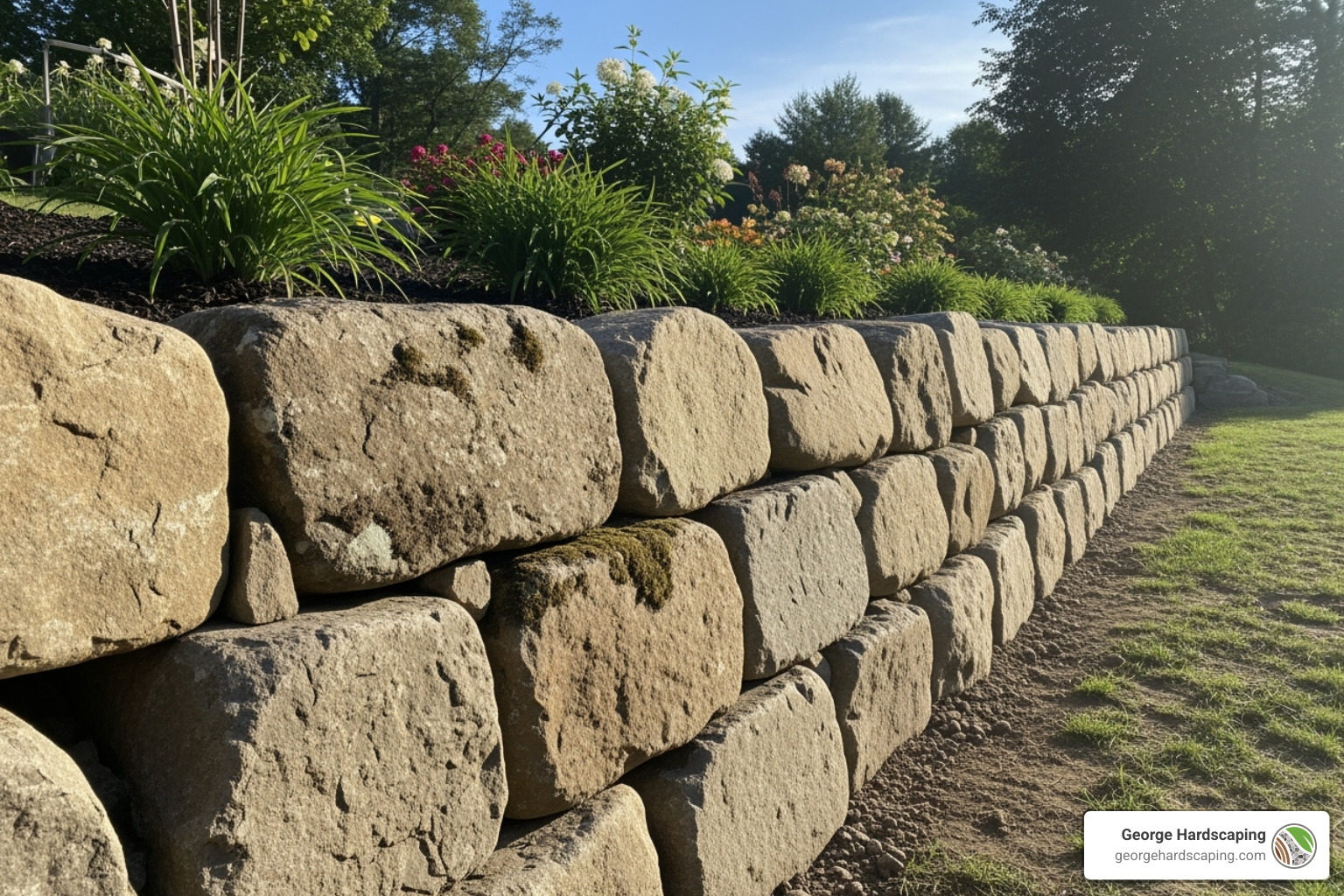
When to Repair:
Repair is a viable option when the wall’s core structure is sound and the problems are localized or correctable. Consider repairing if you see:
- Localized Issues: The failure is confined to a small, specific area, while the rest of the wall remains plumb and stable.
- Cosmetic or Material Degradation: The problem is crumbling mortar or spalled stones, but the wall itself is not moving.
- Minor Movement: A slight lean or bulge in a small section that can be corrected by rebuilding just that part.
- Correctable Drainage: The wall lacks proper drainage, but it can be retrofitted without a full rebuild.
- Fundamentally Sound Base: The wall’s footing is intact and has not settled or shifted significantly.
When to Replace:
Replacement becomes the necessary choice when the wall’s structural integrity is compromised beyond reliable repair. It’s time to replace if:
- Widespread or Catastrophic Failure: The majority of the wall is leaning, bulging, or cracking. Multiple failure points indicate a systemic problem.
- Severe Movement: The wall is leaning at a dangerous angle (often cited as more than 10-15% of its height out of plumb), sliding forward, or has a pronounced bulge across its midsection.
- Compromised Foundation: The base of the wall has sunk, heaved, or been completely undermined by erosion. A wall without a solid foundation cannot be saved.
- Pervasive Material Degradation: The stones themselves are crumbling or the mortar throughout the wall has disintegrated into sand.
- Undersized for the Load: The original wall was never built to handle the current loads (e.g., a new driveway or patio was added above it). A repair will not fix this fundamental design flaw.
The Financial Reality Check: The 50% Rule
A widely used rule of thumb in construction is that if the cost of repairs is estimated to be 50% or more of the cost of a full replacement, replacement is the smarter financial decision. Pouring money into fixing a fundamentally flawed asset is often a losing battle. A new wall comes with the guarantee of a proper foundation, a modern and effective drainage system, and construction methods designed for long-term stability. While the initial outlay is higher, the total cost of ownership is lower than performing a major repair now, only to face another failure in a few years.
Budget Context for Replacement:
- Demolition & Disposal: $15–$30 per linear foot to tear down and haul away the old wall.
- New Natural Stone Wall Construction: $8,000–$20,000+ is a common range for a professionally installed wall of average size. This price depends heavily on height, length, stone type, and site access.
For a deeper dive on new build pricing, see our guide to Retaining Wall Construction Cost at https://georgehardscaping.com/retaining-wall-construction-cost/ and explore our full Retaining Wall Construction services at https://georgehardscaping.com/retaining-wall-construction/.
Professional vs. DIY: Labor, Permits, and the True Cost of a Mistake
Tackling a retaining wall repair yourself might seem like a great way to save on the stone retaining wall repair cost, but for anything beyond the most minor cosmetic fixes, it’s a high-stakes gamble. These walls are heavy, complex structures holding back thousands of pounds of earth. A failed DIY repair is not just a waste of a weekend; it can lead to property damage, safety hazards, and a final bill that is far higher than hiring a professional from the start.
Breaking Down Professional Repair Costs
When you hire a qualified mason or hardscaping contractor, you’re not just paying for labor. You’re investing in expertise, safety, and peace of mind. Here’s what’s included:
- Labor Rates: A professional mason’s labor rates typically range from $75 to $125 per hour. This reflects years of experience in diagnosing failures, understanding soil mechanics, and using specialized tools and techniques correctly.
- Structural Engineer: For serious structural issues like significant bowing, walls over four feet, or designing an anchor system, an engineer’s input is crucial. Expect to pay $120 to $250 per hour for their consultation and design services.
- Insurance and Warranty: Reputable contractors carry general liability and workers’ compensation insurance. This protects you and your property from any accidents during the project. They also typically provide a warranty on their workmanship, giving you recourse if the repair fails prematurely.
- Permits and Inspections: For walls over four feet or any structural work, a permit is often required by your local municipality. This can cost $100 to $500 and ensures the work is done to code. The subsequent inspections verify compliance. The Mason Contractors Association of America is a good resource for understanding professional standards: https://www.masoncontractors.org/.
The Perils of DIY: A Cautionary Tale
Imagine a homeowner sees a stair-step crack and some crumbling mortar. They spend a weekend grinding out the bad mortar and repointing it. It looks great for a few months. But they didn’t address the root cause: hydrostatic pressure from a lack of drainage. By sealing the cracks, they’ve now trapped even more water inside the wall. The next winter, that trapped water freezes, expands with immense force, and blows out an entire section of the wall, sending stones tumbling into the yard. The original, manageable repair that might have cost $2,000 has now become a $10,000 emergency replacement project.
What you might DIY:
- Cleaning efflorescence with a stiff brush and water.
- Patching a few, very small (less than 1/8 inch) non-structural hairline mortar cracks on a wall that is otherwise plumb and stable.
When to absolutely call a professional:
- Any structural issue: Leaning, bowing, bulging, sliding, or foundation settlement.
- Significant cracking: Any horizontal cracks, or stair-step cracks that are spreading.
- Widespread deterioration: If more than 25% of the mortar is crumbling or stones are failing.
- Drainage failures: Any repair requiring excavation, installation of pipe, and replacement of backfill.
- Any work on walls over 3-4 feet tall.
Safety and Compliance:
- Excavation is dangerous. Trenches can collapse without warning. Review OSHA’s trenching and excavation safety guidelines: https://www.osha.gov/trenching-excavation.
- Always call before you dig. Hitting a utility line can be costly and dangerous. In Massachusetts, contact Mass811 at least 72 hours before any excavation: https://www.mass811.com/homeowners/.
Questions to Ask a Retaining Wall Contractor
To ensure you’re hiring a true professional, ask these questions:
- Are you licensed and fully insured (liability and workers’ comp)? Can you provide certificates?
- How many years have you been repairing stone retaining walls specifically?
- Can you provide a list of recent, local references for similar repair projects?
- What do you believe is the root cause of my wall’s failure?
- What is your detailed plan to fix it, including drainage and backfill?
- Will you be handling the permits and inspections?
- What is your process for protecting my lawn and landscaping during the project?
- What kind of warranty do you offer on your workmanship and the materials?
For more guidance, see our article on How to Find a Contractor to Build a Retaining Wall: https://georgehardscaping.com/how-to-find-a-contractor-to-build-a-retaining-wall/.
Frequently Asked Questions about Stone Wall Repair
As professionals serving homeowners across Essex County, we hear many of the same questions and concerns about failing walls. Understanding the process, costs, and what to expect is crucial. Here are clear, detailed answers to the most common questions regarding stone retaining wall repair cost and logistics.
When is a retaining wall officially considered beyond repair?
A wall is generally considered beyond repair when the cost of fixing it approaches or exceeds 50-60% of the replacement cost. More importantly, it’s beyond repair from a structural standpoint when the foundation itself has failed. If the base is crumbling, sinking, or sliding, no amount of work on the wall above it will provide a lasting solution.
Other terminal signs include a severe lean (more than 15% of its height out of plumb), widespread material degradation where the stones themselves are failing, or a situation where the wall is fundamentally undersized for the job it’s being asked to do. In these cases, a new, properly engineered wall is the only safe and responsible long-term investment. See our Retaining Wall Construction services for more: https://georgehardscaping.com/retaining-wall-construction/.
Do I need a permit to repair my stone retaining wall in Massachusetts?
It depends on the scope of work and your specific town’s regulations, which can vary. Generally:
- No Permit Needed: For minor, cosmetic work like cleaning or repointing a few small joints.
- Permit Likely Needed: For any wall over four feet tall (measured from the bottom of the footing to the top of the wall), any structural repairs involving excavation, foundation work, or the installation of anchors, and any major drainage alterations. Always check with your local building department before starting work. For code context, see IBC Chapter 18: https://codes.iccsafe.org/content/IBC2021P2/chapter-18-soils-and-foundations.
How long should a properly repaired stone retaining wall last?
The lifespan of a repair depends entirely on whether the root cause was addressed.
- Cosmetic Repairs: Repointing mortar joints in a harsh climate like New England might be needed every 15–25 years.
- Structural Repairs: A repair that successfully corrects the drainage and foundation issues should last for many decades, potentially as long as a brand-new wall.
A patch job that ignores the underlying problem may fail again in the next season.
Will my homeowner’s insurance help pay for a failed wall?
This is a common question, and the answer is usually no. Standard homeowner’s insurance policies typically exclude damage caused by earth movement (like soil pressure), flooding, and gradual deterioration from age or poor maintenance. Coverage might apply if the wall’s collapse was caused by a specific, covered peril (like a healthy tree falling on it), but this is rare. It’s always best to review your specific policy and speak with your insurance agent.
What is ‘geogrid’ and when is it used in repairs?
Geogrid is a synthetic mesh-like material used for soil reinforcement. During a rebuild, it is laid in horizontal layers extending from the back of the wall into the soil. The soil’s weight locks into the grid, effectively increasing the mass and strength of the entire wall structure and helping it resist pressure. It is a critical component in modern construction for taller walls or walls supporting heavy loads.
Can you match the stone and mortar to my existing historic wall?
Yes, for a skilled mason, this is a key part of a quality repair. Mortar matching involves analyzing the color, texture, and composition (sand type, lime content) of the original mortar to create a new mix that is both aesthetically and chemically compatible. Stone matching involves sourcing new stone from quarries that matches the type, color, and weathering of the existing wall to ensure the repair blends in seamlessly.
What will happen to my garden and lawn during the repair?
Any structural repair will involve some level of disruption. A professional contractor will have a clear plan to minimize the impact. This includes laying down plywood to protect the lawn from equipment, carefully removing and setting aside plants for replanting, and completely restoring the area upon completion. Discuss the site protection and restoration plan with your contractor before work begins.
What should I do before any digging starts?
Absolutely, unequivocally, you must locate all underground utilities. In Massachusetts, you are required by law to contact Mass811 by calling 811 or visiting their website at https://www.mass811.com/homeowners/ at least 72 hours before any excavation begins. They will notify all member utility companies to come and mark the location of their lines on your property. This service is free and prevents costly damage, service outages, and serious safety hazards.
Your Local Retaining Wall Experts in Essex County
When you notice a crack in your mortar or see your stone retaining wall start to lean, it’s more than an eyesore—it’s a structural liability that threatens your property, your safety, and your peace of mind. Gravity and water don’t pause; a small, manageable issue can escalate into a costly and dangerous collapse with surprising speed.
For homeowners throughout Essex County and the North Shore—including Beverly, Boxford, Danvers, Essex, Gloucester, Ipswich, Manchester-by-the-Sea, Marblehead, Newburyport, Peabody, Rockport, and Salem—George Hardscaping brings decades of masonry expertise and deep local knowledge to every project. We understand the unique challenges our region presents, from the heavy clay soils to the brutal freeze-thaw cycles that can destroy improperly built walls.
Our approach combines time-honored craftsmanship with modern, engineered solutions. We don’t just patch symptoms; we perform a thorough diagnosis to identify and correct the root cause of the failure. Whether your historic fieldstone wall needs careful repointing, your leaning wall requires structural reinforcement with helical anchors, or you need a complete, engineered rebuild with a state-of-the-art drainage system, we deliver a high-quality, lasting solution that protects your property for decades to come.
The longer you wait, the more complex and expensive the stone retaining wall repair cost becomes. Don’t let a small problem turn into a major disaster.
Strong CTA: Don’t wait for a small crack to become a collapse. Request an on-site assessment and detailed estimate today: https://georgehardscaping.com/request-estimate/.
Strong CTA: Explore our Retaining Wall Contractor services to see how we can help—from diagnosis and engineering to repairs and new construction: https://georgehardscaping.com/retaining-wall-contractor/.
