
Retaining wall drainage: Ultimate Stability 2025
Why Retaining Wall Drainage is Critical for Your Investment
Retaining wall drainage is the hidden system that ensures your wall stands strong for decades. Without it, water pressure builds up behind the wall—a force known as hydrostatic pressure. This pressure is the primary cause of retaining wall failure, leading to cracking, leaning, and eventual collapse—often requiring costly repairs or a complete replacement.
Quick Answer: Essential Components of Retaining Wall Drainage
- Drainage aggregate (gravel): Minimum 12 inches of clean, angular gravel (3/4 to 1 1/2 inch) behind the wall.
- Perforated pipe: 4–6 inch diameter PVC or HDPE pipe at the base with a 1–2% slope.
- Filter fabric: Geotextile fabric wrapping the gravel to prevent soil from clogging the system.
- Weep holes: Openings spaced 3–7 feet apart for direct water escape (for appropriate wall types).
- Proper backfill: Compacted layers that ensure water flows down and away from the wall.
After heavy rain, saturated soil can weigh up to 50% more than dry soil. When this water has nowhere to go, it exerts thousands of pounds of pressure against your wall. A wall that looks fine today can fail within a few years if this water isn’t managed. The good news: failure is preventable with the right drainage system.
Whether you’re planning a new retaining wall or have an existing wall, understanding drainage is essential. Even a small 2‑foot wall needs proper drainage, as the physics of water pressure apply regardless of height. This guide covers the components, techniques, and professional insights needed to protect your investment, with practical recommendations you can use in Essex County and beyond.
At George Hardscaping, drainage is the backbone of every project we build. If you want a wall that looks beautiful and lasts, start with a design that moves water safely. Explore our retaining wall installation services to see how we engineer every project for durability and code compliance, and review our retaining wall construction process to understand the steps we take to protect your property for decades.
Strong call to action: Ready to prevent costly wall failures and get a system that’s built right? Request a free on‑site estimate and speak with a licensed pro about the best drainage approach for your property.
The Unseen Threat: Why Water Is Your Retaining Wall’s Worst Enemy
When water gets trapped behind a retaining wall, it creates an invisible but powerful force: hydrostatic pressure. This is the silent destroyer of retaining walls and the single biggest cause of failure. As soil becomes saturated, its weight increases dramatically—dry soil weighing around 100 pounds per cubic foot can jump to 130 pounds or more when wet. This combination of increased soil weight and direct water pressure pushes relentlessly against your wall, creating a force it may not be designed to withstand.
Without a proper retaining wall drainage system, this pressure builds until something gives way. The warning signs often appear gradually, but they are always indicators of structural distress, not simple cosmetic flaws.
- Leaning and Bulging: Any forward lean or localized bulge is a red flag. This happens when hydrostatic pressure exceeds the wall’s resistive strength, causing it to deform. A bulge often indicates a specific point of intense pressure, perhaps where a drainage component has failed or was never installed.
- Cracking and Displacement: The type of crack tells a story. Horizontal cracks are a classic sign of hydrostatic pressure pushing the wall outward. Step-cracks, which follow the mortar joints in a block or stone wall, also indicate movement from pressure or settlement. While minor vertical cracks can sometimes result from shrinkage or minor settlement, significant or widening cracks are a serious concern. Open joints and migrating caps or stones are further evidence that the wall is shifting under load.
- Piping or Soil Loss: If you see voids, sinkholes, or trails of sediment forming behind or beneath the wall, it’s a sign of “piping.” This occurs when water is escaping through unfiltered gaps, carrying fine soil particles (silt and clay) with it. This erosion undermines the wall’s foundation and the soil it’s meant to retain, leading to instability.
- Sudden Failure: In the worst-case scenario, a wall can fail catastrophically. This can happen through several modes: overturning (tipping forward from the top), sliding (the entire wall mass moves forward along its base), or deep-seated failure (a larger mass of soil behind and below the wall fails). Such events are often triggered by an extreme rainstorm or rapid snowmelt on already saturated ground.
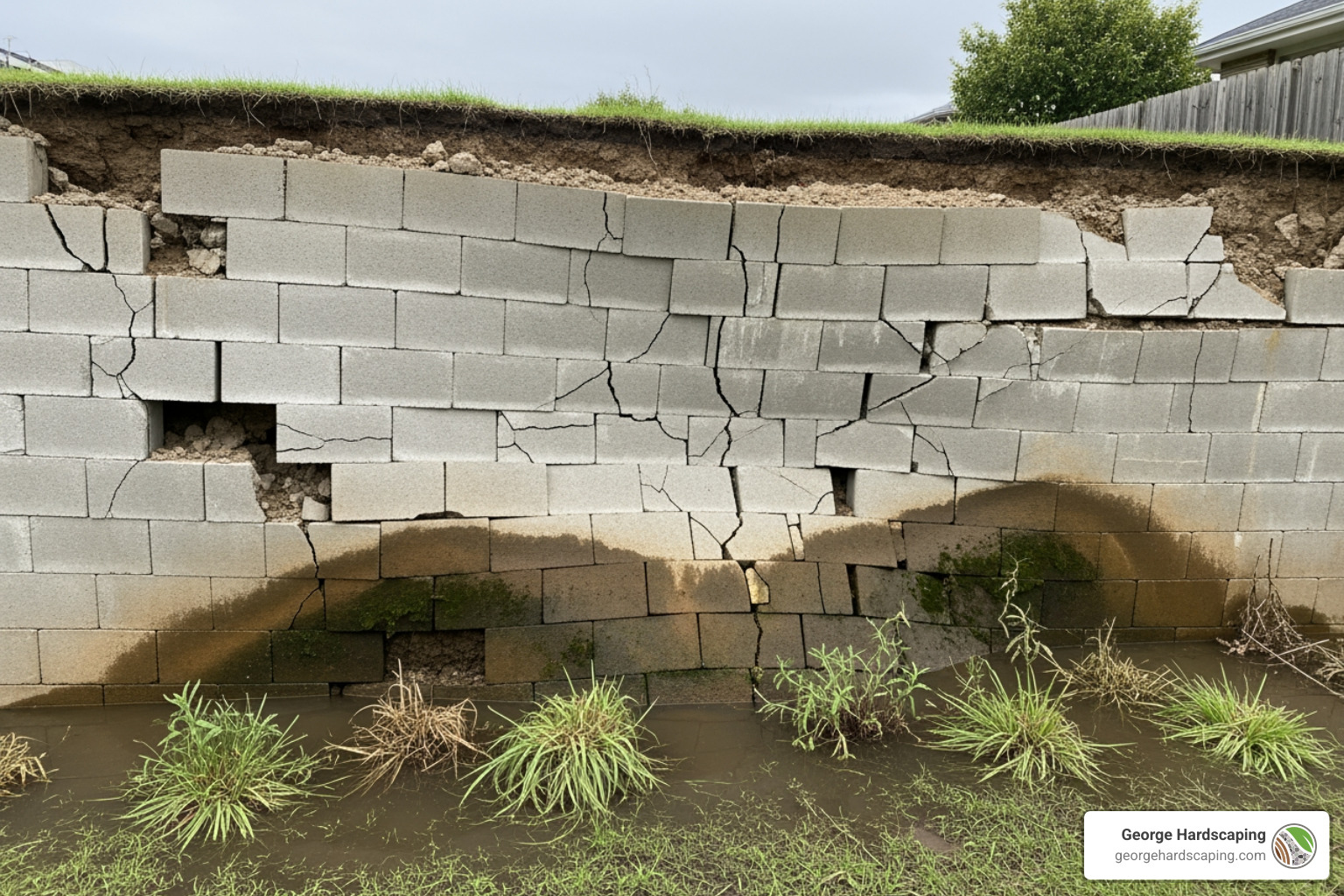
In New England, the freeze-thaw cycle magnifies the problem exponentially. Water trapped in the soil behind the wall freezes and expands by about 9%. This process, known as frost heave, doesn’t just push on the wall once. As temperatures fluctuate, water migrates toward the freezing front, forming “ice lenses”—layers of pure ice that grow and exert immense, localized pressure. This acts like a slow-motion jackhammer, splitting stone, causing concrete to spall, and crumbling mortar joints over just a few seasons. You might also see efflorescence (white, chalky mineral deposits on the wall’s face), a clear sign that excessive water is migrating through the wall structure itself.
Beyond aesthetics, inadequate drainage is a significant safety and liability issue. Retaining walls support slopes, driveways, and patios. A compromised wall can lead to catastrophic soil collapse, damaging adjacent structures, threatening underground utilities, and putting people at risk. If your failing wall damages a neighbor’s property, you could be held liable. This is why most jurisdictions have strict building codes for retaining walls.
Walls over a certain height (often 3–4 feet, but variable by town) or those supporting critical loads (like a driveway or another structure) almost always require professional engineering, permits, and inspections that verify proper drainage. For reference, the International Building Code and local amendments often trigger permits as wall height increases or when loads are present; consult the International Code Council resources for current code topics and your local building department for exact requirements.
High-authority resources agree that drainage is non-negotiable. The Federal Highway Administration’s Mechanically Stabilized Earth Walls and Reinforced Soil Slopes manual emphasizes the importance of drainage to control pore water pressures and maintain stability. Similarly, the National Concrete Masonry Association’s Design Manual for Segmental Retaining Walls outlines drainage details as a core design element. Following these professional engineering principles at a residential scale is the only way to dramatically reduce the likelihood of failure.
If you’re seeing any of these early warning signs—or if your wall has no visible drainage measures like weep holes or a daylighted pipe—act now. Our retaining wall construction services focus on water management from the footing up, and our guide on how to repair a collapsed stone retaining wall shows what can happen when drainage is ignored.
Anatomy of a Dry Wall: Key Components of an Effective Drainage System
A well-designed retaining wall drainage system is a team of components working together to prevent hydrostatic pressure. Cutting corners on any one part can compromise the entire system. The key players are drainage aggregate, perforated pipes, filter fabric, and weep holes or drainage panels. Each plays a critical role in long-term stability.
The Role of Drainage Aggregate (Gravel)
Drainage aggregate, or gravel, creates a permeable zone behind the wall so water can flow downward instead of pushing laterally. We use clean, angular gravel (3/4 to 1 1/2 inches) because the sharp edges interlock for stability while maintaining voids for water flow. Fines (sand, silt, clay) should be minimal; they clog voids and kill performance.
Specifications worth knowing:
- Thickness: A minimum 12-inch column of gravel directly behind the wall, from base to near the top.
- Gradation: Conform to standard aggregate gradations (for example, ASTM D448 for coarse aggregates) to ensure consistent, free-draining performance.
- Separation: Use geotextile to keep native soils from migrating into the stone over time.
For property owners comparing looks and performance, our retaining wall stone options show how the visible face material pairs with a hidden drainage zone engineered to last for decades.
Filter Fabric (Geotextile)
Geotextile filter fabric is the unsung hero of longevity. It allows water to pass while blocking soil particles from infiltrating the drain stone.
- Type: Non-woven, needle-punched geotextiles are commonly used for filtration. Woven fabrics are stronger but may not filter as effectively in all soils.
- Apparent Opening Size (AOS): Match the fabric’s pore size to your soil gradation (see ASTM D4751 standard test method) so fines stay out of the drain while water flows freely.
- Installation: Wrap the gravel “burrito-style” with overlaps facing uphill. Avoid tears or gaps; tape or pin seams as needed.
Perforated Pipe Systems (French Drains)
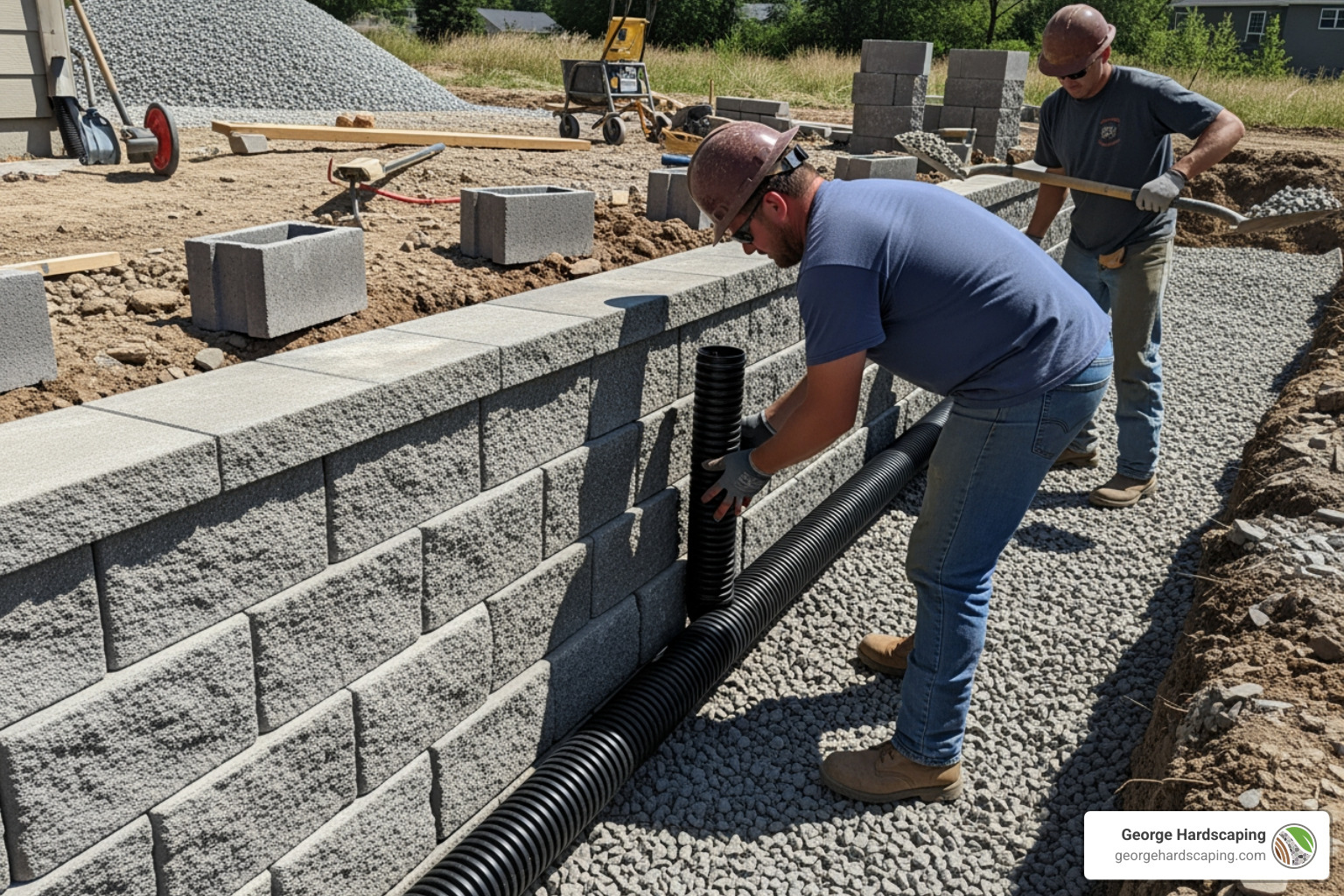
While gravel provides the path, the perforated pipe is what collects and carries water safely away. Without it, water can pool at the base.
Key details:
- Pipe type: Durable 4-6 inch PVC or HDPE. PVC (ASTM D3034/D2729) holds slope and resists deformation; HDPE corrugated is flexible but must be bedded carefully to maintain grade.
- Hole placement: Place perforations down—this draws water from the gravel bed while minimizing sediment drop-in.
- Slope: Maintain a continuous 1-2% downhill slope (1-2 feet of fall per 100 feet of run). Laser levels or string lines help ensure accuracy.
- Outlets: Discharge to daylight with a rodent screen, to an approved storm line, or to an appropriately designed dry well (verify local code). Protect outlets from crushing, clogging, and ice.
For complex sites with high groundwater, consider auxiliary collectors (dual pipes) or underdrains tied into site drainage. Guidance from the FHWA and NCMA underscores the importance of positive, reliable outflow.
Weep Holes and Geocomposite Panels
Weep holes are small openings in the face of certain wall types (often concrete or masonry) that act as pressure relief valves. They allow water behind the wall to escape immediately.
- Spacing: Typically 3-7 feet apart along the base course, aligned with the internal drainage zone.
- Filtration: Always place geotextile or a small gravel pocket behind each weep hole to prevent soil washout.
- Limitations: Many segmental retaining wall systems (SRWs) rely on rear drainage columns and base drains instead of front-face weep holes. Follow manufacturer guidance.
For tight sites or walls with high water inflow, geocomposite drainage panels (a dimpled core with integrated fabric) can be installed vertically against the back of the wall to provide fast, uniform flow. They’re especially useful behind cast-in-place concrete walls and basement retaining walls.
Base Preparation and Subgrade Drainage
Even the best drain column fails if the subgrade traps water. A level, compacted base of free-draining stone (often 3/4 inch crushed) beneath the wall, paired with a blanket drain at the bottom and a chimney drain behind the wall, intercepts groundwater before it builds pressure. These assemblies are standard in professional practice and align with long-standing recommendations in the FHWA’s geotechnical guidance on reinforced soil structures.
Don’t Forget Surface Water
The fastest way to overwhelm a drain is to dump roof runoff and yard flow right into it. Grade the soil at the top of the wall away from the face (a minimum of 5% slope for the first 5-10 feet, where feasible), capture roof water with downspout extensions, and use swales or shallow berms to direct runoff to safe discharge locations. The U.S. EPA’s stormwater best management practices are good references for handling surface water responsibly.
At George Hardscaping, we assess each site’s soil, slope, and hydrology to select the right combination of components for your retaining wall construction. From aggregate gradation to outlet protection, our detailed retaining wall construction process shows how we control water from the first shovel in the ground.
Mastering Water Flow: Best Practices for Retaining Wall Drainage
Effective retaining wall drainage requires a two‑pronged approach: install the drainage system correctly and manage water on the surrounding property. Even the best materials fail if installation is sloppy, and a perfect system can be overwhelmed if surface water isn’t controlled.
Installation Techniques That Make Walls Last
- Base preparation: Excavate to undisturbed subgrade or engineered fill. Place a compacted base of free‑draining crushed stone (often 6–12 inches thick, depending on design), level side‑to‑side and front‑to‑back. Remove organic soils.
- Backfilling in lifts: Place and compact drainage gravel in 8–12 inch lifts. This prevents settlement and ensures voids remain open for flow. Compact native backfill separately from the drain column.
- The “burrito wrap”: Encase the entire drainage aggregate column and pipe in geotextile to prevent fines migration. Overlap seams and keep fabric clean during installation.
- Pipe slope and continuity: Verify a continuous 1–2% fall to the outlet with a level. Avoid sags, bellies, or back‑pitch that trap water.
- Outlet protection: Terminate to daylight with a grate and rodent screen; protect from mower damage, vehicles, landscaping, and ice. Where codes allow, connect to an approved storm drain or dry well sized for your runoff.
- Capillary breaks: In frost‑susceptible soils, design with non‑frost‑susceptible base stone and proper drainage to reduce heave forces.
- Reinforcement and geogrid: For taller walls or surcharge loads (driveways, slopes), integrate geogrid layers per engineering requirements—drainage works together with reinforcement to maintain stability. The NCMA provides detailed guidance on geogrid spacing and embedment.
See our detailed retaining wall construction process for a step‑by‑step look at how we build robust drainage into every wall.
Managing Surface and Groundwater
A drainage system can be overwhelmed if it has to handle all the water from your property. Manage water before it reaches the wall.
- Grading: Ensure final grades at the top of the wall slope away (ideally 5% where site conditions allow). Create a gentle swale parallel to the wall to intercept runoff.
- Swales and berms: Use shallow, vegetated swales or subtle berms to redirect flow to safe outlets. This reduces the volume entering the backfill.
- Downspout control: Extend downspouts to discharge beyond the wall’s backfill and away from slopes. Consider catch basins to intercept mid‑yard flows.
- Groundwater interception: In clayey or perched water conditions, blanket and chimney drains intercept water and move it to the base pipe. On steep sites, staged intercept drains upslope can reduce inflow to the wall.
- Erosion control: Protect exposed soils during construction with blankets, mulch, or vegetation to prevent silts from clogging the drain system. The EPA’s erosion and sediment control resources outline practical BMPs that translate well to residential sites.
Quality Control and Permitting
- Permits and engineering: Many municipalities require permits for walls over a threshold height or near property lines. Check local requirements and consult the International Code Council resources for code frameworks.
- Inspection points: Verify compaction of base and backfill, correct fabric installation, pipe slope, and functional outlets before covering. Photograph each step for records.
- Material verification: Use aggregates of known gradation and clean geotextiles that match your soil conditions. Keep receipts/spec sheets.
Strong mid‑article CTA: Planning a wall this season? Schedule a design consultation with our retaining wall installation services to get a drainage plan tailored to your site, soil, and budget.
Frequently Asked Questions About Retaining Wall Drainage
Homeowners across Essex County often have practical questions about retaining wall drainage. Here are clear, straightforward answers to common concerns.
Does a small retaining wall (e.g., 2 feet) require a drainage pipe?
Yes. The physics of hydrostatic pressure apply regardless of wall height. Water can accumulate behind a 2-foot wall, causing it to lean, bulge, and fail prematurely. While a very small garden border might get by with just a gravel backfill, any structural wall should include a perforated base pipe. See our guide to installing a small retaining wall for a practical overview.
What is the best type of drainage for a wooden retaining wall?
Wooden walls need a two-part strategy to prevent rot and ensure longevity:
1) Waterproofing barrier: Apply a continuous waterproofing membrane to the soil-facing side before backfill.
2) Lightweight, free-draining backfill: Use rounded pea gravel or small crushed stone that relieves pressure on flexible timber members.
Timber walls that skip drainage fail quickly. If you’re weighing replacement, review the cost to replace a railroad tie retaining wall to understand how proper drainage affects long-term value.
How deep should the drainage system be?
Treat drainage as a full-height system, not a single component.
- Drainage aggregate: A continuous 12-inch column from the base of the wall up to within 6-12 inches of finished grade (topsoil can cap the column with fabric separation).
- Perforated pipe: Place at the lowest point of the system, at the base of the wall footing, sloped to daylight or an approved discharge.
Should the perforated pipe holes face up or down?
Down. With holes down, water enters the pipe from the gravel bed beneath, and sediment from above is less likely to drop into the perforations. This configuration is also consistent with common practice in civil and geotechnical guidance from FHWA and NCMA.
Do segmental retaining walls (SRWs) need weep holes?
Usually not. Most SRWs are designed with a rear drainage column and base drain so water exits through the drain system and the joints between blocks. Weep holes are more common in solid-faced cast-in-place concrete or masonry walls. Always follow the wall manufacturer’s recommendations and the National Concrete Masonry Association’s guidance for your wall type.
What type of filter fabric should I use?
Use a non-woven geotextile designed for soil filtration. Select a fabric with an apparent opening size (AOS) that matches your soil: finer soils require smaller openings to prevent migration (see ASTM D4751 standard). Wrap the gravel column fully, overlap seams, and protect the fabric from damage during backfilling.
What gravel size is best behind the wall?
Clean, angular stone in the 3/4 to 1 1/2 inch range provides excellent drainage with interlock that resists settlement. Avoid mixes with fines. Referencing standardized gradations (e.g., ASTM D448 for coarse aggregates) helps ensure predictable performance.
How far should I run the drain to daylight?
Run the drain until it exits at a lower elevation than the wall base with a continuous positive slope (1-2%). Protect the outlet with a screen and surround with riprap if needed. Where daylighting isn’t possible, consult local codes about connecting to storm infrastructure or using a properly sized dry well.
What about freeze-thaw and frost heave in New England?
Provide non-frost-susceptible base stone, robust drainage, and outlets that won’t freeze shut. Grade the finished surface to shed water. Frost heave forces are significantly reduced when water cannot accumulate and freeze in the backfill. The FHWA’s cold-regions guidance for geotechnical design reinforces the value of drainage in mitigating frost action.
Do I need a permit or engineer for my wall?
Many municipalities require permits (and sealed drawings) for walls above a certain height or when surcharges (like driveways or slopes) are present. The International Building Code provides a framework, but local amendments govern. When in doubt, call your building department. We can coordinate engineered designs as part of our retaining wall construction services.
How can I retrofit drainage to an existing wall?
Options depend on wall type and condition:
- Add surface controls: Redirect downspouts, add swales, and regrade to keep water away.
- Install a relief trench: In some cases, you can trench along the top of the wall, add a narrow gravel column with fabric, and tie into a safe outlet.
- Core weep holes: For solid concrete or masonry walls, a pro can core weep holes and create filtered pockets to relieve pressure.
- Rebuild with drainage: If the wall is already leaning or bulging, full reconstruction with proper drainage and reinforcement is the safest route. Our article on how to repair a collapsed stone retaining wall outlines what’s involved.
What’s a simple maintenance checklist?
- Confirm outlets are clear and flowing after storms; add a rodent screen if missing.
- Keep the grade at the top sloped away; avoid mulch mounds that funnel water behind the wall.
- Extend downspouts so roof runoff bypasses the wall’s backfill.
- Watch for new cracks, bulges, or soil loss; address early.
- Avoid planting large, water-loving shrubs directly behind the wall where roots and irrigation can saturate the backfill.
Where can I learn more from authoritative sources?
- Federal Highway Administration Mechanically Stabilized Earth Walls and Reinforced Soil Slopes manual: A gold-standard reference on drainage and stability.
- National Concrete Masonry Association Design Manual for Segmental Retaining Walls: Practical design and drainage details for SRWs.
- U.S. EPA stormwater best management practices: Strategies to manage runoff before it ever reaches your wall.
If you’re unsure about your wall’s condition or don’t see a visible drainage outlet, schedule an assessment. Our retaining wall construction process includes a comprehensive water management plan customized to your site.
Ensure Your Wall Stands Strong with Professional Drainage Solutions
Water is relentless, and without proper management, it will compromise your retaining wall. Effective retaining wall drainage isn’t just one component but a complete system: aggregate for flow, a pipe for collection, and filter fabric for longevity—installed with expert technique and paired with smart site drainage.
A small mistake—an improper pipe slope, the wrong aggregate, or missing fabric—can shorten a wall’s lifespan dramatically. At George Hardscaping, we build for the long term. Our retaining wall installation services are engineered for New England soils and freeze‑thaw conditions, and our retaining wall construction process documents every critical step from base preparation to protected outlets.
Protect your investment and avoid costly failures. Request your free on‑site estimate today, and we’ll design a drainage plan that keeps your wall dry, stable, and beautiful for decades.
Already seeing leaning, cracks, or poor drainage? Book a priority inspection now—we’ll diagnose the issue, provide a clear plan, and, if needed, rebuild with the right drainage so you only do this once.
