
Why Driveway Brick Pavers Are Worth a Closer Look
Driveway brick pavers are one of the most durable, attractive, and long-lasting ways to surface your home’s entrance — and they’re a popular choice across Essex County, MA, from Gloucester to Ipswich and beyond.
Quick answers for homeowners evaluating paver driveways:
| Question | Short Answer |
|---|---|
| How long do brick pavers last? | 25–50 years with proper installation |
| What do they cost? | Averages vary widely — internet data suggests $16–$42+ per sq ft installed |
| Are they better than concrete? | More durable and easier to repair, but higher upfront cost |
| Do they add home value? | Yes — especially for historic and traditional-style homes |
| Do they need maintenance? | Sealing every 3–5 years; occasional joint sand replenishment |
Note: All pricing figures above are average costs sourced from publicly available internet data and do not reflect George Hardscaping’s actual rates.
Your driveway is the first thing anyone sees when they arrive at your home. A cracked, stained slab of asphalt or poured concrete doesn’t exactly say quality. Brick pavers do. They offer an immediate upgrade to your property’s curb appeal, blending structural strength with a classic, upscale aesthetic that complements any architectural style.
Unlike poured concrete — which cracks, stains, and requires full-section replacement when it fails — brick pavers are individual units. If one shifts or breaks, you replace that unit. The rest stays intact. That repairability alone is a major reason why roughly 40% of new driveway installations in competitive markets now use interlocking paving stones. This modular design ensures that any future utility work or minor repairs can be completed without leaving ugly, mismatched patches on your driveway surface.
In Massachusetts, the stakes are even higher. Freeze-thaw cycles put rigid surfaces under serious stress every winter. When water gets under concrete or asphalt and freezes, it expands, causing the surface to crack and buckle. A properly installed paver driveway — built on a compacted aggregate base with sand-set joints — flexes with ground movement instead of cracking under it. This inherent flexibility allows the system to distribute heavy loads and withstand extreme temperature swings without structural failure.
This guide covers everything you need to make a confident decision: materials, patterns, installation standards, costs, and maintenance.
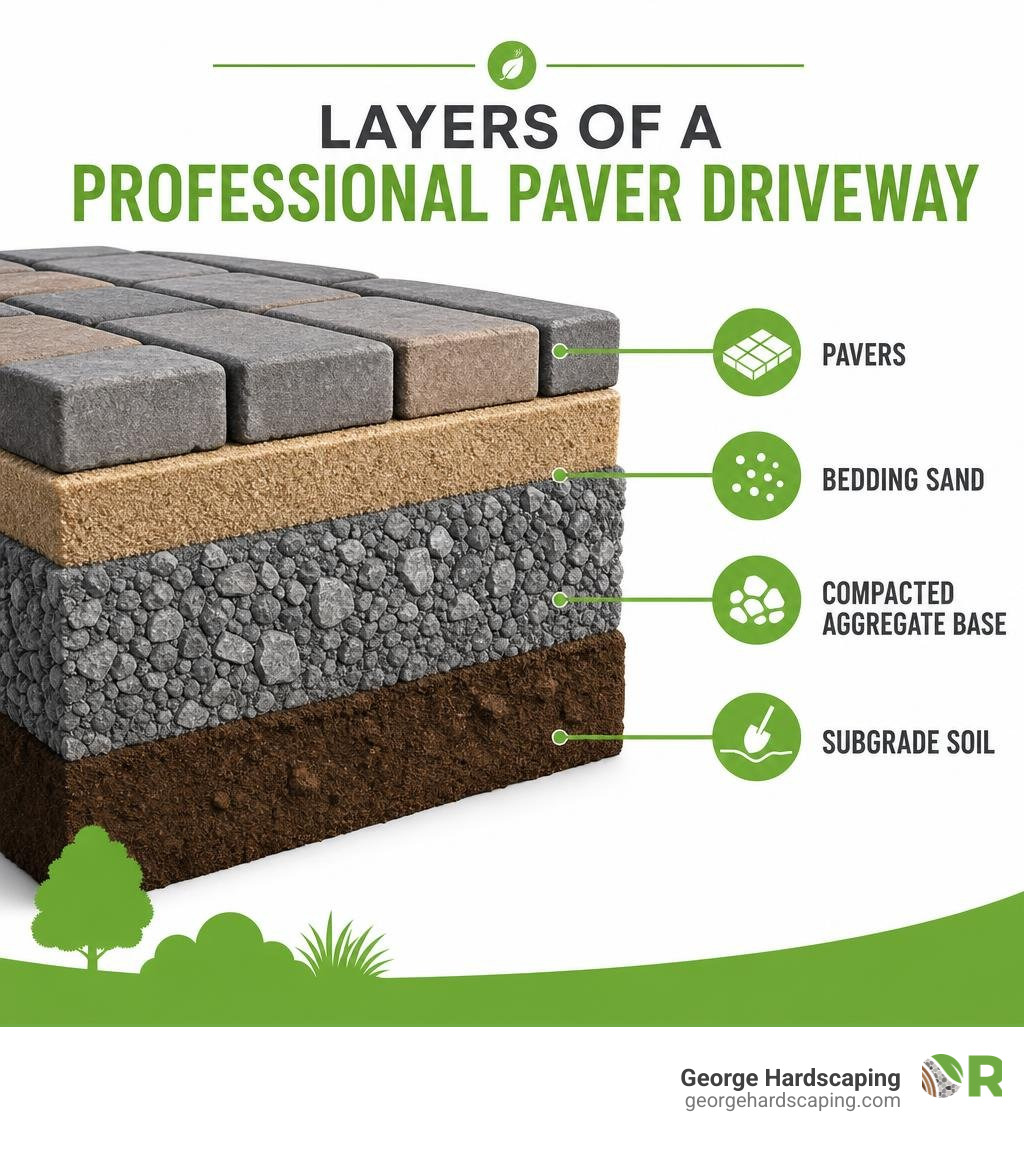
Driveway brick pavers terminology:
Comparing Driveway Brick Pavers to Alternative Materials
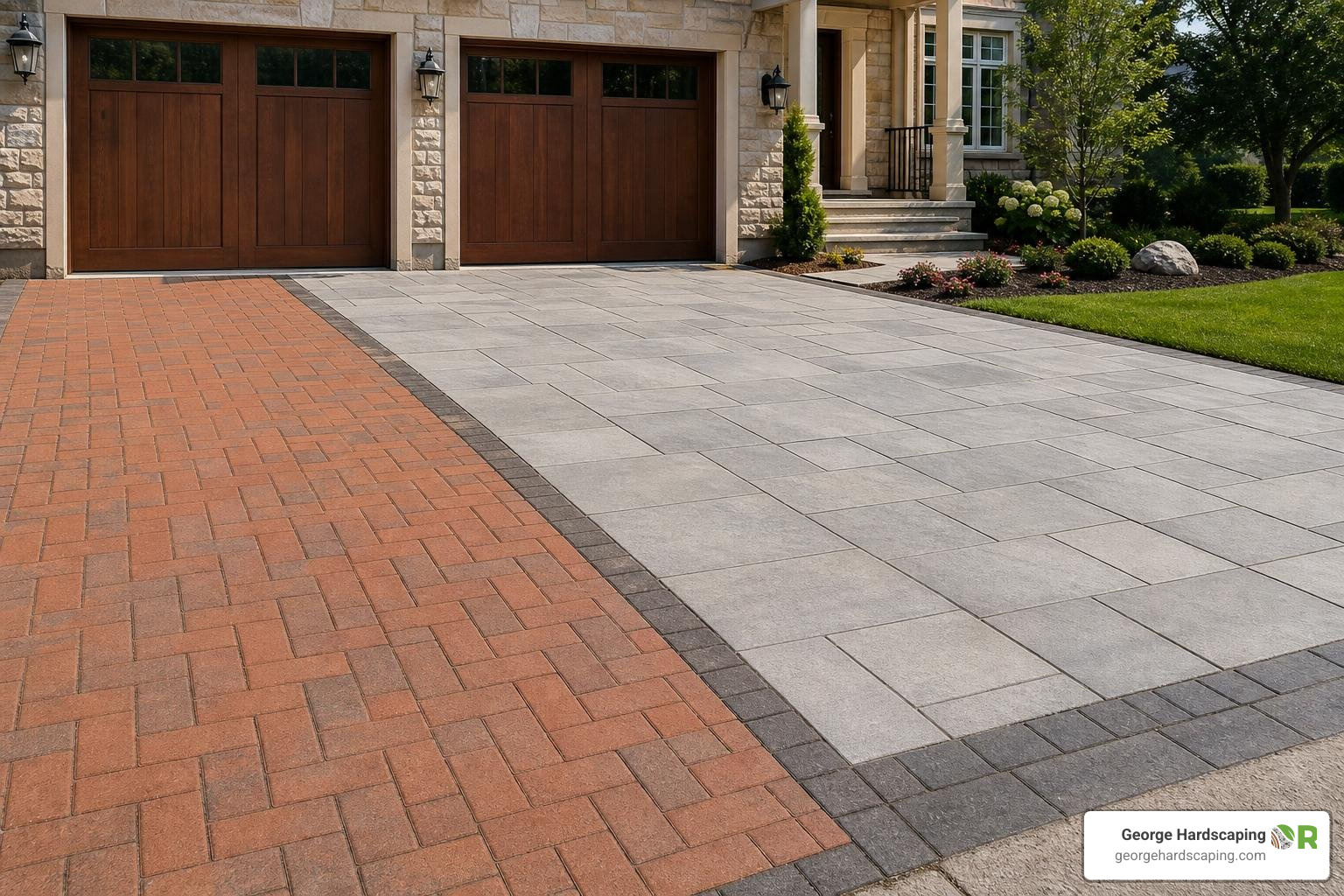
When upgrading a driveway, homeowners usually choose between four primary materials: clay brick pavers, concrete pavers, poured concrete, and asphalt. While asphalt and poured concrete are common, they are structurally rigid. This means they cannot adapt to the shifting soil underneath, eventually leading to unsightly cracks and costly repairs. Over time, these rigid materials degrade under the weight of vehicles and the relentless cycle of New England weather, requiring complete resurfacing or demolition.
In contrast, interlocking paving stones offer a flexible pavement system. When evaluating whether are driveway pavers a good investment, consider their lifecycle value. Paving stones outperform monolithic surfaces in durability, aesthetic appeal, and long-term maintenance costs. While the initial installation cost of pavers is higher, their lifespan is double or triple that of asphalt, making them a far more cost-effective choice over time.
To answer a common structural question: yes, can pavers be used for a driveway safely, provided they are rated for vehicular loads and installed over a properly engineered aggregate base. The key is ensuring the pavers are at least 60mm (2.36 inches) thick for standard residential use, or 80mm (3.15 inches) for heavy-duty applications.
| Driveway Material | Lifespan | Maintenance Level | Repairability | Resistance to Freeze-Thaw |
|---|---|---|---|---|
| Clay Brick Pavers | 25–50+ Years | Low (Occasional sealing/sand) | Excellent (Individual replacement) | High (Flexible joint system) |
| Concrete Pavers | 20–30+ Years | Low to Medium (Sealing required) | Excellent (Individual replacement) | High (Flexible joint system) |
| Poured Concrete | 15–25 Years | Medium (Patching and sealing) | Poor (Requires patching or full slab demo) | Low (Prone to cracking) |
| Asphalt | 10–15 Years | High (Frequent sealcoating/resurfacing) | Moderate (Requires patches or overlays) | Moderate (Softens in summer, cracks in winter) |
The Aesthetic Appeal of Driveway Brick Pavers
True clay brick pavers offer a timeless, classic charm that cannot be replicated by synthetic alternatives. Because they are molded from natural clay and kiln-fired at temperatures exceeding 2,000°F, they develop a dense, ceramic-like structure. This intensive manufacturing process ensures through-body color integrity. Unlike concrete products that rely on added pigments, clay bricks will never fade under UV exposure, maintaining their rich, deep hues for generations.
For historic properties in coastal towns like Gloucester and Ipswich, clay brick pavers preserve the architectural heritage of the home. Over time, as the bricks weather, they maintain their warm red, orange, and deep brown tones, enhancing the property’s curb appeal. Homeowners in Beverly and Danvers often choose clay brick to complement traditional New England colonial or craftsman home styles, creating a seamless transition between the historic landscape and modern living.
Concrete Pavers for Driveway Applications
If you are looking for maximum design flexibility, concrete pavers for driveway installations are an outstanding alternative. Manufactured from high-strength Portland cement and aggregates, concrete pavers can be cast in almost any shape, size, color, and texture. This allows homeowners to achieve the look of natural stone, slate, or even weathered wood planks while enjoying the structural benefits of interlocking concrete.
Modern manufacturing standards allow concrete pavers to achieve compressive strengths exceeding 8,000 PSI, making them incredibly resilient under heavy vehicular traffic. While they require periodic sealing to protect their surface pigments from oil stains and UV fading, they offer a wider array of contemporary shapes and modular patterns that blend beautifully with modern architectural styles. This versatility makes them a favorite for contemporary homes in the North Shore region.
Driveway Paver Design Patterns and Material Selection

Selecting the right layout pattern is not just an aesthetic choice; it directly impacts the structural load capacity of your driveway. While there are countless driveway paver ideas to explore, the most common patterns include herringbone, running bond, and basketweave, often framed by contrasting borders and inlays. Each pattern offers a unique visual rhythm, but they also perform differently under the physical stress of vehicular traffic.
Structural Integrity of the Herringbone Pattern
For areas subject to vehicular traffic, the herringbone pattern – laid at either 45 or 90 degrees – is widely considered the industry standard. The interlocking design of herringbone distributes the weight of heavy vehicles across multiple units, preventing the pavers from shifting, sliding, or rotating under the forces of braking, turning, and acceleration. When a vehicle turns its wheels on a herringbone pattern, the interlocking units lock together tightly, resisting lateral movement.
Using interlocking driveway pavers in a herringbone pattern ensures that the horizontal forces exerted by tires are absorbed evenly. This structural layout minimizes the risk of rutting or joint failure, making it the most durable pattern for residential driveways. Other patterns, like running bond or basketweave, are beautiful for walkways or borders but can shift more easily under heavy vehicular loads if not installed with extreme precision.
Permeable and Eco-Friendly Options
With increasing local regulations regarding stormwater runoff on the North Shore, many homeowners are turning to permeable driveway pavers. These specialized systems feature wider joints filled with small aggregates rather than sand, allowing rainwater to seep directly into the ground. This natural filtration process recharges local aquifers and prevents polluted runoff from entering nearby waterways.
Permeable paving systems are highly effective for stormwater management, reducing the burden on municipal storm drains and preventing pooling water on your driveway. They are particularly beneficial for coastal properties in Gloucester and Ipswich that experience high seasonal rainfall and coastal storms. For broader context on runoff control requirements and best practices in Massachusetts, the state provides stormwater management guidance for property owners, municipalities, and contractors. Implementing these eco-friendly systems can also help homeowners comply with local conservation commission guidelines.
Professional Installation Standards and Base Preparation
The secret to a paver driveway that lasts for decades lies entirely beneath the surface. No matter how beautiful the pavers are, a poor sub-base will result in sinking, shifting, and structural failure. A professional driveway paver installation requires precise excavation, robust base preparation, and proper drainage design. Skipping steps during the preparation phase is the number one cause of driveway failure, which is why hiring experienced professionals is critical.
Sub-Base and Soil Assessment in Massachusetts
In Massachusetts, our soils present unique challenges. The combination of heavy clay soils and severe winter freeze-thaw cycles means that sub-base preparation must be executed with extreme care. During winter, moisture in clay soils freezes and expands, pushing upward against rigid structures. If the base is too thin or holds water, this “frost heave” will ruin the driveway’s flat surface.
To combat this “frost heave,” we excavate to a depth of at least 12 inches for a standard residential driveway. We then lay down a woven geotextile fabric to separate the subgrade soil from the aggregate base, preventing clay from migrating upward into the clean stone. Next, we install a minimum 6-to-8-inch base of crushed aggregate, compacting it in 2-to-3-inch layers using heavy-duty vibratory plate compactors. This dense, stable base allows water to drain away from the surface while providing a rock-solid foundation that resists shifting under heavy loads.
Edge Restraints and Joint Sand Stabilization
Once the aggregate base and a 1-inch bedding sand layer are prepared, the pavers are laid. However, without secure borders, the outer edges of the driveway would slowly push outward over time due to lateral pressure from vehicles. This lateral spread causes the joints to open up, leading to loose pavers and weed growth.
To prevent this, we install heavy-duty, commercial-grade driveway edging pavers secured with concrete haunches or heavy steel spikes. Once the edge restraints are locked in, we sweep high-performance polymeric sand into the joints. This sand contains special polymers that activate when wet, binding the pavers together to create a semi-solid, flexible barrier. This prevents joint erosion, resists weed growth, and deters ants from settling between your pavers, ensuring the structural integrity of the entire system.
Cost Analysis, Investment Value, and Maintenance Protocols
Upgrading to a paver driveway is a significant home investment that delivers exceptional curb appeal and long-term resale value. When planning your budget, it is helpful to look at general industry pricing to understand the scale of the project. While the upfront cost is higher than asphalt, the long-term value and lack of replacement costs make it a highly attractive option for discerning homeowners.
Average Cost Ranges for Massachusetts Homeowners
Disclaimer: The following pricing ranges represent broad industry averages compiled from publicly available online data in 2026. They are intended for educational budgeting purposes only and do not represent the actual pricing or estimates of George Hardscaping.
According to public internet data, the cost of installing a professional paver driveway varies significantly based on site conditions, material selection, and design complexity:
- Concrete Paver Driveway Installation: Average industry ranges span from $38 to $120 per square foot installed.
- Clay Brick Paver Driveway Installation: Average industry ranges span from $42 to $130 per square foot installed.
- Travertine or Premium Natural Stone Paver Driveway: Average industry ranges span from $66 to $210 per square foot installed.
For a typical single-car driveway (200–300 sq ft), industry averages suggest a total cost range of $10,000 to $45,000+ depending on excavation requirements and pattern detail.
For a larger double-car driveway (400–600 sq ft), public data estimates average ranges between $20,000 and $100,000+ when incorporating complex borders, apron details, or custom inlays.
These wide ranges reflect the significant labor, excavation, and base stabilization required to handle local soil conditions in communities like Woburn, Lynnfield, Danvers, and Beverly. Factors such as slope, accessibility, and the removal of existing concrete or asphalt also play a major role in final pricing.
To explore detailed cost factors and savings strategies, read our guide on the real cost of a paver driveway.
Long-Term Maintenance for Driveway Brick Pavers
While the initial investment is higher than asphalt, the maintenance protocols for brick pavers are highly manageable and cost-effective over their 30+ year lifespan.
To keep your driveway looking pristine:
- Sealing: Apply a breathable, penetrating sealer every 3 to 5 years. This protects concrete pavers from fading and guards clay bricks against stubborn oil stains, while also enhancing the natural colors of the stone.
- Weeding: Polymeric sand blocks most weed growth, but any surface-borne weeds can be easily removed with a quick spray of vinegar or a specialized weed barrier treatment.
- Winter Care: When managing driveway snow removal in Massachusetts, ensure your plow operator uses rubber-edged blades or poly-skids to avoid scratching the surface of your pavers. Avoid using harsh chemical deicers; instead, use sand for winter traction to protect the paver finish.
Frequently Asked Questions about Driveway Pavers
Can pavers be installed over an existing concrete driveway?
Yes, under the right conditions. A paver overlay can be completed if the existing concrete slab is structurally sound, free of major settling, and has proper drainage slope. This method can save on demolition costs, but it requires careful planning.
However, when considering if can pavers be installed over concrete driveway, you must account for the elevated height. Adding sand and pavers on top of concrete raises the driveway by about 3 inches, which can create trip hazards or block garage doors. If the concrete is severely cracked, shifting, or has tree root damage, it must be demolished and replaced with a standard aggregate base to prevent the new pavers from shifting.
Are driveway pavers cheaper than concrete?
In terms of upfront installation costs, no. Poured concrete is generally less expensive to install initially. However, when evaluating if are driveway pavers cheaper than concrete over the lifespan of the driveway, pavers often win.
Poured concrete is highly prone to cracking due to our harsh New England winters, and repairing it requires ugly patches or expensive slab replacement. Pavers can be individually removed, the base re-leveled, and the same pavers reinstalled seamlessly, saving you thousands in long-term repair costs. When you factor in the added home equity and durability, pavers represent a superior long-term value.
Is pavers good for a sloped driveway?
Yes, pavers are an excellent option for sloped driveways. Paving stones provide superior traction compared to smooth poured concrete or slick asphalt, especially during wet or icy conditions. The joints between the pavers create natural micro-textures that help tires grip the surface.
When analyzing if is pavers good for slopped driveway, the key is professional execution. Sloped driveways require robust edge restraints, a highly compacted sub-base, and precise drainage channels to prevent water from eroding the joint sand. Properly designed drainage swales or permeable options can help redirect water safely away from your home’s foundation.
Conclusion
Upgrading your home’s entrance with driveway brick pavers is a premier way to boost curb appeal, enhance durability, and make a lasting first impression. From the historic coastal streets of Gloucester to the residential neighborhoods of Woburn, a professionally installed paver driveway stands up to the toughest Massachusetts winters while maintaining its timeless beauty.
At George Hardscaping, we bring years of dedicated masonry and hardscaping expertise to the North Shore. We specialize in designing and installing custom patios, walkways, retaining walls, steps, and premium paver driveways built to last for generations. Our team is committed to delivering exceptional craftsmanship and outstanding customer service on every project.
Ready to transform your property? Let us help you design the driveway of your dreams. Call +781-222-0805 today to speak with our design specialists, or contact our team online to schedule your consultation.
- Quote Form Button: Request an Estimate Online
- Explore Our Services: Learn more about our premier hardscaping and masonry services across Essex County.
