
Is Pavers Good for Slow Driveway? 7 Powerful Pros & Cons 2025
Why Sloped Driveways Need Special Consideration
Is pavers good for slopped driveway installations? The short answer is yes—but with important caveats. Here’s what you need to know:
✓ Pavers work well on slopes when:
– Grade is under 5% (ideal conditions)
– Proper base preparation is done
– Correct patterns like herringbone are used
– Edge restraints prevent shifting
⚠ Extra care needed when:
– Slope exceeds 5-10% grade
– Drainage isn’t properly managed
– Wrong paver patterns are chosen
– Base isn’t adequately compacted
❌ Consider alternatives when:
– Grade exceeds 15-18%
– Budget is extremely tight
– DIY installation is planned
Sloped driveways face unique challenges that flat surfaces don’t. As one industry expert puts it: “Imagine your driveway as a slide, where everything wants to roll down.” Water cascades faster, creating erosion risks. Pavers can shift downhill without proper anchoring. And your car’s brakes work harder on steep grades.
But here’s the good news: pavers actually perform better than asphalt or concrete on many slopes. They offer superior traction, allow individual replacement if damaged, and handle freeze-thaw cycles better than solid surfaces.
The highest sloping paver street on record in North America has an 18% grade—proving it’s possible with the right techniques. For most Essex County homes, slopes rarely exceed 10%, making pavers a viable and attractive option.
Understanding slope dynamics becomes crucial for homeowners throughout the North Shore. In areas like Beverly Hills and Marblehead, where coastal properties often feature natural grade changes, the question of is pavers good for slopped driveway projects comes up frequently. These communities have seen countless successful installations that prove pavers can handle challenging terrain when properly engineered.
The physics of sloped surfaces create several challenges that don’t exist on flat driveways. Gravity constantly pulls everything downhill—not just water, but the pavers themselves, the base materials, and even the vehicles using the surface. This creates what engineers call “lateral forces” that must be contained through proper design and installation.
Water behavior changes dramatically on slopes. Instead of pooling and slowly evaporating like on flat surfaces, water gains momentum as it flows downhill. This increased velocity can wash away joint sand, erode base materials, and create channels that undermine the entire installation. Understanding these forces is the first step in creating a successful sloped paver driveway.
Temperature effects also become more pronounced on slopes. During freeze-thaw cycles, ice formation can create additional pressure that pushes pavers out of alignment. The steeper the slope, the more these forces want to move materials downhill. This is why proper edge restraints and base preparation become absolutely critical for slope installations.
Vehicle dynamics add another layer of complexity. When you brake going downhill, your car’s weight shifts forward, creating additional pressure on the pavers. When accelerating uphill, the rear wheels can spin and create wear patterns. These forces don’t exist on flat driveways, which is why slope installations require different engineering approaches.
Find more about is pavers good for slopped driveway:
– edging options for permeable driveways
– permeable driveway surface options
Is Pavers Good for Slopped Driveway? Key Advantages and Drawbacks
Choosing the right surface for a sloped driveway often comes down to balancing traction, durability, and budget. Here’s the streamlined version of why pavers usually win that contest.
Top advantages
– Traction: Textured paver faces plus thousands of joint lines give tires and shoes extra grip.
– Interlock strength: Properly laid pavers knit together like LEGO® bricks, resisting downhill creep better than loose gravel.
– Built-in drainage: Water escapes through joints instead of puddling on the surface, cutting erosion risk.
– Freeze-thaw resilience: Individual units can move a hair without cracking the whole driveway, a lifesaver in New England.
Key drawbacks
– Up-front cost: Internet averages place pavers around $12–$40 per sq ft (higher on steep slopes). That’s pricier than asphalt, though pavers usually last longer and are cheaper to repair.
– Installation complexity: Good results on anything steeper than ~5 % grade require professional base prep, edge restraints, and patterns such as 45° herringbone.
– Joint-sand maintenance: On steeper slopes, polymeric sand is a must to prevent wash-out.
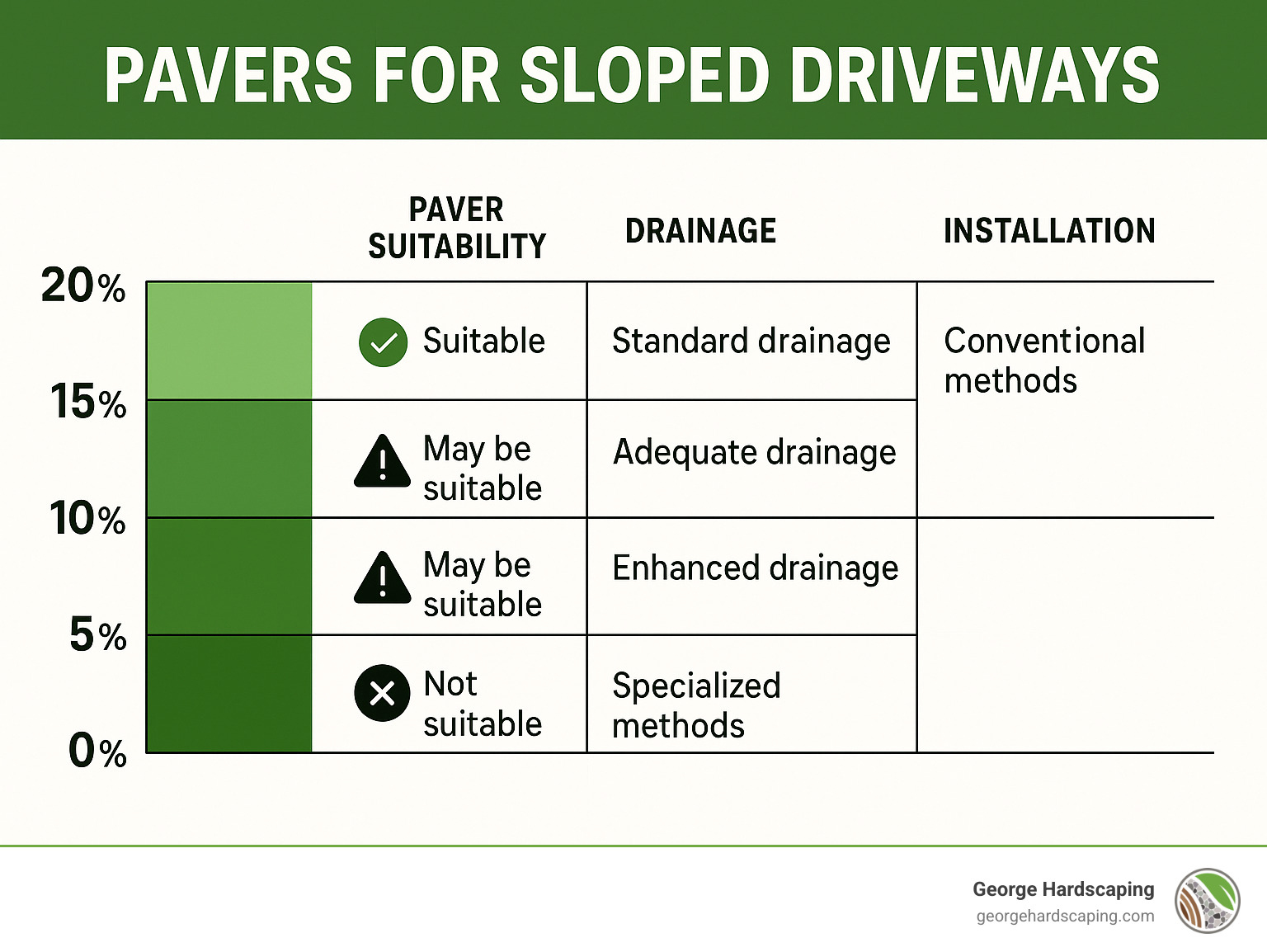
How slope affects suitability
– < 5 % grade: Ideal. Standard base (6–8 inches) and any interlocking pattern work.
– 5 – 10 % grade: Extra steps—herringbone layout, beefier edge restraints, and periodic check of joint sand.
– 10 – 15 % grade: Still doable, but add check dams in the base, geogrid, and professional engineering.
– > 15 – 18 % grade: Consider breaking the run into terraced sections with retaining walls.
Pavers vs. Alternatives
| Surface | Traction | Drainage | Freeze-Thaw | Repair Ease | Typical Up-Front Cost* |
|———|———-|———-|————-|————-|————————-|
| Pavers | Excellent | Excellent | Excellent | Replace one unit | $12–$40 / sq ft |
| Asphalt | Fair | Poor | Poor | Full patch | $3–$10 / sq ft |
| Concrete| Fair | Poor | Fair | Visible patch | $6–$15 / sq ft |
| Gravel | Good | Good | n/a | Re-grade | $1–$3 / sq ft |
*Costs are broad internet averages, not George Hardscaping pricing.
Bottom line? For most North Shore properties with grades under 15 %, pavers provide the best mix of safety, longevity, and curb appeal—provided the base and drainage are engineered correctly.
Engineering a Stable Base: Preparing Sloped Terrain for Pavers
A sloped paver driveway survives—or fails—below the surface. Here’s the condensed playbook our crews follow around Beverly, Salem, and the rest of Essex County.
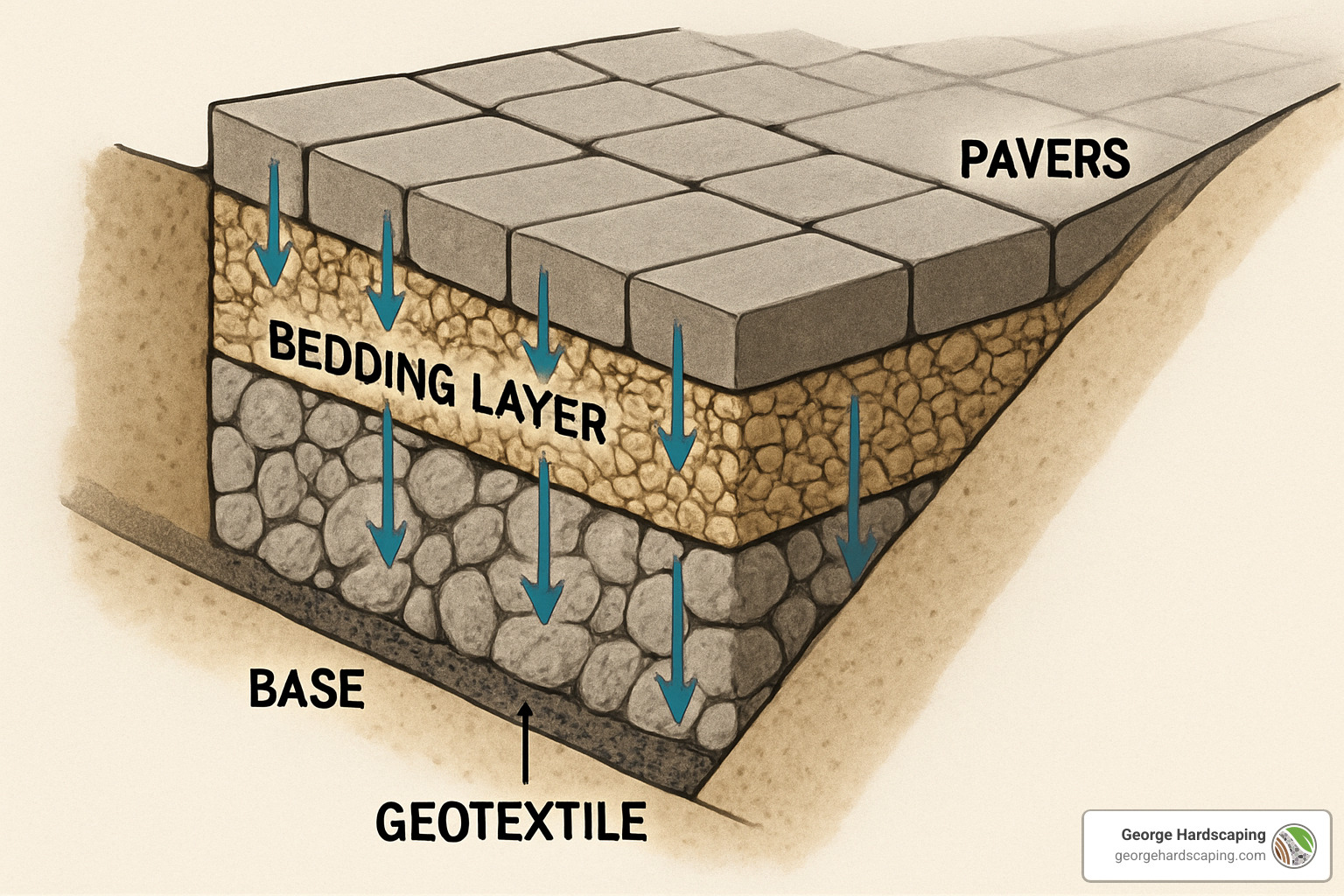
- Subgrade compaction – Native soil is compacted to ±98 % Standard Proctor. No shortcuts: soft ground means sliding pavers.
- Geotextile fabric – A “coffee-filter” layer that keeps crushed stone from disappearing into the soil below.
- Graded aggregate base – 6 inches on gentle slopes; up to 12 inches on steeper sections, built in 3-inch lifts and compacted after each pass.
- Edge restraints – Concrete headers or heavy spiked edging lock the installation in place.
- Optional DriveGrid™ or geogrid – On slopes over ~10 %, a cellular grid ties everything together and spreads loads.
- Bedding sand – Screeded no more than 1 inch thick; coarser sand resists wash-out.
Quick Slope Math
Measure 10 ft horizontally, find the rise or drop in inches, divide by 120, then ×100. A 6-inch drop over 10 ft = 5 % grade.
When to Terrace
Consistent grades above ~15 % often work better as two or more shorter runs separated by a low retaining wall or berm. Upfront cost rises, but so does long-term stability.
Drainage First, Driveway Second
- Channel drains every 20–30 ft on grades ≥ 8 %.
- Permeable base of open-graded stone lets water soak instead of sprint.
- Check dams (mini stone speed bumps) slow subsurface flow on steeper runs.
Done right, this invisible foundation keeps your driveway looking showroom-new for decades. Skip steps, and gravity plus a Massachusetts nor’easter will remind you why shortcuts on slopes never pay off.
More info about Driveway Paver Installation | Slope calculator
Installation Techniques That Keep Pavers From Sliding
With the foundation set, success comes down to placement order, pattern, and joint treatment.
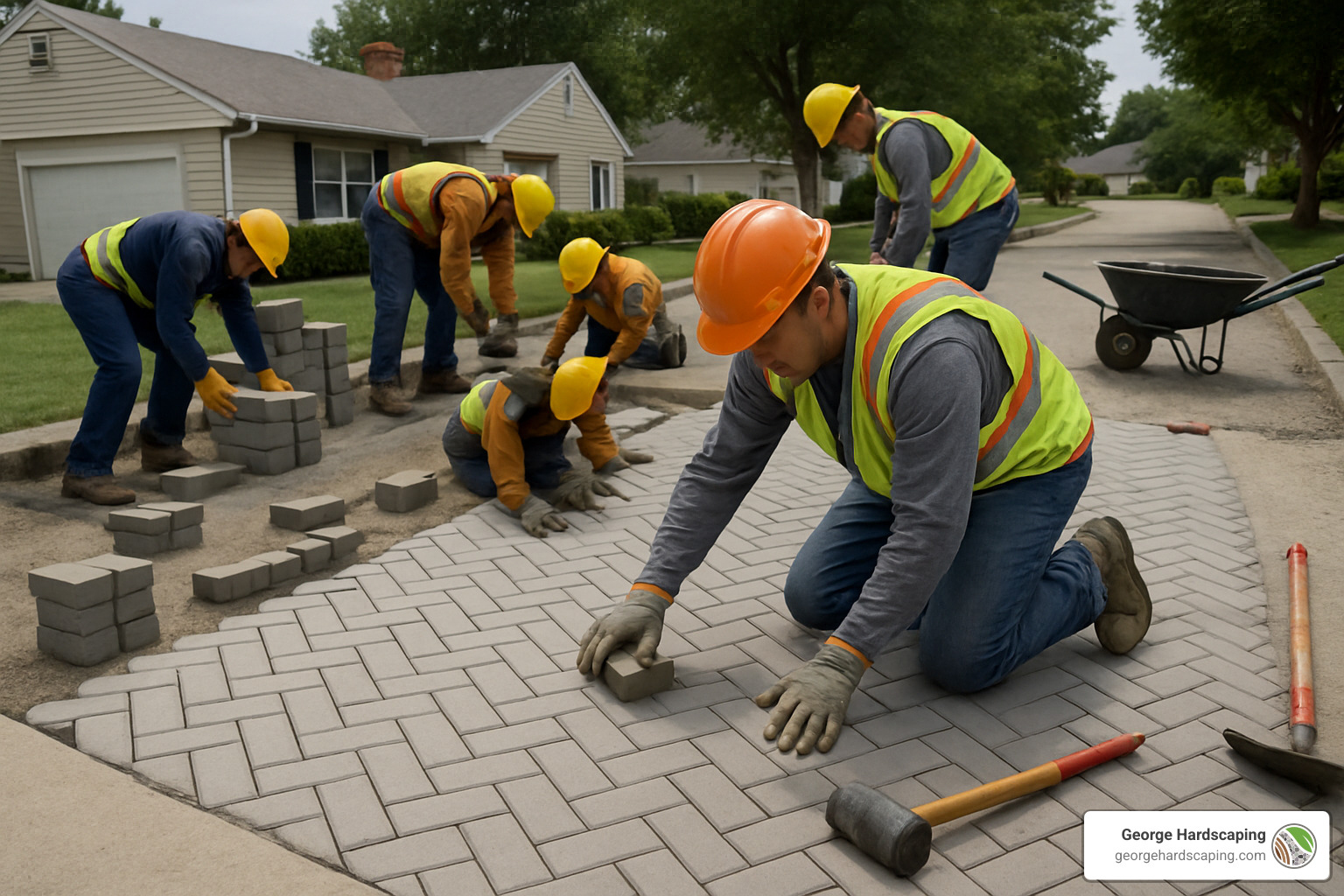
Work bottom-to-top: Each finished course braces the one above it—think brick stairs instead of straight rows.
Stair-step layout: Laying in staggered “stairsteps” adds instant interlock and reduces the chance of a mass slide during construction.
45° herringbone pattern: Our default for anything over ~7 % grade. Each paver contacts four neighbors, spreading downhill forces.
Tight 2–3 mm joints + polymeric sand: Narrow gaps maximize interlock; polymeric sand hardens just enough to fight wash-out yet still flex during freeze-thaw.
Concrete headers top & bottom: Minimum 6 × 12 inches, reinforced with #4 rebar. They’re the bookends that keep the whole installation from inching downhill.
Strategic compaction: Multiple passes with a plate compactor fitted with a neoprene mat seats pavers without scuffing faces.
These techniques add only a few labor hours but years of service life—another reason steep slopes are a pro job, not a Saturday DIY experiment.
Choosing the Right Paver Type, Pattern, and Permeability
Material choice can make or break a sloped driveway.
Concrete pavers – Most popular on the North Shore: predictable strength, endless colors, and pricing that fits many budgets.
Permeable concrete pavers – Same look, but wider joints over an open-graded base to reduce runoff by up to 90 %. Perfect where local storm-water rules apply or erosion is a worry.
Natural stone – Granite and dense bluestone thrive on slopes. Softer stones (e.g., limestone) are risky in freeze-thaw zones.
Skip these on slopes: very thin pavers (< 2.5 inches), slick finishes, or irregular shapes that prevent tight joints.
Climate & Safety Benefits
- Textured surfaces stay grippy in rain and snow.
- Joint lines interrupt ice sheets, easing snow removal.
- Salt-resistant mixes protect coastal driveways in Rockport, Marblehead, and Gloucester.
Need more eco-friendly ideas? See our guide to permeable driveway pavers.
Cost, Maintenance, and Longevity on Slopes
What Will It Cost?
Internet research shows paver driveways ranging $12–$40 per sq ft. Slopes live toward the higher end because they need:
1. Thicker base material
2. Robust edge restraints
3. Extra labor for drainage and pattern work
Remember: these are average online figures, not George Hardscaping’s prices.
Why Many Homeowners Still Choose Pavers
- 30-year life expectancy with minor upkeep beats asphalt’s typical 10–15 years on a slope.
- Sectional repair: swap a few units instead of resurfacing the whole drive.
- Curb-appeal dividend: quality hardscaping often returns 50–80 % of its cost in property value.
Simple Maintenance Calendar
- Spring: Inspect for winter heave; top up joint sand if needed.
- Summer: Light power-wash and weed check.
- Fall: Keep leaves off to prevent stains.
- Winter: Plow or shovel; use calcium chloride (paver-safe) for ice.
DIY or Call a Pro?
Gentle slopes (< 3 %) and small walkways might be homeowner-friendly. Anything steeper, longer, or tied into retaining walls deserves professional engineering—both for performance and for liability. One mis-compacted base layer can turn a steep driveway into an annual money pit. George Hardscaping brings the tools, insurance, and local code knowledge that protect your investment.
Frequently Asked Questions about Sloped Paver Driveways
Are pavers a good choice for steep driveways?
Yes, pavers are often the best choice for steep driveways when you work with an experienced contractor who understands slope dynamics. Here’s why they consistently outperform other materials on challenging grades.
The textured surface and joint lines create natural traction that helps your car grip the slope, even in wet conditions. Unlike smooth concrete that becomes slippery when wet, or asphalt that can soften in summer heat, pavers maintain their grip year-round.
Pavers handle New England’s freeze-thaw cycles like champs. Each individual unit can expand and contract slightly without creating the cracks that plague concrete driveways. When water does freeze, it has somewhere to go—into the joints—rather than building pressure that destroys the surface.
The proof is in real-world performance. The steepest paver installation on record in North America reached an impressive 18% grade—that’s nearly a 1-in-5 slope. While most residential driveways never approach this extreme, it demonstrates what’s possible with proper engineering and installation techniques.
How steep is too steep for a paver driveway?
Most paver installations work beautifully up to 15% grade with standard installation techniques. Beyond 15-18%, we typically recommend terracing with retaining walls to break the slope into manageable sections.
To put this in perspective, a 5% grade means a 6-inch rise over 10 feet of horizontal distance—that’s a gentle incline most people barely notice. A 10% grade represents a 12-inch rise over the same distance, which feels noticeable but remains comfortable for walking and driving.
The “too steep” threshold depends on several factors beyond just the number. Soil conditions matter enormously—stable clay might handle steeper grades than loose sandy soil. The length of the slope also matters. A short, steep section near your garage might work fine, while a long steep run could create erosion problems.
Most residential driveways in Essex County fall well within the suitable range for pavers. We’ve successfully installed paver driveways on slopes throughout Beverly, Salem, and Marblehead where many homes feature natural grade changes that work perfectly with proper paver techniques.
Can damaged pavers on a slope be replaced individually?
Absolutely—and this is one of pavers’ biggest advantages over concrete or asphalt on slopes. When a tree branch damages a few pavers during a storm, or when settling creates a small depression, you can fix just the affected area.
The repair process is surprisingly straightforward. We lift out the damaged pavers, check and level the base material if needed, then install new pavers that match the existing pattern. The surrounding pavers hold everything in place during the repair, so there’s no disruption to the rest of your driveway.
Compare this to repairing concrete or asphalt on a slope—you’re looking at cutting out sections, dealing with drainage during the repair, and trying to match colors and textures. With pavers, a repair is virtually invisible when complete.
This repairability becomes especially valuable on slopes where settlement or erosion might affect small areas over time. Instead of replacing your entire driveway, you maintain it section by section as needed. Many of our clients have driveways that are decades old but look nearly new thanks to occasional individual paver replacements.
The key is keeping a few extra pavers from your original installation stored away. Colors can vary slightly between production runs, so having originals ensures perfect matches for future repairs.
Conclusion & Next Steps
So, is pavers good for slopped driveway installations? After examining all the evidence, the answer is a resounding yes—when you work with professionals who understand the unique challenges slopes present.
Think of it this way: your sloped driveway is like a puzzle where every piece needs to fit perfectly. The proper slope assessment forms the foundation of your puzzle. Appropriate paver selection and patterns create the surface that will serve you for decades. Professional installation ensures all those pieces lock together securely. Adequate drainage planning keeps water from washing your investment away. And quality edge restraints hold everything in place when gravity tries to pull it downhill.
At George Hardscaping, we’ve tackled some pretty impressive slopes throughout Essex County. From coastal properties in Gloucester where ocean winds and salt spray test every installation, to the rolling hills of Boxford where drainage becomes an art form, we’ve learned that no two slopes are exactly alike.
What works beautifully on the sandy soils common in Ipswich might need completely different techniques in the clay-heavy areas around Danvers. That’s why we never give cookie-cutter solutions. Every slope tells its own story, and we listen carefully before recommending the best approach.
Sometimes pavers are absolutely perfect for your situation. Other times, we might suggest terracing with retaining walls, or even alternative materials that better suit your specific needs and budget. Our job isn’t to sell you pavers—it’s to solve your sloped driveway challenge in the most effective way possible.
Here in Beverly, Salem, Peabody, and throughout the North Shore, we’ve seen what happens when slopes aren’t respected. We’ve also seen the joy on homeowners’ faces when their “problem” driveway becomes the neighborhood showpiece. The difference usually comes down to understanding that slopes require expertise, not just enthusiasm.
Ready to find out if pavers are the right solution for your sloped driveway? We’d love to take a look at your specific situation during a free consultation. No pressure, no sales pitch—just honest advice about what will work best for your property.
Whether you’re dealing with a gentle grade that just needs some thoughtful planning, or a steep challenge that requires our most advanced techniques, we’ll help you understand your options. And if permeable pavers might benefit your property, we can explore those permeable driveway options too.
Contact George Hardscaping today to start the conversation about your sloped driveway project. Because here’s what we’ve learned after years of working on North Shore slopes: your driveway doesn’t have to be a daily reminder of a problem. With the right approach, it can become a beautiful entrance that makes you smile every time you come home.
After all, life’s challenging enough without your driveway adding to the stress. Let’s turn that slope into an asset instead of a liability.
