
Commercial Snow Removal Pricing Calculator: 3 Smart Steps
Why Accurate Pricing Makes or Breaks Your Commercial Snow Removal Business
A commercial snow removal pricing calculator is your most valuable tool for creating profitable bids that win contracts while covering all your costs. The challenge every snow removal contractor faces is simple: price too high and lose contracts to competitors. Price too low and work all winter for little profit—or worse, operate at a loss. With costs rising, accurate calculations are more critical than ever.
According to industry data, commercial snow plowing rates range from $50 to $200 per hour, with seasonal contracts spanning $1,000 to $15,000+ depending on property size and service complexity. A systematic pricing approach protects your business from common mistakes like underestimating overhead or failing to account for extreme weather.
Quick Calculator Components:
- Property factors: Square footage, obstacles, surface type, accessibility
- Service costs: Labor ($25-$75/hour), equipment, fuel, materials (salt/sand)
- Overhead expenses: Insurance, maintenance, administrative costs (typically 50% of total)
- Pricing models: Per-push, per-inch, seasonal contracts, or hourly rates
- Profit margin: Industry standard around 30-50% markup
The most successful contractors use structured calculators to ensure every bid covers direct costs, overhead, and a healthy profit margin. This creates consistency and allows for adjustments based on property-specific challenges. This guide will walk you through building and using a calculator to master your pricing strategy.
Key terms for commercial snow removal pricing calculator:
- Commercial snow removal contracts
- Commercial snow removal rates per square foot
- How to bid commercial snow removal
The Core Components: What Every Snow Removal Price Calculation Must Include
An accurate commercial snow removal pricing calculator must capture every expense, from obvious job costs to the hidden overhead that can erode profits. Successful contractors build their prices on a complete picture of their true costs, ensuring every bid is both competitive and profitable.
Understanding Your Overhead and Direct Costs
Many businesses falter by underestimating overhead, which can represent 50% of total operating expenses. According to data from the U.S. Bureau of Labor Statistics, these behind-the-scenes costs are a major component of service pricing. Your calculator must account for them.
- Overhead Costs: These are the expenses required to keep your business running, regardless of job volume.
- Insurance: Comprehensive Commercial Snow Removal Insurance is your largest and most critical overhead expense, protecting you from significant liability risks.
- Equipment Depreciation and Maintenance: Your plows and trucks lose value and require constant upkeep. Calculate this as an hourly cost based on the equipment’s lifespan and usage.
- Administrative Costs: This includes office rent, utilities, scheduling software, and the time spent on quotes and client management.
- Direct Costs: These expenses are tied directly to specific jobs.
- Labor: This goes beyond wages. Your labor burden includes payroll taxes, workers’ compensation, and benefits. A good rule is to multiply the base hourly wage by 1.3 to 1.5.
- Fuel: Track fuel consumption per hour of operation, including travel time between properties, to create accurate estimates.
- Materials: Calculate the cost of salt, sand, and de-icing agents based on usage per property. Proper Ice and Snow Management techniques can help optimize material use.
- Emergency Fund: Set aside funds for unexpected equipment breakdowns to avoid cash flow disruptions during a storm.
How Property-Specific Factors Impact Your Pricing
Every property has unique characteristics that affect the time, equipment, and cost required for service. A thorough site visit is crucial for identifying these variables.
- Property Size: Differentiate between total square footage and the actual plowable area. Base your Commercial Snow Removal Rates Per Square Foot on the area you will actually service.
- Site Complexity & Obstacles: Properties with many light poles, tight corners, or landscaping features require more time and careful maneuvering, reducing efficiency.
- Accessibility: Steep slopes, narrow entrances, or limited turning areas slow down operations and increase risk, justifying higher prices.
- Surface Types: A smooth asphalt lot is easier and faster to clear than a gravel surface or delicate pavers, which require different techniques to avoid damage.
- Snow Placement: Limited on-site storage for snow piles may require hauling, a premium service that can significantly increase the job cost.
- High-Traffic & Priority Zones: Medical facilities or retail entrances often have “zero tolerance” policies, demanding faster response times and more frequent service that should be priced accordingly.
- Terrain and Slopes: Significant elevation changes may require specialized equipment or techniques, impacting both time and cost.
Choosing Your Strategy: Common Commercial Snow Removal Pricing Models
Selecting the right pricing model is critical, as different clients and weather patterns call for different approaches. A flexible commercial snow removal pricing calculator should handle various models to meet diverse needs. Successful contractors understand when to use each strategy and how to present options that benefit both their business and their clients.
| Pricing Model | Best For | Pros | Cons |
|---|---|---|---|
| Per-Push | Areas with frequent, consistent snowfall | Predictable for contractor, simple for client to understand | Can be unpredictable for client if snowfall varies greatly; contractor risks undercharging for difficult conditions |
| Per-Inch | Regions with varying snowfall amounts | Fair for client (pays for actual snow); completely transparent | Requires accurate third-party snow measurement; revenue can be unpredictable in mild winters |
| Per-Event | Regions with less frequent but significant storms | Simple fixed cost per storm; excellent for budgeting | Can be unfair if only light dusting occurs; contractor risks undercharging for severe events |
| Hourly | Complex jobs, unpredictable conditions | Most flexible; contractor compensated for all time; perfect for emergency services | Less predictable for client budgets; requires meticulous tracking |
| Seasonal | Consistent snowfall regions; budget-conscious clients | Predictable income for contractor; fixed budget for client; builds loyalty | Contractor assumes heavy snowfall risk; requires careful contract clauses |
| Multi-Year | Long-term commercial relationships | Guaranteed revenue; client locks in rates; strengthens partnerships | Needs inflation clauses; contractor tied to rates longer term |
Success with any model depends on clear communication and well-defined terms in your Commercial Snow Removal Contracts.
Per-Push and Per-Inch Models: Paying for What You Get
These transparent models build client trust. Per-push pricing involves a set fee each time you service a property, based on a pre-defined accumulation trigger (e.g., 2 inches). Based on market data, rates can range from $75 to $450 for small lots and $200 to $900+ for larger properties, depending on complexity and urgency.
Per-inch pricing offers even more transparency. A typical structure includes a base rate for the first few inches (e.g., $60-$180 for 1-4 inches) and an additional charge for each subsequent inch (e.g., $8-$35 per inch). This model requires accurate snowfall measurement, often from local weather services or on-site stakes. Using historical snowfall data for your region is essential for setting competitive yet profitable rates.
Seasonal and Multi-Year Contracts: Securing Predictable Revenue
Seasonal contracts provide a steady income stream, protecting your business from the unpredictability of winter weather. Clients benefit from a fixed, budgetable cost. Market data suggests seasonal contracts can range from $800 to $4,500 for small properties and $3,000 to $18,000+ for larger ones. However, these contracts are a gamble on the weather. To mitigate risk, always include clauses for excessive snowfall, such as a cap on the total number of pushes or inches covered before additional charges apply. This ensures you can provide reliable Snow Plowing Services without facing financial losses in a severe winter.
Multi-year agreements offer unparalleled business stability, allowing for better long-term planning and equipment investments. Clients often receive a small discount (e.g., 5-10%) for their commitment. To protect your profitability, include annual rate escalators of 3-8% to account for inflation and rising costs. Locking in rates for multiple years without such clauses can turn a profitable contract into a losing one.
Building Your Commercial Snow Removal Pricing Calculator: A Step-by-Step Guide

Creating a commercial snow removal pricing calculator removes guesswork and ensures every bid is profitable. A systematic approach is the foundation of How to Price Commercial Snow Removal effectively. By using a consistent methodology for every quote, you can confidently evaluate which jobs to pursue and know exactly where you stand on every bid.
Step 1: Calculate Your All-In Costs and Job Length
The foundation of a profitable bid is knowing your true costs. This includes not just direct expenses but also overhead and non-billable time.
Your total cost calculation should follow this formula: (Labor Rate × Workers × Hours) + Materials + Overhead Allocation + Travel Time.
- Estimate Job Length: Start with your equipment’s efficiency. An average commercial plow can clear about one acre per hour in ideal conditions. Adjust this estimate for complexities like obstacles or tight corners, which can significantly increase the time required.
- Factor in Travel Time: The time spent driving between jobs is a real cost. Build the cost of wages, fuel, and equipment time for travel into your price.
- Calculate Material Needs: For salt, a common estimate is 800 pounds per acre per application. For a 3-acre property, this is 2,400 pounds of salt. At $80-$120 per ton, that’s a material cost of $96-$144 for that single application. These figures are essential for your Commercial Snow Clearing estimates.
- Allocate Overhead: Assign a portion of your total overhead to each job. If your monthly overhead is 30% of your revenue, apply that percentage to every job’s direct costs to ensure it’s covered.
Step 2: Set a Profitable Price with the Right Markup
Once you know your costs, the next step is to add your profit. The industry standard profit margin is around 50%, but this can vary. Use the correct formula to ensure you hit your target:
Final Price = Total Cost / (1 – Desired Profit Margin)
For example, if your total cost is $4,000 and you want a 40% profit margin, the calculation is $4,000 / (1 – 0.40) = $6,667. This method ensures your profit is 40% of the final price.
Avoid the common mistake of simply adding a percentage to your cost (e.g., $4,000 + 40% = $5,600). This error results in a much lower actual profit margin (28.6% in this case) and has sunk many businesses. Adjust your margins based on job complexity, risk, and client value. For expert financial guidance, consider consulting with a Certified Public Accountant (CPA).
Step 3: Incorporating De-Icing and Other Add-On Services
Add-on services are often where the most significant profit is made. Present them as separate line items in your quote for transparency and flexibility.
- Salt and De-icing: A major revenue source. Pricing can range from $75 to $400 per acre per application. You can price this per application or build a set number of treatments into a seasonal contract.
- Snow Hauling and Relocation: A premium service for when on-site storage is full. Costs can range from $200 to $800 per truckload, covering additional equipment, labor, and disposal fees.
- Sidewalk Clearing: This labor-intensive service is essential for liability protection and often carries higher profit margins. Hourly rates typically run from $35 to $100.
- Roof Snow Removal: A high-risk, high-reward service requiring specialized equipment and training. Pricing can range from $300 to $1,500 per job.
- Eco-Friendly Alternatives: Options like liquid de-icers can differentiate your business. These Eco-Friendly Snow Removal materials often come at a premium price.
Advanced Strategies: Using Your Calculator for Bidding and Risk Management
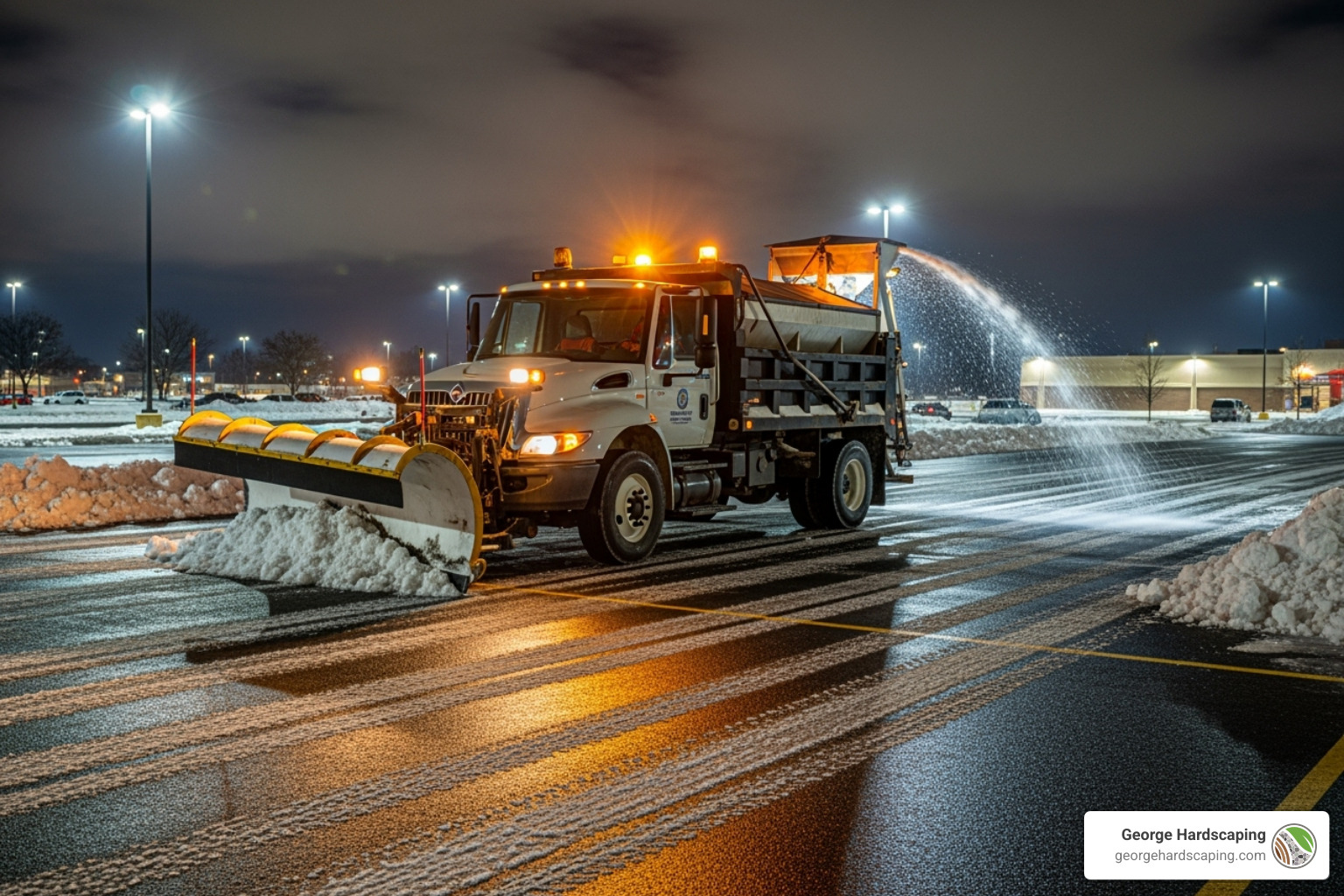
Once you’ve mastered the basics, your commercial snow removal pricing calculator becomes a strategic tool for winning better contracts and managing risk. It allows you to move beyond simple number-crunching to make informed decisions that protect your profitability and position your business for long-term success.
How to Use a Pricing Calculator to Bid Effectively
A calculator allows for flexibility and strategic thinking when creating proposals.
- Create Tiered Bid Scenarios: Instead of a single price, offer clients good, better, and best options. A basic package might cover plowing, while premium tiers add de-icing, sidewalk clearing, or snow hauling. This approach empowers clients to choose and maximizes your revenue potential.
- Negotiate with Data: If a client has a firm budget, use your calculator to see how adjusting variables—like service triggers or the number of salt applications—affects your bottom line. This ensures you never negotiate below your break-even point.
- Build Trust with Transparency: Use your calculator’s data to create detailed, itemized quotes. Breaking down the costs for plowing, salting, and other services demonstrates professionalism and justifies your price.
- Conduct Pre-Bid Site Inspections: Your calculator is only as good as the data you input. A physical site visit is non-negotiable to identify hidden challenges like narrow gates or steep slopes that software can’t see.
Common Pricing Mistakes and How a Calculator Helps
A systematic calculator acts as a safety net against common pricing errors.
- Guesstimating: Relying on visual estimates instead of precise calculations leads to disaster. Small misjudgments on job time or material needs accumulate into major losses over a season.
- Forgetting Overhead: Hidden costs like insurance, equipment depreciation, and administrative time can account for 40-50% of total expenses, according to industry research from the U.S. Bureau of Labor Statistics. A calculator forces you to account for every cost.
- Inconsistent Pricing: Quoting similar jobs differently erodes client trust and can lead to winning unprofitable contracts. A standardized calculator ensures every quote follows the same logic.
- Failing to Plan for Contingencies: What happens if your main plow breaks down or you get double the average snowfall? A good calculator helps you build in costs for an emergency fund and include excessive snowfall clauses in your contracts.
The Role of Technology in Streamlining Pricing
Modern technology improves the power of your pricing calculator, improving accuracy and efficiency.
- Field Service Software: Automates calculations, stores client data, generates professional quotes, and tracks actual vs. estimated costs.
- GPS Mapping Tools: Provide precise square footage measurements from satellite imagery, ensuring your quotes are based on exact dimensions.
- Hyper-Local Weather Forecasting: Helps you anticipate service needs, optimize crew scheduling, and price per-inch contracts more accurately.
- Digital Quote and Contract Delivery: Speeds up the sales cycle by allowing for instant proposal delivery and electronic signatures, giving you an edge in competitive situations.
Frequently Asked Questions about the Commercial Snow Removal Pricing Calculator
Contractors often have practical questions about the real-world numbers that drive a successful snow removal business. Here are answers to some of the most common inquiries.
How much should I charge per inch of snow for a commercial lot?
While rates vary by region and complexity, a common pricing structure is a base rate for the initial accumulation, with additional charges for deeper snow. Based on market data, this often looks like:
- Base Rate: $50 to $150 for the first 1-4 inches.
- Additional Rate: $10 to $30 for each inch beyond the base.
A simple, open lot will be on the lower end, while a complex property in a high-cost area like Essex County, MA, will command higher rates. It’s also wise to consider tiered pricing for different depths (e.g., 5-8 inches, 9-12 inches) as deeper snow requires more time and effort. For extreme depths, switching to an hourly rate is often more practical, as it better reflects the increased strain on equipment and labor.
What is a fair hourly rate for commercial snow plowing?
Based on internet data averages, hourly rates for commercial snow plowing typically range from $50 to $200 per hour. Several factors influence this rate:
- Equipment: A standard pickup with a plow may fall in the $50-$150 range, while heavy equipment like a skid steer or front-end loader can justify $100-$200+ per hour due to higher operating costs and greater efficiency.
- Operator Experience: A skilled operator who works safely and efficiently is worth a premium rate. They minimize liability and complete jobs faster.
- Emergency Service: Call-outs during a storm or after hours often command premium rates, typically 1.5 to 2 times the standard hourly charge.
- Regional Costs: Labor and living costs vary significantly by location. According to industry cost aggregators, regional variations are substantial, so thorough local market research is key.
How do I price salt application for a commercial property?
De-icing is a high-value service with several pricing models that your commercial snow removal pricing calculator should support.
- Per-Application: This is a straightforward flat fee per treatment. Based on market averages, rates are often $150 to $350 per acre or $2 to $3 per 1,000 square feet. This model is simple for clients to understand and budget for.
- Per-Ton or Per-Bag: This model charges for the actual amount of material used plus labor and equipment time. It offers fairness and flexibility for properties with variable needs but requires meticulous tracking.
- Seasonal Package: Many contractors include a set number of de-icing treatments in their seasonal contracts, with clear terms for any additional applications needed. This provides predictable revenue and a fixed budget for the client.
When setting your price, remember to factor in not just the material itself but also equipment wear, storage, handling, and the higher liability associated with ensuring a safe, ice-free surface.
Conclusion: From Calculation to Contract
Mastering your commercial snow removal pricing calculator transforms your business, enabling you to deliver confident, profitable bids that win contracts. The key is a systematic approach: understand every cost, choose the right pricing model for each client, and apply a proper profit margin to ensure financial health.
This disciplined process, improved by modern technology, creates consistency and accuracy in your quoting. It allows you to move from guessing at prices to building clear, comprehensive contracts that protect both you and your clients, preventing disputes and demonstrating professionalism.
At George Hardscaping, we apply this same meticulous approach to all our services across Essex County, MA. While our Commercial Snow Removal services keep properties safe and accessible through winter, our year-round expertise lies in creating exceptional outdoor spaces. We serve communities including Beverly, Boxford, Danvers, Essex, Georgetown, Gloucester, Ipswich, Lynnfield, Manchester-by-the-Sea, Marblehead, Newburyport, North Reading, Peabody, Rockport, Rowley, Salem, Swampscott, Topsfield, and Wenham.
Our core services include designing and building stunning patios, functional retaining walls, and neat walkways and stairs. We also specialize in durable driveway paver installation, custom fire pits, and complete landscape design to improve your property’s beauty and value.
Don’t let winter catch your business unprepared. Whether you need reliable snow management or want to improve your property with professional hardscaping, proper planning and accurate pricing are paramount. Request an estimate today to secure professional services that keep your property safe and functional all year long.
Ready to ensure your commercial property receives the professional care it deserves? Contact a trusted Snow Removal Service Near Me to get a detailed, accurate quote customized to your property’s unique needs.
