
Ice and Snow Management: Your Ultimate 2025 Guide
Why Winter Weather Demands a Plan
Image metadata: Alt text: Snow-covered driveway and icy business parking lot at dawn, illustrating winter access and slip risk. Source: Pexels. Creator: Pexels contributor (photo ID 27306407). License: Pexels free-to-use license. Dimensions requested: 650h x 940w (served responsively). Date accessed: current.
Winter weather doesn’t follow business hours. One morning you might wake up to find your driveway buried under six inches of snow, or worse—your business parking lot covered in a sheet of ice that makes it impossible for customers and employees to safely access your property. In New England, conditions can pivot from slush to flash-freeze in under an hour, and once ice bonds to pavement, every minute of delay increases risk and removal cost.
Ice and snow management is the systematic approach to removing snow and ice from commercial and residential properties to maintain safety, accessibility, and operational continuity. It’s more than just pushing snow; it involves a strategic combination of snow removal, ice treatment, anti-icing, site assessment, documentation, and 24/7 response during storm events.
The stakes are significant. Slip-and-fall incidents spike during winter months and can lead to costly claims, business disruption, and reputational damage. OSHA and other safety bodies emphasize proactive hazard control and documented mitigation, especially for high-footfall areas and workplaces. A reactive approach—waiting to see what a storm delivers—often results in premium emergency rates, supply shortages, and a scramble that leaves gaps in coverage. NOAA’s winter guidance underscores how fast conditions can deteriorate during lake-effect bands or nor’easters, making advance action critical.
A better approach is proactive planning that begins months before the first flake. Smart property managers lock in services early, confirm equipment allocations, and coordinate material strategy (liquid anti-icers, treated salt, and eco-friendlier blends) well ahead of peak demand. This positions your property to stay open, safe, and documented for compliance and risk management.
Quick ice and snow management definitions and resources:
- Commercial snow services: Commercial snow clearing and Commercial Snow Removal
- Sustainable strategies: Eco-friendly snow removal
- Residential service: Driveway snow removal
- Plowing operations: Snow Plowing Service
Why this matters for business operations:
- Duty of care: Property owners and managers owe a duty to maintain reasonably safe conditions. A documented winter program demonstrates due diligence.
- Regulatory alignment: ADA access routes, fire lanes, and emergency exits must be kept clear to avoid fines, shutdowns, or legal exposure.
- Cost control: Pretreatment and early contracts reduce event time, salt usage, and labor costs while avoiding the “panic premium.”
- Supply resilience: During prolonged storms, salt and calcium can be constrained; pre-season planning secures inventory and ensures continuity of service.
For workplaces and public-facing sites, a thorough winter plan is an essential safety program—on par with fire safety and emergency preparedness. For more on employee safety in winter conditions, see OSHA’s winter weather guidance: https://www.osha.gov/winter-weather and NOAA’s winter resources: https://www.noaa.gov/education/resource-collections/weather-atmosphere/winter-weather.
Building Your Winter Defense: The Comprehensive Snow and Ice Management Plan
Successful ice and snow management starts with a solid plan—well before the first snowflake falls. Think of it as your winter insurance policy: the difference between a 5 AM scramble during a blizzard and a calm, coordinated response that keeps your property safe, compliant, and operational.
A comprehensive plan begins with a detailed site assessment during the warmer months. This evaluation identifies critical areas that must remain clear—main entrances, ADA routes, curb ramps, emergency exits, loading docks, fire hydrants, and crosswalks. From this assessment, you develop priority mapping (Tier 1, 2, 3), service triggers, and access strategies for overnight and peak-hour coverage.
Benefits of proactive planning include:
- Predictable budgeting: Lock in pricing and service levels before demand spikes.
- Risk reduction: Documented policies and service logs build a strong defense against slip-and-fall claims.
- Faster service: Pretreatment and pre-positioned equipment reduce response times and the window of risk.
- Sustainability: Anti-icing can lower total chloride usage substantially, benefiting nearby landscaping and waterways.
Key components of a successful plan
- Detailed Site Maps: Diagram every entrance, walkway, stair, curb ramp, parking zone, fire lane, loading dock, and drop-off zone. Assign priority levels and show travel paths for plows and sidewalk crews.
- Pre-Season Site Inspection: Document drainage issues, heaving or uneven pavement, and known icing zones near downspouts or shaded areas. Photograph pre-existing conditions to prevent disputes later.
- Designated Snow Storage: Identify safe, accessible locations for piled snow that don’t obstruct sightlines or ADA routes, and won’t flood entrances during melt cycles. If on-site capacity is limited, plan for hauling.
- Clear Communication Protocols: Establish primary/backup contacts, preferred notification methods (SMS/email/portal), and escalation procedures. Confirm who approves hauling requests and extra applications.
- Defined Service Triggers: Specify thresholds—e.g., anti-icing before storms; plow at 2 inches for lots, 1 inch for walkways; treat ice upon observation or by forecasted refreeze risk.
- Storm Phase Playbooks: Outline specific procedures for pre-storm, active storm, and post-storm operations, including crew rotations for 24/7 coverage.
- Post-Event Verification: Require detailed logs (timestamps, materials used, application rates, and photos). Keep records accessible for at least the statute of limitations for premises liability claims.
Service models to consider
- Seasonal contract with unlimited events and predefined service quality levels.
- Per-event or per-push pricing with clear unit rates and de-icer application tiers.
- Hybrid models for multi-site portfolios, aligning service intensity with location risk.
Accessibility and compliance
- ADA compliance is non-negotiable. Keep accessible routes, curb ramps, and disabled parking stalls clear and safe throughout storms.
- Maintain clear fire lanes and hydrant access for emergency services.
- Ensure safe pedestrian routes from transit stops and employee parking to building entrances.
Technology and documentation
- GPS tracking, mobile reporting, and client portals provide service transparency.
- Weather integrations and pavement temperature sensors (where available) support better timing for applications.
Budget and material strategy
- Incorporate anti-icing with liquid brine for high-traffic surfaces.
- Choose appropriate de-icers by temperature bands and surface sensitivity.
- Plan for refreeze management after thaw cycles.
Internal resources
- Commercial properties: Explore Commercial Snow Removal and Commercial Snow Removal Contracts to formalize scope, triggers, and SLAs.
- Residential properties: A proactive Driveway Snow Removal plan ensures you’re not stuck waiting during peak storms.
- Sustainability: See Eco-Friendly Snow Removal for strategies to reduce chloride use and protect landscaping.
CTA: Ready to develop a site-specific winter plan with maps, triggers, and clear SLAs? Request an estimate and schedule your pre-season site assessment now.
Professional Snow and Ice Removal Services Explained
When winter storms roll through Essex County, a shovel and a bag of salt won’t suffice for most commercial properties. Professional ice and snow management brings the equipment, materials, staffing, and 24/7 oversight necessary to keep people safe and businesses running.
What separates professional operations from ad hoc service isn’t just larger plows. It’s the science-backed approach to timing, materials, risk management, and redundancy:
- Forecast-driven decision-making: Crews mobilize based on hyper-local forecasts and pavement temperatures, not just ambient air temperature.
- Redundancy for uptime: Backup trucks, loaders, and sidewalk machines ensure continuity if equipment fails.
- Calibrated applications: Materials are applied at rates matched to temperature, surface, and storm type—protecting pavement and the environment.
- Documentation for liability defense: Each service is logged, photographed, and time-stamped, creating a defensible record.
Image metadata: Alt text: Large front-end loader with snow pusher clearing a commercial parking lot after a heavy snowfall. Source: Unsplash. Creator: Public submission (Unsplash license). License: Unsplash license (free to use). Dimensions requested: up to 1080w (served responsively). Date accessed: current.

Types of professional services
- Snow plowing and hauling: From pickups in tight lots to loaders for big-box centers, the right machine reduces passes and improves edge-to-edge clearing. When piles limit visibility or consume stalls, stacking and off-site hauling restore capacity. See our Snow Plowing Service and Commercial Snow Removal Equipment for a look at fleet capabilities.
- Liquid anti-icing: Applying brine before the storm reduces bonding, speeds post-storm cleanup, and can cut total salt usage dramatically.
- Granular de-icing: Sodium chloride, magnesium/calcium chloride, or blends selected by temperature and site sensitivity (e.g., near concrete edges, new pavement, or landscaping).
- Sidewalk and entryway clearing: Dedicated sidewalk crews with blowers and walk-behind spreaders keep pedestrian areas and ADA routes safe.
Choosing the right provider
- Insurance verification: Require certificates for general liability, commercial auto, and workers’ comp. Ask to be listed as additional insured with primary/non-contributory wording.
- Equipment and staffing: Confirm 24/7 coverage, backup equipment, and trained sidewalk teams.
- Documented storm plan: Ask how they monitor weather, dispatch, and prioritize during overlapping events.
- Client references: Speak with clients who have similar site complexity and traffic patterns.
- Industry credentials: The Snow & Ice Management Association (SIMA) provides education and certifications such as CSP (Certified Snow Professional). Learn more at https://www.sima.org/.
Local expertise matters. For North Shore properties requiring dependable coverage, see Snow Removal, Beverly, MA. For multi-site commercial portfolios, align service triggers and communication standards with Commercial Snow Removal best practices.
Modern Tools and Techniques in Ice and Snow Management
The ice and snow management industry has been transformed by technology and science, resulting in safer, more efficient, and environmentally responsible service. What once relied on intuition now uses precision and data.
Technology for efficiency and accountability
- Hyper-local weather intelligence: Specialized meteorology, radar loops, road weather information systems (RWIS), and pavement sensors support go/no-go decisions for anti-icing and timely plow mobilization.
- GPS fleet tracking and geofencing: Optimizes routing, reduces overlapping passes, and creates verifiable service records for every lot and walkway.
- Mobile reporting and client portals: Crews submit time-stamped photos, material rates, and notes. Many clients receive automated completion notifications and can audit the season’s history anytime.
Plows, pushers, and attachments
- Plow selection: V-plows for tight or variable-depth conditions; straight blades for open lanes; containment pushers for large lots to move more with fewer passes.
- Edge technology: Poly edges to protect decorative pavements, carbide edges for durability on rough surfaces.
- Sidewalk equipment: Stand-on plows, walk-behind blowers, and compact spreaders keep handwork safe and consistent.
Liquid brine and anti-icing
- Brine basics: A 23% sodium chloride solution is common for general conditions; blends incorporating calcium or magnesium chloride expand low-temperature performance.
- Application timing: Pre-storm application prevents bonding, enabling faster mechanical removal and reduced salt dependency.
- Storage and quality: On-site tanks with recirculation maintain solution efficacy; calibrated pumps deliver the right gallons per lane-mile.
De-icing agents: a comparative look
- Rock salt (sodium chloride): Low cost but reduced effectiveness below ~15°F; can be corrosive to metals and harmful to vegetation.
- Calcium and magnesium chloride: Effective to much lower temperatures; costlier but fast-acting and often less damaging in sensitive areas.
- Treated salts and organic additives: Beet-based additives and other organics improve performance at lower temps and adhere better to surfaces, lowering scatter loss.
- Liquid brine: Used for anti-icing and as a pre-wet for granular salt to accelerate melting action and reduce bounce.
Environmental stewardship
- Targeted applications: Use pavement temperatures to avoid over-application during marginal events.
- Containment and cleanup: Keep material away from catch basins and sensitive landscaping.
- Chloride reduction: Anti-icing and pre-wetting are proven strategies to reduce total chloride usage while maintaining safety. See FHWA’s anti-icing guidance: https://ops.fhwa.dot.gov/publications/fhwahop12046/ and EPA resources on de-icing and water quality: https://www.epa.gov/soakuptherain/soak-rain-de-icing-salts-and-water-quality.
Service verification and transparency
- Event logs: Document times, temps, materials, and photos.
- Exception reporting: Highlight conditions that delayed or modified service, such as blocked access or vehicles left in plow lanes.
- Client access: Many providers offer portals with real-time updates and post-storm summaries that support facility audits and legal defense.
For a closer look at modern machinery and setup, see our Commercial Snow Removal Equipment. For sustainability-first strategies, explore Eco-Friendly Snow Removal and the Minnesota Pollution Control Agency’s Winter Maintenance Manual: https://stormwater.pca.state.mn.us/index.php?title=WinterParkingLotandSidewalkMaintenanceManual. NOAA’s winter hazards overview is also helpful for planning: https://www.weather.gov/safety/winter.
Managing Risk and Liability Through Effective Snow Management
For property owners on the North Shore, winter brings serious liability risks. Slip-and-fall incidents spike during freeze-thaw cycles, and resulting claims can be expensive. Effective ice and snow management—paired with strong documentation—is your first and best line of defense.
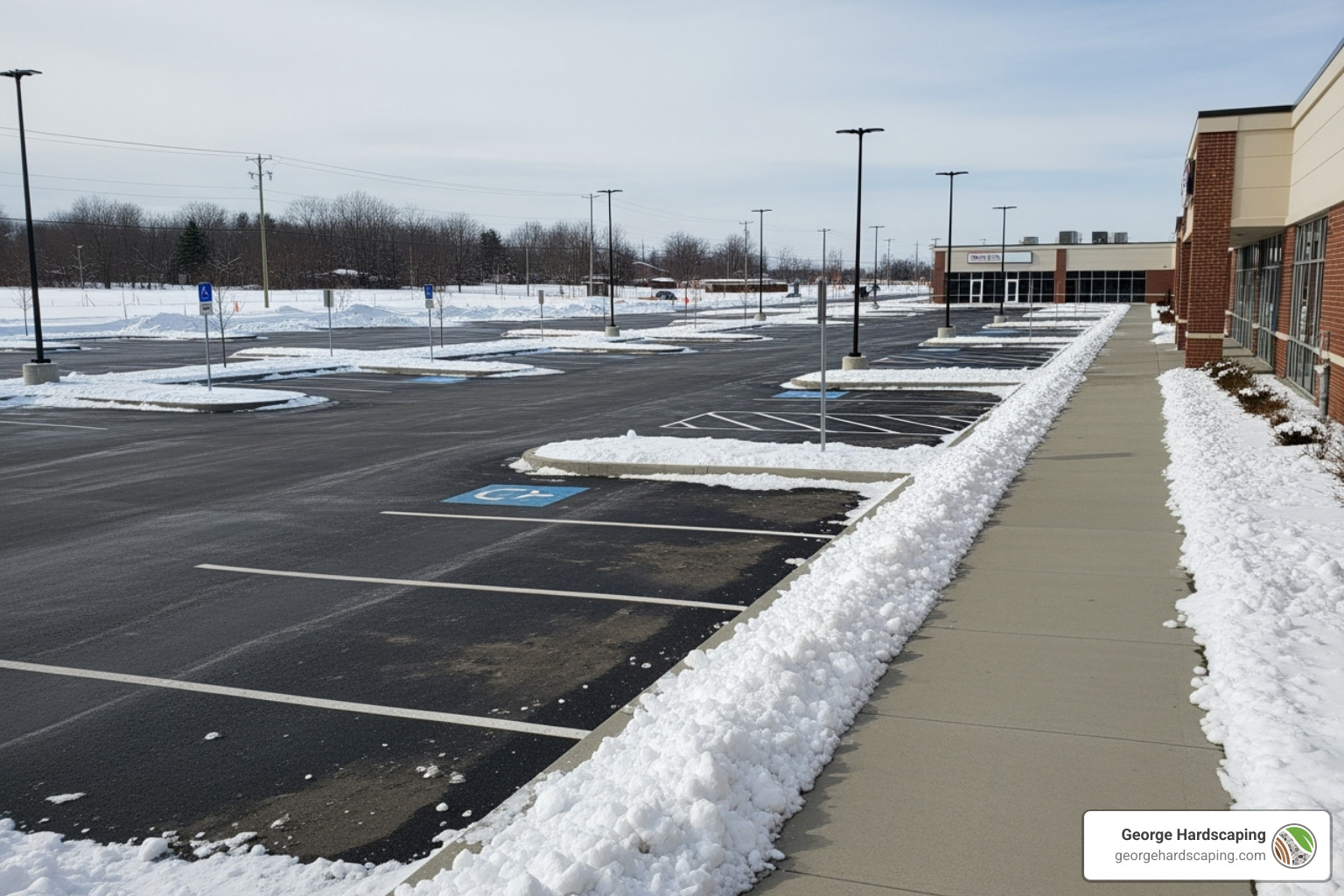
Image metadata: Alt text: Cleared, safe commercial walkway and parking lot after a snowstorm with defined pedestrian paths. Source: Bannerbear-generated image. Creator: Bannerbear template output. License: Permitted for use by account holder. Dimensions: Variable (responsive). Date accessed: current.
How proper management reduces liability
- Demonstrated due diligence: Courts don’t expect you to control the weather, but they do expect reasonable steps to mitigate hazards. A documented winter program proves those steps.
- Timely, proactive response: Monitoring forecasts and pre-treating surfaces before bonding shortens the window of dangerous conditions on your property.
- Comprehensive documentation: Time-stamped logs, material records, and photos are decisive evidence in claims defense.
- Safe design choices: Thoughtful snow storage locations, maintained lighting, and marked pedestrian paths reduce recurring hazards.
Contract details that protect you
- Scope of work: Specify which areas are covered—lots, sidewalks, steps, loading docks, ADA routes, bus stops, and emergency exits.
- Service triggers and priorities: Define accumulations and conditions that trigger action (e.g., 1 inch for walks, 2 inches for lots, refreeze conditions). Prioritize high-risk zones.
- Insurance and indemnification: Require adequate liability and workers’ comp, additional insured status, primary and non-contributory wording, and waiver of subrogation. Understand how your own policy interacts with contractor coverage. Learn more in Commercial Snow Removal Insurance.
- Hold-harmless clauses: Avoid one-sided language. Ensure responsibilities are fairly allocated and aligned with operations.
Record-keeping best practices
- Keep event logs, site maps, and weather data in one place.
- Save photos of pre-existing conditions pre-season and post-event results during winter.
- Document incidents promptly with witness statements, photos, and preservation of any evidence (e.g., footwear type, area conditions).
Operational safeguards
- Lighting: Bright, even lighting in pedestrian areas dramatically cuts risk.
- Signage and cones: Temporary markers guide people around active plowing and known slick spots until treated.
- After-hours coordination: Ensure access for crews overnight, including snow emergency parking policies.
Contracting with confidence
- Align your agreement with operational reality—how your site functions at 7 AM on weekdays versus weekends or holidays.
- Include escalation protocols for extreme events, multi-day storms, and freezing rain.
- Confirm documentation deliverables in the contract: logs, photos, and post-storm summaries.
For a deeper dive on terms that matter, visit Commercial Snow Removal Contracts. If you manage risk across a portfolio, coordinate coverage and claims procedures location by location, and standardize expectations through your master services agreement.
Frequently Asked Questions about Ice and Snow Management
What is the difference between de-icing and anti-icing?
- Anti-icing is the proactive application of liquid brine before a storm to prevent bonding between ice and pavement. De-icing is the reactive application of materials after ice forms to melt it. Anti-icing typically uses less material overall and speeds cleanup.
When is the best time to secure a snow removal contract?
- By July or August. Early agreements allow thorough site assessments, confirm equipment allocations, and lock pricing before demand peaks. See Commercial Snow Removal Contracts.
What does SIMA certification mean for a snow contractor?
- The Snow & Ice Management Association offers recognized credentials and training for best practices in safety, operations, and risk management, helping you identify professionals committed to industry standards. Learn more at https://www.sima.org/.
Will salt damage my pavement or landscaping?
- Chlorides can stress turf and plants and may accelerate corrosion and surface scaling on some concrete. Mitigation strategies include anti-icing to reduce total salt used, using treated salt or alternative blends on sensitive areas, and calibrating spreaders to apply only what’s needed. Explore Eco-Friendly Snow Removal for sustainable options and EPA guidance: https://www.epa.gov/soakuptherain/soak-rain-de-icing-salts-and-water-quality.
How do service triggers work?
- Triggers are objective thresholds for action, such as “plow lots at 2 inches, clear sidewalks at 1 inch, apply de-icer on observation of icing or forecasted refreeze.” Clear triggers eliminate guesswork and ensure consistent service levels regardless of who is on-site.
What’s included in a typical scope of work?
- Lot plowing, sidewalk/entry clearing, de-icer application, and post-event checks. Many contracts specify anti-icing, stacking, and hauling as optional line items. Always confirm whether steps, loading docks, roof access, and remote walkways are included. See Commercial Snow Removal.
Do you provide overnight and early-morning coverage?
- Yes, professional providers staff 24/7 during events. Ensure your contract specifies off-hours service, holidays, and handoff procedures for back-to-back storms.
How do you document service for liability defense?
- GPS timestamps, photos, and material logs are recorded for each visit. Many clients receive post-storm summaries. This documentation supports risk management and insurance claims. Review Commercial Snow Removal Insurance considerations.
Why do I see white “stripes” on pavement before a storm?
- That’s anti-icing brine that will dissolve under precipitation, preventing bonding and making mechanical removal more effective.
What about refreeze after daytime thaw?
- Crews monitor temperatures and solar melt patterns, returning for spot treatments when refreeze conditions are forecasted. Defined refreeze policies should be part of your Commercial Snow Removal Contracts.
Can you clear snow during business hours without disrupting customers?
- Yes. Professional crews use traffic-aware routing, cones, and spotters where needed, focusing on live lanes and high-priority pedestrian paths first to reduce disruption.
What if snow piles block visibility or reduce stall counts?
- Snow storage planning is critical. When on-site capacity or sightlines are compromised, stacking or off-site hauling restores safety and parking capacity. See Snow Plowing Service.
Do you service residential driveways too?
- Yes. For homeowners, reliable Driveway Snow Removal eliminates the 5 AM panic and keeps access safe for work, school, and emergency services.
What temperatures do different de-icers work at?
- Sodium chloride is most effective above ~15°F. Calcium and magnesium chloride work well at lower temperatures and act faster but cost more. Blends and treated salts balance performance and cost. Liquids are used for anti-icing and pre-wetting to reduce scatter and improve melt speed.
How do you protect decorative hardscaping and new concrete?
- We adjust equipment edges (poly vs. steel), set blade heights, and select materials compatible with the surface. Sensitive areas may receive liquid treatments or reduced-chloride strategies. Explore Eco-Friendly Snow Removal for material options.
Do you help with multi-site portfolios?
- Yes. We standardize service levels, triggers, and reporting across locations, providing consolidated summaries and KPIs for facility teams. Learn more at Commercial Snow Removal.
CTA: Have more questions or need a custom plan? Request an estimate and we’ll tailor a winter strategy to your property’s risks, budget, and service level requirements.
Conclusion: Stay Safe and Operational All Winter
Winter doesn’t have to be the season that shuts down your business or creates a liability nightmare. The key to successful ice and snow management is proactive planning long before the first snowflake falls. It begins with a comprehensive site assessment and a strategic plan, and it relies on a partnership with qualified professionals who prioritize your safety and operational continuity.
The benefits are clear: you save money by avoiding emergency service premiums, reduce your liability exposure with documented due diligence, and protect the employees and customers who depend on safe access to your property.
Modern snow management leverages technology like GPS tracking and advanced weather forecasting, along with sophisticated techniques like liquid anti-icing, to deliver precise, efficient, and environmentally responsible service. At its core, this is about risk management. A well-documented plan and a clear contract create a robust defense against slip-and-fall claims.
For businesses and homeowners across Essex County, partnering with a local expert who understands New England winters makes all the difference. At George Hardscaping, we bring the same reliability and craftsmanship to snow management that we bring to our hardscaping projects. We’re not just a service provider; we’re your neighbors, committed to keeping our community safe and moving all winter long.
Don’t wait for a winter storm warning. The time to plan is now.
Ready to build your winter defense plan? Request an estimate for your property today and gain peace of mind, no matter what this winter brings.
