How to Create a Paver Walkway: What You Need to Know Before You Start
How to create a paver walkway in a nutshell:
- Plan your layout – mark the path, choose a width (36-48 inches), and plan a slight drainage slope away from your home
- Call 811 – have underground utilities marked before you dig
- Excavate – dig down 7-10 inches depending on your soil and climate
- Build your base – compact 4-6 inches of crushed stone in layers
- Add bedding layer – screed 1 inch of sand or high-performance bedding (HPB)
- Lay your pavers – set them in your chosen pattern, tap with a rubber mallet
- Cut and edge – trim pavers to fit, install plastic edge restraints
- Finish with polymeric sand – sweep into joints, mist with water, let cure 24-48 hours
A paver walkway does more than connect point A to point B. It adds curb appeal, manages foot traffic, and can completely transform the look of your property. Whether you are looking for a formal entrance or a winding garden path, understanding the engineering behind the installation is crucial. It’s one of the more DIY-friendly hardscaping projects out there, but it requires a commitment to precision and physical labor.
That said, there’s a big difference between a walkway that looks great on day one and one that still looks great after ten winters. The difference almost always comes down to what’s underneath – your base preparation is everything. According to the Interlocking Concrete Pavement Institute (ICPI) standards, a stable base is the single most important factor in preventing pavement failure. In regions like the North Shore of Massachusetts, the soil is often heavy with clay or prone to significant moisture retention, making the base layer even more critical to prevent shifting during the winter months.
Done right, a properly installed paver walkway can last 20-25 years without needing replacement. Done wrong – with a thin or poorly compacted base – you’ll be pulling up sunken, uneven pavers within a season or two. Homeowners in areas like Essex County, MA, where freeze-thaw cycles are a real factor, know this the hard way. The expansion and contraction of the ground can easily heave pavers if the drainage and base aren’t handled with professional care. This guide is designed to provide you with the technical depth needed to ensure your project doesn’t just look good, but remains structurally sound for decades.
In this guide, we’ll walk you through every step of the process – from planning your layout to sweeping in the final round of polymeric sand. We will cover the technical specifications required for a long-lasting installation, including soil types, compaction ratios, and material selection. We will also discuss the aesthetic choices that can elevate a simple path into a statement piece for your landscape.
Simple how to create a paver walkway glossary:
- Brick Walkways
- professional sidewalk construction
- creative sidewalk ideas
Planning and Preparing Your Walkway Design
Before we pick up a shovel, we need a solid plan. Design is where function meets aesthetics. Are you looking for a straight, formal path to the front door, or a winding, organic trail through the garden? Your choice will dictate how much digging and cutting you’ll eventually do. A well-planned design follows the National Concrete Masonry Association (NCMA) technical guidelines for residential hardscapes, ensuring both safety and longevity. Beyond the shape, you must consider the architectural style of your home. A colonial-style home often benefits from the classic look of brick, while a modern farmhouse might look best with large-format grey pavers.
Layout and Dimensions
When deciding on dimensions, think about how the path will be used. A standard walkway width is 36 inches, which allows one person to walk comfortably. However, if you want two people to walk side-by-side, we recommend a width of 48 inches. For those considering accessibility, a wheelchair-accessible path must be at least 36 inches wide but should ideally include a 60-inch turnaround area for ease of movement. If the walkway leads to a main entrance, consider widening the area where it meets the driveway or the porch to create a welcoming “landing zone.”
For more inspiration on how to position your path, check out our front yard paver walkway ideas to see how different shapes can complement your home’s architecture. Remember that curves add beauty but also increase the complexity of your cuts and the amount of waste material you should order. When planning curves, use a garden hose or a long rope to visualize the path on the ground before marking it with marking paint.
Drainage and Slope
Water is the enemy of any hardscape. To prevent puddles or, worse, water seeping into your foundation, your walkway must slope away from the house. A standard rule of thumb is a slope of 1/8 to 1/4 inch per foot. We often use a long level and a string line to ensure this pitch remains consistent throughout the project. If your yard is naturally flat, you may need to build up the base on one side to create this artificial slope. Failure to manage drainage can lead to “pumping,” where water trapped under the pavers forces the bedding sand up through the joints. In areas with heavy rainfall, you might even consider installing a French drain alongside the walkway to redirect excess runoff.
Safety First: Call 811
This is the most important step in the planning phase. A few days before you break ground, you must call 811 or visit their website to have your underground utility lines marked. It’s a free service, and it prevents you from accidentally hitting a gas, water, or electric line—which would turn a fun weekend project into a local news story very quickly. In many jurisdictions, it is actually illegal to dig without a valid utility mark-out. Even if you think you know where your lines are, utilities can be buried at varying depths and locations that might surprise you.
Choosing the Right Pattern for Your Paver Walkway
The pattern you choose affects both the visual “flow” of your yard and the difficulty of the installation. If you are a first-timer, you might want to consider the complexity of the cuts required.
- Running Bond: This is the classic “staggered” look. It’s very easy to install and requires minimal cutting, making it a favorite for DIYers. It is also excellent for making a narrow path appear longer.
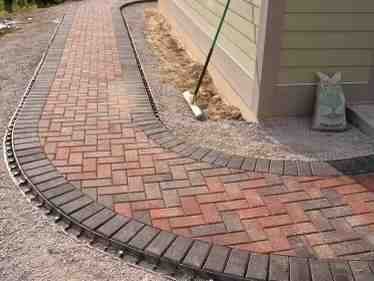
- Herringbone: Set at 45 or 90 degrees, this pattern is incredibly strong because the pavers interlock to resist shifting. However, it requires a lot of precise cuts along the edges. This is the preferred pattern for areas that might see heavy equipment or high-impact use.
- Basketweave: This creates a vintage, woven look by alternating pairs of vertical and horizontal pavers. It’s excellent for flat areas but can be tricky on curves because the geometric alignment is very rigid.
If you’re working in the back of the house, explore our backyard paver walkway ideas to see how these patterns look in a more private setting.
Calculating Material Costs and Quantities
Nothing halts progress like running out of stone on a Sunday afternoon. To calculate your materials, find the total square footage (length x width) and add a 10% waste factor. This extra 10% covers pavers you might break or the small pieces you’ll need to cut for edges. For complex patterns like herringbone, increase this to 15%. Don’t forget to calculate the volume of your base material. A 6-inch base for a 100-square-foot walkway requires approximately 2 cubic yards of crushed stone.
According to industry data, the average cost to install brick pavers for a walkway ranges from $8 to $25 per square foot when hired out. For a DIY project, your material costs will typically fall between $4 and $6 per square foot. These are internet averages and not the specific pricing for George Hardscaping, but they provide a good baseline for your budget. For a deeper dive into budgeting, read our guide on how much does a paver walkway cost.
Essential Tools and Materials for Success
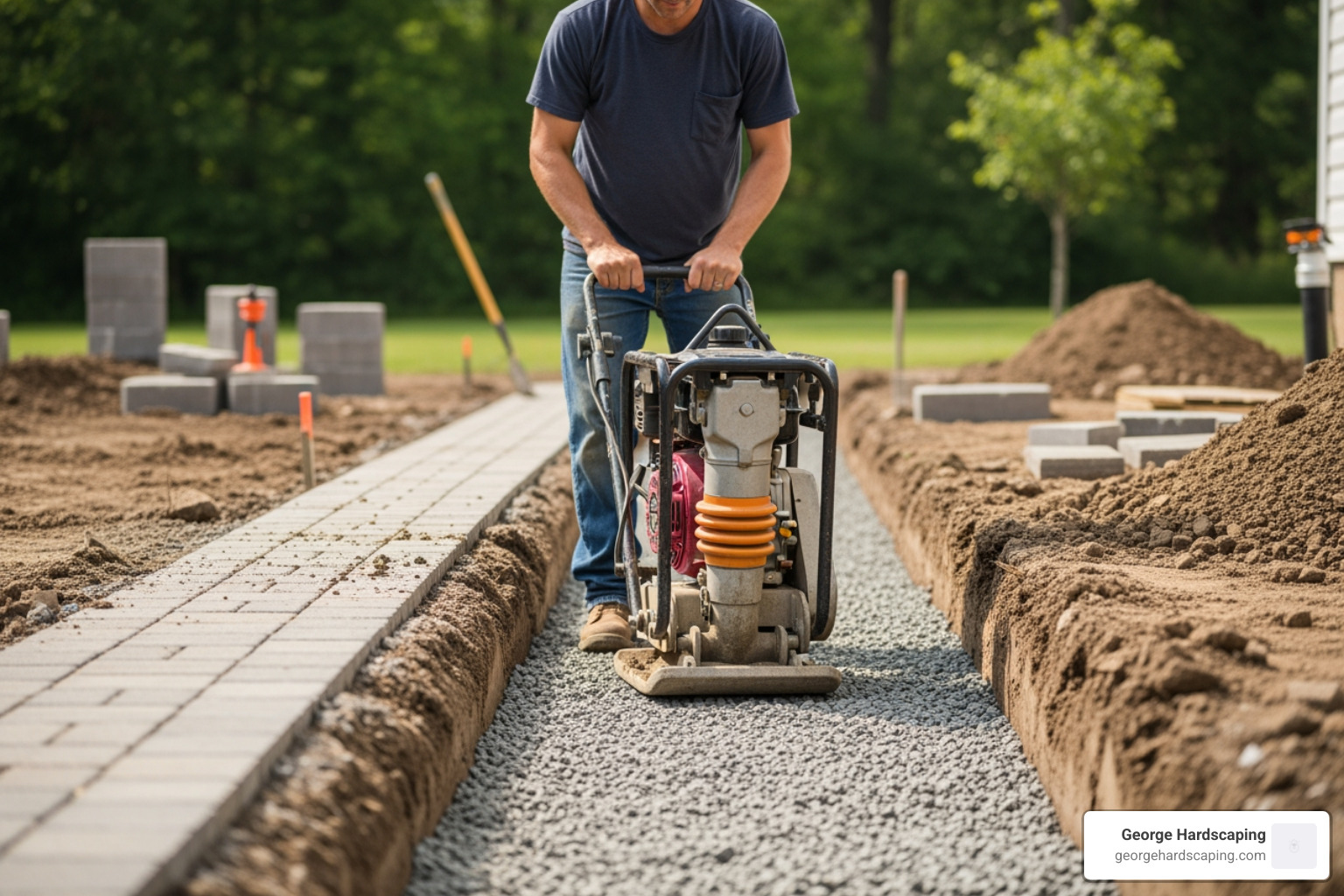
To get professional results, you need professional-grade equipment. While you can use a hand tamper for tiny areas, we always recommend renting a plate compactor for anything larger than a few square feet. Proper compaction is what prevents the “rollercoaster” effect of settling pavers later on. A plate compactor provides thousands of pounds of centrifugal force, which is necessary to lock the aggregate of the sub-base together. You should also ensure you have the proper safety gear, adhering to OSHA safety regulations for crystalline silica when cutting stone or concrete. This includes a high-quality respirator, eye protection, and hearing protection.
The Base Material Comparison Table
The success of your project depends on the sub-base. Here is how the common materials stack up:
| Material | Best Use | Pros | Cons |
|---|---|---|---|
| Crushed Stone (3/4″ minus) | Sub-base | Excellent drainage, interlocks well | Requires heavy compaction |
| Limestone Screenings | Bedding/Base | Compacts very tightly | Can hold moisture in freeze-thaw zones |
| High Performance Bedding (HPB) | Bedding layer | Self-compacting (96%), great drainage | More expensive than sand |
| Concrete Sand | Bedding layer | Easy to level (screed) | Can wash away if edges aren’t tight |
For a successful how to create a paver walkway project, you will also need:
- Mason’s line and stakes for layout and ensuring a straight path
- Screed pipes (1-inch diameter) and a straight 2×4 board for leveling the sand
- Rubber mallet for setting pavers without cracking them
- Circular saw with a diamond blade for precision cuts
- Polymeric sand for joint stabilization and weed prevention
- Plastic edge restraints and 10-inch galvanized spikes to prevent lateral shifting
- Geotextile fabric (optional but highly recommended for clay soils to prevent base contamination)
For more material inspiration, view our paver stone walkway ideas. Using the right materials from the start is the difference between a project that lasts five years and one that lasts fifty.
Selecting High-Quality Paver Materials
At George Hardscaping, we often work with concrete pavers because of their incredible durability and variety. Brands like Belgard commercial grade pavers offer products that are manufactured regionally and designed to withstand the harsh New England climate. These pavers are tested for compressive strength and water absorption, ensuring they won’t crumble after a few winters of salt application. When selecting sand, ensure it meets ASTM C33 specifications for concrete sand, which provides the necessary angularity for stability. Avoid using “play sand,” as the grains are too rounded and will not lock together.
Whether you choose a modern sleek look or an old-world cobblestone texture, ensure you are using an interlocking paver walkway system. These pavers often have small “nubs” on the sides to ensure consistent joint spacing, which is a lifesaver during installation. High-quality pavers are also through-colored, meaning the pigment goes all the way through the stone, so chips are less noticeable over time. This is particularly important for high-traffic walkways where wear and tear are inevitable.
Step-by-Step Guide: How to Create a Paver Walkway
Now it’s time for the “back-breaking” part—but also the most rewarding. Following these steps precisely will ensure your walkway remains flat and beautiful for decades. Remember, the goal is to build a structure that acts as a single, cohesive unit rather than a collection of individual stones.
Step 1: Excavation
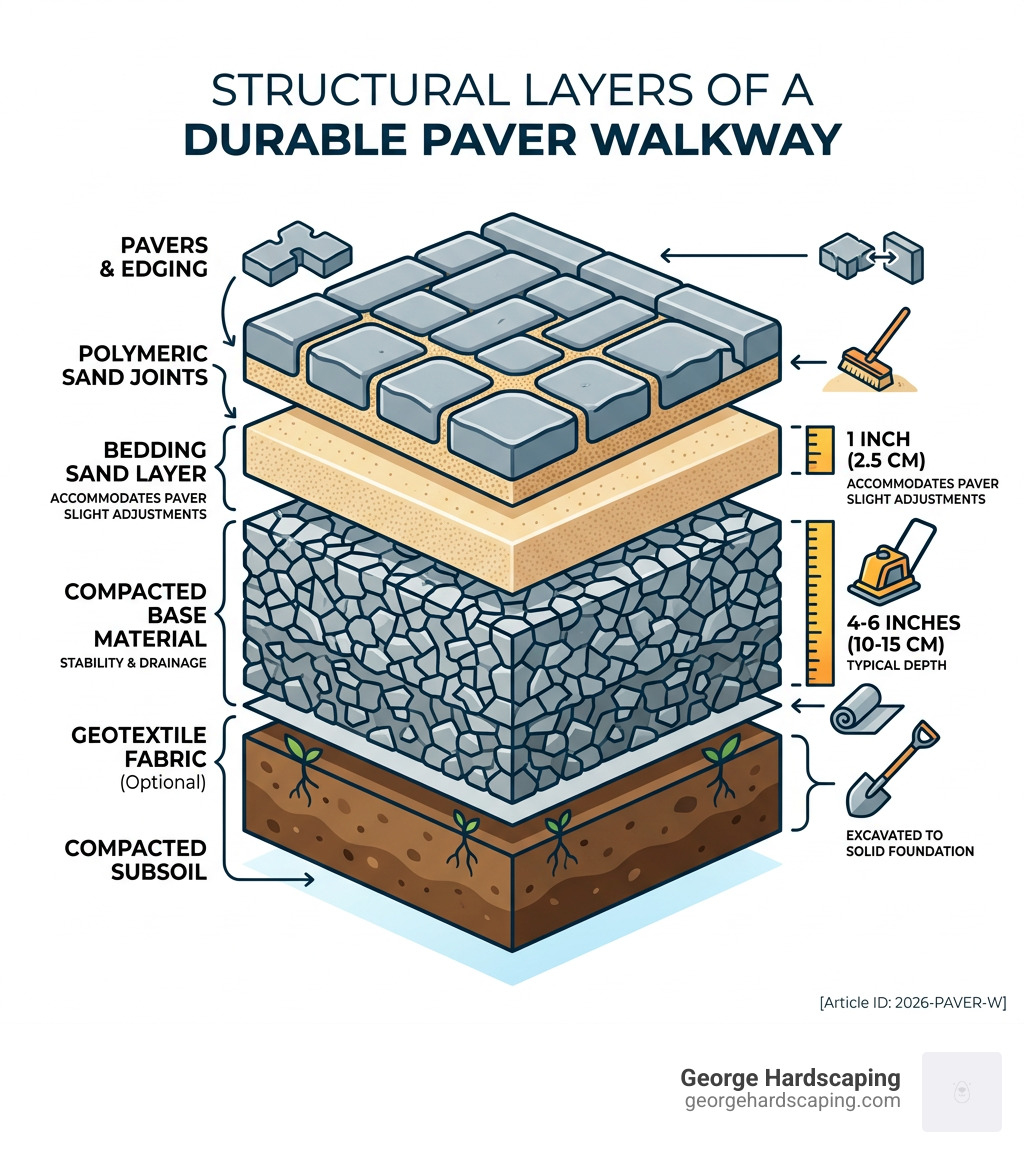
You need to dig deep enough to account for your base, your bedding sand, and the thickness of the paver itself. For a standard walkway in places like Beverly, MA or Danvers, MA, we recommend a total depth of 8 to 10 inches.
- 4-6 inches for the gravel sub-base
- 1 inch for the bedding sand
- 2-3 inches for the paver thickness
Always dig 6 inches wider than the actual walkway on both sides. This provides a stable shoulder for the edge restraints to sit on. If you find the physical demands of excavation and compaction daunting, don’t hesitate to contact a professional paver walkway installer to ensure your project is built to last a lifetime. When excavating, be mindful of tree roots; cutting large roots can destabilize a tree or cause the walkway to heave later as the root grows.
Step 2: Sub-Base Compaction
Fill your trench with crushed stone in 2-inch layers (lifts). After each layer, run the plate compactor over it at least three times. If the stone is dry, mist it lightly with a hose; this helps the particles slide into place for a tighter lock. Your base should be so solid that you can’t drive a steel spike into it with a single hammer blow. This is the foundation of building a walkway that lasts. Proper compaction reaches what engineers call “98% Modified Proctor Density,” which is essential for preventing future settling. If you skip this, your walkway will eventually mirror the unevenness of the soil beneath it.
Step 3: Screeding the Bedding Layer
Once your base is flat and sloped correctly, lay down your 1-inch screed pipes. Spread your bedding sand (or HPB) between them. Use a straight 2×4 board to “saw” across the pipes, leaving behind a perfectly level, 1-inch thick bed of sand. Do not walk on this sand once it is leveled. If you accidentally step on it, you must re-screed that area, or the pavers will sit unevenly. This layer acts as a “cushion” that allows the pavers to be set into a uniform plane.
Step 4: Laying the Pavers and Setting the Pattern
Start laying your pavers at a straight edge, typically against the house or a curb. Place each paver straight down into the sand—do not slide them, or you’ll ruin your perfectly screeded surface. This is known as the “click-and-drop” method. You should feel the paver click against its neighbor as you drop it into place.
As you work, use a rubber mallet to tap the pavers into place. We recommend checking your alignment every 10 rows using a string line to ensure your pattern isn’t “walking” or becoming crooked. This is especially important for long stretches, like those we’ve installed for paver walkways in Reading, MA. If you notice the pattern shifting, use a screwdriver to gently pry the pavers back into alignment before you get too far ahead.
Step 5: Cutting Pavers and Installing Edge Restraints
Eventually, you’ll reach the end of the path or a curve where a full paver won’t fit. Use a circular saw with a diamond blade to make your cuts. For complex curves, you may need to mark each paver individually. Safety note: Always wear eye protection and a respirator, as stone dust contains silica which is harmful if inhaled. Using a wet saw can significantly reduce dust and provide cleaner cuts.
Once the pavers are all laid, you must secure the perimeter. Without edge restraints, the pavers will eventually migrate into your lawn. Place plastic edging tight against the pavers and drive galvanized spikes every 12 inches. This “locks” the entire system in place, preventing lateral movement and keeping your joints tight for years to come.
Finishing Touches: Polymeric Sand and Maintenance
The final step is what makes the walkway look professional and stay weed-free. Polymeric sand is a high-tech mix of graded sand and binder (polymers) that hardens when exposed to water. It creates a semi-rigid joint that can still flex with the ground but won’t wash away.
Applying Polymeric Sand
- Sweep: Pour the sand over the dry pavers and sweep it into the joints until they are full. The pavers must be 100% dry during this step, or the polymers will activate on the surface and leave stains.
- Compact: Run the plate compactor (with a protective cardboard or carpet mat) over the pavers to vibrate the sand deep into the cracks. This ensures there are no air pockets and that the sand is packed tight.
- Refill: Sweep in more sand to top off the joints, leaving the sand about 1/8 inch below the chamfered edge of the paver. This prevents the sand from being chipped away by foot traffic.
- Clean: This is critical—use a leaf blower to remove all dust from the surface of the pavers. Any leftover dust will create a permanent white haze once wet.
- Mist: Use a hose with a misting nozzle to dampen the sand. Do not soak it; you just want to activate the polymers. Mist 3 times, waiting 10-15 minutes between each application to allow the water to penetrate the full depth of the joint.
This process ensures a stable surface for paver walkways in Danvers, MA and other North Shore communities where heavy rain and snow are common. Proper activation of the sand is the difference between a weed-free path and one that requires constant maintenance.
Long-Term Care and Sealing Your Walkway
To keep your walkway looking like new, we recommend a simple maintenance routine. Sweep off debris regularly and rinse with a hose to prevent organic matter from staining the stone. If you notice weeds, it usually means the polymeric sand has eroded; simply clean the joint and add more sand. Avoid using harsh chemicals or power washers at high pressure, as these can damage the surface of the pavers and blast out the joint sand.
Should you seal your pavers? In the freeze-thaw climate of paver walkways in Beverly, MA, sealing can provide an extra layer of protection against salt and moisture. We usually suggest waiting at least one full season to allow the “efflorescence” (a natural white salt deposit) to work its way out of the concrete before applying a sealer. Reseal every 3-5 years to maintain that “wet look” and protect the color from UV fading. Sealing also makes it much easier to clean oil or food stains if the walkway is near a grill or driveway.
Incorporating Steps into Sloped Walkways
If your yard has a significant grade, a flat path might turn into a slide during a rainstorm. For every 6-7 inches of vertical change, you should incorporate a step. This breaks up the momentum of water and provides a safer walking surface.
- Riser height: Keep it consistent, ideally between 6 and 7.5 inches. Inconsistent step heights are a major tripping hazard.
- Tread depth: Ensure there is enough room for a foot to land comfortably (at least 12 inches).
Building steps requires more advanced excavation to create “terraces” for each level. Each step needs its own compacted base to prevent it from tilting forward over time. If you’re dealing with a steep slope, check out our guide on how to build stone steps for a detailed breakdown of the structural requirements. For complex grades, a walkway and retaining wall combination is often the best solution to manage soil pressure and create a beautiful, multi-tiered entrance.
Frequently Asked Questions about How to Create a Paver Walkway
How deep should I excavate for a standard walkway?
For most residential walkways in Essex County, you should excavate between 7 and 10 inches. This allows for a 4-6 inch compacted gravel base, a 1-inch sand bedding layer, and the thickness of the pavers themselves (usually 2-3 inches). If you have heavy clay soil, you may need to go deeper or use a geotextile fabric to prevent the gravel from sinking into the mud. Proper depth is the only way to ensure the walkway stays level through the seasons.
What is the difference between polymeric sand and regular sand?
Regular sand provides friction but can wash away during heavy rain or be pushed out by ants and weeds. Polymeric sand contains water-activated polymers that harden, “locking” the pavers together and creating a barrier that resists weeds and erosion. It’s the gold standard for a professional finish and significantly reduces long-term maintenance. While more expensive, the time saved on weeding makes it well worth the investment.
How do I ensure my walkway doesn’t sink over time?
Sinking is almost always caused by two things: a base that is too thin or poor compaction. Ensure you are using crushed angular stone (not rounded pea gravel) for your base and compacting it in 2-inch increments with a powered plate compactor. Also, ensure your soil at the bottom of the trench is firm and undisturbed before adding your gravel. If the soil is soft or “spongy,” you must continue digging until you hit solid ground or use a stabilization fabric.
Can I lay pavers directly on dirt or grass?
No. Laying pavers directly on soil will result in an uneven, shifting surface within weeks. The soil holds moisture and moves during temperature changes, which will cause the pavers to heave and sink. A proper multi-layered base is required for any permanent installation. Without a base, the pavers will also quickly become overgrown with grass and weeds.
How long should I wait to walk on the new walkway?
You can walk on the pavers immediately after laying them, but you should avoid heavy traffic until the polymeric sand has fully cured. This typically takes 24 to 48 hours depending on the temperature and humidity. Avoid getting the walkway wet (other than the initial misting) during this curing period, as heavy rain can wash out the polymers before they have a chance to set.
Do I need a permit for a paver walkway?
In many North Shore communities, a simple walkway does not require a building permit, but it is always best to check with your local building department. There may be regulations regarding “impermeable surface ratios” on your lot, especially if you live near wetlands or the coast. Ensuring you are in compliance with local zoning laws prevents potential fines or issues when you eventually sell your home.
How do I handle tree roots in the path of the walkway?
If you encounter large roots, try to bridge over them by adding more base material rather than cutting them. Cutting major structural roots can kill the tree or make it unstable. If you must cut small roots, use a clean cut with a saw and consider using a thicker base layer in that area to absorb future root growth pressure.
Conclusion
Learning how to create a paver walkway is a journey that requires a bit of sweat, some heavy lifting, and a lot of precision. There is an immense sense of satisfaction that comes from walking across a path you built with your own two hands—knowing that it was done right from the sub-base up. A well-executed walkway not only improves your daily life by providing a clean, stable path but also provides a significant return on investment for your home’s value, often recouping a large portion of its cost in added equity.
However, we know that not everyone has the time or the desire to spend their weekends behind a plate compactor or a diamond-blade saw. The physical toll of moving tons of stone and sand is significant. At George Hardscaping, we take pride in bringing professional craftsmanship to every project across the North Shore—from the coastal beauty of Manchester-by-the-Sea to the historic streets of Salem and the wooded lots of Boxford. We understand the local soil conditions and climate challenges, ensuring your investment stands the test of time.
Whether you need a simple garden path, a complex multi-level entrance, or a integrated walkway and retaining wall system, we are here to help. We focus on enhancing both the aesthetics and the long-term functionality of your outdoor living space using the highest quality materials and industry-leading techniques. Our team handles everything from the initial utility mark-out to the final cleanup, leaving you with nothing to do but enjoy your new landscape.
Ready to elevate your home’s curb appeal without the DIY stress? Request a professional estimate for your next project today, and let us show you what expert masonry and dedicated service can do for your property. Our team is ready to transform your vision into a durable, beautiful reality that you will be proud of for decades.