
Walkway and Retaining Wall: 15 Inspiring Ideas
Lift Your Yard: The Transformative Power of Walkways and Retaining Walls

Many North Shore homeowners contend with yards that feel more like a challenge than a sanctuary. A steep, muddy slope or a backyard that lacks definition can make you feel like your outdoor space is unusable. Enter the powerful pairing of a properly engineered retaining wall and an artfully routed walkway. The wall restrains the forces of gravity, while the walkway open ups your land’s potential. Together, they convert treacherous slopes into broad, level terraces perfect for a dining set, a fire pit, or raised garden beds, all linked by a safe, beautiful path.
This guide provides deep, practical answers to the questions we hear every week from homeowners in Essex County, covering everything from material choices and design ideas to the professional installation process. We’ll explore real-world cost ranges based on industry data, helping you understand why a thoughtfully designed hardscape is one of the smartest investments you can make in your home.
The Everyday ROI of Getting Your Grade Under Control
A retaining wall is more than a structural necessity; it’s a lifestyle upgrade. The most immediate return is the creation of functional, level ground, changing no-go zones into valuable real estate for play or relaxation. A defined walkway also keeps mud and debris out of your home. Critically, a well-designed system improves drainage, redirecting stormwater away from your house to protect your foundation from hydrostatic pressure and costly water damage. Finally, integrated low-voltage LED lighting can improve safety and create a sophisticated, resort-like ambiance after dark.
Climate-Smart Construction for New England
New England’s relentless freeze-thaw cycles can destroy poorly built hardscapes. That’s why our builds are founded on principles that neutralize these forces. This includes a deep, compacted base of crushed angular stone, a free-draining backfill zone with a French drain to eliminate water pressure, and geogrid reinforcement on taller walls to create a unified, incredibly strong structure. These techniques are non-negotiable for longevity in our climate.
Permits and Planning
Navigating municipal regulations is a critical first step. Most Essex County towns require a building permit for retaining walls over two or three feet, and walls over four feet almost universally demand a plan stamped by a licensed civil engineer. We manage the entire permitting process, ensuring your project is fully compliant, safe, and built to code, so you can focus on the design.
The Foundation of Great Design: Why Combine a Walkway and Retaining Wall?
From the rolling hills of Hamilton-Wenham to the coastal slopes of Gloucester, North Shore yards are rarely flat. A walkway and retaining wall are not two separate projects but two halves of a single solution: the wall tames the grade, while the path makes the new level ground accessible.
Turning Landscape Problems into Possibilities
A retaining wall’s primary job is structural—it holds back soil to prevent erosion and directs water away from your home’s foundation. But when paired with a walkway, it becomes a high-end amenity.
- Unusable Slopes: A multi-tiered retaining wall can carve a steep backyard into distinct, level areas for dining, playing, and gardening, all connected by a graceful walkway with integrated steps.
- Eroding Hillsides: A low wall can permanently stop erosion over a driveway or patio, creating a clean edge for a beautiful planting bed.
- Walk-Out Basements: A wall can widen a narrow, uninviting path to a lower-level door, creating a gracious sunken patio that feels bright and welcoming.
By viewing the wall and walkway as one system, unusable banks transform into stunning tiered gardens, hillside patios, or safe play spaces. See examples in our landscape retaining wall gallery. Walls also define “outdoor rooms,” and low, seat-height walls can double as permanent benches around a patio.
Drainage is Everything
Poor drainage is the number one cause of retaining wall failure. Water trapped behind a wall creates immense hydrostatic pressure. Every George Hardscaping project is built with a robust, multi-layered drainage system: a permeable backfill zone of crushed stone, a high-flow French drain at the base to channel water away, and a rock-solid, compacted base to prevent settling. For walls over 3 ft, we add geogrid reinforcement, tying the wall to the earth behind it to create a massively strong, unified structure.
A Palette of Possibilities: Choosing Materials for Your Project
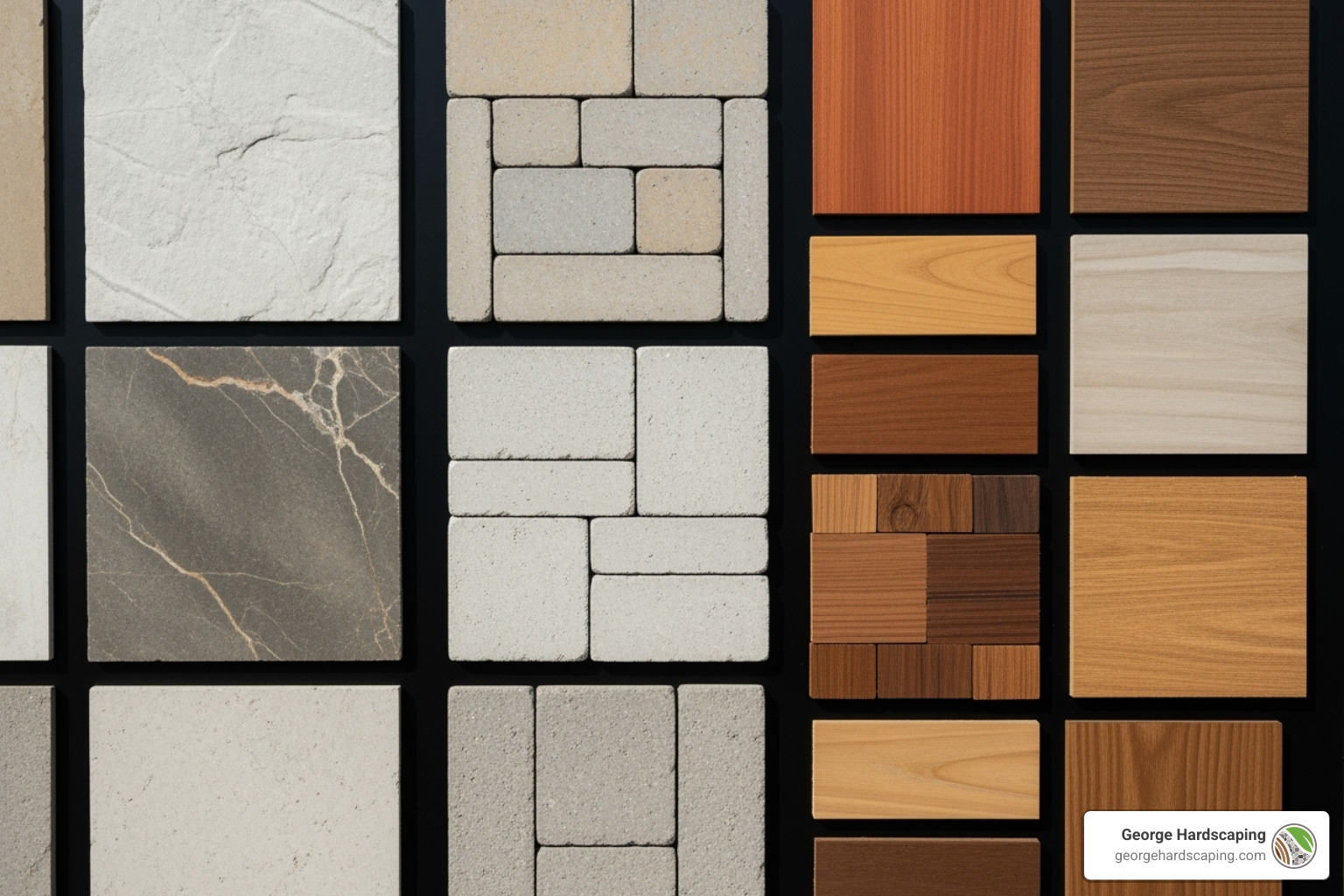
The material you choose is the most significant factor in defining the aesthetic, budget, and long-term performance of your project. On the North Shore, where tradition meets modern design, the options are vast. We’ll explore the most common choices, focusing on their suitability for the demanding New England climate.
Natural Stone
Best for: Historic properties, legacy projects, and landscapes where authenticity and timeless beauty are the primary goals.
Natural stone offers an unparalleled connection to the New England landscape. Its beauty is unique and permanent, with a lifespan often exceeding 100 years. Favorites like weathered New England fieldstone create a rustic, organic look, while precisely cut granite or bluestone offers a more formal, stately appearance. We build both dry-stacked walls, which rely on friction and gravity, and mortared walls for greater height and rigidity. While natural stone carries the highest initial investment in both materials and the skilled labor required for installation, it is virtually maintenance-free and adds significant, lasting value to your property. Explore our stone retaining walls and bluestone walkways.
Concrete & Interlocking Block (SRWs)
Best for: The majority of residential projects that require a superior balance of cost-effectiveness, engineered performance, and versatile style.
Segmental Retaining Wall (SRW) units are the workhorses of modern hardscaping for good reason. These blocks are manufactured under controlled conditions for consistent strength, size, and durability. They are engineered with interlocking mechanisms (such as a rear lip or pin system) that ensure stability and simplify construction. This consistency allows for rapid, efficient installation, which reduces labor costs compared to natural stone. SRWs come in a vast array of colors, textures, and sizes, from styles that convincingly mimic weathered stone to sleek, modern profiles. Their engineered design is specifically intended to integrate seamlessly with geogrid reinforcement, making them the ideal choice for taller, structurally demanding walls. Learn about our concrete wall construction.
Pavers (for Walkways and Patios)
Best for: Creating durable, flexible, and crack-resistant walking surfaces that can be customized to any style.
Unlike a rigid slab of concrete, pavers are individual units laid on a sand bed over a compacted gravel base. This creates a strong yet flexible surface that can move slightly with New England’s freeze-thaw cycles, preventing the large-scale cracking common with poured concrete. The design possibilities are nearly endless, with a huge range of colors, shapes, and laying patterns (like herringbone, running bond, or basketweave). Should a paver ever become stained or damaged, it can be easily lifted and replaced. Permeable paver options are also available, which allow stormwater to filter through the surface, reducing runoff and recharging groundwater. Get ideas from our paver walkway team.
Other Materials
- Poured Concrete: A strong, utilitarian option that can achieve a clean, modern aesthetic. It can be finished with a simple broom texture or stamped with patterns. However, it is highly susceptible to cracking in our climate unless installed with meticulous attention to its base, reinforcement, and the placement of control joints. Repairing cracks can be difficult and unsightly.
- Timber/Wood: Often chosen for its rustic look and lower initial cost, timber walls (typically pressure-treated pine) have the shortest lifespan of any material, usually 15-20 years. They are prone to rot, especially at ground level, and can be damaged by insects. They are best suited for low, non-critical garden walls.
| Material | Typical Installed Cost* | Lifespan | Maintenance |
|---|---|---|---|
| Natural Stone | $30 – $100+ / sq ft | 50-100+ yrs | Low |
| Interlocking Block | $25 – $75 / sq ft | 30-50 yrs | Low |
| Pavers (walkway) | $10 – $40 / sq ft | 25-50 yrs | Low-Moderate |
| Poured Concrete | $30 – $95 / sq ft | 30-50 yrs | Low (crack repair) |
| Timber | $15 – $50 / sq ft | 15-20 yrs | High (eventual replacement) |
*These figures are broad national internet averages intended only for preliminary budgeting; they are not quotes, estimates,or guarantees from George Hardscaping. Local conditions, site access, and design complexity will influence final pricing.
10 Inspiring Walkway and Retaining Wall Ideas
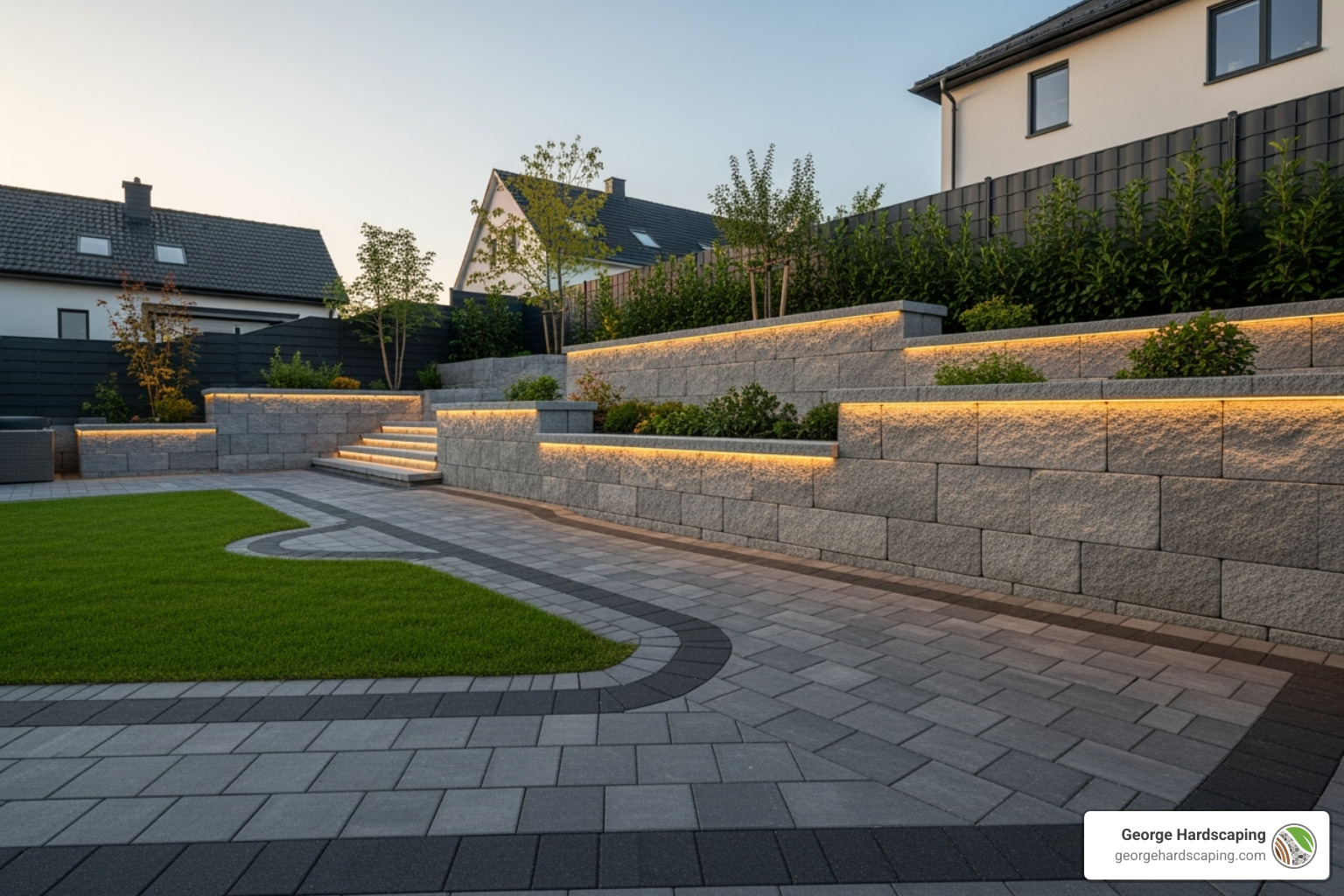
Smart design turns grade problems into beautiful, usable spaces. Use the ideas below as a springboard and adapt them to fit your property and style.
Natural & Rustic
- Boulder Garden Walls: Irregular boulders retain gentle slopes and create planting pockets for rock-garden favorites.
- Meandering Flagstone Path: A low, dry-stack fieldstone wall borders a curving flagstone path for a storybook stroll.
- Woodland Gravel Walkway: A crushed-stone path edged by a low native-stone or timber wall blends seamlessly into a wooded lot.
- Cascading “Living” Tiers: Several low walls form broad terraces; trailing plants spill over the edges for a lush, layered look.
Clean & Contemporary
- Architectural Concrete & Floating Pavers: Smooth concrete walls paired with widely spaced rectangular pavers deliver a minimalist vibe.
- Integrated Linear Lighting: Recess low-voltage LEDs beneath capstones or stair risers for subtle, glare-free guidance after dark.
Made for Entertaining
- Seat-Wall Patio: Build a wall to seat height around a paver patio to gain permanent bench seating and retain surrounding grade.
- Sunken Fire-Pit Terrace: Carve a terrace into a slope; the surrounding wall blocks wind and doubles as extra seating.
- Built-In Outdoor Kitchen: Tie your grill island directly into the retaining wall to hide utilities and save space.
- Grand Front Approach: Flank a wide front walk with formal knee-walls to guide guests and boost curb appeal.
If your lot has a significant elevation change, read our guide on building a paver walkway on a slope for more construction tips.
Budgeting: What Will a Walkway and Retaining Wall Cost?
Understanding the potential cost is a crucial first step in planning. The ranges below are broad national averages compiled from internet data sources and are intended for preliminary planning and comparison purposes only. They are not quotes from George Hardscaping. We provide a detailed, fixed-price proposal after a thorough on-site consultation where we can assess all the variables that affect the final cost.
Retaining Walls (Installed Price Per Square Foot of Wall Face)
- Interlocking block: $25 – $90 per sq ft
- Poured concrete: $30 – $120 per sq ft
- Natural stone (mortared): $50 – $200+ per sq ft
Note: Walls over 3-4 feet require added costs for engineering, extensive base preparation, and geogrid reinforcement.
Walkways (Installed Price Per Square Foot of Walking Surface)
- Gravel / Crushed Stone: $3 – $15 per sq ft
- Poured Concrete: $8 – $40 per sq ft
- Concrete or Brick Pavers: $10 – $60 per sq ft
- Bluestone or other Natural Flagging: $25 – $150+ per sq ft
Key Variables That Drive Your Project’s Final Cost
The wide ranges above reflect how project-specific pricing truly is. Here are the key factors that will determine where your project falls on the spectrum:
- Scale & Complexity: This is the most basic driver. Taller, longer walls and wider walkways require more materials and labor. However, complexity is just as important. A straight, 100-square-foot wall is a simple project. A 100-square-foot wall that is curved, multi-tiered, and has built-in steps requires far more complex cuts, intricate leveling, and layout work, which can easily double the labor cost.
- Material Selection: As noted in the previous section, material costs vary dramatically. A pallet of SRW block might cost $800, while the equivalent coverage in high-quality New England fieldstone could be over $2,500. Furthermore, the labor costs for stone are significantly higher, as a skilled mason must hand-chip, fit, and place each unique stone, a much slower process than laying uniform blocks.
- Site Access: This is a critical logistical factor. If we can use a mini-excavator and skid-steer to efficiently move earth, gravel, and pallets of material, labor costs are contained. If the only access to a backyard is through a narrow 3-foot gate, every pound of material must be moved by wheelbarrow and all digging done by hand. This can add days of strenuous labor to the project schedule and significantly increase the cost.
- Soil & Excavation: The ground itself dictates the difficulty of the job. Excavating in the sandy, easy-to-dig soils of a town like Ipswich is straightforward. Digging through the dense, rocky clay common in Gloucester and Rockport (known as ‘Gloucester Leam’) is much slower and harder on equipment. Hitting unexpected ledge rock or massive boulders can halt progress and may require specialized equipment like hydraulic breakers, adding unforeseen costs.
- Drainage & Water Management: For any wall retaining a slope, this is a non-negotiable cost. A 4-foot by 50-foot wall can have tens of thousands of pounds of water-saturated soil pushing against it. Without a robust drainage system (a French drain, free-draining backfill, and weep holes), this immense hydrostatic pressure will cause the wall to bulge, lean, and ultimately fail. This is not an optional upgrade; it is the core component of a lasting structure.
- Permit & Engineering Fees: These are fixed costs dictated by local regulations. Most towns require a building permit for walls over a certain height (often 3-4 feet). For these taller walls, a plan stamped by a licensed civil engineer is almost always mandatory. A building permit fee might be a few hundred dollars, but the engineering plans can cost anywhere from $1,000 to $3,000 or more, depending on the project’s complexity.
- Demolition & Site Prep: Removing an existing, failing structure adds labor and disposal costs. Breaking up and hauling away an old concrete wall or patio requires heavy equipment and significant disposal fees. Removing a failing railroad tie wall can be even more costly, as old creosote-treated timbers are often considered special waste and require specific disposal methods.
For a more granular look, visit our pages on retaining wall costs and paver walkway costs.
From Plan to Perfection: The Installation Process
A flawless wall and walkway that lasts for decades is not an accident; it is the result of a meticulous, multi-stage process where no steps are skipped. Rushing the unseen foundation and drainage work is the number one cause of premature hardscape failure. Here’s how a professional project unfolds from start to finish.
1 – Site Analysis, Design & Permitting
This initial phase is the most critical for long-term success. We begin with a comprehensive site analysis, using professional-grade tools like a transit or laser level to precisely map the existing topography and calculate the grade changes. We assess soil composition—is it sandy and free-draining, or heavy clay that holds water? We identify natural drainage patterns, locate underground utilities, and confirm property lines. This data forms the non-negotiable blueprint for a safe and effective design. For projects in towns like Ipswich and Rockport, we manage the entire permit application process, which includes submitting detailed site plans, structural drawings, and drainage specifications to the local building department.
2 – Excavation & Base Preparation
The adage ‘a structure is only as strong as its foundation’ is literally true for retaining walls. We excavate a trench that extends at least 6 inches in front of and 12 inches behind the planned wall face. The depth is crucial; we must bury the entire first course of block (at least 6 inches) below the final grade to anchor the wall and prevent it from being pushed out by frost heave or soil pressure. All organic topsoil is removed from the area until we reach stable, undisturbed subsoil, creating a solid platform to build upon.
3 – Footing, Drainage & First Course
This is where the wall’s longevity is truly born. We install and compact a footing of at least 6-8 inches of ¾” crushed angular stone. Unlike rounded pea stone, the sharp, fractured edges of this stone interlock to create an incredibly stable, load-bearing base that resists shifting. At the back of this footing, we lay a 4-inch perforated drain pipe, the heart of the drainage system. This pipe is wrapped in a special filter fabric to prevent silt from clogging it, and it is pitched to carry water safely away to daylight or a dry well. The first course of block is then carefully set on this base, using a 4-foot level on every single block, both front-to-back and side-to-side. An error of 1/8th of an inch on this course can become a glaring 2-inch lean at the top of a 4-foot wall.
4 – Wall & Walkway Build-Out
As we stack subsequent courses of block, we simultaneously backfill the space behind the wall with more clean, crushed stone, not the excavated soil. This creates a ‘drainage chimney’ that allows water to travel freely down to the drain pipe at the base. For any wall over 3-4 feet tall, we integrate geogrid reinforcement at engineered intervals. This high-strength polymer mesh is laid horizontally across a course of blocks and extends several feet back into the slope. When we place and compact the backfill on top of it, the grid uses the immense weight of the earth itself to mechanically anchor the wall, creating a single, unified, and massively strong structure. The adjacent walkway base is built with the same care, using compacted gravel to create a stable, frost-heave-resistant foundation for the pavers.
DIY or Hire a Professional?
A small, decorative garden wall under 2 feet high that is not retaining a critical slope can be a rewarding DIY project. However, any wall intended to hold back a significant slope or standing taller than a few feet requires professional expertise. The physics of retaining walls are unforgiving; the lateral earth pressure increases exponentially with height. A 4-foot wall doesn’t just hold twice the pressure of a 2-foot wall; it can hold up to four times the pressure. A failure is not just a cosmetic issue; it can cause a dangerous landslide, damage your home’s foundation, and create a serious liability. When you factor in the cost of renting a commercial-grade plate compactor and excavator, the risk of a catastrophic mistake, and the legal requirement for engineered plans and permits, hiring an experienced, insured, and certified professional is almost always the safer and more economical choice. Read our tips on finding a retaining wall contractor.
Quick-Hit FAQs
Here are answers to some of the most common questions we receive from homeowners.
What is the most cost-effective yet durable wall material?
Interlocking concrete block (SRW block) typically delivers the best balance of cost, durability, and style. The uniform blocks are engineered for strength and allow for faster, more efficient installation than natural stone, reducing labor costs.
Can I DIY a 4-foot-tall wall?
We strongly advise against it. A 4-foot wall restrains roughly four times the force of a 2-foot wall. It requires deep footings, geogrid reinforcement, and flawless drainage to be safe. Local building codes will also require an engineered plan and permits, making professional installation the only safe option.
How do you prevent a sloped walkway from being icy in winter?
We design walkways with a gentle, consistent grade and use textured materials for better traction. Most importantly, we ensure excellent subsurface drainage so that meltwater is channeled away and cannot refreeze on the surface.
What is the white powder on some concrete walls?
This is efflorescence, a natural and harmless salt deposit left behind as water evaporates from the concrete. It does not affect the wall’s integrity and can be cleaned off or left to weather away naturally.
How long does a typical project take to build?
It depends on the scale. A simple, 50-foot-long, 2-foot-high wall and walkway might take a crew 3-5 days. A large, multi-tiered, engineered wall with a patio could take 2-4 weeks or more.
Do I need a railing on my retaining wall?
Most building codes require a guardrail for any drop-off of 30 inches or more. If your wall creates a patio edge or other surface with a fall hazard of that height, a railing is mandatory for safety.
Conclusion: A Lasting Investment in Your Lifestyle
A carefully planned and professionally engineered walkway and retaining wall is more than just a solution to a slope; it’s a fundamental change of your property. It’s an investment that pays daily dividends by turning awkward, unusable inclines into the most memorable and functional parts of your landscape. By adding usable square footage, solving drainage issues, and boosting rock-solid curb appeal, these structures improve not only your home’s value but, more importantly, your daily enjoyment of it.
George Hardscaping brings the specialized craftsmanship, deep knowledge of New England’s climate challenges, and local code know-how required to make your project a success. From the initial design in Gloucester to the final paver laid in North Reading and every town between, we are committed to building beautiful, durable landscapes that stand the test of time.
Ready to explore the possibilities for your yard and take the first step toward reclaiming your outdoor space? Visit our stairs and walkways page to see more of our work and schedule a free, no-obligation consultation.