
The Timeless Appeal of Curved Stone Steps Design
Curved stone steps design is one of the most sought-after features in residential landscaping — and for good reason. Whether you’re connecting a sloped backyard to a patio or creating a grand front entry, curved stone steps do something straight steps simply can’t: they flow. This fluid movement is not just an aesthetic preference; it is rooted in the principles of biophilic design, which suggests that humans have an innate attraction to the organic, non-linear shapes found in nature. By mimicking the winding paths of a forest or the gentle arc of a riverbank, curved steps create a sense of tranquility and discovery that rigid, linear staircases often lack.
Historically, curved staircases were reserved for grand estates and public monuments, symbolizing wealth and architectural prowess. Today, modern masonry techniques have made these elegant features accessible for residential properties of all sizes. From the historic coastal homes of Marblehead to the sprawling estates of Boxford, homeowners are utilizing curved designs to navigate elevation changes while adding significant visual interest to their landscapes.
Here’s a comprehensive overview of the most popular curved stone step styles and the specific environments where they excel:
| Style | Best For | Common Materials | Design Impact |
|---|---|---|---|
| Concentric semi-circles | Front entries, small yards | Bluestone, granite, concrete | Creates a grand, welcoming focal point |
| S-curve transitions | Wide stairways, informal gardens | Flagstone, limestone | Softens steep slopes with a natural rhythm |
| Meandering hillside paths | Sloped terrain, naturalized landscapes | Granite, fieldstone | Blends seamlessly into the existing topography |
| Cantilevered / floating steps | Modern designs, tight spaces | Granite, engineered stone | Provides a minimalist, high-end aesthetic |
| Formal terraced flights | Steep slopes, structured gardens | Bluestone, limestone | Organizes space into distinct “garden rooms” |
Before embarking on a project, it is essential to understand the technical geometry that makes a curved staircase both safe and beautiful. According to the American Society of Landscape Architects, successful outdoor transitions require a balance of ergonomics and environmental integration. A few key technical specifications to keep in mind include:
- Rise (riser height): Ideally 6–7 inches per step. Consistency is vital; a variation of even 1/4 inch can create a significant tripping hazard.
- Run (tread depth): 12–14 inches is the standard for a natural stride. For curved steps, the run is measured along the “walking line,” usually about 12 inches from the inner radius.
- Radius: This is determined by the curve’s center point. A larger radius creates a sweeping, gentle turn, while a tighter radius is better for compact spaces.
- Pitch: A slight forward slope of 1/8 inch per foot is mandatory. This ensures that water sheds off the stone, preventing ice buildup in winter and algae growth in summer.
- Material Selection: This affects everything from slip resistance to long-term maintenance. Granite, bluestone, and limestone remain the gold standard for New England climates.
Curved steps have been an architectural staple for centuries, and their popularity shows no signs of waning. There’s a reason Houzz design popularity statistics show over 511,000 photos tagged with this feature. It works in almost every setting, from a cozy cottage garden in Essex County to a sleek contemporary patio in a metropolitan area. The challenge, however, is that they are significantly more complex to build than straight steps. Material selection, drainage, foundation depth, and the geometry of the curve itself all require careful planning and professional execution.

Key curved stone steps design vocabulary and resources:
Why Choose a Curved Stone Steps Design for Your Landscape?
When we think about outdoor design, we often focus on the flat surfaces—the patios and the walkways. But the transitions between these levels are where the real magic happens. Choosing a curved stone steps design isn’t just a stylistic choice; it’s a strategic one that enhances the entire “vibe” and functionality of your property. In the world of high-end masonry, curves represent a level of craftsmanship that immediately elevates a home’s perceived value.
Aesthetic Flow and Softening Hard Angles
Most homes are built with right angles and straight lines. While this is great for structural integrity, it can make a landscape feel rigid or “boxy.” We love using curves to break up that monotony. A curved staircase acts as a visual bridge, softening the transition between the man-made structure of your home and the organic, flowing lines of your garden. By integrating curved stone steps design, you invite the eye to travel across the landscape rather than jumping abruptly from one level to the next. This sense of “flow” is a hallmark of professional landscape design, creating a harmonious balance between the built environment and the natural world.
Ergonomic Movement and Safety
Have you ever walked up a set of straight, narrow steps and felt like you were climbing a ladder? It’s not particularly relaxing. Curved steps often allow for a wider “fan” at the base, which creates a more ergonomic movement. As you ascend or descend, the curve naturally accommodates the way the human body turns and balances. This is particularly important on sloped terrains where a straight path might feel too steep or intimidating. A well-designed curve allows for a more gradual ascent, making your outdoor space feel more accessible and comfortable for guests of all ages and mobility levels.
Increasing Property Value and Curb Appeal
In the competitive real estate markets of the North Shore, from Newburyport to Marblehead, first impressions are everything. A grand, curved stone entry isn’t just a set of stairs; it’s a statement of quality. It signals to visitors (and potential buyers) that every detail of the property has been curated with care. According to the Natural Stone Institute, using natural materials like granite and bluestone in custom configurations provides one of the highest returns on investment for outdoor remodeling. For a deeper look at how these elements tie together, check out our Landscape stone steps complete guide.
Selecting the Right Material for Your Curved Stone Steps Design
The material you choose will dictate not just the look of your steps, but how they perform over the next thirty years. In New England, we have to be particularly picky because our “freeze-thaw” cycle is brutal on masonry. When water enters the pores of a stone and freezes, it expands, which can lead to cracking, spalling, and structural failure if the wrong material is used.
Density and Porosity
Density is your best friend when it comes to longevity. High-density stones like granite have very low porosity, meaning they don’t soak up water. This makes them nearly impervious to the damage caused by winter weather. Using Natural stone pro techniques for longevity ensures that the stone you pick can handle the Essex County winters without losing its structural integrity or aesthetic charm.
Color Variation and Matching Architecture
We always recommend looking at stone samples in natural light before making a final decision, as the appearance can change significantly depending on the time of day and moisture levels.
- Granite: Offers a timeless, “salt and pepper” look that pairs beautifully with traditional New England architecture. It is incredibly durable and comes in various finishes, from thermal to honed. See our Granite steps design ideas for inspiration.
- Bluestone: Known for its stunning full-color range (blues, grays, and even tans). It provides a more rustic or “earthy” feel and is a staple in Northeast landscaping. Bluestone steps are a classic choice for patios and garden paths.
- Limestone: Offers a very uniform, clean look often seen in contemporary or French Country designs. However, it is more porous than granite and may require more frequent sealing to prevent staining and weathering.
For a broader range of options, explore our Natural stone steps ideas gallery to see how different textures and colors interact with various home styles.
Top Design Configurations and Aesthetic Styles
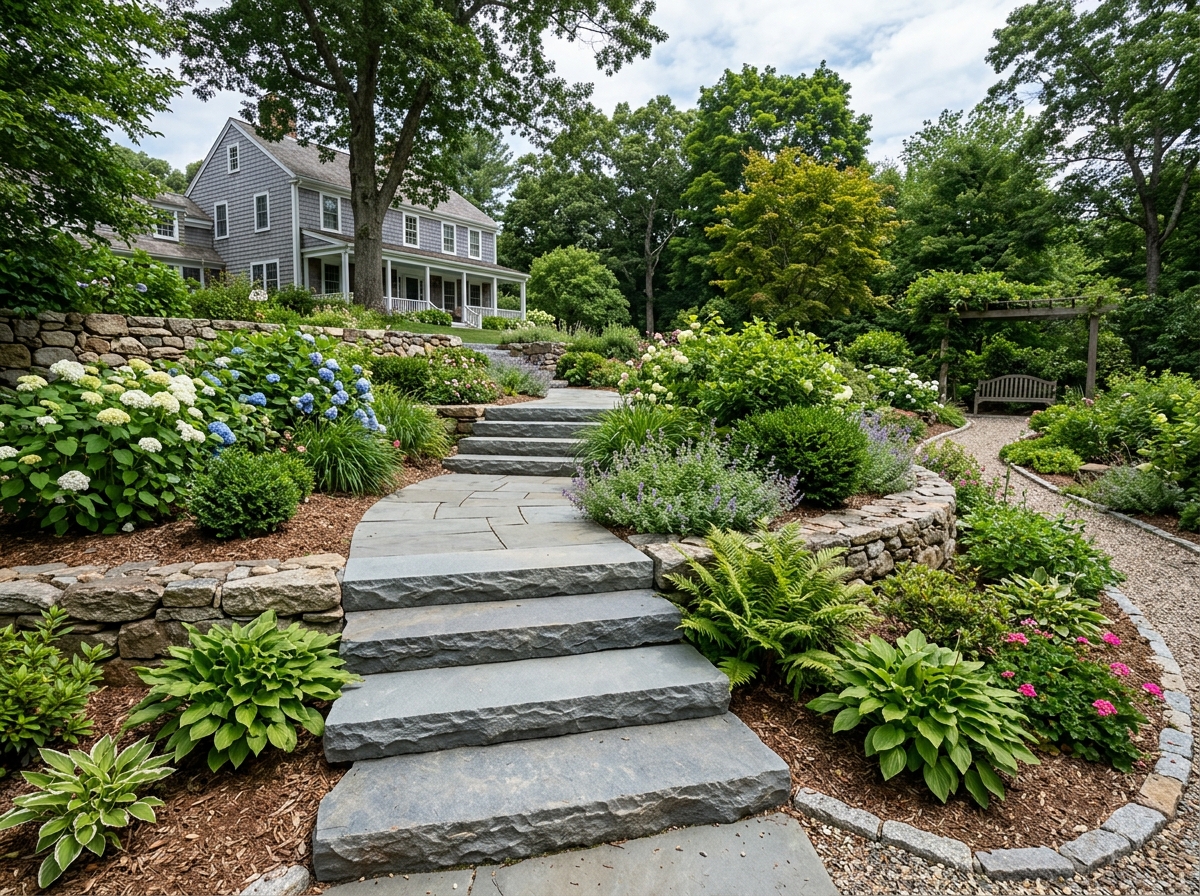
When we sit down to plan a curved stone steps design, the first question is always: “What story are we trying to tell?” Different configurations evoke different emotions and serve different functional needs. The geometry of the curve can be used to direct traffic, highlight a specific view, or create a sense of enclosure.
Concentric Semi-Circles
This is the “Grand Entrance” look. Imagine three or four steps fanning out in perfect semi-circles at your front door. The bottom step is the widest, creating a welcoming platform that says, “Come on in.” This style is particularly effective for small front yards in places like Salem or Peabody, where you want to make a big impact in a limited space. It makes the entryway feel much larger and more significant by drawing the eye outward. This configuration also provides ample space for decorative planters or seasonal decor on the wider lower treads.
The S-Curve Transition
If you have a wide, sprawling backyard, a single straight flight of stairs can look like a scar on the landscape. Instead, we often design “S-curves.” These steps gently wind back and forth as they descend the hill. This configuration is perfect for informal, cottage-style gardens. It creates a leisurely pace, encouraging you to slow down and enjoy the plantings on either side. The S-curve is also functionally superior for very steep slopes, as it allows for a longer path of travel, which reduces the overall steepness of the climb. You can find more inspiration for these layouts in our Backyard stone steps ideas section.
Bullnose Edges vs. Natural Cleft
The “finish” of the stone edge changes the aesthetic entirely.
- Bullnose edges are rounded and smooth. They provide a sophisticated, formal look and are very comfortable for bare feet—making them a top choice for pool areas or patios where children play. They offer a clean, finished line that highlights the curve’s precision.
- Natural cleft edges are rugged and uneven. They look like they were pulled straight from a quarry, which is ideal for rustic or woodland-themed landscapes. These edges help the steps blend into the surrounding soil and plantings. Check out our Outdoor stone stairs ideas to see how these finishes compare in real-world settings.
Cantilevered “Floating” Steps
For a truly modern aesthetic, we can design cantilevered steps. These are thick stone slabs that are anchored into a retaining wall on one side, appearing to “float” over the ground. While this requires significant engineering to ensure the weight is distributed correctly, the visual payoff is incredible. It’s a minimalist approach that highlights the raw beauty of the stone and allows for ground-cover plants or decorative gravel to flow underneath the steps, further enhancing the “floating” illusion.
Integrating Lighting and Safety
A curved staircase is a prime candidate for integrated landscape lighting. Because the treads vary in width and the path changes direction, proper illumination is essential for safety. We often install low-voltage LED “cap lights” under the lip of the stone treads. This not only makes the steps safer to navigate at night but also creates a stunning visual effect, highlighting the texture of the stone and the graceful arc of the curve. For front-of-house projects, our Stone front steps ideas page offers plenty of examples of how to integrate lighting into your design.
Terracing and Meandering Paths on Slopes
Slopes are often seen as “problem areas” in a yard, but we see them as opportunities. A steep hill is just a canvas for a beautiful stone staircase. Instead of one long, exhausting flight of stairs, we prefer to “terrace” the slope. This involves breaking the staircase into smaller sections separated by flat landings. Not only does this make the climb easier, but it also creates spots where you can place a bench or a large potted plant.
When you’re learning how to install stone steps on a slope, the most important rule is to follow the natural topography. A “meandering” path that follows the curve of the land looks much more natural than a straight line forced into the dirt. For more technical details, you can read our guide on how to lay stone steps on slope. These Landscape steps become more than just a way to get from point A to point B; they become a destination in themselves, offering unique vantage points of your garden.
Technical Considerations: Stability, Drainage, and Safety
A beautiful staircase is useless if it shifts, cracks, or becomes a slip hazard after the first winter. In masonry, what you don’t see is just as important as what you do see. The longevity of a curved stone steps design depends entirely on the preparation of the substrate and the management of water.
Foundation Depth and Frost Heave
In Essex County, the “frost line” is a serious consideration. If your steps are built on a shallow foundation, the moisture in the soil will freeze, expand, and push your steps upward—this is called frost heave. When the ground thaws, the steps don’t always settle back into place, leading to uneven treads and dangerous tripping hazards. We emphasize building durable stone steps by excavating deep enough to reach stable, undisturbed soil and backfilling with a thick layer of compacted crushed stone (usually 3/4″ minus). This creates a “floating” base that allows for drainage and resists the movement of the surrounding soil.
The 1/8-Inch Pitch: Why it Matters
Standing water is the enemy of stone. If water pools on your treads, it can lead to algae growth (making them slippery) and accelerated weathering through the freeze-thaw cycle. We build every step with a slight forward pitch—usually about 1/8 inch per foot. This is invisible to the naked eye but ensures that rain and snowmelt run off the front of the step immediately. This is especially critical for curved steps, where water might otherwise collect in the “inside” of the curve if the pitch isn’t perfectly executed.
Forming Systems for Precision
Building a curve requires much more precision than a straight line. We often use specialized tools like EZ-Step metal forming systems or flexible forming for concrete bases to ensure the radius is consistent from the bottom step to the top. These forms allow us to create tight, smooth radiuses that would be nearly impossible to achieve with traditional plywood forms. Precision in the base layer ensures that the final stone treads sit perfectly level and maintain a uniform appearance throughout the entire arc.
Polymeric Sand and Joint Stability
The “gaps” between your stones need to be filled with something that can handle movement while preventing weed growth and insect intrusion. We use high-quality polymeric sand or specialized flexible mortars. Polymeric sand contains polymers that harden when misted with water but stay slightly flexible, allowing the stones to expand and contract with temperature changes without cracking the joints. This is a critical step in stone steps installation that many DIYers skip, only to find weeds growing in their stairs a year later. For those looking to understand the nitty-gritty of the process, we have a detailed walkthrough on how to install stone stair treads that covers everything from adhesive selection to final leveling.
Professional Installation vs. DIY: Avoiding Costly Pitfalls
We get it—the “DIY” spirit is strong in New England. And for small, flat projects like a simple garden border, doing it yourself can be a rewarding way to save money. However, a curved stone steps design on a slope is a different beast entirely. It requires a combination of heavy equipment, geometric calculation, and physical stamina that goes beyond the scope of most weekend projects.
Weight Distribution and Structural Integrity
Natural stone is incredibly heavy. A single granite step block can weigh between 300 and 800 pounds depending on its size. Moving these safely—and setting them so they don’t settle over time—requires heavy machinery like skid steers with specialized attachments. If the weight isn’t distributed correctly, the steps can lean, sink, or even collapse, especially if they are integrated into a retaining wall system. A professional stone steps contractor understands how to calculate the load-bearing requirements of the soil to ensure the structure remains stable for decades.
The True Cost of Mistakes
According to industry data, a DIY stone step project on a slope might cost between $500 and $1,500 in materials and take dozens of hours of labor. However, professional installation for a complex curved design can range from $2,200 to $7,500 or more, depending on the stone type and site conditions. Why the big jump? Because a professional is providing a foundation that will last a lifetime. If a DIY project fails after two years due to poor drainage or a shifting base, you’ll have to pay someone to tear it out and start over—effectively doubling your initial cost. We specialize in custom stone steps in Beverly, MA and the surrounding areas, ensuring the job is done right the first time. If you are ready to move beyond the planning phase, we invite you to request a hardscaping estimate to see how a professional team can manage the complexities of your site.
Common DIY Headaches
- Excavation Challenges: Hitting large “New England potatoes” (giant boulders) mid-dig that require specialized breaking equipment.
- Geometry Errors: Ending up with a curve that doesn’t align with the walkway or leads the user into a garden bed.
- Safety Hazards: Uneven riser heights (even by half an inch) that cause people to trip, creating a significant liability issue.
- Drainage Failures: Accidentally directing water toward the home’s foundation rather than away from it.
If you’re feeling brave and have experience with masonry, you can read our guide on how to build stone steps, but we always recommend a consultation for anything involving curves or significant elevation changes. We also offer services for repairing broken stone steps if a previous installation has started to fail. For more on the professional approach, see our article on how to install natural stone steps.
Frequently Asked Questions about Curved Stone Steps
How do I calculate the radius for curved stone steps?
Calculating the radius is all about finding your “center point.” We usually drive a stake into the ground at the center of the desired curve and use a string line to mark the arc of each step. The distance from the stake to the front of the step is your radius. As you move up the staircase, the radius will change slightly depending on whether the steps are narrowing or widening. It’s a bit of a geometry puzzle! For a more comprehensive look at the math, check out our Build stone steps complete guide.
What is the best stone for slip resistance in wet weather?
In our experience, texture is more important than the type of stone. You want a “thermal” or “flamed” finish on granite, which creates a slightly rough, non-slip surface by popping the surface crystals with high heat. For bluestone, a “natural cleft” finish provides excellent traction because of its organic ridges. Avoid highly polished stones for outdoor steps, as they become incredibly slippery when wet. You can see examples of these textures in our Outdoor stone stairs ideas gallery.
How do I maintain my curved stone steps?
Maintenance is relatively simple but essential. We recommend an annual power wash to remove moss and algae, followed by an inspection of the joints. If you notice the polymeric sand or mortar is cracking, it should be repaired immediately to prevent water from getting under the stone. Depending on the stone type, a breathable sealer can be applied every 3-5 years to prevent staining. Avoid using harsh de-icing salts in the winter, as these can eat away at certain types of stone and mortar; use sand or stone grit for traction instead.
How long does a typical installation take?
A standard curved entry (3-5 steps) usually takes 2-3 days from excavation to final cleanup. Larger hillside projects with multiple landings and curves can take 1-2 weeks. The timeline is heavily dependent on site access and the amount of manual excavation required. To get a precise timeline for your specific project, you can request a hardscaping estimate from our team.
Can I add curved steps to an existing concrete walkway?
Yes, but it requires careful integration. We often use the existing concrete as a partial base or remove a section of it to ensure the new stone steps have a proper, unified foundation. Simply “gluing” stone treads onto old, cracking concrete is a recipe for failure. A professional assessment will determine if your existing walkway can support the weight of new stone features.
Step Up Your Style with George Hardscaping
At George Hardscaping, we believe that your outdoor space should be an extension of your home—a place of beauty, comfort, and lasting quality. Whether you’re in Lynnfield, Danvers, or Wenham, we bring years of Essex County craftsmanship to every project. A well-executed curved stone steps design is more than just a way to change elevation; it’s an investment in your home’s future. It combines the rugged durability of natural stone with the elegant, flowing lines of high-end design, creating a landscape that matures beautifully over time.
If you’re ready to transform your landscape, we’re here to help. Our team specializes in a wide range of services to complete your outdoor oasis:
- Hardscaping and masonry services for all your structural needs.
- Custom patio design and installation to create the perfect entertaining space.
- Expertly crafted walkways and stairs that guide you through your garden.
- Durable retaining walls to manage slopes and create level ground.
Don’t just take our word for it—view our masonry gallery to see the curved steps and stone features we’ve built for your neighbors across the North Shore. From the initial consultation to the final stone placement, we prioritize communication, safety, and unparalleled attention to detail.
Ready to start your project? Contact us today to discuss your vision. Whether you’re looking for a grand granite entrance in Ipswich or a meandering bluestone path in Swampscott, we have the expertise to bring your curved stone steps design to life. Let’s build something beautiful together.
