
Paver Driveway: 10 Powerful Reasons to Choose in 2025
Transform Your Home’s First Impression
A paver driveway is a durable and aesthetically pleasing alternative to traditional concrete or asphalt driveways, consisting of individual interlocking units installed over a prepared base. If you’re researching paver driveways, here’s what you need to know:
| Paver Driveway Quick Facts | Details |
|---|---|
| Average Cost | $10-$17 per square foot installed |
| Lifespan | 30-50 years (up to 75 years for cobblestone) |
| Materials | Concrete, brick, natural stone, permeable options |
| Installation Time | 5-7 days after site preparation |
| Maintenance | Low (occasional cleaning, resealing every 2-3 years) |
Pulling into your driveway should feel like coming home. It’s the first thing visitors see and the last impression they take with them. More than just a place to park your car, a well-designed paver driveway improves your home’s curb appeal while providing long-lasting functionality.
Unlike poured concrete or asphalt, paver driveways offer superior strength—up to three times stronger than traditional options. They flex with freeze-thaw cycles rather than crack, making them ideal for New England’s demanding climate.
What makes pavers stand out is their unique combination of beauty and practicality. With endless design possibilities in colors, patterns, and materials, your driveway can complement your home’s architecture while standing up to heavy vehicles and harsh weather.
While the upfront investment is higher than other options, paver driveways typically last decades longer with minimal maintenance. And should repairs ever be needed, individual pavers can be replaced without disturbing the entire surface—something impossible with concrete or asphalt.
Whether you’re building a new home or upgrading your existing property, a paver driveway represents not just a practical improvement but a significant improvement to your home’s value and appearance.
Quick Paver Driveway definitions:
– are driveway pavers a good investment
– permeable driveway pavers
– brick driveway cost
Paver Driveway 101: Types, Structure & Permeability
Imagine pulling into your driveway at the end of a long day, the satisfying sound of tires rolling over beautifully arranged pavers welcoming you home. A paver driveway isn’t just functional—it’s the red carpet to your castle, combining strength with style in a way that concrete slabs simply can’t match.
What Is a Paver Driveway?
Unlike the monolithic pour of concrete or asphalt, a paver driveway is a bit like a well-orchestrated team. Each individual paver works in harmony with its neighbors, creating a surface that’s amazingly strong yet surprisingly flexible.
When we install a paver driveway at George Hardscaping, we’re actually creating a sophisticated system of layers:
First comes the foundation—we excavate and compact the native soil, then lay down a geotextile fabric that acts like a bouncer, keeping soil and base materials from mixing. Next comes the muscle of the system: 6-12 inches of crushed stone compacted to create a solid, load-bearing base. A thin bed of sand provides the perfect cushion for the stars of the show—your chosen pavers—which we then lock in place with fine joint sand or polymeric sand.
This layered approach gives paver driveways their secret superpower: they flex slightly with ground movement and temperature changes rather than cracking like concrete. As one of our clients recently put it, “It’s like my driveway learned yoga—it just bends with whatever New England weather throws at it!”
Main Paver Types for Driveways
When selecting your perfect driveway pavers, you’ll find a wonderful world of options, each with its own personality:
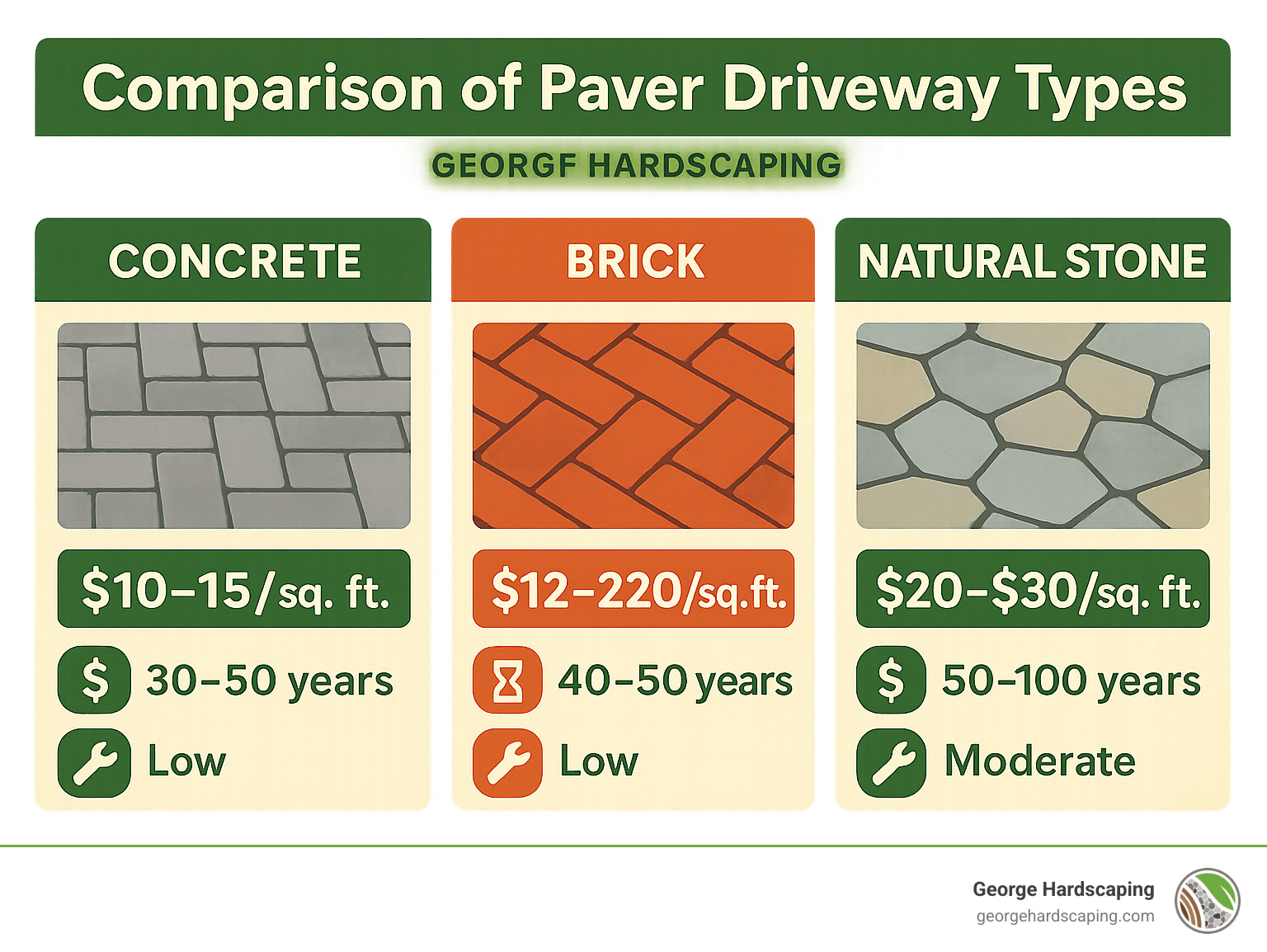
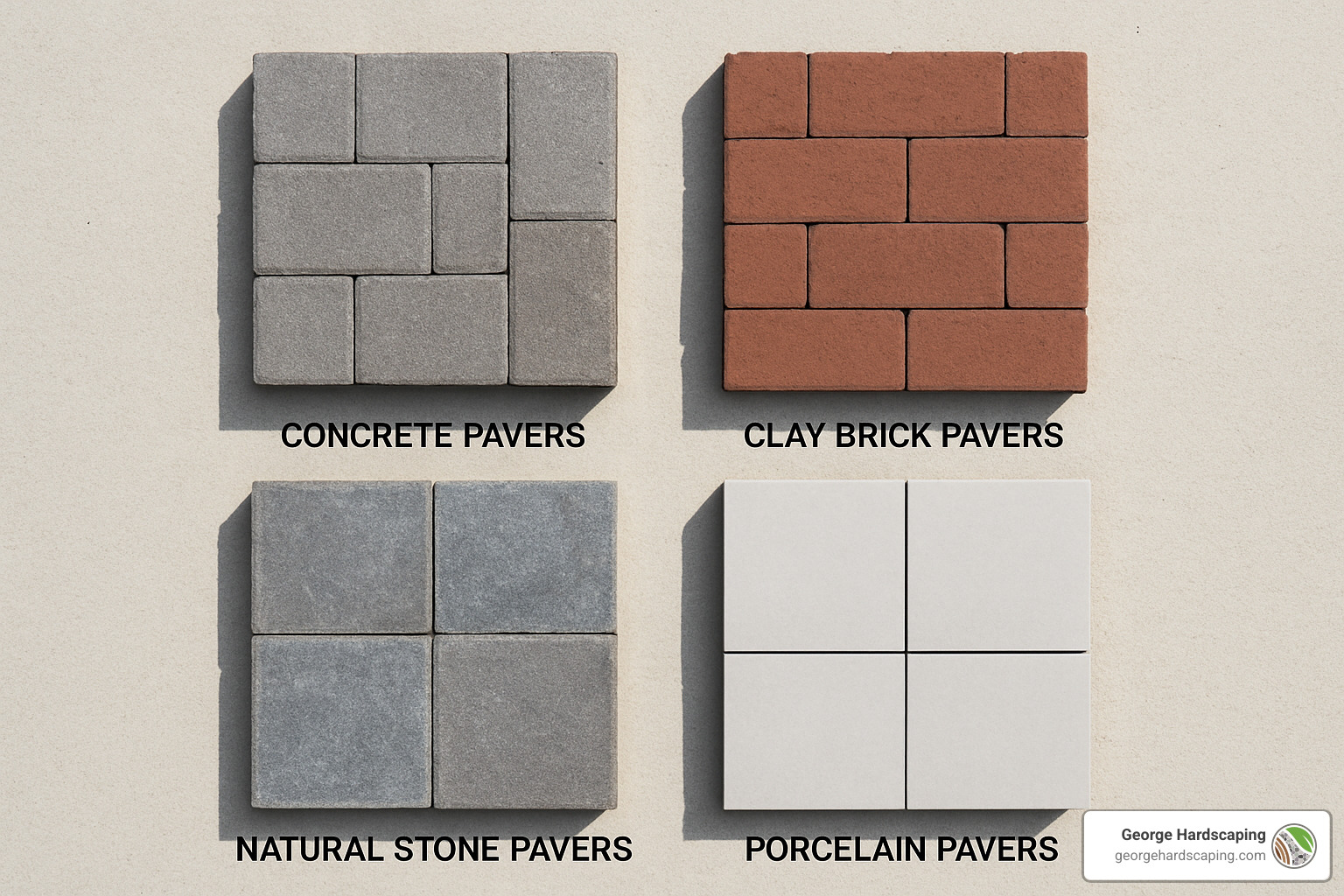
Concrete Pavers are the versatile workhorses of the paver world. They come in endless shapes, colors, and textures—many designed to mimic pricier materials. They’re the practical choice, typically running $6-$20 per square foot installed (based on internet data, not actual George Hardscaping pricing), with a lifespan of 25-50 years with good care.
Clay Brick Pavers bring that timeless, warm charm that never goes out of style. Their rich colors actually improve with age, developing character like a fine wine. They’re a bit more of an investment at $10-$30 per square foot installed (internet averages), but their 25+ year lifespan makes them well worth considering.
Natural Stone Pavers are the luxury option—like choosing a handcrafted suit over off-the-rack. Materials like granite, bluestone, and limestone create truly one-of-a-kind driveways. Yes, they can run $20-$70 per square foot installed (internet data), but cobblestone pavers have been known to last a century with proper care. That’s value that spans generations.
Porcelain Pavers are the newcomers gaining fans fast. They resist stains beautifully and require minimal maintenance. Some even convincingly mimic wood—giving you the warm look without the impracticality of actual wood in a driveway setting.
Permeable Pavers are the environmentally conscious choice, designed with wider joints or built-in openings that let water filter through to the ground below instead of running off into storm drains.
Standard vs Permeable Paver Driveway: Which One Fits?
One of the biggest decisions you’ll make about your paver driveway is whether to go standard or permeable. It’s not just about looks—it’s about how your driveway interacts with water.
Standard paver installations are like the traditional approach—they’re designed to shed water through subtle slopes that direct rainfall toward drainage systems. The joints between pavers are typically narrow and filled with fine sand that creates a relatively waterproof surface. It’s the time-tested approach that works well for many properties.
Permeable driveway pavers take a completely different philosophy—they’re designed to work with nature, not against it. Instead of shedding water, they welcome it, allowing rainwater to pass through the surface and return to the ground. They achieve this through wider joints filled with larger stone aggregate and a specially designed base that creates a reservoir for water to slowly infiltrate back into the soil.
Here’s something that amazes our clients: properly designed permeable paver systems can absorb at least 10 inches of rain per hour—that’s twice the intensity of the heaviest recorded 100-year downpour in America! No wonder they’re becoming increasingly popular in flood-prone areas.
“My permeable driveway turned what used to be a lake every spring into a non-issue,” shares Maria, one of our North Shore clients. “Plus, I love knowing I’m doing something good for the environment.”
Permeable pavers make sense if you battle drainage issues, face local stormwater regulations, or simply want to do your part for the environment. They’re particularly valuable in areas with frequent freeze-thaw cycles, as they reduce ice formation. Many municipalities even offer incentives for installing them.
Standard pavers might be your better bet if your property already drains well, you’re working with a tighter budget (permeable systems typically cost 15-20% more), or your local soil doesn’t percolate well.
As Troy Johnson, a permeable paver specialist we often collaborate with, beautifully puts it: “A properly designed permeable system doesn’t just manage water—it transforms what was once a problem into a resource, allowing rainwater to nourish the surrounding landscape rather than becoming runoff pollution.”
Whether you choose standard or permeable, your paver driveway will provide decades of service while enhancing your home’s value and curb appeal. At George Hardscaping, we’re happy to help you steer these options to find the perfect fit for your property and lifestyle.
Benefits, Drawbacks, Costs & ROI
Looking at a paver driveway is a bit like considering a luxury car versus an economy model—there’s a higher upfront cost, but the driving experience and longevity make a compelling case. Let’s explore what you’re really getting for your investment.
Key Benefits of Choosing Pavers
That satisfying sound of tires rolling over pavers as you arrive home isn’t just pleasant—it signals durability in action. Paver driveways offer remarkable strength, typically two to three times stronger than poured concrete or asphalt. Premium pavers can push this advantage even further, delivering up to four times the strength of traditional options.
What really sets pavers apart is their ability to flex without breaking. Unlike a solid concrete slab that cracks when the ground shifts beneath it, paver driveways have built-in flexibility. Those small joints between each paver act like tiny expansion joints, allowing subtle movement without structural failure.
“We replaced our asphalt driveway three times in 30 years before switching to pavers. We should have done it from the start,” shared one of our Ipswich homeowners, highlighting another key advantage—easy repairs. When damage occurs to a section of your driveway, we can simply lift and replace the affected pavers without tearing up the entire surface.
During our notoriously slippery New England winters, the textured surface and numerous joints of paver driveways provide significantly better traction than smooth concrete or asphalt. This improved safety feature alone gives many homeowners peace of mind.
The design possibilities with pavers are virtually endless. Whether you want your driveway to complement a historic colonial or improve a modern architectural masterpiece, there’s a combination of colors, shapes, and patterns to achieve exactly the look you want.
Potential Drawbacks & Challenges
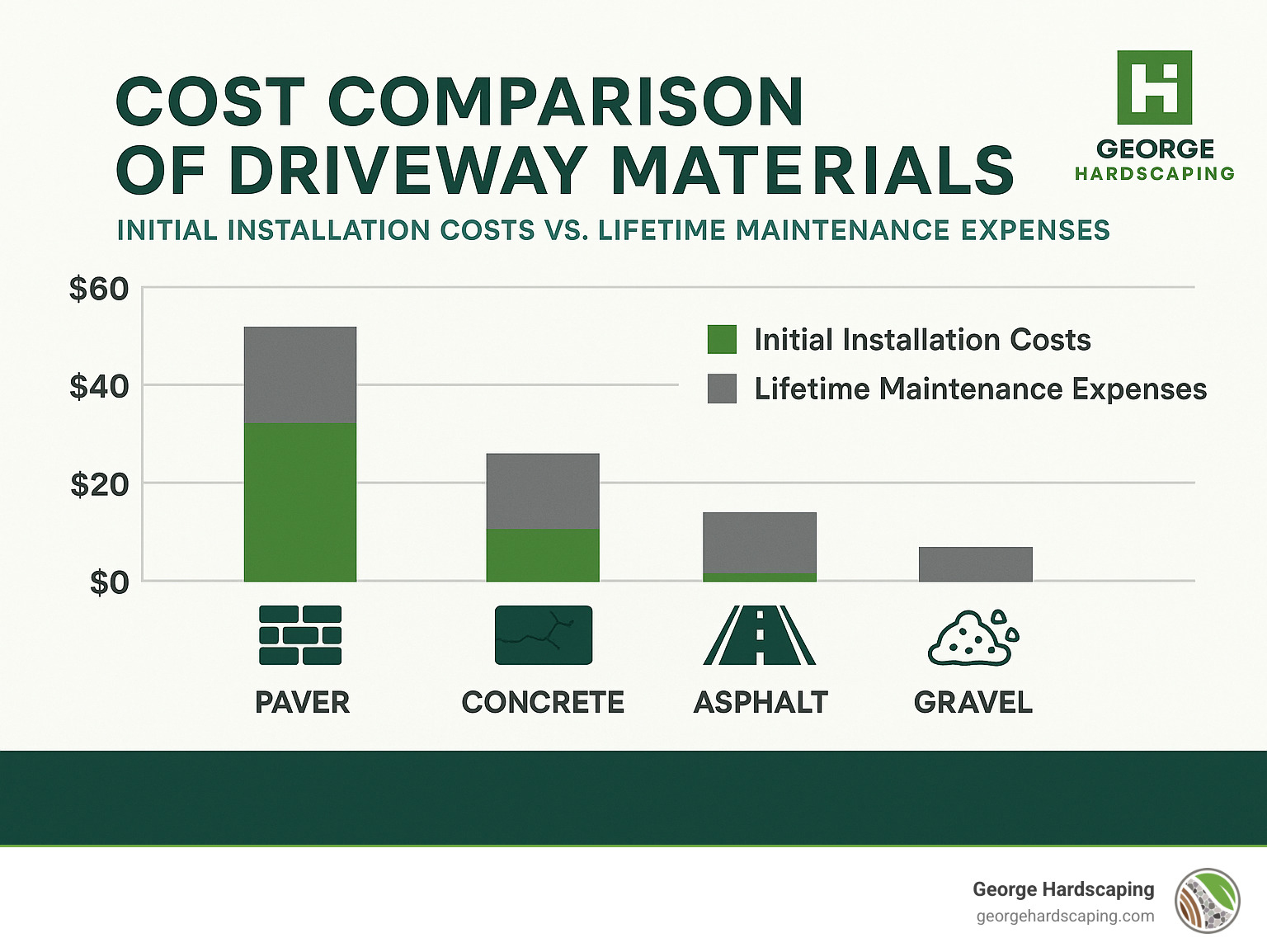
Let’s be honest about the main hesitation most homeowners have—cost. A paver driveway typically runs $10-$17 per square foot installed, compared to $3-$7 for asphalt and $5-$10 for basic concrete. This higher initial investment gives many homeowners pause, though the extended lifespan (30-50 years versus 15-20 for asphalt) makes the long-term math more favorable.
Patience is also required during installation. While an asphalt crew might be in and out in 1-2 days, a properly constructed paver driveway takes 5-7 days after site preparation. This longer timeline reflects the attention to detail required for a lasting installation.
The joints between pavers, while essential to their performance, do require occasional maintenance. Sand can wash out over time, and persistent weeds might find their way through. The good news is that modern polymeric sand products have dramatically reduced these issues compared to installations from decades past.
When winter arrives, snow removal requires a bit more care. The textured surface that provides excellent traction can make shoveling slightly more challenging, and metal shovels should be used carefully to avoid scratching your pavers.
“Paver driveways rank #1 most expensive to install yet require the least maintenance over time,” notes a hardscape industry report. “By paying higher upfront installation costs, homeowners essentially prepay for the minimal ongoing maintenance costs over the driveway’s lifetime.”
How Paver Driveways Perform in New England’s Climate
New England weather seems designed to destroy driveways—freezing winters, sudden thaws, scorching summers, and drenching rains. Fortunately, paver driveways handle these challenges remarkably well.
The freeze-thaw cycles that crack concrete and create potholes in asphalt meet their match in paver systems. Those small joints between pavers provide space for expansion when moisture freezes, preventing the surface failure that plagues solid materials.
Winter performance is particularly impressive. Properly installed paver driveways with slight crowning or slopes allow meltwater to drain away rather than pooling and refreezing. A client in Salem told us after their first winter: “We used to have an ice rink every time it snowed and then warmed up. With our new paver driveway, the meltwater drains away instead of creating dangerous ice patches.”
Quality concrete pavers contain additives that improve their resistance to de-icing salts, helping them maintain both appearance and structural integrity despite winter road salt exposure—a significant advantage in our coastal communities.
When spring downpours arrive, standard paver installations channel water away from your home’s foundation, while permeable options allow rainfall to filter through the surface, reducing puddles and runoff during heavy rain events.

Cost Breakdown & What Influences Price
Understanding what goes into the price of a paver driveway helps you recognize the value behind the numbers. Based on industry data and our experience throughout Essex County, here’s what typically drives the cost of your project:
Most driveways fall into one of three size categories, with corresponding price ranges:
– Small driveways (≤1,000 sq ft) typically cost $9,000–$17,000
– Medium driveways (1,001–2,000 sq ft) range from $15,000–$30,000
– Large driveways (>2,000 sq ft) can run $25,000–$75,000+
Note: These are average costs based on internet data and not actual costs for George Hardscaping. Your specific project may vary significantly based on design complexity, material choices, and site conditions.
Material selection plays a major role in pricing. Concrete pavers generally run $6-$20 per square foot installed, while brick pavers cost $10-$30, and natural stone or cobblestone can range from $20-$70+ per square foot installed.
What happens beneath your pavers significantly impacts cost too. Site preparation—including removal of your existing driveway ($550-$3,000), excavation depth, drainage solutions, and soil stabilization—can represent 30-40% of your total project cost.
Design complexity adds another variable. Simple patterns cost less than intricate designs with borders, accent features, multiple colors, or materials. Curves and custom cuts require more labor and generate more material waste, increasing costs accordingly.
Larger driveways sometimes benefit from a lower per-square-foot cost due to economies of scale. As one contractor explained, “The setup and equipment costs are similar whether we’re installing 500 or 1,500 square feet, so larger jobs can be more efficient.”
For a comprehensive comparison of driveway materials and their costs, check out this detailed guide from AllAboutDriveways.com that breaks down the long-term value proposition of different surfacing options.
Return on Investment & Property Value Boost
Beyond the practical benefits, a paver driveway delivers real financial returns when it’s time to sell your home. The improvement to your property’s curb appeal is immediate and dramatic.
First impressions are powerful in real estate. A Beverly real estate agent told us, “When I bring clients to a home with a well-designed paver driveway, they’re already impressed before we even reach the front door.” This positive first impression often carries through the entire showing.
In terms of concrete numbers, professional appraisers typically value well-executed hardscaping improvements like paver driveways at 50-70% of their installation cost. For a $20,000 driveway installation, this could translate to a $10,000-$14,000 increase in appraised home value.
In competitive markets throughout Essex County, distinctive features like paver driveways help properties stand out. Homes with upgraded exterior features typically sell faster and closer to asking price than comparable properties with basic concrete or asphalt driveways.
When considering are driveway pavers a good investment, look beyond immediate returns. The reduced maintenance requirements and extended lifespan mean you’ll save significantly over decades of ownership. While you might replace an asphalt driveway 2-3 times over a 50-year period, a quality paver driveway installed today could still be serving your home’s next owners.
A homeowner in Marblehead shared this experience after selling: “Our realtor initially suggested listing at $875,000, but after completing the paver driveway, she revised her recommendation to $915,000. We received multiple offers and sold for $925,000—the driveway investment paid for itself and then some.”
Upgraded exteriors signal to buyers that a home has been well-maintained, creating a halo effect that often extends to their perception of the entire property. This perceived quality frequently translates into higher offers and faster sales.
From Blueprint to Reality: Installation & Design Guide
Creating a beautiful and long-lasting paver driveway isn’t just about selecting the right materials—it’s about changing your vision into reality through careful planning and expert installation. Let’s walk through how your driveway dreams come to life, from the first sketch to the final sweep.
Step-by-Step Paver Driveway Installation
The journey to a stunning paver driveway begins long before the first stone is laid. At George Hardscaping, our driveway paver installation process follows a time-tested sequence that ensures lasting beauty and performance.
We start with thorough planning and design, creating detailed layouts that address everything from water drainage to material selection. This crucial phase includes marking utilities (always call 811!) and securing necessary permits—steps that prevent headaches down the road.
Once plans are approved, we begin site preparation, removing existing surfaces and excavating to the proper depth. In New England’s freeze-thaw climate, this typically means digging 12-15 inches deep to accommodate a substantial base.
Next comes what many contractors consider the most critical phase: base preparation. We test your soil’s drainage capabilities and then lay geotextile fabric to prevent material migration. The crushed stone base goes in next, added in 3-inch layers with each one thoroughly compacted before adding the next. This methodical approach prevents future settling and extends your driveway’s lifespan by decades.
“The strength of a paver driveway lies literally in its foundation,” as our project manager often reminds clients. “We spend more time on proper base preparation than any other phase because it’s impossible to correct later without starting over.”
With the base properly prepared, we install sturdy edge restraints—the unsung heroes that prevent pavers from shifting outward over time. A precisely screeded 1-inch layer of coarse, washed sand creates the perfect bedding for your pavers.
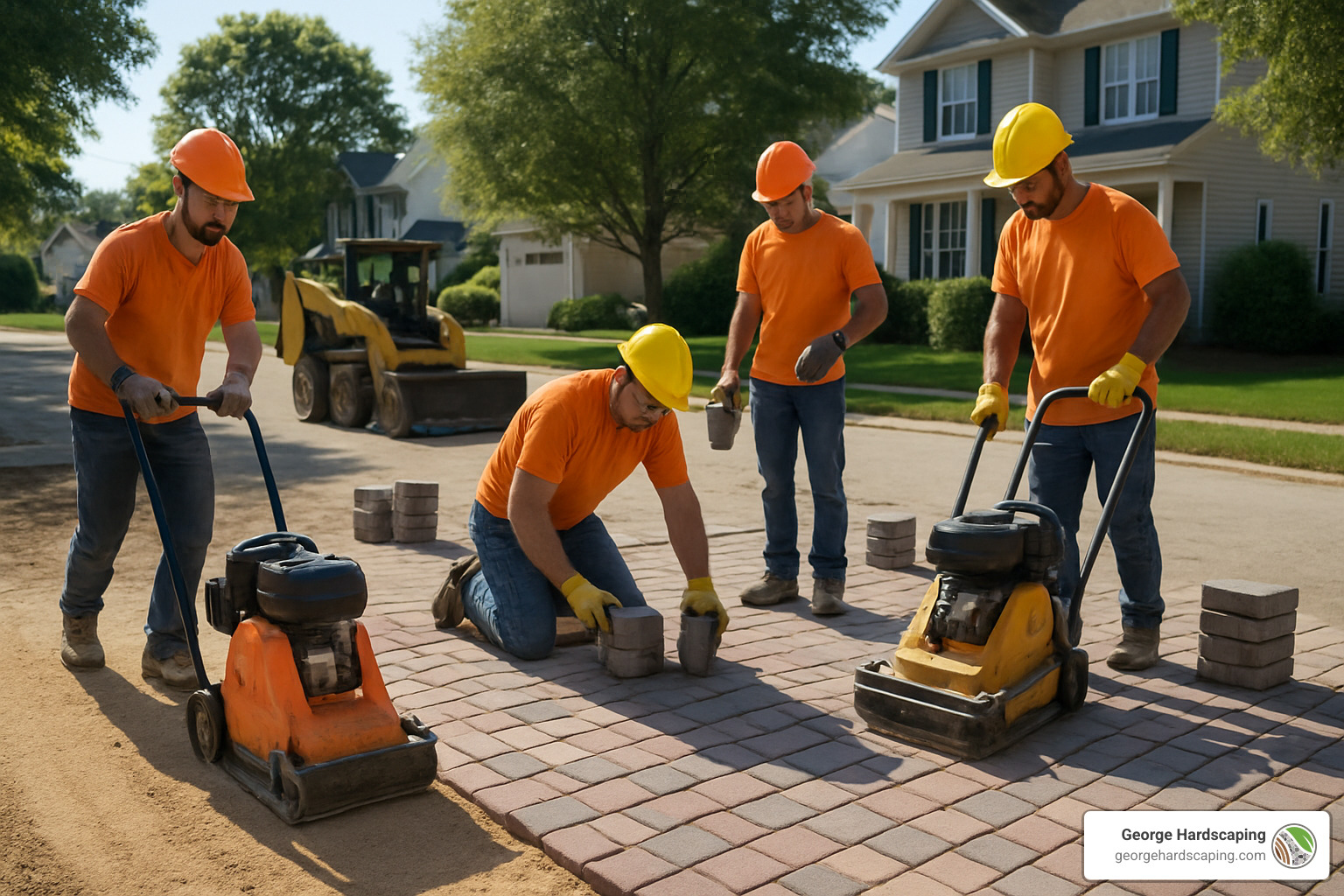
Installation day brings your design to life as we carefully place each paver according to your chosen pattern. Custom cuts around curves and obstacles require precision work with diamond-blade saws. Once placed, the entire surface receives compaction to settle pavers into the bedding sand.
The finishing touch comes with sweeping fine jointing sand or polymeric sand into the joints between pavers, followed by a final compaction and thorough cleaning. The result? A stunning entrance to your home that will welcome you for decades to come.
DIY vs Professional—What You Need to Know
While the idea of tackling a paver driveway yourself might seem appealing, it’s worth understanding what you’re signing up for before grabbing that shovel.
DIY paver installation demands moderate to high skill levels and access to specialized equipment like excavators, plate compactors, and masonry saws. The time commitment is substantial—even experienced DIYers typically spend 2-3 full weekends on an average driveway. While you might save 30-40% on labor costs, you’ll also forgo any professional warranty protection.
Professional installation, on the other hand, brings expertise that only comes from years of experience. Professionals understand the nuances of soil conditions, proper compaction techniques, and drainage requirements that might not be obvious to the untrained eye. What might take you weeks can often be completed in days by an efficient crew with commercial-grade equipment.
A question we frequently hear is can pavers be installed over concrete driveway? While it’s possible in some situations using thin overlay systems, this approach comes with important limitations. The existing concrete must be in good condition without major cracks, proper drainage must be maintained, and the finished height needs to work with existing structures. Always get a professional assessment before attempting this approach.
As one homeowner in Danvers told us after attempting a DIY patio before calling us for their driveway: “I thought I’d save money doing it myself, but after struggling with leveling and dealing with rental equipment breakdowns, I realized some projects are worth hiring experts. The difference in quality is immediately obvious.”
Design Options: Colors, Patterns & Modern Touches
The beauty of choosing a paver driveway lies in the endless design possibilities. Your driveway isn’t just functional—it’s an opportunity to express your personal style and improve your home’s character.
When it comes to patterns, your choice significantly impacts both appearance and performance. The classic herringbone pattern creates a stunning V-shaped design that offers excellent interlock—making it ideal for driveways that need to withstand vehicle weight. For a more traditional look, the running bond pattern creates a simple brick-like appearance that visually elongates your space.
Homeowners seeking something distinctive might choose a basketweave pattern with its woven appearance, or a random/ashlar layout that uses multiple paver sizes for a more natural, less formal feel. For truly dramatic entrances, circular or fan patterns create eye-catching focal points.
Color selection is equally important in creating your dream driveway. Monochromatic installations offer clean, contemporary appeal, while blended color schemes add depth and help disguise inevitable stains. Many homeowners choose to create definition with contrasting borders in darker shades surrounding a lighter field. For a harmonious look, select colors that complement your home’s exterior materials and trim.
“We chose a simple herringbone pattern in a sandy blend for most of the driveway, but added a double border in a contrasting charcoal,” shared a client from Gloucester. “It’s those details that make it look custom rather than cookie-cutter.”
Today’s paver driveways often incorporate modern elements that blend technology with aesthetics. Integrated lighting systems create both safety and ambiance, while oversized format pavers deliver a sleek, contemporary look. Environmentally conscious homeowners might select permeable systems that manage stormwater while creating visual interest. For the ultimate in winter convenience, heated driveway systems eliminate snow shoveling altogether.
For more design inspiration, browse our galleries of driveway paver ideas and modern driveway pavers.
Common Mistakes to Avoid During Install
Even beautiful paver driveways can fail prematurely when installation basics are overlooked. Whether you’re hiring professionals or considering DIY, being aware of these common pitfalls can save you significant headaches down the road.
The most critical mistake is inadequate base preparation. In New England’s freeze-prone climate, skimping on base depth or compaction leads to settling, heaving, and an uneven surface within just a few seasons. Always ensure proper excavation depth (typically 12-15 inches for driveways) and thorough compaction of each base layer.
Using improper sand types is another frequent error. Bedding sand should be coarse, sharp, and washed, while jointing sand must meet specific gradation requirements. That play sand from the home center? It’s not suitable for hardscaping and will lead to unstable installations.
Many DIYers underestimate the importance of sturdy edge restraints. Without proper edging, the outer pavers eventually shift outward, causing the entire surface to loosen and fail. Similarly, neglecting proper slope and drainage (minimum 1-2% away from structures) leads to pooling water that erodes jointing materials and destabilizes your base.
Even pattern selection matters for longevity. Herringbone patterns provide superior interlock for vehicular applications, while running bond patterns should be installed perpendicular to the direction of travel, never parallel.
“I’ve seen beautiful paver driveways fail prematurely because someone tried to save a few hundred dollars on base materials,” notes our lead installer. “The base is 90% of a successful installation, yet it’s completely invisible once the job is done. Never compromise there.”
For more technical insights on proper installation techniques, explore our guide to interlocking driveway pavers.
Caring for Your Paver Driveway: Lifespan, Repairs & Regulations
A properly installed paver driveway can last 30-50 years or more with appropriate maintenance. Your investment deserves proper care to ensure it continues enhancing your property’s beauty and value for decades to come.
Routine Care to Keep Your Driveway Looking New
Maintaining your paver driveway is surprisingly simple, yet makes a tremendous difference in its longevity and appearance.
Regular sweeping or blowing off leaves and debris prevents staining and buildup of organic matter that can foster weed growth. A quick rinse with your garden hose every few weeks removes dust and light soil that dulls the surface over time.
For deeper cleaning, you don’t need special equipment—just use a pressure washer on a gentle setting (under 1,500 PSI) with a fan tip nozzle to avoid damaging the paver surface or washing out joint material. Spring is an ideal time for this more thorough cleaning after winter’s salt and grime have accumulated.
“I have my pavers power-washed professionally every spring, and I apply a fresh coat of sealer every three years,” shares a client from Marblehead. “My driveway still looks nearly new after 12 years, while my neighbor has replaced his asphalt driveway twice in that time.”
Weeds can occasionally appear between pavers, but they’re easily managed. The best prevention is properly installed polymeric sand, which creates a firm barrier while remaining flexible. For any persistent weeds, simply pull them when young or use environmentally friendly weed preventers rather than harsh chemicals that might damage your pavers.
Sealing isn’t mandatory, but many homeowners find it worthwhile for the improved color and stain protection it provides. If you choose to seal, plan on reapplication every 2-3 years, depending on the specific product and your local weather conditions. Always select sealers specifically formulated for concrete or clay pavers to avoid damaging the surface.
Well-defined borders create clean transitions between your driveway and landscape while preventing grass encroachment. Consider driveway edging pavers to frame your installation beautifully while providing functional separation from lawns and gardens.
Repairing or Replacing Damaged Pavers
One of the most significant advantages of choosing a paver driveway is the ability to make targeted repairs without disturbing the entire surface—something impossible with concrete or asphalt.
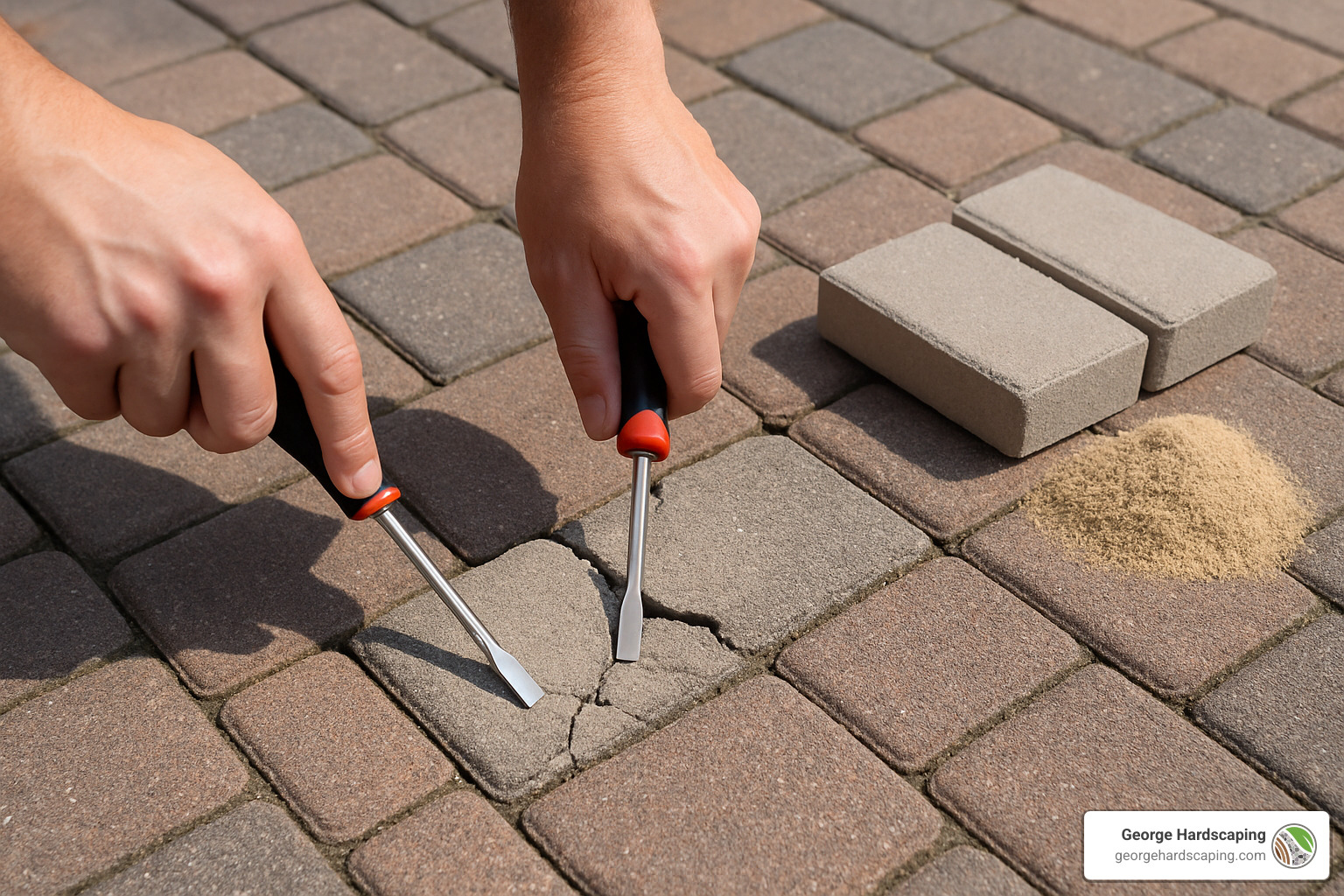
When a single paver becomes cracked or stained beyond cleaning, replacing it is surprisingly straightforward. Using two flat-head screwdrivers, carefully pry out the damaged paver, clean the bedding sand beneath, and drop in the replacement. After sweeping fresh jointing sand into place, your repair is complete—often with no visible evidence that work was done.
For areas that have settled over time, the process is similar but addresses the underlying issue. Remove pavers from the affected area, add and compact additional base material to raise the level, replace the bedding sand, and reinstall the pavers with fresh jointing sand. This targeted approach means you’re fixing the actual problem, not just covering it up.
“We always recommend clients store at least 5% extra pavers from their original installation,” explains our project manager. “Even the best-made pavers can be damaged by exceptional circumstances like dropped tools or chemical spills, and having exact matches makes repairs seamless.”
If you don’t have spare pavers, contact your original installer or the manufacturer. Sometimes, even if the exact color is no longer produced, pavers can be sourced from less visible areas of your driveway (like under planters) and replaced with new pavers where the slight difference won’t be noticeable.
For more information about repair costs, our guide on the cost to install pavers includes details about typical repair pricing.
Sustainability & Environmental Benefits
Beyond beauty and durability, paver driveways offer remarkable environmental advantages that many homeowners find increasingly important.
The most significant benefit comes from permeable paver systems, which allow rainwater to infiltrate the ground naturally rather than running off into storm drains. This natural filtration process reduces flooding and erosion while filtering pollutants from water before it reaches local waterways. A client in Manchester-by-the-Sea experienced this benefit firsthand: “During heavy rainstorms, we used to get water in our basement. Since installing the permeable driveway, not only has the basement stayed dry, but our garden seems healthier—I think it’s benefiting from the filtered rainwater.”
Even standard paver installations contribute to heat island reduction, especially when lighter colors are chosen. Light-colored pavers reflect more sunlight than dark asphalt, helping to keep your property cooler during summer months. Some studies show these surfaces can be up to 20°F cooler than asphalt in direct sunlight—a difference you’ll notice when walking barefoot!
Modern pavers often incorporate sustainable materials in their production. Concrete pavers frequently include recycled materials like fly ash and slag, while clay pavers are made from natural, abundant materials. At the end of their long life cycle, pavers can be crushed and recycled into base materials for new projects, creating a truly sustainable cycle.
For environmentally conscious homeowners, permeable paver systems can be designed to direct filtered water to collection systems for landscape irrigation, reducing water consumption while maintaining beautiful gardens.
If you’re pursuing LEED certification for your home, permeable paver driveways can contribute valuable points in several categories, including Sustainable Sites, Water Efficiency, and Materials & Resources.
Local Regulations, Permits & Incentives
Before starting your paver driveway project in Essex County, understanding local regulations will save you headaches and potential rework.
Most towns in our area require permits for new driveway installations or significant modifications to existing ones. These regulations typically address maximum width at the street, minimum setbacks from property lines, drainage provisions to prevent runoff onto public ways, and specific curb cut requirements where your driveway meets the street.
If your home is part of a Homeowners Association, review their architectural guidelines before finalizing your design. HOAs often have specific requirements regarding paver colors, patterns, maximum driveway dimensions, and decorative elements. Getting pre-approval can prevent costly changes after installation.
Massachusetts communities have increasingly adopted stormwater management regulations that may impact your driveway design. Some towns now require permeable surfaces for new or expanded driveways, while others limit the total impervious surface area on a property. Properties in watershed protection districts may face additional requirements to protect water quality.
“Navigating local regulations can be complex,” notes our permitting specialist. “At George Hardscaping, we handle the permitting process for our clients in all Essex County communities, ensuring compliance while maximizing design flexibility.”
The good news is that environmentally friendly driveway choices may qualify for financial incentives. Some water districts offer rebates for permeable paving installations, stormwater utility fee reductions may be available, and certain tax incentives for green infrastructure might apply in your area.
For properties in historical districts in towns like Salem, Marblehead, or Newburyport, additional approvals may be required to ensure your driveway design complements the historical character of the neighborhood. These extra steps protect the charm and value of these special communities but may require more planning time.
Frequently Asked Questions About Paver Driveways
How long will a Paver Driveway last?
When homeowners ask me about the lifespan of a paver driveway, I’m always happy to share the good news. With proper installation, you can expect your paver driveway to last 30-50 years—sometimes even longer. This significantly outperforms both asphalt (which typically needs replacement after 15-20 years) and poured concrete (usually lasting 20-25 years). Some premium materials like cobblestone can even reach the 75-year mark with good care.
What determines this impressive longevity? It comes down to several key factors. First and foremost is the quality of installation, particularly how well the base was prepared. Your choice of materials matters too—whether you’ve selected concrete, brick, or natural stone pavers. Local climate conditions (especially freeze-thaw cycles), your maintenance routine, and the weight and volume of vehicles using the driveway all play important roles as well.
I always remember what one of our veteran installers told a client: “The pavers themselves rarely fail—it’s almost always the base or edge restraints that determine a paver driveway’s lifespan.” This perfectly captures why professional installation by experienced contractors is such a worthwhile investment.
Can I snow-blow or plow without damage?
New England winters bring plenty of snow, and I’m often asked whether snow removal equipment will damage a paver driveway. The good news is that yes, you can safely clear snow from your paver surface—with a few simple precautions.
For snow blowing, which is generally very safe for pavers, just adjust the height to prevent scraping the surface. If possible, opt for equipment with rubber edges, and try to clear snow before it becomes packed and icy. Many of our clients find snow blowers to be their preferred winter maintenance tool.
If you’re using a plow, you’ll need to exercise a bit more care. Choose a plow with a rubber or polyurethane edge rather than metal, and keep the blade slightly liftd (about 1/4 to 1/2 inch) above the surface. When possible, plow with the pattern of your pavers rather than against it to minimize the chance of catching an edge.
For ice management, calcium chloride-based products are gentler on your pavers than traditional rock salt. It’s best to avoid magnesium chloride on concrete pavers, and some homeowners prefer sand for traction without any chemical impact.
One of our clients in Gloucester shared his experience: “I’ve been snow-blowing my paver driveway for eight winters now, and it still looks great. I just make sure to adjust the height so it doesn’t catch on any slightly raised pavers.”
Do paver driveways add insurance or appraisal value?
When investing in a paver driveway, it’s natural to wonder about the financial returns beyond just improved aesthetics. From both insurance and property value perspectives, the news is positive.
From an insurance standpoint, while you likely won’t see direct premium reductions, paver driveways offer several indirect benefits. These include reduced liability risk thanks to better traction and fewer trip hazards, decreased water damage claims if you’ve installed permeable pavers that improve drainage, and potential qualification for “well-maintained property” discounts with some insurance providers.
One important tip: if you’ve invested in a high-end driveway, consider specifically listing it in your homeowner’s policy to ensure you have full replacement value coverage should damage occur.
When it comes to property appraisals, professional appraisers look at several factors when valuing your paver driveway investment. They consider how it contributes to your home’s overall curb appeal, the quality of materials and installation work, its current condition and age, and how well it fits with neighborhood standards.
Most appraisers value well-executed hardscaping improvements at 50-70% of their installation cost. For perspective, a $20,000 driveway project could translate to a $10,000-$14,000 increase in your home’s appraised value.
I recently spoke with a real estate appraiser who works throughout Essex County, and he explained it this way: “When I’m appraising comparable homes, quality hardscaping like paver driveways often justifies a 2-5% premium on total home value, especially in higher-end neighborhoods where outdoor living spaces are highly valued.”
Conclusion
A paver driveway represents more than just a place to park your car—it’s an investment in your property’s functionality, appearance, and value. When you choose pavers, you’re selecting a surface that offers exceptional strength, remarkable flexibility, and endless design possibilities that will improve your home for decades to come.
Here at George Hardscaping, we’ve transformed hundreds of driveways throughout Essex County. From neat brick installations that complement historic Salem homes to modern permeable systems that manage Gloucester’s coastal storm runoff, each project tells a unique story. What unites them all is our unwavering commitment to quality craftsmanship and our deep understanding of New England’s challenging climate and rich architectural traditions.
Yes, installing a paver driveway requires a higher initial investment than asphalt or poured concrete. But as many of our clients have finded, the long-term value is undeniable. With proper installation and minimal upkeep, your paver driveway will likely be the last one you’ll ever need—a legacy improvement that serves your family for generations rather than years.
“We installed our paver driveway fifteen years ago,” one Ipswich homeowner told us recently, “and it still looks as beautiful as the day it was completed. Our neighbors have replaced their asphalt twice in that time.”
Whether you’re building a new home in Boxford’s wooded landscapes, restoring a historic property in Newburyport’s charming downtown, or simply upgrading your existing Beverly residence, we’re here to help you explore the possibilities. Our team will guide you through every step—from selecting materials that complement your home’s architecture to designing patterns that reflect your personal style.
Your driveway is the first thing you see when you arrive home and the last thing you see when you leave. Shouldn’t it be as exceptional as the rest of your property?
For more detailed information about bringing your dream driveway to life, visit our guide on driveway paver installation or reach out to our team for a personalized consultation. We’re ready to create a driveway that not only stands the test of time but also welcomes you home with beauty and distinction every single day.
