
Why Landscape Drainage Solutions Matter for Your Home and Hardscapes
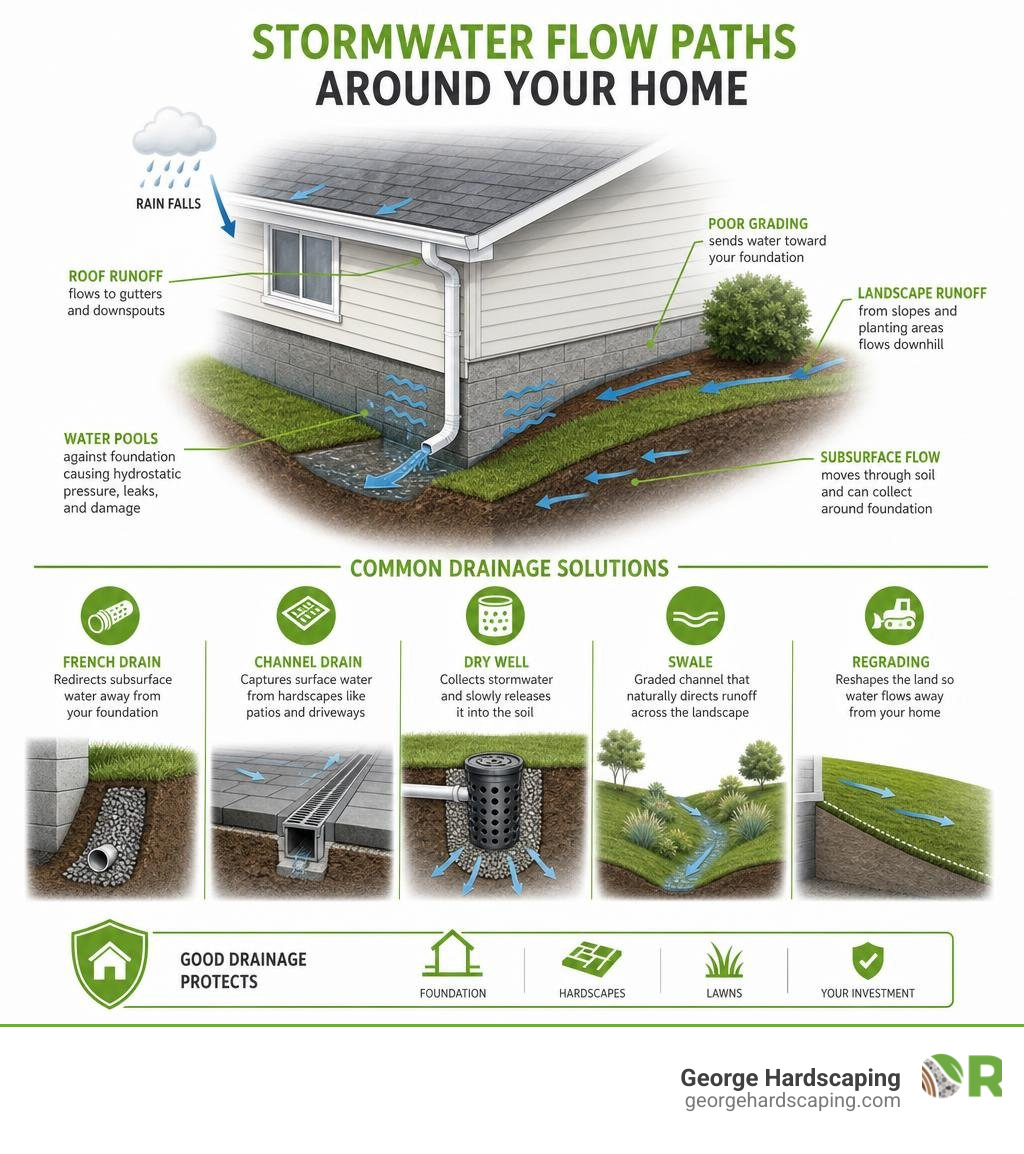
Landscape drainage solutions are the systems, techniques, and design strategies used to move excess water away from your property — protecting your foundation, lawn, and hardscapes from costly water damage.
Here are the most common solutions used in residential properties:
- French drains — perforated pipe buried in a gravel trench to redirect subsurface water
- Channel drains — linear surface drains installed along patios, driveways, and walkways
- Dry wells — underground chambers that collect and slowly release stormwater into the soil
- Swales — shallow, graded channels that guide runoff across the landscape naturally
- Regrading — reshaping the ground so water flows away from your foundation
Water problems are rarely just cosmetic. When rainwater pools against a foundation, it creates hydrostatic pressure — a slow, relentless force that can push moisture through concrete walls, erode soil, and undermine the structural integrity of patios, retaining walls, and walkways.
For homeowners on the North Shore and across Essex County, Massachusetts, this is a real and recurring challenge. The region’s clay-heavy soils, heavy seasonal rainfall, and freeze-thaw cycles make drainage one of the most important — and most overlooked — aspects of any outdoor project.
The good news? A well-designed drainage system doesn’t have to be an eyesore. Modern solutions integrate seamlessly with patios, retaining walls, and landscaping to protect your property while preserving its appearance.
Easy Landscape Drainage Solutions glossary:
- Dry well installation
- Retaining wall drainage
- retaining wall and french drain
Common Causes of Poor Yard Drainage in Massachusetts
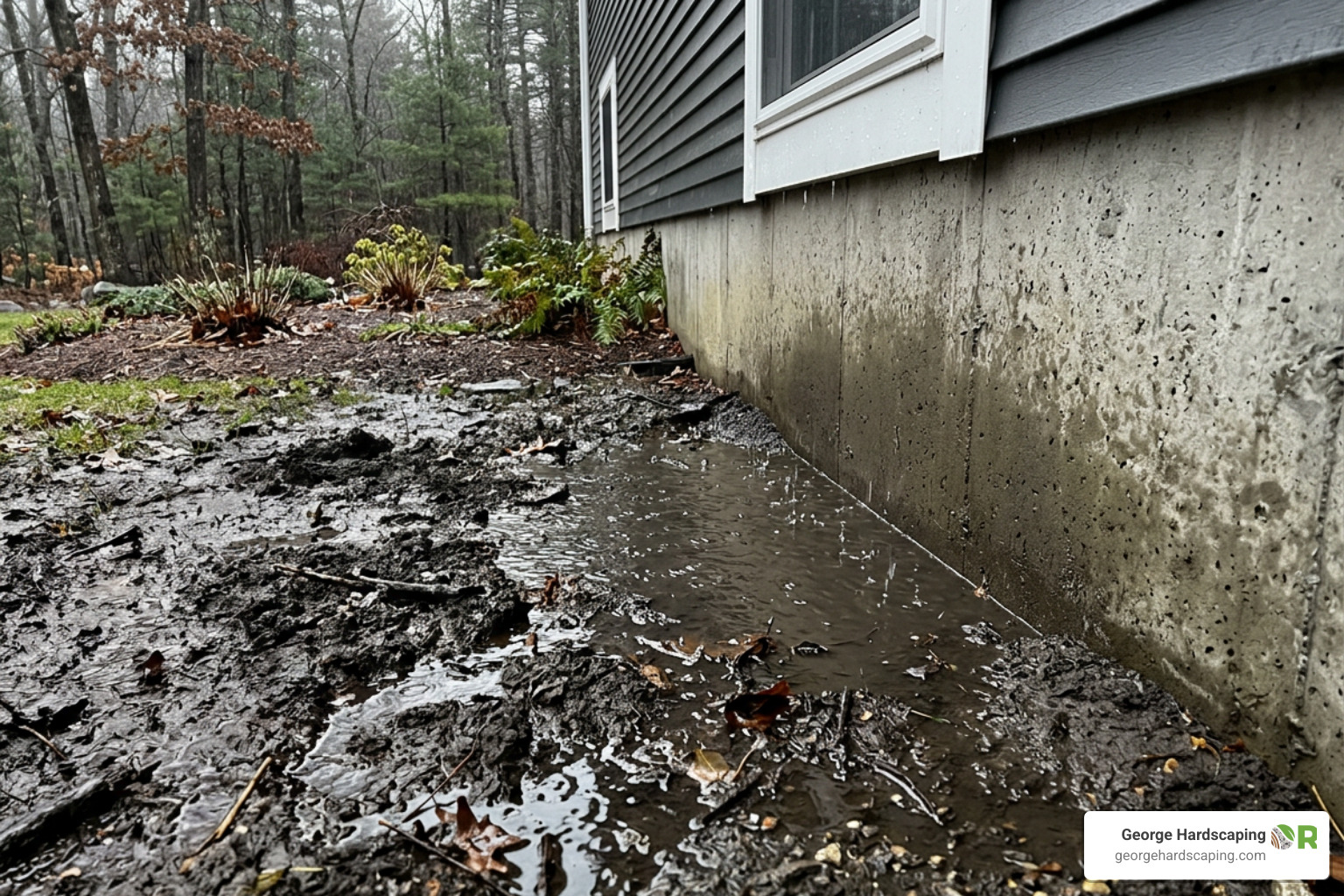
Poor yard drainage is rarely caused by a single isolated factor. Instead, it is typically the result of a combination of natural soil composition, property topography, and human-made hardscapes. In coastal and inland areas across the North Shore—from Gloucester to Woburn—the local geography presents unique challenges that require engineered, long-term interventions.
When water has nowhere to go, it collects in the path of least resistance. This often leads to soggy lawns, failing retaining walls, and water creeping toward your basement or crawl space. To resolve these issues permanently, we must look beyond the surface symptoms and address the root causes. Our comprehensive George Hardscaping Services are designed to analyze these underlying structural and geological patterns before we lay a single stone.
Soil Compaction and Clay-Heavy Substrates
One of the primary culprits behind drainage failures in North Shore communities like Danvers and Beverly is the soil itself. Much of northeastern Massachusetts features clay-heavy soils that naturally resist water penetration. Unlike sandy substrates that allow water to filter through quickly, clay particles are tightly packed, leaving very little pore space for water to travel downward.
Furthermore, construction activities, heavy lawn equipment, and consistent foot traffic compact this clay-heavy substrate over time. Soil compaction destroys the natural soil structure, drastically reducing percolation rates. When a heavy storm hits, the compacted clay acts almost like a sheet of concrete, forcing rainwater to pool on the surface of your lawn or garden beds rather than absorbing naturally into the earth.
Improper Grading and Hardscape Runoff
Topography dictates where water flows. Ideally, a property should have a positive slope, meaning the ground slopes away from the home’s foundation at a rate of at least 2 to 3 inches every 10 feet. Unfortunately, many older homes in historical towns like Gloucester suffer from settled grading. Over decades, the soil surrounding foundations naturally compacts and sinks, creating a negative slope that coaxes stormwater directly toward the foundation walls.
This issue is compounded by improper hardscape installation. Driveways, patios, and walkways are impervious surfaces. If a patio is constructed without the proper pitch, or if a driveway slopes back toward the garage, thousands of gallons of roof and surface runoff will be funneled directly toward your home’s structural elements. Correcting these elevation differences is the first step in ensuring your home remains dry. For more strategies on shielding your structure, explore our guide on No More Leaks: Simple Strategies to Protect Your Home from Water Damage.
The Impact of New England Weather Patterns
In addition to soil and grading, the local climate plays a massive role in drainage issues. Massachusetts experiences intense seasonal weather, including heavy spring rains, rapid snowmelt, and severe coastal storms. During the winter, the ground freezes solid, preventing any surface water from absorbing into the soil. When a sudden warm spell or rain-on-snow event occurs, the runoff has nowhere to go but across the surface, pooling against foundations and overwhelming standard gutters. This freeze-thaw cycle also causes soil to expand and contract, which can shift poorly installed hardscapes and disrupt established drainage paths.
Core Landscape Drainage Solutions for High-Performance Properties
Managing water on a high-end residential property requires a multi-layered approach. We must address both surface runoff (water traveling across lawns and hardscapes) and subsurface water (groundwater moving beneath the surface).
By combining different engineered drainage systems, we can capture water at the point of impact and safely route it to a designated discharge zone. Below is a comparison table outlining the primary systems we deploy to keep your outdoor spaces functional and pristine.
| Drainage System | Primary Function | Ideal Application | Key Benefit |
|---|---|---|---|
| French Drain | Manages subsurface groundwater and relieves hydrostatic pressure. | Retaining wall bases, soggy lawn perimeters, and foundation footings. | Prevents water from seeping through walls and underground structures. |
| Channel Drain | Captures sheet-flow surface runoff on impervious surfaces. | Driveway thresholds, patio edges, and poolside walkways. | Low-profile, highly aesthetic linear integration. |
| Dry Well | Collects massive volumes of stormwater and allows it to percolate. | Downspout discharge points and low-lying landscape collection zones. | Eco-friendly groundwater recharge without municipal runoff. |
Our team integrates these systems into our George Hardscaping Services to ensure that your masonry and hardscaping investments are fully protected from the elements.
French Drains and Subsurface Water Management
French drains are the workhorses of subsurface water management. At its core, a French drain is a trench containing a perforated PVC pipe wrapped in a geotextile fabric filter and backfilled with clean washed stone (such as pea gravel or crushed river rock).
As groundwater rises or flows downhill, it enters the gravel trench, drops through the perforations in the pipe, and flows gravity-assisted to a safe discharge point, such as a dry well or a daylight exit. This system is incredibly effective at relieving the hydrostatic pressure that builds up behind masonry structures. To learn more about how we apply this to masonry, read our Retaining Wall French Drain Complete Guide.
To ensure maximum longevity, we use commercial-grade non-woven geotextile fabric. This fabric acts as a filter, allowing water to pass through while keeping fine soil particles and silt from entering the gravel envelope and clogging the pipe. Without this critical barrier, a French drain can become completely choked with mud within just a few seasons, rendering it useless.
Channel Drains for Patios and Driveways
For solid hardscapes like concrete, brick, or natural stone patios, surface water cannot sink into the ground. When heavy rain falls, water sheets across these flat surfaces. To prevent this water from pooling or flooding adjacent structures, we install channel drains (also known as trench drains).
These are narrow, linear grates installed flush with the paved surface. They capture water across the entire width of a driveway or patio and direct it into an underground pipe system. Channel drains are crucial for managing runoff on sloped driveways in towns like Woburn and Peabody, where steep driveways can otherwise funnel sheets of water directly into garages. For properties looking to minimize surface runoff entirely, combining channel drains with Permeable Driveway Pavers offers an incredibly robust, sustainable solution.
Dry Wells and Stormwater Percolation
What happens to all the water once it’s collected by French drains and downspouts? In Massachusetts, environmental regulations and municipal codes often prohibit routing private stormwater runoff directly into public sewer systems or onto neighboring properties. This is where dry wells play a pivotal role.
A dry well is an underground structural chamber surrounded by crushed stone. It acts as a temporary holding tank for large volumes of stormwater. When a heavy storm hits, water fills the dry well chamber. Over the next several hours, the water slowly percolates through the chamber’s perforated walls and back into the surrounding deep soil, replenishing local aquifers naturally. This is an essential component of any high-performance landscape. If you’re interested in how these systems are constructed underground, check out our dedicated page on Dry Well Installation.
Modern dry wells are typically constructed from heavy-duty, UV-resistant polyethylene chambers. These modular units can be linked together in series to handle larger volumes of water, making them highly adaptable for properties with extensive roof areas or large paved patios.
Designing Custom Landscape Drainage Solutions
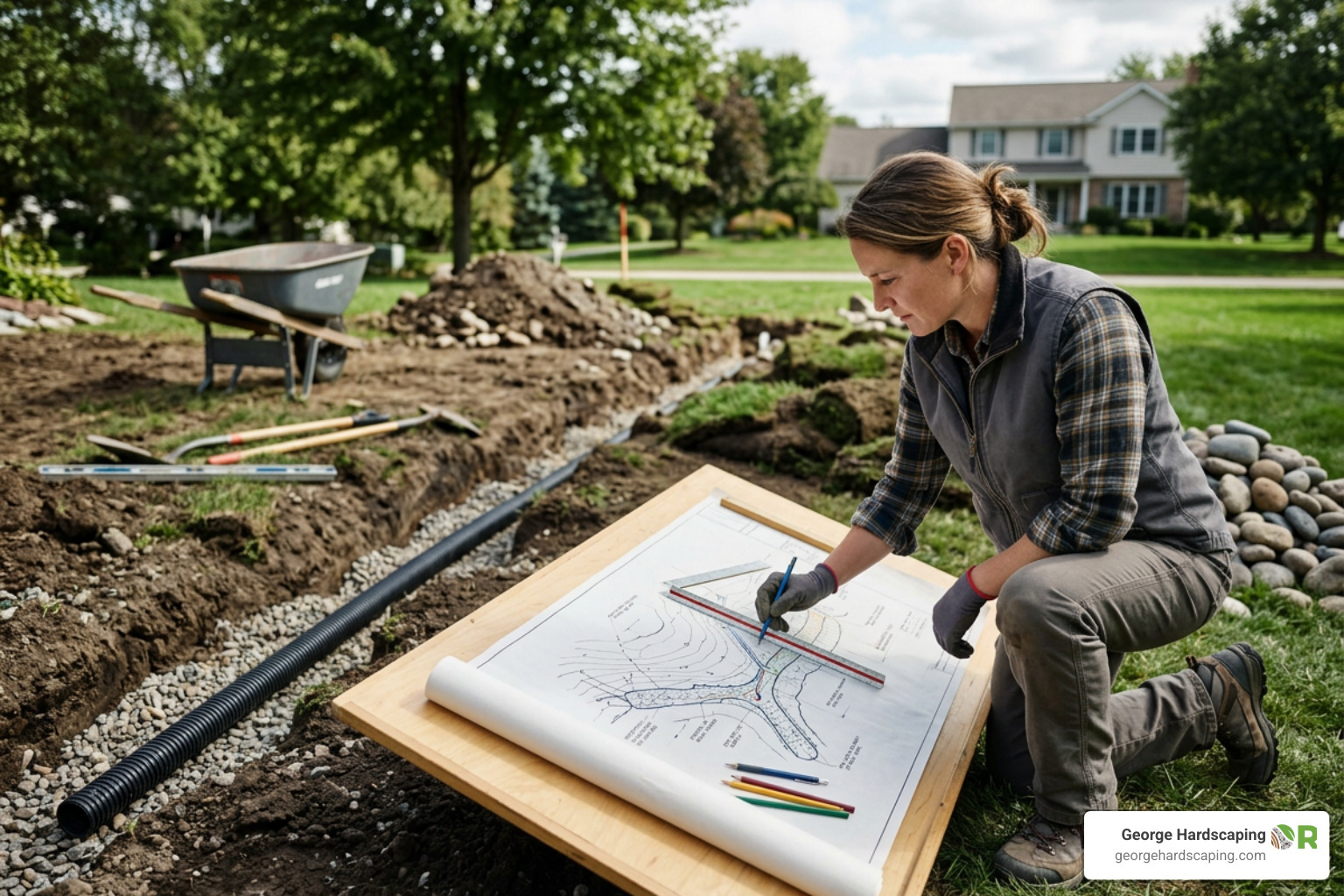
No two properties on the North Shore are identical. A drainage plan that works for a flat, coastal yard in Gloucester may be completely inadequate for a sloped, clay-heavy property in Beverly. Designing an effective, long-lasting system requires careful site analysis, precise calculations, and custom engineering.
When designing custom Landscape Drainage Solutions, we evaluate several key factors:
- Soil Permeability: Testing how fast the soil absorbs water to determine if we need sand-amended trenches or advanced gravel-free systems.
- Topography and Slope: Calculating the exact pitch (minimum 2% slope) required to move water via gravity without relying on mechanical sump pumps.
- Rainfall Intensity: Sizing pipes and catch basins to handle peak storm events rather than average rainfall.
- Product Selection: Utilizing premium materials, such as heavy-duty PVC pipe or engineered aggregate systems. For detailed technical specifications on modern engineered solutions, you can review the NDS EZ-Flow Specifications.
Integrating Drainage with Retaining Walls and Hardscapes
Retaining walls are designed to hold back heavy mounds of earth, but soil becomes exponentially heavier when saturated with water. Without proper drainage, hydrostatic pressure will inevitably build up behind the wall, causing the masonry to bow, crack, and eventually collapse.
To prevent this, we design retaining walls with integrated drainage systems. This includes placing a perforated French drain pipe at the very base of the wall’s footing, backfilling the zone directly behind the wall with clean gravel to allow water to drop down quickly, and installing weep holes or dedicated discharge outlets. This keeps the soil behind the wall dry and structurally stable. For a deep dive into these engineering principles, see our Retaining Wall Drainage Complete Guide.
Permeable Hardscapes as Landscape Drainage Solutions
One of the most elegant ways to solve drainage issues is to prevent surface runoff from forming in the first place. Traditional asphalt and poured concrete force 100% of rainwater to run off their surfaces. Permeable hardscapes, however, allow water to pass directly through the joints and return to the ground below.
By utilizing specialized permeable pavers, porous joint materials, and a multi-layered open-graded stone base, we can create driveways and patios that double as highly efficient drainage systems. This drastically reduces the load on your underground pipes and dry wells while providing a stunning, durable surface that is highly resistant to winter freeze-thaw damage. Learn more about how these sustainable systems function in our article on The Permeable Drive Revolution: How Sustainable Paving Works.
The Importance of Proper Pipe Selection
A common mistake in DIY or low-budget drainage installations is the use of thin, corrugated black plastic pipe. While cheap and flexible, corrugated pipe is highly susceptible to crushing under heavy loads, clogging due to its internal ridges, and being punctured by tree roots. We exclusively use smooth-walled, rigid PVC pipe (such as Schedule 40 or SDR 35). Smooth-walled pipes allow water to flow much faster, are incredibly durable, and can be easily cleared with a plumbing snake or hydro-jetter if a clog ever occurs.
Professional Installation Costs and Maintenance in Massachusetts
Installing a professional-grade drainage system is a major construction project that requires specialized excavation equipment, laser-guided grading tools, and precise engineering. While it requires an upfront investment, it protects your home’s foundation and outdoor living spaces from catastrophic water damage.
Average Industry Cost Ranges
To help you plan your landscape modifications, we have compiled average industry cost ranges based on publicly available online data.
Please note: These figures represent broad industry averages across Massachusetts and do not reflect the actual pricing or guaranteed rates of George Hardscaping. Every property requires a custom assessment to determine exact project requirements.
- French Drains: $100 to $500 per linear foot (depending on depth, soil conditions, and hardscape excavation requirements).
- Dry Wells: $10,000 to $25,000 per unit (including deep excavation, structural chambers, stone backfill, and pipe connections).
- Channel Drains: $150 to $750 per linear foot (highly dependent on whether the drain is integrated into a new hardscape or retrofitted into existing concrete/asphalt).
- Swales and Bio-Swales: $30 to $150 per linear foot (including grading, loam, and specialized plantings or decorative river stone).
Factors That Influence Installation Costs
Several variables can shift your project costs toward the lower or higher end of these ranges. Soil composition is a major factor; digging through hard clay or rocky New England soil requires more labor and heavy machinery than digging through sandy loam. Accessibility also plays a role—if our excavation equipment has to navigate tight spaces between historical homes, the project will take longer. Finally, retrofitting drainage into existing hardscapes (like cutting through an established concrete driveway to install a channel drain) is more labor-intensive than installing systems during a new construction project.
Long-Term Maintenance and Regulatory Compliance
Even the best-engineered drainage system requires periodic maintenance to ensure it continues to operate at peak efficiency. Over time, leaves, silt, and organic debris can wash into catch basins and channel drains. We recommend checking and clearing grates and sediment baskets at least twice a year—typically in late spring and late fall.
In addition to maintenance, environmental compliance is a critical factor on the North Shore. Towns like Danvers and Beverly have strict local conservation commissions and municipal stormwater regulations, particularly for properties near wetlands, coastal zones, or natural waterways. Professional installations must respect these boundaries, obtain the necessary local permits, and ensure that diverted stormwater does not negatively impact neighboring properties or public infrastructure.
Frequently Asked Questions
How do professional landscape drainage solutions protect home foundations?
Professional systems address the root cause of water accumulation. By intercepting surface water and rising groundwater before it ever reaches your foundation, these systems prevent the buildup of hydrostatic pressure. This keeps basement walls dry, prevents soil erosion around concrete footings, and eliminates the risk of structural settling and masonry cracking.
How long do professional landscape drainage solutions last?
When installed with high-grade commercial materials—such as schedule 40 PVC pipes, heavy-duty catch basins, and professional-grade non-woven geotextile fabrics—a professional drainage system can easily last 20 to 30 years or more. Advanced engineered materials can have lifespans exceeding several decades, provided the system is kept clear of debris.
Can I install a French drain or dry well as a DIY project?
While minor surface grading or adding simple gutter extensions can be handled as DIY tasks, installing subsurface French drains or structural dry wells requires professional expertise. Improper slope calculations can cause water to flow backward, worsening your drainage problems. Furthermore, deep excavation carries structural risks and utility hazards. It is highly recommended to work with a licensed professional to ensure correct grading, structural stability, and safety. For a high-level overview of dry well mechanics, you can read our guide on Digging Deep for Dryness: Installing Your Own Dry Well.
How do I know if my retaining wall needs a drainage system?
If you notice water weeping through the joints of your retaining wall, soil eroding from behind the wall, or the wall itself beginning to lean, bow, or crack, these are clear signs of hydrostatic pressure buildup. A proper drainage system, including a French drain and weep holes, is essential to relieve this pressure and prevent structural failure.
What is the difference between a French drain and a trench drain?
A French drain is designed to manage subsurface water (groundwater). It consists of a perforated pipe buried in a gravel-filled trench that allows water to seep in from below. A trench drain (or channel drain) is a surface-level system covered by a grate, designed to capture sheet-flow surface runoff from impervious areas like driveways and patios before it can pool.
Conclusion
A beautiful outdoor space is only as good as the drainage system supporting it. Whether you are dreaming of a luxury stone patio, a custom firepit, or a grand retaining wall, managing water is the single most important factor in ensuring your investment lasts a lifetime.
At George Hardscaping, we bring decades of masonry and hardscaping expertise to the North Shore. From historic coastal estates in Gloucester to residential properties in Woburn, we design and install custom, high-performance drainage systems that blend seamlessly into your landscape design.
Don’t let poor drainage wash away your hardscaping investments or threaten your home’s foundation. Explore our complete range of George Hardscaping Services, or take the first step toward a dry, beautiful yard today.
Ready to protect your property? Request an Estimate or call us directly at +781-222-0805 to schedule your professional site consultation.
