How Much Does It Cost to Repair a Retaining Wall?

Most retaining wall repairs cost $100 to $1,500 according to HomeGuide's national cost guide (HomeGuide, December 2025), and Angi puts the typical repair at $450 to $950, about $700 on average (Angi, July 2026). If the wall has to come down and be rebuilt instead, the same guides put a 50-foot-long, 4-foot-tall wall at $6,000 to $14,000 (HomeGuide) or $7,000 to $24,000 (Angi). The gap between those two outcomes is why the repair or rebuild decision matters more than any single repair price.
These are national published figures, not George Hardscaping prices, and North Shore costs can sit above or below them. Use them to sense-check a quote and to understand what you are paying for.
Published repair costs by problem
Both guides break repairs down by what has gone wrong with the wall.
| Problem | HomeGuide (Dec 2025) | Angi (Jul 2026) |
|---|---|---|
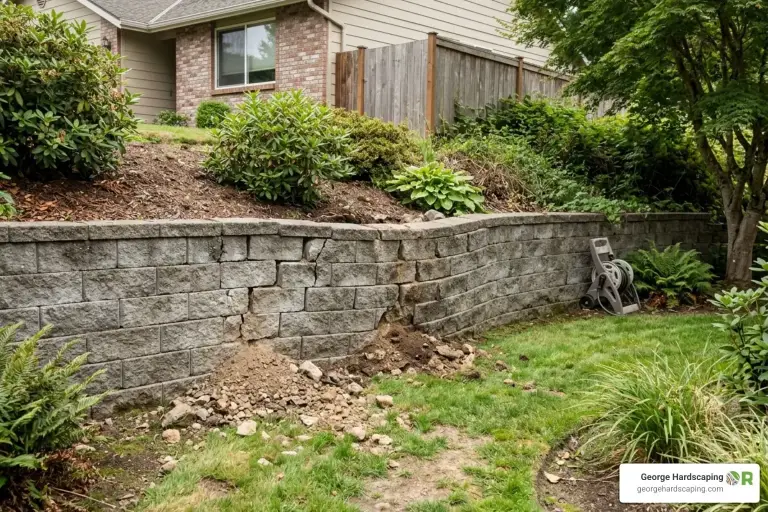
| Leaning or bowing | $200 to $1,500 | $275 to $1,200 |
| Leaking or seeping | $100 to $1,000 | $220 to $990 |
| Cracking or crumbling | $150 to $1,000 | $335 to $1,100 |
| Efflorescence (white salt residue) | $150 to $800 | $220 to $480 |
| Shifted foundation | $40 to $75 per linear foot | $650 to $1,200 |
Sources: HomeGuide retaining wall repair cost; Angi retaining wall repair cost.
These ranges describe fairly contained repairs. A lean that runs the whole length of a tall wall is a different job from a lean in one short section, and it will not land inside these numbers.
Published costs by repair method
A repair is priced by what it takes to fix the cause, not just the symptom. The guides give these rates, including labor and materials unless noted:
- Adding drainage (drain pipe or weep holes): $50 to $80 per square foot (HomeGuide); drilling weep holes through the wall, $60 to $75 per square foot (Angi).
- Anchoring a leaning wall (rods through the wall tied to anchors in the soil): $60 to $80 per square foot (HomeGuide); correcting a bowing or leaning wall overall, $65 to $85 per square foot (Angi).
- Reinforcing and straightening (new mortar and concrete, thickening the base): $50 to $80 per square foot (HomeGuide).
- Replacing a section, by material: wood or railroad ties $10 to $40, stone $10 to $85, block $15 to $55, concrete or cinder block $20 to $45, brick $30 to $60, all per square foot (HomeGuide).
- Labor alone: masons and wall contractors $50 to $75 an hour (HomeGuide) or $50 to $109 an hour (Angi).
- Structural engineer: $100 to $220 an hour (both guides).
- Permits, where a repair needs one: $50 to $450 (HomeGuide) or $50 to $200 (Angi).
What moves a repair bill up or down
Two walls with the same crack can get very different quotes. The usual reasons:
- Cause versus symptom. Resetting stones or patching mortar is cheap. Finding out why they moved, often water trapped behind the wall, and fixing that is where the money goes. A repair that skips the cause tends to come back.
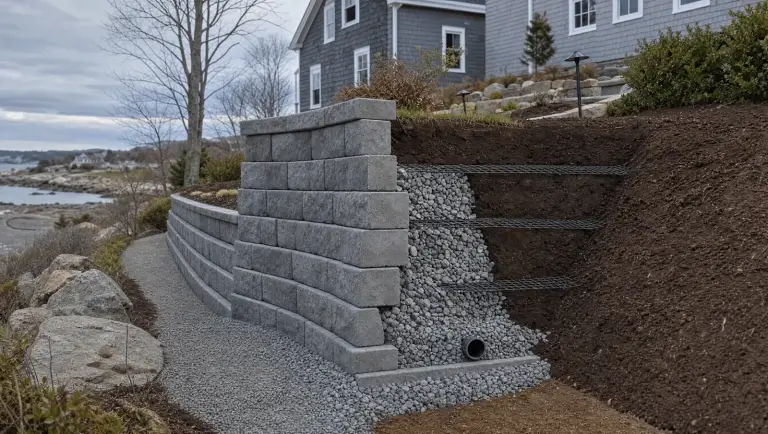
- How much has to come apart. Many repairs mean taking down part of the wall and digging out the soil behind it to add drainage or reset the base. The deeper and longer that section, the higher the cost.
- Height and what the wall holds. A garden wall is a different job from a wall holding up a driveway or sitting near the house. Loaded walls may need an engineer before anyone touches them.
- Matching the material. Natural stone and older brick can be hard to match, which is part of why stone has the widest repair range above.
- Access. Walls behind the house, on steep lots or in tight side yards mean more hand work.
- Weather and salt. In Massachusetts, repeated freezing and thawing of wet soil, and road salt on walls beside driveways and walks, speed up damage. A repair that leaves water trapped in the wall will be tested every winter.
Repair or rebuild: how to decide
Angi's rule of thumb is that repair is the right call when the wall can take the repair and the repair is at least 50 to 75 percent cheaper than a new wall (Angi). In practice, repair usually makes sense when:
- The damage is in one section, not along the whole wall
- The base is sound and the wall hasn't moved much
- Drainage can be added or fixed without taking the whole wall down
A rebuild usually makes more sense when:
- The wall leans or bulges along most of its length
- The footing is shallow or missing, or the wall was built with no drainage and one can't be added
- Earlier repairs have already failed
- It is a railroad tie or timber wall with rot in several courses; see our guide to the cost to replace a railroad tie retaining wall
HomeGuide recommends having a structural engineer look at a leaning or bowing wall before repairing it, to find the underlying cause (HomeGuide). For a mortared or natural stone wall, our main guide on how to repair a stone retaining wall explains how to read the damage and when it points to a rebuild.
Don't wait on a moving wall. If a wall is leaning toward a path, patio, driveway or house, keep people and cars away from the base and have it looked at. A wall that is visibly moving can fail suddenly, especially after heavy rain or a thaw.
Do retaining wall repairs need a permit in Massachusetts?
Often not, but it depends on what the repair changes. Both guides note that repairs typically don't need a permit unless they significantly change the wall's footprint, height or structure (HomeGuide; Angi).
In Massachusetts, the residential code exempts a retaining wall from a building permit only when it is not over four feet tall, measured from the bottom of the footing to the top of the wall, and does not support a surcharge such as a driveway or slope above (780 CMR, R105.2). If a repair turns into rebuilding a wall above that height, or one that holds up a driveway, expect to need a permit. Walls near a wetland, coastal bank or beach can also fall under the Wetlands Protection Act (310 CMR 10.02). Your town's building department and conservation commission have the final say.
How to get a repair quote you can trust
Ask each contractor to see the wall in person and to put these in writing:
- What they think is causing the damage, not just what they will fix
- Exactly how much of the wall comes down and how deep they will dig behind it
- What drainage they will add or repair, and where the water will outlet
- What happens to the price if they find more damage once the wall is opened up
- Whether an engineer or permit is needed, and who arranges it
- Why they recommend repair over rebuild, or the other way round
If digging is involved, Massachusetts law requires notifying Dig Safe (811) at least 72 hours ahead, not counting weekends and holidays (Dig Safe law, M.G.L. c. 82, s. 40).
When the answer is a new wall, George Hardscaping builds landscape retaining walls in stone, rock, brick and concrete for homes across Gloucester and the North Shore. To talk through a wall that is past repairing, request an estimate or call (781) 222-0805.