
When a Retaining Wall Starts to Fail, Every Rain Storm Makes It Worse
Replacing a retaining wall is one of the most critical decisions a homeowner can make when an outdoor structure begins to lean, crack, or crumble. Left unaddressed, a failing wall does not just ruin your home’s curb appeal—it can trigger severe soil erosion, compromise your home’s foundation, and create dangerous safety hazards on your property. In the coastal and hilly terrains of the North Shore, where weather patterns can be unpredictable, a compromised wall is a ticking time bomb.
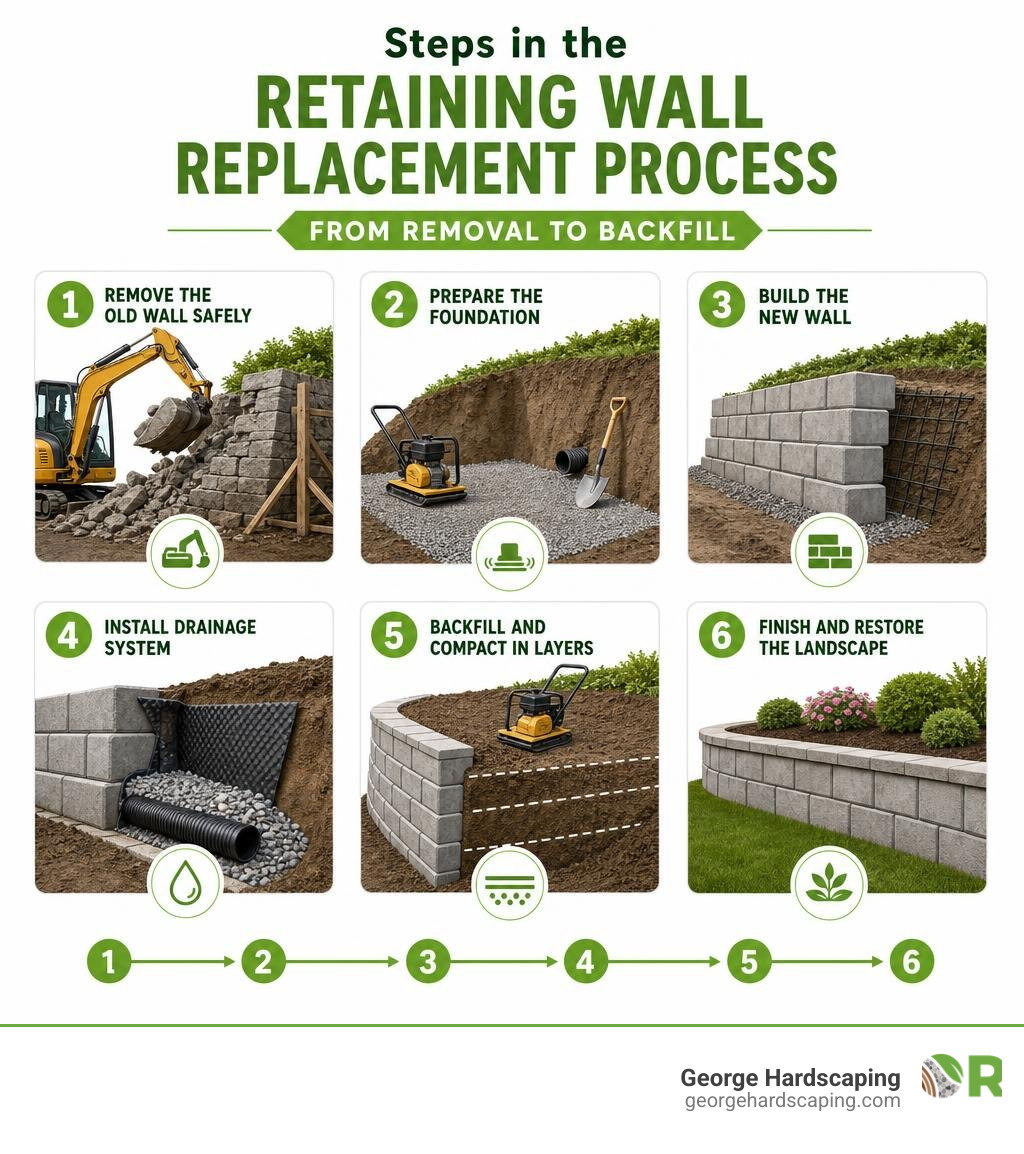
Here is a comprehensive overview of the replacement process for homeowners:
- Identify the problem — Look for leaning over 2 inches, wood rot, severe cracking, or soil separation behind the structure.
- Decide: repair or replace — If the estimated repair costs exceed 50% of a full rebuild, a complete replacement is almost always the smarter, more durable choice.
- Remove the old wall safely — Demolish the old structure section by section, utilizing temporary bracing to prevent sudden soil collapse.
- Prepare the foundation — Excavate the site, compact the subgrade base, and install a robust gravel foundation below the local frost line.
- Build the new wall — Construct the new system using high-quality materials (concrete block, natural stone, or timber) with geogrid reinforcement where structurally required.
- Backfill and finish — Compact the backfill in thin layers, install a dedicated drainage pipe, and restore the surrounding landscape.
Whether you are in Gloucester, Beverly, or anywhere across Essex County, MA, a failing retaining wall is a structural issue that tends to get significantly worse over time—never better.
Water is almost always the root cause of these failures. When proper drainage is not integrated into the wall’s design, rainwater saturates the soil directly behind it. This saturated soil can double in weight, exerting massive lateral force against the structure. One experienced builder who replaced a 16-foot timber wall he had originally built 30 years prior put it simply: the single most important lesson in retaining wall construction is drainage, drainage, drainage.
This comprehensive guide walks you through everything you need to know—from spotting early warning signs, to choosing the right materials, to understanding when you need a professional engineer and a local building permit.
Key terms for replacing retaining wall:
Repair vs. Rebuild: The 50% Rule
When you notice your retaining wall is starting to show its age, the first question is always: Can we just patch this up, or are we looking at a complete rebuild?
To make this decision easier, we recommend using the “50% Rule.” If the cost of repairing your existing wall is equal to or greater than 50% of the cost of building a brand-new one, a full replacement is almost always the more cost-effective path. Repaired walls with deep structural issues are rarely as strong as new ones and often fail again within 2 to 5 years. You can read more about options for fixing minor cosmetic issues in our retaining wall repair complete guide.
It is vital to distinguish between cosmetic damage and true structural failure. Hairline cracks in mortar or minor surface scaling on concrete blocks are cosmetic. These can often be resolved by learning how to repair a stone retaining wall. However, when a wall begins to bulge, lean, or separate from adjacent structures, the underlying structural integrity has been compromised. Cosmetic fixes on a structurally failing wall are merely temporary band-aids that mask a deeper, more dangerous problem.
Some homeowners ask us if they can save money by simply building a new wall directly in front of the old, failing one. We strongly advise against this. Leaving the old wall in place means it will continue to rot, shift, and decay behind the new structure. As it degrades, it transfers its unstable weight (known as a surcharge load) directly onto the new wall. This traps moisture and almost always leads to a “double failure,” where both walls collapse together.
In areas like Woburn, MA, where heavy clay soils are common, this risk is even higher. Clay soil retains water and expands by up to 10% in volume when wet. This massive expansion creates tremendous hydrostatic pressure that will easily push over any poorly planned “double wall” structure. Proper excavation and complete removal of the old wall are non-negotiable steps for a lasting installation.
Structural Engineering and Safety in Replacing Retaining Wall Projects
Replacing a retaining wall is a major structural undertaking. It is not as simple as pulling out old materials and stacking new ones. Because these walls hold back thousands of pounds of earth, safety and proper engineering must be your top priorities.
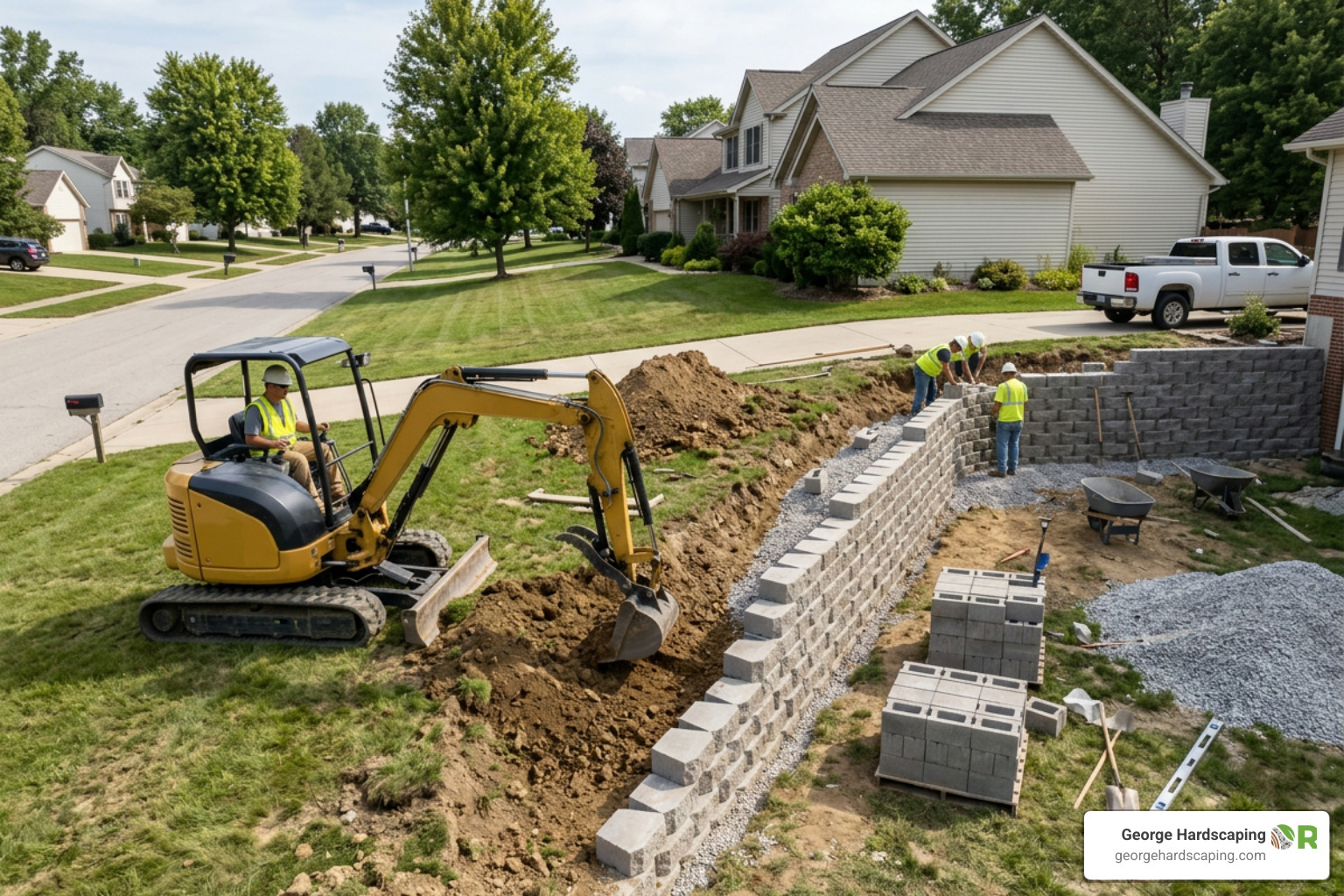
For any wall that stands over 4 feet tall, you must obtain a building permit and have the structure designed by a licensed structural engineer. This ensures the wall can handle the soil pressure and meets all Massachusetts building codes. Working with a licensed retaining wall contractor is the best way to ensure your project is fully compliant, safe, and built to last.
If you are looking for local professionals, you can browse Retaining Wall Construction Companies in Danvers – Houzz or consult resources like the Retaining Wall Construction Ipswich Ma Corlisslandscaping – Jotform to understand local planning requirements. For broader details on structural re-engineering, you can also read about Foundation Wall Replacement: When to Rebuild vs. Repair.
Warning Signs Indicating the Need for Replacing Retaining Wall Systems
How do you know if your wall is on the verge of collapsing? Look out for these critical warning signs:
- Leaning outward by more than 2 inches: This indicates the foundation has shifted or the soil pressure behind the wall has exceeded its strength.
- Rot in over 20% of timber: If you have an old wood wall and can easily poke a screwdriver deep into the wood, the internal structure is rotting away.
- Severe structural cracking: Large, horizontal cracks in concrete blocks or stone mortar mean the wall is bowing under pressure.
- Soil separation: If you notice deep cracks or gaps in the soil directly behind the top of the wall, the earth is actively sliding and pushing the wall forward.
If you notice these signs, especially after heavy rains, you may be dealing with a collapsing retaining wall that requires immediate attention. For more context on identifying these structural failures, see Retaining Wall Repair Near Amherst, Windham, Bedford, NH & MA.
Best Practices for Safely Replacing Retaining Wall Foundations
To safely remove an old wall without causing a sudden soil collapse, we follow a careful, professional step-by-step process:
- Temporary Shoring: Before we touch the old wall, we build temporary support structures to brace the soil slope behind it.
- Section-by-Section Excavation: We never tear down the entire wall at once. We excavate and remove the old materials in small, controlled sections.
- Compacted Aggregate Base: Once the old wall is gone, we dig a trench for the new foundation. A stable wall relies on a compacted gravel base (at least 6 inches deep) buried below the frost line.
- Geogrid Reinforcement: For taller walls, we install layers of high-strength geogrid fabric between the wall courses, extending back into the soil to tie the wall and the earth together.
For a detailed look at how to approach this systematic teardown, you can review the guide on how to Replace a Retaining Wall Like a Pro with Our Step-by-Step Guide – Tidy Home Guide.
The Critical Role of Drainage and Hydrostatic Pressure
We cannot overstate the importance of water management. Hydrostatic pressure—the pressure exerted by standing water trapped in the soil—is the number-one cause of retaining wall failure. When water cannot escape, it builds up behind the wall, creating a force that even the heaviest concrete blocks cannot withstand.
To prevent future failures, every wall we replace includes a dedicated drainage system:
- Perforated Drain Pipe: A perforated pipe is laid at the base of the wall’s backside, sloped to drain water safely away from the structure.
- Gravel Backfill: We place at least 12 inches of clean, crushed stone directly behind the wall. This acts as a chimney, allowing water to quickly sink down to the drain pipe rather than pressing against the wall face.
- Geotextile Fabric: We wrap the gravel in filter fabric (often called a “burrito wrap”) to prevent fine soil particles from clogging the drainage stone over time.
- Weep Holes: For solid masonry or concrete walls, we install weep holes along the bottom course to allow any trapped water to escape.
Material Comparison: Timber, Concrete Blocks, and Natural Stone
Choosing the right material for your new wall will determine its lifespan, aesthetic appeal, and long-term maintenance needs. On the North Shore, we install three primary materials: timber, segmental concrete blocks, and natural stone.
| Material | Average Lifespan | Maintenance Needs | Best Suited For |
|---|---|---|---|
| Pressure-Treated Timber | 10 to 15 years | High (susceptible to rot, warping, and pests) | Budget-conscious, low walls |
| Segmental Concrete Blocks (SRW) | 50 to 75 years | Low (interlocking system, highly durable) | Tall slopes, modern landscapes, curved designs |
| Natural Stone | Decades to centuries | Low to Medium (may require occasional mortar touch-ups) | Historic homes, rustic aesthetics, high-end hardscaping |
If you currently have an old wood wall, we highly recommend upgrading to a modern stone or concrete block system. You can learn more about this transition in our guides on replacing railroad ties with stone and how to replace railroad tie retaining wall.
For a complete breakdown of the financial differences, check out our railroad tie wall replacement cost guide and our article on the cost to replace railroad tie retaining wall.
Upgrading from timber to block completely transforms a yard’s safety and curb appeal. For a real-world example of this transformation, you can read how one homeowner successfully navigated this process: He Replaced a Failing Timber Retaining Wall and Rebuilt the Entire Slope With Block.
Understanding the Real Costs of Replacement
When planning your budget, it is important to look at realistic industry pricing. While general online sources state the average cost is between $300 and $1,500 per linear foot, realistic project costs typically span a much wider range from $600 to $7,500 per linear foot depending on site accessibility, wall height, soil conditions, and your chosen materials. Factors such as steep slopes, limited machine access, and the need for engineered drawings can significantly influence the final price.
Please note: These ranges are average industry costs based on public internet data and do not represent the actual rates or project estimates for George Hardscaping.
To see how local property owners in our area plan these projects, you can look at regional examples like Retaining Wall Boxford MA – Randall Landscaping, Expert Retaining Wall Construction Installers Near Georgetown MA, Retaining Wall Construction – Gloucester, Massachusetts, and Retaining Wall Contractors in Lynnfield, MA.
Frequently Asked Questions About Retaining Wall Replacement
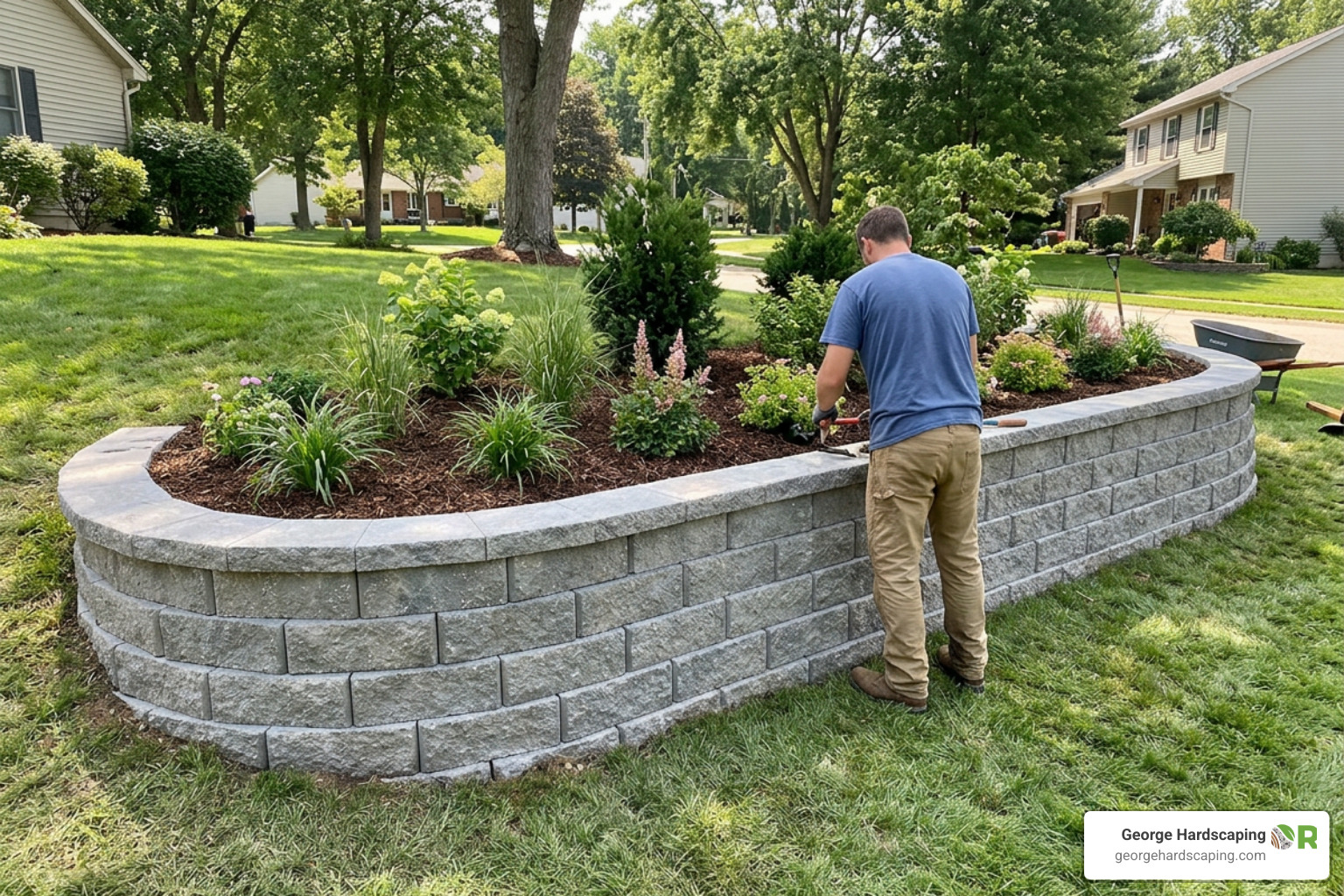
Replacing a retaining wall is a significant investment. Here are some of the most common questions we receive from homeowners planning a retaining wall construction project.
Can I build a new wall directly in front of the old one?
No, we strongly advise against this. Building a new wall directly in front of old, rotting timber or shifting stone is a recipe for premature failure. The old wall will continue to degrade, shifting the soil and trapping moisture between the two structures. This creates immense hydrostatic pressure that will eventually cause both walls to fail. Complete demolition and removal of the old wall is the only way to ensure a stable foundation for the new structure.
Do I need a permit to replace a retaining wall in Massachusetts?
Yes, in most Massachusetts municipalities—including Danvers, MA and Ipswich, MA—any retaining wall that stands 4 feet or taller requires a building permit. This regulation applies to both new installations and replacements. To obtain a permit, you will need to submit engineered plans showing that the new wall is designed to safely handle the soil loads and includes adequate drainage.
How long does a replaced retaining wall typically last?
The lifespan of your new wall depends entirely on the materials you choose and the quality of the installation:
- Segmental Concrete Blocks: These systems have an average design life of 75 years. Because they are dry-stacked and interlock, they can flex slightly with the freeze-thaw cycles of New England winters without cracking.
- Natural Stone: A properly built dry-stack or mortared stone wall can easily last for several decades, and in many cases, over a century.
- Treated Timber: Even with modern preservatives, timber walls in our damp Massachusetts climate typically last only 10 to 15 years before rot and wood-boring insects take their toll.
How do freeze-thaw cycles affect retaining walls in New England?
New England winters present a unique challenge. When water in the soil freezes, it expands. This expansion exerts lateral pressure (known as frost heave) against the back of the wall. If the wall does not have a deep, compacted gravel base below the frost line (typically 4 feet in Massachusetts) and proper drainage, the frost heave will slowly push the wall out of alignment, causing it to tilt, crack, and eventually fail.
Conclusion
A failing retaining wall is a structural hazard that will only get worse with every passing New England storm. By understanding the warning signs of failure, choosing durable modern materials, and prioritizing proper drainage, you can protect your landscape, secure your home’s foundation, and dramatically improve your property’s curb appeal.
At George Hardscaping, we bring decades of North Shore craftsmanship and professional masonry expertise to every project. Whether you need to replace an old, rotting timber wall with a beautiful natural stone structure in Gloucester, MA, or install a modern engineered block system to stabilize a steep slope, our team is here to help. We focus on building retaining walls that are not only visually stunning but engineered to stand the test of time against local clay soils and harsh winter freeze-thaw cycles.
Ready to secure your property with a beautiful, lasting structural solution? Call us today at +781-222-0805 to speak with our specialists, or request an estimate online to schedule your professional on-site evaluation. You can also explore our full range of hardscaping and masonry services or learn more about our custom landscape retaining walls to find the perfect fit for your home.
