
Why a Wet Crawl Space Is a Bigger Problem Than You Think
For many homeowners, the crawl space is an afterthought—a dark, cramped area beneath the floorboards that is rarely visited and easily ignored. However, a wet crawl space is one of the most significant and overlooked threats to a property’s structural integrity, indoor air quality, and long-term value. This is especially true across Massachusetts, where coastal weather, heavy seasonal rains, and freezing winters create a perfect storm for moisture accumulation. In communities like Gloucester, Beverly, Ipswich, Danvers, and Woburn, managing subsurface water is not just a matter of home maintenance; it is essential for protecting your investment.
Quick answer: What is a wet crawl space and why does it matter?
| Factor | What It Means for Your Property |
|---|---|
| Standing water or high humidity beneath the structure | Promotes mold, wood rot, and pest infestations |
| Up to 50% of first-floor air comes from the crawl space | Moisture below directly affects the air quality above |
| Humidity consistently above 70% | Almost guarantees mold growth |
| Saturated soil under the foundation | Leads to uneven settling, cracks, and sagging floors |
| Unaddressed moisture | Worsens over time and becomes far more expensive to correct |
In many Massachusetts properties, crawl space moisture is rarely visible from the occupied living areas above. Yet, this concealed zone directly influences the entire building envelope, indoor environmental conditions, and foundation performance. Water can remain undetected under a structure for months or even years, quietly damaging wood framing, supporting mold colonies, and weakening the soil that supports the foundation.
When water pools or high humidity persists in this subterranean space, it triggers a slow but destructive chain reaction. The wood framing that supports your home absorbs this moisture, leading to wood rot and structural sagging. At the same time, the damp, dark environment becomes a breeding ground for mold, mildew, and wood-boring pests. The longer these conditions go unaddressed, the more extensive—and expensive—the damage becomes.
To protect your home from these hidden dangers, it is crucial to understand the systems that keep your property dry. For instance, a professional dry well installation can efficiently manage subsurface water runoff. Homeowners should also implement proactive measures to prevent foundation damage from heavy rains. Additionally, installing a proper retaining wall drainage system helps relieve hydrostatic pressure, while custom-built landscape retaining walls can redirect surface water away from your home’s perimeter. If you suspect moisture issues under your home, you can request a free estimate to have our team evaluate your property.
For comprehensive project planning or professional drainage consultations in Massachusetts, call the experts at George Hardscaping today at +781-222-0805.
What Causes a Wet Crawl Space?
To effectively correct moisture issues below a structure, the first step is understanding exactly how water reaches the crawl space. Across Massachusetts, and particularly in coastal and suburban areas like Gloucester, Beverly, Ipswich, Danvers, and Woburn, several site, soil, and drainage conditions commonly contribute to persistent wet crawl spaces.
Groundwater Seepage and Hydrostatic Pressure
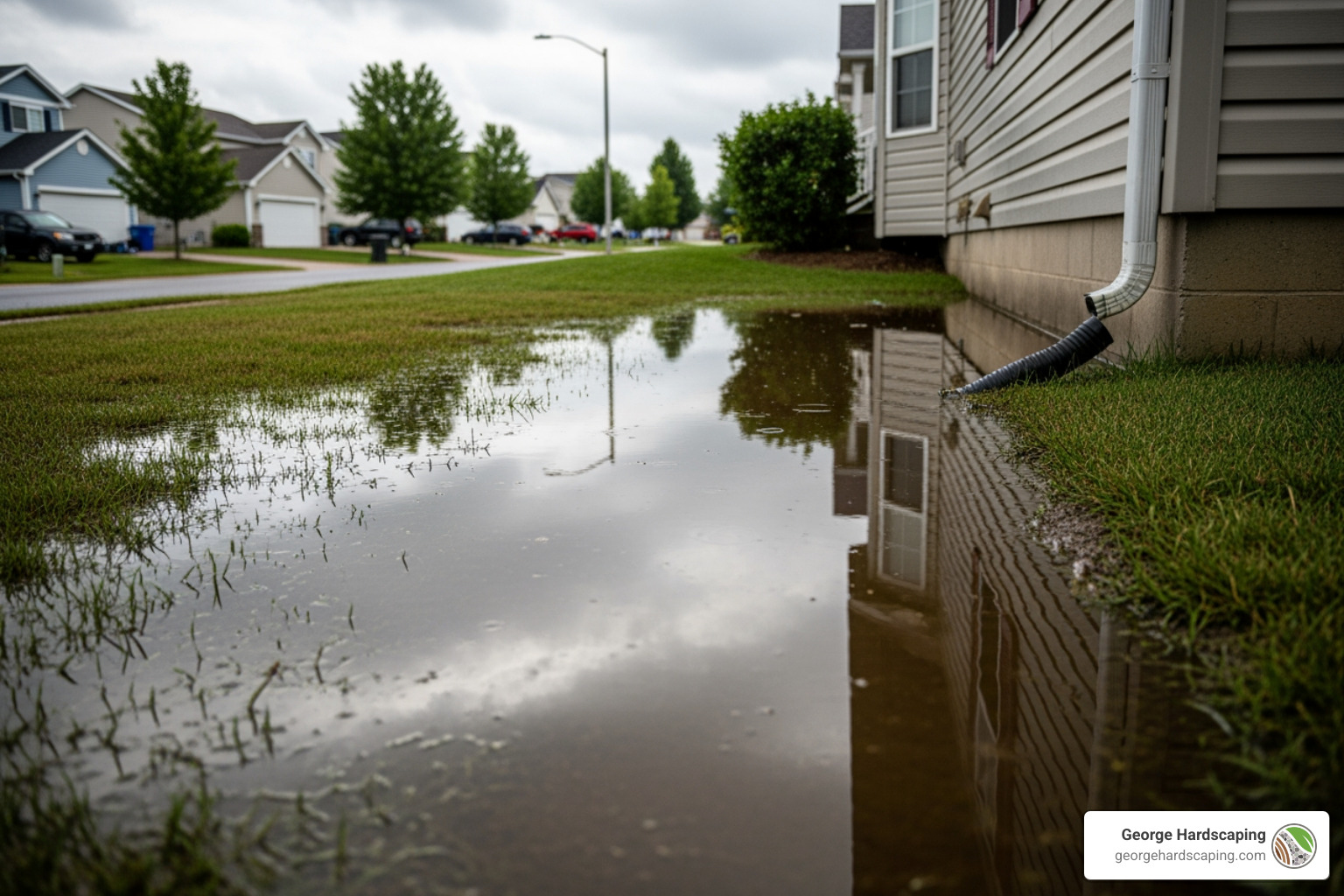
The soil surrounding your foundation acts like a giant sponge, constantly absorbing water from rain, melting snow, and high water tables. When the ground becomes saturated, it creates hydrostatic pressure—the physical weight of the water in the soil pushing against your foundation walls. Concrete, stone, and brick are naturally porous materials. Under hydrostatic pressure, water is forced through microscopic pores, small fractures, and mortar joints. In older Massachusetts homes, which often feature fieldstone or brick foundations, this seepage can be continuous, leading to active trickles or standing water on the crawl space floor.
Surface Runoff and Gutter Overflow
During heavy New England storms, a standard residential roof can shed thousands of gallons of water. If your gutter system is clogged, damaged, or lacks sufficient capacity, this water overflows and pours directly down the side of your home. When downspouts discharge water too close to the foundation, or if the surrounding yard slopes toward the house rather than away from it, this massive volume of runoff pools against the exterior walls. Without proper grading to direct this water away, it naturally drains downward, finding the path of least resistance directly into your crawl space.
Soil Composition and Regional Climate
The geological makeup of Massachusetts plays a significant role in foundation moisture. In coastal communities such as Gloucester, Beverly, and Ipswich, clay-heavy soils are highly common. Unlike sandy soils that allow water to drain quickly, clay retains moisture for extended periods, expanding as it absorbs water and shrinking as it dries. This creates prolonged damp conditions around the foundation. In inland areas like Danvers and Woburn, poor local drainage patterns and low-lying topography can compound these issues, keeping subsurface areas wet long after a storm has passed.
Implementing proper crawl space moisture control tips is an important step for temporary relief, but achieving lasting results typically requires professional drainage design and comprehensive site correction.
How a Wet Crawl Space Damages Foundations
A wet crawl space is far more than just an aesthetic or odor issue; it is a direct threat to the structural performance of your entire home. When water pools or dampness persists below a building, it initiates a damaging chain reaction that can compromise the safety of the structure.
First, the soil beneath the foundation becomes saturated. As clay-heavy soils absorb water, they expand; as they dry, they shrink. This repeated cycle of expansion and contraction causes the soil to shift, compress, and lose its load-bearing capacity. When the supporting soil moves unevenly, the foundation moves with it, leading to differential settlement, foundation cracks, and structural instability.
Inside the crawl space, high humidity and standing water directly attack the wooden support components. Floor joists, sill plates, and subfloor materials absorb moisture from the air. Over time, this continuous moisture absorption leads to wood rot, fungal decay, and structural softening. As the wood weakens, it begins to sag and deform under the weight of the home, resulting in uneven, bouncy, or sloping floors in the living spaces above. For a deeper look into how subsurface water impacts your home’s structural integrity, read about how crawlspace water causes foundation problems.
Indoor Air Quality and the Stack Effect
Even when a crawl space is completely closed off from daily view, the air below the structure does not remain isolated. Due to a natural physical phenomenon known as the stack effect, warm air rises inside a building and exits through upper levels, attic vents, and minor gaps in the building envelope. As this warm air escapes, it creates a vacuum that pulls cooler air upward from the lowest levels of the home—most notably, the crawl space.
Because of this continuous upward airflow, up to 50% of the air on the first floor of your home can originate directly from the crawl space. When that crawl space is wet, the air moving upward into your living spaces carries a variety of harmful contaminants:
- Mold Spores: Relative humidity levels consistently above 70% in a damp crawl space provide the perfect environment for mold to grow on wooden framing and fiberglass insulation. These spores are drawn upward, triggering allergies and respiratory issues.
- Musty Odors: The damp, earthy smells associated with decaying organic matter and mold migrate into occupied interior spaces, making the home unpleasant.
- Allergens and Irritants: High moisture levels support thriving populations of dust mites, which are major contributors to asthma and respiratory distress.
- Pests: Standing water and damp wood attract termites, carpenter ants, rodents, and other pests, which can cause further damage and introduce additional health hazards.
For Massachusetts properties in Gloucester, Beverly, Ipswich, Danvers, and Woburn, addressing these issues requires a comprehensive approach that combines exterior drainage improvements with professional water control measures.
Vented vs. Unvented Crawl Spaces: The Modern Standard
For decades, traditional building codes required crawl spaces to be built with vents. The underlying theory was simple: outdoor air flowing through the vents would circulate under the home and dry out any moisture that accumulated. However, modern building science has thoroughly disproven this approach, demonstrating that traditional venting actually makes crawl space moisture problems significantly worse—especially in humid climates like Massachusetts.
During our warm, humid New England summers, hot and moisture-laden outdoor air enters through the crawl space vents. When this warm, wet air comes into contact with the cooler concrete foundation walls and wooden floor joists under your home, it rapidly cools. As the air temperature drops, it reaches its dew point, and the moisture it carries condenses into liquid water droplets on these cool surfaces. This process essentially turns a vented crawl space into an active moisture generator, fueling mold growth and wood rot.
The modern standard in building science is to seal and condition the crawl space (creating an unvented system). By closing the vents, sealing the ground with a heavy-duty, multi-ply vapor barrier, and insulating the foundation walls, you completely isolate the crawl space from the volatile outdoor elements. This process, often referred to as encapsulation, transforms a damp, dirty crawl space into a clean, dry, and conditioned part of the home’s building envelope.
| Feature | Vented Crawl Space (Traditional) | Unvented/Conditioned Crawl Space (Modern Standard) |
|---|---|---|
| Moisture Control | Poor; introduces humid air and causes condensation | Excellent; seals out outdoor humidity and ground moisture |
| Mold Risk | High; relative humidity often exceeds 70% | Low; maintains safe relative humidity (30% to 50%) |
| Energy Efficiency | Poor; drafts cool or heat the floors above | High; reduces home heating and cooling energy use by 15% to 18% |
| Pest Prevention | Difficult; open vents allow easy pest entry | Excellent; fully sealed perimeter deters rodents and insects |
| Air Quality | Drafts musty, moldy air into the home | Promotes clean, dry air throughout the living spaces |
Transitioning to an unvented, conditioned crawl space not only protects your home’s structural integrity but also dramatically improves your indoor comfort, stabilizes indoor humidity levels, and lowers your utility bills year-round. By preventing the entry of humid summer air and freezing winter drafts, your heating and cooling systems do not have to work nearly as hard to maintain a comfortable indoor climate.
How to Dry Out and Prevent Crawl Space Water Intrusion
If standing water, active leaks, or severe dampness is discovered below a structure, prompt professional action is critical before wood rot, mold growth, and structural deterioration advance. Resolving wet crawl space conditions requires a dual-phase approach: immediate moisture removal and drying, followed by long-term exterior water management to prevent future intrusion.
Immediate Steps for a Wet Crawl Space
If a crawl space contains standing water, the immediate priority is extraction. This is typically achieved using high-capacity submersible sump pumps or commercial water-removal equipment. Once the bulk of the standing water has been removed, professional drying equipment—including industrial air movers and low-grain refrigerant (LGR) dehumidifiers—must be deployed. This equipment circulates dry air and extracts deeply embedded moisture from the soil, concrete foundation walls, and wooden framing components.
However, it is vital to understand that these drying measures are only a temporary first step. If the underlying source of water intrusion is not corrected, the crawl space is guaranteed to become wet again during the next heavy rainstorm or snowmelt event in Gloucester, Beverly, Ipswich, Danvers, or Woburn. A professional inspection is necessary to identify the specific drainage failures, grading issues, or foundation water pathways that are allowing water to enter.
Long-Term Exterior Drainage and Hardscaping Solutions
At George Hardscaping, we believe the most effective way to solve a wet crawl space is to prevent water from ever reaching the foundation in the first place. For properties across Massachusetts, this requires a strategic combination of professional drainage engineering, precise grading correction, masonry expertise, and durable hardscaping construction.
Our team designs and installs custom, heavy-duty systems that intercept and redirect water far away from your structure:
- Landscape Retaining Walls: If your property slopes toward your home, gravity will naturally direct surface runoff toward your foundation. We construct structural landscape retaining walls to terrace the slope, physically re-grading the land and redirecting runoff away from the foundation.
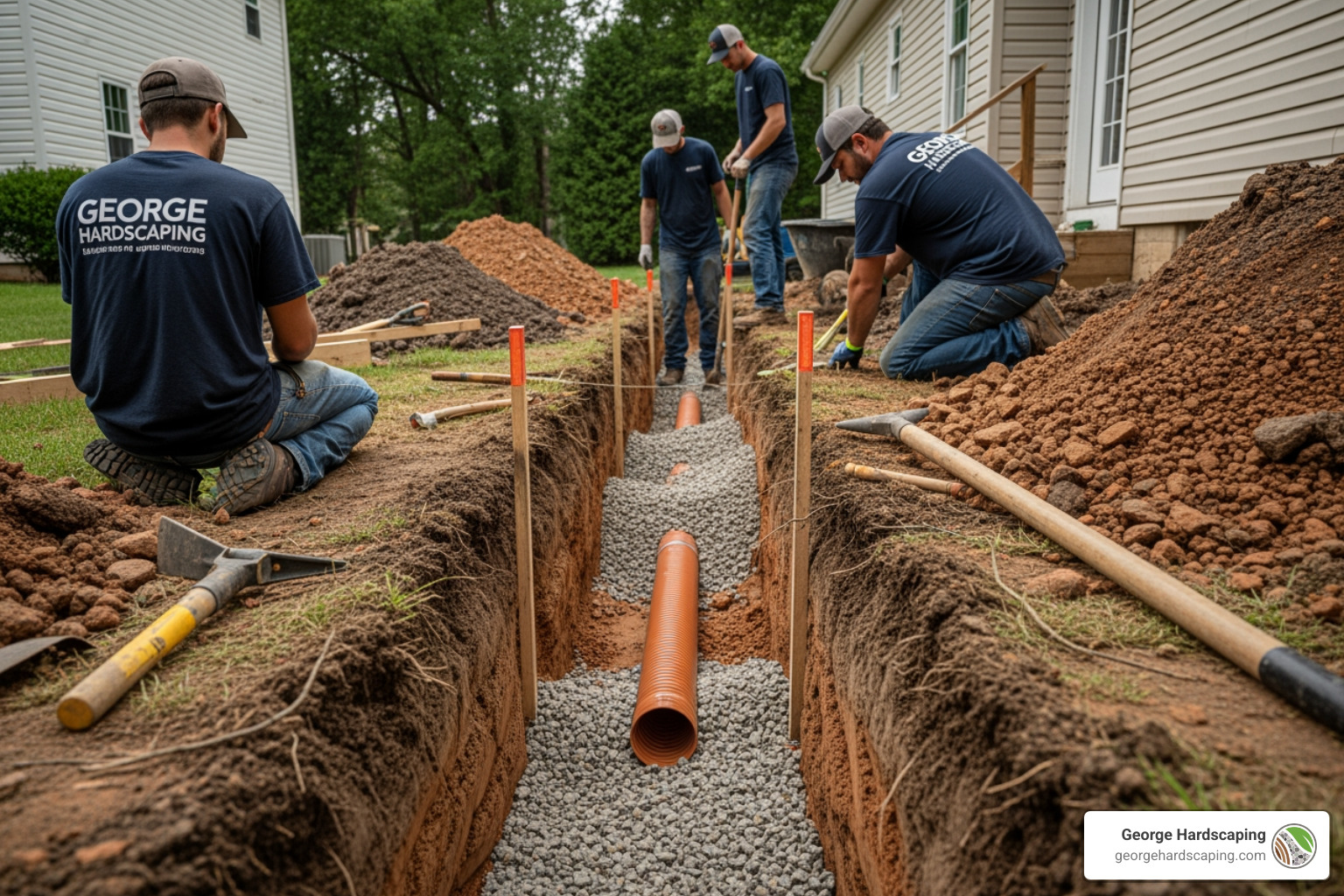
- French Drain Systems: We install sub-surface French drains around vulnerable perimeter areas. These systems consist of perforated pipes surrounded by washed stone and wrapped in filter fabric, designed to capture rising groundwater and channel it safely away from crawl space walls.
- Retaining Wall Drainage: Every retaining wall we build is engineered with advanced retaining wall drainage systems to relieve hydrostatic pressure, ensuring the long-term stability of both the wall and the surrounding landscape.
- Strategic Yard Grading: We reshape the surrounding soil to create a consistent, positive slope away from the structure, ensuring that rainwater flows away from the foundation rather than pooling against it.
These hardscaping-focused solutions are especially valuable for properties in Gloucester, Beverly, Ipswich, Danvers, and Woburn, where complex topography, coastal weather, and subsurface drainage patterns dictate whether a crawl space stays dry.
If you are ready to protect your home with a permanent drainage solution, contact George Hardscaping today. Call us at +781-222-0805 or request a free estimate online to schedule your professional site consultation.
Frequently Asked Questions About Crawl Space Moisture
How much does it cost to fix a wet crawl space in Massachusetts?
Crawl space moisture correction costs vary widely depending on the severity of the water intrusion, site conditions, structural impact, and the specific drainage solutions required. Based on publicly available online industry averages, a common national average for basic moisture control may be around $6,000.
However, to reflect real-world project variability and the unique challenges of Massachusetts properties, broad project ranges are more appropriate. Using public internet data and industry averages only, basic-to-moderate drainage and moisture correction projects may range from approximately $12,000 to $30,000+, while more extensive projects involving major drainage reconstruction, structural repairs, foundation stabilization, and comprehensive encapsulation can exceed that range significantly.
Please note: These figures are average cost ranges sourced from publicly available internet data and industry averages. They are not the actual prices, quotes, or guarantees of George Hardscaping. Every property requires an on-site evaluation to determine an accurate scope of work and cost.
Can a wet crawl space cause foundation failure?
Yes, absolutely. Prolonged water intrusion saturates the soil beneath the foundation, significantly reducing its load-bearing capacity. As the soil shifts, expands, and settles unevenly, foundation walls can crack, bow, or sink. Furthermore, constant moisture contributes to wood rot in sill plates, floor joists, and support posts. When these critical wooden components lose their structural integrity, they can no longer support the weight of the home, leading to sagging floors and potential structural failure.
Is crawl space encapsulation worth it?
In almost all cases, yes. Encapsulation is a highly effective way to protect structural materials, eliminate mold risk, improve indoor air quality, discourage pests, and support better energy performance. However, encapsulation works best when paired with proper exterior drainage and foundation water control. For many Massachusetts properties, especially in Gloucester, Beverly, Ipswich, Danvers, and Woburn, exterior hardscaping and drainage improvements should be evaluated as the primary line of defense before interior encapsulation is completed.
Conclusion
A wet crawl space is a serious threat to your home’s structural stability, indoor air quality, and long-term property value. Whether the issue involves standing water, musty odors, or persistent dampness below the structure, ignoring it typically leads to broader, more destructive, and far more expensive damage over time.
At George Hardscaping, we serve Massachusetts property owners with long-lasting drainage, masonry, and hardscaping solutions designed to keep foundations protected. From custom retaining walls that improve site grading to engineered perimeter drainage systems, we build the robust exterior infrastructure needed to control water at its source in Gloucester, Beverly, Ipswich, Danvers, and Woburn.
Do not wait for moisture to compromise your home’s foundation and air quality. Take action today to secure your property’s future. To discuss your project with our experienced team, request a free estimate online or call us directly at +781-222-0805 to schedule your professional drainage consultation.
