
Is Your Retaining Wall Bulging? Here’s What You Need to Know First
If you need to repair a bulging retaining wall, here’s the short answer:
- Stop using the area near the wall immediately — a bulging wall is a structural warning sign.
- Identify the cause — almost always poor drainage causing hydrostatic pressure buildup.
- Assess the severity — minor bulges (under 1 inch) may be stabilized; severe bulges usually require partial or full reconstruction.
- Call a professional — walls over 4 feet high, or with significant movement, require engineering expertise.
- Fix drainage first — any repair without fixing the water problem will fail again.
A retaining wall that was once straight and solid doesn’t bulge for no reason. That outward push you’re seeing is soil and water pressure winning a battle against your wall’s structure — and it rarely gets better on its own.
For homeowners on Massachusetts’s North Shore — from Beverly to Gloucester and inland toward Woburn — this is a particularly common problem. The region’s clay-heavy soils hold water, and the harsh freeze-thaw cycles of a New England winter make things worse every year.
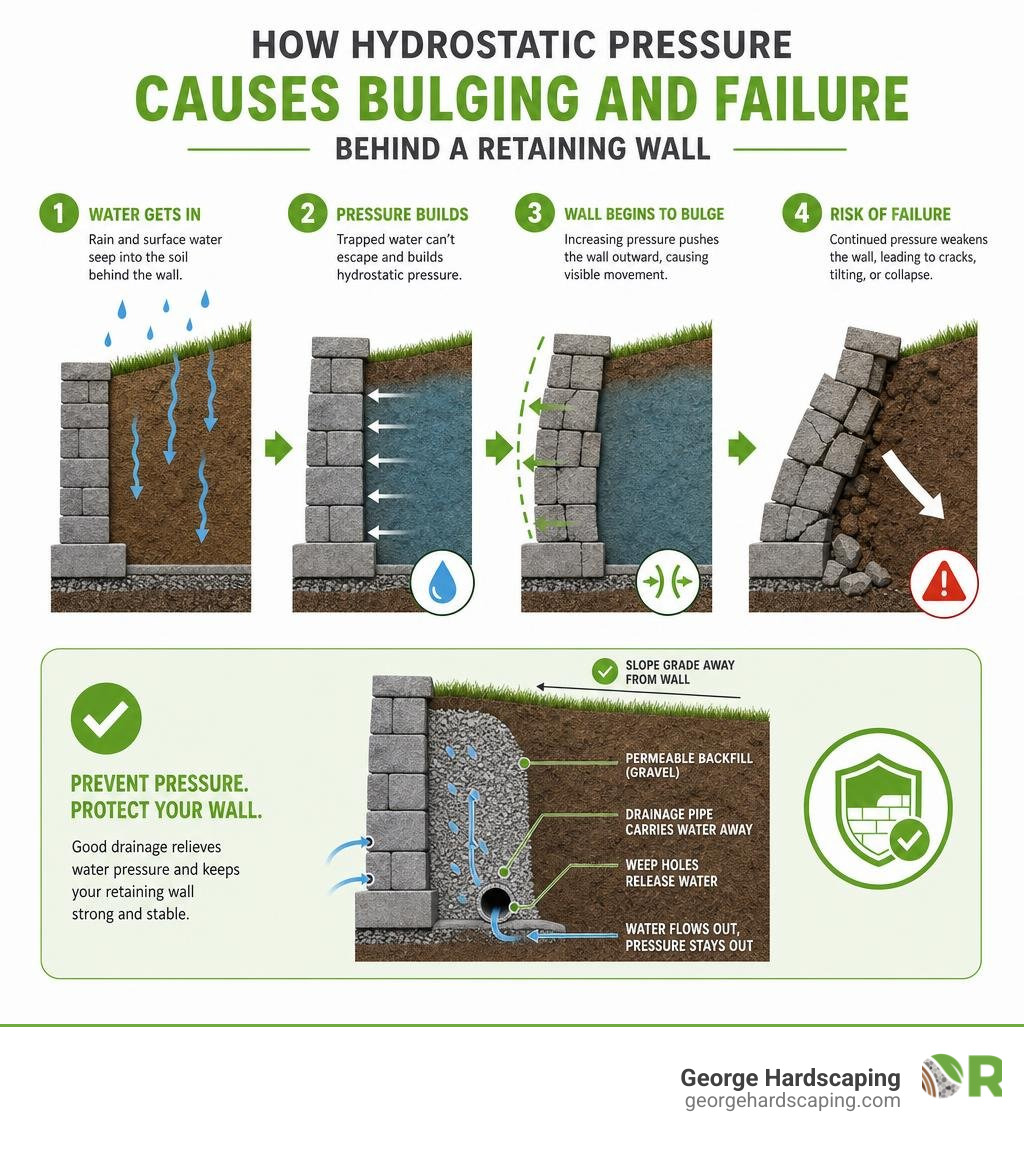
Lack of drainage is cited as the single most common cause of retaining wall failures. When water can’t escape from behind a wall, it builds up pressure — and that pressure pushes outward. Saturated soil can roughly double the lateral force pressing against your wall face.
The good news: caught early enough, a bulging retaining wall can often be repaired without a full teardown. But timing matters. The longer a wall moves, the more expensive and complex the fix becomes. If you’re seeing a wall start to bow, call George Hardscaping at +781-222-0805 to schedule a professional assessment in Essex County or the North Shore.
Simple guide to repair bulging retaining wall terms:
- how to repair a stone retaining wall
- helical anchors retaining wall repair
- leaning retaining wall repair cost
Why Retaining Walls Bulge: Identifying the Root Causes
Before jumping into a repair strategy, we must understand why the wall is failing. If we only fix the cosmetic symptom—the bulge itself—without correcting the underlying physical forces, the wall will inevitably fail again within a few seasons. In our extensive experience handling masonry and hardscaping challenges across Essex County, MA, we have identified several primary culprits behind structural bulging.
Hydrostatic Pressure: The Number One Enemy
Water is incredibly heavy, weighing about 62.4 pounds per cubic foot. Saturated soil is roughly twice as heavy as dry soil. When rainwater or melting snow accumulates behind a retaining wall without a clear path to escape, it builds up immense lateral force known as hydrostatic pressure. This pressure acts like a slow-motion hydraulic jack, pushing the middle or base of the wall outward. Without a proper retaining wall drainage system, even the strongest concrete or stone structures will eventually bow under this weight.
Clay Soil Expansion
Many areas in Massachusetts, particularly coastal zones near Gloucester and inland communities like Woburn, feature heavy clay soils. Clay is highly expansive; it acts like a sponge, absorbing water and swelling significantly in volume. This volumetric expansion exerts relentless outward pressure on the back of the retaining wall. When the dry season arrives, the clay shrinks, leaving gaps that can fill with loose soil, preventing the wall from ever returning to its original position. Over several wet-dry cycles, this “ratcheting” effect creates a permanent, dangerous bulge.
The New England Freeze-Thaw Cycle
In our region, winters are notoriously harsh on hardscape structures. When water gets trapped in the soil behind your wall and freezes, it expands by about 9%. This expansion, known as frost heave, exerts tremendous lateral and upward force. If your wall’s footings are not deep enough, or if the backfill lacks adequate drainage stone to prevent water retention, the freeze-thaw cycles of a single winter can easily ruin a perfectly straight wall.
Surcharge Loads and Construction Defects
A “surcharge load” refers to any weight placed on the ground surface behind the wall—such as a newly paved driveway, a heavy garden shed, or parked vehicles. If the wall was not originally engineered to support these additional loads, it will begin to yield. Furthermore, original construction defects—such as a weak concrete footing, a lack of geogrid soil reinforcement, or using cheap, non-angular backfill like dirt or sand instead of clean gravel—greatly accelerate structural failure.
How to Repair Bulging Retaining Wall Structures: Professional Methods
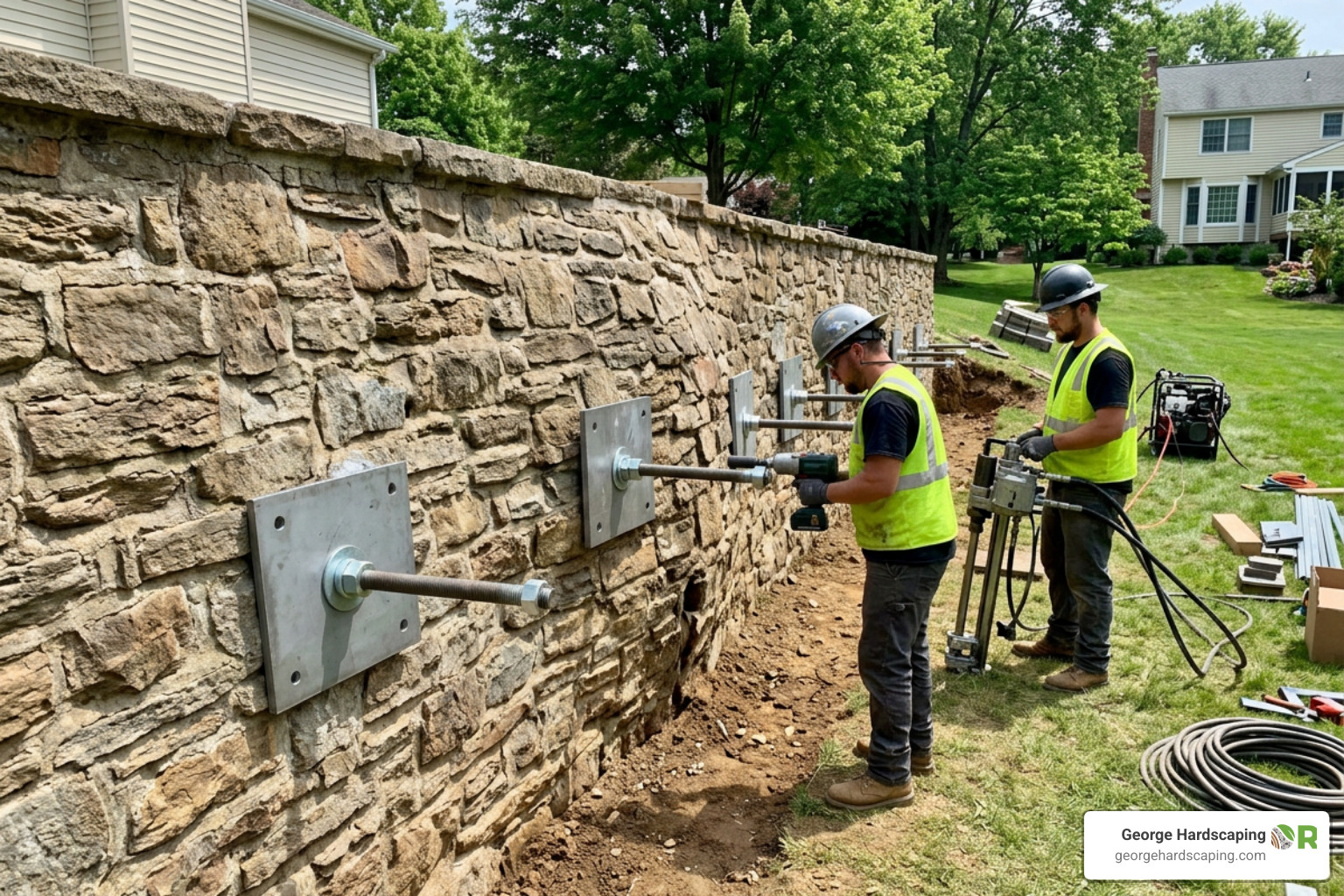
When we are called to repair a bulging retaining wall, we assess the entire structural system to determine the most effective, minimally invasive stabilization method. Modern geotechnical engineering has provided us with highly reliable tools to save walls that once would have required complete demolition.
Wall Anchors and Helical Tiebacks
For severe bulging where the wall is still structurally intact but has shifted out of plumb, wall anchors or helical tiebacks are highly effective solutions.
- Wall Anchors (Deadman Anchors): This system involves excavating a small hole in stable soil well behind the wall, usually 10 to 15 feet back, and burying a heavy steel anchor plate. A steel rod is then drilled through the bulging section of the wall and connected to the buried plate. By tightening a heavy-duty steel plate on the wall’s exterior face, we anchor the wall directly into the stable earth.
- Helical Tiebacks: These are heavy steel shafts with screw-like blades that are mechanically drilled deep into the soil behind the wall until they reach stable load-bearing strata. Once installed, they are secured to the wall face with heavy-duty steel plates. This method is incredibly robust and is often used in complex residential hardscaping projects throughout coastal Massachusetts, including Gloucester, where high water tables and coastal weather patterns demand advanced engineering solutions.
Soil Nailing and Carbon Fiber Reinforcement
- Soil Nailing: This technique involves drilling long, steel-reinforcing bars, or nails, directly into the soil mass behind the wall at a downward angle and grouting them into place. A drainage layer and a new structural face, often shotcrete or decorative stone veneer, are then applied over the top.
- Carbon Fiber Reinforcement: For masonry or concrete block walls showing minor mid-section bowing or horizontal cracking, we can apply high-strength carbon fiber straps. Carbon fiber is up to ten times stronger than steel in tension. When bonded to the wall face with structural epoxy, it prevents further outward movement and stabilizes the masonry without changing the wall’s footprint.
Partial Reconstruction
If the bulge is localized, affecting only a 10-to-15-foot section of a modular block or dry-laid stone wall, we often perform a partial reconstruction. This involves carefully dismantling the damaged section in an inverted V-shape, excavating the failed backfill, correcting the drainage, and rebuilding the wall using the original materials reinforced with modern geogrid. For more details on these customized strategies, consult our retaining wall repair complete guide.
Why DIY is Not Recommended to Repair Bulging Retaining Wall Systems
While minor cosmetic issues, like sealing a hairline crack in a small garden border, can occasionally be tackled by an ambitious property owner, attempting to repair a bulging retaining wall as a DIY project is highly discouraged.
- Extreme Safety Hazards: A bulging wall is under immense, active tension. Excavating soil from behind a compromised wall without proper shoring can trigger a sudden, catastrophic collapse. Tons of soil and stone can fail in seconds, presenting a severe risk of injury or death.
- Heavy Machinery Requirements: Properly fixing a structural wall requires specialized equipment, including mini-excavators, skid steers, and heavy plate compactors. Operating this machinery safely and effectively requires years of professional training.
- Engineering and Permitting Compliance: In Massachusetts, most municipalities require structural engineering plans and building permits for retaining wall repair or construction over certain height thresholds, often around 3 to 4 feet depending on the town and project conditions. Professionals ensure the work is reviewed for local code compliance and applicable state requirements, including information published through the Massachusetts State Building Code.
- Compaction and Soil Mechanics: Achieving the correct soil compaction behind a wall is a precise science. Under-compacted soil will settle, causing the wall to sink or tilt; over-compacted soil can exert too much lateral force, creating a new bulge.
If you are noticing structural issues on your property, do not wait for a catastrophic collapse. Contact the experts at George Hardscaping today to schedule your professional hardscape repair near me assessment and secure your property’s foundation.
Step-by-Step Professional Process to Repair Bulging Retaining Wall Failures
When our team at George Hardscaping takes on a structural repair project, we follow a rigorous, engineered protocol to ensure the wall remains stable for decades. Here is how we execute a professional repair:
Step 1: In-Depth Site Inspection and Assessment
We begin by measuring the exact lean and bulge of the wall using a plumb bob or structural levels. We inspect the surrounding landscape for surcharge loads, identify water runoff patterns, and evaluate the condition of the existing masonry or blocks. If the wall has moved significantly, we collaborate with a structural engineer to design a custom stabilization plan.
Step 2: Shoring and Excavation
Safety is our top priority. Before any soil is removed, we install temporary bracing or shoring to support the wall. We then carefully excavate the failed, saturated soil from behind the bulging section, taking care not to disturb the surrounding landscape or utility lines.
Step 3: Retrofitting the Drainage System
Since water is the root cause of almost all failures, we install a high-performance drainage system. This includes laying a 4-inch perforated drain pipe, or weep tile, wrapped in geotextile filter fabric along the base of the footing. We then drill new, 3-inch diameter weep holes through the wall face at regular intervals to allow trapped water to escape freely.
Step 4: Installing Structural Reinforcement
Depending on the engineered plan, we install helical tiebacks, soil nails, or layers of high-strength geogrid. Geogrid is a synthetic mesh that locks the backfill soil particles together, turning the soil mass itself into a reinforced, stable structure that pulls back against the wall face.
Step 5: Backfilling with Clean Aggregate and Compaction
We replace the old, clay-heavy backfill with clean, 3/4-inch angular drainage stone. This stone allows water to flow downward rapidly to the drain pipe rather than building lateral pressure. We backfill in thin, 6-inch layers, or lifts, using mechanical plate compactors to achieve maximum structural density without over-stressing the wall.
For a deeper look into how we diagnose and correct these structural issues, read our guide on fixing a leaning retaining wall.
Material-Specific Repair Strategies for Massachusetts Landscapes
Different retaining wall materials react uniquely to soil pressure and environmental stress. Consequently, our repair strategies must be tailored to the specific material of your wall.
Segmental Block Walls
Segmental block walls (like those built with Allan Block or Keystone systems) are highly durable gravity structures. When they bulge, it is usually because the geogrid was omitted or the backfill was not compacted properly. Because these blocks are dry-stacked, we can often dismantle the bulging section, clean the blocks, install proper drainage, and rebuild them using the exact same materials. This makes them highly cost-effective to repair. If you are located on the North Shore, including Lynnfield and Beverly, our team can help you design and install a durable block system that stands up to local soil conditions.
Natural Stone Walls
Whether dry-laid or mortared, natural stone walls are a hallmark of historic New England properties in towns like Ipswich and Beverly.
- Dry-Stone Walls: These walls are designed to be flexible and permeable. Over decades, settling soil or tree roots can cause localized bulging. We repair these by carefully dry-stacking the stones back into place, matching the historic pattern. For historic preservation tips, read our guide on How to Repair a Stone Retaining Wall.
- Mortared Stone Walls: These rigid structures are highly susceptible to cracking and bulging when water gets trapped behind them and freezes. Repairing them requires clearing clogged weep holes, stabilizing the core, and executing precise masonry repairs. Homeowners in coastal communities like Ipswich and Gloucester can rely on our expert masonry services for historic and modern stone wall solutions.
Timber Sleeper Walls
Timber walls (often built with railroad ties) have a limited lifespan, typically lasting 10 to 20 years. They usually bulge because the wood has rotted at the base or the tieback “deadmen” have decayed. Because timber degrades structurally over time, we almost always recommend a full replacement with a modern stone or block system rather than attempting to repair rotten wood. If you are in the Georgetown area, we highly recommend replacing failing timber with a modern, durable stone or block system.
The Cost of Retaining Wall Repair vs. Replacement
When deciding whether to repair or replace a bulging wall, budget is naturally a primary consideration. To help you plan, we have compiled average industry pricing based on publicly available internet data.
Please note: All prices listed below are average costs sourced from public internet data and are not the actual prices of George Hardscaping. Retaining wall projects vary wildly based on site accessibility, wall height, soil conditions, and permitting requirements.
To give you a realistic idea of the wide range of industry pricing, we have structured the table below using a broad range where the low end reflects 2x the standard industry average and the high end reflects at least 5x the average to account for complex engineering challenges.
| Service Type (Based on Public Internet Data) | Standard Industry Average | Low-End Range (2x Average) | High-End Range (5x+ Average) |
|---|---|---|---|
| Minor Repairs (Crack sealing, block replacement) | $500 | $1,000 | $2,500+ |
| Structural/Drainage Repairs (Tiebacks, drainage retrofit) | $1,200 | $2,400 | $6,000+ |
| Full Rebuild / Replacement (Demolition, excavation, new wall) | $6,072 | $12,144 | $30,360+ |
As a general rule of thumb, a full replacement of a retaining wall can cost 4 to 5 times as much as a targeted structural repair. If the structural integrity of your wall’s materials is still excellent, investing in professional stabilization methods like helical tiebacks and drainage retrofits is an incredibly smart, cost-effective decision that can extend the life of your wall by decades.
For a comprehensive breakdown of the financial factors involved in these projects, please review our resources on retaining wall cost and How Much Does It Cost to Repair a Retaining Wall.
Frequently Asked Questions about Retaining Wall Repair
Can a bulging retaining wall be straightened without a full rebuild?
Yes, in many cases, a bulging wall can be stabilized and partially straightened without a complete teardown. By using heavy-duty helical tiebacks or wall anchor systems, we can secure the wall to stable soil deep underground. Over time, with careful excavation behind the wall and systematic tightening of the anchor plates, the wall can often be pulled back toward its original vertical alignment. However, if the wall has moved more than 2 inches out of plumb or has suffered severe structural cracking, a partial or full rebuild is usually required.
How does the Massachusetts winter affect a repaired retaining wall?
The harsh winters in Massachusetts present a major challenge to retaining walls. When water freezes in clay-heavy soils, it expands, creating “frost heave” that pushes relentlessly against the back of the wall. If a wall has been repaired using proper, clean angular gravel backfill and a robust drainage pipe, the water will drain away before it can freeze. This prevents frost heave entirely, ensuring your repaired wall remains perfectly straight even during the coldest winter months.
What is the most critical factor in preventing future wall bulging?
Without a doubt, proper drainage is the single most critical factor. Even the thickest concrete wall will eventually fail if water is allowed to pool behind it. To prevent future bulging, a wall must have a dedicated 4-inch perforated drain pipe at its base, a minimum of 12 inches of clean drainage stone directly behind the masonry, and clear weep holes to relieve hydrostatic pressure. Regular maintenance, such as clearing leaves and debris from weep holes, is also essential.
Conclusion
A bulging retaining wall is a serious structural warning sign, but it does not have to mean a stressful, incredibly expensive property disaster. By understanding the root causes, like hydrostatic pressure and clay expansion, and addressing them with proven, professional engineering methods, we can restore the safety, functionality, and beauty of your landscape.
At George Hardscaping, we have spent years serving Essex County, MA, building a reputation for uncompromising quality and master craftsmanship. Whether you are dealing with a historic dry-stone wall in Gloucester, a modern segmental block wall in Woburn, or a masonry repair need in Beverly or Ipswich, our team has the specialized expertise to deliver a permanent, warrantied fix.
Do not wait for a minor bulge to turn into a costly collapse. Secure your landscape today.
Ready for a permanent solution?
- Request a professional assessment online: Get a Free Estimate
- Explore our services: George Hardscaping Hardscaping & Masonry Services
