
Why Understanding Leaning Retaining Wall Repair Cost Matters for Essex County Homeowners
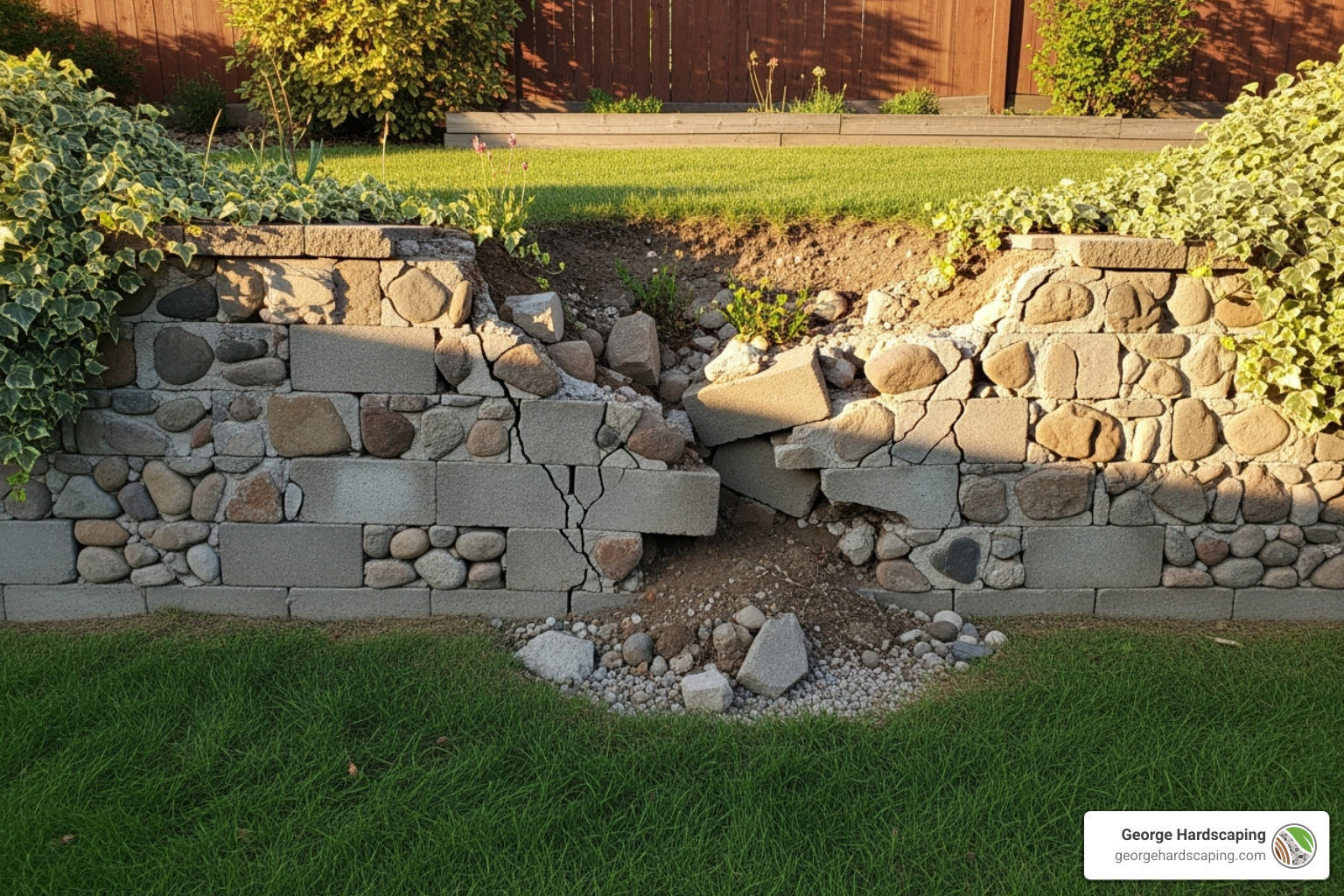
Image metadata: title: Leaning Retaining Wall in a Residential Yard; alt: leaning retaining wall – leaning retaining wall repair cost; source: George Hardscaping page asset; subject: residential retaining wall showing forward lean and structural distress.
A leaning retaining wall is more than a cosmetic flaw—it is a structural emergency that threatens your family’s safety, your landscape, and your property value. In Essex County’s freeze–thaw climate, minor issues can escalate quickly if drainage is poor or the wall was not engineered properly. The leaning retaining wall repair cost can range from a few hundred dollars for simple fixes to well over five figures when excavation, anchoring, and partial reconstruction are required. Understanding what drives those costs helps you act fast and spend wisely.
Quick reality check: internet-based averages suggest a wide range of repair costs because wall height, materials, access, and the root cause of the lean vary. A modest 3–4 ft garden wall with clogged weep holes can often be stabilized for far less than a tall, load-bearing wall with inadequate footings and saturated soils. Even so, there is one constant: waiting makes problems—and costs—bigger. Our Essex County team routinely sees projects where a timely $800 drainage correction could have prevented a $12,000 rebuild.
If you take only one thing from this guide, make it this: water management is everything. Hydrostatic pressure from trapped water behind the wall is the number one cause of leaning and failure, as recognized by national guidance such as the Federal Highway Administration’s Retaining Walls and Reinforced Soil Slopes manual. For background on these forces and how they act on walls, see the FHWA overview in Retaining Walls and Reinforced Soil Slopes.
We’ll cover costs, common failure causes, repair methods like helical anchors for retaining walls, when replacement is the right call, and how to choose the right pros. We’ll also link to relevant George Hardscaping service pages so you can move from learning to action quickly.
Quick Cost Overview (typical internet-based ranges, not George Hardscaping pricing):
- Minor Repairs: $250–$500 (crack sealing, clearing drainage)
- Moderate Leaning: $500–$1,500 (anchoring, reinforcement)
- Severe Damage: $1,500–$5,000+ (partial rebuild)
- Complete Replacement: $6,000–$20,000+
Note: These are averages pulled from public sources and not George Hardscaping pricing. Local conditions, access, engineering needs, and materials can shift costs significantly.
What drives cost in Essex County:
- Seasonal freeze–thaw cycles aggravate weak drainage and improper backfill.
- Tight access in older neighborhoods can require hand excavation and compact equipment.
- Clay pockets and perched groundwater lift hydrostatic pressure.
- Surcharge loads (decks, sheds, parking) near the wall top increase design and repair complexity.
If your wall is leaning today, a targeted fix now can prevent an expensive rebuild later. When you’re ready to explore practical solutions—from drainage improvements to anchors—review our comprehensive Retaining Wall Solutions guide and the specialized page on Helical Anchors Retaining Wall. For additional context on retaining wall engineering principles, the American Society of Civil Engineers provides technical resources that explain the fundamental forces at work.
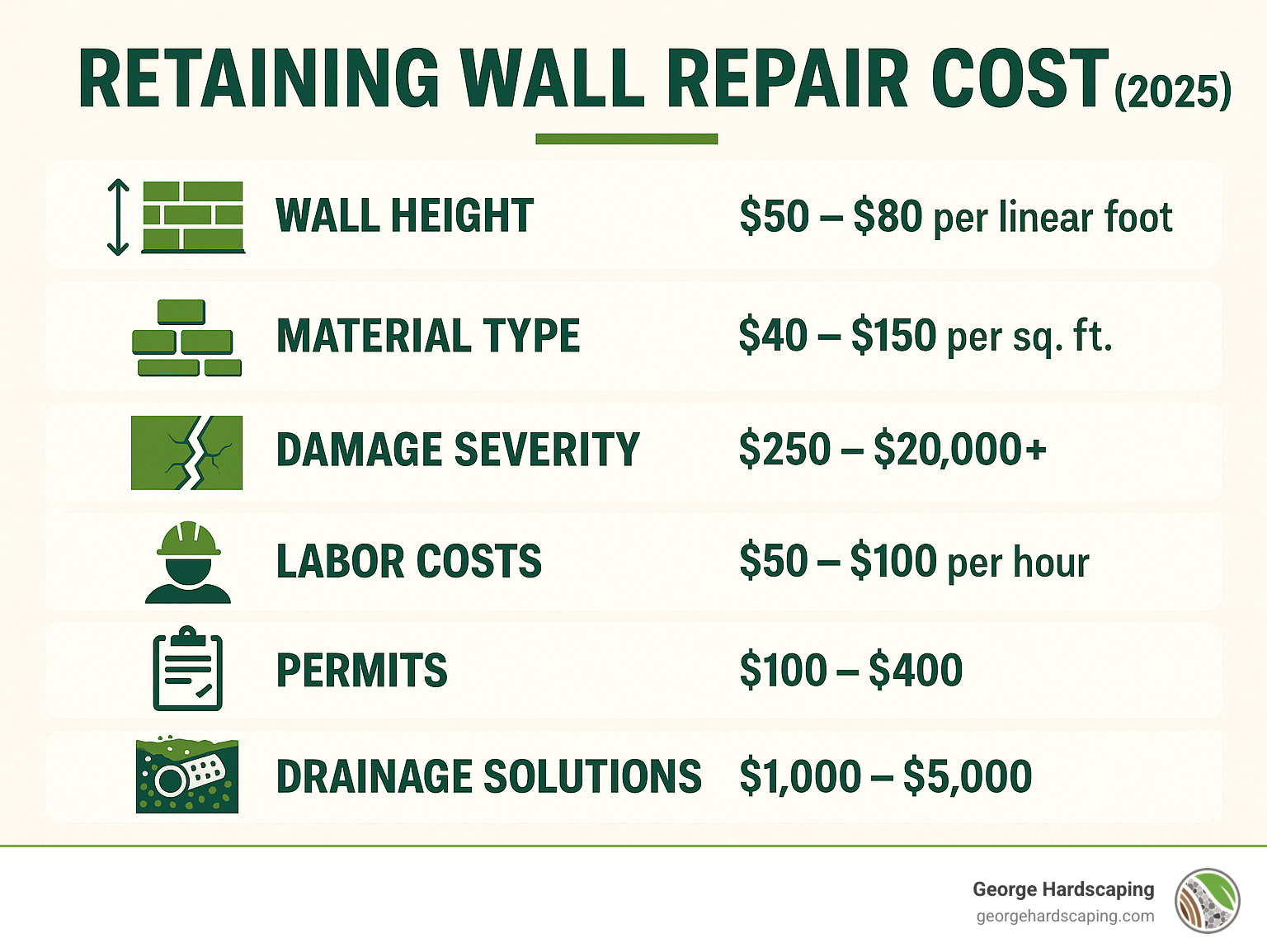
Image metadata: title: Retaining Wall Repair Cost Breakdown Infographic; alt: Comprehensive breakdown of retaining wall repair costs including factors like wall height, material type, damage severity, labor costs, permits, and drainage solutions with specific price ranges for each component – leaning retaining wall repair cost infographic; source: George Hardscaping page asset; subject: infographic summarizing cost drivers and ranges for wall repair.
Prefer to speak with a pro now? Strong CTA: Schedule your on-site assessment today. Our experts will diagnose the cause and give you a clear plan and price options. Request a visit via our Retaining Wall Contractor page or go straight to our Request Estimate form.
Why Is My Retaining Wall Leaning and What’s at Stake?
A retaining wall leans when the forces pushing from behind exceed the wall’s resistance. In plain terms: the soil and water are winning. Determining the cause is essential to predict the leaning retaining wall repair cost and choose a lasting fix.
The most common culprit is hydrostatic pressure—water trapped in soil behind the wall that cannot drain out. In Essex County, saturated soils after storms and snowmelt amplify lateral pressure. Without the right combination of gravel backfill, filter fabric, perforated drain pipe, and weep holes, water builds up and presses the wall forward. Industry and agency resources emphasize the importance of drainage; for example, see the FHWA’s Retaining Walls and Reinforced Soil Slopes manual on lateral earth pressures and drainage basics and the NCMA overview on segmental retaining wall best practices.
Other common causes include:
- Inadequate Footings: A footing that’s too shallow, narrow, or built on unstable soil invites rotation and settlement.
- Improper Backfill: Using heavy clay or compacted native soil instead of free-draining aggregate traps water.
- Missing or Clogged Drainage: Absent or blocked weep holes and drain pipes retain water, increasing pressure with every storm.
- Soil Compaction Issues: Poorly compacted lifts or uneven compaction create differential settlement and pressure points.
- Surcharge Loads: Additions like new patios, parking pads, sheds, or raised garden beds near the wall crest boost lateral force.
- Freeze–Thaw Cycles: Water expands when it freezes, pushing outward on the wall. Repeated cycles exacerbate small defects.
- Tree Roots and Burrowing: Root growth and burrowing animals can destabilize backfill and footings over time.
The evidence you see will often hint at the cause. Bulging or bowing suggests sustained pressure; gaps forming between the soil and wall top point to settlement or soil sloughing; rust stains or efflorescence can indicate chronic moisture issues. If your wall is segmental (block) construction, displaced caps and stair-stepped separations often occur where drainage is weakest.
The Real Risks of Doing Nothing
- Complete Wall Collapse: Failure can be sudden, scattering tons of material. This is a serious safety hazard for kids, pets, and passersby.
- Property Damage: A failing wall can damage patios, driveways, fences, sheds, and sometimes nearby building foundations.
- Soil Erosion and Landslides: On slopes, a failed wall may trigger downslope movement of soil. For background on slope hazards, see USGS Landslide 101.
- Rising Costs: A fix that could be handled with drainage and tiebacks today can become a partial rebuild (or total replacement) within a season.
When Your Wall is Screaming for Help Seek a professional assessment immediately if you notice:
- Rapid Lean Progression: Changes visible week-to-week or after heavy rain.
- Large, Expanding Cracks: Horizontal or diagonal cracking wider than 1/4 inch, especially if growing.
- Bulged Sections: Localized outward bowing along the wall face.
- Soil Washout or Sinkholes: Erosion at the toe, voids behind the wall, or undermined footing areas.
- Heaving or Uplift: Footing or base layers popping from freeze–thaw or subgrade movement.
Remember: the right diagnosis drives the right repair. A professional who evaluates drainage, soils, and structure can help you choose between drainage improvements, retaining wall anchors, reinforcement, or rebuilding. Our team uses local experience plus published standards as a cross-check, including FHWA guidance and NCMA best practices. The Portland Cement Association also provides valuable technical resources on proper retaining wall construction and maintenance standards.
Decoding the Leaning Retaining Wall Repair Cost
Putting real numbers to a repair plan reduces stress and prevents surprises. While every site is unique, national averages for common fixes often fall between $450 and $1,500. However, for taller walls, sites with difficult access, or walls with advanced structural damage, projects can range into the tens of thousands when significant excavation, new drainage, anchoring, and partial rebuilding are required.
Note: These are average costs based on internet research and not actual George Hardscaping pricing. Your final cost is a unique calculation based on wall height and length, soil conditions, site accessibility, local permitting, chosen materials, and any required professional design.
Typical Repair Ranges (internet-based):
- Crack Sealing and Minor Patching: $250–$500
- Drainage Cleanout and Weep Hole Restoration: $300–$800
- Moderately Leaning Wall Reinforcement (e.g., anchors/tiebacks): $500–$1,500
- Severe Structural Corrections and Partial Rebuilds: $1,500–$5,000+
- Complete Replacement (50 ft typical wall): $6,000–$20,000+
Key Factors That Determine Your Final Bill
- Wall Dimensions: Taller and longer walls require more material, larger footings, and more labor. Design and permitting thresholds are often triggered for walls over 4 feet in height, adding engineering costs.
- Severity and Location of Damage: A localized lean near a corner is a far cheaper fix than widespread bowing along the entire wall, which indicates systemic failure.
- Site Access: This is a major cost driver. Tight lots, fences, or steep terrain can prevent the use of efficient machinery, requiring manual labor and smaller equipment, which increases costs.
- Excavation Requirements: Any repair requiring digging behind the wall is a significant undertaking. Costs include labor, hauling away old soil, and bringing in specified engineered backfill.
- Soil and Groundwater Conditions: Clay-rich soils, common in New England, hold water and expand, increasing pressure. The presence of groundwater demands more robust and expensive drainage solutions.
- Engineering and Permits: Taller, tiered, or critical load-bearing walls often require stamped plans from a structural engineer and municipal inspections. For general code context, consult the International Building Code Chapter 18: Soils and Foundations (2021). Always verify your town’s specific rules.
Repair Costs by Wall Material (internet-based):
- Timber/Wood: Susceptible to rot, repairs often involve replacing entire sections. Tieback installation is common. Expect costs of $40–$60 per square foot for significant repairs.
- Concrete/Cinder Block: Minor crack injection is inexpensive ($150–$400), but if the lean is due to systemic failure, these cosmetic fixes are useless. Anchoring or partial rebuilds are necessary.
- Stone Retaining Walls: Repairing natural stone is a craft. Resetting stones and re-pointing joints is labor-intensive, with costs from $300 for minor work to over $1,600 for significant sections.
- Brick: Often a veneer. Repointing can cost $300–$1,250. If the structural block behind the brick has failed, the repair is much more extensive.
Understanding the Leaning Retaining Wall Repair Cost by Solution
- Anchoring & Tiebacks: Installing helical anchors for retaining wall repair is an engineered solution that typically runs $60–$80 per linear foot, varying with wall height and soil density. These steel shafts with helical plates are drilled through the wall into stable soil, transferring the lateral load. The installation is less invasive than a full rebuild and provides immediate stabilization. This method must be paired with drainage upgrades to address the root cause.
- Drainage System Installation: This is the most critical part of any long-term repair. It involves excavating to install a perforated drain pipe, washed stone, and filter fabric to channel water away. This can range from $70–$90 per square foot of wall face due to the significant excavation involved. Addressing water is non-negotiable.
- Reinforcement: For walls being partially rebuilt, adding reinforcement is key. This can mean steel rebar in concrete walls or, more commonly, layers of geogrid. Geogrid is a polymer mesh laid into the slope during backfilling, tying the wall face to a stabilized soil mass. The total installed cost is dominated by labor and excavation.
- Straightening: In some cases, a wall with a sound footing can be pushed back. This involves excavating behind the wall and using hydraulic jacks to realign the face. It can run $60–$80 per linear foot but is only viable if the foundation is intact and a full drainage system is installed immediately after.
- Partial Rebuilds: This involves dismantling failed sections and rebuilding from a corrected base up, including modern drainage and reinforcement. Costs typically range from $70–$125 per linear foot but vary widely with site conditions.
Additional Line Items That Commonly Appear on Estimates
- Mobilization and Access Preparation: Building temporary ramps, removing fences, or protecting landscaping.
- Haul-Off and Disposal: The cost to remove and dispose of old soil and demolished wall materials.
- Filter Fabric and Washed Stone: Essential, non-negotiable materials for modern drainage systems.
- Engineering Review: Fees for a structural engineer to assess the failure and design a certified repair plan.
- Permitting and Inspections: Municipal fees, which vary by town. Many Essex County towns require permits for walls over 3–4 ft.
Pro tip: If your wall is already leaning, anchoring without solving drainage is a short-term fix. The physics of hydrostatic pressure will continue to act on the wall until water has a reliable exit path. Review long-term approaches in our Retaining Wall Solutions guide and see how anchors are designed on our Helical Anchors Retaining Wall page.
Repair or Replace? Making the Right Financial Decision
Choosing between repair and replacement is a balance of risk, cost, and lifespan. While repairing a leaning retaining wall usually costs less upfront, those savings evaporate if the wall lacks fundamentals like drainage, adequate base, or proper reinforcement. If a repair can restore structural integrity and address root causes, it’s often the smart move. But if repairs approach 50–75% of full replacement and the wall has multiple compounding issues, replacement frequently wins on total cost of ownership.
Signs Your Wall May Be Unsalvageable
- Widespread Material Failure: Severe rot in timber, spalling or delamination across concrete block faces, or stone disintegration over large spans.
- Multiple, Growing Cracks: Particularly horizontal cracks and stepped cracks that widen after rain events.
- Severe Lean: A lean exceeding roughly 1 inch per foot of height suggests foundational issues and potentially unsafe conditions.
- Compromised Footings: Evidence that the base is undersized, undermined, or shifting.
- Damage Exceeding 50–75% of the Wall: At that point, you’re effectively rebuilding most of the system anyway.
Comparing the Leaning Retaining Wall Repair Cost to a Full Replacement
- Repair Costs: $250 for minor fixes to $5,000+ for complex stabilizations and partial rebuilds.
- Replacement Costs: For a typical 50 ft wall, $6,000–$20,000+ depending on materials, height, design, and access.
- Demolition: Removing the old wall typically adds $10–$20 per linear foot.
Hidden Costs of a Full Replacement
- Demolition and Debris Hauling
- Extensive Excavation and Soil Management
- New Base, Drainage, and Backfill Components
- Design and Engineering (often required for taller walls)
- Landscape Restoration (topsoil, sod, plantings)
Long-term Value Considerations
- Lifespan and Warranty: A properly engineered replacement wall with correct drainage, base, and reinforcement can deliver decades of service and often includes better warranties than piecemeal repairs.
- Aesthetics and Property Value: A straight, durable wall improves curb appeal and protects adjacent investments like patios and driveways.
- Future Maintenance: Building it right once can reduce recurring maintenance and patchwork repairs.
To explore budget ranges for new builds and how design choices affect price, see our detailed Retaining Wall Construction Cost guide and our Retaining Wall Design page.
Assembling Your Repair Team: DIY vs. Hiring Professionals
A retaining wall is an engineered structure holding back thousands of pounds of soil and water. While homeowners should tackle routine upkeep, structural repairs are dangerous and complex, requiring trained professionals. Choosing the right team is the most important step; it reduces the total cost of ownership because they diagnose the real problem and implement a permanent solution the first time.
DIY Retaining Wall Repair: What You Can (and Can’t) Do Appropriate homeowner tasks focus on maintenance, not structural intervention:
- Seal Hairline Cracks: Use a high-quality masonry caulk to seal small, non-structural cracks to limit water intrusion.
- Clear Weep Holes and Drain Outlets: Routinely check that drainage points are free of leaves and debris so water can escape.
- Light Repointing: For small, cosmetic areas of failing mortar, if you have prior masonry experience.
Tasks to Leave to Professionals:
- Excavation Behind the Wall: This is extremely dangerous due to the risk of sudden collapse. It requires proper shoring and safety protocols. For context, see OSHA’s Trenching and Excavation Safety guidelines.
- Anchors, Tiebacks, and Helical Systems: These are engineered solutions requiring precise calculations and specialized equipment.
- Straightening and Rebuilding: This involves careful sequencing of demolition, excavation, compaction, and drainage installation. Mistakes will lead to a second failure.
- Structural Assessments and Design: A structural engineer’s analysis is the gold standard for diagnosing failure in tall, heavily loaded, or severely distressed walls.
Hiring the Right Professionals Your team will likely consist of a specialized contractor and, for complex projects, a structural engineer.
- Masonry and Hardscaping Specialists: Look for a company with verifiable expertise in repairing retaining walls similar to yours. Review our process on our Hardscaping Contractor page.
- Structural Engineer: For any wall over four feet, supporting a driveway, or showing severe distress, engaging an engineer is a wise investment. They provide an unbiased diagnosis and a certified repair plan. Consultations run $100–$220 per hour, with initial assessments often costing $150–$300. For an example of professional rigor, see the Wisconsin DOT inspection guidelines.
Your Contractor Vetting Checklist: Critical Questions to Ask A professional contractor will welcome these questions. Vague answers are a serious red flag.
- Licensing and Insurance: “Can you provide proof of licensing for my town and certificates for both general liability and worker’s compensation insurance?”
- Project Experience & Portfolio: “Can you show me a portfolio of at least three similar retaining wall repairs, preferably local? Can I speak with those homeowners?”
- Root Cause Diagnosis: “What do you believe is the primary cause of my wall’s failure, and how will your solution fix it permanently?”
- The Drainage Plan: “Please detail the drainage system you plan to install. What type of aggregate, fabric, and pipe will you use, and where will it outlet?”
- Detailed, Written Scope: “Will I receive an itemized estimate breaking down costs for labor, materials, permits, and disposal? What are the potential contingencies?”
- Team and Timeline: “Who will manage the project on-site? What is the estimated start date and duration?”
- Warranty: “What specific warranty do you offer on the repair, covering both materials and labor?”
Permits, Inspections, and Other Essential Costs
- Permit Requirements: Many Essex County towns require permits for walls over 3–4 ft tall or for any structural repairs. Your contractor should handle this.
- Permit & Inspection Fees: These municipal fees often range from $50–$450 for permits and $150–$300 for inspections.
- Site Preparation: Costs for vegetation clearing, temporary access, and staging materials may be itemized separately.
Strong CTA: Ready to stop the lean and protect your property? Get fast, professional help now. Visit our Retaining Wall Contractor page for expertise and options, or jump straight to our Request Estimate form to schedule an on-site assessment.
Frequently Asked Questions About Leaning Retaining Wall Repair
Homeowners facing a leaning wall often have similar questions. Here are clear, practical answers based on field experience and published guidance.
How much lean is too much for a retaining wall? Any measurable lean deserves attention. A commonly cited rule of thumb is that a lean of roughly 1 inch per foot of wall height is a critical threshold requiring immediate professional evaluation. A 4 ft wall leaning 4 inches is a major red flag. Also watch for widening cracks, bulging courses, or gaps opening behind the wall—these often signal growing lateral pressure. Early diagnosis usually lowers the leaning retaining wall repair cost.
Can a leaning retaining wall be fixed without being replaced? Yes, if the wall’s base is sound and damage is not widespread, stabilization without full replacement is often possible:
- Helical Anchors and Tiebacks: Anchors are driven into stable soils and connected to the wall to counter lateral pressure. Learn more here: Helical Anchors Retaining Wall.
- Drainage Upgrades: Installing a perforated drain with washed stone backfill, filter fabric, and functioning weep holes relieves hydrostatic pressure—the root cause of most leaning.
- Straightening and Reinforcement: In select cases, controlled excavation and jacking can realign the wall, followed by reinforcement and drainage improvements.
What are the best ways to prevent leaning in the future?
- Ensure Proper Drainage: Gravel backfill, a properly sloped perforated pipe, filter fabric, and clear weep holes are essential.
- Manage Surface Water: Grade to move runoff away from the wall; extend downspouts and consider swales.
- Avoid Surcharge Loads: Keep heavy items (sheds, hot tubs, stacked materials) away from the wall crest.
- Inspect and Maintain: Check your wall seasonally and after major storms; clear weep holes proactively.
- Build It Right: Engage experienced pros for design and construction to ensure proper base, geogrid (if used), and compaction. For widely accepted best practices on segmental retaining walls and geogrid, see NCMA’s FAQs.
Will insurance cover retaining wall repairs? Coverage varies. Many policies exclude wear-and-tear or poor construction but may cover sudden damage caused by a covered peril. Review your policy and talk to your carrier. For general guidance on home insurance topics, see the National Association of Insurance Commissioners (NAIC) consumer resources. Document conditions with photos and professional reports to support any claim.
How long do typical repairs take?
- Minor Repairs: A few hours to a day.
- Anchors and Drainage Upgrades: 1–3 days for moderate walls, depending on access and excavation needs.
- Partial Rebuilds: Several days to a week or more, especially for taller walls or difficult sites.
What’s the best time of year for retaining wall repairs in Essex County? Spring through fall offers favorable conditions, but urgent stabilization work can occur year-round. Winter work is possible with proper planning, though frozen ground and snow management can affect timelines and access.
How do tiebacks, helical anchors, and geogrid differ?
- Tiebacks (including helical anchors) are installed through the wall into stable soil, then tensioned to resist outward movement.
- Geogrid is a tensile reinforcement layer placed between block courses during construction. It extends back into the retained soil, creating a composite mass that resists movement. It is typically part of a rebuild or new construction rather than a retrofit.
Are permits required for repairs? Often yes, especially for structural work or walls at or above certain heights. Many municipalities require permits for walls over 3–4 ft and may require engineered plans. Always check your local office. For general code context, see IBC Chapter 18 on soils and foundations. The Concrete Network’s guide on retaining wall permits also provides helpful insights on when permits are typically required.
How can I tell if drainage is my problem? Red flags include stained or constantly damp wall faces, rust or efflorescence streaks, soggy soils behind the wall, and weep holes that are dry even after heavy rain (which may mean they are blocked). If you dig behind the wall and find fine soils instead of washed stone wrapped in fabric, your drainage system likely needs correction.
What materials last the longest? Properly designed segmental block walls with adequate base, geogrid, and drainage are durable and low-maintenance. Concrete and stone systems often outlast timber, which can rot over time. However, any material can fail prematurely if drainage and design fundamentals are ignored. For material-specific considerations, review our page on Stone Retaining Walls.
What should I ask a contractor before hiring?
- How will you diagnose the root cause of the lean?
- What is your drainage plan to prevent recurrence?
- Do you recommend anchors, straightening, partial rebuild, or replacement? Why?
- What permits and inspections are needed, and who handles them?
- What warranty do you offer on labor and materials?
Have more questions? See our broader guide to Retaining Wall Solutions for design, materials, and repair options custom to New England conditions.
Your Next Steps: Securing Your Landscape and Investment
A leaning retaining wall won’t heal itself. As we’ve outlined, leaning retaining wall repair costs can range from a few hundred dollars for minor maintenance to tens of thousands where major excavation, anchoring, and rebuilding are required. The single best way to control costs is to act before the problem grows.
What a Professional Assessment Includes
- Visual Inspection: Assess lean, bulging, cracking, and movement patterns.
- Drainage Evaluation: Check for weep hole function, proper aggregate backfill, and working drain lines.
- Subgrade and Access Review: Identify risks and determine the safest, most efficient repair approach.
- Solution Options and Pricing: From drainage-only corrections to anchors, reinforcement, or replacement when warranted.
Strong CTA: Don’t wait for the next storm to test your wall. Book a professional assessment now. Contact our team through our Retaining Wall Contractor page or submit a request via Request Estimate. You’ll get a clear diagnosis and an action plan to stabilize your wall and protect your property.
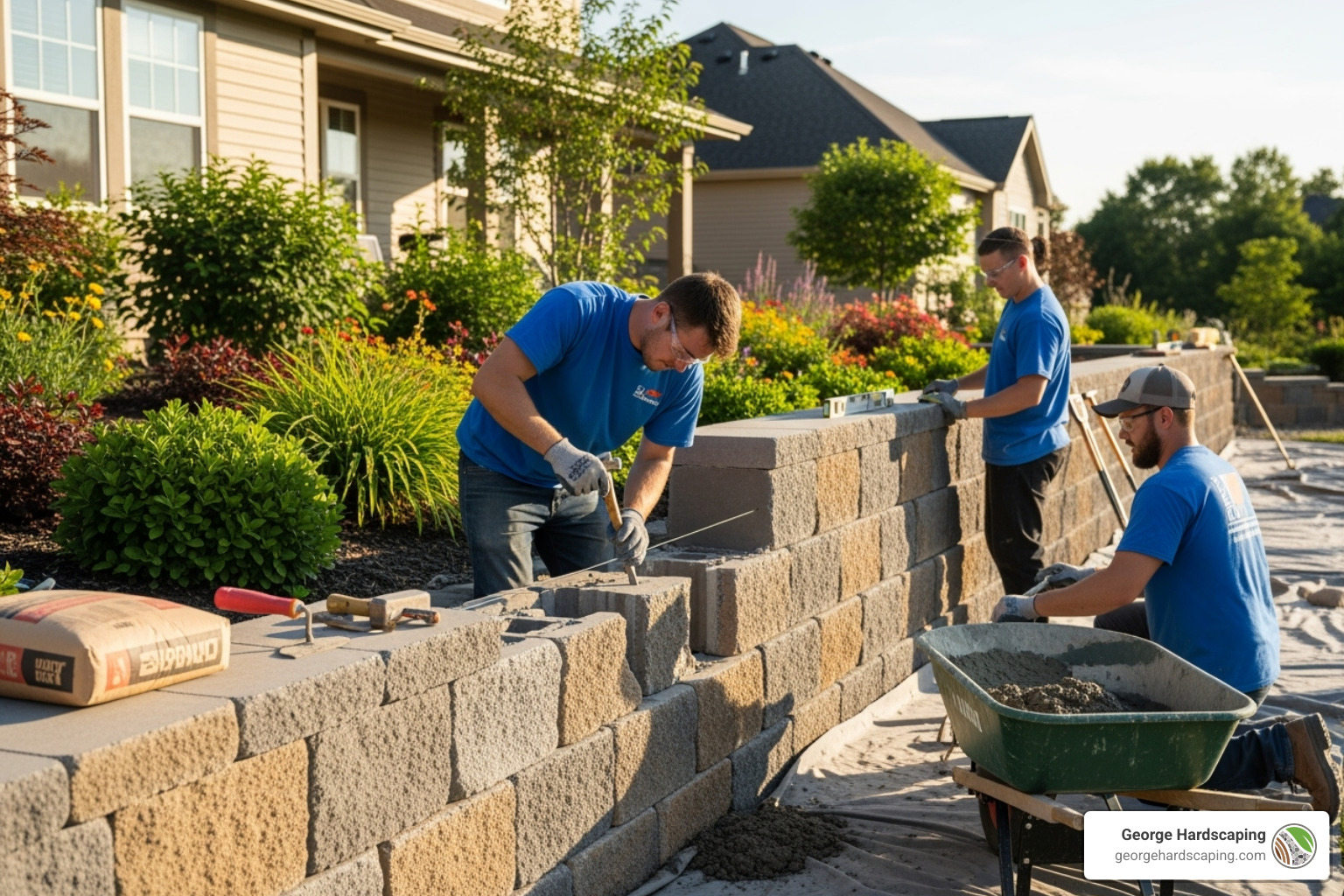
Image metadata: title: George Hardscaping Crew Repairing a Residential Retaining Wall; alt: George Hardscaping team professionally repairing a retaining wall in a residential setting, ensuring structural integrity and aesthetic appeal. – leaning retaining wall repair cost; source: George Hardscaping page asset; subject: professional crew performing wall stabilization and drainage improvements on a home property.
At George Hardscaping, we’ve spent nearly two decades helping Essex County homeowners diagnose and fix the real causes of leaning walls—especially drainage and base issues made worse by New England’s freeze–thaw cycles. Whether you need targeted anchors and drainage upgrades or a full rebuild with modern design, we’ll guide you to the safest, most cost-effective solution. Take the first step now so a manageable repair doesn’t become a major rebuild.