
Retaining wall designer: 4 Steps to Lasting Walls
Step 1: Site Assessment and Pre-Design Planning
Retaining wall design is the comprehensive process of planning, engineering, and specifying a structure that holds back soil, or “retains” it, to create a stable and usable difference in ground elevation. A truly successful design is one that guarantees safety, structural stability, and impressive longevity. This is achieved not by chance, but through a rigorous methodology involving precise calculations, informed material selection, and proven construction methods.
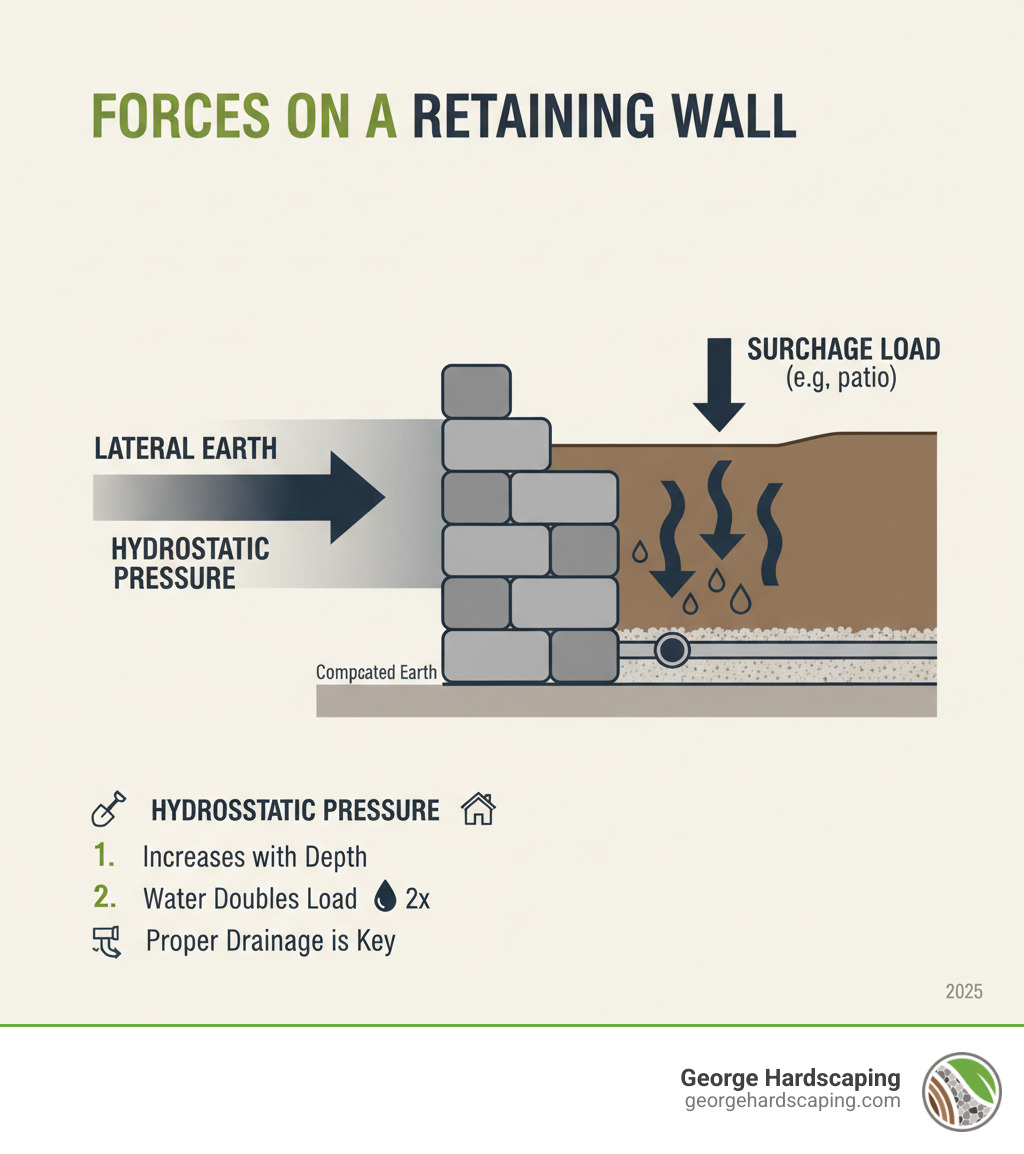
A retaining wall is far more than a simple stack of blocks; it is a dynamic structural system constantly resisting immense forces. The primary adversary is lateral earth pressure, the relentless push of the soil behind it. This is often compounded by hydrostatic pressure from trapped water and surcharge loads from anything built above, like driveways, patios, or even heavy snow loads. An incorrect or under-engineered design can lead to catastrophic failure—bulging, cracking, or complete collapse—often within just a few years. Conversely, a professionally designed and constructed wall can serve its purpose flawlessly for 50 to 100 years or more, transforming a difficult slope into level terraces, preventing costly erosion, or elegantly defining raised garden beds.
Key Elements of Proper Retaining Wall Design:
- Site Assessment – A deep evaluation of soil mechanics, surface and subsurface drainage patterns, property lines, and existing features to identify all constraints and opportunities.
- Structural Calculations – The engineering core, where all anticipated forces (lateral earth pressure, water pressure, surcharges) are calculated to determine the required resistance and establish robust safety factors.
- Material Selection – A careful choice of the appropriate wall type and materials, balancing the structural demands of height and load with budget and aesthetic goals.
- Foundation Design – The critical base of the wall, ensuring proper excavation depth, removal of poor soil, thorough soil compaction, and installation of a stable, level base material.
- Drainage System – A non-negotiable system of perforated pipes, clean drainage aggregate, and geotextile fabric designed to intercept and redirect water, preventing the buildup of destructive hydrostatic pressure.
- Reinforcement – The use of geogrid mesh or steel rebar for any wall over 3-4 feet in height or those supporting heavy loads, creating a unified, stable mass of earth and structure.
- Professional Engineering – The mandatory engagement of qualified geotechnical and structural engineers for walls exceeding local height thresholds (typically 3-4 feet), where the physics become exponentially more complex.
The difference between lasting success and imminent failure lies in meticulously addressing three factors: the forces acting upon the wall, the quality of its construction, and the effectiveness of its drainage system. The physics are unforgiving; a 6-foot wall must endure roughly four times the lateral pressure of a 3-foot wall. This exponential increase is why professional engineering becomes a legal and practical necessity.
In Essex County and across the North Shore of Massachusetts, we contend with a challenging climate defined by deep frost, intense freeze-thaw cycles, significant groundwater fluctuations, and highly varied soil types, from sandy loam to dense marine clay. This guide covers the essential steps to help you understand what makes a retaining wall truly built to last in our unique New England environment.
Understanding Your Property’s Needs
A thorough site assessment is the mandatory first step. We analyze property lines, zoning setbacks, existing structures, and buried utilities to determine the optimal location and geometry for the wall. For any wall over 3 feet, engineers evaluate the entire design envelope for global stability. Key considerations include:
- Soil Conditions: A professional geotechnical analysis is crucial for tall or critical walls. This involves soil borings and laboratory testing to determine the soil’s type, strength, density, and water-holding capacity. This data dictates everything from foundation design to backfill requirements and reinforcement needs. While the USDA’s Web Soil Survey provides useful preliminary data, only on-site testing can verify the actual conditions your wall will face.
- Water Drainage: We meticulously assess both surface runoff patterns and subsurface groundwater flow. Understanding where water comes from and where it wants to go is fundamental to designing a drainage system that prevents hydrostatic pressure buildup. The EPA’s guidance on stormwater basics underscores why proactive water management is the single most important factor in a wall’s longevity.
- Slope and Access: The steepness and height of the existing slope determine the necessary wall height and whether a single tall wall or a series of shorter, tiered walls is more appropriate. Site access dictates the type of machinery that can be used, influencing construction methods, timeline, and cost.
- Local Codes: We ensure every design complies with Essex County and specific municipal regulations. In Massachusetts, retaining walls must conform to 780 CMR, the state building code, which is based on the International Building Code. This includes rules on height, setbacks, and when a building permit and engineered plans are required.
Pre-construction planning is exhaustive and includes topographic surveys to establish precise elevations, utility locates through Dig Safe to prevent dangerous conflicts, and securing any necessary environmental or conservation commission approvals.
Setting Goals for Your Wall
Beyond the technical requirements, we focus on your vision for the space:
- Functional Goals: Are you trying to create a flat, usable lawn for children to play on? Do you need to solve a dangerous erosion problem? Are you looking to build a driveway or patio on a slope? A patio retaining wall installation can be designed to double as built-in seating, maximizing utility.
- Aesthetic Goals: The choice of material and style defines the landscape’s character. Do you envision a rustic, natural stone look or a clean, contemporary feel? Explore our Modern Retaining Wall Designs for inspiration, or see how a Garden Retaining Wall can become a stunning centerpiece of your property.
Aligning on these goals early on informs whether a gravity, reinforced segmental, or cantilevered solution is the best fit. It also clarifies the scope of related elements like integrated steps, lighting, and the final retaining wall landscaping that will complete the project.
Step 2: The Core Principles of Retaining Wall Design
Professional engineering ensures a beautiful wall is also a lasting one. A retaining wall is in a constant battle with the earth behind it. The soil exerts a relentless horizontal push, infiltrating water adds immense weight and pressure, and any structures or weight on top (a surcharge) add to the load. The design must be robust enough to decisively win this battle for decades, not just for a few seasons.
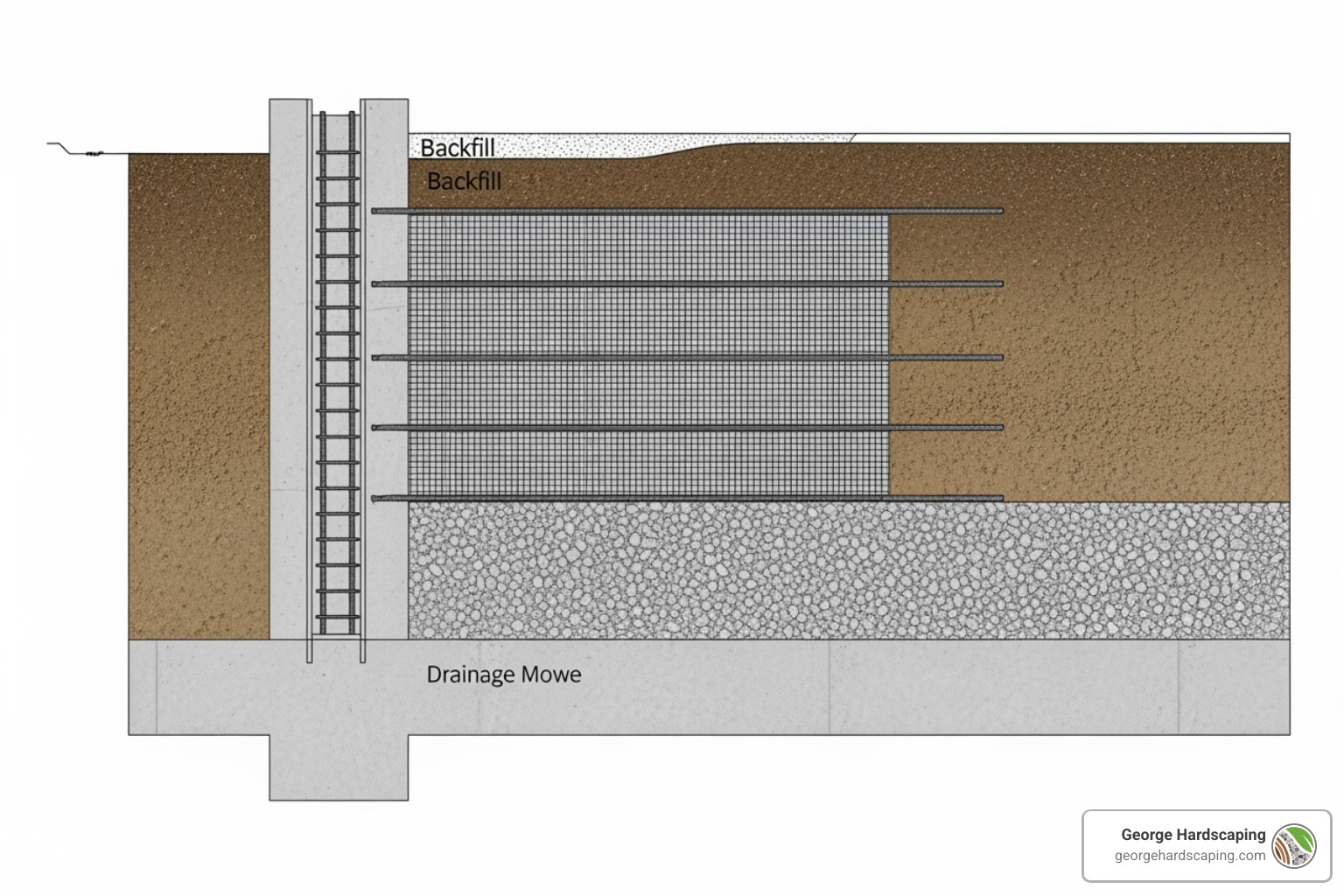
As walls get taller, the forces they must resist increase exponentially, not linearly. A 6-foot-tall wall faces approximately four times the lateral earth pressure of a 3-foot-tall wall. This dramatic escalation of force is precisely why building codes mandate professional engineering for walls over 3 or 4 feet in height—the margin for error vanishes, and the consequences of miscalculation become severe.
Understanding and Calculating Forces
Every sound retaining wall design begins with a thorough analysis of the forces it will encounter:
- Lateral Earth Pressure: This is the primary horizontal force exerted by the soil mass behind the wall. It increases with depth, creating a triangular pressure distribution that is zero at the top and maximum at the base. Engineers use established geotechnical principles like Rankine or Coulomb theories to calculate this pressure based on the soil’s properties (its weight and internal friction angle).
- Hydrostatic Pressure: Water that accumulates in the soil behind the wall is the most dangerous force a wall can face. Because water is much heavier than soil and exerts pressure equally in all directions, it can easily double or even triple the total load on the wall. In Essex County’s wet climate, designing for total water removal is not an option—it’s a requirement.
- Surcharge Loads: Any additional weight placed on the soil within a distance equal to the wall’s height will add pressure. This includes the weight of patios, driveways, parked vehicles, adjacent buildings, or even heavy snow accumulation. These loads must be calculated and added to the overall force the wall must resist.
Engineers analyze these destabilizing forces to ensure the wall’s design provides more than enough resistance to overturning (tipping forward) and sliding (pushing forward at its base). A safe design requires that the resisting forces are significantly greater than the destabilizing forces, a concept known as the factor of safety. Typical minimum safety factors are 1.5 against sliding and 2.0 against overturning, as recommended by the NCMA’s Design Manual for Segmental Retaining Walls.
Common Modes of Failure and Prevention
Understanding how walls fail is the key to designing them for success:
- Overturning & Sliding: These are the most common failures, caused by underestimating the lateral pressure. They are prevented with a sufficiently wide and heavy base, adequate mass, and, in taller walls, the inclusion of soil reinforcement (geogrid).
- Bearing Capacity Failure: This occurs when the soil beneath the foundation is too weak to support the immense weight of the wall and the soil behind it, causing the wall to settle, tilt, or sink. Prevention involves deep excavation to competent native soil and the construction of a wide, compacted gravel footing.
- Global Stability Failure: This is a deep-seated failure where the entire hillside, including the wall, slides. It is a risk on steep slopes or with weak soil layers. This catastrophic failure mode requires a thorough geotechnical analysis by an engineer and is a primary reason why professional design is critical for challenging sites.
Proper footing design, a comprehensive drainage system, and correct soil reinforcement will prevent virtually all common wall failures. The initial investment in a correct, engineered design is minimal compared to the extremely high cost of repairing retaining wall failures. For the most challenging sites, advanced solutions like helical anchors retaining wall systems may be specified by the engineer.
Key Structural Concepts
Cantilever walls are a classic example of smart engineering. They use an L-shaped or inverted T-shaped concrete footing that extends under the retained soil. This clever design uses the weight of the soil itself (acting on the ‘heel’ of the footing) as a stabilizing force to help hold the wall upright and resist overturning. These walls rely on precisely calculated steel reinforcement (rebar) placed in the concrete where tensile (pulling) forces are highest, allowing the concrete to handle the compressive (pushing) forces. During cantilever retaining wall construction, the concrete strength, rebar size, and spacing are all specified by an engineer based on detailed calculations, resulting in slender yet incredibly strong structures that can last for generations.
Step 3: Choosing Wall Types and Materials
With a clear understanding of your site’s geology and the forces at play, the next step is to select the most appropriate wall type and materials. This decision is a careful balance of three factors: the structural requirements dictated by the engineering analysis, your project budget, and the desired aesthetic for your outdoor space. A 3-foot-high garden terrace has vastly different needs than an 8-foot-high slope stabilization project, and making the right choice is essential to ensure your wall is both functionally sound and visually stunning.
The best projects are born when structural needs and aesthetic vision are seamlessly integrated. A perfectly engineered wall that looks out of place is a missed opportunity, while a beautiful wall that fails is a catastrophic waste of money. Let’s explore the options to find the perfect fit for your property. For a visual guide, you can explore our retaining wall block options to see the vast range of possibilities.
Common Types of Retaining Walls
Different wall types employ different strategies to resist earth pressure. Each has an ideal application based on height, site conditions, and cost.
- Gravity Walls: These are the most straightforward type of wall, using their sheer mass and weight to hold back the soil. Traditionally built from large materials like solid concrete blocks, stacked fieldstone, or massive boulders, they are constructed with a wide base and often a slight backward lean (a “batter”) to improve stability. They are a reliable and often cost-effective choice for walls up to about 10 feet, depending on the material. Our experience with gravity retaining wall construction and boulder retaining wall construction shows how these can create a rugged, powerful, and naturalistic look.
- Cantilevered Walls: These are highly engineered structures, typically made of reinforced concrete, that use leverage to their advantage. They feature an L-shaped or T-shaped footing that extends back under the retained soil. The weight of the soil on this “heel” of the footing acts as an anchor, preventing the wall from overturning. This allows for a much more slender vertical profile compared to a gravity wall of the same height, making them ideal for taller walls (up to 16 feet or more) or in areas with limited excavation space. Our cantilever retaining wall construction projects are always executed from detailed, stamped engineering plans.
- Segmental Retaining Walls (SRWs): These are the most popular and versatile systems in modern landscaping. They use high-density, interlocking modular concrete blocks. For short, non-critical walls (under 4 feet), they can function as simple gravity walls. For taller applications, their true strength is unlocked by incorporating layers of high-strength polymer mesh, known as geogrid, at specific intervals. The geogrid extends deep into the backfill, creating a unified and stabilized soil mass that acts as the true retaining structure. SRWs offer nearly endless aesthetic options in color, texture, and size, making them suitable for everything from a simple garden retaining wall to complex, curving, and tiered landscapes.
- Anchored Walls: When you need maximum holding power, are dealing with very tall walls, or have extremely limited space for excavation, anchored walls are the ultimate solution. These systems use a relatively thin wall face that is braced by anchors (such as cables or rods) driven deep into the soil or rock behind the wall. These anchors are then tensioned, actively pulling the wall back and holding it against the earth. These are highly specialized, engineered solutions for the most challenging residential or commercial projects, sometimes using advanced systems like helical anchors retaining wall.
Selecting the Right Materials for Your Project
The material you choose defines your wall’s personality, durability, maintenance needs, and overall cost.
- Modular Concrete Blocks: Engineered for precise dimensions, consistent strength, and interlocking performance, these blocks are a workhorse material. They come in a vast array of colors, textures (from split-face to smooth), and sizes, capable of creating a crisp, modern look or convincingly mimicking the appearance of natural stone. Their predictable performance and interlocking design make them a durable and popular choice, with properly installed walls easily lasting 50-75 years. Our expertise in block retaining wall construction ensures we use systems and methods proven to withstand New England’s harsh freeze-thaw cycles.
- Poured-in-Place Concrete: For ultimate strength, complex geometric shapes, or tall cantilever walls, nothing beats steel-reinforced concrete. It creates a single, monolithic structure that is incredibly strong and durable. The face can be finished with a standard smooth surface, or given a decorative treatment like a board-form, stamped, or stained texture. However, it is a labor-intensive and expensive option requiring extensive formwork, precise rebar placement, and skilled finishing. When structural demands are paramount, our concrete retaining wall construction team delivers precision-built results.
- Natural Stone: For a timeless, one-of-a-kind aesthetic, natural stone is unparalleled. Whether it’s a formal mortared wall or a rustic dry-stacked wall, the unique character of each stone creates a feature that feels like it has always been part of the landscape. This material requires significant skill, labor, and artistry to fit and install correctly, making it a premium option. For clients who value this enduring beauty, our natural stone retaining walls showcase the highest levels of expert masonry.
- Timber Walls: While pressure-treated timber can seem like a cost-effective choice for very short, non-critical garden borders, its lifespan is severely limited in our region. Even properly treated wood will eventually succumb to rot, moisture, and insect damage in New England’s humid climate. Timber walls are also highly susceptible to shifting and damage from frost heave. For any structural application, we strongly guide clients toward permanent masonry solutions that offer far better long-term value and peace of mind.
Step 4: Critical Construction Details for a Lasting Wall
An excellent retaining wall design is only a blueprint for success; its potential is realized or squandered during construction. Cutting corners on unseen details like foundation depth, soil compaction, or drainage installation is a guaranteed recipe for premature failure. At George Hardscaping, we treat every single retaining wall construction detail as a non-negotiable element of a professional build.
This is where decades of hands-on experience make all the difference. A qualified contractor doesn’t just follow the plan; they understand the why behind it. They verify compaction densities with proper testing, meticulously check drainage installations before backfilling, and ensure every layer of reinforcement is placed with precision. This meticulous, process-driven work is what separates a wall that will stand for 50+ years from one that begins to fail after just a few harsh New England seasons.
The Foundation: Your Wall’s First Line of Defense
A wall’s longevity begins at its base. This unseen foundation is what anchors the entire structure, and if it is prepared incorrectly, nothing built on top of it can be considered stable. The process is methodical:
- Excavation: We begin with precise excavation to the depths specified in the engineering design, ensuring we remove all weak, organic topsoil and any other unsuitable materials.
- Subgrade Compaction: The native soil at the bottom of the trench, the subgrade, is then compacted to a minimum of 95% of its maximum dry density. This creates a firm, unyielding platform that prevents the wall from settling over time.
- Leveling Pad Installation: We install a leveling pad of compacted, crushed granular aggregate (gravel). This pad must be perfectly level, front-to-back and side-to-side, as it provides the stable surface on which the first course of blocks or the concrete footing is placed. Any imperfection here will be magnified as the wall gets taller. On sloped ground, step footings are created, where the foundation is excavated in level steps to ensure the base of the wall remains perfectly horizontal and stable along its entire length.
Compaction targets are verified against engineering standards like ASTM D698/D1557. The base and drainage stone we use are always clean, angular, crushed aggregates meeting ASTM D448 gradations, which guarantees they lock together and provide clear pathways for water to drain freely.
The Importance of Drainage in Retaining Wall Design
If there is one secret to a wall’s longevity, it is this: control the water. Hydrostatic pressure from trapped groundwater is the single leading cause of retaining wall failure. A properly designed and installed retaining wall drainage system is not an upgrade; it is an essential component that provides multi-layered protection:
- Wall Rock (Drainage Zone): A column of clean, crushed stone (typically 0.25″ to 1.5″ in size) is placed directly behind the wall units. This creates a highly permeable, free-draining zone where water cannot build up pressure.
- Perforated Drainage Pipe: A 4-inch perforated pipe is laid at the base of the wall rock, bedded in the stone. This pipe collects all the water that drains down and carries it away to a safe discharge point, away from the wall’s foundation.
- Geotextile Filter Fabric: This critical fabric is placed between the wall rock and the native or backfill soil. It acts as a separator, allowing water to pass through into the drainage zone while blocking the fine soil particles that would otherwise migrate into the stone and clog the entire system.
For solid concrete walls, weep holes are formed at the base to serve the same function, allowing trapped water to escape. All drainage outfalls are designed to discharge water safely to daylight or connect to a larger stormwater system, following EPA stormwater guidance.
Reinforcement and Advanced Construction
As walls exceed 3-4 feet in height, the forces become too great for the wall units alone. This is where reinforcement becomes necessary. Geogrid reinforcement—a high-strength, flexible polymer mesh—is laid in horizontal layers between courses of blocks and extended back into the soil. This technique creates a reinforced soil mass, a composite structure of soil and grid that works as a single, stable unit to resist lateral forces. The length, strength, and spacing of the geogrid are determined by the engineer and must be installed with absolute precision. Handling corners, curves, and obstructions requires specific, engineered solutions, which are common in large retaining wall construction.
Best practices include carefully conditioning the backfill soil with moisture for optimal compaction, using the right-sized compaction equipment in lifts (layers), and protecting the geogrid from damage during backfill placement. For cantilever walls, we adhere to strict tolerances for rebar placement and follow proper concrete curing procedures to ensure maximum strength. Where excavation space is severely limited, specialized solutions like helical anchors retaining wall systems may be integrated into the design.
Finishing Touches for Function and Beauty
Once the structural work is complete, the finishing details transform the wall from a raw structure into a polished landscape feature:
- Wall Caps: Capstones provide a clean, finished look and are secured with a high-strength adhesive to protect the wall core from water infiltration.
- Fences and Guardrails: Safety is paramount. Fences or guardrails are often integrated for walls adjacent to patios, driveways, or walkways.
- Steps and Planters: Integrating steps provides functional access through the wall, while built-in planters can soften the look and turn the wall into a living part of your retaining wall landscaping.
Want your wall built once and built right? Our team obsesses over every detail. Contact us for block retaining wall construction, concrete retaining wall construction, or natural stone features that demand true craftsmanship.
When to Hire a Professional for Your Retaining Wall
While a small, decorative garden wall under 18 inches high might seem like a manageable DIY project, the vast majority of retaining wall design and construction projects demand professional expertise. In our years of service, we have been called to inspect, repair, or completely replace countless DIY or handyman-built walls that failed within a few years due to unseen but critical errors in their foundation, drainage, or backfilling.
The financial and safety risks associated with a failing retaining wall are significant. A collapse can cause thousands of dollars in property damage, create serious liability issues with neighbors, and pose a direct threat of injury. Any wall that is retaining a critical slope, is over a few feet high, supports a structure like a patio or driveway, or is located near a property line should be handled exclusively by qualified professionals. The economics are clear: a properly engineered and built wall is a one-time investment that lasts for decades, while a poorly built wall often requires a complete, and more expensive, reconstruction. Professional work from the start is always the most cost-effective solution in the long term.
The Roles of Engineers and Contractors
Building a successful retaining wall is a collaborative effort between specialized professionals:
- Geotechnical Engineer: This is the soil expert. They perform site investigations to analyze the soil’s strength, composition, and stability. Their report provides the essential data that forms the foundation for a safe and efficient design, especially critical in Essex County’s diverse and often challenging soil conditions.
- Wall Design Engineer (Structural Engineer): For walls over 3-4 feet in Massachusetts, a licensed professional engineer is legally required to design the wall and produce stamped plans for permitting. Using the geotechnical data, they perform the structural calculations to specify the wall’s dimensions, foundation requirements, drainage system, and reinforcement schedule.
- Qualified Contractor: As your retaining wall builder, we are the team that translates the engineering plans into a physical structure. Our role is to execute the design with precision, manage the project, and apply our deep knowledge of local North Shore soil, climate, and construction best practices. Knowing how to find a contractor to build a retaining wall who understands and respects this collaborative process is key to your project’s success.
Permitting, Inspections, and Safety
Most municipalities in Massachusetts require building permits for retaining walls that exceed a certain height (typically 4 feet) or that support a surcharge. The state’s requirements are derived from 780 CMR, which is based on the International Building Code. We handle the entire permitting process, coordinating with local building departments and, when necessary, Conservation Commissions for projects near wetlands or other sensitive areas. The permit process also protects you, the homeowner, by ensuring the plans are reviewed by the town inspector. This is followed by mandatory site inspections at critical stages, such as after the footing is excavated and before backfilling, to verify compliance.
Safety is our top priority. All excavation work follows strict OSHA safety practices. Before any digging begins, we coordinate a full utility mark-out through Dig Safe to locate and avoid any buried gas, electric, or water lines.
Selecting the Right Partner
When vetting a contractor, look for a true professional. They should provide:
- Proof of current liability and workers’ compensation insurance and all necessary licenses.
- A detailed, written scope of work that explicitly describes the base preparation, compaction standards, drainage system, backfill specifications, and reinforcement schedule.
- A portfolio of and references for similar projects completed in the New England area.
- Clear, written warranty terms for both materials and labor.
- A defined project schedule and clear communication plan, including how weather delays are handled.
Calculating the True Cost
The true cost of a retaining wall is a comprehensive figure that includes:
- Materials: The wall blocks or stone, base aggregate, drainage rock, geogrid, pipe, and filter fabric.
- Labor: The cost for a skilled crew to perform excavation, compaction, precise construction, backfilling, and final site cleanup.
- Equipment: Professional projects require heavy equipment like excavators, skid-steers, and various types of compactors.
- Engineering & Permitting: Fees for the design engineer, geotechnical testing (if needed), and municipal building permits.
While it can be tempting to choose the lowest bidder, this is often a red flag that corners are being cut on unseen but vital components like foundation depth or drainage stone. The cost of repairing retaining wall failure always exceeds the cost of building it right the first time. Our detailed guide on how much a retaining wall costs to install provides additional context on realistic budgeting.
Ready to discuss your retaining wall project? Our team brings decades of experience in building engineered retaining walls across the North Shore. Contact us today for a professional consultation, and let’s build a retaining wall that is made to last.
Conclusion
A well-executed retaining wall is the perfect synthesis of science and art. It must perform its essential engineering function—tirelessly holding back the earth and expertly managing water—while simultaneously enhancing the beauty, value, and utility of your landscape. That is the exceptional result achieved only when solid retaining wall design meets thoughtful, experienced craftsmanship.
Throughout this guide, we have emphasized the critical, often unseen, elements that ensure a wall stands the test of time. From the initial geotechnical assessment and site planning to the meticulous details of the foundation, the comprehensive drainage system, and the precise installation of reinforcement, every single step is crucial to the final outcome. These are not areas for guesswork or approximation; they demand professional knowledge, adherence to engineering principles, and a commitment to precision.
Here in Essex County, our unique and demanding climate requires a higher standard of construction. The relentless freeze-thaw cycles of a North Shore winter can pry apart and destroy a poorly built wall in just a few seasons, which is why deep, local experience matters. At George Hardscaping, we have built our reputation on understanding these regional nuances and constructing walls that are not only beautiful but are fundamentally engineered to last for generations.
An investment in a professionally designed and built retaining wall pays dividends for years to come. It creates safe, valuable outdoor living space, protects your property from the destructive forces of erosion, and significantly increases your home’s curb appeal and market value. Most importantly, it provides you with the invaluable peace of mind that comes from knowing the job was done right from the ground up.
To explore the aesthetic possibilities, you can view our retaining wall block options and see examples of our past work in natural stone retaining walls. If your site presents unique challenges, we have the expertise to integrate specialized solutions, whether that involves helical anchors retaining wall systems or the engineering of a cantilever retaining wall construction that blends seamlessly with your landscape.
We are committed to meticulous, by-the-book execution: proper soil compaction verified to ASTM D698/D1557 standards, multi-layered drainage systems with clean, specified stone (ASTM D448 gradations), high-performance geotextiles selected per AASHTO M288 guidelines, and code-compliant details that meet or exceed the International Building Code. This technical rigor is what allows your wall to endure our region’s most severe weather, year after year.
Ready to transform your yard with a retaining wall that is both beautiful and built to last?
Contact us today for a professional consultation and let our team of experts guide you from the initial concept to the final, successful construction. Let’s work together to create an outdoor space you and your family will be proud of for decades to come.
Prefer to start with a design conversation? We can meet with you on-site to assess your property’s soils, drainage, and access, discuss your aesthetic vision, and outline the best structural approach—whether that’s a simple garden retaining wall, a complex series of stepped terraces with integrated stairs, or a heavily reinforced system to support a new driveway or patio. When you’re ready, we’ll provide a detailed, line-item proposal so you know exactly what you’re getting and why it’s designed to last a lifetime.
