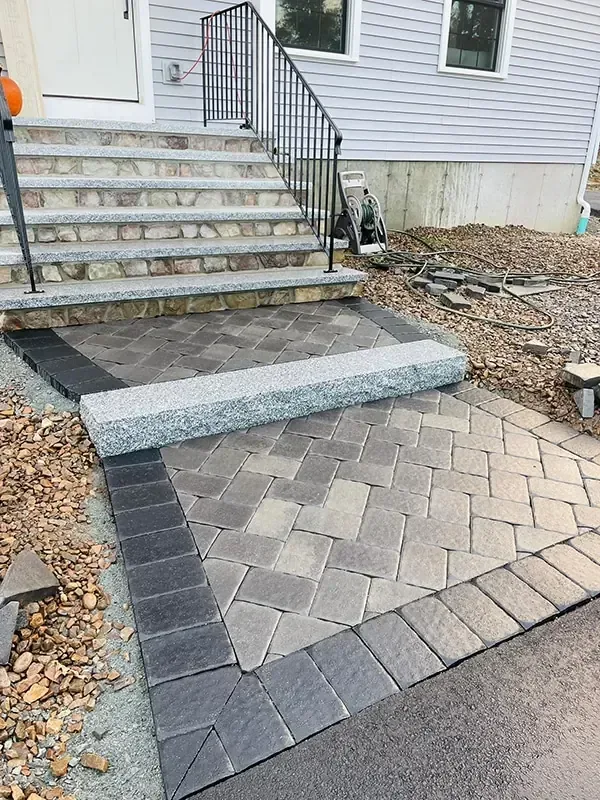
Can You Plow or Snowblow a Paver Driveway Without Damaging It? A North Shore Winter Guide
You'll learn how plows, snowblowers and shovels interact with a paver driveway, which installation details protect it, and how to prepare your equipment and surface for winter.
The short answer
- Yes. A properly installed paver driveway can be plowed, snowblown and shoveled all winter.
- Most damage starts where a blade catches a raised paver, a loose edge or a rough transition, so a flush surface and solid edge restraints matter most.
- Raise plow shoes and snowblower skid shoes slightly, and use rubber or poly edges where you can.
- Walk the driveway before the first storm and again in spring to catch lifted or loose pavers early.
Why pavers and snow equipment can get along
A question North Shore homeowners often ask when weighing a paver driveway is simple: will the plow tear it up? At George Hardscaping, we install paver driveways in towns like Ipswich, Beverly, Danvers and Newburyport, where clearing snow is just part of owning a driveway. A well-built paver driveway handles plowing, snowblowing and shoveling without trouble. Driveway pavers are dense, and the whole system is designed to carry vehicle loads.
When damage does happen, it almost always traces back to a short list of causes:
- A paver sitting higher than its neighbors, which gives a steel blade something to catch.
- An edge without proper restraint, where border pavers can be pushed outward or pulled loose.
- A rough transition at the garage slab or the street, where the blade drops off or hits a lip.
- Equipment set too low or too aggressive, scraping corners and the surface finish.
The first three are installation questions. The last one comes down to how you, or whoever plows for you, set up the equipment. Both are manageable.
Most plow damage starts at a paver that's already sitting proud, so a flat, tight surface is your best protection.
Installation details that make a paver driveway plow-friendly
If you're still planning your driveway, these are the details worth asking any installer about. In snow country, they deserve as much attention as color or pattern.
A compacted base built for vehicles
A driveway base has to carry cars and trucks and survive repeated freeze-thaw cycles. When the base is thin or poorly compacted, individual pavers settle or heave over the years, and a heaved paver is exactly what a plow blade finds. Ask how the base will be prepared and compacted for your soil and drainage conditions.
Solid edge restraints
Pavers stay locked together because they're held firmly at the edges. Without a restraint, the sideways push of a blade moving snow toward the lawn can nudge border pavers outward, open the joints and loosen the field behind them. A properly anchored edge restraint, often paired with a border course of pavers, keeps the perimeter firm.
A flush finish and smooth transitions
The surface should be even from paver to paver. The two lines that deserve extra attention are where the driveway meets the garage floor and where it meets the street apron. A small lip at either spot is where blades tend to snag. When those transitions are set flush, the blade rides across them.
Chamfered pavers and full joints
Many concrete driveway pavers have a small beveled edge, called a chamfer, that helps keep a blade from catching a corner. Joints filled tight with joint sand help the pavers stay interlocked and limit movement.
You can see what goes into our paver driveway installation work, and if you'd like someone to look at your property and talk through these details, you can request an estimate.
Ask specifically how the driveway will meet the garage slab and the street, since those two lines take the most abuse from a plow.
Plowing a paver driveway: what to tell your plow driver
Whether you hire a plow service or have a neighbor with a truck, a short conversation before the season prevents most problems.
- Tell them it's pavers. Drivers clear many driveways in a storm, and a heads-up changes how they approach yours.
- Ask about the cutting edge. Rubber or polyurethane cutting edges are gentler on pavers than bare steel. Some operators already run them for decorative surfaces.
- Raise the shoes a little. Plow shoes that hold the blade slightly above the surface leave a thin layer of snow behind, but they keep steel off the pavers. You can shovel or sweep what's left, or let the sun take care of it.
- Go easy on back-dragging. Pulling the blade backward across the driveway, especially near the garage, is where corners tend to catch.
- Mark the edges. Driveway stakes or reflective markers along both sides help the driver avoid clipping the border or pushing into the lawn.
Set stakes in the lawn just outside the paver edge. Driving them between pavers or right against the edge restraint can disturb the very edge you're trying to protect.
A thin skim of snow left by raised plow shoes is a fair trade for keeping a steel blade off your pavers.
Using a snowblower and shovel on pavers
Snowblowers
Most homeowner snowblowers work well on pavers once they're adjusted properly.
- Two-stage machines: adjust the skid shoes so the scraper bar rides just above the surface instead of dragging on it. Poly skid shoes and scraper bars are available for many models; your owner's manual will tell you what fits and how to adjust it.
- Single-stage machines: these clear by letting a rubber paddle touch the surface. Worn paddles can expose harder parts, so inspect and replace them as the manual describes.
- Slow down at borders and transitions, where a slightly raised edge is most likely.
Do any adjusting with the engine off and the machine cooled down. If the chute or auger clogs, shut the machine off, wait until every moving part has completely stopped, and clear it with the clearing tool. Never reach in with your hands or feet.
Shovels
A plastic shovel, or one with a poly wear strip, is easy on pavers and on any sealer. A steel-edged shovel usually won't hurt dense concrete pavers, but it can scuff a sealed surface and catch a raised corner. Push snow instead of chopping at packed ice; hacking at ice with a metal tool can chip paver edges.
If your snowblower jams, shut it off and wait for everything to stop before clearing it with the tool, never your hands.
Ice melt and traction on a paver driveway
Pavers cope well with freeze-thaw. The joints let a little water move through, and individual units can shift slightly without cracking the way a poured slab can. Deicers still deserve some care.
- Check your paver manufacturer's guidance on deicers first, since they know their product best.
- Avoid ice melt containing ammonium nitrate or ammonium sulfate, which are widely known to be hard on concrete.
- Clear the snow first so the ice melt only has a thin layer to work on, use the smallest amount that does the job, and sweep up leftover pellets once the surface dries.
- Sand adds traction, but it tracks indoors and can work into the joints, so plan to sweep it off in spring.
Clearing snow soon after it falls, before tires pack it into ice, cuts down on how much deicer you need at all. If your front steps are stone or brick, our guide to ice melt that's safe for stone and brick steps covers those surfaces in more detail.
Clearing snow before tires pack it down means far less ice melt, which is better for your pavers and your lawn.
Before the first storm and after the last one
A few minutes of checking at each end of the season keeps small issues from turning into bigger ones.
Before the first storm
- Walk the driveway and look for pavers sitting higher or lower than their neighbors, gaps at the edges and loose border units.
- Put in edge markers while the ground is still soft enough to take a stake.
- Talk with your plow driver and adjust your snowblower's skid shoes.
- Make note of any problem pavers. By late fall it's often too cold for resetting work or for joint sand products that need warm, dry conditions to set, so mark those spots, ask the driver to keep the blade up over them, and plan the repair for spring.
After the last storm
- Sweep away sand and leftover deicer.
- Look for scuffs along the garage and street transitions, pavers lifted by frost and joints that have lost sand.
- A single sunken or heaved paver can usually be lifted and reset. Settling across a wide area points to a base or drainage problem that's worth having a professional look at.
One real advantage of pavers in a New England winter is that damage, when it happens, tends to be local. A chipped paver can be pulled and swapped for a matching one without patching or cutting the whole surface. That's why it's smart to keep a few spare pavers from the original installation stored in the garage or shed.
Keep a few spare pavers from your installation so a winter chip can be replaced with an exact match.
Common questions
Is a paver driveway harder to clear than asphalt or concrete?
Not much. Smooth-faced pavers with small chamfers clear much like other surfaces. If your plow shoes or skid shoes are raised, you may leave a thin layer of snow behind, which is easy to sweep or shovel.
Can I hire a regular plow service for a paver driveway?
Yes. Tell the driver the driveway is pavers, ask whether they use a rubber or poly cutting edge, and mark your edges before the ground freezes. Those three steps prevent most problems.
Should I seal my pavers before winter?
Sealing is optional and depends on the paver and the look you want, so follow the manufacturer's guidance. Most sealers need dry, mild weather to apply properly, which is often gone by late fall, so it's usually better to plan sealing for the warmer months.
What should I do if the plow already lifted or chipped a paver?
Mark the spot so it doesn't get hit again. In spring, the paver can usually be lifted and reset or replaced. If many pavers have moved, have a professional check the base and drainage.
Are tumbled or cobble-style pavers OK to plow?
They can be, though their rounded edges and textured surfaces sit a bit less evenly than smooth pavers. A quick sweep afterward may be needed.