
Introduction: Why a Failing Wall is More Than Just an Eyesore
A retaining wall is a critical feature that protects your property from erosion, prevents landslides, and preserves the stability of your landscape. In Essex County and along the North Shore, where varied terrain and coastal weather are common, these structures are essential. When a retaining wall starts to fail, it’s more than an aesthetic issue; it’s a serious risk. A collapsing wall can damage your home’s foundation, cause sinkholes, or lead to flooding.
Retaining wall repair becomes necessary when you spot warning signs like leaning, bulging, cracking, or water pooling at the base. While minor cracks can sometimes be a DIY fix, significant structural problems require professional intervention. The key is to act quickly. Most retaining wall issues are repairable if addressed early, saving you thousands of dollars and protecting your property.
This guide will walk you through the entire repair process. You’ll learn how to assess the damage, understand the common causes of failure, compare repair methods, and decide whether to fix or replace your wall. Whether you have a classic stone retaining wall or a modern block retaining wall, this guide will provide the knowledge you need to make informed decisions and protect your investment.
Step 1: Assessing the Damage and Understanding the Cause
Before any repair can begin, you must play detective to understand what’s wrong with your wall and why. A thorough inspection is the first step. Start by looking for the most obvious red flags: leaning or tilting. Even a slight lean indicates that the soil behind the wall is exerting immense pressure. Similarly, look for bulging or bowing sections, where the wall face curves outward, signaling a compromise in its structural integrity. According to Wisconsin DOT inspection guidelines, these are distress signs that demand immediate attention.
Cracks tell their own story. Horizontal cracks often point to pressure from waterlogged soil, while stairstep cracks in block walls suggest foundation settlement. Also, inspect the materials themselves. Is mortar crumbling or is concrete flaking? This degradation is often caused by age and the harsh freeze-thaw cycles in New England. Finally, look for water seeping through the wall or pooling at its base. This is a clear sign of a drainage problem, the most common cause of wall failure.
Other subtle signs include efflorescence, a white powdery substance indicating moisture intrusion, and rotting wood in timber walls. Ignoring these warnings can lead to a catastrophic collapse, which can trigger landslides and damage property, a risk highlighted by geological experts like the U.S. Geological Survey.
The root cause of most failures is almost always water. Hydrostatic pressure—the force of water trapped in saturated soil—is the silent killer of retaining walls. This is why poor drainage is the number one culprit. Without a way for water to escape, the pressure builds until the wall gives way. Other common causes include:
- Improper Footing: A wall built on an unstable foundation will inevitably shift and settle.
- Surcharge Loads: Placing too much weight near the wall, such as from parked vehicles or new construction, can overwhelm its design capacity.
- Expansive Soils: Clay-rich soils swell when wet and shrink when dry, creating constant stress on the wall.
- Tree Roots: Growing roots can exert thousands of pounds of pressure, pushing a wall out of alignment.
If you see significant leaning, major bulging, or widespread cracking, it’s time to stop your assessment and call a professional. A structural engineer or an experienced contractor can determine the severity of the issue and recommend the safest course of action. Never attempt to prop up a failing wall yourself; the forces involved are immense and dangerous. For more information on identifying and solving these issues, see our retaining wall solutions complete guide and our page on retaining wall construction details.
A Homeowner’s Guide to Retaining Wall Types and Materials
The type of retaining wall you have dramatically affects how it fails and how it can be repaired. Understanding your wall’s material and construction is key to a successful retaining wall repair.
Structurally, walls are often categorized as gravity walls, which use their sheer mass (stone, concrete) to hold back soil, or cantilevered walls, which use a reinforced footing for leverage. Other types include sheet piling (driven into the ground) and anchored walls (supported by cables). Our team has particular expertise in gravity retaining wall construction, a durable and popular choice in Essex County.
Comparing Common Retaining Wall Materials
The material of your wall determines its lifespan, common problems, and repair complexity.
- Timber/Railroad Ties: Affordable and rustic, but prone to rot and insect damage. Lifespan is typically 15-40 years. Repairs involve replacing deteriorated timbers, which requires careful bracing.
- Concrete Blocks (Segmental): Versatile and long-lasting (50-100 years), but highly dependent on proper drainage and foundation. Common issues include cracking, bulging, and settlement. Our page on block retaining wall construction offers more detail.
- Poured Concrete: Very strong and durable (50-100 years), but repairs can be complex, often requiring epoxy injections or carbon fiber reinforcement to fix structural cracks and spalling.
- Cinder Blocks: More porous and less robust than concrete blocks, making them more susceptible to water damage and crumbling. Proper reinforcement and drainage are critical. Learn more about repairing a cinder block retaining wall on our dedicated page.
- Natural Stone: The classic New England look, with a lifespan of over 100 years. The primary weakness is deteriorating mortar, which can lead to shifting stones. Repairing and preserving historic natural stone retaining walls requires specialized masonry skills to match original materials and techniques, balancing authenticity with modern structural needs.
- Gabion Walls: These rock-filled wire baskets offer excellent drainage and a modern aesthetic, lasting 50-100 years. Failures are usually due to wire corrosion, and repairs are relatively simple.
The Ultimate Guide to Retaining Wall Repair Methods
Before starting any work, safety is paramount. Secure the area around an unstable wall with temporary bracing or barriers. While a handy homeowner might tackle minor cosmetic fixes, any structural problem—like significant leaning or bulging—demands professional expertise. Attempting a major DIY repair without understanding soil mechanics is risky and strongly discouraged, though some minor leaning may be addressable with care, as noted in this expert DIY guide.
Fixing Minor Issues: Cracks, Crumbling, and Water Seepage
Many common problems can be addressed with straightforward techniques:
- Patching Cracks: Small, non-structural cracks in concrete can be cleaned and filled with concrete repair caulk or an epoxy filler.
- Repointing Mortar: For brick or stone walls, crumbling joints should be cleared of old mortar and repacked with a fresh, matching mix to restore strength and prevent water intrusion.
- Efflorescence Removal: This white powder can be scrubbed off, but it indicates a moisture problem. The underlying drainage issue must be fixed to prevent its return.
- Sealing: Applying a breathable masonry sealant adds a layer of protection against moisture.
- Improving Surface Drainage: Simply regrading the soil to slope away from the wall can significantly reduce water pressure. Our page on affordable retaining wall solutions offers more budget-friendly ideas.
Addressing Major Structural Problems: Leaning and Bowing
Leaning and bowing are signs of serious structural distress that require professional intervention.
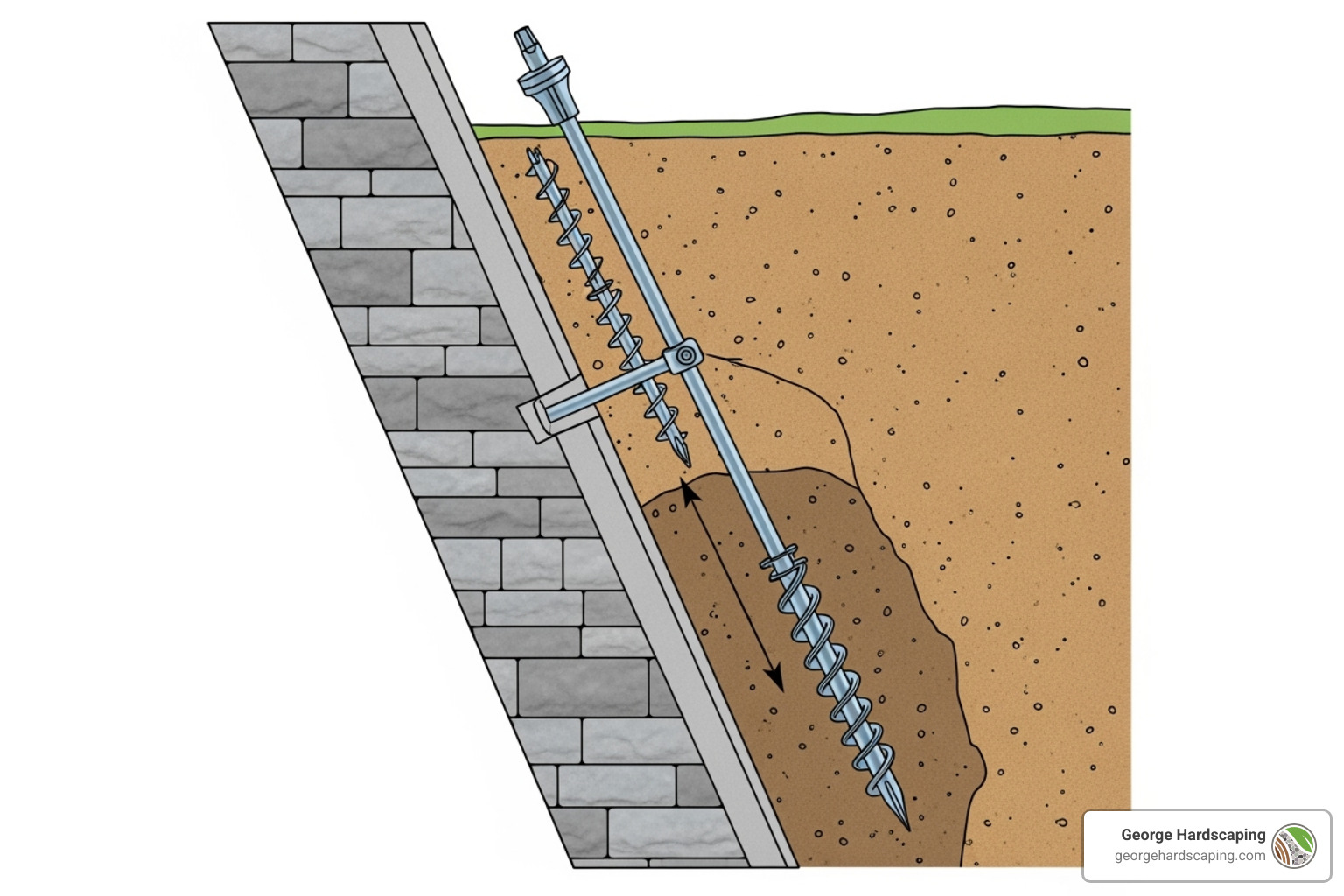
Repairs often begin with excavation to relieve pressure and allow for inspection and reinforcement. The old, saturated soil is replaced with free-draining gravel. For walls that are leaning, installing tiebacks or anchors is a common solution. Helical anchors are screwed deep into stable soil behind the wall and tightened to pull it back and provide permanent support. We specialize in using helical anchors for retaining wall repair, a highly effective method for saving compromised walls. In some cases, advanced geotechnical solutions, as discussed by industry experts like the Geoprofessional Business Association, can stabilize a wall without requiring a full rebuild. When damage is too severe, rebuilding sections of the wall from the foundation up is the only option.
The Importance of a Proper Retaining Wall Drainage System
We can’t say it enough: drainage is everything. Most wall failures are caused by hydrostatic pressure from trapped water. A proper drainage system is not an optional upgrade; it’s essential for the wall’s longevity. An effective system includes:
- Weep Holes: Small openings at the base to let water escape.
- Gravel Backfill: A layer of clean gravel behind the wall allows water to flow down freely.
- Perforated Drain Pipe: A pipe at the base collects water and channels it away.
- Filter Fabric: This geotextile fabric separates soil from the gravel, preventing clogs.
Installing a proper retaining wall drainage system is the best insurance against future failure.
The Big Decision: Repair vs. Full Replacement
Deciding whether to repair or replace your retaining wall is a critical choice that balances cost, safety, and long-term stability. Key factors to consider include the wall’s age, the extent of the damage, and its underlying structural integrity. A professional assessment is crucial, but here are some general guidelines.
Repair is often sufficient for:
- Minor, non-structural cracks or crumbling mortar.
- Localized damage to a few blocks or stones.
- Slight leaning that can be corrected with anchors.
- Problems where the root cause (like poor drainage) can be definitively fixed.
Replacement is likely necessary for:
- Severe leaning (often more than 6-12 inches) or widespread bulging.
- Extensive, deep cracking that compromises the entire structure.
- Widespread material failure, like severely rotted timber or disintegrated concrete.
- A fundamentally flawed original construction (e.g., no footing or drainage).
For more on building a new wall correctly, see our guide on retaining wall construction.
Analyzing the Cost of Retaining Wall Repair and Replacement
Understanding the costs is key to your decision. Please note: the following figures are based on national averages and are not official George Hardscaping prices.
Repair Costs:
- Average Range: $250 to $5,000, with most homeowners paying around $750 for moderate repairs.
- Minor Fixes: Patching cracks or cleaning efflorescence can cost $150 – $850.
- Structural Solutions: Straightening a wall can cost $60-$80 per linear foot, while installing helical anchors is often in a similar range. Adding a proper drainage system may cost $70-$90 per square foot.
- Rebuilding Sections: Expect to pay $70-$125 per linear foot for partial rebuilds.
For a more detailed breakdown, visit our page on the cost of repairing a retaining wall.
Replacement Costs:
- Average Range: Building a new wall typically costs between $3,500 and $10,000.
- Additional Costs: Don’t forget to budget for the removal of the old wall ($500-$1,500), permit fees, and landscape restoration.
While a new wall is a larger upfront expense, it’s a long-term investment in your property’s safety and value. Learn more about the factors that influence retaining wall construction cost on our site.
How to Choose a Qualified Contractor for Your Retaining Wall Repair
When your retaining wall shows signs of trouble, the contractor you choose can make the difference between a lasting solution and a costly mistake. Poor workmanship doesn’t just waste money—it can lead to repeated failures, escalating damage, and even dangerous collapses. Retaining wall repair requires specialized knowledge that goes far beyond general contracting. You need someone who understands soil mechanics, drainage engineering, and the unique challenges of earth retention.
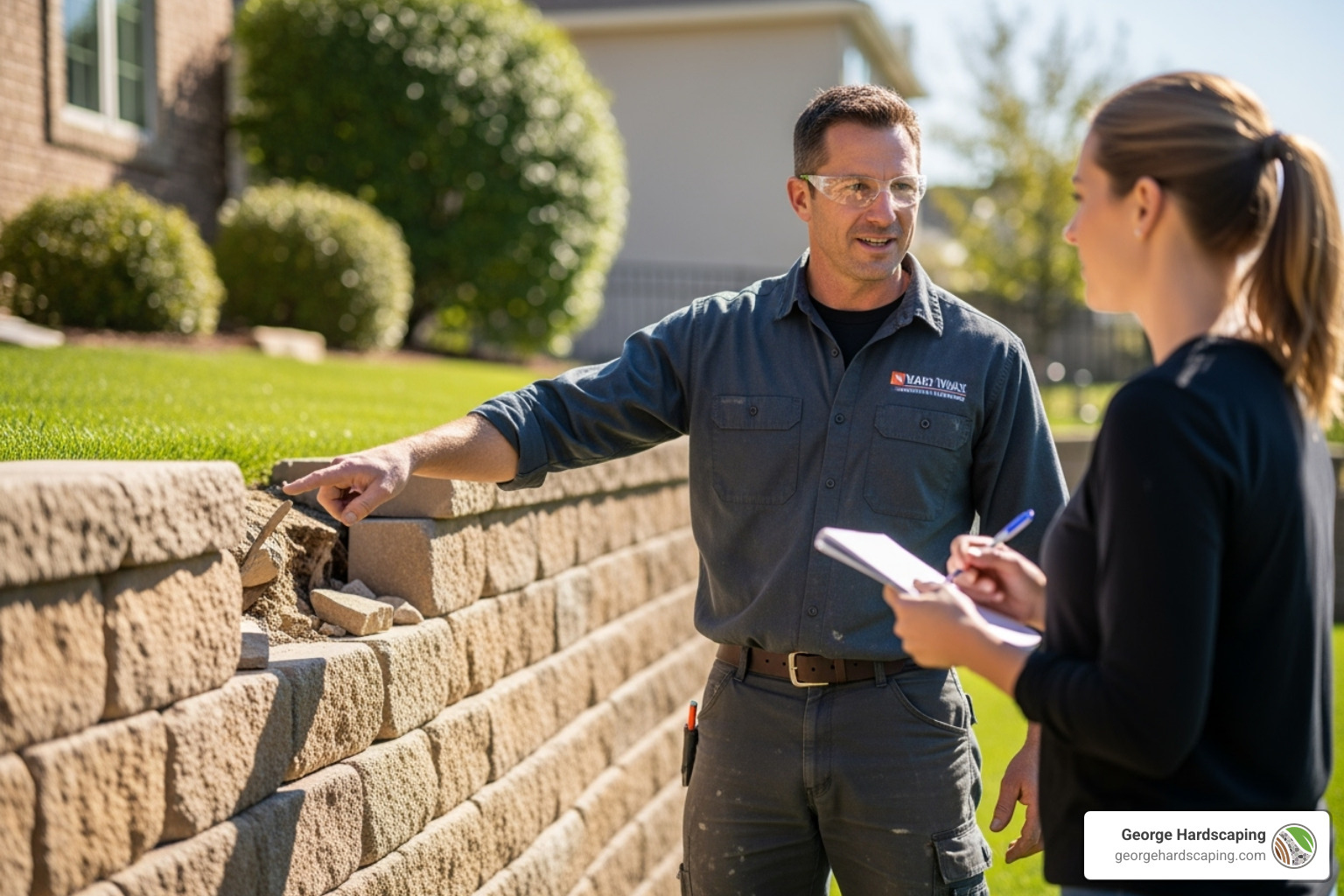
Here in Essex County, we’ve seen what happens when homeowners hire the wrong contractor. Walls that lean again within months. Drainage systems that never work. Materials that don’t match or aren’t suitable for our climate. That’s why we always recommend taking your time with this decision.
Start by verifying that any contractor you’re considering carries proper licensing and comprehensive insurance. This includes both liability coverage and worker’s compensation. If someone gets hurt on your property or something goes wrong during the repair, you want to know you’re protected. Don’t just take their word for it—ask to see current certificates.
Local experience matters tremendously in this work. A contractor who understands Essex County’s soil conditions, freeze-thaw cycles, and typical drainage challenges will design better solutions than someone from out of the area. Clay soils behave differently than sandy soils. Coastal properties face different moisture challenges than inland ones. Your contractor should know these nuances without you having to explain them.
Ask to see a portfolio of completed projects, particularly repairs similar to yours. If you have a failing stone wall, you want to see their stone wall work. If your block wall is bowing, look for examples of structural reinforcement they’ve completed. Quality contractors are proud of their work and happy to show it off. If someone hesitates to provide examples, that’s a red flag.
Customer reviews and references tell you what it’s actually like to work with a contractor. Online reviews give you a broad sense of their reputation, but don’t stop there. Ask for direct references from recent clients and actually call them. Ask about communication, timeliness, problem-solving, and whether they’d hire the contractor again. These conversations reveal things you won’t find in a formal review.
When you receive a quote, it should be detailed and transparent. Vague estimates like “we’ll fix your wall for $3,000” don’t give you enough information. A proper quote outlines exactly what work will be done, what materials will be used, how drainage will be addressed, the project timeline, and a clear breakdown of costs. If something seems unclear or missing, ask questions before signing anything.
For more guidance on finding the right professional for your project, our article on how to find a contractor to build a retaining wall offers valuable advice that applies equally well to repair work.
Questions to Ask Your Retaining Wall Contractor
Once you’ve narrowed your options to two or three qualified contractors, it’s time to dig deeper. The questions you ask now will help you understand not just what they’ll do, but how they think about your problem.
“What’s your experience with my specific type of wall and this kind of damage?” This question gets to the heart of their expertise. Someone who’s repaired dozens of natural stone retaining walls will approach your stone wall differently than someone who primarily works with poured concrete. Listen for specific examples and detailed knowledge about your wall type.
“What repair method do you recommend, and why is it the best solution?” A good contractor should explain their diagnosis clearly and walk you through their recommended approach. They should also mention alternatives and explain why they’re suggesting one method over another. If they can’t explain it in terms you understand, or if they seem annoyed by the question, keep looking.
“What’s your estimated timeline for this project?” You need to know when work will start, how long it will take, and what might cause delays. Weather affects outdoor masonry work, especially in New England. Material delivery can take time. Understanding the realistic timeline helps you plan and sets proper expectations.
“Do you offer a warranty on your work?” This is crucial. A warranty shows confidence in workmanship and gives you recourse if something goes wrong. Make sure you understand what’s covered, what’s not, and for how long. Get it in writing as part of your contract.
“How will you address drainage to prevent this from happening again?” This might be the most important question of all. Any repair that doesn’t include a proper drainage solution is just a temporary patch. The contractor should talk knowledgeably about weep holes, drainage pipes, filter fabric, and gravel backfill. If they gloss over drainage or suggest it’s not necessary, walk away.
“What permits will be required, and who handles them?” Depending on your wall’s height and location, permits may be necessary for major repairs. Some municipalities in Essex County have specific requirements. Your contractor should know local regulations and clarify who’s responsible for obtaining permits. Don’t assume anything—get this sorted out before work begins.
At George Hardscaping, we believe in transparent communication from the first conversation through project completion. We answer every question thoroughly because we want you to feel confident in your decision. Our team brings decades of experience with all types of retaining walls, from historic stone structures to modern segmental systems. We understand the unique challenges of working in Essex County and along the North Shore.
When you work with us, you’re getting more than just skilled retaining wall contractor services—you’re getting partners who care about the long-term stability and beauty of your property. We don’t cut corners on drainage. We don’t use substandard materials. And we stand behind every project with a solid warranty.
Ready for a professional assessment? Request your free estimate today! We’ll visit your property, thoroughly inspect your wall, explain exactly what’s happening and why, and provide you with a detailed proposal for lasting repair. No pressure, no surprises—just honest expertise and quality craftsmanship you can count on.
Frequently Asked Questions about Retaining Wall Repair
Here are answers to some of the most common questions we hear from homeowners.
Can a severely leaning retaining wall be fixed?
Yes, in many cases. A professional can often fix a leaning wall without a full replacement. Common methods include excavating behind the wall to relieve pressure, then pushing it back to vertical and reinforcing it. As noted by experts like Bob Vila, installing tiebacks or helical anchors is a highly effective technique to pull the wall back and secure it into stable soil. However, if the wall’s foundation has failed or the materials are severely degraded, replacement might be the only safe option. A professional assessment is essential to make the right call.
How long should a properly built retaining wall last?
The lifespan depends heavily on the material, construction quality, and drainage. Here are some general estimates:
- Timber/Railroad Ties: 15-40 years
- Concrete Blocks & Poured Concrete: 50-100 years
- Natural Stone & Gabion Walls: 50-100+ years
A well-designed drainage system and regular maintenance are the most critical factors in maximizing any retaining wall’s lifespan.
Does homeowners insurance typically cover retaining wall damage?
Coverage is nuanced. Retaining walls are often covered under the “Other Structures” portion of a policy, but only for specific perils like fire or vehicle impact. Most standard policies exclude damage from the most common causes of failure, such as:
- Earth movement (landslides, settlement)
- Floods (requires separate insurance)
- Gradual deterioration or lack of maintenance
- Hydrostatic pressure (water pressure from poor drainage)
Always review your specific policy or speak with your agent to understand what is and isn’t covered. Do not assume you are protected against all types of damage.
Conclusion: Protecting Your Investment with Proper Care and Repair
Your retaining wall is a structural guardian, protecting your property’s value and safety. Ignoring warning signs can lead to catastrophic failure, but proactive care and timely retaining wall repair can prevent disaster.
This guide has shown that the keys to a long-lasting wall are acting early, understanding the cause of the failure, and prioritizing drainage. While minor fixes can be a DIY task, structural issues require a professional. A leaning block retaining wall or a crumbling historic natural stone retaining wall needs an expert who understands soil mechanics and proper reinforcement, like installing helical anchors.
Investing in a proper repair or a well-built replacement protects your home’s foundation, prevents erosion, and ensures the safety of your landscape. At George Hardscaping, we bring years of specialized experience to properties throughout Essex County. We understand our local climate and soil, and we build solutions that last.
A failing wall won’t fix itself. The longer you wait, the more complex and expensive the solution becomes. Let our team provide an honest assessment and quality craftsmanship to secure your landscape for decades to come.
Don’t wait for a small problem to become a major collapse. Contact us to discuss your masonry service needs in Stoneham, MA and get a lasting solution for your retaining wall.
