
Is It Really Possible to Put Large Pavers on Your Pool Deck?
Can you put large pavers on your pool deck? Yes — in most cases, you can. But whether it’s the right move depends on a few key factors: the condition of your existing surface, the stability of the ground beneath it, and how the pavers are installed.
Here’s the quick answer:
| Condition | Can You Install Large Pavers? |
|---|---|
| Existing concrete is structurally sound, minimal cracking | Yes — mortar-set overlay is a strong option |
| Existing concrete has major cracks or is shifting | No — tear-out and replace first |
| New installation on properly compacted base | Yes — with correct base depth and drainage |
| Ground around pool has not been properly compacted | Not yet — base prep is required first |
Large-format pavers, such as 24×24 or larger units, are increasingly popular on Massachusetts pool decks. They create a clean, modern look with fewer grout lines. But they also require more precision to install — and more care in preparation — than smaller interlocking pavers.
The stakes are real. A poorly installed paver deck can shift, crack, or become a safety hazard within just a couple of years. Done right, it can last 25 years or more and meaningfully increase your property’s value.
This guide walks you through exactly what you need to know before making a decision.
Can i put large pavers on my pool deck glossary:
Can I Put Large Pavers on My Pool Deck? Feasibility and Sizing
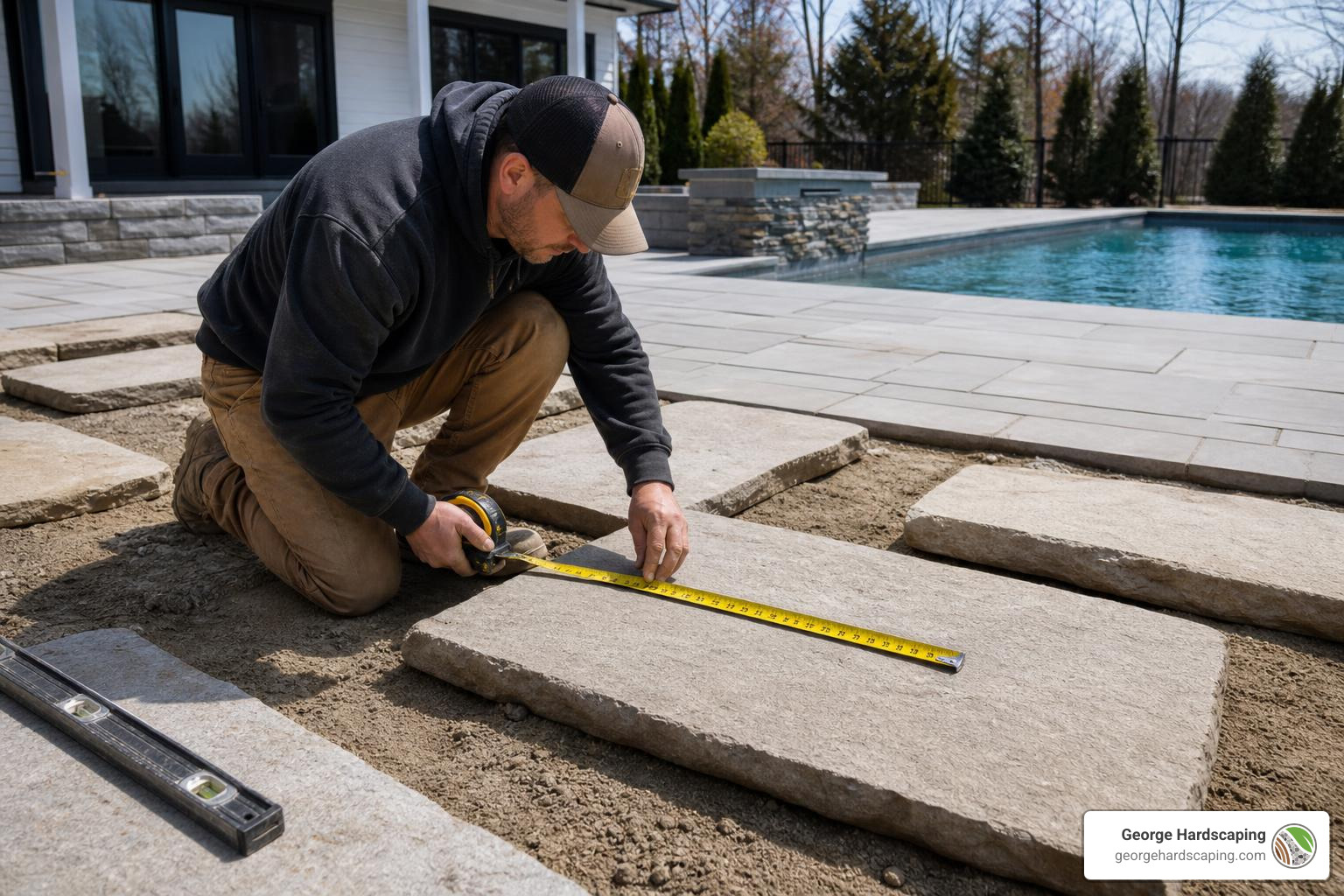
For pool decks, we generally consider a paver “large-format” when it is bigger than the common small interlocking sizes. That usually includes:
| Paver Size | Is It Large-Format? | Common Pool Deck Use |
|---|---|---|
| 12×24 inches | Yes, often considered large-format | Modern linear layouts, borders, coping transitions |
| 18×18 inches | Borderline large-format | Transitional designs |
| 24×24 inches | Yes | Clean modern pool decks |
| 24×36 inches | Yes | Premium large-slab appearance |
| 36×36 inches and larger | Very large-format | Requires very precise base and handling |
So, if you are asking, “can I put large pavers on my pool deck?”, the practical answer is: yes, if the structure below them is ready for them.
Large pavers are less forgiving than small interlocking pavers. A smaller paver can hide slight variations in the base because there are more joints and more individual pieces. A large paver acts more like a slab. If one corner is unsupported, it can rock. If the base settles, it may crack. If water gets underneath and freezes, Massachusetts winter will happily remind you that water expands when frozen.
In Massachusetts communities such as Gloucester, Ipswich, and Woburn, freeze-thaw cycles matter. Pool decks here are exposed to rain, snow, ice, salt air in coastal areas, and summer pool chemicals. That does not mean large pavers are a bad choice. It means the installation has to be designed for New England conditions.
Large pavers can be installed in two main situations:
- Over an existing concrete pool deck
- As a new installation after removing the old deck
Overlaying existing concrete can work when the concrete is stable, properly sloped, and not severely cracked. Thin remodel pavers, natural stone, and certain porcelain pavers are often used for overlays because they reduce the amount of height added to the deck.
However, overlaying is not a magic trick. It does not fix a failing slab. If the concrete underneath is moving, sinking, heaving, or holding water, the new pavers will inherit those problems.
For a deeper look at proper installation around pools, see our guide to Pool Paver Decks Installation.
Before choosing large pavers, we look at:
- Existing slab condition
- Drainage and slope
- Pool coping height
- Door thresholds
- Skimmer lids and drains
- Expansion joints
- Soil stability
- Freeze-thaw exposure
- Slip resistance
- Surface temperature in summer
A large-format pool deck can look beautiful. But it needs to be treated like a hardscape system, not just a surface upgrade.
Large-Format Pavers vs. Smaller Interlocking Pavers
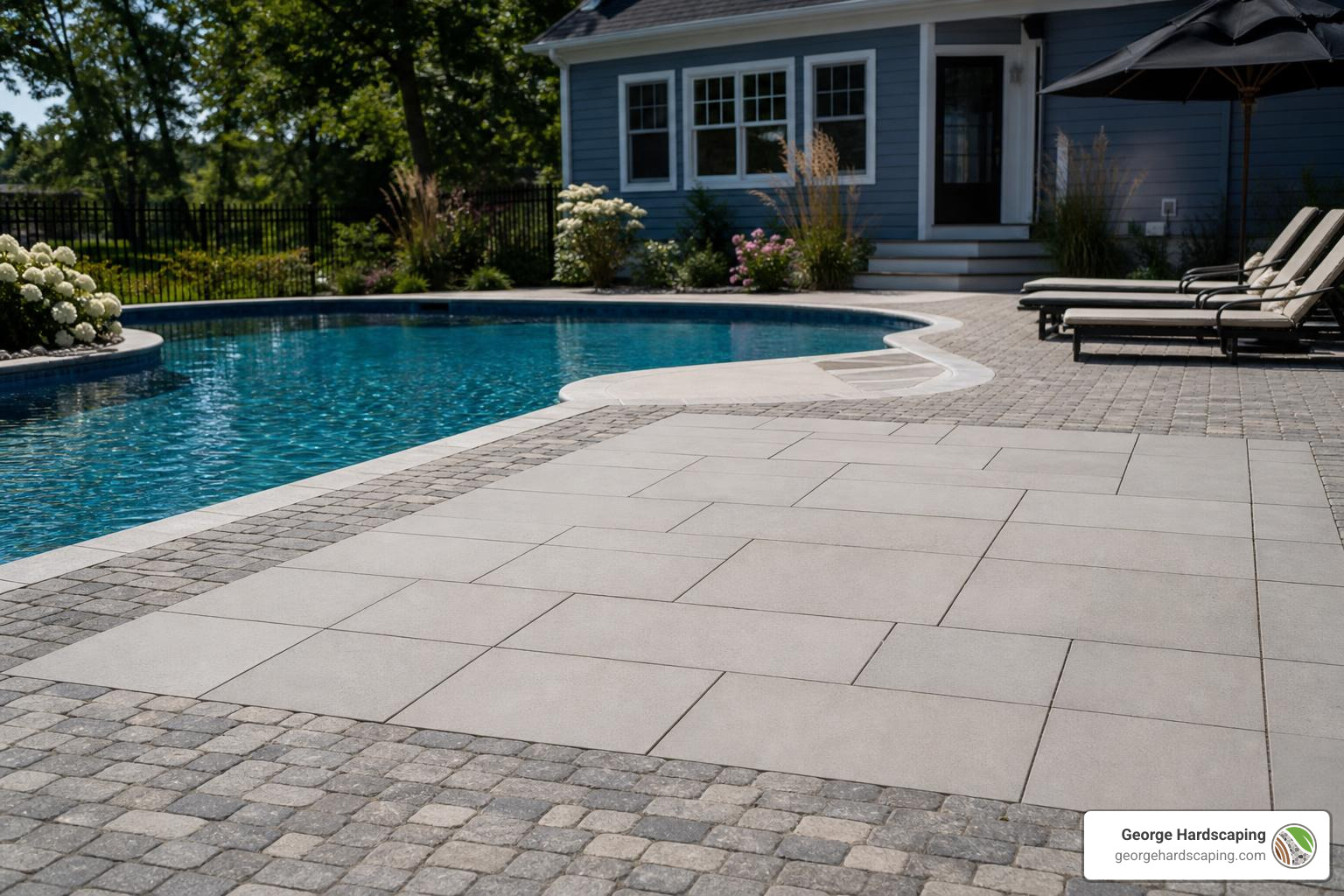
Large pavers and smaller interlocking pavers can both work around pools. The better choice depends on the look you want, the condition of the site, and how much movement the deck may experience over time.
Here is the simple comparison:
| Feature | Large-Format Pavers | Smaller Interlocking Pavers |
|---|---|---|
| Appearance | Modern, clean, fewer joints | Traditional, patterned, more joints |
| Installation tolerance | Requires very flat, stable base | More forgiving of minor movement |
| Shifting risk | Higher if base is imperfect | Lower when properly interlocked |
| Weed growth | Fewer joints, fewer weed paths | More joints, more maintenance |
| Repair | Individual pieces replaceable but heavier | Easier individual replacement |
| Slip resistance | Depends heavily on finish | Depends on finish and joint texture |
| Heat retention | Depends on color and material | Depends on color and material |
| Best use | Stable slabs, premium pool decks | Areas with more movement or complex shapes |
The main benefit of large-format pavers is visual. They make a pool deck feel more open, modern, and calm. Fewer joint lines can also mean less joint maintenance and fewer places for weeds or moss to appear.
The downside is that large pavers do not like uneven support. If the base is not compacted evenly, a large paver may wobble or crack. Around a pool, that matters because wet surfaces raise the safety stakes.
Smaller interlocking pavers have more joints, but those joints are part of their strength. They distribute movement across many pieces. When installed with edge restraints and polymeric sand, they can perform very well on pool decks, especially where curves, slopes, and grade changes are involved.
Large pavers are often best when:
- The design goal is modern and minimal
- The existing concrete is sound
- The base can be built or corrected properly
- The paver material is rated for exterior wet areas
- The installer can maintain tight tolerances
Smaller interlocking pavers are often better when:
- The pool deck has many curves
- The ground is more prone to movement
- Easier spot repairs are a priority
- A traditional pattern is preferred
- Budget flexibility is important
If you are still comparing materials, our guides to the Best Pavers for Pool Area and Natural Stone vs Porcelain are useful next reads.
One important note: fewer joints does not automatically mean less slippery. Slip resistance comes from the surface texture and material rating, not just the size of the paver. Around pools, we prefer textured, tumbled, brushed, sandblasted, or slip-rated finishes. Smooth polished stone around a wet pool is usually a poor choice for safety and performance.
Ground Stability and Base Preparation for Large Pavers
The ground around a pool is not always as stable as it looks.
When a pool is installed, soil is excavated and then backfilled around the pool walls. That backfilled soil may settle over time. In Massachusetts, moisture and freeze-thaw movement can make that settling more noticeable. This is especially important in coastal or variable-soil areas such as Gloucester, Ipswich, and Woburn.
Large pavers need a stable base because they span more area. Think of a large paver like a dining table. If one leg is shorter, the whole table rocks. With a paver, that “short leg” is usually a low spot in the base.
A proper base may include:
- Removal of unstable soil
- Geotextile fabric where needed to separate soil from stone
- Compacted crushed stone base
- Proper base depth for Massachusetts freeze-thaw conditions
- Screeded setting bed or mortar bed, depending on the system
- Edge restraints where applicable
- Proper drainage paths
- Correct slope away from the pool and structures
For new installations in Massachusetts, base depth is site-specific. Many pool deck projects require a deeper and more carefully compacted base than a simple walkway because the area is wet, heavily used, and close to a pool shell. In freeze-thaw climates, installers often increase base depth compared with warm-weather regions. According to the Interlocking Concrete Pavement Institute (ICPI), proper base construction is one of the most critical factors in long-term paver performance.
For overlay projects, the existing concrete becomes part of the “base.” That is only acceptable if the concrete is stable. If the slab is cracked because of surface shrinkage, it may still be a candidate. If the slab is cracked because the ground below is sinking, it is not.
Signs the ground or slab may be unstable include:
- Wide cracks
- Cracks with height differences from one side to the other
- Sunken areas near the pool edge
- Puddling after rain
- Hollow sounds under concrete
- Coping movement
- Soil washout near deck edges
- Previous patching that has failed
This is where professional assessment matters. We do not want to install a beautiful surface over a problem that is still moving underneath. That is how pavers become trip hazards.
For more background on pool deck systems, see The Ultimate Guide to Pool Deck Pavers.
Installation Methods: Mortar vs. Sand Base
Large pool deck pavers are usually installed one of two ways:
- Mortar-set or wet-set installation
- Sand-set or dry-lay installation
Both can be appropriate, but not in every situation.
| Installation Method | Best For | Main Advantage | Main Risk |
|---|---|---|---|
| Mortar-set overlay | Sound existing concrete slabs | Strong bond, less movement | Requires excellent slab prep and drainage |
| Mortar-set new install | Certain stone or porcelain systems | Stable, precise finish | More labor and curing time |
| Sand-set on compacted base | New paver installations | Drainage, flexibility, repairability | Can shift if base or edge restraints are poor |
| Sand-set over concrete | Generally not preferred for pool overlays | Lower initial complexity | Water can wash bedding sand, causing wobble |
Mortar-set installation
For large pavers over existing concrete, mortar-set installation is often the stronger option. The installer prepares the concrete, addresses cracks where appropriate, applies a suitable bonding system, and sets the pavers in mortar.
This method helps reduce movement because the pavers are bonded to a stable slab. It is commonly used for stone or porcelain pavers in overlay applications.
Important details include:
- The concrete must be clean and structurally sound
- Cracks must be evaluated before covering
- The surface must be properly sloped
- Pool coping height must be adjusted if needed
- Expansion and movement joints must be respected
- A proper exterior-rated mortar system must be used
- Joints must be filled with an appropriate grout or joint material
- Drainage must not be blocked
Sand-set installation
Sand-set pavers are installed over a compacted crushed stone base with a thin layer of bedding sand. This is common for new paver installations. It can work very well when the base is built correctly and the pavers are locked in with edge restraints and polymeric sand.
For large-format pavers, the base has to be especially flat and consistent. A small void under a 24×36 paver can become a wobble. A wobble can become a crack. A crack can become a service issue that requires correction.
Sand-set installation is generally not our favorite approach for overlaying existing concrete around a pool. Water can get between the pavers and concrete, wash out bedding material, and create movement. In Massachusetts, trapped water can also freeze and expand.
Drainage and grading
Pool decks should move water away from the pool structure and away from the home. A common target is a 1% to 2% slope, depending on site conditions, code requirements, and deck layout. Another common field rule is about 1/8 inch to 1/4 inch per foot, but the correct slope depends on the exact design.
Drainage planning may include:
- Surface pitch
- Channel drains
- Deck drains
- Permeable joints where appropriate
- Redirecting runoff away from pool walls
- Avoiding low spots near coping
- Maintaining safe walking transitions
In Massachusetts, where heavy rain and winter ice are both part of life, drainage is not optional. It is part of safety.
For material-specific installation planning, see our pages on Pool Deck Stone Pavers and Porcelain Pavers for Pool Deck.
Cost Considerations and Long-Term Value in Massachusetts
As of May 2026, pool deck paver costs vary widely based on material, site access, demolition, base preparation, coping, drainage, and installation method.
Important pricing note: All prices below are broad planning ranges based on publicly available internet data and general industry averages. They are not actual prices, quotes, guarantees, or rates from George Hardscaping. Every Massachusetts pool deck is different, especially when freeze-thaw preparation, drainage, and existing slab condition are involved.
For cautious planning purposes, online industry data suggests large paver pool deck projects can fall in a wide range of about $50 to $250 per square foot. That wide range accounts for basic paver systems on the lower end and premium natural stone, porcelain, complex overlays, drainage work, or full replacement on the higher end.
For a 500 square foot pool deck, that creates a broad planning range of roughly:
| Project Size | Broad Online Planning Range |
|---|---|
| 500 sq ft pool deck | $25,000 to $125,000 |
Again, this is not George Hardscaping pricing. It is a broad planning range based on publicly available online data and industry variability.
Factors that affect cost include:
- Paver material: concrete, porcelain, travertine, granite, limestone, or other stone
- Paver size and thickness
- Overlay vs tear-out and replacement
- Existing concrete condition
- Base depth and compaction needs
- Drainage improvements
- Pool coping replacement
- Edge restraints
- Curves and cuts
- Access for equipment
- Sealing requirements
- Freeze-thaw detailing
Large-format pavers may cost more to install than smaller pavers because they require more careful leveling, handling, cutting, and layout. Some large porcelain or natural stone units are also more expensive as materials.
However, the long-term value can be strong when the system is built correctly. Quality paver pool decks can last decades with proper base preparation and maintenance. They also offer localized repair options. If a paver is damaged, it may be possible to replace that specific piece instead of resurfacing the entire deck.
Maintenance costs to consider include:
- Seasonal cleaning
- Joint inspection
- Polymeric sand touch-ups where applicable
- Sealer application for certain materials
- Occasional stain treatment
- Winter care with paver-safe products
Light-colored pavers, textured surfaces, and breathable sealers can help improve comfort and longevity. Around pools, glossy sealers are usually not recommended because they can increase slipperiness.
For more detail on budgeting, visit our guide to the Cost to Install Pavers Around Pool. For maintenance planning, see How to Seal Pool Deck Pavers.
In areas like Gloucester, Ipswich, and Woburn, a well-built pool deck is not just a summer upgrade. It is part of the property’s outdoor living space. If the installation solves drainage, improves safety, and modernizes the pool area, it can add meaningful functional and visual value.
Ready to transform your pool area with premium large-format pavers? Contact our team today to discuss your project and get a detailed, professional assessment of your pool deck.
Schedule a Pool Deck Consultation
Frequently Asked Questions About Large Pool Deck Pavers
Can I put large pavers on my pool deck if the existing concrete is cracked?
Sometimes, but it depends on the crack.
Hairline surface cracks are not always a dealbreaker. Many older concrete pool decks have minor shrinkage cracks. If the slab is still flat, stable, and properly sloped, a mortar-set overlay may be possible after proper preparation.
Larger cracks are different. If cracks are wide, uneven, or actively moving, large pavers should not be installed over them without correcting the underlying issue. A paver overlay will not stop a slab from continuing to settle.
A professional inspection should check:
- Crack width
- Whether one side of the crack is higher
- Whether the crack continues through coping
- Whether the slab rocks or sounds hollow
- Whether water pools near the crack
- Whether soil has washed out below the slab
In many cases, the best choice is to tear out failing concrete and rebuild the base. It costs more upfront, but it avoids paying twice: once for the overlay and again for the repair after failure.
Can I put large pavers on my pool deck without professional help?
We do not recommend DIY installation for large-format pool deck pavers.
This is not like placing a few stepping stones in a garden. Large pavers are heavy, precise, and unforgiving. Around a pool, mistakes can create trip hazards, drainage problems, slippery transitions, and cracked materials.
A professional installation involves:
- Evaluating the pool structure and coping
- Checking slab stability
- Planning drainage
- Building or correcting the base
- Managing freeze-thaw movement
- Cutting pavers accurately
- Maintaining consistent joint spacing
- Setting slope correctly
- Using the correct mortar, sand, grout, or joint material
- Protecting the pool from debris during work
If you are determined to understand the process, keep it high-level: prepare a stable base, maintain slope, use rated materials, and never cover serious structural problems. For actual installation, especially in Massachusetts, hiring a professional is the safer and smarter route.
Large pavers look simple when finished. That is because the hard part is hidden underneath.
How do large pavers compare to travertine in heat retention?
Travertine is often praised because it tends to stay cooler than dense concrete or dark stone. Its porous structure and lighter color options can make it more comfortable under bare feet in summer.
That said, heat retention depends on several factors:
- Color
- Density
- Surface texture
- Sun exposure
- Wind
- Moisture
- Sealer type
- Thickness
- Material composition
Light-colored travertine can perform very well around pools. Light porcelain pavers can also be a strong option, especially when slip-rated for wet exterior use. Light concrete pavers may be more comfortable than dark concrete, but dense concrete can still get hot in direct sun.
In Massachusetts, pool decks can become uncomfortable during peak summer afternoons. If barefoot comfort is a priority, choose lighter colors, textured finishes, and materials known for lower heat absorption.
Also consider shade. Umbrellas, pergolas, plantings, and smart layout choices can make as much difference as the paver itself. The best pool deck design is not just about the surface. It is about how people actually use the space.
Conclusion
So, can I put large pavers on my pool deck? Yes, if the deck structure, base, drainage, and installation method are right.
Large-format pavers can create a stunning, modern pool deck with fewer joints, strong visual impact, and long-term value. But they are not a shortcut. They require careful evaluation, proper base preparation, accurate grading, and the right installation system.
Choose an overlay when:
- Existing concrete is structurally sound
- Cracks are minor and stable
- Drainage can be maintained or improved
- Added height will not create problems
- Coping and thresholds can be handled properly
Choose tear-out and replacement when:
- Concrete is sinking or shifting
- Cracks are wide or uneven
- Water pools on the deck
- Soil has settled around the pool
- The base was never built correctly
- You want the longest-lasting result
At George Hardscaping, we help Massachusetts clients create outdoor spaces that are safe, durable, and professionally built. Our masonry and hardscaping work focuses on craftsmanship that holds up in local freeze-thaw conditions.
If you are considering large pavers for your pool deck, we can help you evaluate the existing surface, compare materials, and choose the right installation approach.
Ready to get started on your Massachusetts pool deck transformation? Contact George Hardscaping today to schedule your professional site evaluation and receive a comprehensive project quote.
You can also learn more about our broader hardscape work through George Hardscaping Masonry Services.
