
Stone Retaining Wall Repair Near Me: Trusted 2025 Guide
Why Your Stone Retaining Wall Deserves Attention
If you’re searching for stone retaining wall repair near me, your property may have a wall showing signs of distress. A stone retaining wall is more than a decorative feature; it’s a crucial structural system engineered to prevent soil erosion and protect your landscape. When it fails, it can lead to significant safety hazards and costly property damage, especially on sloped lots or near critical areas like driveways, patios, and home foundations. A collapse not only endangers people and property but can also lead to complex liability issues.
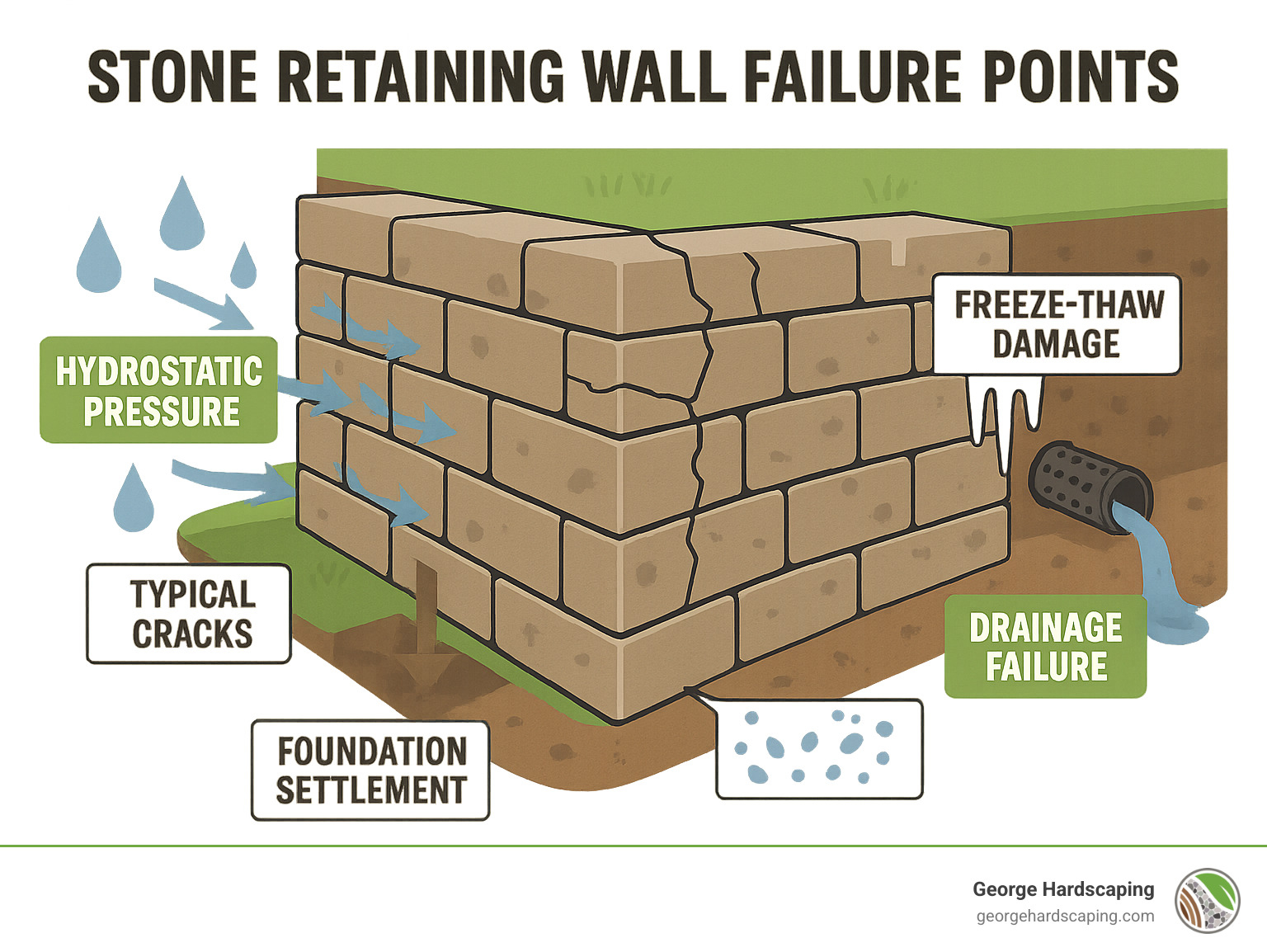
Massachusetts weather and soils are particularly tough on all types of masonry. The relentless freeze-thaw cycles of a New England winter, combined with heavy nor’easter rains, create a perfect storm for wall failure. Our regional soils, often a mix of clay, loam, and the infamous Gloucester stony loam found in Essex County, can retain massive amounts of water. This saturation creates immense hydrostatic pressure that pushes relentlessly against the wall. Poor drainage is the number one cause of failure, and even a beautifully built wall will eventually succumb without a clear, unobstructed path for water to escape. A wall that appears stable today can deteriorate with surprising speed once water becomes trapped behind it.
Quick Action Steps for Homeowners:
- Identify the Problem: Regularly inspect your wall for warning signs like cracks, leaning, bulging, clogged weep holes, or crumbling mortar. Take dated photos from the same position to track any movement over time.
- Get a Professional Inspection: A qualified contractor will do more than just a visual check. They will evaluate the wall’s structure, drainage system, soil conditions, and any surcharge loads. They should use tools like a laser level or string line to quantify any leaning or bulging.
- Compare Costs: Minor repairs like repointing can range from $300–$1,600. Major stabilization, drainage overhauls, or partial rebuilds can cost several thousand dollars. A full replacement can range from $3,500–$10,000+ depending on the wall’s size, site access, and any required engineering.
- Choose a Licensed Local Contractor: It is critical to verify their Home Improvement Contractor (HIC) license, full liability and worker’s compensation insurance, and references. Prioritize contractors with specific, proven experience in repairing stone walls and installing drainage systems in our local climate.
- Act Quickly: Small issues escalate rapidly under the immense force of water pressure and freeze-thaw cycles. Early intervention is the most effective way to save money and prevent a catastrophic failure.
Note: These are average costs based on internet data and not actual costs for George Hardscaping.
While retaining walls can last anywhere from 20 to over 100 years, developing problems require immediate attention. A small crack or a slight lean can quickly become a full-blown collapse, especially if the wall lacks adequate drainage or sits on an undersized, frost-susceptible base. In Essex County, MA, our varied soils and grades make proper base preparation and robust back-drainage systems absolutely essential. A timely, professional repair not only restores stability but can add decades to your wall’s service life, preserving your landscape and your peace of mind.
Two essentials govern durable repairs: addressing the root cause (almost always water and base support) and matching the repair method to the wall type (e.g., dry-stacked vs. mortared). You will save significant time and money by investing in a thorough initial assessment and a comprehensive solution that combines true masonry craft with sound engineering principles.
For background on specialized reinforcement, see these terms and guides relevant to your stone retaining wall repair near me search:
Strong CTA: Ready to stop small problems from becoming big ones? Schedule a professional on-site assessment now: Request your free estimate.
Is Your Wall Crying for Help? Signs of Failure and Their Causes
Your stone retaining wall works tirelessly to protect your property, but over time, the immense forces it contains can cause signs of distress. Acting on these warnings quickly can save you thousands of dollars in repairs and prevent serious safety hazards. If you’re searching for stone retaining wall repair near me, here are the key signs of failure to watch for:
- Leaning or tilting: Even a subtle lean is a serious indicator of excessive soil pressure or foundation failure. Progressive tilting—a lean that worsens over weeks or months—is a red flag demanding urgent intervention. You can monitor this by placing a 4-foot level vertically against the wall and measuring the gap at the top or bottom.
- Bulging or bowing: An outward curve or “belly” in the wall’s face almost always points to trapped water and immense hydrostatic pressure. This often means the drainage system has failed or was never installed, turning the backfill into a water-logged weight that pushes stones outward. Without relief, the bulge will grow, and stones will eventually dislodge.
- Cracks: The pattern of a crack tells a story. Horizontal cracks often relate to lateral earth pressure pushing the wall forward. Vertical cracks can indicate the wall is bending due to differential settlement of its foundation. Stair-step cracks that follow the mortar joints are a classic sign of base movement, often caused by frost heave or foundation washout.
- Separation from adjacent structures: Look for new or widening gaps between the retaining wall and your house foundation, steps, or connecting wing walls. This indicates movement that compromises the stability of both the wall and the adjoining structure.
- Crumbling mortar or loose stones: If your mortar is soft, sandy, or sounds hollow when tapped, it’s failing and allowing water to penetrate the wall’s core. In a dry-stacked wall, loose or shifting stones indicate a loss of the critical interlock between stones, often due to base deformation or pressure from behind.
- Water damage: Visible signs of water problems include efflorescence (a white, powdery residue left as water evaporates), dark staining, persistent moss or algae growth, and soggy or sunken soil at the wall’s base or behind it. These are clear signals that the wall’s drainage system is not functioning.
- Sinking or settling: A wavy or uneven top line, or localized depressions appearing in the yard directly behind the wall, often indicate an inadequately prepared base, poor soil compaction during construction, or soil being washed out from behind or beneath the wall.
For comprehensive solutions to these and other masonry issues, explore our masonry repair services.
Understanding the Root Causes of Damage
An effective repair must address the underlying cause, not just the visible symptom. The primary culprits behind wall failure include:
- Poor drainage: This is the number one cause of retaining wall failure. Saturated backfill soil is significantly heavier than dry soil and exerts immense lateral hydrostatic pressure. Without a free-draining backfill material (like washed stone) and a functional outlet (like a perforated pipe and weep holes), water becomes trapped and will exploit any weakness.
- Improper foundation: A wall’s foundation, or footing, must be wide enough, deep enough, and built on solid, well-compacted ground. A shallow base built on loose topsoil is doomed to fail. In our climate, footings must extend below the frost line (around 48 inches) to prevent frost heave, a powerful force that can lift and break entire sections of a wall.
- Freeze-thaw cycles: Water penetrates small cracks in stones and mortar joints. When it freezes, it expands with incredible force (up to 9%), prying the wall apart from the inside. When it thaws, the gap is left wider, allowing more water in for the next freeze. This relentless cycle gradually destroys the wall’s integrity.
- Soil settlement: If the soil beneath the foundation was not properly compacted in uniform layers, it can settle unevenly over time, causing the wall to bend, crack, and tilt.
- Surcharge loads: A retaining wall is designed to hold back a specific amount of weight. Adding unplanned weight (a “surcharge”) on the soil above the wall can cause it to fail. Common examples include building a new patio or shed, parking a car, piling large amounts of snow, or even planting large trees too close to the wall.
- Poor construction: Flaws in the original build, such as using rounded stones that don’t interlock well, not incorporating a proper “batter” (backward lean), using the wrong type of mortar, or having an insufficient wall mass, will all lead to a shorter lifespan and premature failure.
Regular professional inspections, which may cost between $150–$300, are a wise investment that can catch these issues early. For a technical look at what professionals assess, review this state-level guide: Wisconsin DOT Retaining Wall Inspection Guide (PDF). For industry-leading best practices, see the NCMA Best Practices Guide.
The Critical Role of a Professional Inspection
Don’t attempt to diagnose a failing structural wall on your own. A qualified contractor will conduct a thorough investigation, which includes:
- Examining the entire drainage system, including weep holes, drain outlets, and signs of trapped water.
- Verifying the foundation’s condition by checking for signs of settlement, frost heave, or washout.
- Evaluating the soil type, groundwater conditions, and identifying any surcharge loads impacting the wall.
- Providing a detailed repair vs. replacement analysis, including cost estimates and the anticipated service life of each option.
- Outlining any local permit requirements and determining if engineered drawings are necessary for the repair.
In cases of severe failure or complex site conditions, a geotechnical engineer may be recommended for in-depth soil and pressure analysis, ensuring the repair plan is designed with the correct safety factors for a permanent solution. For comprehensive hardscape build capabilities after repair or replacement, explore our hardscape construction services.
Your Guide to Stone Retaining Wall Repair Near Me: Techniques and Materials
A retaining wall is an engineered system designed to hold back soil, and when problems arise, the right repair technique is essential for a lasting fix. The key to a successful stone retaining wall repair near me is to match the method to your specific wall type while simultaneously correcting the drainage and base conditions that caused the failure in the first place.
Common Types of Stone Walls and Their Repair Needs
Understanding your wall’s construction is the first step to a successful repair. Each type has unique failure modes and repair requirements.
- Dry-stacked stone walls: Built without mortar, these walls rely on the immense weight of the stones, friction, and careful interlocking placement. Repairs typically involve carefully dismantling the failed section, correcting the underlying base or drainage problem, and then rebuilding the section with proper batter (backward lean) and stone interlock. In many rebuilds, modern geogrid fabric can be layered into the backfill to tie it to the wall face, dramatically increasing its strength.
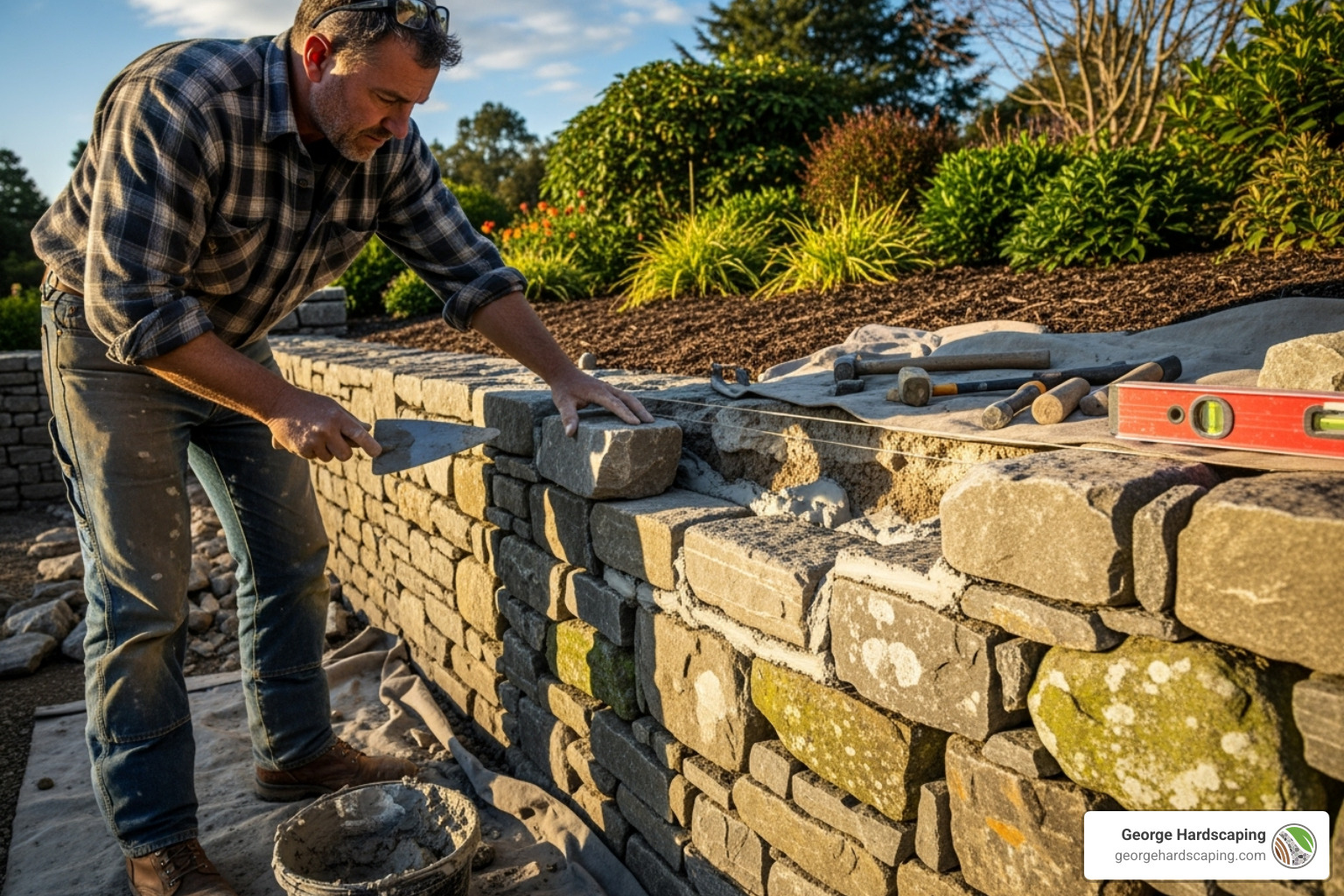
- Mortared stone walls: In these walls, mortar binds the stones into a rigid, monolithic structure. Over time, aging mortar joints crack and deteriorate, allowing water to infiltrate and build pressure. Repairs often include raking out the old, failed mortar, repointing the joints with a compatible mortar mix, resetting any loose stones, and adding or clearing weep holes to relieve hydrostatic pressure.
- Gravity retaining walls: Most traditional stone walls are gravity walls, meaning they resist pressure with their sheer mass. If they begin to lean or bulge, it’s a sign the forces behind them exceed their weight. Solutions may involve improving drainage, excavating and widening the base, or selectively reconstructing the wall to increase its mass or batter.
- Stone veneer over masonry: This type of wall has a structural core of concrete block (CMU) or poured concrete, with a decorative stone face bonded to it. Failure often occurs when moisture gets between the veneer and the core, breaking the bond. Repairs focus on re-attaching the stone veneer, installing proper flashing and waterproofing, and ensuring the backup wall has adequate drainage.
- Boulder retaining walls: When the massive stones in a boulder wall shift, it signals serious base problems or extreme pressure. Stabilization is a major undertaking that requires heavy equipment to excavate, install drainage upgrades, and carefully reset the multi-ton boulders.
| Feature | Dry-Stacked Stone Wall Repair | Mortared Stone Wall Repair |
|---|---|---|
| Primary Issues | Displaced stones, bulging, settlement, loss of interlock | Crumbling mortar, cracked stones, spalling, veneer detachment |
| Common Repairs | Re-setting stones, re-compaction of base, adding geogrid reinforcement | Repointing, stone replacement, crack injection, adding weep holes |
| Drainage | Gaps between stones help, but still requires a dedicated back-drainage system | Absolutely critical to add/clear weep holes and install a full back-drainage system |
| Reinforcement | Geogrid layers and proper batter | Helical anchors or tiebacks for leaning/bowing walls |
Proven Repair Methods for Lasting Results
We prioritize addressing root causes—almost always water and base support—to prevent recurring problems. Our proven methods include:
- Repointing mortar joints: For mortared walls, we use grinders and chisels to remove deteriorated mortar to a depth of at least 2x the joint width. We then pack a new, compatible mortar mix in layers, tooling it to match the original profile and ensure a strong, water-shedding bond. Using a mortar that is harder than the stone itself is a common mistake that leads to stone spalling; we ensure compatibility.
- Epoxy or polyurethane crack injection: For structural cracks in concrete backing or mortared walls, low-viscosity resins can be injected under pressure. This not only seals the crack from water but can also structurally rebond the sections, restoring monolithic strength.
- Rebuilding damaged sections: When stones have moved or the base has failed, the only correct fix is to dismantle and reconstruct the compromised area. We carefully number and salvage usable stones to maintain the wall’s original appearance and ensure sustainability.
- Installing proper drainage systems: Since poor drainage is the top cause of failure, this is the most critical part of most repairs. We typically excavate behind the wall, install a perforated drainpipe in a bed of gravel at the base, place a 12-24″ column of washed angular stone backfill, protect the system with geotextile filter fabric, and add or clear weep holes through the wall face. See our retaining wall drainage system guidance for more.
- Using tiebacks or helical anchors: For leaning or bowing walls where excavation is difficult or insufficient, we can install retaining wall anchors. These are steel rods or screws drilled deep into the stable soil behind the wall. A plate on the wall’s face is then used to apply tension, pulling the wall back toward plumb and securing it permanently. As noted in the Federal Highway Administration (FHWA) technical guidance on wall stabilization, anchoring is a proven engineering method for stabilizing failing walls.
Note: Helical anchor installation typically ranges from $60–$180 per linear foot, though costs vary by site and engineering. This is average online data and not an actual quote from George Hardscaping.
Drainage and Backfill: Where Most Walls Win or Lose
The best time to fix drainage is during the repair process. Key components of a robust system include:
- Free-draining backfill: Washed, 3/4-inch angular stone is ideal. It allows water to drop freely to the drainpipe, doesn’t compact, and reduces frost heave potential. Never use soil or sand as backfill.
- Filter fabric: This geotextile fabric acts as a separator between the drainage stone and the surrounding soil, preventing silt and clay from clogging the system.
- Perforated drainpipe: A rigid, perforated PVC pipe is placed at the base of the wall, sloped to a daylighted outlet away from the structure. The holes should face down to collect water.
- Weep holes: For mortared walls, these small pipes or gaps should be placed every 4-6 feet along the base to provide an exit path for any water that builds up.
For broader context on soil and drainage principles, you can use the USDA NRCS Web Soil Survey to learn about your local soil’s characteristics.
Materials That Matter
- Mortar selection: Historic or softer stones require a lime-rich mortar (like ASTM C270 Type N or O) that is softer than the stone itself. This allows for slight movement and ensures moisture can escape, preventing the stone face from spalling off.
- Stone matching: We take care to reuse original stones to preserve the wall’s character. If new stones are needed, we source them to match the original in color, density, and weathering qualities.
- Geogrid and geotextiles: These engineered fabrics are the secret to modern, ultra-stable walls. Geogrids reinforce the soil mass behind the wall, while geotextiles provide essential filtration and separation.
When Engineering Is Required
Walls over four feet in height, walls supporting a surcharge (like a driveway or slope), or walls with complex failure modes typically require a structural or geotechnical engineer to design the repair. Many municipalities, following guidelines from the International Building Code, mandate engineered plans for such walls. Our team is experienced in coordinating with engineers to ensure all repairs are fully compliant, safe, and built to last.
If your repair evolves into a new build, we provide end-to-end support—from design to construction—through our retaining wall contractor services.
The Repair vs. Replace Dilemma: Making the Right Financial Decision
When your stone retaining wall is failing, you face a critical choice: repair or replace. The right decision balances immediate cost, long-term durability, aesthetics, and safety. It’s not just about fixing what you see—it’s about investing in a solution that ensures the wall can withstand water, frost, and soil loads for decades to come.
Breaking Down the Cost of Stone Retaining Wall Repair
Understanding the financial side of your stone retaining wall repair near me search is key. Costs vary widely based on the wall’s condition, size, and site accessibility.
These are average costs based on internet data and not actual costs for George Hardscaping.
- Minor Repairs (Repointing, limited stone reset): $300–$1,600. Best for cosmetic issues or very localized problems on an otherwise stable wall.
- Moderate Repairs (Drainage upgrades, partial rebuild of a section): Typically in the low to mid-thousands, depending on the length of the wall and the extent of excavation required.
- Major Structural Stabilization (Helical anchors, extensive reconstruction): Often several thousand dollars and up. These are highly project-specific and may require engineering fees.
Key factors influencing repair costs:
- Extent of Damage: Stabilizing a severely bulging wall or correcting a failed foundation is far more complex and costly than sealing a few mortar joints.
- Labor and Skill: True stone masonry is a craft. Skilled labor often runs $50–$100 per linear foot or more. Work on historic walls requiring special materials and techniques can increase costs.
- Materials: Sourcing natural stone to match an existing wall and using specialized, compatible mortars can add to the expense.
- Site Access and Logistics: Tight yards, steep slopes, and the need to protect existing landscaping can significantly extend timelines and increase labor costs due to limited access for machinery.
- Permits and Engineering: Structural work, walls over 4 feet tall, or projects near wetlands often trigger permit fees and the need for costly engineered plans.
For a detailed overview, explore our resource on the cost of repairing a retaining wall.
When Is Full Replacement the Smarter Choice?
While repairing is often the first thought, replacement can be the more cost-effective and safer choice in the long run. Consider replacement when:
- Widespread Structural Failure Exists: If more than 30-40% of the wall is bulging, leaning, or has displaced stones, a patch-up repair will likely be a temporary fix, and other sections will soon fail.
- The Foundation Has Failed: You can’t build a durable structure on a poor foundation. If the base is too shallow (not below the frost line), too narrow, or has settled and cracked, the entire wall must be rebuilt from the ground up.
- The Wall is at the End of its Lifespan: If the stones themselves are crumbling (spalling) and the entire structure shows pervasive deterioration, it’s time for a new wall.
- The Original Construction was Flawed: If the wall was built with no drainage system, no batter, and poor materials, a repair will be fighting a losing battle. It’s better to start fresh with a proper design.
- You Want to Change the Landscape: A replacement provides an opportunity to modernize the design, improve property use, and integrate features like stairs or lighting. Explore modern retaining wall designs that can transform your space.
We help homeowners weigh the immediate costs of repair against the long-term lifecycle value of a full replacement. For planning a new build, see our retaining wall construction cost guide and consult our retaining wall contractor team for a tailored plan.
Strong CTA: Not sure whether to repair or replace? Book a professional evaluation and get a clear analysis of your options. Request your free estimate.
How to Find the Best Local Contractor for Stone Retaining Wall Repair Near Me
Choosing a qualified, reputable contractor is the single most important step toward a successful, long-lasting repair. For a stone retaining wall repair near me in Essex County, MA, it is crucial to prioritize teams that have deep, firsthand knowledge of our local soils, challenging freeze-thaw cycles, and municipality-specific permitting processes.
Your Checklist for Vetting a Masonry Contractor
Don’t hire anyone without running through this essential checklist:
- Verify License and Insurance: This is non-negotiable. Confirm their Massachusetts Home Improvement Contractor (HIC) registration is active and ask for a current certificate of insurance showing both general liability and worker’s compensation coverage. This protects you from liability for accidents on your property.
- Use the official state resource to verify: Check a Home Improvement Contractor registration (Mass.gov)
- Ask for Local, Relevant References: Don’t just ask for references; ask for references from recent clients who had a similar stone wall repair, especially one involving drainage or foundation work. Call them and ask about their experience.
- Review Their Portfolio: A picture is worth a thousand words. Examine their gallery of completed Stone Retaining Walls. Look for before-and-after examples that show they can handle complex reconstructions, not just simple repointing jobs.
- Get Detailed, Itemized Quotes: A vague, one-page quote is a red flag. A professional proposal should be a multi-page document that itemizes every phase: demolition, excavation, base preparation, specific drainage components (pipe type, stone specs, fabric), stone setting, mortar type, backfilling, compaction, and site cleanup. It should also detail the payment schedule.
- Understand the Warranty: A reputable contractor stands by their work. Ask for details on their warranty for both labor and materials. Specifically, what does the warranty cover regarding drainage performance and structural stability?
- Assess Their Safety Plan: Professional contractors take safety seriously. They should be able to explain how they will protect your property and their crew, following OSHA trenching and excavation safety standards for any digging over 5 feet deep.
- Confirm Permitting and Engineering Support: An experienced local team will know when a permit is required and will handle the application process. They should also have established relationships with local engineers for projects that require stamped plans.
For more guidance, see our post on how to find a contractor to build a retaining wall.
Proactive Prevention: Keeping Your Wall Strong for Years
After your professional repair is complete, prevention is the most cost-effective strategy to ensure its longevity:
- Annual Inspections: Each spring, after the ground has thawed, walk the length of your wall. Look for any new cracks, signs of movement, or shifting. Check that the ground behind the wall hasn’t sunk.
- Maintain Drainage: This is the most important maintenance task. Keep weep holes and drain outlets clear of leaves, debris, and mulch. Ensure gutter downspouts discharge well away from the wall’s backfill zone. Maintain a gentle grade that directs surface water away from the top of the wall.
- Manage Vegetation: The roots of large trees and shrubs can exert immense pressure and destabilize a wall over time. Avoid planting large species within a distance equal to their mature height from the wall.
- Avoid Surcharge Loads: Don’t pile heavy materials like firewood or soil near the top of the wall, and don’t allow vehicles to park there unless the wall was specifically engineered to support that load.
To integrate your repaired wall into a beautiful and functional landscape, explore our retaining wall landscaping ideas. If you’re planning major improvements like patios or walkways behind the wall, coordinate with our hardscape construction services for a fully integrated and engineered approach.
Frequently Asked Questions about Stone Retaining Wall Repair
Homeowners searching for stone retaining wall repair near me often have similar questions. Here are detailed answers to the most common inquiries we receive in Essex County, MA.
How long does a stone retaining wall repair take?
It depends entirely on the scope of work, site access, and weather conditions.
- Minor Repairs: Simple repointing or resetting a few stones can often be completed in 1–2 days.
- Moderate Repairs: A partial rebuild of a small section with a drainage upgrade typically takes 3–7 days.
- Major Repairs: Extensive reconstruction, projects requiring helical anchors, or full-length drainage overhauls can take 1–3 weeks or more, especially if engineering and permitting are involved.
After a thorough on-site inspection, a professional contractor can provide a specific and realistic timeline.
Can a leaning stone retaining wall be fixed?
Yes, in many cases a leaning wall can be saved, especially if addressed before the lean becomes severe. The process typically involves:
- Carefully excavating the soil behind the wall to relieve the immense pressure.
- Installing a robust, modern drainage system (perforated pipe, washed stone, filter fabric, and new weep holes).
- Rebuilding the wall section by section, re-establishing the proper backward lean or “batter.”
- For severe cases, installing structural reinforcement like tiebacks or helical anchors that pin the wall to stable soil deep behind it.
The feasibility and cost depend on the severity of the lean, the wall’s construction type, and the condition of its foundation.
Do I need a permit to repair my stone retaining wall in Massachusetts?
It depends on the scope, height, and location. Rules vary by town, but general guidelines are:
- No Permit Needed: Typically for minor maintenance like limited repointing or replacing a handful of stones in-kind (“ordinary repairs”).
- Permit Likely Required: For any structural work, significant reconstruction, changes in height, or for any wall over a certain threshold (often 4 feet). Walls supporting a “surcharge” (like a driveway or foundation) almost always require a permit, regardless of height.
- Environmental Permits: If the wall is located near a wetland, riverfront, or in a flood zone, additional approvals under the Massachusetts Wetlands Protection Act may be required. An experienced local contractor can guide you through this process.
What is ‘batter’ and why is it important for a stone wall?
Batter is the intentional backward slope or recess of a retaining wall’s face as it rises. For every foot of height, a properly built wall should step back a certain amount (e.g., 1-2 inches). This clever design feature uses gravity to its advantage, leaning the wall’s own weight back into the hill it’s retaining. It significantly improves the wall’s ability to resist lateral earth pressure and is a key characteristic of a stable gravity or dry-stacked wall. A wall built perfectly vertical (with no batter) is inherently less stable and more prone to failure.
What causes most retaining walls to fail?
Water pressure is the number one enemy. When the soil behind a wall becomes saturated, its weight increases dramatically, and it exerts immense hydrostatic pressure, pushing the wall outward. This is almost always due to a failed or non-existent drainage system. Secondary causes include an undersized or frost-heaved foundation, poor compaction, unexpected surcharge loads, and using the wrong construction materials. The NCMA Best Practices Guide provides industry-backed guidance on proper construction.
Can you repair a stone wall that is part of a historic property?
Yes, but it requires specialized expertise. Historic wall repair often falls under the purview of local historical commissions and demands a preservation-focused approach. The goal is to “repair in kind,” using materials and techniques that match the original construction. This can involve sourcing specific types of stone, chemically analyzing the original mortar to create a compatible lime-based mix, and using traditional stone-shaping and setting techniques. A contractor experienced in historic masonry is essential to preserve the wall’s character and value.
Can I DIY a retaining wall repair?
For very minor, non-structural issues like clearing weep holes or repointing a few small, accessible mortar joints, a skilled DIYer might be successful. However, any structural problem—leaning, bulging, significant cracking, or foundation failure—requires professional intervention. The forces involved are immense, and excavation can be dangerous. Improper DIY work can easily worsen the problem, lead to a catastrophic collapse, and dramatically increase the final cost of the professional repair.
Will my homeowner’s insurance cover the repair?
It’s unlikely, but possible. Most standard policies cover sudden, accidental damage (e.g., a tree falls on the wall). However, they almost always exclude damage from gradual failure due to age, poor maintenance, faulty construction, or earth movement—which covers most wall failures. You should contact your insurance agent and carefully review your policy. For general consumer guidance on insurance, see the National Association of Insurance Commissioners (NAIC).
How do I make sure my contractor is qualified?
Verify their Massachusetts HIC license and insurance. Check local references for similar jobs. Scrutinize their portfolio. Insist on a detailed, itemized contract that explicitly includes drainage and base reconstruction. For state registration verification, use the official resource: Check a Home Improvement Contractor registration. If excavation is involved, confirm they follow OSHA trenching and excavation safety protocols.
If your wall repair is part of a larger project, our team can seamlessly integrate the work with our comprehensive hardscape construction services to ensure your patio, steps, and walkways are all built to the same high standard.
Your Trusted Partner for Stone Retaining Wall Repair in Essex County, MA
Your stone retaining wall is a critical asset, protecting your property’s value and adding timeless New England beauty. When it shows signs of distress like cracking, bulging, or leaning, swift and decisive action is essential to prevent further damage and ensure safety. Throughout this guide, we’ve covered the key warning signs to look for, the primary causes of failure like hydrostatic pressure and frost heave, and the proven repair techniques for both dry-stacked and mortared stone walls.
Making the right repair-versus-replace decision requires a professional assessment of the wall’s foundation, the extent of the damage, and the long-term goals for your property. While minor repairs can be straightforward, most lasting solutions involve addressing the root cause: water. This often means a full drainage system overhaul, and in some cases, structural reinforcement with helical anchors.
At George Hardscaping, we combine traditional stone masonry craftsmanship with modern engineering principles to deliver repairs that are built to last. We are proud to serve homeowners in Beverly, Peabody, Salem, Marblehead, Topsfield, and throughout the North Shore. Our team understands the unique challenges of Essex County’s soils and weather, and we tailor our solutions accordingly.
As your local, licensed, and insured Retaining Wall Contractor, we are ready to protect your landscape investment with integrity and expertise.
Strong CTA: Don’t wait for a small problem to become a major expense. Protect your property today. Request your free estimate and let our experienced team restore your stone retaining wall’s strength and beauty.
