
Laying Bluestone Walkway: Perfect Guide 2025
The Timeless Appeal of Bluestone Walkways
Laying bluestone walkway creates one of the most durable and beautiful pathways for your home. It blends the character of natural stone with everyday practicality: sure-footed traction, long service life, and a look that suits historic homes as well as modern architecture.
Quick Steps for Laying Bluestone Walkway:
- Excavate 6-8 inches deep and mark your layout
- Create base with 4-6 inches of compacted crushed stone
- Add setting bed of 1 inch stone dust or sand
- Set stones starting from a corner, using a rubber mallet
- Fill joints with polymeric sand or stone dust
- Compact and clean for a final finish
Bluestone, a dense sandstone widely used across the Northeast, is prized for its strength, non-slip surface, and naturally sophisticated palette—cool blue-grays mingled with warm rusts, greens, and lilac tones. For homeowners who value materials that age gracefully, bluestone is a standout choice. When installed correctly, it resists chipping and cracking, handles New England’s freeze–thaw cycles, and maintains its elegant appearance with minimal upkeep. For background on dimension stone performance criteria, see the ASTM C616 standard overview, which outlines requirements for quartz-based dimension stone used in building applications.
The biggest advantage of a bluestone walkway is its longevity. Unlike poured concrete that can crack with seasonal movement or brick that may spall in harsh winters, bluestone’s tight grain and natural texture perform exceptionally well in all seasons. It’s also a safe surface—its cleft texture provides traction, and thermal-finished options offer a subtly textured, slip-resistant plane that feels comfortable underfoot.
Budgeting and cost expectations are important at the outset. Based on internet research, average costs to install a bluestone walkway range from $25–$75 per square foot (these are not George Hardscaping’s prices and may vary by region, access, and design complexity). The lower end reflects simple layouts and readily accessible sites; the higher end typically involves complex patterns, extensive cuts, larger stone sizes, curves, steps, or integrated lighting and edging. If you’re weighing DIY versus professional help, our in-depth resources on how to install stone walkway, base for flagstone walkway, and the cost to install stone walkway can help clarify scope, tools, and timelines.
Beyond pure function, a bluestone path is a signature design element that frames your landscape. Straight runs flatter formal facades; gently winding routes invite exploration through gardens and outdoor rooms. Bluestone also coordinates naturally with complementary features like Bluestone Steps, Stone Steps Design, and integrated Walkways & Stairs projects.
Strong CTA: Ready to get started? Book your on-site consultation today. Request your free estimate through our Hardscape Design & Installation Services or connect with our team via Hardscaping Services to plan the perfect bluestone walkway for your property.
Planning Your Project: What to Know Before You Start
The excitement of laying bluestone walkway can make you want to start digging immediately, but careful planning is the foundation of a successful project. A thoughtful plan ensures your walkway is beautiful, safe, and built for decades of service.
Choose your bluestone type and format carefully:
• Thermal Finish Bluestone: Flame-treated for a subtly textured, flat surface and consistent thickness, making installation more forgiving. Its uniformity suits formal layouts and clean-lined modern designs. It’s an excellent choice if this is your first time setting natural stone.
• Natural Cleft Finish: Split along natural bedding planes, offering varied textures and thicknesses that feel rustic and organic. The nuanced surface is gorgeous but requires more skill to achieve a flush, trip-free surface.
• Dimensional vs. Irregular: Dimensional (square/rectangle) pieces streamline patterns like running bond, basketweave, and herringbone. Irregular flagging creates charming, puzzle-like routes ideal for cottage gardens and woodland paths. For coordinating transitions, see our Stone Walkway Installation Guide and inspiration for Bluestone Steps and Stone Steps Design.
Size, scale, and layout:
• Width: A 4-foot path comfortably allows two people to pass; 3 feet works for single-file routes. Widen curves slightly to maintain comfort. If accessibility is a priority, consult the 2010 ADA Standards for Accessible Design for guidance on route width, cross slope (≤ 2%), and running slope limits.
• Flow: Connect entries, driveways, patios, and utility areas using gentle curves and sight lines. Avoid tight S-shaped turns that complicate cutting and create tripping hazards.
• Drainage: Plan for a 1/4 inch per foot pitch away from structures. Where water is a challenge, consider underdrain or permeable details and integrate grading with other improvements. Our Hardscaping Services can bundle drainage, walkways, and steps into one coherent plan.
Tools and materials checklist:
• Layout: Stakes, mason’s line or garden hose, marking paint, measuring tape
• Earthwork and base: Shovel, pick, wheelbarrow, hand tamper, plate compactor (rental recommended), landscape rake
• Stone handling and cutting: Rubber mallet, 4–6 ft level, straightedge, spacers, masonry saw with diamond blade
• Base and bedding: 3/4-inch crushed stone (angular), stone dust or coarse bedding sand, optional geotextile separation fabric for weak or clay soils
• Jointing and edging: Polymeric sand or stone dust, steel/plastic edging or stone borders, broom, blower, fine mist hose nozzle
• Safety: Safety glasses, hearing protection, N95 or better respirator for cutting, gloves, knee pads. When cutting and handling silica-containing materials, follow OSHA crystalline silica guidelines.
Budgeting and DIY vs. pro installation:
Based on internet research, bluestone walkway installation typically ranges from $25–$75 per square foot (note: these are not George Hardscaping’s prices). Variables include stone type, cut complexity, site access, soil conditions, and design features like steps, lighting, and edging. DIY can reduce labor costs but requires time, skill, and rented equipment. Professional installation adds expertise, efficiency, and warranty protection. For a deeper dive, see our guides on Cost to Install Stone Walkway and How to Install Stone Walkway.
Design integration with your landscape:
• Harmony and continuity: Use consistent materials and colorways from the front entry to backyard living areas. A bluestone walkway pairs beautifully with bluestone or granite steps, mixed cobble borders, and stone risers. Explore our Walkways & Stairs portfolio to see cohesive solutions.
• Edging and borders: Decide early whether you want a crisp steel/plastic edge, a complementary stone soldier course, or planting pockets to soften the path. Early decisions streamline excavation and base prep.
• Lighting and safety: Plan for low-voltage path lighting, integrated step lights, or downlighting from trees. Routing conduit during excavation simplifies installation later.
High-authority planning references: For best practices in residential site design and drainage, Cornell’s horticulture resources provide a strong foundation; explore the Cornell University Horticulture portal for research-based landscape guidance. If your design requires geotextile separation or stabilization on weak soils, see the Federal Highway Administration’s primer on geosynthetics in roadway applications for general principles relevant to separation and filtration in bases.
CTA: Want a pro to validate your plan or handle the heavy lifting? Schedule a design consult and free estimate through our Hardscape Design Services or talk to our team about comprehensive Hardscaping Services for turnkey execution.
Step-by-Step Guide to Laying a Bluestone Walkway
With planning complete, it’s time to bring your vision to life. Laying bluestone walkway combines careful preparation with craftsmanship. Follow these four phases—site preparation, base creation, stone setting, and joint filling—for durable, attractive results.
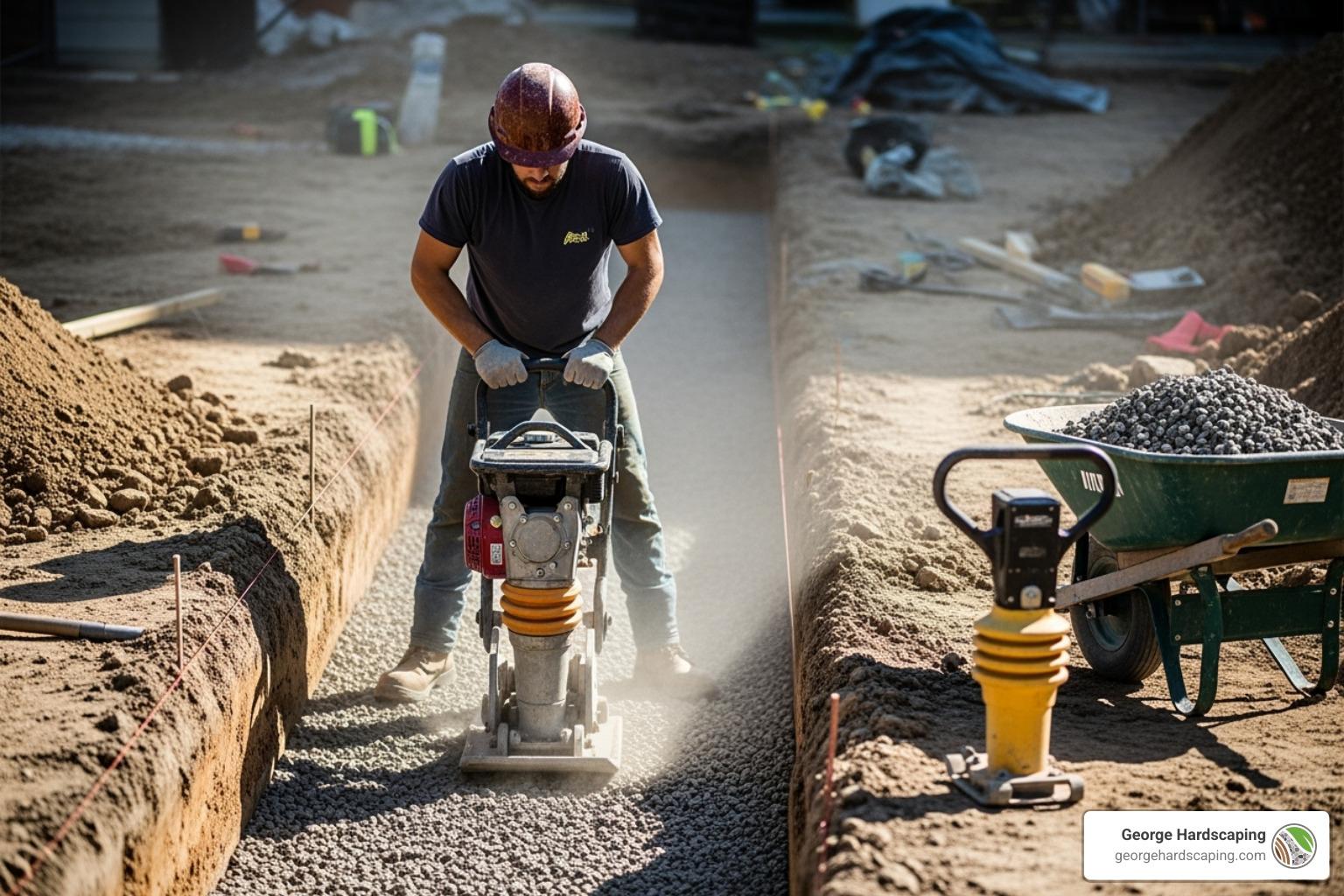
Preparing the Site for Laying a Bluestone Walkway
1) Layout and boundaries: Mark the route with stakes and mason’s line for straight runs or a hose for curves. Step back to view sight lines from key vantage points—front door, driveway, windows, and seating areas. Adjust radii so curves are gentle enough to cut efficiently.
2) Excavation and overdig: Excavate 6–8 inches below finished grade, plus the stone thickness, and overdig the width by about 6 inches to provide working room for base and edging. Remove sod, roots, and organic matter completely. In clay or wet soils, consider digging an additional inch to accommodate geotextile separation fabric.
3) Subgrade preparation: Rake the subgrade smooth and compact with a plate compactor. Moistening dry soil lightly can improve compaction. Aim for a firm, unyielding surface. Establish drainage with a consistent pitch of roughly 1/4 inch per foot away from structures. Where runoff is a concern, integrate shallow swales or drain inlets into the plan.
4) Optional geotextile: On weak, silty, or organic subgrades, lay a non-woven geotextile before the base to separate soil from aggregate and maintain long-term base performance. For context on how geosynthetics improve base stability and drainage, see the FHWA geosynthetics overview.
Creating a Stable, Well-Draining Base
The base is the unseen hero of your walkway. Angular 3/4-inch crushed stone interlocks under compaction, creating a stable yet permeable foundation.
• Lift placement: Install the base in 2–3 inch lifts. Compact each lift thoroughly with a plate compactor before adding the next. For most walkways in freeze–thaw climates, target 4–6 inches of compacted base—more if the soil is weak or the walkway will see heavier loads (e.g., wheelbarrows, service carts).
• Density and flatness: After compacting the final lift, check for soft spots or bounce. Add material and re-compact where needed. Use a 6–8 foot straightedge to verify a flat, continuously pitched plane.
• Screed guides: If you prefer precision, set a pair of temporary pipes or screed rails atop the base to guide a 1-inch setting bed. Pull off excess bedding with a straightedge for a consistent thickness.
Once the base is compacted, spread a 1-inch layer of stone dust or coarse bedding sand to create the setting bed. Rake it smooth, but do not compact it yet. For technical background on bedding layers and edge restraint principles for unit paving systems, browse the knowledge resources of the industry trade associations like the former ICPI/NCMA knowledge base (ICPI resources provide foundational guidance on bedding and edge restraint concepts).
Techniques for Cutting and Setting Your Bluestone
This is where your walkway takes shape—care and patience here make the difference between good and great.
• Dry layout and sequence: Stage stones near the work zone and do a rough dry fit, especially for irregular flagging. Start laying from a straight, visible edge or corner so minor adjustments accumulate away from focal points.
• Setting each stone: Place the stone on the 1-inch setting bed and tap it down with a rubber mallet. Use a long level or straightedge to check both the local plane (no rockers or proud edges) and the cross-plane across adjacent stones. Maintain the drainage pitch while keeping walking surfaces comfortable.
• Height corrections: If a stone sits low, lift it and add bedding material. If high, temporarily remove and scrape away some bedding. Avoid hollow voids under corners—stones should be fully supported.
• Joint spacing: For dimensional stone, keep joints consistent. For irregular pieces, vary the joints naturally but avoid very tight pinches that are hard to fill. Aim for joints you can reliably compact with polymeric sand or pack with stone dust.
• Cutting: Use a masonry saw with a diamond blade for clean, accurate cuts. Mark lines with chalk or a wax pencil. For compound curves, make a cardboard template and transfer the line to the stone. Always wear safety glasses, hearing protection, and a respirator. Cutting creates silica dust; review OSHA’s silica safety guidance and use wet cutting where possible to suppress dust.
• Borders and edging: Decide whether to install edging (steel or HDPE) just outside the last course or create an integral stone border. Edging should be staked and anchored into the compacted base, not loose soil, to resist spread.
• Transitions and steps: Where the walkway meets steps, patios, or driveways, carry your joint lines and elevations cleanly through transitions. If you’re integrating steps, our tutorial on How to Install Natural Stone Steps covers riser height, tread depth, and safe nosing details.
Quality checks as you go:
• Walk-test each section to feel for rocking stones or lippage. Correct immediately rather than hoping joint sand will fix it—it won’t.
• Reconfirm pitch with your level and a line level. Ensure that water flows away from structures and that there are no birdbaths where water might linger.
• Keep stones clean. Brush off fines and slurry before they dry on the surface.
Joint Filling, Consolidation, and Final Passes
After all stones are set and stable, sweep the surface clean and dry. Fill joints:
• Polymeric sand: Sweep into joints until full, then sweep all residue off the stone faces. Use a blower to clear fines from surface textures. Lightly mist with a fine spray per the manufacturer’s instructions, allowing water to activate the polymers without flooding, which can wash out binder.
• Stone dust or fine gravel: For a natural look, pack joints fully, mist lightly, and top off after settlement. This approach drains well and complements irregular flagstone.
Lightly compact or tamp the surface with a pad-protected plate compactor or a hand tamper across the stones to settle jointing and identify any last adjustments. Top off joint material as needed. When complete, you should have flush, stable stones, full joints, and consistent pitch.
Pro tip: If you’re working in shaded, damp areas where moss is welcome for a softened, established look, leave room for low, shallow joints and avoid polymeric sand there. For most main walkways and high-traffic entries, polymeric joints offer better long-term stability and weed resistance.
For additional professional tips on everything from base construction to pattern alignment, our Stone Walkway Installation Guide offers deeper insights, and our Hardscaping Services can handle all phases—layout, excavation, base, stone setting, and finishing—for a turn-key result.
Finishing Touches and Long-Term Maintenance
With the heavy lifting done, these final steps transform your project into a polished, professional-looking pathway. Finishing the joints and edges and establishing a maintenance plan are crucial for the longevity and beauty of your new walkway.
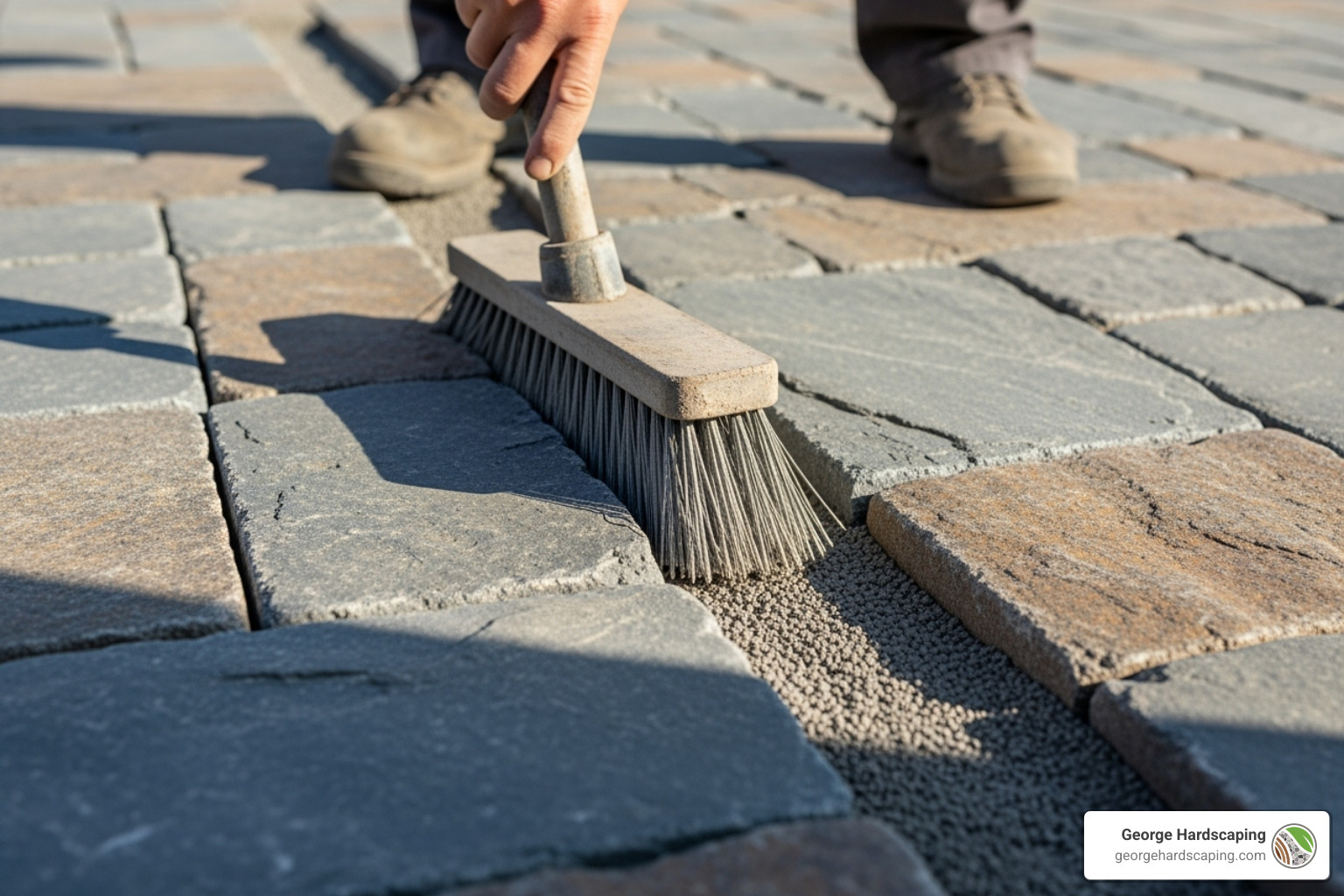
Filling the Joints and Adding Edging
The gaps between your stones are key to the walkway’s stability and appearance. Choosing the right joint filler is an important decision.
• Polymeric Sand: Popular for its ability to harden slightly after misting, it locks stones together, discourages weeds and ants, and reduces washout. Follow manufacturer instructions carefully and avoid over-wetting.
• Stone Dust or Fine Gravel: Excellent for a natural aesthetic, especially with irregular stones or garden paths. It drains well, is easy to top off, and blends with the stone’s organic character.
• Moss Growth: In moist, shaded areas, some homeowners encourage moss to grow in joints for an aged effect. Keep in mind that moss can be slippery when wet, so avoid encouraging it on steep slopes or primary entry routes.
Edging provides a clean border and contains the base materials, preventing outward migration. Steel edging offers a crisp, nearly invisible line; plastic edging is budget-friendly and flexible for curves; stone borders create a traditional frame. Choose edging early so excavation widths and base placement accommodate it. For more design ideas and integrated solutions, browse our Walkways & Stairs projects.
Sealing, Cleaning, and Winter Care
Sealing is optional and a matter of preference. Penetrating sealers protect against stains and can enrich color without creating a glossy film. Many homeowners prefer the natural patina of unsealed bluestone. If you’re undecided, wait and seal later if staining becomes a concern. For stone care principles, the Natural Stone Institute’s maintenance guidance outlines general do’s and don’ts for natural stone surfaces.
Routine cleaning is straightforward: sweep regularly, rinse with water as needed, and use a stiff brush with mild soap for stubborn dirt. Avoid harsh acids and aggressive pressure washing that can erode joint material or etch the surface.
Winter maintenance: Use a plastic shovel or a shovel with a protective edge to avoid chipping. For de-icing, avoid rock salt (sodium chloride) when possible; choose plant- and pet-safer options such as calcium magnesium acetate (CMA) and follow label directions. For environmental best practices related to de-icers, see the EPA overview on road salt impacts.
Long-term care is minimal: periodically top off joints, especially in the first season; re-level any stones that settle (lift, adjust bedding, reset); and keep edges and drainage clear. If you prefer professional upkeep, our team offers seasonal checkups and refresh services through our comprehensive Hardscaping Services.
Frequently Asked Questions about Bluestone Walkways
Even with a detailed guide, homeowners often have questions about laying bluestone walkway—especially about foundations, winter performance, and long-term stability. Here are answers to the most common inquiries.
What is the best base for a bluestone walkway?
Use a multi-layer system designed for stability and drainage:
1) Compacted subsoil: After excavation, compact the native subgrade thoroughly to minimize future settlement.
2) Crushed stone base: Install 4–6 inches (or more for weak soils) of 3/4-inch angular crushed stone in 2–3 inch lifts, compacting each lift with a plate compactor.
3) Setting bed: Place a uniform 1-inch layer of stone dust or coarse sand over the compacted base to make fine height adjustments while setting each stone.
In wetter or weaker soils, a non-woven geotextile between subgrade and base improves separation and long-term performance. For general principles behind geosynthetic separation and filtration, consult the FHWA geosynthetics primer.
How do you stop bluestone pavers from wobbling?
Wobble almost always traces back to an inadequate base or inconsistent bedding. Prevent wobble by:
• Compacting every layer thoroughly—including the subgrade and each base lift
• Screeding a consistent 1-inch bedding layer
• Ensuring full support under each stone—no voids under corners or along edges
• Resetting any stone that rocks before jointing
• Locking the system laterally with full joints and proper edging
Can you lay bluestone directly on dirt or sand?
No. Dirt and uncompacted sand are unstable and prone to uneven settlement, weed growth, frost heave, and poor drainage. A compacted crushed stone base is essential for long-term performance.
How thick should bluestone be for a walkway?
For pedestrian walkways, 1 to 1.5 inches thick is common for thermal-finished dimensional pieces laid on a proper base. Natural cleft pieces vary; select thicknesses that maintain strength across the stone’s span. Heavier-use areas or larger pieces may benefit from thicker stone to limit flex and edge chipping.
Do you need edge restraints for a dry-laid bluestone walkway?
Yes—edge restraints keep the base from spreading and maintain joint integrity. Use steel or heavy-duty plastic edging anchored into the compacted base, or build an integral stone border set tightly with a compacted base shoulder.
Should I use polymeric sand or stone dust in the joints?
Both work. Polymeric sand offers better weed and ant resistance and reduces washout in high-traffic areas. Stone dust or fine gravel yields a softer, more natural look and is easy to refresh. Choose based on your aesthetic and maintenance preferences.
Is sealing bluestone necessary?
Optional. Penetrating sealers help resist stains from leaves, oils, or grills and can deepen color subtly. Many homeowners prefer unsealed stone that develops a natural patina. If you do seal, use a breathable, penetrating product designed for natural stone. For general stone maintenance best practices, see the Natural Stone Institute’s guidance.
What about winter—will freeze–thaw cycles ruin my walkway?
With a proper base, correct pitch, and well-compacted materials, freeze–thaw is not a problem. Avoid standing water by maintaining a 1/4 inch per foot slope and keeping joints and edges intact. Use appropriate de-icers (like CMA) and avoid prying ice with metal tools that can chip stone edges.
How do I minimize weeds and ants in the joints?
Use polymeric sand where practical, keep joints full, and maintain clean edges. Good drainage and a compacted base reduce conditions that invite pests. If weeds appear, pull them early and top off joint material as needed.
Can I lay bluestone over existing concrete?
Yes, with caveats. The slab must be sound, properly pitched, and free of major cracks. You can:
• Mortar-set method: Bond bluestone onto the slab with a suitable thinset/mortar and use grouted joints—great for entries and stoops.
• Dry-laid method over slab: Less common; requires mechanical edge restraint and careful drainage planning to avoid trapping water.
If your slab is failing, it’s often more cost-effective to remove it and install a new base. Our team can evaluate options and integrate new Walkways & Stairs with steps, landings, and railings.
What slope should a walkway have for drainage and comfort?
About 1/4 inch per foot is a reliable target for shedding water without feeling steep. If accessibility is a design goal, consult the 2010 ADA Standards for Accessible Design for maximum slopes and cross slopes for accessible routes and entrances.
How do I choose between dimensional and irregular bluestone?
Dimensional stone creates structured patterns and is simpler to set quickly. Irregular flagging delivers a bespoke, organic aesthetic but takes more time to puzzle-fit and cut. Consider the home’s architecture, your maintenance style, and whether you prefer a formal or naturalistic look. For ideas and a professional second opinion, explore our Hardscape Design Services and gallery of Hardscaping Services.
What else should I plan for up front?
• Lighting and conduit routing during excavation
• Edge restraint type and location
• Integration with steps, landings, and patios
• Drainage solutions in wet areas (swales, underdrains)
• Snow storage areas to prevent piling heavy loads on edges
For a turnkey solution, we can plan and execute the entire scope—from design to finishing touches—under one contract.
Conclusion: Your Path to a Beautiful Outdoor Space
We’ve walked through the complete process of laying bluestone walkway—from planning and preparation to cutting, setting, and finishing. Bluestone is popular for good reason: it’s strong, slip-resistant, and visually timeless, standing up to New England’s demanding seasons while elevating curb appeal and day-to-day usability.
A properly built bluestone walkway is more than a path—it’s a long-term investment in safety, function, and design cohesion. Integrated with complementary elements like steps, borders, and lighting, it becomes a unifying thread through your landscape. And with routine upkeep—occasional joint top-offs, debris removal, and mindful winter care—your walkway will look and perform beautifully for decades.
Strong CTA: Transform your property with a bluestone walkway designed and installed to last. Contact George Hardscaping today to schedule your consultation and request a free estimate through our Hardscape Design Services or start a conversation about a comprehensive build with our Hardscaping Services.
If you’re exploring related improvements, we can integrate Walkways & Stairs, Bluestone Steps, and custom Stone Steps Design into a cohesive plan. Prefer to DIY and just need expert guidance? Dive into our Stone Walkway Installation Guide, learn the Base for Flagstone Walkway, and review the Cost to Install Stone Walkway to budget accurately.
Your dream outdoor space is within reach. Let’s lay the first stone together—on a foundation built to perform for fifty years, not five.
