
How to install paving stones walkway: Ultimate Flawless 2025
Why Installing Paving Stones Walkways Transforms Your Property
Learning how to install paving stones walkway is one of the most rewarding exterior projects a homeowner can take on. When done correctly, a paver walkway upgrades curb appeal, improves safety, and can increase property value. Compared with poured concrete or asphalt, interlocking pavers provide superior crack resistance, better drainage, easy repairs, and a richer, more architectural look. In climates like Essex County and the North Shore of Massachusetts, these advantages become even more meaningful because freeze-thaw cycles are unforgiving.
At a high level, the process follows these steps:
- Plan, measure, and mark the layout
- Call 811 before digging; check local codes and HOA rules
- Excavate to the proper depth and establish slope
- Compact the subgrade; install geotextile fabric
- Build and compact a layered crushed stone base
- Screed a uniform 1-inch bedding sand layer
- Lay pavers in a stable pattern, checking alignment constantly
- Cut edge pieces precisely; install edge restraints
- Vibrate in polymeric sand; mist to set; allow to cure
But don’t be fooled: excellence hinges on meticulous base preparation and proper compaction. The base is the structural backbone of your walkway. Shortcuts at this stage lead to settling, puddling, heaving, and loose pavers within a season. New England soils vary widely—from sandy loam to dense, poorly draining clays—so the same backyard can have different behavior from one end to the other.
If you want to take this on as a DIY project, this guide will walk you through the exact techniques professionals use—so you can avoid the most common pitfalls. If you’d rather get guaranteed results without the heavy lifting, our team handles everything from excavation to final sealing.
Strong, clear CTA #1: Ready for a stunning, long-lasting walkway without the guesswork? Request your free, no-obligation estimate today through our fast online form: Request a free estimate.
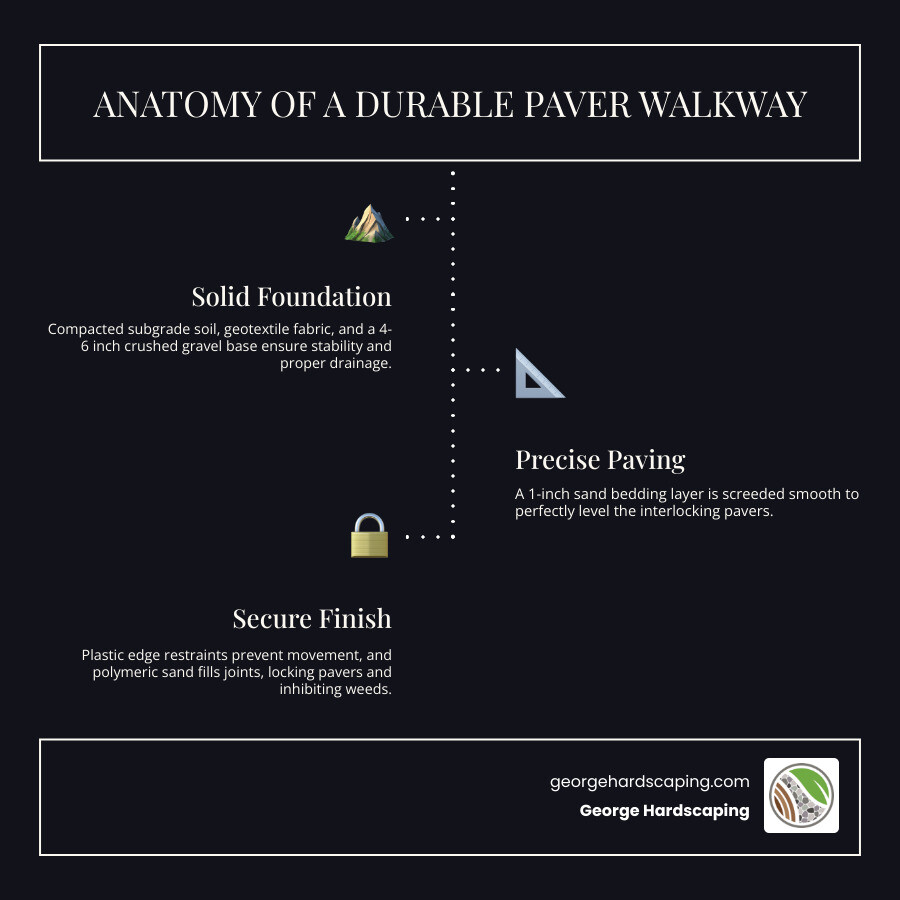
Key reasons homeowners choose pavers:
- Durability in freeze-thaw: Properly built paver systems flex where rigid slabs crack.
- Easy repairs: Lift and reset individual pavers if utilities are added or a small area settles.
- Drainage: Joints and a free-draining base move water away, reducing puddles and ice.
- Design versatility: Color blends, textures, borders, and inlay patterns lift aesthetics.
- Safety: A level, textured surface offers good traction in wet and winter conditions.
For readers who want a quick reference to complementary projects and planning concepts, see:
- How to plan the structural layers: base for flagstone walkway
- Budgeting tips and ranges: cost to install stone walkway
- Simple pattern know-how: lay brick walkway
Compliance notes and references you can trust:
- Always call before you dig: Call 811 – Know What’s Below
- Understand your native soils: USDA Web Soil Survey
- Silica dust safety when cutting pavers: OSHA – Respirable Crystalline Silica
- Benefits of permeable pavements for drainage: EPA – Permeable Pavement
Phase 1: Planning, Design, and Preparation
Great walkways start on paper, not in the dirt. A few hours of smart planning can save days of rework and years of headaches. Consider the following design factors before the first shovel hits the ground:
- Function: Is the walkway a primary path to the front door, a garden connector, or a path to a patio? Primary paths are typically 42–48 inches wide for comfortable side-by-side walking; secondary paths can be 30–36 inches.
- Style: Complement your home’s architecture. Traditional colonials look sharp with running bond and soldier-course borders; contemporary homes can shine with linear plank pavers.
- Curves vs. straight runs: Curves are welcoming and natural but require more cuts and precise layout; straight runs are simpler and faster to build.
- Drainage and slope: All hardscapes should move water away from structures. A common target slope is roughly 1/4 inch per foot (about 2%) away from your home.
- Elevation transitions: If the grade changes significantly, integrate landing pads and steps. Steep slopes often benefit from built-in steps and brick stairs instead of a continuous steep path.
Safety first: Call 811 and verify codes
- Call at least a few business days before digging: Call 811 – National One-Call. Marked utilities prevent dangerous and costly accidents.
- Check local building and zoning regulations: Verify setbacks, stormwater rules, and hardscape coverage limits. In HOA communities, confirm approved materials and colors.
Accessibility considerations
- Comfortable width: 48 inches is an excellent target for primary walkways. For tighter spaces, never drop below 30 inches in areas of regular traffic.
- Grade management: Keep walkways at or below ~5% (1:20) for comfort wherever possible.
Site assessment and layout
- Observe water behavior after rain. Identify low spots and downspout discharge zones. Redirect water before it crosses your path, or integrate drainage solutions.
- Use stakes, mason’s line, and marking paint to outline the walkway. A flexible garden hose helps visualize curves before committing.
- Set control strings to your finished height with the desired slope built in. Measure down from strings to determine excavation depth uniformly.
How deep to dig? Build from the finished surface down
- Paver thickness (typically 2 3/8 inches)
- Bedding sand (1 inch)
- Crushed stone base (4–6 inches for walkways; in frost-prone or poorly draining soils, increase to 6–8 inches)
- Total excavation often runs 7–10 inches, plus any extra for soft or organic soil removal.
Estimating materials accurately
- Square footage: Length × width. Add 10% extra pavers for cuts and waste.
- Base material: Convert depth to feet and multiply by area to get cubic feet; divide by 27 for cubic yards.
- Use manufacturer calculators for speed: Unilock Paver Calculator.
Tool and material checklist (rent what you don’t own)
- Layout and excavation: Tape measure, marking paint, string lines, stakes, spade, shovel, wheelbarrow.
- Compaction: Plate compactor (critical for full-sized walkways); hand tamper for tight corners.
- Base and screeding: Landscape rake, 2–3 straight 1-inch screed rails, 6–8 foot straightedge/screed board, long level.
- Cutting: Masonry saw with diamond blade; hearing, eye, and dust protection. See OSHA guidance: OSHA – Silica.
- Materials: Non-woven geotextile fabric; 3/4-inch crushed stone; concrete sand for bedding; polymeric sand for joints; pavers rated for freeze-thaw; edge restraints and 10-inch spikes.
Drainage planning and soil insight
- If you have heavy clay or low-permeability soils, consider slightly increasing base depth for stability.
- Use the USDA Web Soil Survey to learn your soil type and drainage capacity.
Budgeting and project scoping
- Materials and rental equipment typically cost a fraction of labor—but the learning curve and physical effort are significant. For context, explore our guidance on planning and budgeting here: building a walkway, cost to install stone walkway, and pattern basics in lay brick walkway.
Local expertise matters
- In Essex County and the North Shore, frost depth, snow loads, and freeze-thaw cycles stress hardscapes. If your site has a high water table, tree roots, or existing drainage issues, professional input can save money in the long run. Our team designs with these factors in mind across all our hardscaping and masonry services.
Phase 2: Building a Stable Foundation
The foundation is the unsung hero of how to install paving stones walkway. Get this right, and your path stays true and level for years—even through harsh winters. Get it wrong, and you’ll be chasing dips, heaves, and gaps.
Compacting the subgrade
- Excavate to your target depth based on paver thickness, bedding sand, and base.
- Remove all organic material (roots, topsoil). Organic matter decomposes and causes uneven settling.
- Moisture helps compaction. The subgrade should be slightly damp—not muddy—when you compact it. A light sprinkle may be beneficial if the soil is dusty and dry.
- Compact in multiple passes with a plate compactor. Overlap each pass by half the machine width. Edges and corners may need a hand tamper.
Geotextile fabric: Why it matters
- Roll non-woven geotextile over the compacted subgrade, overlapping seams by 12–18 inches. This separation layer prevents the crushed stone from pumping down into native soil and reduces frost-related movement.
- Geotextile also limits weed growth from below while still allowing water to pass through.
Base material selection
- Dense-graded aggregate (DGA, 3/4″ minus, crusher run) is the most common base for walkways in our region. The mix of fines and angular stone locks together under compaction to form a solid, supportive layer.
- In specific designs—like permeable systems—an open-graded base (clean, uniformly sized stone without fines) promotes rapid drainage. Open-graded systems require careful design to function well in freeze–thaw conditions.
Lift thickness and compaction technique
- Place crushed stone in 2–3 inch lifts. Compact each lift thoroughly before adding the next. Never place the full 4–8 inches and compact once; layered compaction is non-negotiable for long-term performance.
- Expect at least 2–4 compactor passes per lift, more for heavy or wet material. You should feel the base stiffen and see minimal displacement underfoot.
- Test with a screwdriver or spike: Driving a steel spike into a properly compacted base should require real effort.
Edge support in the base
- Where the walkway borders lawn or beds, keep the compacted base wide enough to support the edge restraint. We often extend the base 4–6 inches beyond the paver edge so spikes bite into dense stone, not soft soil.
Screeding the bedding sand
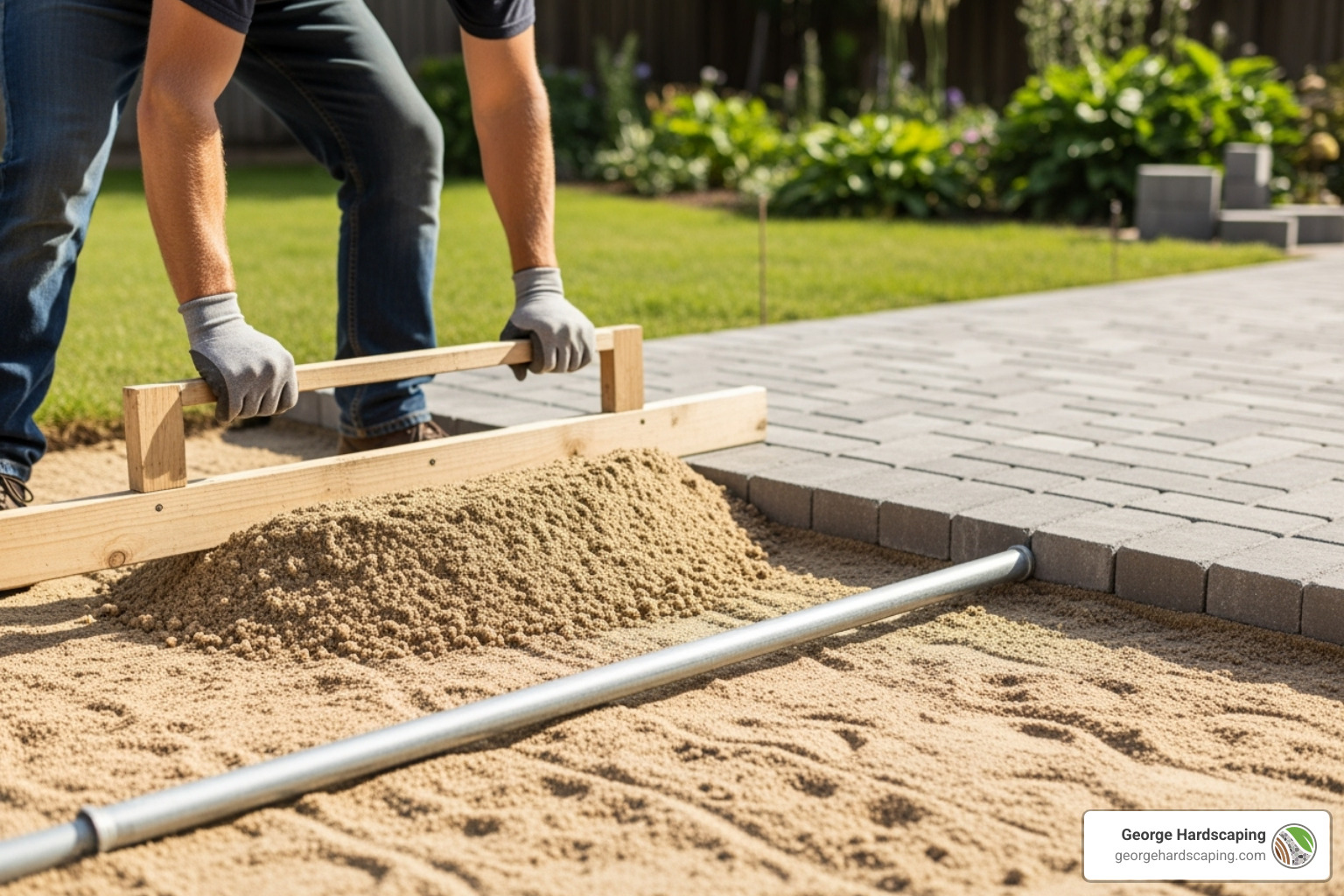
- Use straight 1-inch metal conduit or similar as screed rails. Set them parallel along the slope to the exact finished height minus paver thickness.
- Pour concrete sand between rails and pull a straightedge (a rigid 2×4 works) in a sawing motion to achieve a dead-flat surface. Move the rails forward and fill voids as you progress.
- Do not pre-compact the bedding sand. Final vibration after paver installation will settle the pavers into the sand uniformly.
Moisture and weather considerations
- Avoid installing over saturated subgrades or in heavy rain. Waterlogged soils and bases can’t compact to spec.
- In hot, dry weather, lightly mist the subgrade and the base layers before compacting to help particles lock up.
Quality checks before laying pavers
- Straightedge test: Place a long level or straightedge across the base and bedding layers. Correct any high/low spots now; they will telegraph through to the finished surface.
- Slope verification: Use a line level on your string or a digital level to confirm your target 1/4 inch per foot slope away from structures.
Professional standards and further reading
- For background on pavement layer concepts and best practices for permeable systems, see the Federal Highway Administration’s tech resources on the topic: FHWA – Permeable Pavements.
Phase 3: How to Install Paving Stones Walkway
With the base and bedding sand complete, you can begin the most satisfying part: laying the pavers. The secret to a straight, tight-looking walkway is to control three things throughout: reference lines, joint spacing, and height consistency.
Start from a fixed edge
- Use a straight, immovable reference such as your house foundation, a driveway edge, or a snapped chalk line.
- Work off the pavers you’ve already set to avoid disturbing the screeded sand.
Pattern selection and performance
- Running bond: Simple, fast, and forgiving. Great for first-time installers and long, narrow walks. It also reduces cuts and waste.
- Herringbone: Superior interlock and load transfer; excellent for high-traffic entries and driveways. More cutting and precision required.
- Basket weave or ashlar: Attractive and traditional; plan for more layout time.
- Borders: A contrasting soldier-course (pavers installed longways) or sailor-course (pavers installed on edge) border elevates the look and contains the field pattern visually.
Laying technique tips
- Maintain uniform 1/8-inch joints unless your pavers have spacer nubs. A tight but consistent joint is essential for jointing sand to lock the system.
- Pull alignment strings every few feet. Check rows against a string to correct small deviations early.
- Check for flatness across multiple pavers with a long level. Small height tweaks are made by lifting a paver and adding or removing a pinch of bedding sand.
- Don’t “hammer” pavers into place beyond gentle taps with a rubber mallet; leave final settling to the plate compactor.
Working curves and transitions
- For sweeping curves, temporarily set full pavers close to the edge, trace the curve on each, then cut.
- Consider using smaller units at tight radii; they adapt better and produce cleaner curves.
- At steps or door thresholds, aim for comfortable riser heights and adequate landing depth. Where grades change significantly, integrate safe, handsome steps: steps and brick stairs.
Cutting pavers safely and cleanly
- Use a wet saw with a continuous-rim diamond blade for the cleanest cuts. Dry-cutting creates silica dust; follow OSHA safety guidance: OSHA – Silica.
- Mark cuts clearly and make slow, steady passes. For gentle curves, make a series of kerf cuts and clean the waste with a hammer and chisel.
- Set cut pieces into the field and check that joints remain uniform and the surface remains flush.
Borders and edge restraint planning
- Dry-lay the border and confirm it follows the slope and ties into grade transitions neatly.
- Leave enough compacted base outside the border line for spikes to anchor edge restraints solidly.
Pro-checklist before moving to jointing
- All full pieces set; edge and corner cuts fitted and dry.
- Joints consistent; field pattern aligned to reference lines.
- Surface flatness verified; any proud or low stones corrected now.
For more inspiration, browse examples of professional installs that balance pattern, border, and color selection: gallery of completed projects.
Phase 4: Finishing, Securing, and Maintenance
The finish stage transforms a bed of individual hand-placed stones into a unified, durable surface. Two steps do most of the heavy lifting here: secure edges and lock the joints.
Edge restraints: Your lateral insurance policy
- Types: High-quality PVC edge restraints, aluminum edging, or cast-in-place concrete curbs. For most residential walks, PVC or aluminum restraints anchored into the compacted base work beautifully.
- Installation: Press restraints firmly against the paver border. Drive 10-inch spikes every 12 inches, plus at corners and radius changes. Ensure the restraint tops sit low enough to cover with soil or mulch for an invisible finish.
Jointing with polymeric sand
- Why polymeric sand: It locks pavers together, reduces weed pressure, deters insects, and resists washout.
- Dry conditions are mandatory: Both pavers and joints must be completely dry before spreading. Wind-blown or damp sand won’t flow and won’t cure correctly.
- Application steps:
1) Pour sand on the surface and sweep diagonally to pack joints.
2) Run a plate compactor over the surface with a pad (a protective urethane mat or piece of carpet) to vibrate sand into joints. Overlap passes.
3) Sweep and compact again until joints are filled to the recommended height (usually down slightly from the chamfer).
4) Blow off every grain of excess sand with a leaf blower at a shallow angle. Any residue can cure into a permanent haze.
5) Mist gently with a hose per your sand manufacturer’s instructions, typically in multiple light passes. Avoid flooding; too much water can wash polymers out or cause blotching.
6) Protect the area from rain until the initial set completes (often 24 hours). Avoid foot traffic during this time.
Sealing: Optional, often beneficial
- A breathable sealer can deepen color, resist stains, and slow fading. Let new installations cure and dry thoroughly before sealing (usually a few weeks). Reapply every 3–5 years depending on exposure.
- Always follow the sealer manufacturer’s guidance for surface prep and application. When in doubt, test a small, inconspicuous area first.
Winter and long-term care
- Snow removal: Use shovels with plastic edges or snow blowers set to avoid scraping joints aggressively.
- Ice management: Use calcium chloride-based products, which are less aggressive on concrete products and joint sands than rock salt.
- Routine maintenance: Sweep debris periodically, rinse with a hose as needed, and spot-clean with a mild detergent. If joints loosen over years of use, top up with fresh polymeric sand during warm, dry weather.
If your walkway doubles as a transition to a driveway or patio, aligning techniques and edge strategies across spaces enhances performance and appearance. See our broader approach in patio design and installation and how we upgrade base specs for heavy loads in driveway paver installation.
When DIY Becomes “Don’t Involve Yourself”
This is not a simple weekend job. A typical 40–80 foot walkway requires moving several tons of soil, base stone, and sand—plus precise layout, cutting, and compaction. Expect renting and operating a plate compactor, making dozens of accurate saw cuts, and working on your knees for hours. Many DIY attempts stumble in three places: inadequate base depth, poor compaction, and incorrect slope. The result is often a bumpy, puddling path that shifts by spring.
Why New England is especially unforgiving
- Freeze-thaw cycles: Water expands on freezing, lifting poorly supported areas. As it thaws, voids form and pavers settle unevenly.
- Mixed soil profiles: Clay pockets retain water; sandy pockets drain quickly. A one-size-fits-all approach fails on a single site.
- Winter maintenance: Plows, blowers, and de-icers stress the surface and joints—only a well-built system holds up.
Signs you should call a pro
- Your site has drainage issues, a high water table, or tree-root conflicts.
- The path crosses utilities, irrigation lines, or requires precise step integration.
- You’re not equipped for safe, dust-controlled cutting (silica exposure is a real hazard).
- You need a guaranteed outcome on a fast timeline for a home sale or a major event.
What you gain with a professional crew
- Correct base design for your soil and use case.
- Commercial-grade equipment and dust control for safe, clean cuts.
- Tight patterns, clean borders, and crisp edges that lift curb appeal.
- A warranty-backed investment built for our climate.
Strong, clear CTA #2: Want a guaranteed-straight, winter-tough walkway installed by a local team that does this every day? Get started now: Request a free estimate, or explore our complete hardscaping and masonry services to see how we can transform your property from curb to patio.
See what’s possible
- Browse recent work, patterns, and border ideas in our gallery of completed projects. If your walkway connects to an outdoor living area, our patio design and installation page outlines how we unify spaces with consistent base specs, drainage, and design language.
Planning a larger landscape upgrade? Retaining grade or creating terraced transitions can turn a steep, slippery lawn into a safe, beautiful approach. We routinely combine walkways with landscape retaining walls for durable, sculpted results.
Frequently Asked Questions about Installing Paver Walkways
We’ve compiled the most common questions from homeowners in Essex County about how to install paving stones walkway.
How deep do I need to dig for a paver walkway?
- Start with paver thickness (often 2 3/8 inches) + 1 inch of bedding sand + 4–6 inches of compacted crushed stone base. Many New England sites benefit from 6–8 inches of base, especially in clayey or poorly draining soils. Always excavate deeper where you encounter soft, organic, or disturbed soils until you reach a stable subgrade.
Can I install pavers directly on dirt or just on sand?
- No. Pavers need a compacted, layered base. Installing directly on soil or a thin sand layer leads to quick settling, frost heave, and trip hazards. The bedding sand’s purpose is fine leveling—support comes from the compacted base.
What’s the best paver pattern for a beginner?
- Running bond is the easiest, cleanest pattern for straight walks and first-time installers. Herringbone delivers superior interlock (ideal for driveways and heavy use) but requires more cuts and precision.
How long does a typical walkway install take?
- For a DIYer, expect 2–4 full days depending on length, site conditions, and tool familiarity. A professional crew might complete a similar project in 1–2 days thanks to equipment, experience, and division of labor.
Do I need geotextile fabric?
- In our climate and soils, yes, we strongly recommend non-woven geotextile over the compacted subgrade. It separates soils from base stone, resists pumping, and helps manage freeze–thaw movement.
What kind of sand goes under pavers?
- Use concrete sand (coarse and angular). Avoid play sand or masonry sand, which are too fine and can compact poorly. Refer to recognized material specs such as ASTM C33 for guidance on acceptable aggregates (see overview: ASTM C33).
How do I control dust when cutting?
- Use a wet saw whenever possible. If you must dry cut, wear a NIOSH-approved respirator and follow safety practices due to the hazards of respirable silica: OSHA – Silica. Cutting outdoors and using dust collection attachments helps.
Should I use permeable pavers?
- Permeable systems are excellent for managing runoff on suitable soils and can reduce icing by limiting surface water. They require specific base design and maintenance. Review the EPA’s overview of permeable pavement strategies: EPA – Permeable Pavement, and consult a pro for site-specific feasibility.
How do I prevent weeds in the joints?
- Most weeds originate from seeds that land on top, not from below. Keep the surface swept, maintain full joints with polymeric sand, and edge borders tightly. In shady, damp areas, occasional treatment or re-sanding may be needed.
Will my walkway heave in winter?
- A well-compacted, well-drained base dramatically reduces heave. Slope the surface correctly, keep water away from the base, and avoid saturated soils during construction. If your site has challenging drainage, consider professional design that includes underdrain or permeable strategies.
Can I put pavers over existing concrete?
- Sometimes. If the slab is stable, well-drained, and at the right height relative to doors and steps, thin pavers can be installed over a bond layer or bedding. However, overlay installs don’t solve drainage trapped beneath the slab. In freeze–thaw regions, full-depth paver systems often perform better long-term.
What’s the best way to melt ice on pavers?
- Use calcium chloride-based de-icers sparingly and avoid rock salt where possible. Shovel promptly to limit ice formation. In high-traffic entries, consider a sealed surface to improve stain resistance and cleaning.
How do I maintain my paver walkway?
- Sweep regularly, rinse as needed, spot-clean with mild detergent, and top up polymeric sand when joints erode or loosen. Consider re-sealing every 3–5 years if you prefer richer color and stain protection.
Where can I see examples and get help?
- View patterns, borders, and color combinations in our gallery of completed projects. For turn-key design and construction, explore patio design and installation and our comprehensive hardscaping and masonry services. When you’re ready for a precise quote and schedule, use our quick form: request a free estimate.
