
How to install a retaining wall blocks: 5 Easy Steps
Why Installing Retaining Wall Blocks is a Game-Changer for Your Yard
How to install a retaining wall blocks is a top search for homeowners who want to reclaim sloped yards, prevent erosion, and add usable outdoor living space. A well-built segmental retaining wall (SRW) can turn an unusable hillside into functional terraces for patios, gardens, play areas, or driveways. When built correctly—on a compacted base with reliable drainage and, when required, geogrid reinforcement—your wall can last decades and elevate curb appeal and property value.
This guide provides a complete, practical process for DIYers in Essex County and the North Shore. It covers planning, excavation, base prep, laying and leveling blocks, drainage, backfilling, capping, and advanced techniques like curves, steps, and geogrid reinforcement. It also lists tools and materials, offers time and cost tips, and highlights common mistakes to avoid. If you decide mid-project that professional help would save time or reduce risk, our crew is here to step in with proven methods and local code expertise through our retaining wall contractor services.
Why this matters: the most common cause of retaining wall failure is hydrostatic pressure—water buildup behind the wall. Secondary causes include poor base preparation, lack of geogrid where needed, and improper backfill or compaction. This guide emphasizes the fundamentals that prevent these issues, so your wall resists freeze-thaw cycles, heavy rain, and seasonal movement typical in New England soils.
Quick overview of the build process:
- Plan and prepare: confirm utilities, permits, layout, and materials.
- Excavate and compact: dig the trench, compact subgrade, add base gravel.
- Create a level base: screed and compact 3–6 inches of 3/4-inch crushed angular stone.
- Lay first course: perfectly level blocks set the entire project up for success.
- Stack courses: stagger joints, maintain setback/batter, and check level frequently.
- Install drainage: perforated pipe, gravel backfill, and separation fabric.
- Reinforce when required: install geogrid at specified elevations and lengths.
- Backfill and compact: build in lifts to reduce settlement.
- Cap and finish: adhesive-set caps, final grading, and landscaping.
If you prefer a professional touch or your site conditions are complex, explore our complete hardscape solutions:
- Retaining wall block options
- Retaining wall drainage system
- Retaining wall with seating
- Full-service hardscaping and masonry services
Strong CTA: Ready to move from plans to progress? Get a fast, professional assessment and quote from our local experts: book your consultation now with our retaining wall contractor services.
Planning Your Retaining Wall Project
Proper planning determines whether your wall looks great and lasts—or shifts, bulges, and fails. Invest time here and the build goes smoothly.
Before You Dig: Permits, Utilities, and Site Readiness
- Call before you dig: Use the free national service Call 811 to mark underground utilities. This protects you from striking gas, electric, water, or telecom lines. Schedule markings several days in advance.
- Check codes and permits: Municipal rules vary across Essex County. In many towns, walls over 2–3 feet may require permits; walls at or above 4 feet almost always require permitting and often engineered design, especially with surcharges (driveways, parking, structures above). Start with your town’s building department and the International Code Council for general guidance. If your property is in an HOA, review covenants for materials, height, and setback restrictions.
- Understand soil and drainage: Identify soil type (clay, loam, sand) and observe drainage patterns after rain. Clay-heavy soils common in our area hold water, increasing pressure on the wall. A simple jar test can help you estimate texture; see a university guide from University of Minnesota Extension. For deeper insight, consult the USDA’s Web Soil Survey.
- Frost and freeze-thaw: In New England, frost depth and freeze-thaw cycles demand a well-compacted, free-draining base. Water must have a place to go, or ice lenses can heave blocks.
- Slope and surcharge: Evaluate what will be above the wall—slopes, driveways, sheds, pools. These add surcharge, affecting design and often requiring geogrid or engineering.
- Property lines and setbacks: Verify lot lines to keep the wall inside your property and compliant with setbacks and easements.
Layout and Design Considerations
- Footprint and alignment: Stake the wall’s path with string lines. For curves, use a garden hose to visualize the layout before digging. Consider sightlines from patios, doors, and windows.
- Height strategy: Shorter terraced walls can be preferable to a single tall wall, especially on steeper grades. Terraces break up height, reduce pressure, and create planting or seating opportunities.
- Block choice: Choose engineered SRW blocks designed for retaining walls, not decorative garden edgers. Evaluate face style, color, unit depth, and systems (lip, pin, or friction). See our retaining wall block options for guidance.
- Add-on features: Plan for integrated seating, steps, or lighting early. If you want a seat-wall look, see our retaining wall with seating. For stairs that blend seamlessly, explore our walkways and stairs and steps and brick stairs services.
Tools and Materials Checklist
Essential tools:
- Excavation tools: shovels (round/square), digging bar, pick, wheelbarrow.
- Layout and leveling: stakes, mason’s line, line level, 4-foot level, torpedo level, string line blocks.
- Compaction: hand tamper (for small jobs) and plate compactor (recommended).
- Cutting: hammer and masonry chisel, or a wet masonry saw for clean cuts.
- Finishing and safety: rubber mallet, broom, utility knife, safety glasses, hearing protection, gloves, dust mask/respirator.
Materials:
- Blocks: SRW blocks and matching capstones.
- Base: 3/4-inch crushed angular gravel (also called 3/4-inch crushed stone or 3/4-inch minus). Avoid round pea gravel.
- Drainage: 4-inch perforated drain pipe with fabric sock, plus 3/4-inch crushed stone for a 12-inch drainage zone behind the wall.
- Separation fabrics: landscape fabric (non-woven geotextile) to keep fines from clogging drainage stone.
- Adhesive: high-strength exterior-grade concrete construction adhesive for caps.
- Optional reinforcement: geogrid for walls requiring reinforcement. Learn more from industry references like Tensar’s geogrid guidance.
Tip: For aggregate gradation guidance, see ASTM references such as ASTM D448. Note that the spec is paywalled, but the summary defines standard sizes.
How to Calculate Quantities
- Blocks: Wall face area (length × height) ÷ face area per block = number of blocks. Add 10–15% for cuts and waste, more for curvy layouts.
- Base gravel: Trench length × trench width × base depth. Most SRWs use 3–6 inches of compacted base. Include a little extra for leveling.
- Drainage stone: Plan a continuous 12-inch-wide zone of 3/4-inch crushed stone directly behind the wall for the entire height. Volume = wall length × 1 ft × wall height.
- Pipe and outlets: Measure the wall length for perforated pipe, plus solid pipe for daylighting to a safe discharge point.
Your supplier can convert volume to tons. As a rule of thumb, 1 cubic yard of crushed stone is roughly 1.3–1.5 tons.
Safety and Timing
- Work in safe lifts and slopes when excavating. For trench and excavation safety, consult OSHA’s guidance.
- Avoid building on saturated soil or during heavy rain. Wet subgrade compacts poorly and settles later.
- Allow adequate time for compaction at each step. A small wall can be a one-weekend build; larger/curved/reinforced designs take longer.
Considering complementary features now reduces rework later. If you’re pairing the wall with a patio, see our patio design and installation services. For driveways or transitions at the top/bottom of a wall, explore our driveway paver installation. And to create a focal point on a new terrace, our custom outdoor firepits are a perfect addition.
The Step-by-Step Process: How to Install a Retaining Wall Blocks
With planning complete, you’re ready to build. Follow each step carefully—details in base preparation, leveling, drainage, and, when needed, reinforcement determine long-term performance.
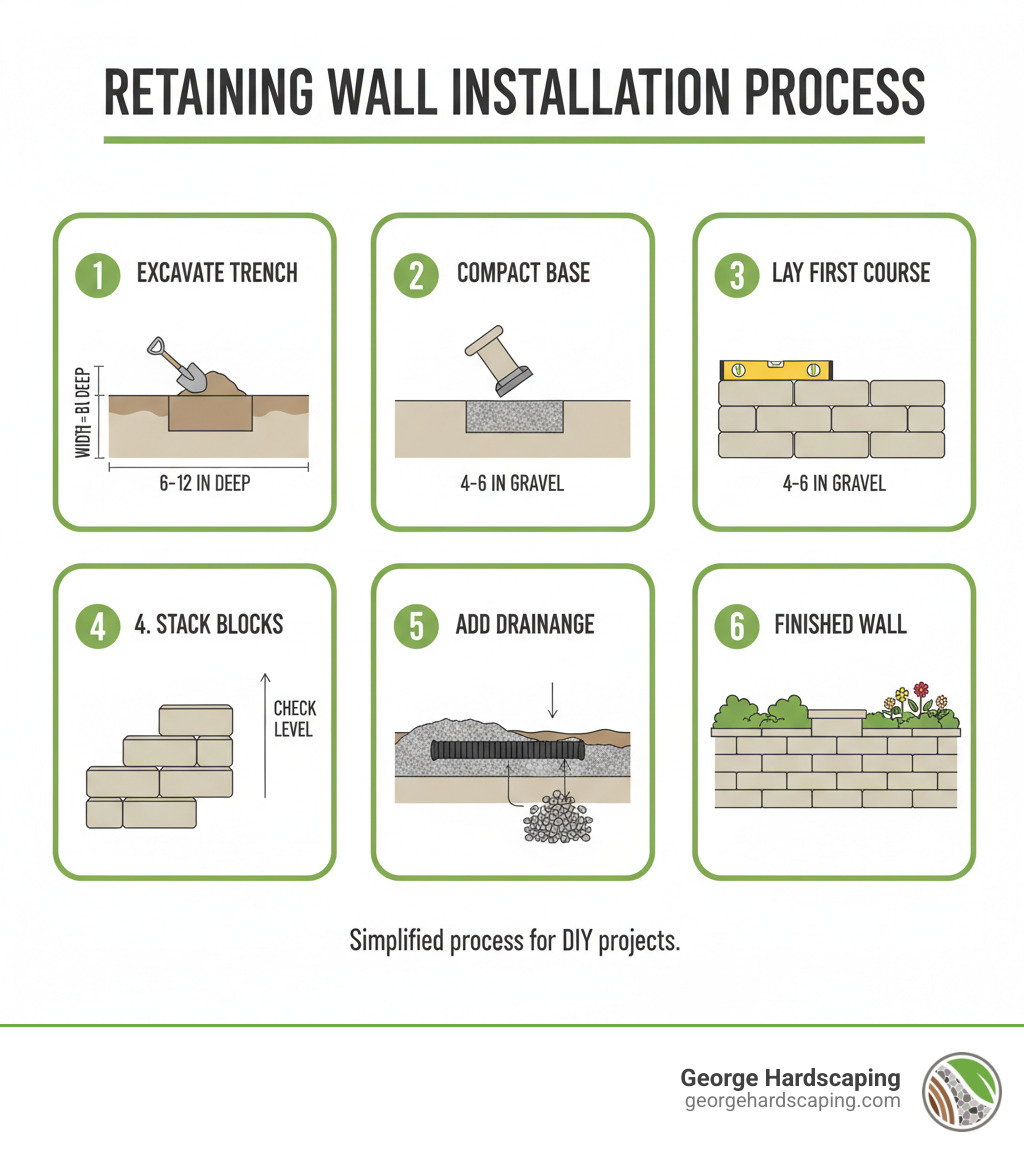
Step 1: Excavating the Trench and Preparing the Foundation
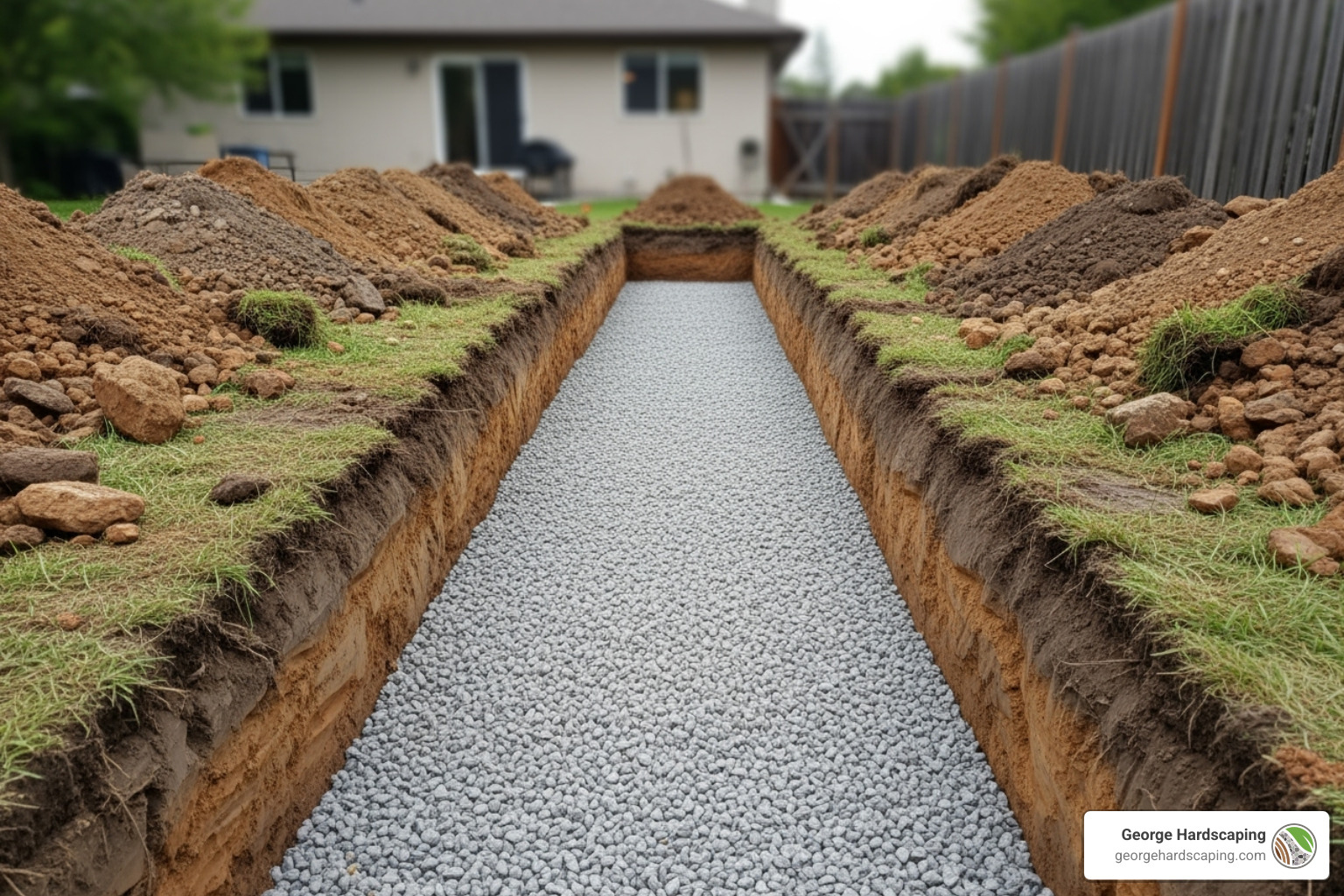
1) Clear and mark: Remove sod, roots, and organic material. Mark the front edge with paint or stakes and string. Curves can be free-formed with a garden hose and then staked.
2) Dig the trench: Depth = base thickness (3–6 inches of compacted 3/4-inch crushed stone) + the buried height of the first course. As a rule, bury 10% of wall height with a minimum of 6 inches. Width = at least twice the depth of the block to allow working room (and wider for curves).
3) Compact the subgrade: Use a plate compactor in overlapping passes until the native soil is firm. In clay soils, consider adding a thin layer of crushed stone to improve the working surface.
4) Base gravel: Place 3–6 inches of 3/4-inch crushed angular stone; screed it level and compact thoroughly. The base should be dead level front-to-back and along the length. In freeze-thaw climates, a well-compacted, free-draining base helps prevent heaving.
5) Optional underlayment: On soft or mixed soils, lay a non-woven geotextile to separate the base stone from the subgrade, reducing pumping of fines into the base over time.
Pro tip: Never substitute sand or pea gravel for base stone. Sand can wash out; pea gravel’s rounded particles act like ball bearings.
Step 2: Laying the Foundation—The First Course
The first course controls the entire wall. Perfection here prevents hours of correction later.
- Start at the lowest point: Set your first block where the grade is lowest and build uphill. If your block has a rear interlocking lip, remove it for the first course so blocks sit flat on the base.
- Level meticulously: Place the block, check front-to-back and side-to-side level with a torpedo level, and tap into place with a rubber mallet. Use a long 4-foot level across multiple blocks to ensure consistent elevation.
- Align the face: Use a string line to keep the front faces straight on straight runs. For curves, dry-fit and adjust gaps to maintain a smooth arc.
This precise base and first-course setup mirrors the attention to detail we bring to our patio design and installation services, where base prep and leveling also determine final results.
Step 3: Building Up—Stacking Subsequent Courses
- Clean as you go: Brush debris from the top of the course you’re building on so blocks sit tight and true.
- Stagger joints: Use a running bond pattern, offsetting vertical joints from the course below. You’ll likely cut half blocks to start alternating courses.
- Maintain setback/batter: Most SRW systems have a built-in setback via lips or pins. This slight backward lean increases stability. Confirm the manufacturer’s specs and check periodically with a level.
- Check level frequently: Every few blocks and every course, verify level both ways and across several blocks.
- Adhesive near the top: On the top couple of courses (below caps), construction adhesive adds extra security, especially in high-traffic or seating areas.
Step 4: Ensuring Longevity with Proper Drainage
Hydrostatic pressure is the #1 enemy of retaining walls. Your goal is to give water an easy path away from the wall.
- Drain pipe: Lay a 4-inch perforated pipe with a fabric sock at the wall base behind the first course. Slope it 1% to daylight at a safe outlet or tie into a dry well or storm system where permitted. Consult rainfall data via NOAA Atlas 14 if sizing outlets for large areas.
- Drainage stone: Maintain a 12-inch-thick zone of 3/4-inch crushed stone directly behind the wall up the full height. This free-draining chimney reduces water pressure.
- Separation fabric: Place landscape fabric between drainage stone and native backfill to prevent fines from clogging the stone. Fold and overlap fabric as you build courses.
For broader stormwater considerations (especially near impervious surfaces), see the EPA’s stormwater resources: EPA Stormwater.
Step 5: When and How to Use Geogrid Reinforcement
Not all walls are gravity-only. Walls over certain heights—or those with surcharges, poor soils, or limited space—require geogrid reinforcement. Manufacturer tables specify when to reinforce, how much, and at what elevations.
- When it’s required: As a very general rule of thumb, unreinforced gravity walls often max out around 3–4 feet depending on block depth, batter, and conditions. Add surcharge, clay soils, or a steep slope behind the wall, and reinforcement may be needed at lower heights. Always follow block manufacturer guidance and local code requirements.
- How to install: Typically, geogrid is installed every 1–2 courses, extended back from the wall into the soil mass. Place grid with the strong direction perpendicular to the wall face, pull taut, and pin or friction-lock under the block course per the system’s instructions. Overlap side-by-side runs per manufacturer specs (often 1–2 feet). Backfill and compact over each layer before adding the next.
- Length and setbacks: Grid length can be 60% or more of wall height, adjusted for soil type and surcharge. Follow engineering or manufacturer charts. For fundamentals and best practices, consult industry resources like NCMA/CMHA best practices and Tensar’s geogrid guidance.
Important: Reinforced walls and walls over 4 feet should be designed by a qualified professional. Our team builds both gravity and reinforced SRWs and can coordinate engineering when needed via our retaining wall contractor services.
Backfilling and Compaction During the Build
- Build in lifts: Place backfill in 6–8 inch lifts behind the drainage stone and compact each lift. Avoid using organic soil; use clean, well-graded fill. Keep heavy equipment at least 3 feet from the back of the wall and compact with smaller compaction equipment near the wall.
- Protect alignment: As you compact, watch for movement in the wall face and adjust as needed.
Mid-Project CTA: Prefer guaranteed results and a quicker timeline? Get a professional plan, accurate costs, and a flawless finish—schedule your on-site assessment today with our retaining wall contractor services. We also integrate walls seamlessly with walkways and stairs and driveway paver installation.
Finishing Your Wall and Advanced Techniques
These final steps deliver a polished look and protect your investment for decades.
Capping and Final Backfill
- Backfill as you build: Continue to extend the 12-inch drainage stone zone, separated from soil with fabric. Place and compact backfill in 6–8 inch lifts until you reach near finished grade.
- Topsoil zone: For the final 6–8 inches behind the top of the wall, you may switch to topsoil if you’re planting. Keep mulch and planting soil a bit lower than the cap to reduce washout.
- Install caps: Clean the top course thoroughly, then apply a continuous bead of high-strength concrete adhesive. Seat capstones with a slight overhang (1–1.5 inches) for a crisp, shadowed edge. Allow adhesive to cure as directed by the manufacturer.
Handling Curves, Corners, Steps, and Slopes
- Curves: Tapered blocks make gentle curves easier. For tighter radii, remove small fins or make slight block cuts to keep joints tight while maintaining the running bond.
- Corners: Some SRW systems include corner blocks. Otherwise, you’ll miter or alternate standard blocks to create interlocked 90-degree turns. Alternate overlaps each course (like log cabin corners) for strength.
- Steps: Integrate steps where grade changes. Build solid, level landings, and use block risers and caps or treads for a unified look. See our dedicated steps and brick stairs and walkways and stairs services for ideas and execution.
- Terracing: Multiple short walls with planting beds between can be more stable and visually softer than one tall wall, and they often reduce or eliminate reinforcement needs.
- Slopes along the wall path: Step the foundation. Each step starts a new level section; remember to bury the first course for every stepped run.
Drainage Finishes and Outlets
- Daylight the drain: Route the perforated pipe to daylight at a slope or to an approved discharge like a dry well. Use solid pipe for the outflow segment so water doesn’t re-enter soil near the face of the wall.
- Cleanouts: On long walls, consider adding cleanout risers to access the drain if needed in the future.
Maintenance Tips
- Seasonal checkups: After heavy rains and spring thaws, walk the wall to check for bulges, settlement, or erosion. Touch up grading to keep surface water flowing away from the wall.
- Vegetation: Avoid deep-rooted plantings immediately behind the wall unless designed for it. Shallow-rooted groundcovers are often a good fit.
- Sand and salt: Near driveways and roads, salt runoff can affect concrete surfaces. Rinse caps and adjacent hardscapes periodically during winter.
For complex finishes and add-ons—including lighting, outdoor kitchens, and poolside terraces—our team integrates walls with larger outdoor living plans. Explore complementary services like pool deck installation, patio design and installation, and full-service hardscaping and masonry.
Frequently Asked Questions about Retaining Wall Installation
Here are clear, practical answers to common homeowner questions.
How high can I build a retaining wall without a permit?
It depends on your municipality. Many towns allow walls under 3 feet without a permit, while others cap no-permit walls at 2 feet. Walls over 4 feet often need a permit and engineered design, especially with surcharges like driveways or slopes above. Check with your local building department and refer to general guidance from the International Code Council. When in doubt, ask—fines or rip-and-replace orders are costly.
What is the best base for a retaining wall?
Use 3–6 inches of compacted 3/4-inch crushed angular stone. The angular edges lock tightly when compacted, creating a stable, free-draining base. Avoid sand (can wash out) and pea gravel (rounded and unstable). Compact native subgrade, then compact base in thin lifts. For aggregate gradations, see ASTM D448.
Do all retaining walls need drainage?
Yes. Without drainage, water builds up behind the wall, creating hydrostatic pressure that leads to bulging or failure. A 12-inch drainage stone zone behind the wall, separation fabric, and a sloped perforated drain pipe to a safe outlet are essential. For broader stormwater context, see EPA stormwater.
When do I need geogrid reinforcement?
Reinforcement is required based on wall height, soil type, slope behind the wall, and surcharge. Many gravity walls top out around 3–4 feet. Manufacturer charts (and engineers) specify grid elevations and lengths. For a technical overview, see CMHA knowledge center and Tensar’s geogrid guidance. We can evaluate your site and provide a reinforced design through our retaining wall contractor services.
Can I build a retaining wall in cold weather?
You can, but avoid working on frozen or saturated subgrade. Freezing conditions complicate compaction and adhesive curing. Plan around forecast freezes and precipitation, and protect freshly placed materials.
How long does a retaining wall last?
A properly built SRW with the right base, drainage, and reinforcement can last several decades. Durability is highest when you compact each lift, keep surface water away, and follow manufacturer specs.
What does a typical project cost and how long does it take?
Costs vary with height, length, curves, soil conditions, access, and whether geogrid or engineering is required. DIYers should also factor tool rental (plate compactor, saw). A simple 2–3 foot wall might be a weekend project; larger, curved, or reinforced walls can take several weekends or are best handled by a pro. For an accurate estimate and timeline, request a site visit through our retaining wall contractor services.
Can I pair my wall with other features?
Absolutely. Many homeowners pair walls with new patios, steps, seat walls, or fire features. Consider our patio design and installation, custom outdoor firepits, and walkways and stairs.
Conclusion
By following this step-by-step guide on how to install a retaining wall blocks—planning carefully, preparing a stable base, setting a perfect first course, stacking with proper setback, adding robust drainage, and reinforcing with geogrid when required—you’ll build a wall that looks great and stands up to New England weather for decades. The result: reclaimed yard space, safer slopes, less erosion, and a more valuable, more livable property.
If your project involves challenging soils, a tall wall, tight site access, curves and corners, steps, or structural surcharges, bring in a pro. Our team at George Hardscaping designs and builds code-compliant, long-lasting SRWs across Essex County and the North Shore—from Marblehead and Beverly to Topsfield and Ipswich. We handle everything from layout and permitting to engineered reinforcement, drainage, and a clean, polished finish that integrates with patios, walkways, and driveways.
Strong CTA: Get it done right the first time. Schedule your on-site consultation today with our expert retaining wall contractor services, and explore our project gallery for inspiration. Prefer a complete outdoor transformation? Ask about combining your wall with patio design and installation, walkways and stairs, and driveway paver installation for a cohesive, high-impact upgrade.
