
Why Build an Outdoor Fireplace with a Pizza Oven
How to build an outdoor fireplace and pizza oven starts with careful planning, the right materials, and a step-by-step approach to construction. This project is the ultimate backyard upgrade, combining the warmth of a traditional hearth with the culinary versatility of a wood-fired oven. For homeowners in Essex County and the North Shore, where outdoor seasons are precious, maximizing your backyard’s functionality is not just about aesthetics; it is about creating a year-round destination for family and friends.
Quick Build Overview:
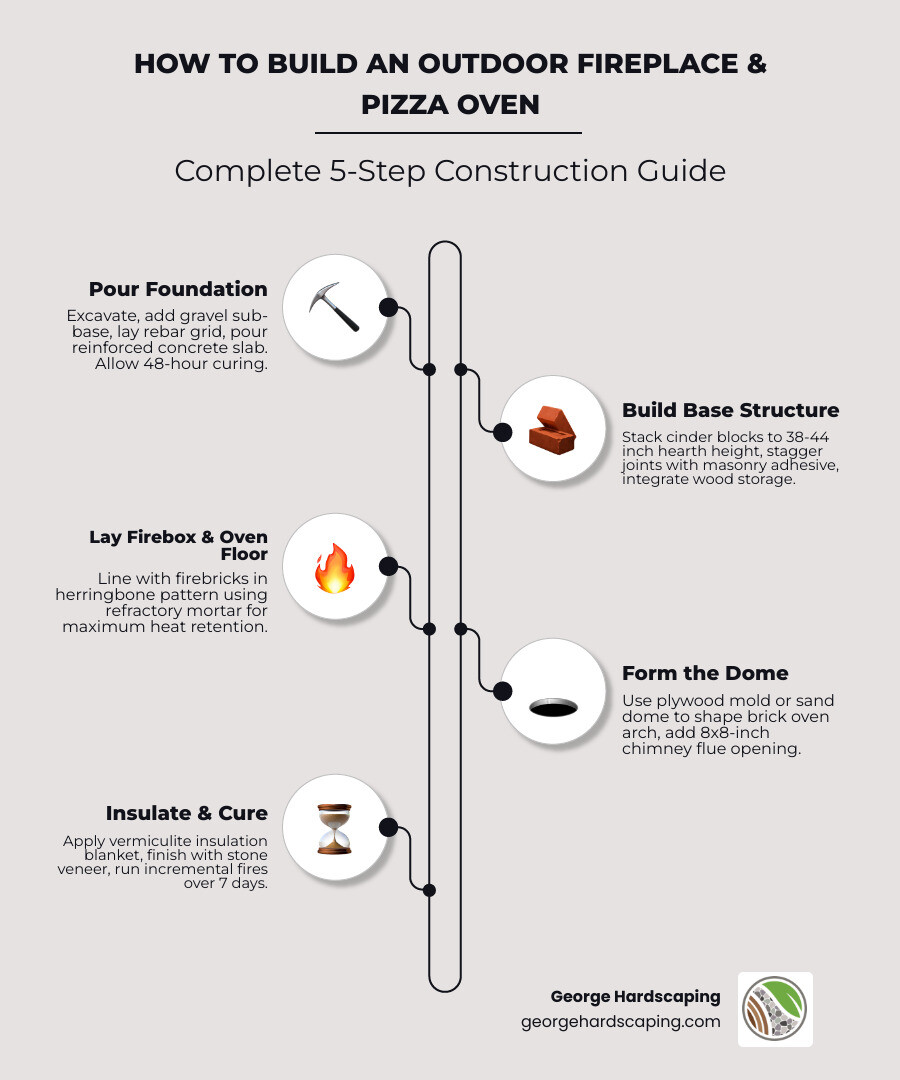
- Plan & Permit – Choose a location with 3-foot clearance from combustibles, check local codes, and ensure the site is level.
- Build Foundation – Pour a reinforced concrete slab with a rebar grid and a compacted gravel base to prevent frost heave.
- Construct Base – Stack concrete blocks 38-44 inches high, incorporating cavities for wood storage and structural support.
- Lay Oven Floor – Install high-density firebrick in a herringbone pattern using thin joints of refractory mortar.
- Form Dome – Use a plywood mold, sand mound, or exercise ball to shape the brick dome, ensuring an 8×8-inch chimney opening.
- Add Fireplace – Construct the firebox adjacent to the oven, ensuring proper drafting and shared or separate flue systems.
- Insulate & Finish – Apply a ceramic fiber insulation blanket and finish with a high-quality stone veneer or stucco exterior.
- Cure & Fire – Execute a strict 7-day curing schedule with small, incremental fires to remove deep-seated moisture.
Timeline: 2-4 weeks (including curing) | DIY Cost: $500-$2,500 | Professional Install: $3,500-$15,000+
There’s something truly magical about gathering around an outdoor fire while a wood-fired pizza cooks at 700 degrees just a few feet away. The combination of an outdoor fireplace and pizza oven transforms your backyard into what many homeowners describe as a “social mecca.” It is a place where the digital world fades away, and the simple pleasures of fire, food, and conversation take center stage. This dual-purpose structure offers more than just ambiance; it is a cooking powerhouse capable of roasting vegetables, smoking meats, baking artisanal bread, and producing restaurant-quality pizza in under 90 seconds.
Building this feature is a significant undertaking that requires a blend of masonry skills, physical labor, and technical knowledge. While the materials are readily available at most hardware stores, the execution requires precision. You are not just stacking bricks; you are engineering a thermal mass that must withstand extreme temperature fluctuations and the harsh New England climate. According to the Masonry Institute of America, proper material selection and structural reinforcement are the most critical factors in the longevity of outdoor masonry features.
Whether you’re a seasoned DIY enthusiast ready to tackle this challenge or someone exploring options before calling in professional fireplace installation services, this guide walks you through every decision and construction phase. We’ll cover everything from choosing between wood-fired and gas options to troubleshooting common issues like cracking and poor heat distribution. By the end of this guide, you will have a comprehensive understanding of how to build a structure that adds significant value to your home and quality to your life.
How to build an outdoor fireplace and pizza oven word list:
Planning Your Dual-Purpose Outdoor Feature
Before you mix your first bag of concrete, the planning phase is where the success or failure of your project is determined. Planning is the most critical phase of figuring out how to build an outdoor fireplace and pizza oven. Unlike a portable grill, once this masonry structure is built, it is a permanent fixture of your landscape.
First, consider the location with extreme care. You want a level surface that is close enough to your indoor kitchen for convenience but far enough away to be safe. We recommend a minimum 3-foot clearance from any combustible structures, including your house, wooden fences, or overhanging trees. Pay attention to the prevailing wind direction in coastal towns like Marblehead or Gloucester; you don’t want smoke blowing directly into your dining area or your neighbor’s open windows. Consulting the National Fire Protection Association safety standards can provide additional guidance on safe clearances for outdoor fire features.
Utility access is another factor that often gets overlooked. If you plan on adding integrated lighting, a gas starter, or even a sink nearby, you’ll need to coordinate with local utility lines before you dig. Furthermore, check with your local building department in Beverly, Salem, or Ipswich regarding permits. Most towns categorize pizza ovens under the outdoor fireplace builder ultimate guide regulations, but specific setbacks and chimney height requirements vary. If you live in a community with a Homeowners Association (HOA), get their approval in writing before breaking ground to avoid costly modifications later.
Finally, evaluate your soil stability. A full masonry fireplace and oven can weigh several thousand pounds. If the ground is soft or has poor drainage, the structure will shift, leading to structural cracks. In the North Shore area, we often deal with rocky or clay-heavy soils that require a deep, well-compacted gravel sub-base to prevent frost heave during our cold Massachusetts winters. The frost line in this region can reach 48 inches, so your foundation must be robust enough to handle the ground’s movement.
Choosing the Right Materials for How to Build an Outdoor Fireplace and Pizza Oven
The materials you choose will determine how well your oven holds heat and how long the structure lasts. You cannot use standard red bricks for the interior of the oven or fireplace; they contain moisture and air pockets that will cause them to crack or even explode under high heat. You must use fire bricks (refractory bricks), which are made from high-alumina clay designed to withstand temperatures up to 1,800°F.
To hold these bricks together, you need refractory mortar. Standard mortar will crumble when exposed to the 700-1,000°F temperatures required for a perfect Neapolitan crust. For the structural base, standard concrete blocks (cinder blocks) are perfectly fine since they won’t be in direct contact with the flame.
If you are looking for specific blueprints, the Pompeii brick oven plans are an industry standard for DIYers, providing detailed dimensions for the dome and entry arch. Other essential materials include:
- Rebar and Gravel: For a reinforced foundation that resists cracking.
- Vermiculite or Perlite: Mixed with Portland cement to create an insulating layer under the oven floor, ensuring heat stays in the bricks rather than escaping into the base.
- Angle Iron or Steel Lintels: To support the weight of the bricks over the fireplace and oven openings.
- Stone Veneer: For a beautiful, professional finish that matches your patio design and installation.
Essential Tools for How to Build an Outdoor Fireplace and Pizza Oven
Masonry work is physically demanding, and having the right tools makes the difference between a frustrating mess and a professional-grade masterpiece. A masonry wet saw is non-negotiable; you will be making hundreds of precise cuts to fit bricks into the dome and arch. Renting one for a week is often more cost-effective than buying a cheap version that won’t last the project.
Accuracy is everything in masonry. You must have a high-quality 4-foot level and a plumb line. If your base isn’t perfectly level, the entire structure will lean as you build upward, which becomes increasingly obvious as you reach the chimney. If you’re unsure about these terms, it helps to spend time researching masonry basics before you start.
Other tools you’ll need:
- Trowels: A margin trowel for tight spaces and a pointing trowel for finishing joints.
- Mortar Mixer or Heavy-Duty Wheelbarrow: For mixing concrete and mortar in consistent batches.
- Rubber Mallet: To tap bricks into place without damaging the firebrick surface.
- Safety Gear: This is vital. Use a N95 respirator when cutting bricks to avoid breathing in harmful silica dust, along with high-impact eye protection and ear protection.
Step-by-Step Guide: How to Build an Outdoor Fireplace and Pizza Oven

Now that the planning is done, it’s time to get your hands dirty. The foundation is the most important part of the build. If the foundation fails, the whole project fails, regardless of how beautiful the stonework is. For a structure of this weight, a standard 4-inch patio slab is insufficient.
- Excavation: Dig a hole roughly 8-12 inches deep, extending 6 inches beyond the footprint of your structure on all sides to distribute the load.
- Sub-Base: Fill the bottom with 4-6 inches of crushed gravel (3/4-inch minus is ideal) and compact it thoroughly using a plate compactor. This provides drainage and a stable platform.
- Forms and Rebar: Build a wooden frame (form) using 2×6 or 2×8 lumber. Lay a grid of #4 rebar spaced 12 inches apart, suspended about 2 inches off the gravel using “chairs.”
- Pouring: Mix and pour high-strength concrete (4,000 PSI). Use a long straight board (screed) to level the surface, followed by a bull float to smooth it.
- Curing: Let the slab cure for at least 3-7 days before building on it. Keep it moist by misting it with water or covering it with plastic to prevent rapid drying and cracking.
If this stage feels overwhelming, we recommend looking into professional fireplace installation services to ensure your heavy structure has the support it needs. Contact George Hardscaping for a professional consultation if you are unsure about your soil’s load-bearing capacity.
Constructing the Base and Wood Storage
The base raises the oven to a comfortable working height. For most people, a hearth height of 38 to 44 inches is ideal. This allows you to use a pizza peel without straining your back or leaning too close to the heat.
Using cinder blocks, lay out your first course. It is critical to stagger the joints (like a running bond pattern) for structural integrity. Use high-strength masonry adhesive or Type S mortar between the blocks. We often design the base with “H” or “U” shaped cavities to serve as dry wood storage. This keeps your fuel close at hand and protected from the elements. As you build, constantly check that your walls are level and plumb. For more details on this phase, see our guide on how to build an outdoor fireplace with cinder blocks.
Building the Fireplace Firebox and Oven Floor
Once the base is capped with a reinforced concrete lintel or thick pavers, you can begin the heat-facing elements. This is where the “refractory” work begins.
For the fireplace, line the interior with firebricks. A herringbone pattern is popular for the floor because it looks great and prevents the pizza peel from getting caught on the edges of the bricks as you slide food in and out. Use thin joints of refractory mortar—the thinner the joint, the stronger the bond under heat. The International Residential Code (IRC) provides specific guidelines for firebox dimensions that you should follow for safety.
For the pizza oven floor, you must first lay an insulating layer of vermiculite concrete (a 5:1 ratio of vermiculite to Portland cement). This prevents the heat from being sucked out of the oven into the cold base below. On top of this insulation, lay your firebricks flat. Do not mortar the floor bricks into place; laying them tightly in a bed of sand and fireclay allows them to expand and contract without cracking. This creates the thermal mass needed to cook a pizza in under 90 seconds. Learn more about how to build an outdoor brick fireplace to master these lining techniques.
Forming the Pizza Oven Dome
The dome is where the “FlameRoll” happens—the circular motion of heat that cooks the top of the pizza as the floor cooks the bottom. There are three common ways to build the dome:
- Plywood Arcs: Cut plywood into the shape of the dome’s interior and use them as a “rib” system to support the bricks until the mortar sets.
- Sand Dome: Build a mound of moist sand in the shape of the oven interior, cover it with wet newspaper, and lay bricks over it. Once the mortar is dry, you shovel the sand out through the door. This is often the easiest method for beginners.
- Exercise Ball: For a smaller, budget build, an inflatable exercise ball can serve as a temporary form, though it offers less control over the final shape.
Build the brick arch for the door first. The door height should be approximately 60-63% of the dome height for optimal airflow and heat retention. Install an 8×8 inch chimney vent at the front of the dome, just behind the arch. This ensures smoke goes up the flue rather than out the front into your face. After the dome is complete, wrap it in a ceramic fiber insulation blanket to keep the heat inside where it belongs. This is a hallmark of custom outdoor firepit designs that prioritize performance and safety.
Technical Challenges and Design Considerations
Integrating a fireplace and a pizza oven into one structure presents unique engineering challenges. The biggest issue is smoke management. If the two units share a chimney, you need a properly designed “Y” junction or a very large flue to handle the volume of smoke if both are used simultaneously. However, we generally recommend using one at a time to ensure the best draft. A poorly designed chimney will result in smoke billowing out of the front of the oven, ruining the cooking experience and potentially staining your stone veneer.
Thermal expansion is another major concern. Different materials expand at different rates when heated. If you tie the stone veneer too tightly to the hot firebricks without an expansion gap, the veneer will pop off or crack. We use a layer of ceramic fiber insulation or a small gap filled with high-heat silicone to prevent this. For a professional look that lasts, consider our stone veneer fireplace installation expertise to handle these technical nuances. Proper expansion joints are the difference between a structure that lasts five years and one that lasts fifty.
Wood-Fired vs. Gas-Fired: Which is Best?
This is the ultimate debate among outdoor cooking enthusiasts. Wood-fired is the purist’s choice. It provides that authentic smoky flavor and can reach temperatures in excess of 1,000°F. It’s “visceral, fun, and theatrical,” making the cooking process an event in itself. However, it takes about an hour to heat up and requires constant attention to maintain the fire. You also need a reliable source of seasoned hardwood, like oak or maple, to avoid excessive soot.
Gas-fired ovens offer incredible convenience. You flip a switch, and you’re ready to cook in 20 minutes. The temperature is much easier to regulate, which is great for beginners or those who want to use their oven for roasting meats at lower, consistent temperatures. Some homeowners opt for a hybrid system—using gas to get the oven up to temperature and adding a small piece of wood for flavor. If you lean toward the convenience of gas, check out our guide on how to build an outdoor gas fireplace.
Maximizing Space with Integrated Prep Counters
Don’t forget the “kitchen” part of your outdoor kitchen. You need a place to stretch dough, chop toppings, and set down hot pans. Integrating prep counters on either side of the fireplace makes the space much more functional and turns the area into a full-service cooking station.
We recommend using heat-resistant materials like granite or sintered stone (like Dekton). These materials won’t scorch if you set a hot pizza pan on them and are easy to wipe down after a flour-heavy dough session. Incorporating these into your patio with fireplace ultimate guide plans creates a seamless look that adds significant value to your home in towns like Ipswich, Topsfield, or Hamilton. A well-designed counter space also allows guests to participate in the pizza-making process, making it a truly interactive experience.
Finishing, Curing, and Long-Term Maintenance
The final step in how to build an outdoor fireplace and pizza oven is the finish. Once the structural masonry is done, you can apply a natural stone veneer, a traditional stucco finish, or even a modern brick face. This is where your craftsmanship really shines and where the structure begins to blend with your home’s architecture. Clean the brickwork as you go; once mortar dries on the face of a stone, it is very difficult to remove without harsh acid washes that can damage the stone’s finish.
Our hardscaping and masonry services focus on these finishing touches that make a project look like it belongs in a luxury magazine. Whether you prefer the rustic look of New England fieldstone or the clean lines of modern pavers, the finish is what protects the underlying structure from the elements.
The Critical Curing Process
You cannot build an oven on Saturday and cook pizza on Sunday. If you do, the moisture trapped in the mortar and insulation will turn to steam, expand rapidly, and shatter your new oven from the inside out. You must follow a strict 7-day curing schedule to ensure all deep-seated moisture is safely evaporated:
- Days 1-2: Let the structure air dry naturally. Keep the oven door open to allow airflow.
- Day 3: Light a very small fire using only a few handfuls of kindling. Keep the temperature under 200°F for about an hour.
- Day 4: Increase the fire size slightly, aiming for 300°F for two hours.
- Day 5: Bring the temperature up to 400°F. You may see steam escaping; this is normal.
- Day 6: Reach 500°F. This is the “whitewashing” stage where soot on the dome begins to burn off.
- Day 7: You can finally bring the oven up to full cooking temperature (700°F+).
Seasonal Care and Troubleshooting
Maintaining your oven is relatively simple but essential for longevity. After each use, once the oven is completely cold, remove the ash. A brass-bristled brush is perfect for cleaning the firebrick floor without scratching it. Avoid using water to clean the interior, as firebricks are porous and will absorb moisture.
In the North Shore area, winterizing is important. While these structures are built to last, the freeze-thaw cycle can be brutal on masonry. We recommend using a high-quality, breathable cover during the winter months to prevent snow and ice from sitting in the oven cavity. If you notice small hairline cracks in the mortar, don’t panic; this is normal thermal expansion. Large cracks, however, should be patched with refractory mortar immediately to prevent water from entering and freezing. For help with seasonal maintenance or new projects, our patio design and installation team is always available to provide expert care.
Frequently Asked Questions about Outdoor Fireplace and Pizza Oven Combos
How much does it cost to build a DIY pizza oven and fireplace?
Based on current market data, a DIY build typically ranges from $500 to $2,500 for materials like firebricks, cinder blocks, refractory mortar, and basic insulation. The wide range is due to the choice of finishing materials; natural stone veneer is significantly more expensive than a simple stucco finish. Additionally, you should budget for tool rentals, such as a masonry wet saw, which can cost $70-$100 per day.
A professional installation by a licensed contractor typically ranges from $3,500 to $15,000+ depending on the size, complexity, and integrated features like gas lines or granite counters. Please note that these are average costs based on market research and are not actual project quotes for George Hardscaping. While the upfront cost is higher, a professionally built masonry feature can add significant resale value to your home, often returning 60-80% of the investment according to real estate experts in the North Shore area, where outdoor living spaces are highly coveted.
How long does the construction process take?
For a DIYer working on weekends, expect to spend 2 to 4 weeks from start to finish. The actual masonry work might only take two or three long weekends, but you must account for the concrete foundation curing (3-7 days) and the final oven curing process (7 days). Weather is a major factor in Massachusetts; rain or extreme humidity can delay the drying of mortar and the pouring of concrete. Rushing any of these “waiting” periods is the most common cause of project failure, leading to structural cracks or steam-damaged domes that require expensive repairs.
Can a beginner successfully build this project?
Yes, but it requires patience and a willingness to learn basic masonry skills. Using a DIY pizza oven kit (like those from Chicago Brick Oven) can make the process much easier for beginners because the dome is pre-engineered for optimal airflow and heat retention. If you are comfortable with a level, a masonry saw, and a trowel, you can do this. However, if you want a complex, multi-functional outdoor kitchen with integrated gas lines and custom stonework, hiring a professional fireplace installation service is recommended to ensure safety and longevity. Many homeowners find that the peace of mind provided by a professional build, which includes warranties and guaranteed structural integrity, is worth the investment.
Conclusion
Building an outdoor fireplace and pizza oven is a labor of love that pays dividends in memories, delicious meals, and backyard ambiance. From the first pour of the foundation to the first wood-fired Margherita pizza, every step is an investment in your home’s outdoor living experience. This project is more than just a home improvement; it is a lifestyle upgrade that encourages outdoor living and brings people together around the warmth of a fire, creating a “social mecca” in your own backyard.
At George Hardscaping, we specialize in bringing these complex masonry projects to life across Essex County and the North Shore. Whether you are in Newburyport, Danvers, or Manchester-by-the-Sea, our commitment to quality craftsmanship ensures your outdoor feature stands the test of time and the harsh New England elements. We understand the technical nuances of thermal expansion, proper drafting, and structural integrity that are required for a high-performance outdoor kitchen that can be enjoyed year-round, even during the cooler Massachusetts autumns.
Ready to transform your backyard into the ultimate social hub? Request a custom outdoor firepit estimate today, and let’s start planning your dream outdoor kitchen. Whether you need a full professional build or just expert advice on your DIY journey, we are here to help you move from foundation to flame with confidence. Don’t settle for a basic backyard when you can have a culinary destination right outside your door that adds value to your property and quality to your daily life.
