
Why Bluestone Walkway Installation Creates Lasting Beauty
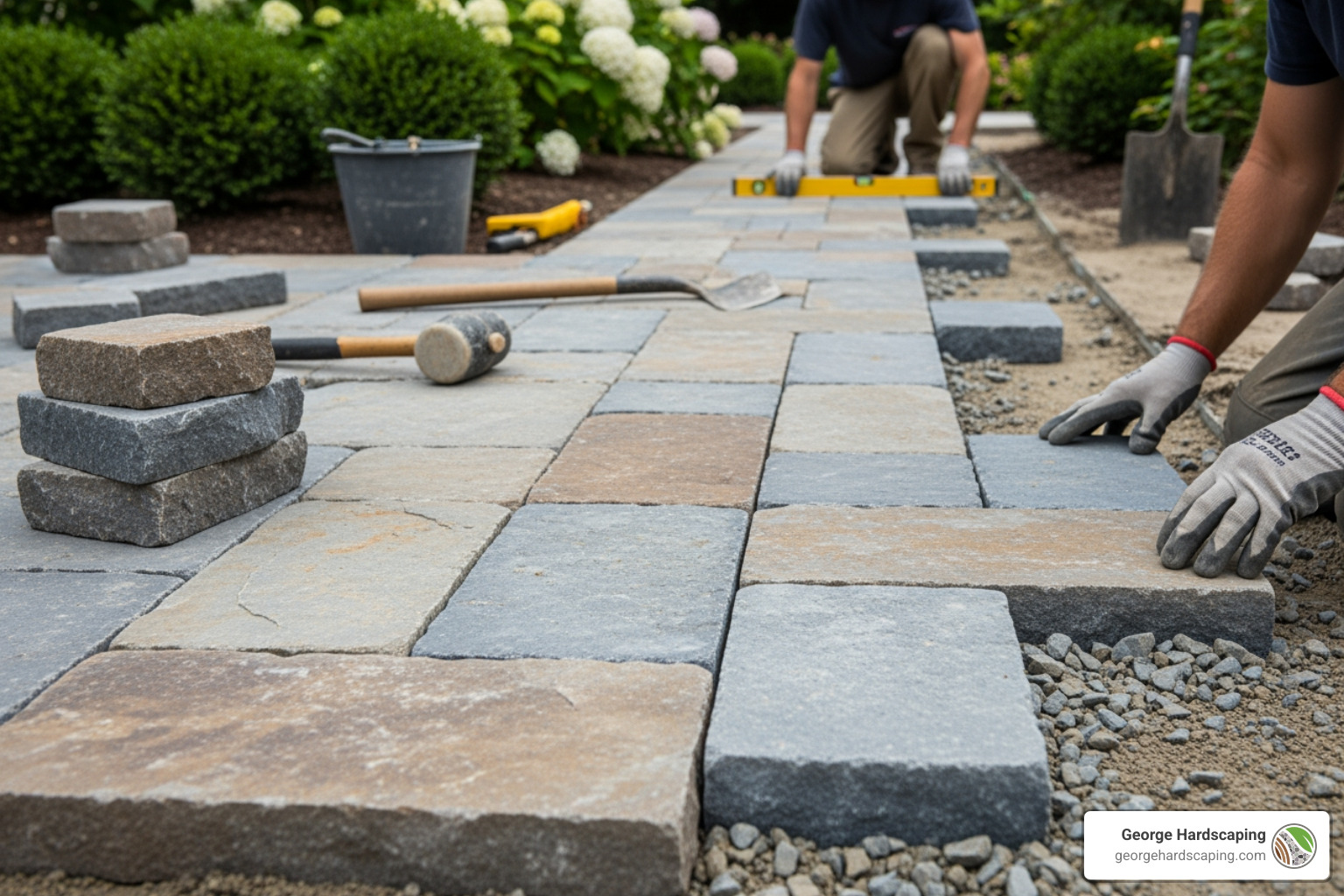
A bluestone walkway installation does more than just create a path; it transforms your property with a feature that marries natural, evolving elegance with century-long durability. Whether you’re crafting a grand entrance from your driveway to your front door or a meandering garden path, bluestone delivers a timeless aesthetic that, unlike many materials, genuinely improves with age. Over the years, it develops a rich patina, a subtle deepening of color and character that tells a story of seasons passed.
Quick Answer for DIY Installation:
- Excavate 8-10 inches deep for New England climates, extending 6 inches beyond walkway edges.
- Build a frost-proof base with 6-8 inches of compacted 3/4-inch crushed stone.
- Add a setting bed of 1-2 inches of screeded stone dust or coarse sand.
- Lay bluestone with consistent 1/2 to 3/4-inch gaps between stones.
- Fill joints with high-quality polymeric sand and activate carefully with water.
- Install permanent edging to contain the walkway materials and prevent shifting.
The profound beauty of bluestone lies in its geological origin. Formed as a sedimentary sandstone over millions of years, it is quarried primarily from the mountains of Pennsylvania and New York. This dense composition, layered with rich color variations—from its signature blue-gray to a full spectrum of earth tones like green, brown, and lilac—ensures that every installation is a unique work of art, impossible to replicate with manufactured products.
For homeowners in Essex County and across the North Shore, bluestone offers a distinct practical advantage. It is exceptionally well-suited to handle New England’s demanding freeze-thaw cycles, which can crack and destroy lesser materials. The proof is etched into the urban landscape of the Northeast; historic bluestone sidewalks installed over a century ago in cities like Boston, Philadelphia, and New York City still serve their communities today, a testament to their incredible resilience.
The real question isn’t whether bluestone is worth the investment—it’s whether you’re prepared for the demanding installation process or if it’s time to call in professionals.
According to a survey of internet averages, a DIY installation typically ranges from $25-$75+ per square foot when you factor in materials, delivery fees, and specialized tool rentals. Professional installation averages $50-$150+ per square foot, a price that reflects the complexity of the design, site conditions, and the value of expert craftsmanship. It’s important to note these figures represent a wide range and are not George Hardscaping’s actual pricing.
The physical labor involved is intense and should not be underestimated. A single 2×3 foot slab of 2-inch thick bluestone can weigh over 200 pounds. A successful project requires more than just muscle; it demands precision in grading, expertise with a plate compactor and masonry saw, and the stamina for several days of heavy lifting. The reward, however, is a pathway that can outlast your mortgage, requires minimal maintenance, and adds significant, lasting value to your property. Many homeowners find their bluestone walkway becomes a favorite and most complimented feature of their landscape.
If you’re considering natural stone pavers for your property, understanding the complete installation process is the first step toward making a confident and informed decision. This comprehensive guide will walk you through every critical stage, from selecting the perfect bluestone type to achieving a finish that looks professional and is built to endure.
Planning Your Project: From Blueprint to Bluestone
Proper planning is the foundational phase of a successful bluestone walkway installation, a step that guarantees your new path will enhance your home’s curb appeal for decades. This stage is about more than just picking stones; it involves understanding the material’s properties, its performance in our local climate, and the diverse options available to match your vision.
Bluestone is a dense, feldspathic sedimentary sandstone quarried in the northeastern U.S., primarily New York and Pennsylvania. Its geological formation under immense pressure gives it incredible compressive strength and a low absorption rate, making it ideal for demanding outdoor applications. While renowned for its classic blue-gray hue, its palette is surprisingly rich, featuring a natural mix of greens, lavenders, rusts, and sandy shades.
For homeowners in Essex County, bluestone’s durability is a primary attraction. It excels in our four-season climate, resisting cracking and spalling from relentless freeze-thaw cycles far better than concrete or less dense stone. With a proper installation, a bluestone walkway can easily last over 100 years, making it a profoundly cost-effective long-term investment compared to materials needing replacement every 15-20 years.
Let’s examine how bluestone compares to other common walkway materials:
| Material | Average Cost (Pavers Only, per sq ft) | Lifespan | Maintenance | Performance in New England | Heat Retention | Notes |
|---|---|---|---|---|---|---|
| Bluestone | $6-$40+ | 100+ years | Low | Excellent | Medium-High | Highly durable, freeze-thaw resistant, natural non-slip texture, improves with age. Requires a deep, properly compacted base to prevent frost heave. |
| Concrete Pavers | $3-$10 | 50+ years | Moderate | Good | Medium | Can fade from UV exposure, susceptible to efflorescence (white haze), requires edge restraints to prevent spreading. |
| Brick | $4-$15 | 50-100 years | Moderate | Good | High | Classic look, but can chip or crack under impact. Mortar joints can degrade and require repointing. Clay pavers are more durable than traditional brick. |
| Poured Concrete | $4-$10 | 25-50 years | Low to Moderate | Fair to Good | Medium | Prone to cracking from freeze-thaw cycles, which is difficult to repair seamlessly. Can be stained by leaves and chemicals. Limited aesthetic flexibility. |
| Travertine | $5-$30 | 100+ years | Low | Fair | Low | Stays cool to the touch, great for pool decks. However, it can be susceptible to damage from de-icing salts and may degrade in harsh freeze-thaw conditions if not properly sealed and installed. |
As the table illustrates, bluestone’s combination of longevity, low maintenance, and superior performance makes it a standout choice for New England landscapes. For more inspiration on integrating a new path, explore our Walkway Design Tips and browse these inspiring Front Yard Walkway Ideas.
Understanding Bluestone Types and Finishes
Bluestone is not a monolithic product. Its versatility is one of its greatest strengths, offering various types and finishes that provide distinct aesthetics and functional qualities. Selecting the right one for your bluestone walkway installation is crucial for achieving your desired look and ensuring long-term practicality.
- Natural Cleft Finish: This is the most traditional and popular finish. It’s created by splitting the stone along its natural sedimentary layers, resulting in a beautifully textured, slightly uneven surface. This texture provides excellent natural slip-resistance, making it a safe choice for New England’s wet and icy winters. Its rustic charm is undeniable, but be aware that the thickness can vary from piece to piece (typically 1 to 2 inches), requiring more skill to set perfectly level.
- Thermal (Flamed) Finish: This modern finish is achieved by applying intense, high-temperature heat to the stone’s surface, causing crystals to pop and create a uniform, stippled, non-slip texture. The process tends to enhance and deepen the blue and gray colors. Thermal bluestone is sawn to a uniform thickness, making installation faster and resulting in a cleaner, more contemporary appearance with tighter joints.
- Irregular Flagstone: Also known as crazy paving, these are large, naturally shaped pieces of bluestone fitted together like a grand-scale puzzle. This style is perfect for creating organic, flowing paths in informal gardens and rustic landscapes. It requires significant artistic skill and cutting to achieve tight, elegant joints.
- Dimensional Cut Stone: For a more formal and orderly aesthetic, dimensional bluestone is precisely cut into uniform squares and rectangles. This type allows for classic patterns like running bond or basketweave and is a popular choice for walkways leading to traditional, colonial, or modern homes where clean lines are desired.
At George Hardscaping, we source and install a wide range of natural stone pavers to suit any design preference and functional requirement.
Budgeting, Tools, and Materials
Understanding the financial and logistical scope of your bluestone walkway installation is critical. As noted, costs vary significantly between a DIY approach and professional service.
For a DIY project, internet averages suggest costs of $25-$75+ per square foot. This includes the stone itself ($6-$40+/sq ft depending on type and finish), base materials like gravel and stone dust ($8-$12/sq ft), and essential tool rentals. A plate compactor rental can run $50-$200+/day, and a professional-grade masonry saw may cost $75-$300+/day. Don’t forget ancillary costs like delivery fees for bulk materials and waste disposal.
Professional installation, while a higher upfront investment at $50-$150+ per square foot, often provides superior long-term value. This price reflects expert execution, guaranteed proper base preparation for our climate, efficiency, and peace of mind. These are internet average costs and not George Hardscaping’s actual pricing. For a detailed, personalized quote based on your specific project, we encourage you to contact us directly.
Here is a comprehensive list of what you’ll need:
Essential Tools for Bluestone Walkway Installation:
- Shovel (round and square point) and Wheelbarrow: For excavation and moving materials.
- Plate Compactor: Absolutely non-negotiable for compacting the subsoil and base layers to prevent future settling. Renting is the most common option.
- Masonry Saw with Diamond Blade: For making clean, precise cuts. A wet saw is highly recommended to control dust.
- Rubber Mallet: For setting stones without cracking them.
- Level (4-6 foot length): For checking the overall slope and ensuring individual stones are perfectly set.
- Stakes and Mason’s Line: For laying out the path and maintaining straight lines and a consistent grade.
- Screed Rails (e.g., 1″ metal conduit) and a Straight 2×4: For creating a perfectly flat setting bed.
- Garden Rake, Hand Tamper, Pointed Trowel.
- Safety Gear: ANSI-rated safety goggles, hearing protection, heavy-duty gloves, steel-toed boots, and a dust mask are mandatory, especially when cutting stone.
Required Materials:
- Bluestone Pavers: Your chosen type and finish (natural cleft, thermal, irregular, dimensional).
- 3/4-inch Crushed Stone (ASTM No. 57 stone): For the primary structural base layer.
- Stone Dust or Coarse Concrete Sand (ASTM C33): For the 1-2 inch setting bed.
- Polymeric Sand: The superior choice for filling joints to prevent weeds and insect infestation.
- Paver Edging: Heavy-duty plastic, steel, or aluminum to contain the entire system.
For a more detailed breakdown of project expenses, refer to our comprehensive guide on the Cost to Install Stone Walkway.
The Ultimate Guide to Bluestone Walkway Installation
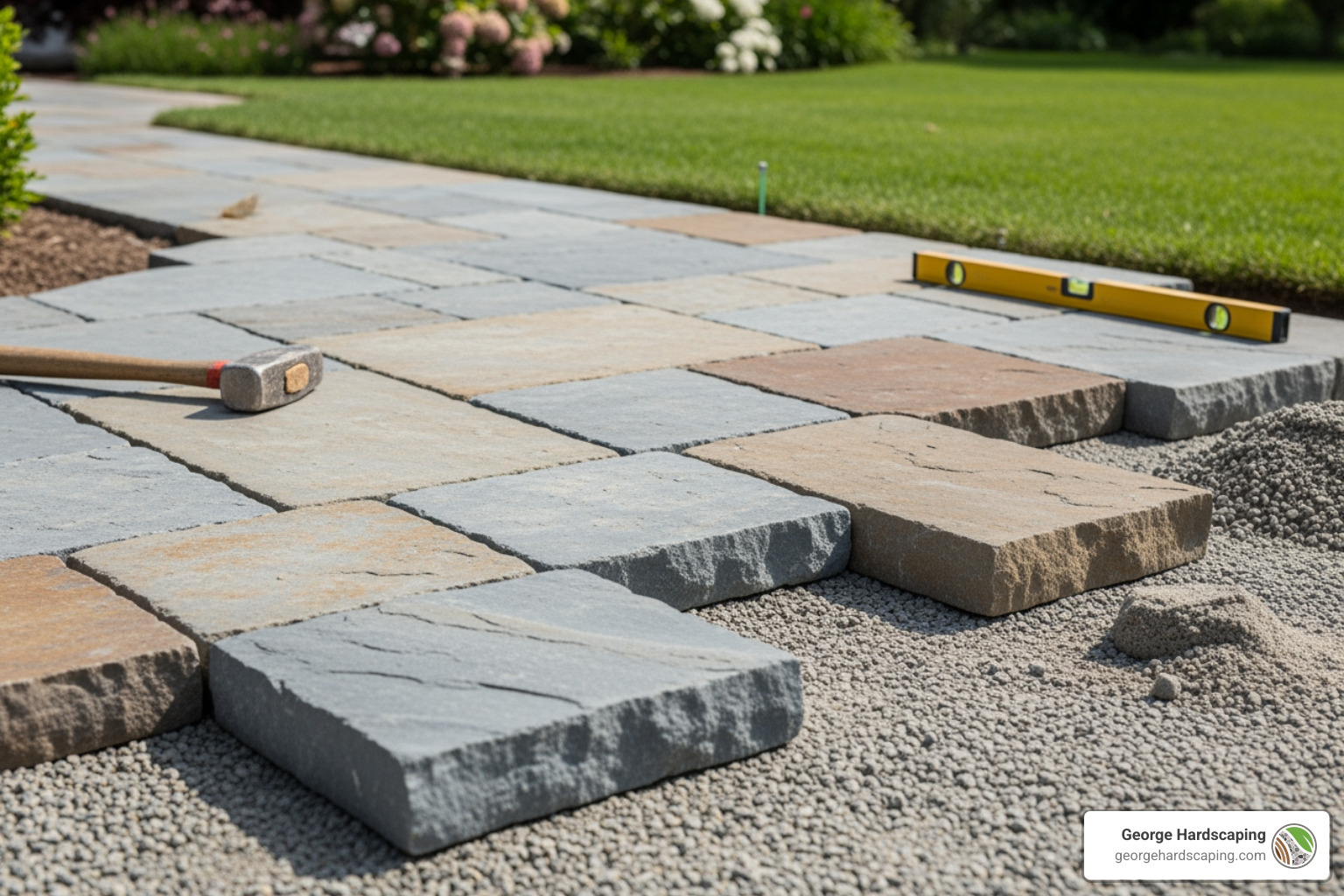
A meticulously prepared base is the unseen hero of a successful bluestone walkway installation. It is the foundation that guarantees longevity and stability against New England’s formidable elements. A deep, frost-proof base is not just recommended; it is paramount to prevent the shifting, heaving, and eventual failure caused by freeze-thaw cycles. This step, more than any other, directly dictates your walkway’s performance for generations. For a complete overview, our Stone Walkway Installation Guide offers comprehensive guidance.
Step 1: Site Preparation and Excavation
This is where your vision begins to take physical form. Precise site preparation is the cornerstone of a durable and aesthetically pleasing bluestone walkway. Rushing this stage will lead to problems down the road.
First, mark the path of your proposed walkway. Use wooden stakes or landscape marking paint and a mason’s line to outline the exact dimensions. A 4-foot wide walkway is generally ideal for residential use, allowing two people to walk comfortably side-by-side. For secondary garden paths, 3 feet may suffice. Once marked, extend your outline by about 6 inches on each side. This extra space is crucial to accommodate the installation of edge restraints and provide necessary working room.
Before a single shovel hits the ground, it is a legal and safety requirement to call 811 (the national “Call Before You Dig” hotline) at least 2-3 business days in advance. This free service coordinates with local utility companies to mark the location of any underground lines for gas, water, electric, and communications, preventing dangerous, costly, and potentially fatal accidents.
Next, excavate the entire area to a depth of 8-10 inches below the final desired height of the walkway. In New England, this depth is critical for creating a robust base that can withstand our deep frost line and prevent frost heave. Remove all grass, topsoil, roots, and any other organic matter from the area, as these materials will decompose and cause settling. The type of soil you have (e.g., heavy clay vs. sandy loam) can also impact drainage and may require a slightly deeper base.
As you excavate, you must establish a positive drainage slope. The walkway should slope away from your home’s foundation and other structures at a gradient of 1/4 inch per foot. Use a 4-foot level with a 1-inch block taped to one end to easily check this slope as you work. Ensure the entire subsoil base is graded consistently.
Finally, compact the subsoil with unwavering thoroughness. Even if the ground appears firm, it contains air pockets that will compress over time. Rent a plate compactor and make several overlapping passes over the entire excavated area until the soil is dense and stable. This is a non-negotiable step for preventing future settling of your walkway. For those tackling more complex projects on uneven terrain, our guide on How to Build a Paver Walkway on a Slope offers essential additional insights.
Step 2: Building the Base
With your site properly excavated, graded, and compacted, it’s time to build the multi-layered base that will support your bluestone for decades.
Begin by laying a 6-8 inch layer of 3/4-inch crushed stone (often called an open-graded base). This angular stone is the ideal material because the pieces interlock when compacted to form a strong, stable, and highly permeable foundation that allows water to drain freely, preventing it from freezing and heaving the stones above.
The key to a truly stable base is compaction in lifts. Compact the crushed stone in 2-3 inch lifts (layers). Do not attempt to dump all 8 inches of stone in at once and compact it; the compaction force will not reach the bottom layers. Spread a 3-inch layer, compact it thoroughly with the plate compactor, then add the next 3-inch layer and repeat until you reach your desired base height. This ensures maximum density throughout the entire base.
Once the structural base is complete, add the setting bed: a 1-2 inch layer of stone dust or, preferably, coarse concrete sand. This layer is not for structural support; its purpose is to provide a medium that is easy to manipulate for the precise leveling of each individual bluestone paver.
Spread the setting bed material evenly, then screed the surface. Place two parallel pipes (1-inch metal conduit works perfectly) on top of your compacted base. The height of the pipes will determine the depth of your setting bed. Pour the sand or stone dust between and over the pipes, then drag a straight 2×4 across the top of the pipes in a sawing motion. This removes the excess material and creates a perfectly smooth, flat, and properly sloped surface on which to lay your bluestone. For further expert advice on base construction, this helpful guide on building a walkway from This Old House provides valuable information.
Step 3: Laying and Fitting the Bluestone
This is the most rewarding stage of the bluestone walkway installation process, where your project finally begins to look like a finished walkway.
If you’re working with irregular flagstone, a crucial preliminary step is to dry-fit the stones on an adjacent lawn or driveway. This allows you to arrange the pieces like a puzzle, finding the best fits, minimizing cuts, and establishing a pleasing rhythm. Aim for consistent joint widths and avoid long, continuous joint lines. Once you have a layout you like, take a photo and transfer the stones, piece by piece, to the prepared setting bed.
Whether using irregular or dimensional stones, start laying from a fixed point, such as your front door, patio edge, or house foundation. This ensures the pattern is anchored and square to the most important visual element. For dimensional stone, plan your layout to avoid ending up with awkward, tiny sliver cuts at the edges.
Maintain consistent joint spacing of 1/2 to 3/4-inch between pavers. This gap is essential for the joint filler to work effectively and allows for micro-movements of the stones without chipping.
Carefully place each slab onto the setting bed, being careful not to disturb the screeded surface. Use a rubber mallet to gently tap the stones into place until they are firm and perfectly level with adjacent stones. Use your long level frequently, checking across multiple stones to ensure a smooth, trip-free surface. Adjust individual stones by adding or removing small amounts of setting sand underneath with a trowel.
Cutting is an inevitable part of the process. Use a wet masonry saw with a diamond blade for the cleanest, most precise cuts while minimizing hazardous silica dust. Always wear your full safety gear: goggles, heavy-duty gloves, hearing protection, and a respirator. For a more rustic, hand-hewn edge on irregular flagstone, you can also use a hammer and chisel, scoring a line and carefully chipping away material. Our dedicated page on Laying Bluestone Walkway provides more in-depth techniques and pattern ideas.
Finishing Touches and Long-Term Care
Once the heavy lifting of laying the bluestone is complete, the final steps of your bluestone walkway installation are what lock in the durability and create a polished, professional look. These finishing touches are not optional; they are vital for the walkway’s structural integrity, aesthetic appeal, and long-term performance.
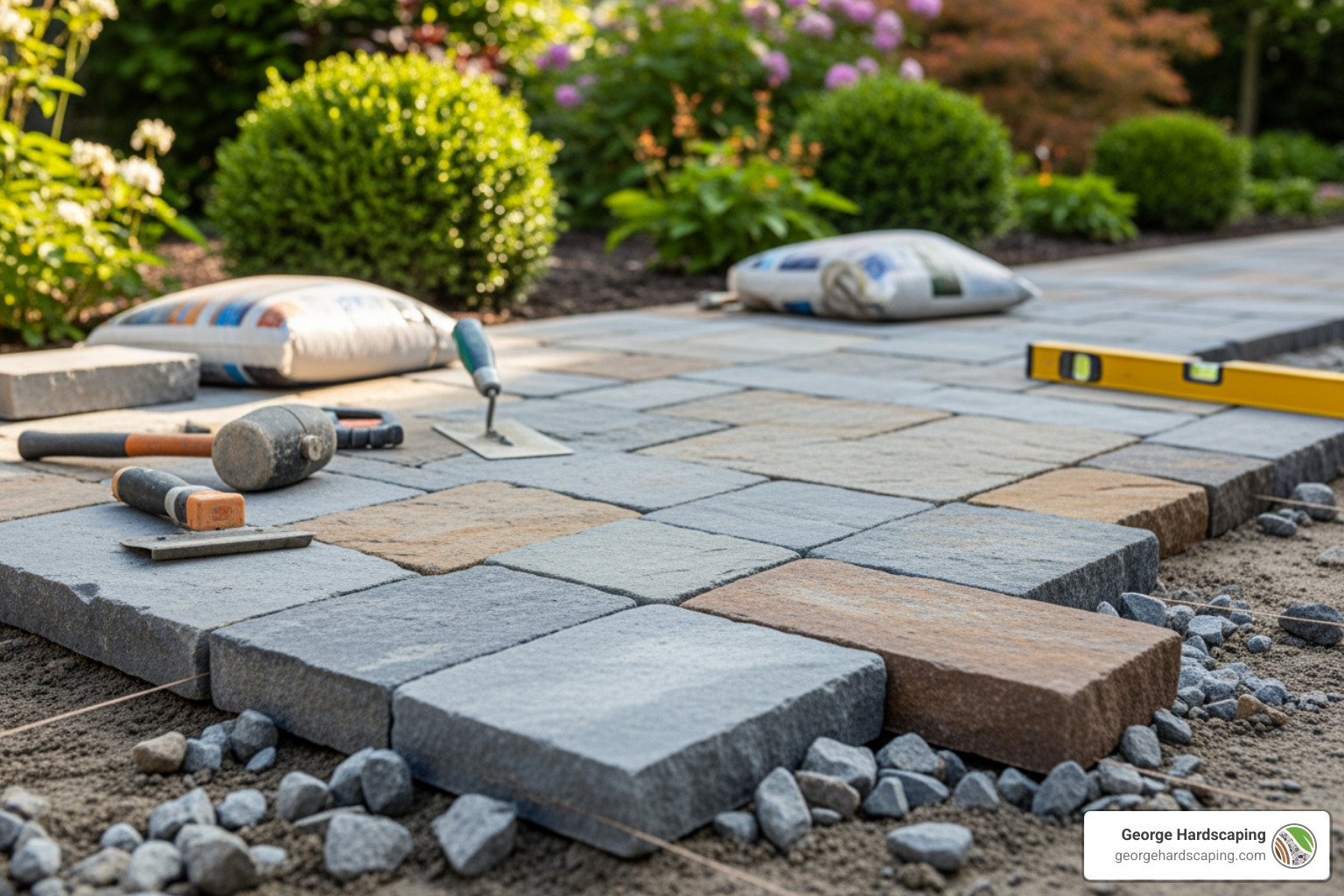
Proper joint stabilization and edge restraint are key to preventing weed growth, stopping insect intrusion, and keeping the stones from shifting over time. A well-maintained walkway retains its beauty and function for a lifetime. Should you need assistance down the line, our Hardscape Maintenance Service can help keep your bluestone looking its best.
Filling Joints and Installing Edging
Choosing the best joint material is a critical decision that directly impacts maintenance and longevity. Each option offers different benefits:
- Polymeric Sand: This is our top recommendation for most applications. It is a fine sand mixed with polymer binders. When properly activated with water, it hardens to form a strong yet flexible bond that locks pavers in place, resists erosion from rain and wind, and creates an impenetrable barrier against weeds and ants. Sweep it into the dry joints until they are completely full, compact the sand into the joints with a plate compactor (using a protective mat), top off the joints, and then meticulously remove every grain of excess sand from the stone surface with a leaf blower before watering.
- Stone Dust: A traditional, permeable option that allows water to drain through the joints. It provides a firm joint but offers minimal weed resistance and is prone to washing out over time, requiring periodic replenishment.
- Gravel: Fine gravel, like 1/4″ crushed stone or pea gravel, works well for rustic, irregular flagstone paths where a more informal, permeable look is desired. It requires the most maintenance for weed control.
To activate polymeric sand with water, use a hose nozzle set to a very fine mist or “shower” setting. Lightly wet the surface in sections, allowing the water to soak in. Repeat this process 2-3 times as per the manufacturer’s instructions. Do not flood the area or use a high-pressure jet, as this can wash the polymers out of the sand, rendering it useless. Avoid these common mistakes: applying to damp pavers, leaving a haze of sand on the surface before watering, or applying right before rain is forecast.
Installing permanent edging is a non-negotiable step that acts as the frame for your entire walkway system. It contains the base and setting bed materials, preventing them from washing out laterally and causing the outer stones to shift and sink. Options include heavy-duty plastic, steel, or aluminum edging, secured with long metal stakes. The top of the edging should be installed so it sits just below the level of the grass, making it invisible and allowing for easy mowing. For the ultimate in durability, a concrete toe or curb can be poured along the edge. For professional edging and paver installation, it’s always wise to consult a Paver Walkway Installer.
How to Maintain and Repair Your Bluestone Walkway
One of the greatest benefits of a bluestone walkway installation is its low-maintenance nature, but a little seasonal care goes a long way in preserving its beauty and structural integrity.
Seasonal Maintenance Schedule:
- Spring: Gently clean the walkway with a pH-neutral stone cleaner and a stiff-bristle (not wire) brush to remove winter grime. Inspect all joints for any cracking or erosion and top off with polymeric sand as needed.
- Summer: Sweep regularly to keep the surface free of leaves and debris that can decompose and cause stains. Address any weeds that may appear in compromised joints immediately.
- Fall: Keep the walkway clear of falling leaves. Wet leaves can release tannins that will stain the surface of the bluestone.
- Winter: Use only stone-safe de-icers. Harsh rock salt (sodium chloride) can cause pitting and scaling on the stone’s surface. Look for products containing magnesium chloride or calcium chloride, or use sand for traction.
Sealing is optional but highly recommended in New England. A high-quality, breathable, penetrating sealer applied every 3-5 years can protect against salt damage, stains from oil or leaves, and excess moisture absorption, while also enhancing the stone’s natural color. Always ensure the walkway is perfectly clean and bone-dry before applying a sealer.
Even with the best installation, minor issues can arise over decades. Here’s how to tackle them:
- Settling or Uneven Stones: This usually indicates a minor issue with the setting bed. Carefully pry up the affected stone and the ones next to it. Add or remove small amounts of coarse sand to re-level the area, re-compact the sand with a hand tamper, and reset the stones.
- Stains: Address stains immediately. Use a poultice or a specific natural stone cleaner designed for the type of stain (e.g., oil, rust, organic). Always test on an inconspicuous area first.
- Major Frost Heave: If an entire section of the walkway heaves, it’s a sign of a fundamental base failure (inadequate depth or poor drainage). This is a significant issue that may require professional intervention to excavate and rebuild the base in that area.
For any complex issues or repairs that feel beyond your scope, our Hardscape Repair Near Me services are always available to restore your walkway to its original condition.
Frequently Asked Questions about Bluestone Walkways
Embarking on a bluestone walkway installation project naturally brings up many questions. As experts in the field, we’ve compiled answers to some of the most common inquiries we receive from homeowners considering this timeless upgrade.
How deep should the base be for a bluestone walkway?
In New England’s climate, the base is everything. To prevent frost heave—the upward swelling of soil during freezing conditions that can destroy a walkway—we recommend a total excavation depth of 8-10 inches. This depth accommodates a 6-8 inch layer of compacted 3/4-inch crushed stone and a 1-2 inch setting bed of coarse sand or stone dust. This robust, multi-layered foundation provides the necessary structural support and, crucially, allows water to drain away from the surface before it can freeze and expand. Skimping on base depth is the single most common cause of walkway failure in our region.
What is the best material to put between bluestone pavers?
The “best” joint material for your bluestone walkway installation depends on your desired aesthetic and maintenance tolerance.
- Polymeric Sand: For 95% of projects, this is the superior choice. It hardens when wet to lock pavers tightly, creating a durable, semi-flexible joint that effectively resists erosion, prevents weed growth, and deters ants and other insects. It is the modern standard for a low-maintenance, long-lasting installation.
- Stone Dust: A traditional, permeable option that packs tightly. It offers a classic look but provides little resistance to weeds and can wash out over time, requiring occasional replenishment.
- Fine Gravel (e.g., 1/4″ chip stone): An excellent choice for rustic, irregular flagstone paths, providing maximum permeability and a natural aesthetic. However, it requires the most diligent weed control.
- Living Joints (Moss or Thyme): For a romantic, old-world look in shady, low-traffic areas, some homeowners encourage moss or creeping thyme to grow between the stones. This creates a beautiful, living pathway but requires specific conditions to thrive.
Is bluestone slippery when wet?
Safety is a primary concern for any walking surface, and bluestone performs exceptionally well in this regard. Most bluestone finishes offer excellent natural slip resistance.
- Natural Cleft Bluestone: With its naturally textured, slightly uneven surface, this finish provides a fantastic grip underfoot, even in rainy or icy conditions, making it an extremely safe choice for walkways.
- Thermal (Flamed) Bluestone: The process of heat-treating the surface creates a uniform, stippled texture that also significantly improves its slip resistance.
A highly polished or “honed” bluestone finish, which is smooth to the touch, can be very slippery when wet. However, this finish is almost exclusively used for indoor applications like countertops or flooring and is not recommended for outdoor walkways in a four-season climate. When planning your bluestone walkway installation, choosing either natural cleft or thermal finishes ensures you get a path that is as safe as it is beautiful.
Can I install a bluestone walkway over an existing concrete path?
Yes, this is possible and is known as an overlay, but it must be done with extreme caution. The existing concrete must be in excellent condition—completely free of major cracks, heaving, or settling. You can then lay a 1- to 2-inch sand or stone dust setting bed directly on the concrete and set the bluestone on top. However, this method has risks. Any future cracking or movement in the underlying concrete slab will transfer directly to your bluestone, causing it to fail. A better, though more labor-intensive, approach is to remove the old concrete and install a proper gravel base from scratch.
Does bluestone get hot in the summer?
Like most natural stones, bluestone will absorb and retain heat from direct sunlight. Darker, full-range bluestone will get hotter than the lighter, blue-select varieties. While it can get warm to the touch on a hot summer day, its heat retention is generally comparable to or slightly more than concrete pavers. If the walkway is in a full-sun area and will be used by bare feet (e.g., leading to a pool), a lighter-colored stone like travertine might be a cooler alternative.
Conclusion: A Path Built to Last
A bluestone walkway installation is far more than a simple home improvement project; it is a long-term investment in the enduring beauty, character, and functionality of your property. Throughout this guide, we’ve journeyed from the geological origins of this remarkable stone to the meticulous, scientific process of building a frost-proof base. We’ve detailed the artistry of laying the stones and the critical finishing touches that ensure their permanence. We’ve seen how bluestone’s natural elegance, combined with its exceptional durability and innate resistance to New England’s challenging climate, makes it a superior choice that is truly built for generations.
The deep satisfaction of a beautifully crafted bluestone path—one that enhances your landscape, adds tangible value to your home, and welcomes visitors for decades to come—is truly unparalleled. The final result is a perfect fusion of art and engineering. Whether you choose to embrace the challenge and reward of a DIY project or entrust the work to skilled professionals, the insights shared here will empower you to make informed decisions and demand outstanding results.
For homeowners in Essex County and the North Shore, MA, who value peace of mind and a flawless finish, the expert team at George Hardscaping provides exceptional masonry services and world-class hardscape installations. We take immense pride in transforming outdoor spaces with quality craftsmanship, meticulous attention to detail, and a commitment to building landscapes that last a lifetime.
Are you ready to take the first step on a path that will become a cherished part of your home’s legacy? Request an Estimate today to discuss your vision with our design experts. Let us help you create a timeless bluestone walkway that you and your family will cherish for a lifetime.
