
Why Professional Masonry Services Near Me Make All the Difference
Masonry services near me connects homeowners with professionals who build and restore brick, stone, and concrete structures-and in the North Shore, craftsmanship is only half the story. The other half is regional performance engineering: salt air, wind-driven rain, and aggressive freeze-thaw cycles expose weak base prep, poor drainage, and incompatible mortar fast. Local masons understand that Essex County soils (from Marblehead’s rocky ledge to Reading’s clay pockets) require the right excavation depth, compaction, and water management to prevent frost heave, settlement, and recurring cracking.
In Massachusetts, durable masonry blends time-tested methods with modern detailing: proper capstones and drip edges, correctly sized weep paths, and joint profiles that shed water instead of collecting it. This matters even more in historic districts like Salem or Newburyport, where preservation requirements often call for mortar compatibility with older, softer brick. The National Park Service preservation briefs on repointing historic masonry explain why mortar that is too hard can force moisture and stress into the brick, leading to spalling and irreversible damage. “Near me” should mean proven experience with local materials, local weather, and local code expectations.
High-performing masonry also requires system thinking. A patio isn’t just a surface-it’s excavation, base aggregate, edge restraint, pitch, and runoff control. A retaining wall isn’t just blocks or stone-it’s embedment, drainage stone, filter fabric, outlets, and correct batter to resist hydrostatic pressure. When your property is planned as one integrated hardscape, you get better drainage, fewer trip hazards, and a more cohesive finished look. That’s why many homeowners pair masonry with hardscape construction services so patios, walkways, steps, and walls work together instead of competing for water flow.
If you’re planning an outdoor upgrade, start with the right scope: patio design services to establish layout and drainage, engineered landscape retaining wall construction for slopes and grade changes, and safe walkways and stairs installation that tie everything together. For classic curb appeal, steps and brick stairs installation can modernize entries while keeping a traditional New England aesthetic.
Quick Answer: What Local Masonry Contractors Offer
- Hardscaping projects: Custom patios, walkways, stairs, and structural walls-often delivered as full hardscaping masonry services.
- Repairs & restoration: Repointing, chimney rebuilding, brick replacement, and foundation-related repairs.
- Materials: Brick, natural fieldstone, granite, bluestone, concrete pavers, and stone veneer.
- Typical costs: $350-$850 for basic repairs; $25-$55/sq ft for brick walls; $50-$125+/sq ft for natural stone; $35,000-$55,000 for large restorations (site conditions and access can shift pricing).
- Estimates: Reputable contractors typically provide on-site evaluation, scope clarity, and itemized pricing.
Industry guidance from the International Masonry Institute technical resources and the Brick Industry Association technical notes on masonry detailing consistently emphasizes moisture management, flashing integration, and correct joint tooling to slow deterioration. For retaining walls, the NCMA segmental retaining wall design resources outline best practices for drainage and stability-key on sloped New England lots.
Quality masonry also adds perceived and real property value because it improves function (safe access and drainage) and aesthetics (premium materials and craftsmanship). Data and consumer research from organizations like the National Association of Home Builders repeatedly shows exterior improvements and durable outdoor living features can influence buyer appeal.
Direct CTA (prominent): For masonry that looks better and lasts longer, request a free estimate to get a clear scope, materials plan, and timeline from a local team.
Image metadata: Title: “Masonry services near me” | Subject: North Shore masonry and hardscape craftsmanship | Description: Professional stone patio and masonry installation designed for freeze-thaw durability. | Alt text: “Finished stone patio and masonry detailing built for North Shore Massachusetts freeze-thaw conditions.”
Comprehensive Guide to Masonry Services Near Me
When searching for masonry services near me, you’re usually looking for construction that’s built unit-by-unit: brick, stone, or block set with mortar (or in some hardscape cases, dry-laid and restrained). Unlike a continuous concrete pour, masonry work is modular. That modularity is a major advantage in New England because it can better tolerate small movements from seasonal ground shifts-and when damage does occur, a qualified mason can often repair a localized area without removing an entire slab.
The Mason Contractors Association of America recognizes masonry as one of the most durable building systems, but durability is not automatic. Performance depends on correct detailing: the right base depth, correct mortar selection, proper joint tooling, thoughtful drainage, and appropriate materials for the exposure conditions (salt, shade, wind, and freeze-thaw). In coastal Massachusetts, the best contractors plan for water to escape rather than hoping it never enters.
A good local contractor also helps you choose the right approach for your property:
- Patio design services to plan traffic flow, furniture zones, and drainage pitch.
- Landscape retaining wall construction to manage slopes, protect usable yard space, and control runoff.
- Walkways and stairs installation to improve safe access to entries, driveways, and backyards.
- Steps and brick stairs installation for classic curb appeal and durable entryways.
Mortar, Materials, and Local Expertise (What “Near Me” Should Actually Mean)
Mortar is not just “cement between bricks.” It is a designed component of the wall, intended to be compatible with the masonry units and the exposure environment. The Masonry Institute of America technical library explains why mortar selection matters: mortar that is too strong (too hard) can concentrate stress into the masonry units, while mortar that is too weak may erode prematurely.
In historic towns, this becomes critical. Many older bricks are soft-fired and intended to work with more flexible, lime-forward mortars that let the wall “breathe.” The National Park Service guidance on repointing historic masonry recommends matching mortar properties to the original construction so moisture can move through joints instead of damaging brick faces.
Professionals commonly reference standards such as ASTM C270 for mortar types (often Type N above grade for flexibility; Type S below grade for higher strength), and they pay attention to:
- Joint tooling: concave joints generally shed water better than raked joints.
- Curing conditions: temperature and humidity affect strength gain and bond.
- Unit absorption: some brick and stone require pre-wetting or adjusted mixes.
- Exposure: chimneys and freestanding walls face harsher weather than sheltered façades.
For stone selection and installation standards, the Natural Stone Institute technical resources provide guidance on stone properties, anchoring, and best practices. For cement chemistry and mortar fundamentals, the Portland Cement Association resources on mortars are widely referenced for mix behavior and performance.
Core Services of Local Masons
Professional masonry services typically include a mix of new construction, upgrades, and repair work:
- Bricklaying and brick features: Walls, piers, garden borders, and entry systems built with consistent courses, correct bonding, and water-shedding details. For entry upgrades, steps and brick stairs installation can dramatically improve safety and appearance.
- Stone installation and stone masonry: Full-bed stonework, veneer systems, and custom accents. Stone masonry services can be ideal for bluestone landings, granite treads, and natural stone walls.
- Structural masonry: Work that must meet code requirements for stability and safety, including foundation-related repairs and structural walls. In Massachusetts, code expectations are tied to the 780 CMR Massachusetts building code.
- Restoration and repointing: Repairing joints, replacing damaged units, and correcting moisture pathways while preserving existing materials.
- Outdoor living construction: Features like custom outdoor firepit installation and pool deck installation designed for safety, durability, and comfort.
Site Conditions and Planning (What Pros Measure That Homeowners Don’t Always See)
A local mason should evaluate the property as a system before quoting:
- Excavation depth and frost considerations: New England conditions demand stable subgrade and base construction to limit movement.
- Drainage and pitch: Patios and walkways should move water away from foundations and toward safe discharge points.
- Soil type and compaction strategy: Clay holds water; sandy soils drain but can settle if not compacted correctly.
- Utility locating and permits: Massachusetts homeowners should expect Dig Safe coordination where required.
- Material sourcing and matching: Especially important for visible repairs and historic work.
To plan a cohesive project, review what is hardscape in construction so your patios, walls, and walkways function together.
Vetting Contractors (A Practical Checklist)
- Ask how they will build the base (depth, stone type, compaction method).
- Confirm drainage strategy (pitch, drain stone, weep paths, outlet locations).
- Request examples of similar local work and discuss material options.
- Verify you’re working with a licensed masonry contractor and confirm liability and workers’ comp coverage.
- Expect an itemized scope (demo, excavation, base, materials, disposal, and warranty terms).
Direct CTA (prominent): Get a clear plan and a written scope-request a free estimate with an on-site visit.
Popular Hardscaping and Masonry Projects for Local Homes
In Essex County, hardscaping masonry services are often the most practical way to add usable outdoor space and solve drainage or grade problems. The best-looking projects are typically the ones with the best “invisible” work: excavation, base stone, compaction, edge restraint, and drainage. When those layers are correct, patios stay flatter, stairs feel safer, and walls resist leaning and cracking over time.
Patios and Outdoor Living
A professional patio begins with patio design and installation services that account for how the space will be used and where water will go. A quality patio system commonly includes:
- Excavation to stable subgrade.
- Geotextile fabric in soft or mixed soils.
- Compacted crushed-stone base installed in lifts.
- Bedding layer appropriate to the material system.
- Edge restraint to prevent lateral spread.
- Correct pitch away from structures.
Material options vary by budget and maintenance preferences:
- Natural stone (bluestone, granite): premium appearance and long service life.
- Concrete pavers: consistent sizing, easier spot repairs, many style options.
- Permeable pavers: designed to help manage runoff and reduce puddling.
For technical guidance on paver systems, the Interlocking Concrete Pavement Institute (ICPI) resources outline best practices for base preparation, edge restraint, and long-term performance. For inspiration on materials and layouts, explore stone patio design ideas.
Landscape Retaining Walls
Professional landscape retaining wall construction helps homeowners reclaim usable yard space and prevent erosion. Most wall failures trace back to two issues: inadequate base preparation and inadequate drainage.
A correctly built retaining system typically includes:
- Proper base embedment and leveling.
- Drainage aggregate behind the wall.
- Filter fabric to prevent soil migration into drain stone.
- A drain outlet strategy (daylight, drywell, or approved discharge).
- Appropriate reinforcement where required.
For homeowners who want to understand the engineering basics, the Federal Highway Administration overview of earth retaining structures explains why drainage and lateral earth pressure matter. The NCMA segmental retaining wall resources further detail best practices and design concepts commonly used for SRW systems.
Walkways and Stairs
Walkways and stairs installation improves safety and everyday function: less mud tracked indoors, safer routes in winter, and clearer transitions between levels. Walkways require stable bases and consistent pitch to reduce trip hazards and water pooling.
For stairs, dimensional consistency is essential. Building standards referenced through the International Code Council stress uniform riser height and tread depth to reduce falls. Material choices include:
- Granite treads: highly durable and ideal for high-traffic entries.
- Brick steps: classic New England character; great for matching older homes. Consider steps and brick stairs installation when you want a timeless look with modern stability.
Custom Features
- Custom outdoor firepit installation: Built with fire-rated components and clearances that align with widely recognized fire safety guidance from the NFPA codes and standards.
- Driveway paver installation: Requires a thicker, load-rated base, careful pitch, and edge restraint to resist vehicle forces.
- Pool deck installation: Focuses on drainage, slip resistance, and surface comfort in sun and heat.
Direct CTA (prominent): Ready to upgrade your yard with a patio, wall, steps, or walkway that’s built for New England? Request a free estimate for an on-site consultation and a written plan.
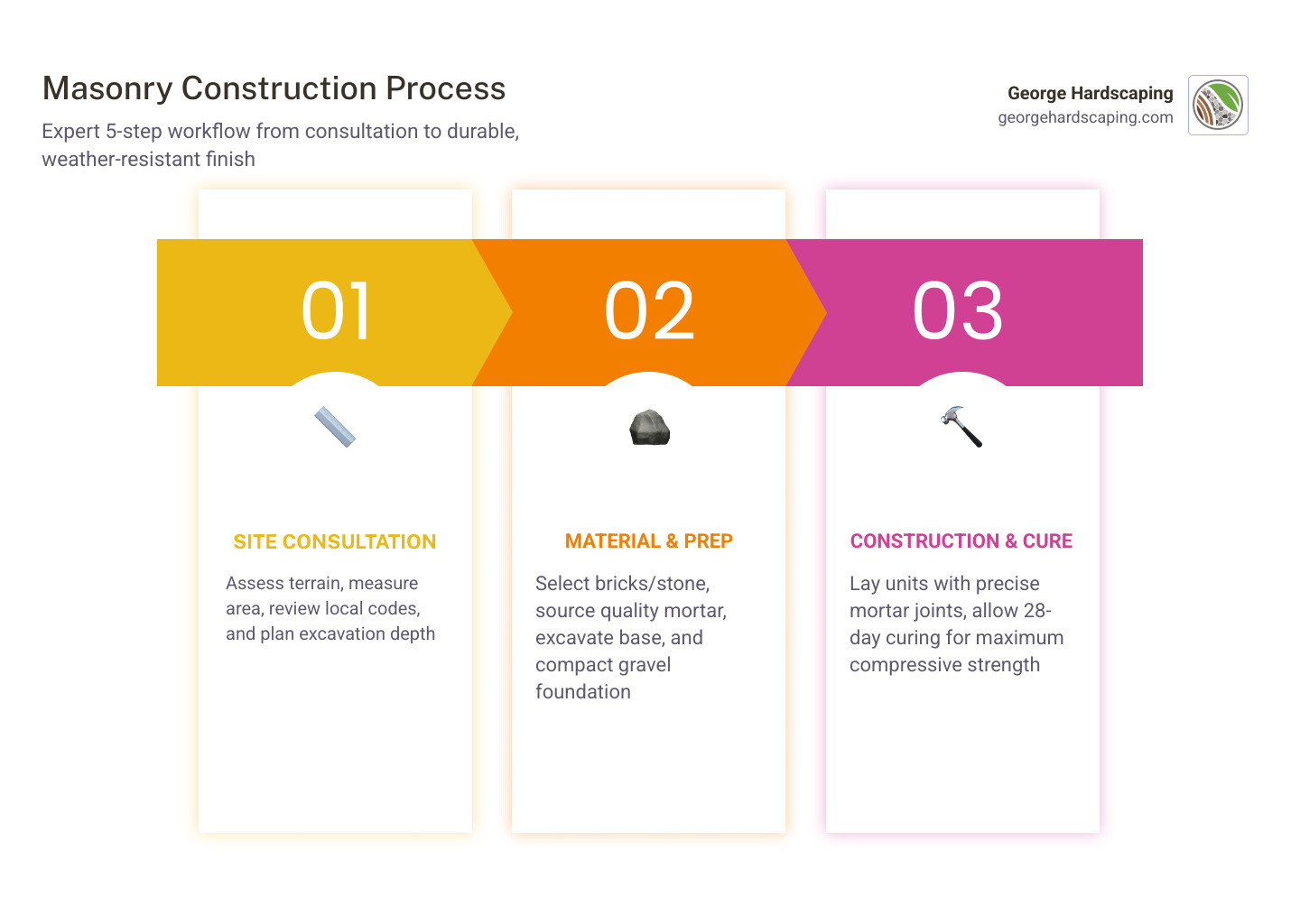
Image metadata: Title: “5-step masonry process” | Subject: How professional masonry projects are built | Description: Infographic explaining consultation, materials, base prep, construction, and curing to improve durability in freeze-thaw climates. | Alt text: “Infographic showing five key steps of a professional masonry project from consultation to curing.”
Masonry Repair, Restoration, and Maintenance
Homeowners search for masonry repair near me when mortar fails, bricks crack, or water starts getting where it shouldn’t. In New England, freeze-thaw cycles accelerate small problems into larger ones: water enters hairline cracks, freezes, expands, and gradually breaks the bond between mortar and masonry units. Coastal exposure can compound this with wind-driven rain and salt that increases moisture loading.
For preservation and repair best practices, contractors often reference the U.S. General Services Administration masonry preservation procedures and the Brick Industry Association technical notes, which emphasize moisture management, correct joint treatment, and appropriate repair methods.
Warning Signs You Shouldn’t Ignore
- Spalling: Brick faces flake or pop off due to saturation and freeze-thaw pressure (often seen on shaded, north-facing walls).
- Efflorescence: White salt deposits that indicate moisture movement through the wall.
- Bulging or leaning: Can signal failed ties, poor backfill/drainage, or structural movement and should be evaluated promptly.
- Mortar deterioration: Crumbling, missing joints, or sandy mortar that needs repointing.
- Loose caps/coping stones: Failed bedding allows water to penetrate the wall core.
Specialized Repairs (What a Pro Mason Can Do)
- Repointing / tuckpointing: Removing failing mortar to the correct depth and packing new compatible mortar.
- Brick replacement (“toothing in”): Removing damaged bricks and matching replacements while keeping adjacent masonry intact.
- Lintel and sill repair: Restoring structural supports to prevent recurring cracking above openings.
- Crown/cap repairs: Rebuilding water-shedding caps on chimneys and freestanding walls.
- Resetting steps and landings: Correcting pitch, settlement, and trip hazards while improving drainage.
If your project includes exterior living areas, repair work can often be coordinated with new construction through hardscaping masonry services so the finished result looks unified.
Maintenance Tips That Extend Masonry Life
- Keep grade sloped away from foundations (commonly 6 inches over 10 feet, where feasible).
- Extend downspouts several feet away from masonry and direct water to safe discharge.
- Avoid non-breathable coatings on older brick; the National Park Service preservation guidance cautions that trapped moisture can accelerate decay.
- Use safer de-icing options where appropriate; harsh salts can damage masonry and adjacent landscaping.
- Inspect chimneys and exposed walls seasonally; catch small joint failures early.
- Keep vegetation, mulch, and soil from staying piled against masonry surfaces.
Those seeking landscape masonry contractors near me should look for teams that handle both new builds and repair/restoration, since drainage and base issues often tie the two together. For location-specific considerations, see masonry services in Beverly, MA and masonry services in Swampscott, MA.
Comparing Costs and Timelines for Masonry Work
Labor typically accounts for 50% to 70% of a masonry project’s cost, but pricing can swing based on access, demolition needs, drainage complexity, and the material system you choose. Understanding the main cost drivers helps you compare bids more accurately-and helps ensure you’re comparing equal scopes (not just equal totals).
Average Cost Breakdown
Note: These are regional averages and not actual quotes for George Hardscaping.
| Project Type | Average Cost Range | High-End Range |
|---|---|---|
| Basic Brick Repair | $350 – $850 | $2,500+ |
| Brick Wall (per sq ft) | $25 – $55 | $150+ |
| Natural Stone Wall (per sq ft) | $50 – $125 | $350+ |
| Tuckpointing (per sq ft) | $10 – $30 | $90+ |
| Patio Installation (per sq ft) | $20 – $50 | $75+ |
| Full Restoration | $35,000 – $55,000 | $150,000+ |
Factors Influencing Your Quote
- Site access and staging: Tight access, fencing, or narrow side yards increase labor and time (common in older neighborhoods and coastal streets).
- Slope and grade changes: Steeper lots may require engineered landscape retaining wall construction, additional drainage work, and more excavation.
- Material selection: Natural stone typically costs more than concrete pavers, but can offer a distinctive finish and long service life.
- Permits and structural requirements: Walls over certain heights may require design considerations and must align with the 780 CMR Massachusetts building code.
- Drainage complexity: Catch basins, channel drains, and controlled discharge points add cost but often prevent expensive future repairs.
- Demolition and disposal: Removing failing masonry, old concrete, or buried debris can be a meaningful cost line item.
Timelines, Curing, and Seasonal Planning
- Initial set: often 24 to 72 hours depending on temperature, mix, and exposure.
- Early-use strength: commonly 3 to 7 days for light foot traffic in many applications.
- Full cure: approximately 28 days for cementitious materials (conditions vary).
In Salem, Marblehead, and surrounding towns, winter masonry requires temperature management, protection from rapid drying, and scheduling around cold snaps. Concrete and masonry temperature practices are commonly discussed in standards and guidance from groups like the American Concrete Institute.
When you combine multiple outdoor elements into one coordinated scope, you can often reduce mobilization costs and avoid conflicting drainage decisions. Consider planning patios, steps, and walkways together with hardscape construction services.
Direct CTA (prominent): Want an exact, site-specific price and timeline? Request a free estimate for an itemized quote based on your yard conditions and goals.
Frequently Asked Questions About Masonry
What is the difference between concrete and masonry?
Concrete is a continuous slab prone to cracking in shifting soils. Masonry uses individual units and mortar joints, providing flexibility and easier localized repairs. For those seeking landscape masonry contractors near me, masonry offers better long-term value and simpler future modifications.
Can damaged bricks be repaired?
Yes. Masons can perform “tooth-in” repairs, replacing individual bricks without disturbing the surrounding wall. For residents in the North Shore, pages like masonry services in Beverly, MA and masonry services in Swampscott, MA show how local conditions influence material matching.
How do I find a reliable local mason?
A licensed masonry contractor should provide insurance and a portfolio of local projects. Confirm they can support your specific scope, such as stone masonry services or landscape retaining wall construction.
Should I seal my masonry?
Modern pavers often benefit from breathable sealers to reduce staining. However, sealing historic bricks can be risky if the product traps moisture. The National Park Service Preservation Briefs caution against using waterproof coatings on historic masonry.
How long does a stone wall last?
A well-built stone wall with a proper foundation can last 50 to 100 years. Longevity is directly proportional to the quality of its base preparation and drainage system.
Do I need permits for masonry work?
Many towns require permits for walls over 4 feet or for work affecting drainage. In Massachusetts, the Massachusetts building code (780 CMR) governs structural requirements. Resources like masonry services in Salem, MA can provide location-specific guidance.
What is the best time of year for masonry work in New England?
The ideal season runs from late April through mid-November. Mortar requires temperatures above 40°F to hydrate properly. While winter masonry is possible with heated enclosures, planning for warmer months ensures optimal curing conditions.
Conclusion
George Hardscaping serves the North Shore with masonry built for New England. Whether you need patio design and installation, walkways and stairs, or landscape retaining wall construction, we deliver lasting craftsmanship grounded in correct base prep, drainage, and material compatibility.
Pairing masonry with a unified hardscape construction service plan ensures your patio, steps, and walls work together. We also specialize in stone masonry services, driveway paver installation, and custom outdoor firepit installation to create outdoor spaces that look intentional-not piecemeal.
For restoration and maintenance, focus on identifying moisture pathways and using compatible materials, following the U.S. General Services Administration masonry repair procedures and best practices outlined by the International Masonry Institute. Quality materials and skilled workmanship pay dividends for decades.
As a licensed masonry contractor serving Beverly, Salem, and Swampscott, we understand the region’s weather, soils, and architectural styles.
Strong CTA #1 (prominent): Don’t wait for cracks to grow-request a free estimate today for a clear plan, materials recommendation, and timeline.
Strong CTA #2 (prominent): Get ideas first, then get it built right-explore stone patio design ideas and request a free estimate for a consultation.
Browse related services like pool deck installation and masonry work to build a high-value hardscape.
Image metadata: Title: “Masonry services near me project showcase” | Subject: Finished masonry and hardscape craftsmanship | Description: Completed stonework and patio installation demonstrating durable construction and clean detailing. | Alt text: “Completed North Shore masonry project showcasing clean stonework joints and durable patio construction.”
