
Stone Wall Repair: Perfect 2025 Guide
Why Stone Wall Repair is Essential for Your Property
Stone wall repair is a foundational maintenance task that protects not only the structural integrity of your wall but also the aesthetic value and safety of your entire property. A well-maintained stone wall is a significant asset, enhancing curb appeal and defining outdoor spaces. Whether you own a classic dry-laid fieldstone boundary wall, a formal mortared garden wall, or a critical structural retaining wall, timely maintenance is the key to longevity.
It prevents minor, easily fixable defects from escalating into complex, costly, and potentially dangerous failures. In a demanding freeze–thaw climate like coastal Massachusetts, walls are constantly under assault from moisture, extreme temperature swings, and shifting soils. Addressing issues such as loose stones, cracked or missing mortar, and subtle leaning at the first sign of trouble is the most effective and economical way to avoid a full reconstruction.
Quick Stone Wall Repair Overview:
- Small DIY Repairs: Ideal for minor issues like replacing a few loose stones, filling small cracks, or repointing isolated mortar joints. Material costs are typically low, ranging from $38–$200.
- Professional Repairs: Necessary for structural work, extensive repointing, or sections requiring partial rebuilding. Costs often range from $50–$150 per square foot, influenced by factors like structural complexity, site access, and the need for precise stone-matching.
- Full Rebuilds: Required for major collapses or systemic failures. These extensive projects can range from $50,000–$70,000 or more, depending on the wall’s length, height, site access, and the scope of required drainage engineering.
- Common Causes of Damage: The primary culprits include freeze–thaw cycles, poor drainage leading to hydrostatic pressure, soil erosion, invasive tree roots, physical impacts, and the natural aging of materials.
- When to Call Professionals: It is critical to engage experts for walls over 4 feet tall, any wall that is actively leaning or bulging, significant collapses, signs of foundation failure, or complex drainage problems.
Stone walls are more than just boundaries; they are an integral part of New England’s cultural and historical landscape. With hundreds of thousands of miles of historic stone walls recorded across the region, they represent a tangible link to our agricultural past and local heritage. While many small repairs are manageable as DIY projects for handy homeowners, recognizing the crucial difference between a simple cosmetic fix and a serious structural hazard is vital for both safety and the wall’s long-term survival. Water management, in particular, is the single most defining factor for durability. When moisture infiltrates a wall’s joints or core and then freezes, it expands with immense force, prying stones and mortar apart from the inside out.
For mortared walls, success hinges on using the correct type of mortar and meticulous joint preparation to achieve a durable, weather-resistant bond and a visually consistent finish. For dry-stacked walls, stability depends on thoughtful stone selection, creating strong interlocking patterns, and building upon a stable, well-drained base. Retaining walls introduce another layer of complexity: they must be engineered to resist immense lateral soil pressure and safely channel water away, often requiring sophisticated drainage elements. If your wall is holding back earth or stands taller than four feet, the safest and most effective path is to consult a professional who understands both advanced masonry techniques and soil mechanics. For these critical projects, see our specialized expertise at George Hardscaping: Landscape Retaining Walls.
Just as important as the repair technique is planning for the long term. A well-executed repair, combined with proper drainage, proactive vegetation control, and regular seasonal maintenance, can add decades to a wall’s life. If you prefer a dedicated crew to assess and handle every aspect of the project—from diagnosing the root cause to remedying drainage issues and rebuilding sections with precision—our comprehensive Hardscaping & Masonry Services ensure your wall is not only repaired correctly but is fortified to last for generations.
Identifying the Need for Stone Wall Repair
Even the most robustly constructed stone walls will weather, settle, and show signs of age over time. The key to preserving these structures is early detection, which prevents small, manageable defects from spiraling into large-scale failures that demand complete demolition and rebuilding. Understanding the powerful forces acting on your wall—and knowing precisely what symptoms to watch for—empowers you to decide when a simple tune-up will suffice and when it’s time to bring in a professional mason.
Common Causes of Stone Wall Damage
- Water and Freeze–Thaw Cycles: Water is the number one enemy of masonry in cold regions. When water from rain or melting snow penetrates joints, cracks, or the porous core of a wall, it can cause immense damage. As the water freezes, it expands by approximately 9%, exerting incredible force that widens cracks, loosens stones, and breaks down mortar. This process, known as frost heaving, causes a cumulative effect across many cycles, leading to bulging, spalling (flaking of the stone surface), and complete joint failure. For an accessible primer on this phenomenon, see the National Park Service’s guidance on masonry deterioration in its Preservation Briefs.
- Hydrostatic Pressure, Soil Erosion, and Settlement: This is particularly critical for retaining walls. Poor grading, clogged weep holes, or a lack of a proper drainage system allows water to saturate the soil behind the wall. This creates immense hydrostatic pressure, pushing outward on the structure. Simultaneously, uncontrolled water flow can erode the soil beneath the foundation stones, creating voids that lead to differential settlement, cracking, and eventually, tipping or collapse of the wall.
- Tree Root Intrusion: The slow, powerful growth of roots from nearby trees can shift massive stones, push joints apart, and completely undermine a wall’s foundation. What starts as a small sapling can become a major threat over a decade. Even seemingly harmless climbing vines can be problematic, as they trap moisture against the stone and mortar, accelerating decay and providing a pathway for water intrusion.
- Physical Impact: Accidental damage is a common issue, especially for walls near driveways or roads. Vehicle strikes, glancing blows from snow plows, and heavy equipment traffic can dislodge stones, fracture entire sections, and compromise the wall’s structural integrity, particularly at vulnerable corners and edges.
- Natural Aging and Mortar Decay: No material lasts forever. Over decades, mortar naturally weathers, loses its bond strength, and becomes soft and crumbly. Dry-laid walls, which rely on friction and gravity, can slowly loosen as ground vibrations, frost heave, and seasonal expansion and contraction take their toll year after year.
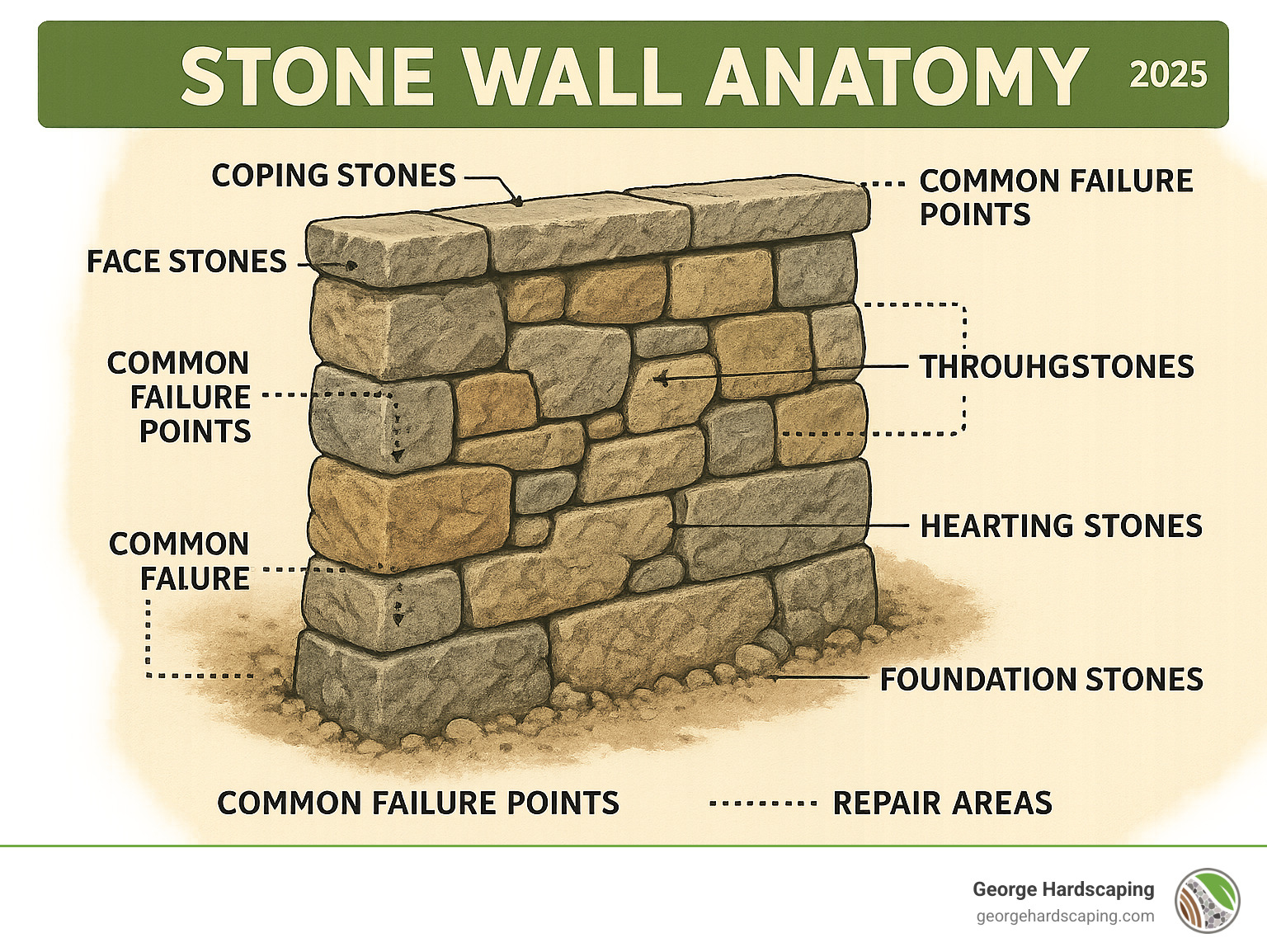
- Inadequate Original Construction: Many wall failures are destined from day one due to poor building practices. Common flaws include insufficient base preparation, a lack of ‘batter’ (a slight inward lean for stability), missing throughstones in dry-stacked walls, or the use of overly hard, cement-rich mortars on historic stone, which can cause the stone itself to crack and spall.
For retaining walls, proper drainage and soil reinforcement are not optional—they are essential for safety and longevity. Industry guidance from associations such as the National Concrete Masonry Association outlines best practices for drainage and managing lateral loads in segmental retaining walls (see NCMA Retaining Wall Resources). While your stone wall may not be made of segmental blocks, the underlying principles of drainage and surcharge management are universal and still apply.
Telltale Signs Your Wall Needs Attention
- Leaning or Bulging Sections: A noticeable outward lean or a ‘belly’ in the face of the wall is a major red flag. This often indicates severe lateral soil pressure, a failing drainage system, or foundation failure. Retaining walls showing these symptoms require prompt professional assessment; learn more about our diagnostic approach at Landscape Retaining Walls.
- Significant Cracks: While hairline cracks in mortar can be a normal part of aging, wider (non-hairline) vertical cracks often signal settlement issues. Step-cracks that follow the mortar joints or long horizontal cracks may suggest dangerous soil pressure or frost damage.
- Loose, Missing, or Displaced Stones: If you can wiggle stones with your hand, or if they have visibly slipped forward or fallen out, the wall’s structural interlock and load-bearing capacity are compromised.
- Crumbling Mortar (Sandiness): If you can easily scrape mortar out of the joints with a key or if it has a sandy, powdery texture, it is no longer effectively binding the stones. Repointing with a compatible mortar is necessary to restore strength.
- Efflorescence (White Powdery Stains): These salt deposits on the wall’s surface are a clear sign of persistent water movement through the masonry. The water dissolves natural salts within the stone or mortar and deposits them on the exterior as it evaporates. The National Park Service discusses these moisture pathways and their effects in its guidance on cleaning and water-repellent treatments.
- Water Pooling at the Base: Puddles and perpetually soggy soil along the toe of the wall point to grading or drainage problems that are actively working to undermine the structure from below.
- Displaced Coping/Capstones: The top course of stones is the wall’s first line of defense against rain and snow. If these capstones are missing or shifted, they allow water to pour directly into the wall’s core, dramatically speeding up deterioration.
If your wall is over four feet tall or is responsible for restraining soil, local building codes will likely require engineering or permits for major repairs and rebuilds. The International Residential Code (IRC) has special provisions for taller retaining walls; it is always wise to consult your local authority and applicable standards through the International Code Council to confirm the specific requirements in your municipality.
DIY vs. Professional: Deciding Your Repair Strategy
After identifying the trouble spots on your stone wall, the next critical step is to decide whether to tackle the work yourself or hire a professional. This decision should not be taken lightly. The right choice depends on the scope of the damage, safety considerations, the tools required, and your personal comfort level with masonry and drainage work. While small cosmetic fixes can be highly rewarding DIY projects, structural issues—especially on retaining walls—are best left to experienced masons who can accurately diagnose and correct the root causes, not just the visible symptoms.
Small-Scale DIY Stone Wall Repair Projects
For homeowners with a good set of tools and a willingness to learn, certain small-scale repairs are entirely appropriate to handle on your own. These tasks are typically low-risk and can prevent minor issues from worsening.
Appropriate DIY tasks include:
- Replacing a Few Loose Stones: In a low, non-structural section of a garden wall or boundary wall, resetting one or two dislodged stones is a manageable task.
- Filling Minor Mortar Cracks: Hairline cracks in a mortared wall can be filled with a compatible mortar mix or a high-quality masonry caulk to prevent water intrusion.
- Repointing Isolated Joints: If you notice a few small areas where the mortar has become sandy or has fallen out, you can carefully rake out the old mortar and repoint those specific joints.
- Cleaning and Vegetation Removal: Regularly clearing moss, weeds, and debris from the wall’s surface and base is a simple but effective maintenance task that improves air circulation, allows the wall to dry, and reduces moisture retention.
For homeowners looking for guidance, there are many resources available. For an illustrated, step-by-step overview of the basics for repairing a short, non-structural wall, you can consult homeowner-oriented tutorials like this guide from Better Homes & Gardens. However, always remember that a decorative garden wall is fundamentally different from a load-bearing or soil-retaining wall in terms of both risk and the required repair techniques.
Essential Safety Note: Masonry work involves inherent risks. It requires heavy lifting, the use of sharp chisels, and the creation of dust. Always wear safety glasses or goggles, heavy-duty gloves, and steel-toed boots. When using power tools for cutting or grinding, hearing protection is a must. A dust mask or, ideally, a respirator is crucial to protect your lungs from silica dust, which can cause serious health problems. The Occupational Safety and Health Administration (OSHA) provides essential general guidance on personal protective equipment.
When to Hire a Professional for Stone Wall Repair
Recognizing the limits of a DIY approach is critical for your safety and the long-term stability of your wall. Call a professional, certified mason when you encounter any of the following situations:
- Large Collapses or Section Failures: A significant fallout of stones is never a simple problem. It indicates deeper, systemic issues such as foundation failure, overwhelming hydrostatic pressure, or a complete loss of structural bond that requires professional diagnosis and reconstruction.
- Pronounced Leaning or Bulging: Active movement in a wall is a sign of impending failure. This is a dangerous situation that requires immediate attention from an expert who can safely dismantle the unstable section and rebuild it with proper drainage and structural reinforcement.
- Foundation Failure: If the base of your wall is undermined, settling, or washed out, it needs to be completely rebuilt from the ground up. This involves excavation, installation of a new compacted base, and often the integration of engineered drainage solutions.
- Walls Over Four Feet Tall: Any wall, especially one retaining soil, that is over four feet in height is generally considered a significant structural element. Repairs and rebuilds on such walls should follow established engineering principles and may require permits and stamped architectural plans to be compliant with local building codes.
- Uncertain or Complex Drainage Conditions: If you suspect water is the root cause of the problem but are unsure how to manage it, a professional is essential. Poorly handled water will quickly destroy even the most meticulous repair. Professionals can design and install comprehensive solutions like grading, weep holes, and French drains.
At George Hardscaping, we provide complete, cradle-to-core solutions. Our process begins with a thorough site assessment and drainage diagnosis, followed by careful stone matching and reconstruction using time-tested techniques. Explore our full capabilities at Hardscaping & Masonry Services. If you are trying to compare the potential scope and budget for more serious repairs, this companion resource can provide valuable insight: Cost of Repairing Retaining Wall.
Strong CTA: If your wall is leaning, bulging, or has collapsed sections, do not wait for the problem to get worse. A small failure today can become a catastrophic and expensive collapse tomorrow. Get a professional assessment to ensure your safety and protect your property. Request an estimate today and our team will inspect your wall, diagnose the underlying issues, and provide a clear, written plan to make it sound and beautiful again.
A Step-by-Step Guide to Repairing Your Stone Wall
Whether you are planning a small DIY touch-up or want to better understand the process a professional crew will undertake, the following steps outline the core techniques for repairing both mortared and dry-laid stone walls. It is impossible to overstate this point: correct drainage is just as important as the stonework itself. A beautiful repair that inadvertently traps water is, by definition, a short-lived repair destined for premature failure.
Essential Tools and Materials
A proper repair requires the right equipment. A basic kit includes: personal protective equipment (safety glasses, heavy-duty gloves, hearing protection, dust mask/respirator); a mason’s hammer, a cold chisel, and a brick chisel for shaping stone and removing old mortar; various tuckpointing and pointing trowels for applying new mortar; stiff-bristled and soft-bristled brushes for cleaning; buckets and a power drill with a mixing paddle; a 4-foot level, plumb line, or laser level; and a mason’s line for maintaining straight courses.
For larger work, wheelbarrows, shovels, and pry bars are indispensable. Materials typically include a compatible mortar mix (or specific components like hydraulic lime for historic work), clean sharp sand, replacement stones matched to the existing wall, washed angular gravel for drainage backfill, and non-woven geotextile fabric to separate the drainage aggregate from native soils.
Mortar selection is a science and is critical to a durable repair. Modern mortars are categorized by type based on their compressive strength and flexibility. For stone wall repair, Types N and S are most common.
| Mortar Type | Strength & Composition | Best Use Cases |
|---|---|---|
| Type S Mortar | High compressive strength (min. 1800 psi). Higher cement content provides excellent bond and durability. | Suited to structural applications, retaining walls subject to significant soil pressure, and below-grade work. Ideal for weather-resistant performance in harsh freeze–thaw conditions. |
| Type N Mortar | Medium compressive strength (min. 750 psi). More flexible and breathable due to a higher lime-to-cement ratio. | Excellent for general above-grade wall repairs on non-structural walls. Its flexibility makes it more forgiving of slight movement, and it is often preferred for older walls where a softer, compatible mortar is needed to prevent damage to the stone. |
For a highly technical overview of mortar types and their properties, see the Portland Cement Association’s guide to masonry mortars. For historic stone and soft brick, it is imperative to consult the National Park Service’s detailed repointing guidance to avoid using overly hard mortars that can damage the historic stone. Technical standards such as ASTM C270 (Standard Specification for Mortar for Unit Masonry) outline the specific property requirements for each mortar type.
How to Repair a Mortared Stone Wall
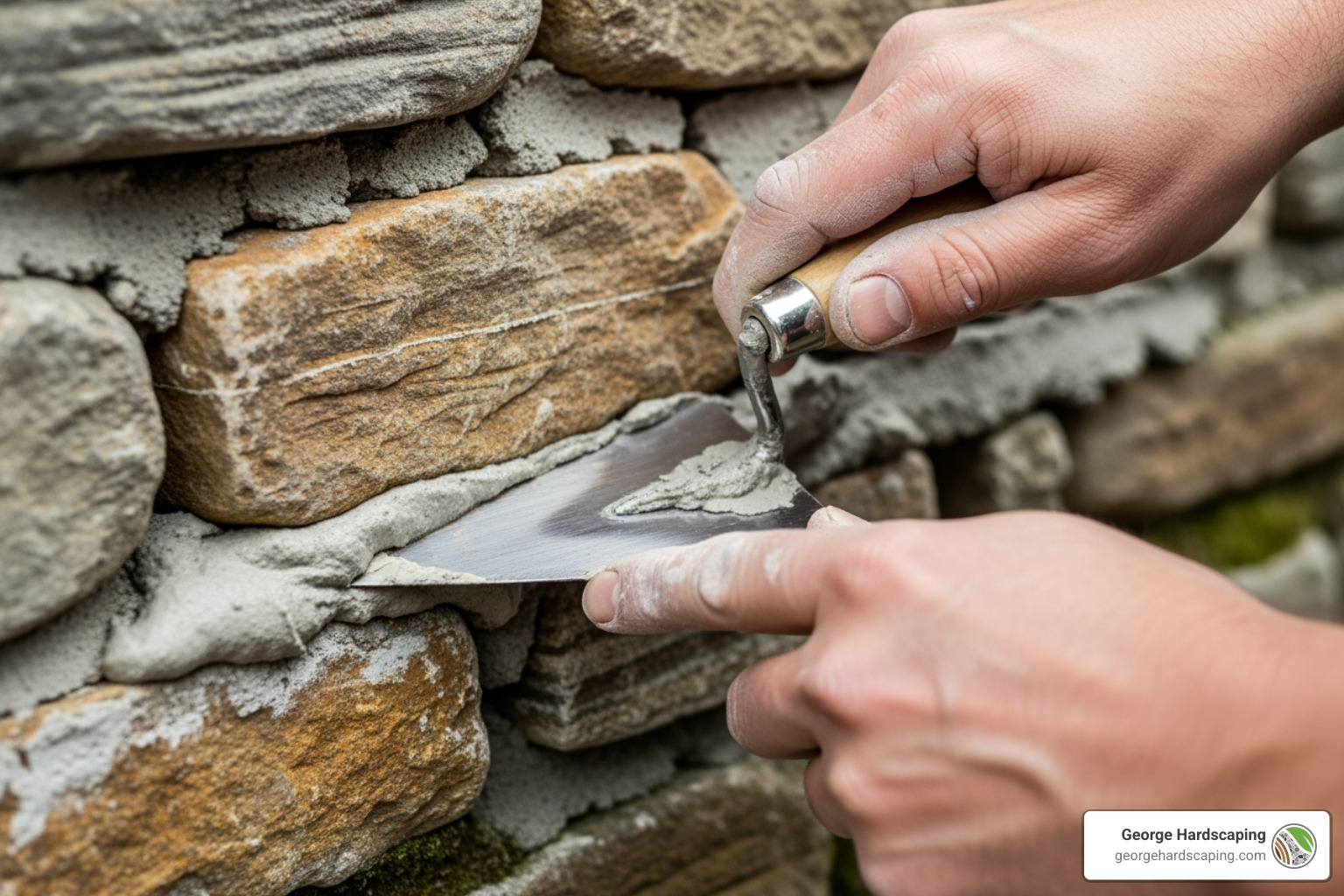
- Evaluate and Mark Scope: Carefully inspect the entire wall. Identify all cracked, hollow-sounding, or sandy joints. Tap gently along the joints with a hammer to locate hidden voids. Mark all areas needing repair with chalk or tape. Note any loose face stones or displaced capstones.
- Remove Deteriorated Mortar: Using a cold chisel, hammer, or a specialized raking tool, carefully remove the loose and deteriorated mortar. The goal is to achieve a clean, square-edged cut to a depth of at least 2 to 2.5 times the joint width (typically about 3/4 to 1 inch). This depth is critical for a strong mechanical bond. Avoid damaging the edges of the adjacent stone. Once removed, use a brush and a vacuum or compressed air to remove all dust and debris from the joint.
- Dampen the Substrate: Lightly mist the joints and stones with water so they are damp but not saturated. This is a crucial step known as ‘surface-saturated dry’ (SSD). It prevents the dry, porous stone from rapidly sucking the moisture out of the new mortar, which would result in a weak bond and a poor cure.
- Mix Compatible Mortar: For many general repairs, a standard blend of 6 parts clean masonry sand, 1 part Portland cement, and 1 part hydrated lime works well. Mix to a consistency of thick peanut butter that holds its shape on a trowel. On older or softer stone, consider a lime-rich or a Natural Hydraulic Lime (NHL) mortar as advised by preservation guidance. Always mix batches consistently and allow the mortar to ‘slake’ (rest) for 10-15 minutes before final mixing, per manufacturer recommendations.
- Reset Loose Stones: If stones need to be reset, apply a generous layer of mortar to the bed (bottom) and head (side) joints. Press the stone firmly into place, wiggling it slightly to ensure the fresh mortar fills all voids behind and under the stone. Use small stone shims or wooden wedges to hold the alignment perfectly while the mortar begins to set.
- Pack and Tool Joints: Using a pointing trowel, tightly pack the new mortar into the prepared joints in thin layers (lifts) of about 1/4 inch. Compacting the mortar in lifts is essential to eliminate voids and create a dense, water-resistant joint. Once the joint is full, allow the mortar to become ‘thumbprint hard.’ Then, use a jointing tool to strike the joint to match the existing profile (e.g., struck, flush, or slightly recessed). Tooling compacts the surface, making it more durable.
- Clean and Detail: While the mortar is still fresh but not fully hardened, use a soft brush to carefully sweep away any smears or excess mortar from the face of the stones. On sensitive or historic stone, avoid aggressive acid cleaners; use only mild, approved methods consistent with the stone type.
- Cure Properly: Proper curing is essential for strength. Protect the newly repaired areas from direct sun, strong wind, and freezing temperatures for at least 72 hours. Lightly mist the wall with water 2-3 times a day for the first 2-3 days to slow dehydration, which reduces shrinkage cracking and dramatically improves the final bond strength.
How to Repair a Dry-Stacked Stone Wall
Dry-laid walls are a masterful puzzle of gravity, friction, and careful interlock. The repair goals are to re-establish a solid base, create well-interlocked faces, ensure a well-compacted and free-draining core, and maintain a slight inward lean (batter) into the slope it retains.
- Document and Carefully Dismantle: Work methodically from the top down in the failed area. Take photos or use numbered chalk to mark key stones to aid in accurate reassembly. Set the stones aside in the order they were removed.
- Rebuild the Base: Excavate the failed section down to firm, undisturbed subgrade. For retaining walls, this is the time to add or improve the footing. Add a 6-8 inch layer of compacted gravel (e.g., 3/4-inch crushed angular stone) to create a solid, load-bearing base that also allows for drainage. Ensure this base is level and properly aligned.
- Establish Batter and Bond: Set the largest, flattest stones as your first course. As you build up, establish a slight inward batter (a common rule of thumb is a 1-inch setback for every foot of height on retaining applications). Critically, follow the ‘one-over-two’ and ‘two-over-one’ rule: each stone should span the joint between the two stones below it, and its center should be covered by a stone above it. This avoids long, weak vertical seams.
- Integrate Throughstones: These are the essential structural binders of a dry-stack wall. Every few feet along the length of the wall, and every couple of courses in height, you must insert long stones that span the full width of the wall, tying the two faces together. Without throughstones, the faces will eventually bulge and separate.
- Hearting and Core: As you build the faces, pack the central cavity tightly with smaller, angular ‘hearting’ stones. This is not a place to dispose of dirt or round river rocks. The angular stones lock together to create a solid, unified mass that prevents the face stones from shifting.
- Install Drainage: For any wall retaining soil, drainage is non-negotiable. Place a layer of washed, angular gravel (like the base material) directly behind the wall. At the base, install a perforated drainpipe (sleeve-wrapped to prevent clogging) set in the gravel, ensuring it has a positive slope to a safe outlet where water can ‘daylight’ away from the wall. A layer of geotextile fabric should be placed between the native soil and the gravel backfill to prevent silt from clogging the drainage system over time.
- Set the Capstones: Finish the wall with a course of large, heavy, overlapping capstones. These serve to shed water away from the core and add critical weight to lock the top course of stones firmly in place.
If your dry-laid wall is retaining soil, you must assume that drainage is a required component of the repair. The best stonework in the world cannot defy the laws of physics; it will fail against hydrostatic pressure without a clear path for water to escape. Our team routinely designs and installs these critical drainage elements as part of our work on Landscape Retaining Walls, ensuring your rebuilt section won’t be undone by the next wet New England winter.
Costs, Prevention, and Long-Term Maintenance
Budgeting for stone wall repair requires a clear understanding of the variables involved. Costs can fluctuate significantly based on the wall type, site access, extent of the damage, drainage requirements, stone sourcing, and whether professional engineering or permits are necessary. A crucial principle to remember is that investing early in a correct, comprehensive fix—especially one that addresses underlying drainage issues—almost always costs significantly less than waiting for a partial or total collapse.
Understanding the Costs of Stone Wall Repair
- DIY Repairs (Minor): For small-scale repointing or resetting a couple of stones, material costs are minimal, often running between $38 and $200 for a bag of mortar, some sand, and perhaps a masonry caulk. Your time, patience, and labor are the main investments.
- Professional Repairs (Moderate to Extensive): When you hire a mason for tasks like partial rebuilds or extensive repointing, costs typically range from $50 to $150 per square foot. The final price is influenced by the complexity of the work. A simple repointing job will be at the lower end, while a repair requiring careful dismantling and rebuilding of a bulging section will be at the higher end.
- Structural Rebuilds: Rebuilding long sections of a wall or an entire failed wall is a major construction project. Costs can easily reach $50,000 to $70,000 or more, particularly when extensive excavation, engineered drainage systems, and sourcing of specialty stone are involved. If you are weighing budget scenarios for a large retaining wall project, our detailed guide on the Cost of Repairing Retaining Wall can provide more specific insights.
Key Cost Drivers to Consider:
- Drainage: This is a major factor. Adding perforated drains, gravel backfill, geotextile fabric, and proper daylighting for the outlet is an essential investment for retaining walls that adds to the initial cost but is critical for longevity.
- Stone Availability and Matching: If the repair requires new stone, matching the type, color, size, and weathering of local fieldstone or antique granite capstones can add lead time and cost. Sourcing reclaimed stone is often more expensive than using new quarried material.
- Site Access and Protection: Difficult access, such as a backyard with no vehicle entry, steep slopes, or tight property lines, increases labor hours. The need to protect existing lawns, mature gardens, and driveways from heavy equipment also affects the overall project cost.
- Engineering and Permits: Walls over certain heights (typically four feet) or those in specific jurisdictions (e.g., near wetlands or property lines) may require stamped drawings from a structural engineer and formal building permits. These professional services and municipal fees are an added cost. Always check with local building officials. In Massachusetts, homeowners can also review state guidance on working with registered contractors to ensure compliance. General code resources are available via the ICC.
How to Prevent Future Damage
Proactive prevention is the most powerful tool for ensuring your wall’s longevity. Water control is the heart of this strategy.
- Master Surface and Sub-Surface Drainage: Ensure the ground grade slopes away from the top and bottom of the wall to prevent water from pooling. For retaining walls, a properly installed system of free-draining backfill, weep holes, and a perforated drainpipe daylighted to a proper outlet is not a luxury—it’s a necessity.
- Strategic Vegetation Management: Avoid planting large trees within a distance equal to their mature height from the wall, as their roots will eventually find and damage the foundation. Keep climbing vines and aggressive weeds off the wall’s faces and capstones, as they trap moisture and can work their way into joints.
- Implement Seasonal Care: In winter, avoid using deicing salts near stone and mortar, as they can accelerate deterioration; use sand for traction instead. In the spring and fall, clear accumulated leaf litter and debris from the wall’s top and base to prevent it from becoming a compost pile that holds moisture against the structure.
- Choose Breathable Protection: If you consider sealing a mortared wall, only use a high-quality, breathable, silane/siloxane water-repellent treatment designed for masonry. Never use plastic coatings, waterproof paints, or non-breathable films, as they trap moisture inside the wall, leading to catastrophic freeze-thaw damage.
For general best practices on managing water around landscapes and slopes, university extension resources provide excellent, science-based advice. See this helpful guidance on grading and slope stability from the University of Minnesota Extension.
Best Practices for Long-Term Maintenance
- Conduct an Annual Inspection: Every spring, after the ground has thawed, walk the length of your wall and inspect it closely. Look for new cracks, loose stones, shifting capstones, and any signs of water pooling or soil erosion at the base.
- Address Small Fixes Promptly: Don’t let small problems fester. Repoint small mortar cracks and reset a single loose stone immediately to prevent water from infiltrating the wall’s core and causing wider damage.
- Keep Drains and Weep Holes Clear: Ensure that all weep holes and the outlets for any sub-surface drains are free of leaves, soil, and debris so they can function as designed.
- Document Changes Over Time: Take a few photos of your wall from the same vantage points each year. This creates a visual record that can help you track subtle but significant changes, such as a slow increase in a bulge or lean.
If you prefer the peace of mind that comes with professional oversight, we offer seasonal checkups and maintenance repair services for clients across Essex County. Learn more about our comprehensive capabilities at Hardscaping & Masonry Services.
Frequently Asked Questions about Stone Wall Repair
What is the best mortar mix for a stone wall?
For most general-purpose repairs on modern stone walls, a Type N mortar mix is an excellent choice. A widely used recipe is a blend of 6 parts clean masonry sand, 1 part Portland cement, and 1 part hydrated lime. The addition of lime is crucial; it improves the mortar’s workability, flexibility, and breathability, helping it accommodate the natural seasonal expansion and contraction of the wall without cracking.
For structural retaining walls or below-grade applications, a stronger Type S mortar may be more appropriate. For historic walls (typically pre-1930s) built with soft stone, using a modern, hard mortar can cause irreparable damage to the stone itself. In these cases, a lime-rich mortar or a natural hydraulic lime (NHL) mortar is essential. Always consult the National Park Service’s repointing guidance for compatibility considerations on older structures.
Can I use concrete instead of mortar to repair my stone wall?
Absolutely not. This is a common and very damaging mistake. Concrete is a structural building material designed for high compressive strength; it is far more rigid and less vapor-permeable than appropriate masonry mortars. Using concrete to patch a stone wall traps moisture, which leads to severe freeze–thaw damage and spalling of the surrounding stone. Its rigidity means it will crack under the wall’s natural movement, and its different texture and color will create an ugly, mismatched patch. Always choose a compatible mortar that meets accepted standards (e.g., ASTM C270).
How can I match the color of the new mortar to my old wall?
Matching mortar color is an art that requires patience. The key is to mix small test batches and apply them to a discreet area of the wall. You can adjust the color by varying the proportion of white vs. gray Portland cement and by using different colored masonry sands. Masonry pigments are also available but should be used sparingly. It is critical to let the test patches cure for several days, as wet mortar looks much darker than its final, dry shade. A professional mason will have experience creating custom blends and can also match the texture and joint profile for a seamless repair.
When do I need a permit or an engineer for stone wall work?
Requirements vary by municipality, but a general rule of thumb is that any wall over four feet in height, or any wall that is retaining soil (a retaining wall), will likely require a building permit. For these taller or more critical walls, the local building department may also require plans stamped by a licensed structural engineer, especially if the wall is near a property line, supports a load (like a driveway or patio), or is on a steep slope.
Always consult your local building department before starting work. You can find general information on building codes from the International Code Council. When in doubt, ask us—we routinely coordinate with local officials to ensure all our projects are fully compliant. Explore our approach to engineered solutions at Landscape Retaining Walls.
What are the earliest warning signs of a failing retaining wall?
Be vigilant for subtle signs. The earliest warnings include: outward movement (leaning or bulging), the appearance of new horizontal cracks along the wall face, and tension cracks appearing in the soil at the top of the wall, a few feet back from the edge. Clogged weep holes, persistent wet spots, or efflorescence (white powdery stains) are also red flags, indicating that water is not draining properly and is building up dangerous hydrostatic pressure behind the wall. Early intervention—which often involves restoring or adding proper drainage—is the key to preventing a catastrophic failure.
What is the difference between repointing and rebuilding?
Repointing (or tuckpointing) is a maintenance procedure that involves carefully removing the deteriorated mortar from the joints of an otherwise stable wall and replacing it with new, compatible mortar. It addresses the ‘glue’ holding the stones together. Rebuilding, on the other hand, is a structural repair that involves dismantling a section of the wall (or the entire wall) and reconstructing it from the foundation up. Rebuilding is necessary when the wall has lost its structural integrity due to foundation failure, bulging, or collapse.
What is ‘batter’ and why is it important for a dry-stack wall?
‘Batter’ refers to the intentional, slight inward lean of a wall, from its base to its top. For a dry-stack retaining wall, batter is a critical design element. It uses gravity to its advantage, allowing the wall to lean back into the earth it is holding, which makes it significantly more stable and resistant to the outward pressure of the soil.
Is winter a bad time to repair stone walls in Massachusetts?
It depends on the scope of work. Any work involving fresh mortar should only be done when temperatures will remain consistently above 40°F for several days to allow for proper curing. However, other phases of a project, such as structural stabilization, drainage improvements, excavation, and the careful dismantling of a failed section, can often proceed in cold weather if planned correctly. We schedule seasonally sensitive tasks to protect the integrity of the work. If you have a winter wall emergency, we can recommend a phased approach to stabilize the site.
How long should a well-repaired wall last?
With proper drainage and the use of compatible materials, a professional repair can last for many decades. Dry-laid walls built with good foundations, proper batter, and sufficient throughstones often outlive mortared walls in wet climates because they drain freely by design. Mortared walls built with suitable mixes, well-tooled joints, and effective water management can also deliver exceptionally long service life.
What if I need drainage work along with masonry repairs?
Combining drainage upgrades with stone repairs is not only smart but often essential for a lasting solution. A wall that has failed due to water pressure will fail again if the drainage is not fixed. Our crews are experts at integrating these systems. We routinely install French drains, add weep holes, grade the surrounding landscape, and install proper backfill and outlet daylighting as a core part of the repair solution. Learn how this fits into broader project planning via our Hardscaping & Masonry Services and get started with a request for estimate.
Strong CTA: Protect your valuable property and avoid the high cost of a complete rebuild. Book a professional wall assessment now to understand your options. Request an estimate and get a clear plan, timeline, and budget from our experienced team.
Conclusion
Stone wall repair is about far more than just patching a few joints or replacing a fallen stone—it’s about preserving the unique character, structural function, and long-term value of your property for decades to come. In New England’s demanding climate, a successful and durable repair is built on three non-negotiable pillars: superior water management, the use of correct and compatible materials, and the application of time-tested construction techniques. By addressing small issues quickly, you can prevent major failures. By bringing in a professional when a wall leans, retains soil, or shows signs of foundation or drainage failure, you ensure the safety and stability of your landscape.
George Hardscaping proudly serves the communities of Essex County—from Beverly and Boxford to Manchester-by-the-Sea and Newburyport—with expert repairs that respect the history of your wall while delivering modern performance and durability. For critical structural work and retaining walls, our integrated approach to stonework and drainage engineering ensures that the investment you make in a repair today will hold strong through many New England winters.
Ready to act and restore the integrity of your stone wall? Get expert guidance and a no-obligation proposal from the local leaders in masonry. Request an estimate. To explore our related capabilities—from new retaining walls to custom patios and walkways—see our full suite of solutions at Hardscaping & Masonry Services.
