
Replacing Railroad Ties with Stone: Ultimate Guide 2025
Why Replacing Railroad Ties with Stone is Your Best Investment
Image metadata: Title: Stone retaining wall replacing railroad ties; Alt: stone retaining wall replacing railroad ties – replacing railroad ties with stone; Source: George Hardscaping; License: Used with permission; Caption: A natural stone wall replaces a failing railroad tie wall for a permanent upgrade.
Replacing railroad ties with stone transforms your failing retaining wall into a permanent, beautiful landscape feature that can last 50-100 years. You’re not just swapping materials—you’re eliminating a recurring liability, removing toxic creosote from your landscape, and establishing a structure engineered to handle New England’s freeze-thaw cycles and heavy storm events.
Key Benefits of Stone Over Railroad Ties:
- Durability: Stone walls last 50-100 years vs. 10-20 years for railroad ties
- Safety: No toxic creosote chemicals leaching into your soil
- Value: Significant increase in property value and buyer appeal
- Maintenance: Virtually maintenance-free once installed
- Appearance: Timeless, natural beauty that improves with age
Quick Project Overview:
- Remove old railroad ties and dispose properly
- Excavate and prepare foundation with drainage
- Install stone courses with proper techniques
- Backfill and finish with landscaping
If you’re a North Shore homeowner dealing with a rotting, bowing, or failing railroad tie wall, you’re not alone. These treated timber walls were popular decades ago, but they come with serious problems that only get worse over time. Railroad tie walls typically fail after 10-20 years due to rot and structural weakness. The creosote treatment also poses health risks and contaminates your soil.
A natural stone retaining wall offers the permanent solution you need. Stone walls withstand New England’s harsh freeze-thaw cycles, require virtually no maintenance, and add significant value to your Essex County property. While smaller walls can be DIY projects, those over 3 feet tall require professional installation to ensure structural integrity. Our retaining wall contractors design and build for longevity.
Ready to replace a failing tie wall with a permanent stone solution? Get a site assessment and clear plan. Request your free estimate.
Why this upgrade is especially smart in New England:
- Freeze-thaw resilience: Stone and proper drainage eliminate frost-heave issues
- Stormwater performance: Correct drainage reduces hydrostatic pressure
- Sustainability: Natural stone is inert and reusable
- Design flexibility: Natural stone makes curves, terraces, and integrated steps easy to execute beautifully
Explore our hardscaping and masonry services to see how walls can connect seamlessly to patios, walkways, and steps.
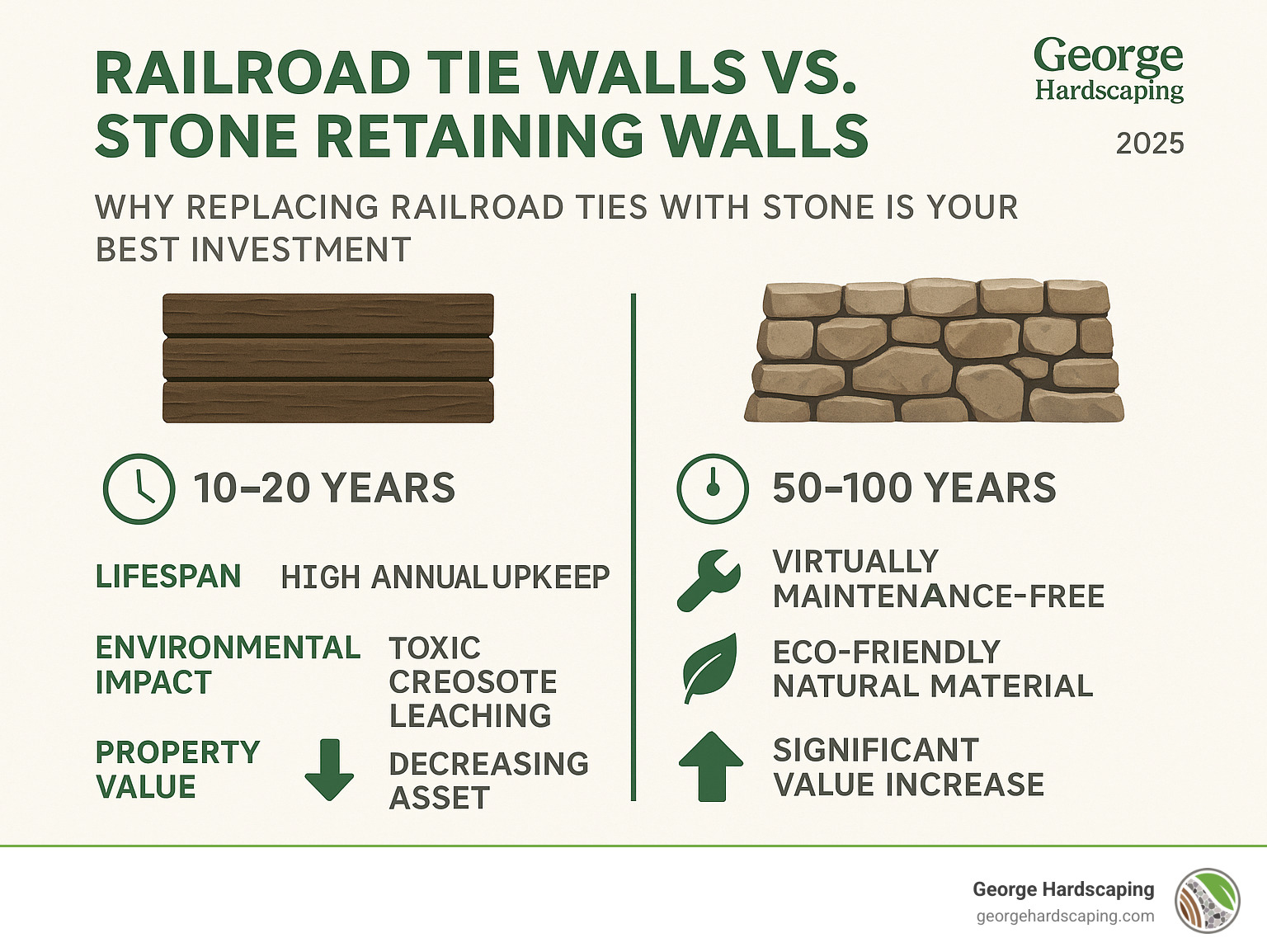
Image metadata: Title: Stone vs. Railroad Ties Comparison; Alt: Infographic comparing railroad tie walls versus stone retaining walls showing lifespan, maintenance, environmental impact, and value; Source: George Hardscaping; License: Created for George Hardscaping; Caption: Why stone walls outperform railroad ties across durability, safety, and value.
Why Your Railroad Tie Wall is a Ticking Time Bomb
Railroad ties were once a popular, affordable choice for retaining walls, but what seemed like a rustic landscape feature is often a ticking time bomb. Across Essex County, from Beverly to Newburyport, we see these walls degrade into crumbling hazards.
The problems are predictable. As an organic material, wood is vulnerable to nature. The most common issue is rotting wood, where moisture and fungi break down the fibers, turning ties soft and spongy. This decay leads to structural failure, causing walls to bow, warp, or even collapse under soil pressure. As the ties shift, gaps appear, leading to soil erosion and creating an inviting home for pests like termites, which can then threaten your home’s foundation.
The Hidden Dangers of Creosote
Beyond structural issues, railroad ties contain creosote, a toxic wood preservative derived from coal tar. The U.S. Environmental Protection Agency classifies creosote as a probable human carcinogen; learn more at the EPA’s overview of creosote. The Agency for Toxic Substances and Disease Registry also details human health effects in its Creosote ToxFAQ. These chemicals can leach into your soil, contaminating gardens and posing a risk to children and pets who play nearby.
Because of these toxins, old railroad ties are considered hazardous waste and require special disposal. They cannot be thrown in the regular trash or burned. Proper disposal must follow state guidelines to protect the environment, a step we handle in compliance with all Massachusetts hazardous waste management regulations.
Telltale Signs Your Wall Needs Immediate Replacement
Knowing when to replace your wall is key to preventing property damage or injury. Look for these warning signs:
- Visible rot: wood that is soft, crumbly, or discolored
- Splintering ties: wood breaking apart easily
- Leaning or bulging: any section pushing outward
- Gaps between ties: spaces opening up as the wall shifts
- Soil washing through: debris accumulating at the base
- Fungal growth: mushrooms or mold growing on ties
- Rusting fasteners: visible corrosion indicating moisture
- Drainage failure: pooling water behind or at the base
If you see any of these signs, it’s time to consider a permanent replacement. Our experienced retaining wall contractors can assess your wall’s condition and outline a safe, code-compliant path forward. Before any replacement work begins, always contact utility locating services—New England homeowners can use Dig Safe to mark underground lines and ensure safe excavation.
Choosing Your Upgrade: Why Natural Stone is the Superior Solution
When you’re replacing railroad ties with stone, you’re not just fixing a problem—you’re making a permanent investment in your property’s beauty and value. While the upfront cost of stone is higher than timber, the long-term benefits make it the clear winner.
Here’s how the two materials compare:
| Feature | Natural Stone | Treated Timber (Railroad Ties) |
|---|---|---|
| Lifespan | 50-100+ years | 10-20 years |
| Aesthetics | Timeless beauty, improves with age | Rustic look that degrades over time |
| Maintenance | Virtually maintenance-free | Requires ongoing repairs and replacement |
| Environmental Impact | Natural, inert, eco-friendly | Leaches toxic creosote into soil |
| Property Value | Significant value increase | A depreciating liability |
The Best Advantages of a Natural Stone Wall
Natural stone offers benefits that no other material can match:
- Extreme durability: Stone is impervious to rot, pests, and New England’s freeze-thaw cycles
- Timeless aesthetic: Classic beauty that never goes out of style
- Increased property value: Quality stonework is a major selling point
- Unique character: No two stone walls are identical
- Design flexibility: Stone can form curves, terraces, planters, and integrated steps
See how we blend walls and access with stone steps and stairs.
Natural Stone vs. Other Modern Options
Homeowners sometimes compare natural stone with segmental retaining wall (SRW) blocks or poured concrete. The National Concrete Masonry Association explains SRW performance in its resource on segmental retaining walls. While these options have their place, natural stone remains the top choice when you want a structural feature that is both enduring and authentically beautiful, especially in historic North Shore neighborhoods.
What are the best types of stone for retaining walls?
New England offers a fantastic selection of local stone:
- Fieldstone: Gathered from local fields, offering a classic, rustic New England look
- Granite: Incredibly dense and strong, ideal for maximum strength requirements
- Limestone: Typically cream or light gray, offering a clean, refined appearance
- Flat vs. rounded stones: Flat stones are easier to stack and create more stable walls
Matching Material to Your Site:
- Soil conditions: Clay-rich soils exert more lateral pressure
- Slope and load: Steeper grades require engineered details
- Aesthetic context: Historic homes benefit from fieldstone or split granite
Not sure which stone is right? Our team blends structural engineering with artisan stonework. Explore our hardscaping and masonry services and discuss options with a retaining wall contractor.
Dry-stack vs. mortared stone:
- Dry-stack: Relies on interlocking stones and gravity, excellent for drainage
- Mortared: Uses mortar for a formal look, requires weep holes for drainage
The Complete Guide to Replacing Railroad Ties with Stone
Replacing a railroad tie wall with stone is a major construction project that requires careful planning and execution. While it may look like simple stacking, the process involves excavation, drainage engineering, and skilled stonework.
Project Planning
Before starting, proper preparation is key:
- Safety first: Always wear heavy-duty gloves, safety glasses, and steel-toed boots
- DIY vs. professional: Small walls under three feet can be DIY; taller walls require professional expertise
- Local building codes: Most Essex County towns require permits for walls over four feet. Check the State Building Code (780 CMR)
- Call 811: Before any digging, use Dig Safe to mark utilities
Step 1: Demolition and Site Preparation
Old railroad ties are heavy and waterlogged. We remove ties from the top down, carefully shoring up soil to prevent collapse. The creosote-treated ties are transported to an approved facility for proper disposal.
Next, we excavate a trench for the new wall’s foundation. The trench must be wide enough for the base course and drainage column. We install and compact a gravel base in thin lifts until level and rock-solid.
Step 2: Building a Rock-Solid Foundation and Drainage System
Water pressure is the number one enemy of retaining walls. A robust drainage system is essential:
- Compacted gravel base: Creates a stable platform that distributes weight
- Geotextile fabric: Separates drainage stone from soil
- Perforated drain pipe: 4-inch pipe sloped to outlet channels water away
- Clean drainage stone: Allows water to flow freely to the drain pipe
- Daylighted outlets: Direct water safely away from the structure
Step 3: Laying the Stone for Your New Retaining Wall
This is where artistry meets engineering. We begin by sorting stones, selecting the largest, flattest ones for the base. The first course is set partially below grade on the compacted foundation. From there, we build upward, staggering all vertical joints to create an interlocking structure.
We build with a slight backward lean (1 inch per foot of height) which uses gravity to help resist soil pressure. As the wall gains height, we continue backfilling with drainage stone.
Additional engineering for taller walls:
- Geogrid reinforcement: For walls over 4 feet
- Terracing: Splits tall walls to reduce loads
- Surcharges: Driveways or slopes require engineering adjustments
If your property has a slope, we often integrate stone steps and stairs into the wall design for comfortable, code-compliant access.
When we sign off on a wall, it’s because the hidden components—base, backfill, drainage—were executed to last. For walls requiring engineered design, our retaining wall contractor team manages the entire process, including permitting and inspections.
Cost, Longevity, and Maintaining Your Investment
When replacing railroad ties with stone, the upfront cost is higher, but the long-term value is undeniable. A railroad tie wall needs replacement every 10-20 years. A stone wall is a one-time investment that lasts 50-100 years or more.
A Breakdown of Costs
The final cost depends on several factors. While online averages range from $25 to $75+ per square foot, every project is unique:
- Stone type: Locally sourced fieldstone is often more affordable than premium granite
- Labor: Typically accounts for 50-70% of the cost
- Site access: Difficult sites increase labor costs
- Drainage and foundation: Critical components adding 15-20% to budget
- Disposal fees: Required cost for creosote-treated ties
- Engineering and permits: Required for taller walls
Illustrative examples:
- 2.5-foot garden wall, 30 linear feet: Lower price range
- 4-foot structural wall, 60 linear feet: Mid to upper range
- 6-foot terraced system with steps: Upper range
Understanding ROI
Unlike timber walls that decay, a well-built stone wall becomes part of the property’s long-term value. Home buyers put a premium on professional masonry. For context on exterior improvements, see Remodeling Magazine’s Cost vs. Value.
Project timeline:
- Planning and design: 1-3 weeks
- Demolition: 1-3 days
- Excavation and drainage: 1-4 days
- Wall construction: Several days to weeks
- Final cleanup: Same day
Best Practices for a Wall That Lasts a Lifetime
One of the best features of a stone wall is its minimal maintenance. Unlike timber, it requires no sealing, staining, or pest control. For walls over four feet, we often add geogrid reinforcement for maximum stability.
Simple annual checklist:
- Check drainage outlets each spring
- Inspect for shifting or settling
- Manage water flow from gutters
- Keep deep-rooted shrubs back from wall
If you’re ready to budget and schedule, our team provides transparent pricing and clear build schedules. Explore our hardscaping and masonry services and book a site visit.
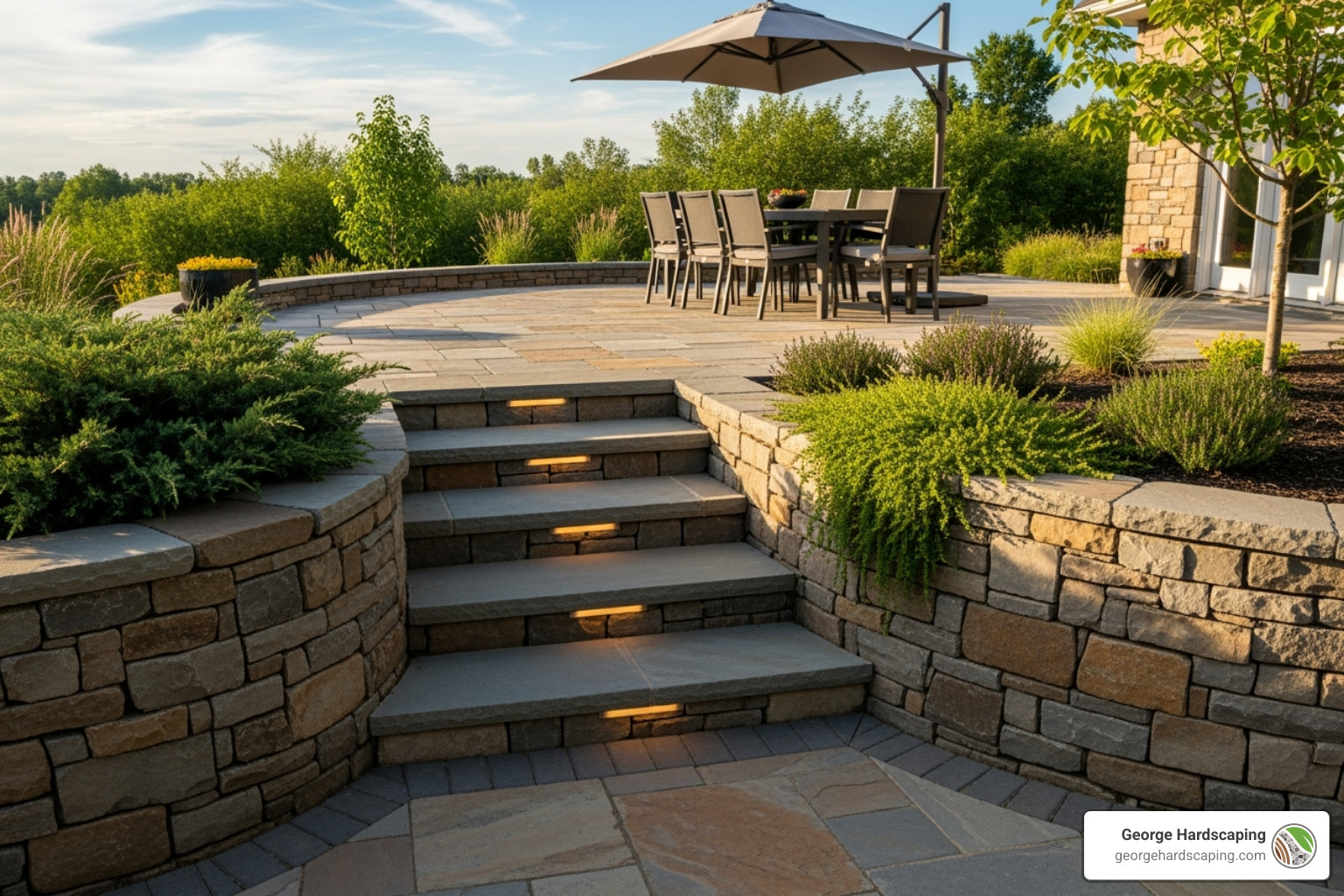
Image metadata: Title: Finished natural stone retaining wall with steps; Alt: Beautifully finished natural stone retaining wall with integrated landscaping and steps leading to a spacious patio; Source: George Hardscaping; License: Used with permission; Caption: Integrated steps and a drainage-first build deliver beauty and performance.
Pro Tip: When comparing quotes, ensure each proposal specifies the same essentials—base depth, drainage details, and cap specifications.
Ready for a permanent, low-maintenance wall that pays you back every year? Request your free estimate today.
Frequently Asked Questions about Replacing Retaining Walls
Homeowners across the North Shore often have similar questions when considering replacing railroad ties with stone.
How long does a stone retaining wall last compared to railroad ties?
A properly built stone retaining wall can last 50 to 100 years or more. In contrast, railroad tie walls have a lifespan of only 10-20 years before they begin to rot, warp, and fail. The longevity of stone makes it a far superior long-term investment.
Do I need a permit to replace my retaining wall in Essex County, MA?
Most likely, yes, if the wall is tall. In many Massachusetts towns, any retaining wall over four feet in height requires a building permit and often an engineered design. Check your municipality and refer to the State Building Code (780 CMR). We coordinate with local officials as part of our retaining wall contractor service.
Can I build a stone retaining wall myself?
It depends on the scale. A small garden wall under three feet can be a DIY project. However, any wall over three feet tall or retaining significant load should be built by a professional. If you’re unsure, consult the pros at George Hardscaping.
How do you dispose of old railroad ties?
We remove them in sections and transport to licensed facilities. Because creosote is hazardous, disposal must follow state rules. Learn more at Massachusetts hazardous waste management.
What’s the difference between dry-stack and mortared stone walls?
- Dry-stack walls rely on interlocking stones and allow natural drainage
- Mortared walls use mortar for a tighter face and require designed drainage
Both methods can be engineered for long life; the choice depends on design goals.
Do stone walls need footings below the frost line?
Unlike poured concrete, gravity stone walls are typically built on a wide, compacted crushed-stone base that drains—preventing frost heave. The goal is a stable, well-drained foundation.
How do you handle water behind the wall?
We install a graded base, geotextile separator, vertical drainage column, and perforated pipe that slopes to daylight. Managing water is the most important factor in wall longevity.
Can you integrate steps, lighting, or planters?
Absolutely. We often pair walls with stone steps and stairs, low-voltage lighting, and planted terraces.
What about building near utilities or property lines?
Before digging, call Dig Safe so lines are marked. Property line setbacks vary by town; we confirm local requirements before design.
How much maintenance is required?
Very little. Each spring, confirm outlets are clear and check for unusual settlement. With proper construction, stone walls are largely maintenance-free.
How soon can you start?
Most projects move from estimate to install within seasonal scheduling. Small replacements take about a week; larger walls may take two to three weeks. We provide a clear schedule in your proposal.
What’s the best way to get started?
Book a site visit so we can evaluate your existing wall. You’ll receive a written plan and transparent estimate. Use our simple form to request your estimate.
Transform Your North Shore Landscape with a Lasting Stone Wall
Replacing railroad ties with stone is more than a repair; it’s a permanent upgrade to your property. You’ll trade a deteriorating, toxic liability for a beautiful, structurally sound feature that adds significant value and curb appeal. No more worrying about rot or collapse—just decades of timeless beauty that improves your home and landscape.
A professionally built stone wall is an investment in quality, safety, and peace of mind. At George Hardscaping, our expertise in masonry and deep knowledge of North Shore landscapes ensure your project is built to last. We serve communities throughout Essex County, from Marblehead to Hamilton, delivering expert craftsmanship that stands the test of time. From first assessment to final cleanup, we handle demolition, hazardous tie disposal, permitting, drainage engineering, stone selection, and artisan installation. Explore our full range of hardscaping and masonry services and get inspired by the possibilities.
Strong final CTA: Ready to replace creosote-soaked ties with a beautiful, permanent stone wall? Get a clear plan, a fair price, and a guaranteed schedule. Request your free, no-obligation estimate today, and let our retaining wall contractors build it right the first time.
