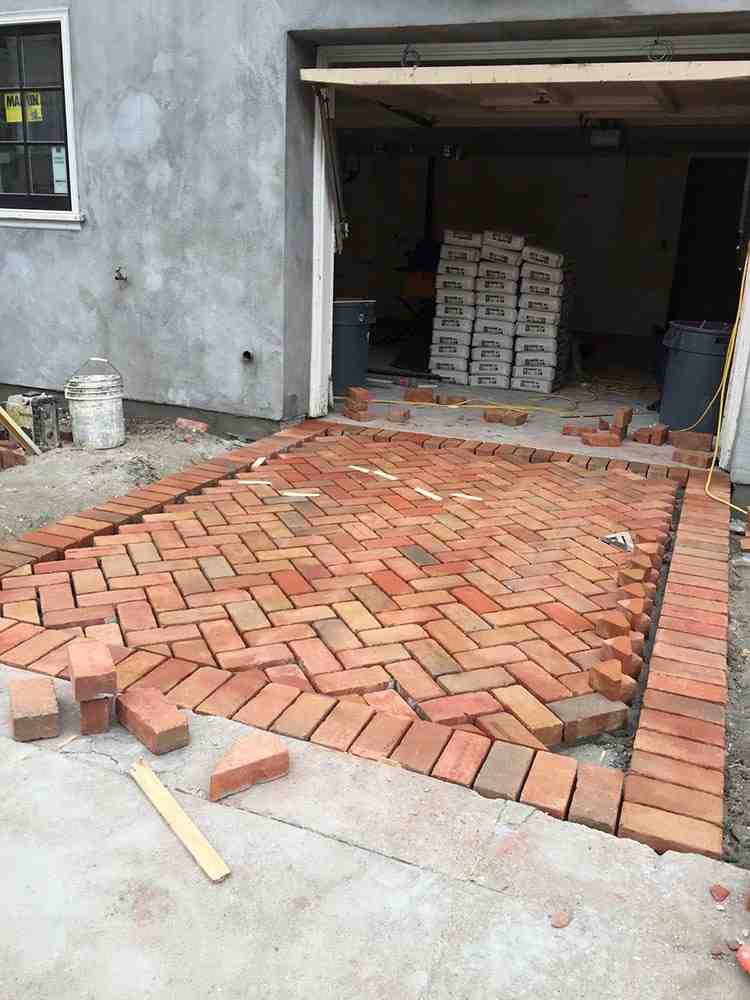
Paver Driveway Contractor: #1 Elite & Perfect
Your Guide to a Lasting First Impression
A Paver Driveway Contractor does more than just lay stones; they craft the grand entrance to your home, changing a purely functional space into a statement of elegance and quality. This first impression sets the tone for your entire property, creating a durable and beautiful surface that can last for decades with the right professional installation. Your driveway is the first thing guests see when they arrive and the last thing they see when they leave. It is more than just a place to park—it is a critical component of your home’s curb appeal and a reflection of your attention to detail.
While standard asphalt and concrete driveways serve a basic purpose, they cannot compete with the superior combination of durability, easy repairability, and timeless beauty that pavers offer. Many homeowners wonder, are driveway pavers a good investment? The answer is yes, especially when you consider their longevity, safety, and aesthetic value.
Choosing the right contractor is the single most important decision you will make in this process. A beautiful paver driveway’s lifespan of 25 to 50 years is not guaranteed by the materials alone; it is earned through expert craftsmanship. Here are key factors to consider when hiring a professional:
- Experience and Credentials: A proven track record is essential. Look for a contractor with extensive, dedicated hardscaping experience. Verify they hold all necessary state and local licenses, carry comprehensive liability insurance to protect your property, and possess certifications from respected industry organizations.
- Portfolio and Local Reviews: A picture is worth a thousand words. Ask to see an extensive portfolio of completed paver driveway projects, specifically in your local area. Check online reviews and ask for testimonials from past clients in your town to gauge their reputation for quality and professionalism.
- Meticulous Installation Process: A top-tier contractor will be transparent about their methods. They should follow a strict paver driveway installation process that includes a robust aggregate base, proper drainage engineering, high-quality materials, and a solid warranty on both labor and materials.
- Transparent and Detailed Pricing: You should receive a detailed, written estimate that clearly breaks down the driveway pavers cost, itemizing materials, labor, equipment, and the project timeline. This transparency helps prevent surprise fees and ensures you know exactly what you are paying for.
- Local Climate Expertise: For homeowners in Essex County and the North Shore, this is critical. Harsh New England winters, with relentless freeze-thaw cycles and heavy salt use, can destroy a poorly installed driveway in just a few seasons. A local contractor understands how to build a foundation that can withstand these extreme temperature swings without sinking, shifting, or cracking.
This guide will walk you through the essentials of hiring a Paver Driveway Contractor. From understanding why pavers outperform other materials to asking the right questions during a consultation and recognizing the hallmarks of expert craftsmanship, you will gain the confidence to choose a partner who can deliver a driveway that looks stunning and is built to last.
Why a Paver Driveway is a Superior Investment
When planning a new driveway for your home in Essex County or the North Shore, you are typically faced with a few primary options: asphalt, poured concrete, or interlocking pavers. While asphalt and concrete are common, paver driveways consistently prove to be the superior long-term investment, particularly in the challenging New England climate.
The fundamental difference lies in structure. Asphalt and concrete are rigid, monolithic slabs that are highly susceptible to cracking under the immense pressure of ground movement caused by intense freeze-thaw cycles. When moisture seeps into the ground, freezes, and expands, it puts upward pressure on the slab, leading to the spiderweb cracks and heaving that plague many driveways in the region.
Paver driveways, by contrast, are a flexible system of individual, interlocking units. This flexibility allows the driveway to move and shift subtly with the ground, absorbing pressure without breaking. This helps prevent the widespread, unsightly cracking that is common with rigid surfaces.
Beyond their resilience to weather, pavers offer excellent repairability. If a few pavers become stained by oil or damaged by a heavy impact, they can be individually lifted and replaced, restoring the driveway’s original look. This is very different from concrete or asphalt, where repairs often mean patches that never quite match or expensive replacement of larger sections.
Pavers also require less ongoing maintenance than asphalt, which needs to be seal-coated regularly to protect it from oxidation and water damage. The textured surface of many paver styles offers improved safety by providing better traction for both vehicles and pedestrians, especially in wet or icy conditions, which is a major benefit during long winters.
Best Durability and Weather Resistance
The strength and durability of a paver driveway comes from the interlocking system. When installed correctly over a properly compacted base, the individual pavers work together to distribute the weight of heavy vehicles evenly across a wide area. This helps prevent rutting, sinking, or shifting, even under the daily stress of SUVs and trucks.
For homeowners in Beverly, Boxford, Danvers, and across the North Shore, this translates to a driveway that is engineered to last, resisting not only the wear and tear of daily use but also the corrosive effects of road salt used throughout winter.
The New England climate, with its dramatic temperature swings and deep frosts, is a true test for any exterior surface. Where concrete and asphalt are likely to crack under this relentless stress, paver driveways are designed to flex and adapt. This structural resilience reduces internal stresses that can cause failure in rigid materials, helping the driveway remain intact, functional, and attractive for decades. In many cases, a professionally installed paver driveway can be expected to perform well for 25 to 50 years.
To see how similar principles of longevity are applied across patios, walkways, and outdoor living spaces, explore George Hardscaping’s durable hardscaping and masonry services.
The Beauty of Endless Customization
Another reason to choose a paver driveway is the design freedom it offers. Unlike the uniform gray of concrete or the plain black of asphalt, pavers provide many options for color, shape, and texture.
You can choose from a wide range of styles to complement your home’s architecture and surrounding landscape. Popular paver patterns include:
- Herringbone: A dynamic, interlocking pattern that is strong and visually interesting.
- Basket Weave: Creates a textured look reminiscent of classic European courtyards.
- Running Bond: A simple, linear pattern that creates a sense of length and flow, ideal for long driveways.
- Circular Kits: Often used as a central feature or accent, creating a focal point for the design.
The design can be further improved by incorporating contrasting borders, decorative aprons where the driveway meets the street, or inlays and mosaics to create a unique entrance that boosts curb appeal. Whether you prefer the rustic character of cobblestone or a sleek, modern layout, pavers provide the tools to bring that vision to life.
You can explore real-world examples of different colors, patterns, and layouts in George Hardscaping’s gallery of custom designs.
Exploring Your Paver Options: Materials and Designs
The versatility of paver driveways extends beyond patterns and colors to the materials from which they are made. Each type of paver offers a different combination of aesthetics, durability, performance, and cost, allowing you to tailor the right solution for your home in Ipswich, Lynnfield, Marblehead, or any neighboring North Shore community.
From the engineered consistency of concrete pavers to the timeless beauty of natural stone, understanding your options is the first step toward creating your ideal driveway. For more design ideas, you can explore custom paver walkway and stair projects that show how different materials perform in real outdoor spaces.
Concrete, Brick, or Natural Stone?
Choosing the right material balances appearance, performance, and budget. A professional Paver Driveway Contractor can help explain the pros and cons of each.
- Concrete Pavers: These are the most widely used pavers for driveways. Manufactured under controlled conditions, they are dense, strong, and uniform. They are available in many shapes, sizes, colors, and textures, and can mimic the appearance of natural stone or traditional brick. Their durability and color retention make them a practical option for many homeowners.
- Brick Pavers: For a classic look, clay brick pavers are a strong choice. Made from fired clay, their rich tones and traditional rectangular shape offer a timeless style. Brick is typically more expensive than standard concrete pavers but is very durable and maintains its color.
- Natural Stone Pavers: For a premium, one-of-a-kind appearance, natural stone stands out. Granite, bluestone, and flagstone each offer unique colors and textures. These materials are often used when a high-end, custom look is the priority. Cobblestone, a traditional form of natural stone paver, provides an old-world feel while handling heavy loads and weather extremely well.
For homeowners who want deeper technical details about manufactured concrete products, material standards and best practices are available from the National Concrete Masonry Association.
Permeable pavers are another option some homeowners consider when they are focused on stormwater management. These systems are designed so water can drain through the joints, reducing runoff and helping with on-site drainage. A contractor familiar with local conditions can explain whether a permeable system makes sense for your specific property.
Designing Your Driveway: From Basic to Breathtaking
Your driveway layout should support daily use and contribute to the overall style of your property. A thoughtful design considers how many vehicles you need to accommodate, how you enter and exit the property, and how the driveway connects to walkways, steps, and outdoor living areas.
Common layout options include:
- Classic Straight Design: A direct path from the road to the garage. This straightforward design can be personalized with contrasting borders, a decorative apron, or a carefully chosen paver pattern.
- Graceful Circular Driveways: Best suited to larger lots, circular and semi-circular driveways create a grand, welcoming entrance. They allow easier entry and exit without backing up and serve as a focal point for front yard landscaping.
- Courtyard Style Driveways: This layout creates a broad paved area in front of the home or garage, providing ample parking and a sophisticated turnaround space. A courtyard-style driveway can double as an outdoor gathering area.
The most attractive driveway designs are coordinated with surrounding landscaping and hardscaping. George Hardscaping often ties new driveway projects into custom outdoor firepits, walkways, and patios to create a cohesive outdoor space. Integrating lighting, planting beds, and seating areas can help the driveway feel like a natural part of the overall landscape rather than an isolated feature.
The Blueprint for Durability: A Paver Installation Guide
A paver driveway is only as strong as the foundation beneath it. That is why professional installation, carried out with attention to detail and in line with industry standards and manufacturer specifications, is essential. Although a finished paver surface may look like a simple pattern, the process behind it involves excavation, grading, base construction, and drainage planning. For most homeowners, this is not a suitable DIY project.
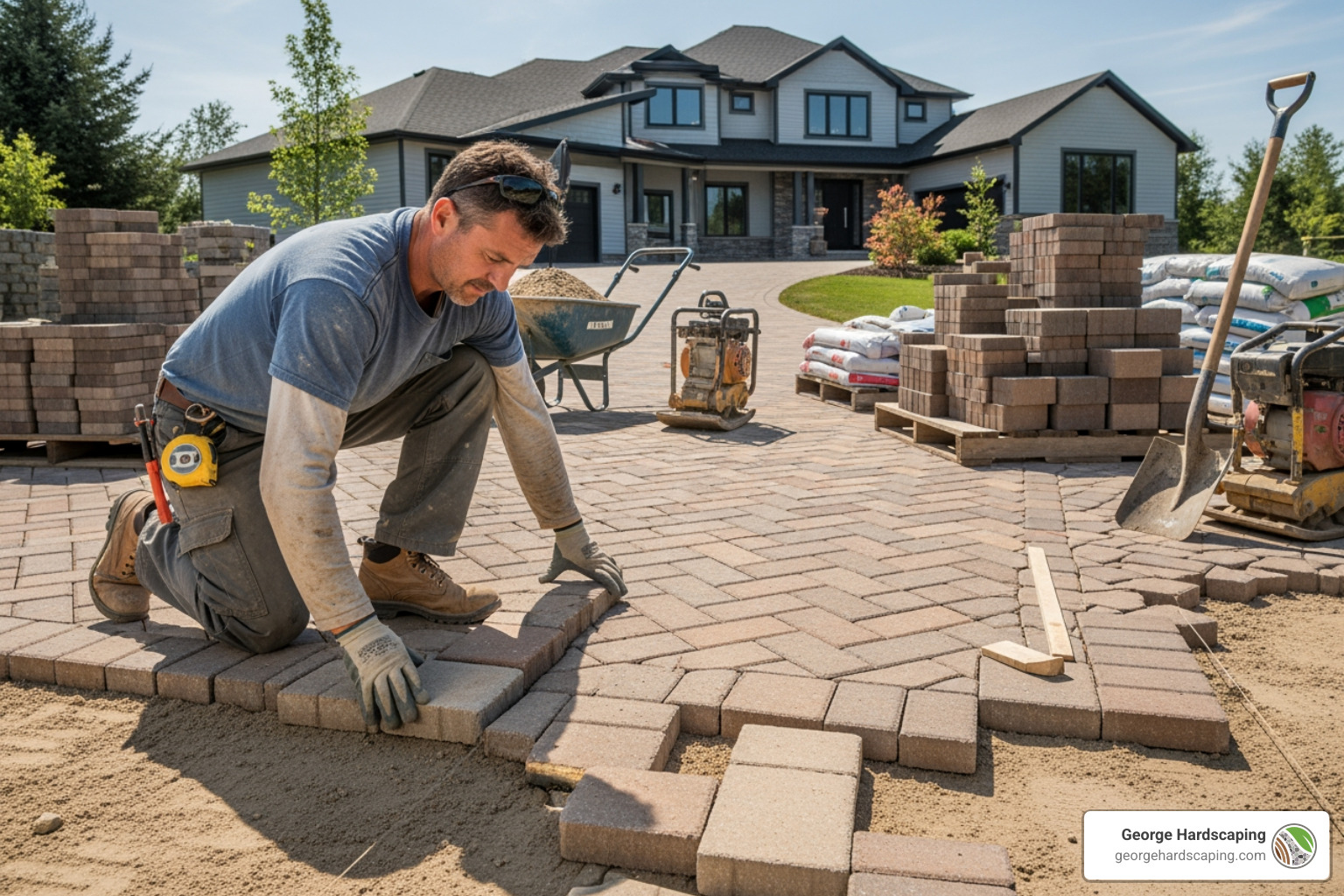
The Critical Role of Base Preparation and Drainage
Base preparation is the most important stage of a paver driveway installation, especially in communities such as Essex, Georgetown, and Gloucester, where soil conditions and weather demand robust solutions.
The process typically begins with excavation to remove the existing driveway and any unsuitable sub-base materials. Contractors often excavate deep enough to remove topsoil and reach stable sub-grade soil. This sub-grade is then graded for proper water flow and compacted with heavy equipment to create a stable platform.
Next, a geotextile fabric is installed. This layer acts as a separator, preventing the crushed stone base from mixing with the underlying soil over time, which can otherwise cause sinking and settlement.
On top of the fabric, a thick base of crushed aggregate stone is placed. For driveways, at least several inches of compacted aggregate is standard, and more may be used depending on soil conditions and expected traffic. The stone is installed in layers, and each layer is compacted thoroughly. This compacted base is what supports the pavers and helps the driveway withstand vehicle loads and freeze-thaw cycles.
Proper grading is built into every layer so that water flows away from your home’s foundation and garage. In many cases, grading alone is not enough, so additional drainage solutions are integrated when needed:
- Trench Drains: Long, narrow drains with grates that are used to intercept and move surface water away from garage doors or broad paved areas.
- Swales: Gently sloped, vegetated channels that guide water away from the driveway and into appropriate drainage areas.
- French Drains: Perforated pipes placed in gravel-filled trenches to capture and redirect subsurface water, reducing pressure under the driveway.
These methods help control water, reducing the risk of pooling, erosion, and damage to the driveway structure. Similar drainage and base concepts are used when George Hardscaping designs landscape retaining walls to manage slopes and stabilize soil.
From Laying Pavers to Final Touches
Once the base is properly prepared and compacted, the crew moves on to setting the pavers. A thin, uniform bedding layer of coarse sand is spread over the base and carefully screeded to create a smooth surface.
Pavers are then placed by hand according to the selected pattern, with care taken to keep joints tight and consistent. Edge restraints made from plastic, concrete, or other durable materials are installed around the perimeter and secured to hold the pavers in place and prevent movement over time.
After all pavers are set, the surface is compacted with a plate compactor. This step seats the pavers into the bedding sand and improves the interlock between units. Once compacted, jointing sand, most often polymeric sand, is swept into the joints. After a light mist of water, polymeric sand cures to form a firm, yet flexible joint that locks the pavers together and helps deter weeds and insects.
A final clean-up and inspection follow to confirm that the surface is even, properly graded, and visually consistent. In some cases, a breathable sealant is applied after curing to deepen color and provide additional stain resistance.
Finding the Right Paver Driveway Contractor for Your Project
Choosing the right Paver Driveway Contractor is the most important step in ensuring the success and longevity of your new driveway. In Essex County and the North Shore, local soil conditions, winter weather, and municipal requirements present specific challenges. Working with a seasoned local contractor such as George Hardscaping can make the process smoother and help ensure the finished driveway performs as intended.
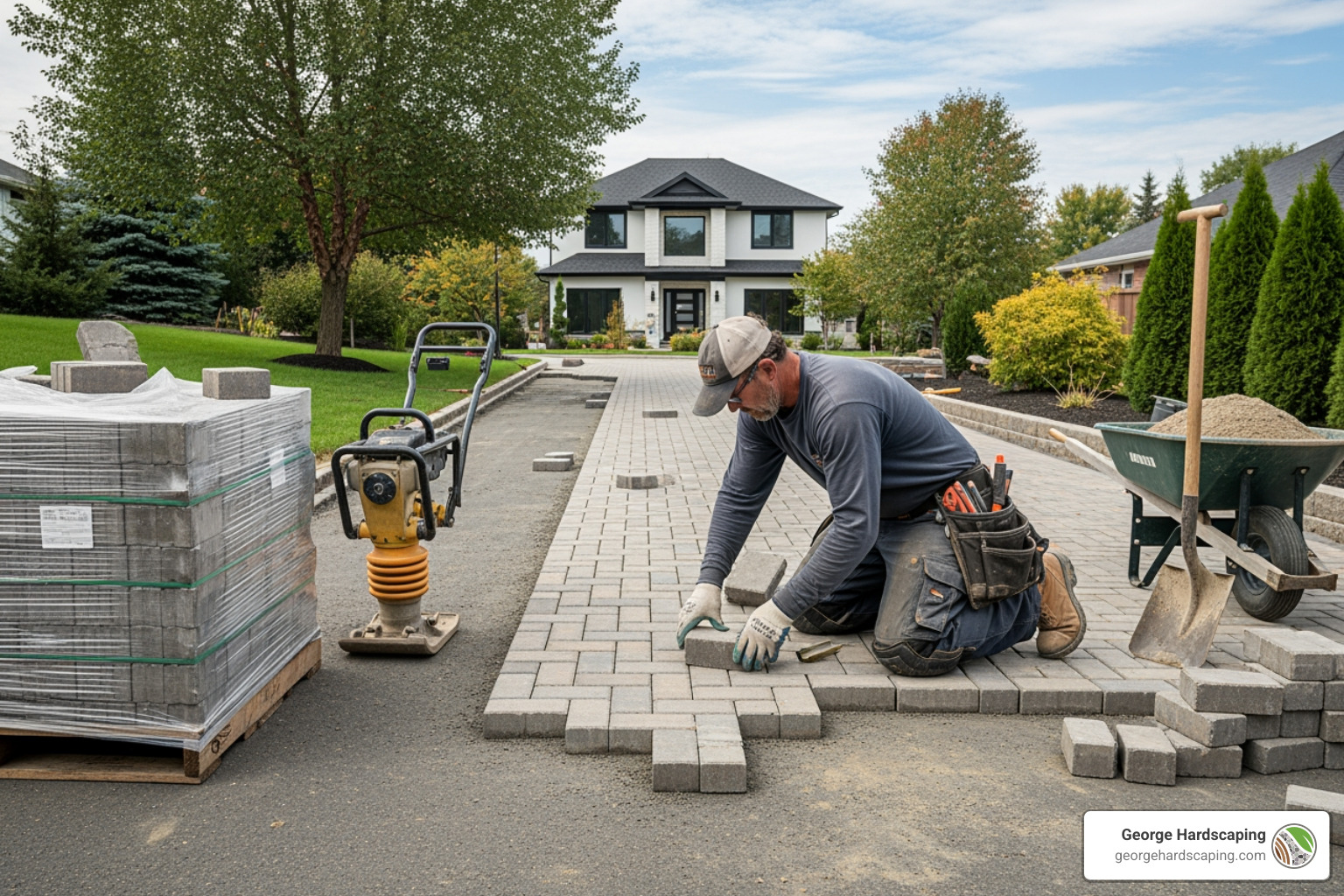
What to Look for in a Paver Driveway Contractor
When comparing contractors, it is important to look beyond the lowest estimate. Focus on credentials, experience, and proven results.
- Years of Dedicated Experience: Contractors with many years of specialized hardscaping experience are more likely to understand best practices and how to handle challenging site conditions.
- Proper Licensing and Insurance: Always confirm that the contractor is licensed to work in your town and carries both general liability and workers’ compensation insurance. This protects you if an accident or property damage occurs during the project.
- Portfolio of Local Work: Ask to see examples of completed paver driveways in nearby communities such as Newburyport, North Reading, or Peabody. A strong portfolio shows the contractor’s capabilities, style range, and familiarity with local properties.
- Customer Testimonials and References: Read online reviews from homeowners in the area and request references you can contact directly. Speaking with past clients is a useful way to learn about communication, cleanliness, and how well the driveway has held up.
- Industry Certifications: Certifications from organizations such as the Interlocking Concrete Pavement Institute show that the contractor has invested in professional training and follows recognized installation standards.
- A Clear Written Contract: A reputable contractor will present a written contract detailing the scope of work, specific materials, base depth, drainage approach, payment schedule, and timeline.
Questions to Ask Your Potential Paver Driveway Contractor
Good communication at the start of the project sets expectations and helps you compare proposals fairly. Consider asking:
- “What type of warranty do you offer on your workmanship, and what is the manufacturer’s warranty on the pavers?”
- “What is your estimated project timeline from start to finish, and how are weather delays handled?”
- “What depth of compacted base do you install for driveways in this area, and how do you adjust for soil conditions?”
- “Which paver materials and brands do you recommend for my property, and why?”
- “What is your team’s experience specifically with paver driveway installations?”
- “Who will be my main point of contact during the project, and will there be a dedicated on-site project lead?”
- “How do you protect existing lawn areas, plantings, and nearby hardscaping during construction?”
- “What does your cleanup process include once the project is complete?”
- “How are payments structured throughout the project?”
These questions will help you identify a contractor who is organized, transparent, and confident in their process. When you are ready to speak with a local specialist, you can request a free estimate from George Hardscaping and discuss design ideas, budget, and scheduling in more detail.
Cost, Lifespan, and Common Issues
Understanding cost and long-term performance will help you make an informed decision about a paver driveway. General online data suggests that average costs for paver driveways can range from a few thousand dollars for small, basic installations to significantly more for large, intricate designs with premium materials. These figures are broad industry ranges, not specific quotes.
The actual cost for your driveway in Rockport, Rowley, Salem, Swampscott, or another North Shore community depends on several factors:
- Driveway Size and Scope: Total square footage has the biggest impact on cost, since it determines how much material and labor is required.
- Paver Material Choice: Standard concrete pavers are usually the most economical option, while architectural slabs, classic brick, and natural stone materials such as granite or bluestone come at higher price points.
- Site Conditions and Accessibility: Steep grades, poor soil that requires extra base, tight access for equipment, or the need for retaining walls all affect the labor and materials needed.
- Design Complexity: A straightforward running bond pattern is generally faster to install than more complex herringbone or basket weave patterns. Intricate borders, inlays, and multiple color zones also increase installation time.
- Drainage Requirements: Extra drainage solutions, such as French drains or trench drains, add cost but are critical to long-term performance on many sites.
Although the initial investment for a paver driveway is often higher than for basic asphalt or standard concrete, the expected lifespan is significantly longer. A properly installed paver driveway can reasonably be expected to last 25 to 50 years, and sometimes more, when maintained correctly.
Even the most durable surfaces can experience occasional issues, but with pavers these are typically manageable:
- Weed Growth: Weeds can appear in joints if sand washes out over time. Quality polymeric sand helps prevent this, and joints can be cleaned and re-sanded when needed.
- Sinking or Shifting: Localized settlement is usually a sign of base issues. This highlights why careful base preparation is important. If a small area settles, pavers can be lifted, the base corrected, and the same pavers reset.
- Efflorescence: A white, powdery film that may appear on new concrete or clay pavers. This is a natural phenomenon caused by mineral salts migrating to the surface and is not a defect. While it typically weathers away with time and rain, homeowners wanting to speed up the process can use specialized cleaners. Reputable manufacturers provide detailed guidance on how to manage it; for example, you can review technical notes on efflorescence from the Brick Industry Association.
Understanding the Long-Term Value
When you look at the total cost of ownership over time, a paver driveway often proves to be more economical than lower-cost alternatives. While the upfront price is higher, the longer lifespan, reduced maintenance, and easier repairs can make it a better long-term value.
Asphalt, for example, typically requires sealcoating every few years and may need complete replacement after a decade or two. Poured concrete can be prone to cracking, and repairs are often difficult to blend in a visually pleasing way.
Pavers, by comparison, have a straightforward maintenance routine:
- Routine Cleaning: Occasional sweeping and rinsing with a hose and mild detergent are usually enough to keep the surface looking fresh.
- Joint Re-Sanding: Over time, some joint sand may erode or settle. Topping up the joints helps maintain interlock and deter weeds.
- Sealing (Optional): Some homeowners choose to seal their pavers every few years to improve color and make cleaning easier. This is optional and can be timed according to preference and usage.
- Spot Repairs: If a small section becomes stained or settles, individual pavers can be lifted and replaced without affecting the rest of the driveway.
By choosing a paver driveway, you are investing in an entrance that can offer decades of service with relatively low upkeep. For a more detailed look at how George Hardscaping plans, installs, and maintains these systems, visit the page on expert driveway paver installation services.
Conclusion: Partner with a Pro for a Perfect Paver Driveway
Throughout this guide, you have seen why a paver driveway is an attractive choice for homeowners in Essex County and the North Shore. Pavers offer durability, weather resistance, design flexibility, and straightforward maintenance, all of which contribute to long-term value and improved curb appeal.
The success of your project, however, depends on the contractor you choose. Materials alone cannot guarantee performance. The base preparation, drainage design, pattern layout, and finishing work carried out by your Paver Driveway Contractor will determine how well your driveway stands up to traffic and weather.
For homeowners in Beverly, Boxford, Danvers, Essex, Georgetown, Gloucester, Ipswich, Lynnfield, Manchester-by-the-Sea, Marblehead, Newburyport, North Reading, Peabody, Rockport, Rowley, Salem, Swampscott, Topsfield, and Wenham, George Hardscaping offers local expertise and a focus on craftsmanship. The same attention to detail that goes into driveways is also applied to related hardscaping and masonry projects, including patios, walkways, retaining walls, and custom fire features.
If you are ready to upgrade your home’s entrance, consider how a well-designed paver driveway can tie together your front yard, walkways, and outdoor living areas. A short consultation can answer questions about materials, layout, budget, and timing.