
How to install stepping stones walkway: 4 Perfect Steps
Why a Stepping Stone Walkway Transforms Your Outdoor Space
Learning how to install stepping stones walkway is one of the most rewarding and transformative DIY projects you can undertake for your garden or yard. More than just a way to get from point A to point B, a well-crafted path adds structure, character, and elegance to your landscape. It protects your delicate lawn from the wear and tear of foot traffic and provides a clean, solid footing during the notoriously wet and muddy New England seasons. For homeowners throughout Essex County, MA, from the coastal towns to the inland suburbs, these paths are a practical and beautiful solution to common landscape challenges like soil erosion, soggy yards, and unsightly shortcuts worn into the grass.
A thoughtfully designed and built stepping stone walkway masterfully blends form and function. It can serve as a grand, welcoming guide for guests approaching your front door, a practical connector from the driveway to a side entrance, or a whimsical, meandering trail through a flower garden that leads to a secluded patio or cozy fire pit. With the right materials and a solid plan, you can create a durable, all-season walking surface that not only withstands the elements but also beautifully complements your home’s existing architecture and your personal style.
Quick Installation Steps:
- Plan and mark your path layout, ensuring a comfortable stride (typically 12–18 inches center-to-center).
- Dial 811 to have underground utilities located and marked before any digging.
- Excavate each stone location to a depth of 5–7 inches, ensuring the hole is wider than the stone.
- Build the base layers: add 2–4 inches of compacted crushed gravel, followed by 1–1.5 inches of coarse leveling sand.
- Set each stone, ensuring it is level and stable using a rubber mallet and a spirit level.
- Backfill the gaps around and between stones with topsoil, polymeric sand, or decorative gravel.
- Test the stability of every stone and check that the overall path has a slight slope for proper drainage.
The appeal of building your own path extends far beyond the potential cost savings. It grants you complete creative control over the entire design process, from selecting rustic, irregular natural flagstone to choosing sleek, modern concrete pavers. While the installation process itself is straightforward enough for a determined DIYer, the secret to a professional-quality, long-lasting walkway lies in the meticulous preparation of its foundation. The vast majority of DIY failures—sinking stones, wobbly surfaces, and frost-heaved paths—can be traced back to skipping or rushing the crucial base preparation steps. This foundation is what prevents your hard work from being undone by time and weather.
Key benefits of a properly installed stepping stone path include:
- Improved Curb Appeal and Property Value: A beautiful walkway is a high-impact feature that immediately enhances the look of your property, making it more attractive to visitors and potential buyers.
- Reduced Lawn Maintenance: By creating a designated path, you eliminate muddy tracks and worn-out grass, reducing the need for lawn repair and reseeding.
- Clear Garden Definition: Walkways create clean, defined edges between garden beds, lawns, and other landscape features, bringing a sense of order and intention to your design.
- Enhanced Accessibility and Safety: A stable, even path provides safe and easy access across your property, especially during wet, icy, or snowy conditions.
- Full Customization: You can choose the materials, layout, and style that perfectly reflect your personal taste and complement your home’s aesthetic.
A proper installation is, in essence, a small-scale civil engineering project. It involves creating a layered system of materials designed to manage heavy loads and control water. From the compacted subgrade at the bottom to the interlocking crushed gravel and the finely tuned sand bed, each layer performs a specific, critical job. When these layers are installed correctly, your walkway will remain stable and beautiful for decades, successfully enduring the punishing freeze–thaw cycles that define a Massachusetts winter.
Cost and Timeline: For a small to medium path of 10–20 stones, a dedicated DIYer can typically complete the project over one or two weekends. Material costs are the biggest variable and depend heavily on your choice of stone. Natural flagstone, bluestone, and granite are premium materials with higher price points, while manufactured concrete pavers offer a durable and budget-friendly alternative. If your long-term vision includes expanding your path into a full front walk, a new patio, or integrated garden steps, our team can help ensure a seamless design. We specialize in integrating new and existing features through our comprehensive hardscaping services.
Safety First: Before you break ground, you must call 811. This free, mandatory service arranges for local utility companies to mark the location of underground lines for gas, water, electric, and communications. Digging without this information is illegal and extremely dangerous. Learn more at the official Call 811 website. When handling heavy stones, always lift with your legs, not your back, and work with a partner whenever possible.
Finally, always consider drainage. A subtle slope of about 1/4 inch per foot, directed away from your home’s foundation or other structures, is crucial for preventing water from pooling and causing potential damage. For homeowners interested in sustainable landscaping, using permeable joint fillers like decorative gravel or certain ground covers allows rainwater to soak back into the ground. This practice aligns with the EPA’s stormwater management recommendations in their Soak Up the Rain initiative.
If your project vision grows to include retaining walls, elaborate steps, or a patio connection, our expert team can help you develop a cohesive and structurally sound outdoor plan. Explore our integrated hardscaping and landscaping solutions to see what’s possible.
Planning Your Perfect Path: Materials, Tools, and Layout
Thorough planning is the most critical phase of any successful hardscaping project. A well-designed stone walkway does more than just look good; it protects your lawn from developing unsightly wear patterns, clearly defines your garden spaces, and provides mud-free footing during the damp New England seasons. Homeowners from Beverly to Danvers have successfully transformed their yards with thoughtful walkway designs that add significant function, safety, and curb appeal.
How to Plan the Layout and Spacing
Your primary goal is to create a path that feels comfortable and natural to walk on. For most adults, a center-to-center spacing of 12 to 18 inches between stones accommodates a natural stride. To determine your personal ideal spacing, walk across your lawn at a normal pace and have someone measure the distance between the centers of your footprints. For a path intended for single-file walking, such as through a garden, a width of 24 to 36 inches is usually sufficient. If you want to allow two people to walk side-by-side, as you might for a main entryway, plan for a width of 48 to 60 inches.
To visualize your path before committing, lay a garden hose or a long rope on the ground to outline the edges. Walk the proposed route multiple times. Does it flow well? Do the curves feel gentle and natural, or are they too sharp? Experiment with different styles: straight, geometric paths create a formal, classic feel, while gentle, sweeping curves offer a more organic and relaxed journey. Avoid tight zigzags or awkward turns that force unnatural steps. Once you are satisfied with the layout, place your actual stones along the path to confirm the spacing and visual balance. Finally, mark the outline of each stone with spray paint or a spade.
Site constraints to consider:
- Existing Trees and Roots: Plan your path to avoid cutting through major tree roots (those larger than 2 inches in diameter), which can harm the tree and complicate your excavation.
- Drainage Patterns: Observe your yard after a heavy rain. Avoid routing your path through low-lying areas that naturally collect water, as this will compromise the foundation over time.
- Slope and Safety: Keep grade changes as smooth and gradual as possible. For any slope steeper than a 1:12 ratio (one inch of rise for every 12 inches of run), you should incorporate stone steps for safety.
- Maintenance Access: Ensure your path leaves enough clearance for lawn mowers, wheelbarrows, and other garden equipment.
- Future Plans: Consider future lighting needs, visibility from windows, and how the path will connect to future projects like a deck or patio.
Accessibility Note: For routes intended to be accessible for all abilities, maintain gentle slopes (ideally under 5% or a 1:20 ratio), ensure stone surfaces are even and non-slip, and keep gaps between stones to a minimum (less than 1/2 inch).
Choosing the Right Materials and Tools
Essential Tools:
- Shovel (a pointed spade for digging and a flat shovel for moving material)
- Level (a 24-inch or 48-inch level for accuracy)
- Rubber Mallet (for setting stones without cracking them)
- Hand Tamp (for compacting soil and gravel)
- Wheelbarrow (for moving stone, gravel, and soil)
- Tape Measure
- Safety Glasses and Work Gloves
- Utility Knife (for cutting landscape fabric)
- Garden Rake
- Mason’s String and Stakes (for laying out straight lines)
Optional but Helpful Tools:
- Stone Dolly or Hand Truck (for moving very heavy stones)
- Knee Pads
- Screed Rails and a straight 2×4 Board (for creating a perfectly level sand bed)
- Plate Compactor (can be rented for larger projects to ensure optimal base compaction)
Essential Materials:
- Stepping Stones: Use stones that are at least 2 inches thick to prevent cracking under weight and stress. Natural stone like flagstone, bluestone, or granite offers unique character and durability. Manufactured concrete pavers provide consistent thickness and size, which can make the leveling process much faster and easier.
- Crushed Gravel: Use 3/4-inch minus crushed angular gravel for the base. The term “minus” means it includes smaller particles and dust, which helps it lock together tightly when compacted. This material provides excellent drainage and stability. Avoid using pea gravel or rounded river rock, as the round shapes will shift and slide under load like marbles.
- Leveling Sand: A 1 to 1.5-inch layer of coarse, washed concrete sand sits atop the gravel base. This layer is for fine-tuning the height and level of each individual stone. Look for sand that conforms to ASTM C33 standards.
- Geotextile Fabric: Use a woven geotextile landscape fabric to separate the native soil from your gravel base. This prevents the gravel from sinking into the soil over time (a process called subgrade migration) and adds significant stability and longevity to your path.
Material Durability: The harsh freeze–thaw cycles of New England demand dense, low-absorption stone. High-quality granites, quartzites, and bluestones hold up exceptionally well. For more inspiration on durable material assemblies, see our detailed stone walkway installation guide.
Estimating Quantities:
- Stones: Count the number of stones needed based on your layout.
- Gravel and Sand: To calculate the volume needed, use the formula: Length (ft) x Width (ft) x Depth (ft) = Cubic Feet. Convert your depth from inches to feet (e.g., 4 inches = 0.33 feet). Since base materials are sold by the cubic yard, divide your cubic feet total by 27. Always add 10–15% to your gravel calculation to account for compaction.
Budget Tips:
- Choose smaller, more manageable stone sizes to make lifting and placement a one-person job.
- For a more organic look that can be budget-friendly, mix different types of compatible stones or use wider spacing in less-trafficked garden areas.
Design Cohesion: Create a harmonious look by choosing stone colors and textures that tie into your home’s siding, foundation, or roofing. If you plan to add a patio or steps later, selecting compatible materials now is key. Our team specializes in creating integrated designs through our Walkways & Stairs services.
Ready to skip the heavy lifting? Book a professional installation with our Essex County team. Get your free consultation: Request an estimate.
How to Install a Stepping Stone Walkway: Step-by-Step Guide
With your plan, tools, and materials ready, it’s time to bring your vision to life. Following these steps methodically is the key to learning how to install stepping stones walkway like a professional. Remember to prioritize safety: always wear safety glasses and gloves, and get a partner to help when lifting heavy stones.
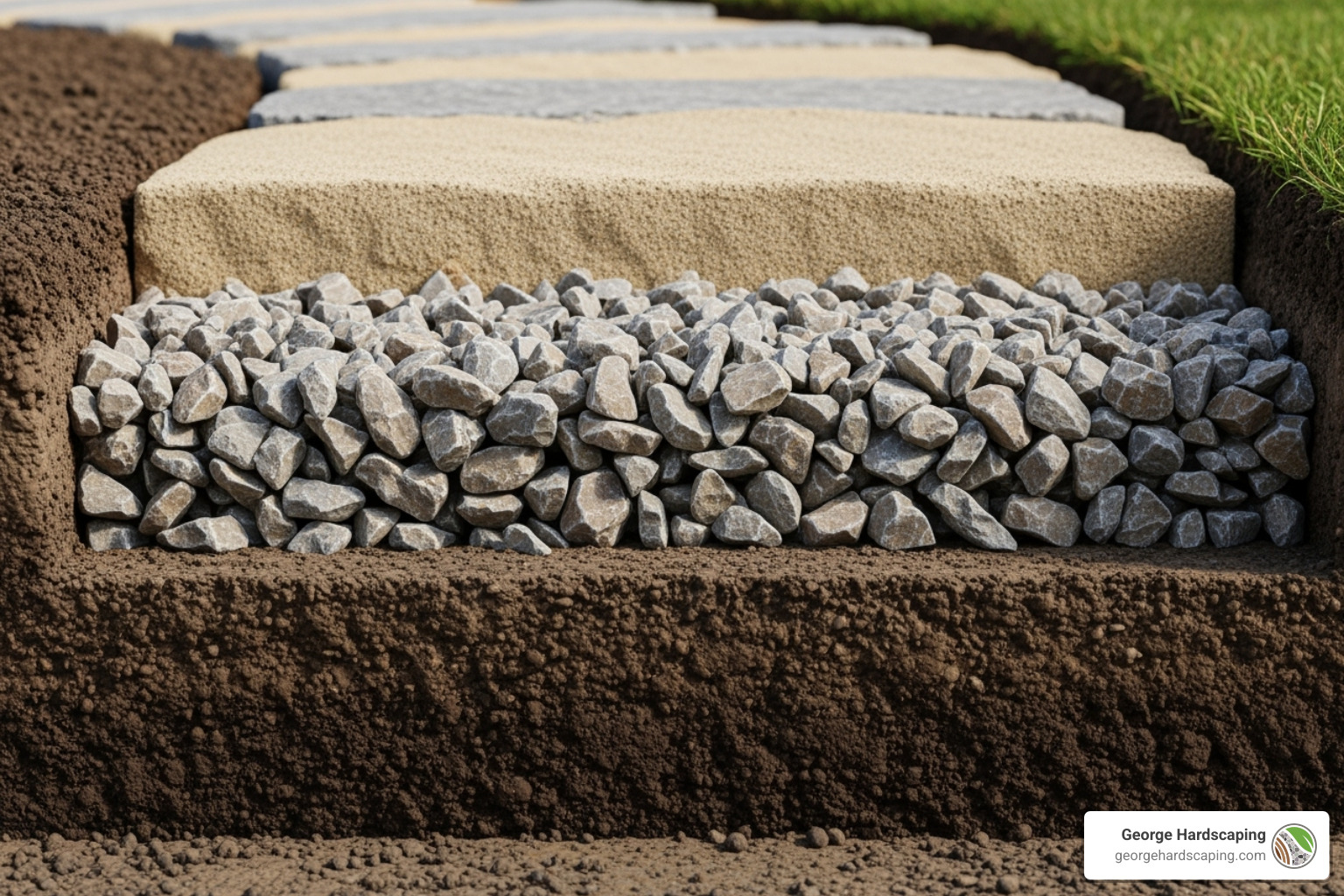
Step 1: Excavation and Site Preparation
First, arrange the stones in their final positions according to your plan. Walk the path one last time to ensure the stride feels comfortable. Using spray paint or a sharp spade, carefully outline each stone, then set the stones aside. Before you dig, dial 811. This free, essential service will arrange for utility companies to mark the location of any underground lines, preventing a dangerous, costly, and potentially fatal accident. Learn more at Call 811.
Your excavation depth needs to account for the thickness of the stone plus the base materials. For a standard 2-inch thick stone, you will need room for a 3-inch gravel base and a 1-inch sand bed. This means your total excavation depth should be 6 inches. Use a sharp spade to cut the sod within your markings. If you want to reuse the grass, cut it carefully and set it aside in a shady spot. Remove the soil, digging about 2-3 inches wider than the stone’s outline to provide working room. If you encounter soft, dark topsoil or organic matter, dig deeper until you reach the firmer, lighter-colored subgrade. The stability of your path depends on this solid bottom layer.
Pro Tip: Once you’ve reached the desired depth and the bottom of the hole is flat, compact the subgrade soil thoroughly with a hand tamp. Lightly moistening the soil before tamping can help it compact to a greater density, creating a more stable foundation.
Step 2: Building a Stable Foundation
This is the most critical step for ensuring a long-lasting path. The foundation layers provide drainage and structural support, preventing stones from sinking or heaving during freeze-thaw cycles.
- Install Geotextile Fabric: Cut a piece of woven geotextile fabric to fit the bottom of your excavated area. This layer separates your gravel base from the soil below, preventing them from mixing and ensuring your base remains stable and well-drained for years.
- Add and Compact Crushed Gravel: Add your 3/4-inch minus crushed gravel in 2-inch layers (or “lifts”). After adding each lift, compact it thoroughly with the hand tamp until it is solid. You’ll know it’s compacted when the tamp bounces slightly. Repeat this process until you have a total gravel depth of 2–4 inches. This multi-layer compaction is crucial for creating a dense, interlocking base.
- Spread the Leveling Sand: Add 1 to 1.5 inches of coarse leveling sand over the compacted gravel. To create a perfectly flat and consistent surface, use two parallel pipes or boards (screed rails) set to the correct height. Pull a straight 2×4 board across the rails to screed the sand smooth.
Drainage: Ensure the entire base system has a slight slope away from any nearby structures, like your home’s foundation. A slope of 1/8 to 1/4 inch per foot is sufficient to carry water away and prevent pooling.
For more advanced foundation techniques, especially for challenging soil conditions, see our guide on the Best Way to Lay Flagstone Walkway.
Step 3: Installing and Leveling Your Stepping Stones
Carefully place your first stone onto the prepared sand bed. Give it a slight wiggle and a few firm taps with the rubber mallet to settle it into the sand. Place your level across the stone’s surface, checking it in both directions (side-to-side and front-to-back). If the stone is too high in one spot, tap it down gently with the mallet. If it’s too low, lift the stone, add a small amount of sand to the low area, and reset it. The goal is a perfectly level and stable stone that does not rock or wobble in any direction.
Tips for Consistency:
- Maintain your planned 12–18 inch center-to-center spacing as you move from one stone to the next.
- If the path is adjacent to a lawn, set the top of the stones about 1/4 to 1/2 inch below the grade of the soil. This allows a lawn mower to pass over them without hitting the stone edges.
- On sloped terrain, each individual stone should still be set perfectly level side-to-side, creating a series of small, level landings as the path descends.
If you’re using irregular flagstones, take time to rotate and test-fit different pieces to find the most visually pleasing and stable arrangement. If a stone rocks on a high point, lift it and remove a small amount of sand from that specific spot.
Step 4: Finishing Touches
These final details lock your stones in place and give the walkway a polished, professional look.
- Backfill the Edges: Use the soil you excavated earlier to backfill the gaps around the outside edges of the stones. Tamp this soil down firmly to provide crucial lateral support, which prevents the stones from shifting sideways over time.
- Fill the Joints: Fill the gaps between the stones with your chosen material:
- Soil and Grass Seed: Creates a soft, natural look that blends seamlessly with the surrounding lawn.
- Polymeric Sand: This is a fine sand mixed with a polymer binder. When swept into the joints and misted with water, it hardens to a firm, mortar-like consistency that locks stones in place and effectively resists weed growth and insect burrowing.
- Decorative Gravel or Stone Dust: Offers a clean, crisp look and excellent permeability.
- Ground Cover Plants: Planting low, durable ground covers like creeping thyme or Irish moss creates a beautiful living carpet between the stones.
Water Management: Using permeable joint fillers like gravel or plants helps reduce stormwater runoff by allowing water to soak into the ground, a practice encouraged by the EPA’s Soak Up the Rain program.
Quality Check: Walk the entire path, stepping firmly on each stone to test for any remaining wobble. Make any final adjustments now. After a few days, especially after the first rain, check again and add more joint filler if any has settled.
For projects that require a seamless connection to existing steps or a new patio, professional execution is key. See how we handle these transitions in our Walkways & Stairs services.
Project Safety: Protect your back by using proper lifting techniques. Keep heavy loads close to your body, maintain a straight back, and bend with your knees and hips. For detailed guidance on safe material handling, consult OSHA’s resources on safe lifting.
If you decide that the precision and labor involved are more than you want to handle, our professional masons can complete your project efficiently and to the highest standard. Explore our full range of hardscaping services.
Design Alternatives and Long-Term Maintenance
Your stepping stone path is more than just a functional walkway; it’s a powerful design element that can define the character of your entire landscape. The materials you select, the pattern you create, and the fillers you use in the joints all contribute to the final aesthetic. These choices can create anything from a rustic, organic look to a sleek, modern style, while also improving drainage, traction, and seasonal resilience.
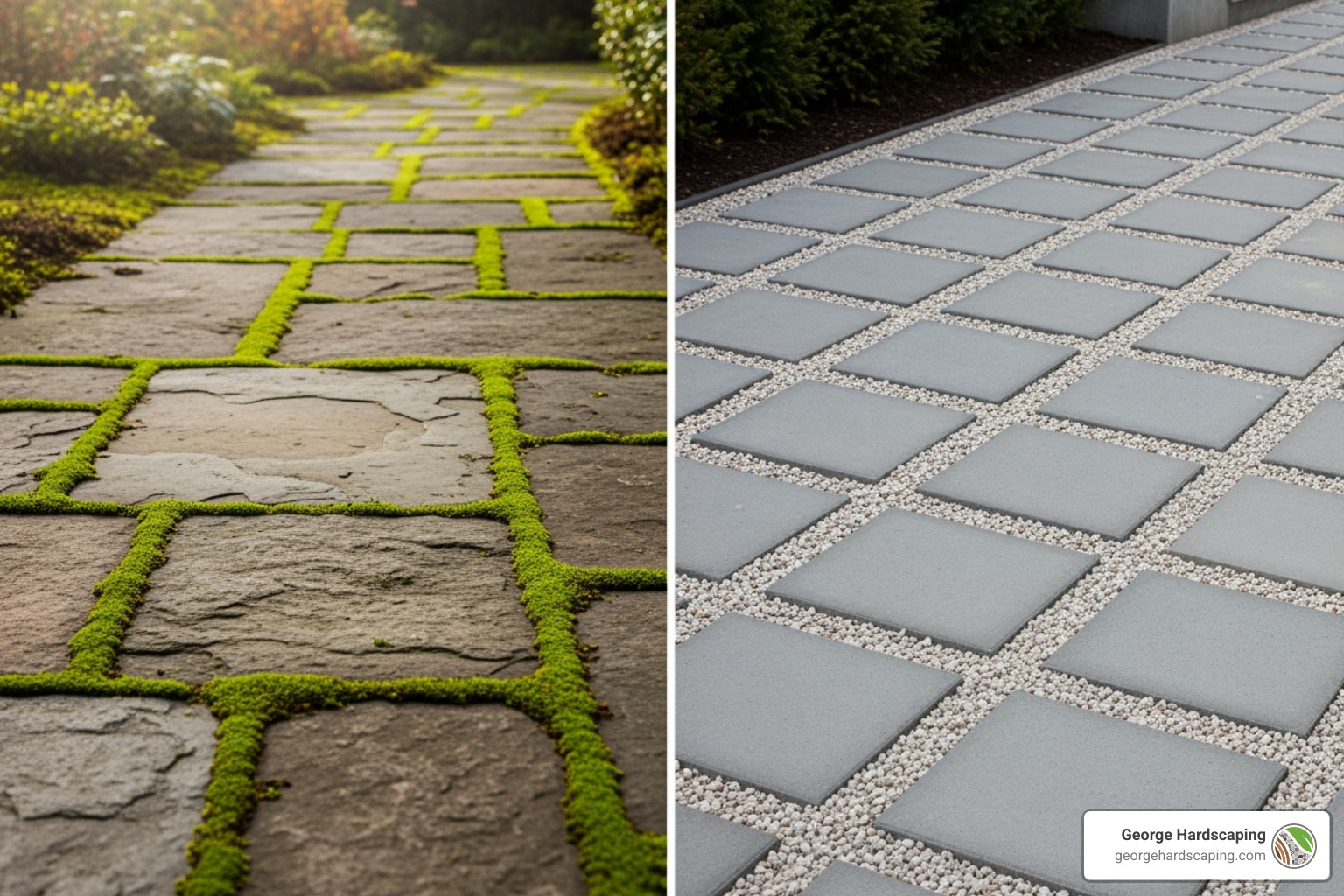
Popular Design Directions:
- Natural & Rustic: Use large, irregular flagstones with wide, planted joints filled with moss or creeping thyme. This creates an ‘old-world’ feel, as if the path has been there for centuries.
- Clean & Contemporary: Opt for uniform, large-format concrete slabs or precisely cut bluestone in square or rectangular shapes. Set them in a straight or offset pattern with tight joints filled with fine, dark-colored gravel for crisp, clean lines.
- Classic New England Cottage: Combine natural stone with reclaimed brick edging for a touch of historic charm. This mixed-media approach adds texture and a sense of permanence.
Edging and Transitions: For a more formal and contained look, consider adding an edge restraint. Options include flexible no-dig plastic edging, rigid steel edging, or a soldier course of paver bricks or cobblestones. Proper edging helps to hold the base materials in place and prevents grass from encroaching onto the path.
Lighting and Safety: Integrating low-voltage path lights along your walkway not only enhances its beauty at night but also significantly improves safety. Where slopes become too steep for a comfortable walk, don’t hesitate to transition to steps. Our team can create a custom stone steps design that perfectly matches your walkway for an attractive and safe transition.
Sustainability:
- Maximize the use of permeable joints (gravel, sand, plants) to reduce stormwater runoff.
- Choose locally quarried stone when possible to reduce the carbon footprint associated with transportation.
- Plant drought-tolerant, native ground covers in the joints to minimize watering needs.
How to Maintain Your Stepping Stone Pathway
Because you learned how to install stepping stones walkway with a proper foundation, long-term maintenance should be minimal and straightforward.
- Regular Cleaning: Sweep the path regularly with a stiff broom to remove leaves, dirt, and other debris. For stubborn dirt or organic stains (like from fallen berries), use a scrub brush with water and a mild, pH-neutral soap. Avoid using a pressure washer, as it can dislodge joint filler and damage the surface of some stones.
- Weed Management: Hand-pull any weeds that appear in the joints as soon as you see them. If you used polymeric sand, weed pressure will be significantly reduced. For other fillers, a narrow-bladed weeding tool can be very effective.
- Filler Maintenance: Annually inspect the joints. Top off any areas where the filler material (gravel, sand, or soil) has settled or washed away. Keeping the joints full is key to maintaining the stability of the stones.
- Seasonal Checks: After the winter thaw is complete, walk the entire path and carefully check for any stones that may have shifted or become wobbly due to frost heave. A properly built base minimizes this risk, but minor adjustments may occasionally be needed.
- Winter Care: Use plastic shovels or snow blowers with raised augers to avoid scratching the stone surfaces. Never use rock salt (sodium chloride) on natural stone or concrete pavers, as it can cause spalling and permanent damage. Instead, use safer de-icing alternatives like calcium chloride or calcium magnesium acetate.
If your path is on a slope or near drainage-sensitive areas, perform inspections in both spring and fall. For persistent water pooling issues, you may need to add a small French drain or regrade an adjacent area. Our team integrates comprehensive drainage solutions into every project as part of our hardscaping and landscaping services.
Common Installation Issues and Solutions
- Wobbly Stones: This is almost always due to an uneven or improperly compacted base. The fix is to carefully lift the unstable stone, add or remove leveling sand as needed to create a perfectly stable bed, re-screed the sand, and reset the stone firmly.
- Drainage Problems: If water pools on or around your path, the slope is incorrect. You may need to lift a section of the path to regrade the base, ensuring a consistent 1/8–1/4 inch per foot slope away from structures.
- Persistent Weeds: If weeds are a constant battle, your joint filler is the problem. Consider removing the existing filler and replacing it with properly installed polymeric sand.
- Frost Heave: If a stone is pushed up after winter, it means water got into the base and froze. This indicates the gravel base may be too shallow or poorly drained. The solution is to excavate that section deeper and install a proper 4-inch (or deeper) compacted gravel base.
- Cracked Stones: This usually happens when stones are too thin (less than 2 inches) or have a natural flaw. Carefully remove the broken pieces and install a thicker, high-quality replacement stone on a properly prepared base.
For cohesive upgrades and expert fixes to existing hardscapes, see our Walkways & Stairs services and browse our full range of hardscaping services. For professional insights into building for longevity, refer to our detailed stone walkway installation guide.
Frequently Asked Questions about Stepping Stone Walkways
After helping hundreds of homeowners across Essex County design and build their ideal walkways, we’ve heard the same questions many times. Here are detailed answers to help you learn how to install stepping stones walkway with confidence and avoid common pitfalls.
What is the best base for stepping stones?
The best and only professionally accepted base is a multi-layer system engineered for drainage and stability. It is not just one material, but a sequence of layers working together:
- Compacted Native Soil (Subgrade): This is the very bottom of your excavation. Once all organic topsoil is removed, this firm soil is compacted to create a solid, unyielding platform that will not settle further.
- Woven Geotextile Fabric: This fabric is laid on top of the subgrade. Its crucial job is to separate the soil from the gravel, preventing the gravel from being pushed down into the soil over time. This preserves the integrity and drainage capacity of your base.
- Crushed Gravel Sub-base (2–4 inches): A layer of 3/4″ minus crushed angular stone is installed and compacted in lifts. Its angular edges interlock to form a rock-solid, load-bearing base. Crucially, the gaps between the stones allow water to drain through freely, which is the primary defense against frost heave.
- Leveling Sand Bed (1–1.5 inches): This final layer of coarse sand sits directly under the stone. It is not for structural support; its only purpose is to provide a medium that is easy to manipulate for making the fine adjustments needed to get each stone perfectly level and stable.
This system is the professional standard for a reason: it systematically prevents sinking, shifting, and water damage—the three biggest enemies of any hardscape project in a climate with freezing temperatures.
How do you keep stepping stones from shifting?
Preventing shifting and wobbling is a three-part strategy that addresses forces from below, beside, and within the path:
- A Solid Base: The number one cause of shifting is an inadequate base. Build a dense, wide, and well-compacted gravel base that extends at least 4-6 inches beyond the edges of the stones themselves. This distributes the load over a wider area.
- Proper Setting: Set each stone firmly into the sand bed with a rubber mallet. Check for any wobble or rocking motion. If it moves at all, lift it and adjust the sand underneath until it is completely stable before moving on.
- Edge and Joint Support: Backfill the soil tightly against the outside edges of the path. Then, fill the joints between the stones with a material that provides lateral support. Polymeric sand is especially effective as it hardens to lock the stones together.
Can you just lay stepping stones on grass?
While you can place stones directly on top of the grass for a very temporary, informal path, it is not a durable or safe solution. Without a proper excavated base, several problems will arise quickly: the stones will sink unevenly into the soft topsoil, creating a wobbly and dangerous tripping hazard. Grass and weeds will immediately grow over the edges and into the joints, making maintenance a constant chore. Most importantly, during freeze–thaw cycles, the water-saturated soil beneath the stones will expand and move them around, ruining any semblance of a level path by the first spring.
How far apart should stepping stones be?
For a comfortable walking rhythm, most adults find a center-to-center spacing of 12 to 18 inches to be ideal. The best way to customize this is to take a natural, comfortable stride on flat ground and have someone measure the distance from the heel of your back foot to the heel of your front foot. Use this measurement as your guide. Maintain consistent spacing for a sense of rhythm, but feel free to make slight adjustments to accommodate curves or obstacles.
How thick should stepping stones be?
A minimum thickness of 2 inches is strongly recommended for any stone that will be underfoot. Thinner stones are far more susceptible to cracking under point loads (like the leg of a heavy piece of furniture) or from the stress of frost heave. Thicker stones (2.5-3 inches) are more forgiving of minor imperfections in the base and offer superior long-term durability.
What slope should I aim for?
Proper drainage is critical. You should build in a subtle slope to shed water away from structures like your house foundation. A grade of 1/8 to 1/4 inch of fall for every foot of run is the standard (a 1-2% slope). For comfortable walking, the slope along the path’s length should be as gentle as possible (ideally 5% or less). While residential paths are not required to meet ADA standards, using their guidelines as a reference for slope and surface evenness is a great way to improve safety for everyone.
Is a landscape fabric layer really necessary?
Yes, but it’s crucial to use the right kind. You need a woven geotextile fabric, not the flimsy black fabric sold for weed control in garden beds. A geotextile’s job is separation. It creates a permanent barrier between your compacted subgrade soil and your crushed gravel base. Without it, the forces of water and weight will eventually cause the gravel to sink into the soil and the soil to pump up into the gravel. This compromises the entire base, leading to poor drainage and eventual failure of the path.
How do I handle muddy or low-lying areas?
If your path must cross a chronically wet or muddy area, you need to engineer a more robust solution. Excavate deeper than usual to remove all of the soft, organic soil. Continue until you hit firm, stable subsoil. Then, build up your base with extra layers of compacted gravel to bring it back to the required height. In very problematic areas, you may need to install a French drain running parallel to the path to intercept water before it reaches the walkway’s base. We integrate these types of drainage solutions into our hardscaping and landscaping projects to protect your investment.
What plants work well between stones?
Choose low-growing, tough, foot-tolerant ground covers. For sunny, well-drained spots, great options include creeping thyme, woolly thyme, blue star creeper, and various types of sedum. For shadier or moister areas, try Irish moss (Sagina subulata) or dwarf mondo grass. Always select plants that are hardy for your specific climate by checking the USDA Plant Hardiness Zone Map.
How long does installation take?
A small, straight path of 10–20 stones can often be completed in a weekend by two reasonably fit people. However, projects with curves, slopes, heavy excavation, or very large stones will take significantly longer. Hiring a professional crew dramatically accelerates the timeline, ensures precision grading, and eliminates the risk of costly mistakes. See our Walkways & Stairs services for professionally installed options.
Can I integrate my walkway with other features later?
Absolutely. Many homeowners start with a simple stepping stone path and later decide to add connecting features like a patio, steps, or low retaining walls. If you think this might be in your future, planning for it now can save a lot of headaches. Choose a stone type, color, and style that will be easy to match later. Pay close attention to elevations to ensure a smooth transition. We specialize in creating cohesive, multi-phase outdoor living spaces through our hardscaping services and have extensive experience with features like landscape retaining walls. For more professional insights, read our in-depth stone walkway installation guide.
Conclusion: Enjoy Your New Handcrafted Path
Congratulations on mastering the steps for how to install stepping stones walkway. By investing the time to learn and do it right, you’ve transformed a vision into a beautiful, functional reality that adds lasting value and significant curb appeal to your home. Every time you walk this path, from carrying in groceries to taking a quiet stroll through your garden, you’ll feel the immense pride and satisfaction of having built it with your own hands.
Your new walkway is far more than just a route through your yard. It is a key element of your landscape design, a feature that protects your lawn, provides safe and clean footing in all weather, and brings a sense of structure and intention to your outdoor spaces. The skills you’ve acquired—from proper site planning and excavation to the critical techniques of base preparation, compaction, leveling, and finishing—are the foundational principles behind all successful, long-lasting hardscaping projects.
You now understand that the secret to a path that endures is not the stone on top, but the carefully engineered, multi-layered base beneath it. This knowledge empowers you to tackle future projects with confidence.
If this project has inspired you to think bigger—perhaps expanding from a simple garden path to a grand front entry, a multi-level terrace with integrated steps, or a full patio and seating area—professional expertise can ensure a stunning, cohesive result that stands up to New England’s challenging climate. Our team at George Hardscaping builds enduring outdoor spaces with meticulous grading, robust base systems, and premium materials, guaranteeing your investment will last for decades to come.
Ready to upgrade your property with a professionally designed, warrantied walkway or a complete outdoor transformation? Schedule your on-site consultation now: Request an estimate.
For larger or more complex projects in Essex County, MA, the expert masons at George Hardscaping can help you design and build the perfect walkway, seamlessly integrated with steps, patios, and retaining elements. Explore our custom Walkways & Stairs solutions and see how our hardscaping and landscaping services bring beauty, function, and durability together.
Let’s turn your ideas into a resilient, low-maintenance outdoor space you’ll love for decades. Contact George Hardscaping today to get started: Request an estimate.
