
Why Installing a Brick Paver Walkway on Soil Transforms Your Landscape
How to install a brick paver walkway on soil is one of the most common questions homeowners ask when facing muddy trails cutting across their yards or when planning to connect outdoor spaces. Whether you’re tired of tracking mud indoors after every rain or want to add lasting curb appeal to your North Shore property, a properly installed brick walkway solves both problems. A well-designed path does more than just provide a dry place to walk; it defines the flow of your outdoor living space, protects your lawn from compaction, and increases the overall market value of your home.
Quick Answer: The Essential Steps
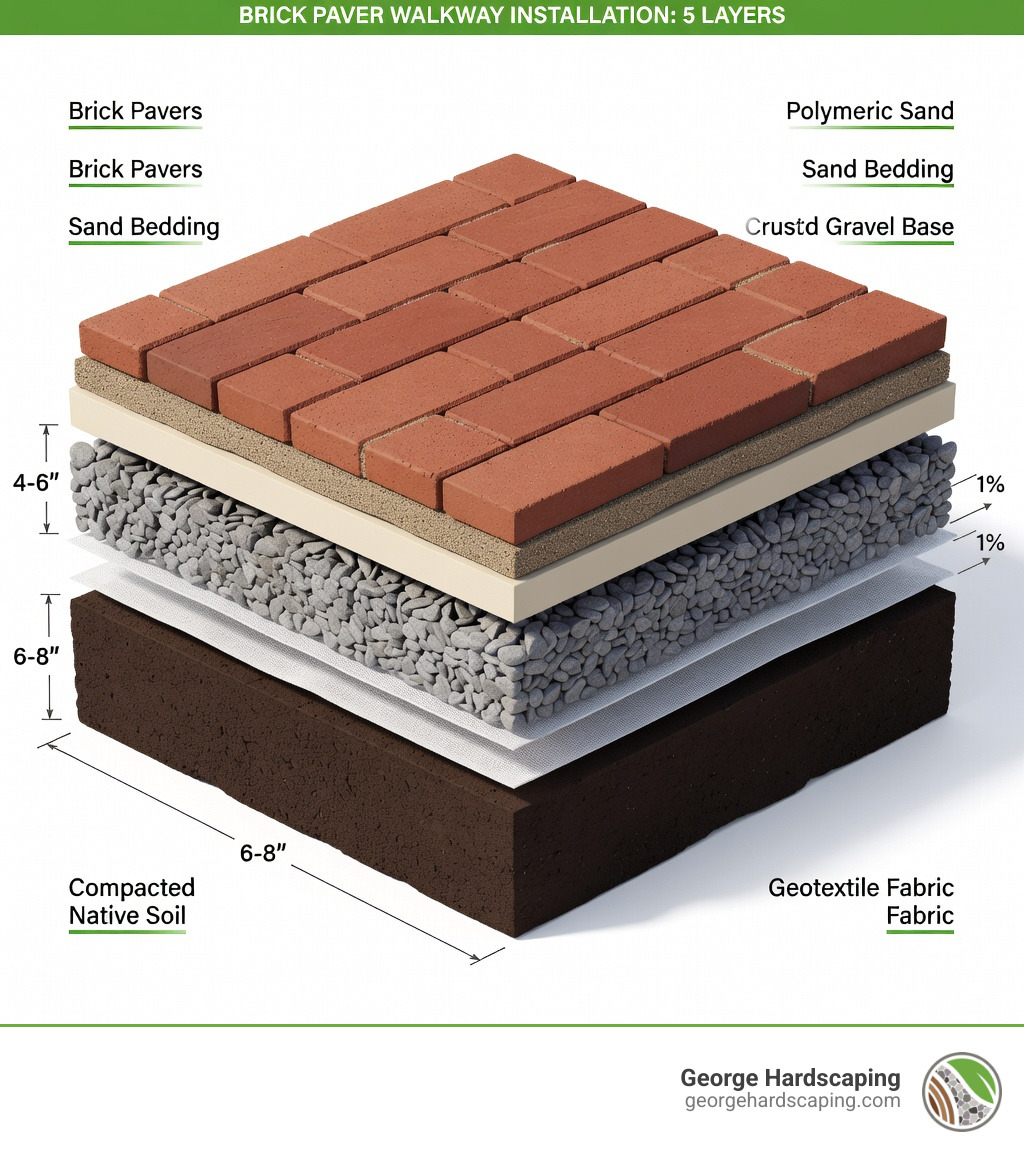
- Excavate 6-8 inches deep to accommodate base layers and ensure structural stability.
- Compact soil and lay geotextile fabric to prevent weeds and keep base materials from migrating.
- Add gravel base (4-6 inches), compacting in 2-inch layers to achieve maximum density.
- Screed sand bedding to 1-inch thickness using guide pipes for a perfectly level surface.
- Lay pavers in your chosen pattern (like herringbone or running bond) with consistent joints.
- Install edge restraints to prevent the walkway from spreading or shifting over time.
- Fill joints with polymeric sand and activate with water to lock the system together.
The difference between a walkway that lasts decades and one that becomes a maintenance nightmare comes down to proper base preparation. Many homeowners attempt to save time by laying pavers directly on tamped dirt—a shortcut that leads to weeds, shifting, and uneven surfaces within just 1-2 years. In the harsh New England climate, where frost heave can lift entire sections of pavement, the foundation is the most critical component of the build.
The reality is straightforward: a brick paver walkway installed on soil requires a multi-layer foundation system. You’ll need to excavate, build a stable gravel base, add sand bedding, and finish with polymeric sand joints. The process takes 8-10 hours for a typical 20-foot path and costs between $200-$900 for DIY materials, though average professional installation runs $8-$25 per square foot based on national data. This investment of time and resources ensures that your path remains flat and beautiful through years of heavy foot traffic and seasonal changes.
This guide walks you through every step of the installation process, from calculating materials to finishing touches. We’ll cover soil preparation techniques specific to Essex County’s clay soils, explain how freeze-thaw cycles affect your base depth, and show you which mistakes to avoid. By the end, you’ll understand exactly what’s required to build a walkway that stands up to New England weather. For homeowners considering paver stone walkway ideas or exploring front yard walkway ideas, understanding the proper installation method helps you make informed decisions—whether you tackle the project yourself or hire professionals like George Hardscaping to handle the heavy lifting.
Simple how to install a brick paver walkway on soil word guide:
- Brick Walkways
- Paver Walkway Installer
- cost to install pavers
Essential Materials and Tools for Your Project
Before you break ground, you need to gather a specific set of materials and tools. Understanding how to install a brick paver walkway on soil starts with knowing that you aren’t just buying bricks; you are building a structural system designed to distribute weight and manage moisture. Using the wrong materials is the leading cause of premature walkway failure.
Materials List
- Brick Pavers: Choose “hard-burned” common bricks or pavers rated for ground contact. According to Technical Notes from The Brick Industry Association, these are denser and less porous than wall bricks. Specifically, look for pavers that meet the ASTM C902 standard for pedestrian traffic, which ensures they can withstand the freeze-thaw cycles common in a Beverly or Salem winter without cracking or spalling.
- Crushed Gravel: You need “3/4-minus” or “crusher run” gravel. This material includes sharp-edged stones ranging from 3/4 inch down to stone dust. Unlike rounded pea gravel, these angular pieces lock together when compacted to create a rigid, load-bearing surface.
- Coarse Sand: Also known as concrete sand or washed sharp sand. This layer provides the final leveling bed for your pavers. Avoid play sand or masonry sand, as the grains are too rounded and fine, which can cause the pavers to “float” or shift under pressure.
- Landscape Fabric: A heavy-duty, non-woven geotextile is essential. It acts as a separation layer, preventing the expensive gravel base from sinking into the soft native soil while still allowing water to drain through.
- Edge Restraints: Plastic or metal L-shaped edging is vital for keeping the pavers from spreading outward over time. These are secured with long steel spikes driven into the gravel base.
- Polymeric Sand: This specialized sand contains chemical binders that harden when activated with water. It locks the bricks together, prevents weed growth in the joints, and stops ants from excavating the sand bed.
Tool Requirements
Building a walkway is physically demanding work that requires precision. As noted in the Missouri Extension Guide on Brick Walks, having the right mechanical tools makes the job manageable and ensures professional-grade results. You will need:
- Plate Compactor: Renting a gas-powered plate compactor is non-negotiable. It provides the thousands of pounds of centrifugal force needed to settle the gravel base. Hand tamping is rarely sufficient for anything longer than a few feet.
- Masonry Saw: For any curves, angles, or custom fits, a circular saw equipped with a diamond-grit blade is required. This allows for clean, crisp edges that won’t crumble.
- Screed Pipes: Two 1-inch diameter PVC or galvanized steel pipes serve as guides for leveling your sand bed. These ensure your bedding layer is a uniform thickness across the entire path.
- Rubber Mallet: Used to gently tap pavers into the sand bed to ensure they are level with their neighbors without risk of cracking the brick surface.
- Laser Level or Line Level: Essential for ensuring your walkway maintains a consistent slope away from your home’s foundation to prevent water damage.
Calculating Quantities and Budget
To avoid multiple trips to the supply yard in Peabody or Danvers, use these standard ratios to estimate your needs. Accurate calculations prevent waste and keep your project on schedule:
- Bricks: Plan on 4.5 to 5 bricks per square foot for standard 4×8 pavers.
- Gravel: 1 ton of crushed gravel covers approximately 100 square feet at a 4-inch depth. For a 20-foot walkway that is 3 feet wide, you will need roughly 1.5 to 2 tons including the over-excavation width.
- Sand: 1 cubic yard of sand covers about 80 square feet at a 1-inch depth.
- Overage: Always add a 10% overage to your order. This accounts for bricks broken during delivery, mistakes made during the cutting process, and the extra width needed for edge restraints.
When considering the paver walkway installation cost, DIY costs for a 20-foot path typically range from $200 to $900 depending on the brick quality. If you choose higher-end materials or complex patterns, costs can rise. Professionally, the average cost to install brick pavers ranges from $8 to $25 per square foot, which includes the heavy labor of excavation, hauling away debris, and professional grading.
Site Preparation: How to Install a Brick Paver Walkway on Soil
The longevity of your walkway is determined by what you do before the first brick is laid. When we discuss how to install a brick paver walkway on soil, we are really talking about soil management and hydrology. In Essex County, we often deal with clay-heavy soils that hold moisture and expand significantly when frozen. If you don’t prepare the site correctly, the natural movement of the earth will destroy your hardwork in a single season.
Excavation Depth and Drainage
You must excavate deep enough to fit all your layers while ensuring the finished surface sits slightly above the surrounding grade to prevent puddling. For a standard garden path, we recommend a trench 7-9 inches deep. This allows for 4-6 inches of compacted gravel, 1 inch of sand, and the thickness of the brick (usually 2.25 to 2.5 inches).
Crucially, you must establish a drainage slope. Your walkway should drop 1/4 inch for every foot of width or length, directed away from any structures. This is known as the “pitch.” Without this, water will pool under your pavers, leading to a phenomenon called “pumping,” where the sand bed liquefies under pressure and the bricks sink into the mud. Use a string line and a line level to verify this slope throughout the excavation process.
Comparison: Longevity of Installation Methods
| Feature | Direct on Soil | Proper Multi-Layer Base |
|---|---|---|
| Expected Lifespan | 1-2 Years | 20-25 Years |
| Weed Resistance | None | High (with fabric/polymeric sand) |
| Stability | Sinks/Shifts quickly | Remains level and flat |
| Frost Resistance | Poor (Heaves in winter) | Excellent |
| Maintenance | High (Constant resetting) | Low (Occasional sweeping) |
If your yard has a significant incline, you may need to learn how to build a paver walkway on a slope to prevent erosion from washing out your foundation. Slopes require additional considerations like timber or stone steps to break up the grade.
Step-by-Step: How to Install a Brick Paver Walkway on Soil
- Mark the Area: Use stakes and mason’s string to outline the path. Add 6 inches to the width of the trench on both sides to allow room for the edge restraints to sit on the gravel base.
- Call 811: Before you dig in Boxford or Topsfield, you must contact the national 811 ‘Call Before You Dig’ service to have your utility lines marked. Striking a gas or power line is dangerous and expensive.
- Removing Vegetation: Dig out all grass, roots, and large rocks. Any organic matter left behind will rot over time, creating voids that cause the path to settle unevenly.
- Subgrade Compaction: Once the dirt is exposed, run the plate compactor over the bare soil. You want the “floor” of your trench to be as hard as possible. If the soil is extremely wet, let it dry for a day before compacting.
- Geotextile Placement: Lay your landscape fabric over the compacted soil. Overlap seams by at least 12 inches and ensure the fabric extends up the sides of the trench slightly to fully encapsulate the gravel base.
Adapting for Climate: How to Install a Brick Paver Walkway on Soil in Cold Regions
In the North Shore area, including Newburyport and Gloucester, freeze-thaw cycles are a major concern. When water in the soil freezes, it expands and pushes upward (frost heave). To combat this, we recommend increasing your gravel base to a full 6 inches. This extra depth provides better drainage and a thicker “buffer” zone, ensuring that water doesn’t stay trapped directly under your pavers where it can cause the most damage.
Building the Foundation: Gravel, Sand, and Screeding
The foundation is where most DIY projects fail. You cannot simply dump 4 inches of gravel in a trench and expect it to be stable. Instead, add the crushed stone in “lifts” of no more than 2 inches at a time. Dampen the stone slightly with a garden hose—this acts as a lubricant, helping the sharp particles slide into a tighter lock—and run the plate compactor over each layer at least three to four times. You should not be able to see your footprint in the gravel once it is properly compacted.
Once the gravel is rock-hard and follows your intended slope, it’s time for the sand bedding. This layer is for leveling and providing a “seat” for the bricks, not for structural support. If the sand layer is too thick (over 1.5 inches), it will eventually shift and cause the pavers to become uneven.
The Screeding Technique
To get a perfectly flat surface that follows your drainage pitch:
- Lay two 1-inch PVC pipes parallel to each other on top of the compacted gravel. These act as your rails.
- Pour coarse concrete sand between the pipes, slightly overfilling the area.
- Take a straight, notched 2×4 board and “saw” it back and forth across the top of the pipes, pulling the excess sand toward you. This leaves a perfectly smooth 1-inch bed of sand.
- Remove the pipes carefully and fill the resulting indentations with a hand trowel, smoothing them to match the surrounding sand.
Do not walk on the sand once it is screeded. If you accidentally step in it, you must re-screed that section. If you are working on a large or complex project, you may want to consult a paver walkway installer to ensure this step is handled with the precision required for long-term durability.
Laying the Bricks: Patterns, Cutting, and Edging

Now comes the rewarding part: laying the pavers. Start from a fixed corner or against a permanent edge like a porch step or driveway. This ensures your lines stay straight from the beginning.
Pattern Selection
- Running Bond: The easiest for beginners. Bricks are laid in rows with staggered joints, similar to a standard brick wall. It requires minimal cutting and is very forgiving.
- Basketweave: A classic look where pairs of bricks alternate direction (two horizontal, then two vertical). It is very stable but requires precise dimensions to avoid “creeping” joints.
- Herringbone: The most durable pattern because the 45-degree or 90-degree angles lock the bricks together, preventing shifting in all directions. This is the best choice for heavy foot traffic or areas where a lawnmower might cross the path, though it requires the most cutting at the edges.
Maintain a joint consistency of 1/16 to 3/16 of an inch. If you place them too tightly (butt-jointed), they can chip as they expand in the summer heat. Use the “click-drop” method: hold the brick against the edge of the previous one and drop it straight down into the sand without sliding it.
Edge Restraints and Cutting
As you reach the edges or curves, you will likely need to cut bricks to fit. Use a masonry saw with a diamond blade for clean results. Always wear safety goggles and a dust mask, as brick dust contains silica. Once the bricks are laid, install your plastic edging immediately. Secure it with 12-inch galvanized spikes driven into the gravel base every 12 inches. This “frames” the walkway and prevents the bricks from migrating into your lawn or garden beds. For complex designs involving stairs or elevation changes, you might look into professional walkway and stair services to ensure the structural integrity of the transitions.
Finishing Touches: Polymeric Sand and Long-Term Maintenance
The final step in how to install a brick paver walkway on soil is the “lock-in.” This is what transforms a collection of loose bricks into a solid, monolithic surface. Sweep the entire surface clean of any debris before applying polymeric sand, as any leaves or twigs trapped in the joints will eventually rot and create holes.
- Spread the Sand: Pour the polymeric sand over the dry pavers. It is critical that the pavers are 100% dry; if they are damp, the polymers will activate on the surface and leave a permanent white haze. Sweep the sand into the joints until they are full.
- Vibrate: Run the plate compactor over the bricks. To protect the brick faces from scratching, place a protective mat or a piece of outdoor carpet underneath the compactor. This vibration shakes the sand deep into the joints, filling any air pockets and settling the bricks into the sand bed.
- Refill and Clean: You will notice the sand level drops after vibration. Add more sand as needed, sweep again, and then use a leaf blower on a low setting to remove every speck of dust from the surface of the bricks. Any dust left behind will harden into a film once wet.
- Activate: Lightly mist the walkway with water using a spray nozzle. Do not soak it with a heavy stream, as this will wash the polymers out of the sand. You want to dampen the sand just enough to trigger the chemical bond throughout the full depth of the joint.
The sand will require a curing time of 24-48 hours depending on the humidity. During this time, keep foot traffic, pets, and irrigation systems off the path.
Long-Term Care
While pavers can last 20-25 years, they do require basic maintenance to stay in top condition. We recommend:
- Annual Sweeping: Keep debris off the surface to prevent organic matter from breaking down in the joints and providing a medium for weed seeds.
- Weed Prevention: If a weed does appear, pull it immediately. Do not let the roots expand, as they can break the polymeric bond.
- Sealing: Every 2-3 years, consider applying a high-quality paver sealant. This protects the color from UV fading and further hardens the joint sand against erosion. If your path ever settles due to extreme weather or tree root growth, you can learn how to repair brick walkway and stairs by lifting individual bricks, leveling the base, and re-sanding.
Common Mistakes and Professional Considerations
Even with a detailed guide on how to install a brick paver walkway on soil, certain pitfalls remain common for DIYers. Avoiding these will save you from having to redo the entire project in three years.
- Skipping the Fabric: Without geotextile fabric, your gravel will eventually mix with the native soil, especially during the spring thaw. This causes the walkway to sink and become uneven.
- Poor Compaction: If you don’t use a mechanical plate compactor, the path will settle unevenly the first time a heavy person walks on it or a heavy rain saturates the ground.
- Improper Slope: Water running toward your house can cause basement leaks and foundation damage. Always ensure the pitch is directed away from the home.
- Using Stone Dust: Many old-school guides suggest stone dust for the bedding layer. However, stone dust holds moisture and does not drain as well as coarse sand, which can lead to increased frost heave.
DIY installation is a great way to save money, but it is back-breaking labor. Excavating 8 inches of soil for a 20-foot path means moving several tons of dirt, gravel, and brick by hand. If the physical demands or the technical precision of leveling feel overwhelming, our hardscaping and masonry services are designed to give you a perfect, guaranteed result without the stress.
CALL TO ACTION
Ready to transform your landscape without the back-breaking labor? Contact the experts at George Hardscaping for a professional walkway estimate today! We serve homeowners across Essex County, including Marblehead, Swampscott, and Lynnfield, with high-quality craftsmanship that stands the test of time.
Frequently Asked Questions about Brick Walkways
Can I lay pavers directly on dirt?
No. Laying pavers directly on soil is a recipe for failure. The soil will shift with moisture changes and frost, causing the pavers to become uneven and create trip hazards. Additionally, weeds will grow through the joints almost immediately because there is no barrier. Always use a compacted gravel and sand base to ensure a stable, long-lasting surface.
How deep should I dig for a brick walkway?
For a standard residential walkway in a climate like Massachusetts, you should dig 7-9 inches deep. This depth allows for a 4-6 inch gravel base (essential for drainage), a 1-inch sand bed, and the thickness of the brick itself. If you are in an area with particularly poor drainage or heavy clay, digging slightly deeper for more gravel is recommended.
What is the best sand for paver joints?
Polymeric sand is the gold standard for paver joints. Unlike regular sand, it contains additives that cause it to harden when activated with water. This prevents the sand from washing out during heavy rains, resists weed growth, and keeps ants from nesting under your walkway. It also provides a flexible joint that can handle minor ground movement without cracking.
How do I stop weeds from growing in my walkway?
The best defense against weeds is a three-part system: use a heavy-duty geotextile fabric under your gravel base, use polymeric sand in the joints, and keep the surface clean of organic debris. If weeds do appear, it is usually because dirt has blown into the top of the joints, rather than growing up from the soil below.
Can I use a plate compactor on the bricks themselves?
Yes, but you must use a protective pad. Running a metal plate compactor directly on brick pavers can scratch or crack them. Use a specialized rubber mat attachment or a piece of outdoor carpet to cushion the impact while still providing the vibration needed to settle the bricks and the joint sand.
Conclusion
Building a brick paver walkway is a classic home improvement project that offers incredible value and aesthetic appeal. By following the proper steps—excavation, layered compaction, and using the right materials—you can turn a muddy path into a beautiful, durable feature of your home. Whether you are in Manchester-by-the-Sea or Rockport, the principles of a solid foundation remain the same: drainage and compaction are the keys to success.
At George Hardscaping, we pride ourselves on being the Essex County hardscaping experts. We understand the local soil conditions and the harsh New England winters, ensuring every project we touch is built to last for decades. We take the guesswork out of site preparation and grading, providing you with a walkway that is as functional as it is beautiful.
CALL TO ACTION
Don’t settle for a muddy path or a DIY project that shifts after the first winter. Enhance your home’s curb appeal with a custom-designed walkway that reflects your style and adds value to your property. View our gallery for inspiration or call us today to start your project with the North Shore’s premier masonry team!
