
How to build an outdoor fireplace: 5 Easy Steps to Bliss
Why an Outdoor Fireplace is the Ultimate Backyard Upgrade
Dreaming of cozy evenings under the stars? Learning how to build an outdoor fireplace can turn that dream into a year‑round reality. Done right, it adds comfort, extends the outdoor season, and elevates your landscape with a focal point that anchors patios, seating, and garden paths. Just as important, it can be a smart financial move: research shows an outdoor fireplace can increase property value by as much as 12 percent (see the National Association of Realtors’ summary of home improvements ROI: https://www.nar.realtor/ncrer.nsf/files/execsumsirmansmacpherson2.pdf/$FILE/execsumsirmansmacpherson2.pdf). And beyond dollars, spending time around a fire measurably reduces stress and supports well‑being, according to peer‑reviewed findings (SAGE Journals: https://journals.sagepub.com/doi/full/10.1177/147470491401200509).
If you live in Essex County and across the North Shore—from Beverly and Salem to Marblehead and Newburyport—an outdoor fireplace can be the heart of your outdoor living room, tying together patios, walkways, and gardens. It complements a wide range of hardscape designs and lets you enjoy the shoulder seasons with warmth and ambiance. This comprehensive, code‑conscious guide explains how to plan, design, and execute a durable, beautiful masonry fireplace, whether you’re tackling it as a DIY project or partnering with a local expert like George Hardscaping.
Essential steps to build an outdoor fireplace:
- Plan and get permits: Choose a code‑compliant location, confirm rules, and call 811 before digging.
- Pour a foundation: Excavate below frost depth, build forms, reinforce, and place a structural concrete slab.
- Build the structure: Construct the base with CMUs, then the firebox with firebrick and refractory mortar.
- Install the chimney: Properly size the smoke chamber and flue; follow the 3‑2‑10 rule for termination height guidance and local code.
- Apply finishes: Add stone, brick, or stucco veneer; install a cap with spark arrestor; then cure the masonry before first fire.
Value, style, and comfort aside, a fireplace should be engineered for safety and longevity. That means proper footing design, water management, careful firebox geometry, and chimney draft. The result is a feature that looks fantastic on day one and continues performing for decades.
Quick note on fit and flow: An outdoor fireplace becomes a natural anchor point for the rest of your living space. Consider how it will connect to your patio and seating area—perhaps as the centerpiece of a new outdoor room. If you’re adding or upgrading a patio concurrently, review our patio design and installation services to create a coordinated plan that feels intentional from the start: https://georgehardscaping.com/patio-design-installation/.
Clear, proactive planning is where the magic begins—and where costly mistakes are avoided. Read on to learn exactly how to build an outdoor fireplace that drafts properly, looks right at home, and meets local requirements.
Planning and Designing Your Perfect Outdoor Fireplace
The magic of how to build an outdoor fireplace begins in the planning phase. A thoughtful plan addresses code, safety, wind, seating, and aesthetics, ensuring your investment looks beautiful and performs flawlessly in all seasons.
Location, Fuel, and Design
Location selection
- Wind and smoke: Study your yard’s prevailing wind to direct smoke away from doors, windows, and seating. The National Weather Service offers wind rose tools for regional wind patterns: https://www.weather.gov/. If your property has consistent breezes, position the fireplace so the opening faces slightly away from the typical wind direction.
- Clearances: Typical rules require fireplaces 10–30 feet from the home and at least 10 feet from property lines, trees, and combustible structures. Always confirm with your local building department and HOA if applicable. Integrate the fireplace with a cohesive patio plan that considers traffic flow and sightlines. Explore our patio design and installation services here: https://georgehardscaping.com/patio-design-installation/.
- Utilities: Before any digging, call 811 or visit https://call811.com/ to mark utilities. This is required by law and prevents dangerous strikes.
Fuel types
- Wood‑burning: Offers the classic crackle, aroma, and campfire vibe. Requires a correctly sized masonry firebox, smoke chamber, and flue, plus annual chimney maintenance. Wood storage and ash handling should be planned from the start. For a comprehensive build that balances tradition and performance, our hardscaping masonry services can help: https://georgehardscaping.com/hardscaping-masonry-services/.
- Gas (natural gas or propane): Delivers immediate convenience with a switch or remote and consistent, controllable heat. Gas units often allow sleeker footprints and modern styling. Gas lines must be installed by a licensed professional per code. Learn more about options at: https://georgehardscaping.com/gas-fireplace-outdoor/.
Design styles and scale
- Traditional Brick: A timeless choice that evokes warmth and classic Americana. Brick offers a uniform pattern and can be laid in various bonds (running bond, herringbone) to create subtle texture. It pairs naturally with colonial and craftsman homes, and complements hardscapes like bluestone or clay paver patios.
- Modern Stacked Stone: Characterized by clean, horizontal lines and layered texture, this style uses tightly fitted ledgestone for a sleek, contemporary look. It’s an excellent match for modern architecture and minimalist landscapes.
- Old World Stucco or Fieldstone: For a rustic, European feel, consider a stucco finish (which can be colored to match your home) or natural fieldstone. Fieldstone provides an irregular, naturalistic appearance that blends seamlessly into a garden setting, creating a sense of permanence and history.
- Freestanding vs. Integrated: A freestanding fireplace is a powerful, standalone focal point. An integrated design becomes part of a larger structure, such as a retaining wall or seat wall, creating a cohesive, built-in look that defines an intimate outdoor room. See how retaining walls and fireplaces can be combined for structure and style: https://georgehardscaping.com/landscape-retaining-walls/ and https://georgehardscaping.com/patio-and-fireplaces/.
Sizing principles that improve performance
- Opening size: A common outdoor fireplace opening is roughly 36–42 inches wide and 28–36 inches tall for family‑sized use. The key is proportion. An opening that is too wide or tall relative to its depth and flue size will spill smoke. Oversizing the opening without correctly engineering the rest of the system is the most common cause of a poorly drafting fireplace.
- Flue area: Proper draft relies on the “stack effect”—the principle that hot, buoyant air rises. The flue acts as an engine, pulling smoke up and away. As a rule of thumb from industry standards, size the flue cross‑section to approximately 1/10 of the fireplace opening area for round flues and about 1/12 for square/rectangular flues. This ensures the volume of exhaust can be handled efficiently. See technical guidance from respected sources like the Chimney Safety Institute of America (CSIA): https://www.csia.org/ and the Brick Industry Association: https://www.gobrick.com/ (search Residential Chimneys technical notes). These ratios are a starting point and may need adjustment for outdoor settings and local conditions.
- Chimney height: A taller chimney generally creates a stronger draft. Follow local code and recognized best practices for termination height. The widely referenced “3‑2‑10 rule” says the top should be at least 3 feet above the roof penetration and 2 feet higher than any part of the structure within 10 feet. While a freestanding outdoor fireplace doesn’t penetrate a roof, the principle of rising above nearby obstructions to avoid downdrafts still applies. Discuss applicability with your inspector because free‑standing outdoor fireplaces aren’t penetrating a roof; local rules will govern. For safety practices, see NFPA: https://www.nfpa.org/.
Seating layout and circulation
- Allow 6–8 feet between the hearth and primary seating for comfort and safe circulation. Build wider pathways near high‑traffic edges.
- If you host larger groups, add secondary seating behind the primary row and a clear path for serving or access to an outdoor kitchen. If an outdoor kitchen is part of your vision, integrate the fireplace location for wind and smoke considerations early and pair the stonework for a unified aesthetic.
Water, frost, and drainage
- In North Shore climates, freeze‑thaw cycles demand solid foundations, waterproofing details, and positive drainage. Site the fireplace where grading moves water away. Consider installing weep holes (small gaps in the mortar of the lowest CMU course) to let trapped moisture escape. A gravel base and projecting cap with drip edges also limit water absorption and splash‑back on veneer.
Compliance and project approach
- Local regulations: Always verify setbacks, height limits, material requirements, and inspection schedules with your town’s building department. Essex County communities sometimes differ block by block.
- 811: Mark utilities before soil is disturbed: https://call811.com/.
- HOA rules: Check for appearance guidelines and approved materials.
DIY from scratch vs. using a fireplace kit
| Feature | Full DIY Build From Scratch | Pre-fabricated Fireplace Kit |
|---|---|---|
| Cost | Lower raw material costs, higher time | Higher upfront, faster build |
| Time | Weeks for first‑timers | Core assembly in hours |
| Skill Level | Advanced masonry skills required | Beginner to intermediate |
| Design Flexibility | Unlimited | Fixed core, flexible finishes |
Kits shine because drafting geometry is engineered for you—often the trickiest part. A full custom build gives you unlimited freedom for scale, storage cubbies, extended hearths, and integrated seat walls. For either path, our expert masonry services can handle foundation, firebox, and veneer to ensure long‑term performance: https://georgehardscaping.com/hardscaping-masonry-services/.
CTA: Ready to get a code‑compliant design tailored to your yard, wind patterns, and style? Book a site visit and estimate now: https://georgehardscaping.com/request-estimate/.
Essential materials and tools
- Tools: Shovels, levels, squares, string line, wheelbarrow, screed board, mixing tools, masonry saw, safety glasses, hearing protection, gloves, N95 mask for dust, and a drill with masonry bits.
- Materials: Concrete mix, gravel, rebar, wire mesh, CMUs (cinder blocks), firebrick, high‑temperature refractory mortar, flue liner, damper (if used), veneer (stone, brick, stucco), masonry mortar or stone adhesive, flashing and cap, and a chimney cap with spark arrestor. If you’re creating connecting paths or steps, see our walkways and stairs services to finish the space seamlessly: https://georgehardscaping.com/walkways-stairs/.
How to Build an Outdoor Fireplace: A Step-by-Step Guide
With planning complete, it’s time to build. This section covers the major milestones: foundation, firebox, chimney, finishes, and curing. Take your time—precision in layout and dimensions pays off with better drafting, longer life, and safer operation.
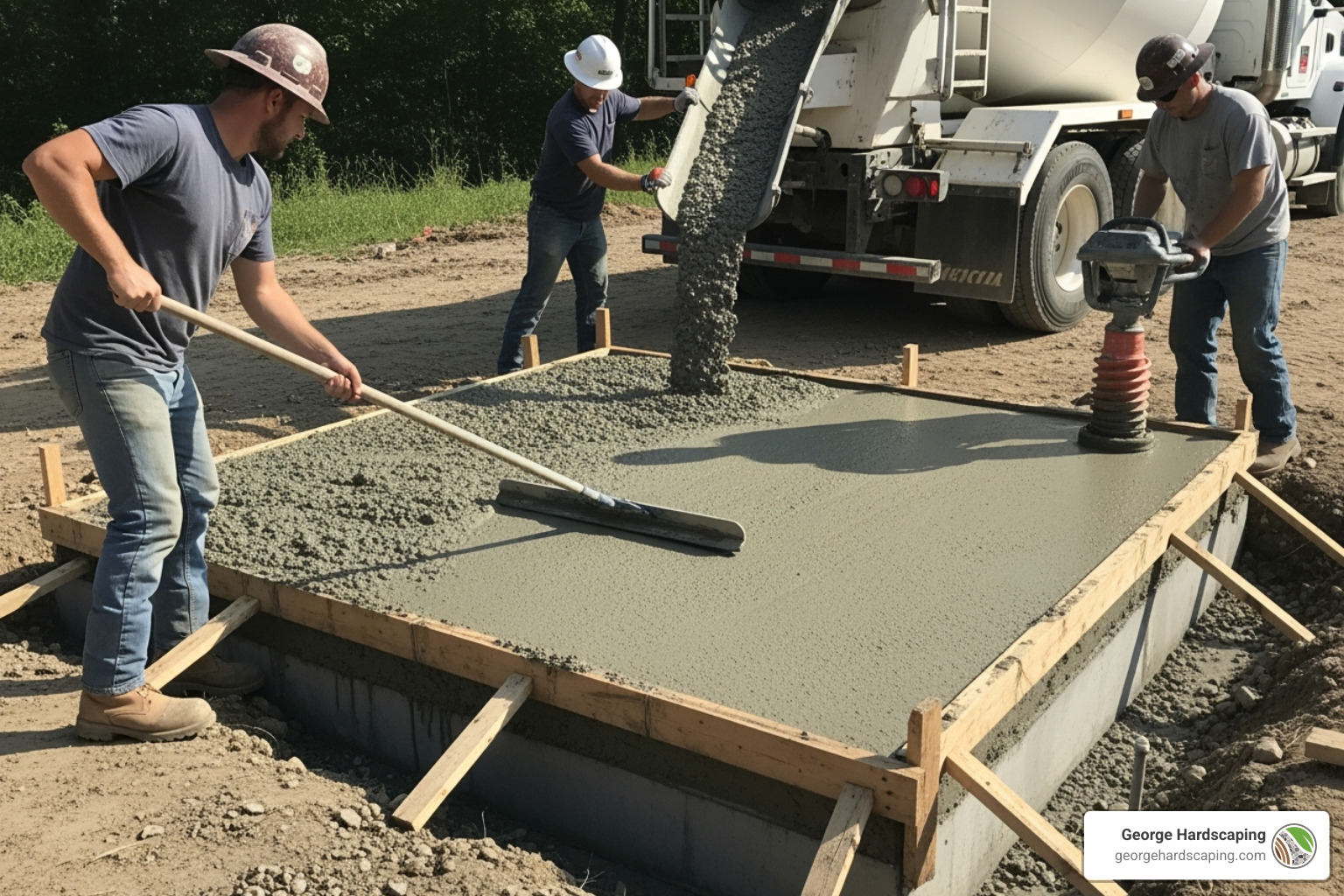
Step 1: Prepare the site and pour the foundation
A solid foundation prevents settling and cracking for a structure that can weigh 3,000–4,000 pounds or more.
1) Excavate: Mark the footprint and dig below your local frost line (use a frost depth reference map to estimate; for general guidance see: https://www.hammerpedia.com/frost-line-map/ and confirm locally). In cold climates, 42–48 inches is common, but always verify with your building department. For very large structures or soft soil, a soil test may be recommended.
2) Base prep: Add 4–6 inches of compacted gravel to promote drainage and minimize frost heaving. Maintain a level, compacted base.
3) Forms and reinforcement: Build sturdy forms (2×6 or 2×8), square the corners, and set elevations with stakes. Install a rebar grid (e.g., #4 bars at 12–16 inches on center each way), held in the middle of the slab’s thickness with rebar chairs. This reinforcement provides critical tensile strength.
4) Pour and finish: Place concrete with a minimum strength of 3,000 PSI, vibrating or rodding to eliminate voids. Screed to level, and float for a smooth, slightly textured finish. Typical slab thickness ranges from 6 to 8 inches depending on soil and load; consult local code or an engineer for large or tall structures.
5) Cure: Keep the slab damp or covered for several days to allow it to cure slowly and gain maximum strength. Wait at least a week before building on it. Treat this step with the same care you would for structural patio bases or seat walls. If you’re also upgrading a patio, coordinating pours can streamline labor—learn more about patios and fireplaces: https://georgehardscaping.com/patio-and-fireplaces/.
Step 2: Construct the firebox and base structure
The base provides mass and stability; the firebox is the heart that must withstand heat and channel smoke efficiently.
- CMU base: Lay the first course of CMUs (cinder blocks) on the slab with masonry mortar. Check level and plumb continuously and stagger vertical joints for strength. Incorporate storage niches for wood if desired, and leave knockouts or chases for future lighting or gas if part of your plan (have a licensed pro install gas).
- Firebox layout: Build the firebox with dense firebrick and high‑temperature refractory mortar, keeping joints tight (about 1/4 inch). For superior heat reflection, splay the side walls so the firebox is wider at the front than the back. This classic geometry (found in Rumford-style fireplaces) pushes radiant heat out into the seating area. A raised firebox floor improves ember management and radiant heat.
- Throat and damper: Above the firebox opening, the throat narrows to accelerate smoke into the smoke chamber. A smoke shelf behind the throat helps prevent downdrafts. Many outdoor fireplaces skip a damper, but including one can help in windy sites; verify local code. Proper throat geometry is crucial to avoid smoke roll‑out.
- Opening proportions: As a baseline, keep your opening height roughly 2/3 to 3/4 of its width. Then size the flue per recognized ratios (e.g., about 1/10 of opening area for round flues, about 1/12 for square/rectangular; outdoor settings may need slightly more). For technical guidance, consult resources from the Brick Industry Association and similar authorities: https://www.gobrick.com/.
Step 3: Build the chimney and ensure proper draft
A properly designed chimney is essential for safety and performance.
- Flue liners: Use listed ceramic, clay, or stainless steel flue liners. Set each section with refractory mortar and keep the interior surfaces smooth. Ensure the flue size matches your opening and smoke chamber geometry.
- Smoke chamber: The chamber transitions from the throat to the flue. Smooth, tapered walls help concentrate flow. Parge the interior smooth to reduce turbulence.
- Chimney shell: Build CMU or brick around the flue to create the outer structure. Maintain even bed joints and check plumb and square as you rise.
- Height and placement: Follow local regulations for termination height. The often cited 3‑2‑10 rule offers a performance benchmark; for standards and safety information see the Chimney Safety Institute of America (https://www.csia.org/) and NFPA (https://www.nfpa.org/). Outdoor, free‑standing fireplaces aren’t penetrating a roof, but adequate height and clear updraft are still critical.
- Cap and spark arrestor: Install a chimney cap to keep rain and animals out. Choose a cap with an integral spark arrestor—mesh openings commonly 1/2 inch max to prevent ember escape. Verify mesh size with your local code. A cap also reduces water infiltration that can damage the chimney.
Step 4: Apply the finishing veneer and customize
Finishes transform the structural core into a showpiece that complements your home and landscape.
- Veneer choices: Natural stone (fieldstone, ledgestone), brick, stucco, or manufactured stone. Match or tastefully contrast your home’s materials for a cohesive look. In freeze‑thaw climates, choose materials and mortars rated for exterior exposure.
- Setting veneer: For stone or brick veneer, you must first attach metal lath to the CMU block, then apply a “scratch coat” of mortar. Once that sets, you can apply the veneer. Use appropriate masonry mortar or stone adhesive per manufacturer specs. Back‑butter heavier stones and tie back to the CMU with mechanical anchors as required.
- Hearth and mantel: A noncombustible hearth in front of the opening creates a safe zone for embers. If adding a mantel, ensure adequate clearance above the opening and use noncombustibles or install a heat shield if aesthetics demand a closer placement. Verify minimum clearances with your local code official.
- Integrations: Consider tying the fireplace into seat walls or a low retaining wall to form a defined outdoor room. For structural retaining walls nearby, our team can design them to work elegantly with the fireplace massing: https://georgehardscaping.com/landscape-retaining-walls/.
Step 5: Weather management and detailing
- Water shedding: Add drip edges, slightly slope horizontal surfaces, and consider a breathable masonry sealer appropriate for your finish to reduce water absorption.
- Freeze‑thaw resilience: Ensure grade slopes away from the fireplace and keep mulch/soil off the veneer. Use de‑icing products cautiously around masonry.
CTA: Prefer a pro‑built core with perfect draft and a custom veneer? Request a design consultation and estimate: https://georgehardscaping.com/request-estimate/.
Pro tip: If you’re weighing a factory‑engineered kit, many come with matched firebox and flue geometry that’s hard to replicate on your first DIY attempt. You can still fully customize the veneer for a one‑of‑a‑kind look. For guidance, talk with our masonry specialists: https://georgehardscaping.com/hardscaping-masonry-services/.
Safety, Maintenance, and Curing
Building an outdoor fireplace is a major investment. Protect it—and your family—through proper curing, safe operation, and routine maintenance. Following respected guidance from organizations such as NFPA (https://www.nfpa.org/) and CSIA (https://www.csia.org/) helps ensure long‑term safety and performance.
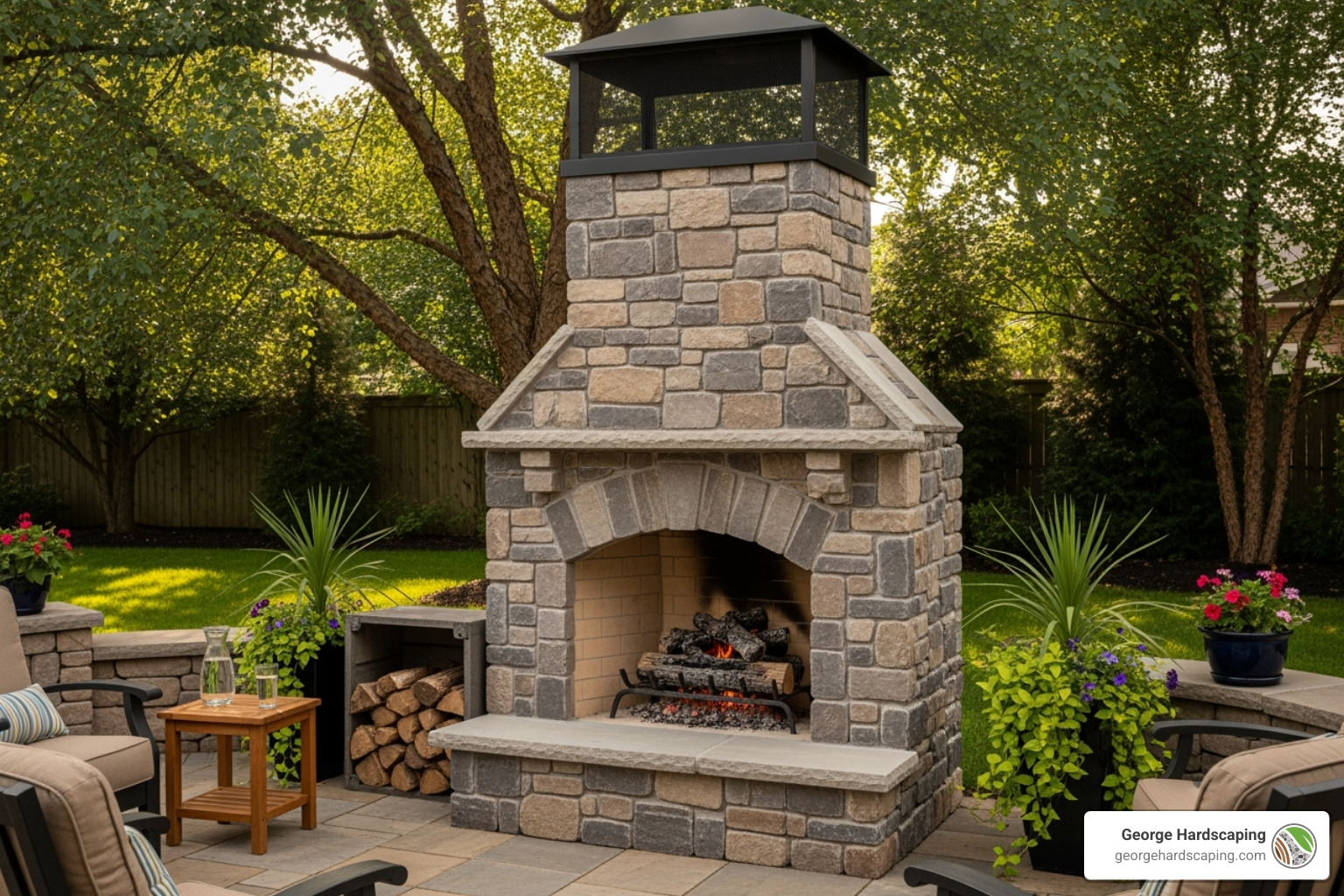
Curing the masonry
- 30‑day cure: Wait a full 30 days before lighting the first fire. Concrete and mortar contain moisture that must evaporate slowly. Firing too soon turns trapped water into steam, which can crack joints and spall veneer.
- Break‑in fires: After 30 days, start with several small, low‑heat fires of short duration. This gradual heat‑up helps the system acclimate and drives off residual moisture safely.
Fire safety essentials
- Clearances and surroundings: Keep the area around the fireplace free of combustibles—no overhanging branches, stacked firewood, or soft furnishings too close to the opening. Maintain a noncombustible hearth in front of the firebox.
- Spark control: Use a mesh screen in front of open flames and ensure the chimney cap incorporates a spark arrestor (commonly a 1/2 inch mesh maximum; verify locally).
- Supervision and tools: Never leave a fire unattended. Keep a class ABC fire extinguisher, a charged garden hose, or a sand bucket nearby. Extinguish fully before turning in for the night.
- Fuel quality: Burn only seasoned hardwood with a moisture content below 20%. Seasoned wood produces less creosote and smoke. For guidance on cleaner wood burning practices, see the EPA Burn Wise program: https://www.epa.gov/burnwise.
- CO awareness: Even outside, avoid partially enclosing the fireplace area in a way that can trap smoke or carbon monoxide. Ensure adequate air circulation.
Annual maintenance checklist
- Chimney sweeping: Have the flue inspected and swept annually by a qualified technician to remove creosote and soot that can ignite. CSIA provides consumer information on chimney safety and certified sweeps: https://www.csia.org/.
- Inspect and repair: Check for cracked mortar joints, chipped firebrick, or loose veneer. Repair small defects early to prevent water infiltration and freeze‑thaw damage.
- Cap and flashing: Inspect the chimney cap and any flashing or counter‑flashing interfaces. Replace damaged components promptly to keep water out of the system.
- Ash handling: Store cooled ashes in a metal container with a tight‑fitting lid and place it on a noncombustible surface—never on a deck or near siding. Dispose of ashes safely after several days.
- Weather protection: If desired, use a fitted, breathable cover in the off‑season to keep wind‑driven rain and snow off the fireplace face and hearth. Avoid trapping moisture behind non‑breathable tarps.
Cold‑climate tips for Essex County
- Freeze‑thaw cycles: Small cracks can quickly grow when water infiltrates and freezes. Seal repairs promptly and keep the hearth swept clean to minimize ice formation.
- Snow and ice: Do not use salt or harsh de‑icers on masonry surfaces; opt for calcium magnesium acetate or sand to improve traction.
If you prefer expert help, George Hardscaping builds to code and best practices from the foundation up. Our team can also set up a recurring inspection and maintenance schedule so your fireplace keeps performing year after year. Contact us to discuss your project: https://georgehardscaping.com/request-estimate/.
Frequently Asked Questions about Building an Outdoor Fireplace
When planning an outdoor fireplace, a handful of questions come up again and again. These answers combine practical experience with guidance drawn from authoritative references including ICC/IRC frameworks, NFPA, CSIA, and EPA Burn Wise. Always verify final requirements with your local building department.
How much does it cost to build an outdoor fireplace?
- DIY materials: A basic masonry build can start around $1,300–$2,500 for core materials (concrete, CMUs, firebrick, refractory mortar, flue liner), but premium veneer (natural stone), custom mantels, and expanded hearths can add several thousand dollars.
- Kits: Prefabricated cores often start above $1,000 and can rise quickly with size and upgraded finishes. Many homeowners choose a kit for engineered draft reliability and then invest in high‑end veneer.
- Professional installation: Typical ranges are $1,500 to $8,000+ depending on scale, finish, site access, and structural complexity. A large, custom stone fireplace with integrated seat walls or storage will trend higher. For a personalized estimate aligned with your site and design goals, request a visit: https://georgehardscaping.com/request-estimate/.
How long does it take to build an outdoor fireplace?
- Foundation cure: Allow 24–48 hours to set forms and initial cure, then several days before building on it.
- Construction: A dedicated DIYer may spend a week or more on the base, firebox, and chimney—often over a few weekends. A kit’s core may assemble in 4–5 hours.
- Finishes: Veneer, mantel, and hearth details can add several days.
- Curing: The entire structure needs a full 30 days after completion before the first fire. Expect the total project timeline to extend beyond a month from ground‑break to first burn.
Do I need a permit to build an outdoor fireplace?
- Almost always. Your city or town will specify setbacks, height restrictions, allowable materials, and inspection steps. Start with your local building department before purchasing materials.
- Importance: Permits ensure safety, code compliance, and smooth home sales and insurance coverage.
What codes or standards apply?
- Look for guidance aligned with the International Residential Code (IRC) and NFPA standards for chimneys and fireplaces. While you can’t always access full code text for free, your building department will advise on applicable sections. As a rule, follow flue sizing best practices, use listed materials, and maintain clearances from combustibles. Find NFPA resources at: https://www.nfpa.org/ and general chimney safety information at: https://www.csia.org/.
What if my fireplace smokes or drafts poorly?
- Common causes: Undersized flue relative to opening size, a smoke chamber that’s too abrupt or rough, insufficient chimney height, or strong prevailing winds at the opening.
- Fixes: Add height to the chimney, smooth/parge the smoke chamber, retrofit a wind‑rated cap, resize the opening (reduce height), or consult a pro to verify ratios. Sometimes a small design change dramatically improves draft.
What is the difference between an outdoor fireplace and a fire pit?
- The primary difference is structure and smoke control. A fireplace is a vertical structure with a firebox and a chimney designed to direct smoke up and away from the seating area. This makes them ideal for placement on patios closer to the house. They radiate heat forward, creating a cozy “outdoor living room” feel. A fire pit is an open, 360-degree fire feature, great for larger gatherings where people can circle around it like a campfire; smoke direction is dependent on the wind. We build custom versions of both: https://georgehardscaping.com/custom-outdoor-firepits/.
Can I cook in my outdoor fireplace?
- Yes, with the right accessories. While not a primary cooking appliance, many people enjoy cooking over the embers. You can use a simple freestanding grill grate inside the firebox to grill steaks or vegetables. For a more integrated solution, hardware can be built in to support a swinging grill rack. Some also use cast-iron Dutch ovens placed directly on the hot coals. Just be sure to clean up any food grease to avoid attracting pests.
Can I build an outdoor fireplace under a roof or pergola?
- Only if materials and clearances are designed for it and local code allows. Many pergolas are combustible and require generous clearances and heat shielding. In most cases, place the fireplace in the open with a safe buffer to structures and roof overhangs. Your inspector has the final say.
Is gas a better choice than wood for my yard?
- Gas wins for convenience, immediate heat, and lower maintenance. Wood wins for authenticity and higher peak heat from a big flame. Gas lines must be installed by licensed pros per code. Explore gas options: https://georgehardscaping.com/gas-fireplace-outdoor/.
How do I choose a veneer that lasts in New England weather?
- Select freeze‑thaw‑resistant materials and mortars, provide good drainage, and avoid trapped water. Natural stone and high‑quality manufactured stone both perform well when detailed correctly. Keep soil and mulch off the veneer and use breathable sealers where appropriate.
What maintenance should I plan for each year?
- Sweep the chimney (wood‑burning), inspect mortar joints and veneer, verify cap integrity, clean the hearth, and manage vegetation. Burning properly seasoned hardwood reduces creosote accumulation—see EPA Burn Wise for best practices: https://www.epa.gov/burnwise.
Can I integrate seating, storage, or an outdoor kitchen with the fireplace?
- Absolutely. Seat walls at 18–20 inches high invite conversation. Wood storage cubbies flanking the firebox are popular, and outdoor kitchens can be planned nearby for convenience. Coordinate wind and smoke direction with the grill location. For masonry integration done right, explore our services: https://georgehardscaping.com/hardscaping-masonry-services/ and https://georgehardscaping.com/patio-and-fireplaces/.
Do you offer design‑build services for fireplaces in Essex County and the North Shore?
- Yes. George Hardscaping designs and builds custom fireplaces and fire pits with code‑compliant foundations, proper drafting geometry, and beautiful, durable veneers. We also integrate patios, walkways, and walls to deliver a cohesive outdoor living space. Start your project here: https://georgehardscaping.com/request-estimate/.
Your Dream Backyard Awaits
A well‑built outdoor fireplace is more than a project—it’s the permanent campfire your household gathers around through spring blossoms, summer nights, and crisp fall evenings. When you take the time to plan site conditions, fuel type, and code details—and when you build on a solid foundation with correctly proportioned firebox and chimney geometry—you get a fireplace that drafts properly, withstands New England winters, and looks like it has always belonged in your landscape.
Whether you go all‑in on a DIY build or prefer a kit with engineered draft that you finish with custom stonework, the best results come from a holistic plan that ties the fireplace to the surrounding hardscape. That includes the patio layout, seat walls, walkways, and how guests move through the space. If you are ready to design a fireplace that complements your home and lifestyle—and gets built right the first time—our team can help with everything from permitting to the final cap.
CTA: Transform your backyard with a code‑compliant, beautiful outdoor fireplace crafted for New England weather. Request your on‑site consultation and estimate today: https://georgehardscaping.com/request-estimate/.
For homeowners across Essex County and the North Shore, George Hardscaping specializes in custom outdoor fire features, patios, walkways, and retaining walls that are as durable as they are stunning. Explore our related services for cohesive results:
- Patio and fireplaces: https://georgehardscaping.com/patio-and-fireplaces/
- Patio design and installation: https://georgehardscaping.com/patio-design-installation/
- Hardscaping masonry services: https://georgehardscaping.com/hardscaping-masonry-services/
- Custom outdoor fire pits: https://georgehardscaping.com/custom-outdoor-firepits/
- Landscape retaining walls: https://georgehardscaping.com/landscape-retaining-walls/
- Walkways and stairs: https://georgehardscaping.com/walkways-stairs/
If you can imagine it, we can help you build it—with the craft, safety, and longevity your home deserves. Ready when you are.
