
Build stone steps: 1 Ultimate Guide to Durable Steps
Why Building Stone Steps Transforms Your Property
When you build stone steps, you do more than just connect two different elevations; you create a functional work of art that fundamentally enhances your property’s value, accessibility, and safety. Whether you’re looking to tame a sloped yard, bridge the grade change between a driveway and a front entry, or link a raised patio to a sunken garden, natural stone provides a solution of unmatched durability and timeless beauty. With minimal maintenance, these steps can last for generations. Properly designed and installed steps feel solid and comfortable underfoot, are engineered to shed water efficiently, and blend seamlessly into the surrounding landscape, looking as if they’ve always been there.
For homeowners throughout Essex County, MA—from the rolling hills of North Andover to the coastal properties in Marblehead—stone steps solve a host of common landscape challenges. They replace treacherous muddy paths, deteriorating and slippery wooden stairs, and inaccessible grassy slopes with safe, elegant passage. Natural stone not only addresses these functional issues but also adds significant, lasting curb appeal that complements New England’s historic architecture and natural beauty. With thoughtful planning, your new steps can become the central spine of a larger landscape design, tying into other hardscape features such as walkways, retaining walls, patios, and outdoor living areas to create a cohesive, inviting, and navigable outdoor environment.
What truly sets professional-quality stone steps apart is the synthesis of artistry and engineering. The process is a masterclass in precision. It begins with meticulous planning of dimensions—typically a 5- to 8-inch rise and a 12- to 18-inch run for optimal comfort and safety. This is followed by careful excavation down to solid, undisturbed subgrade, the establishment of a deeply compacted and well-draining base, and the methodical setting of stones from the bottom up with exacting alignment and pitch.
Each tread must be perfectly level from side-to-side, completely solid underfoot with no rocking, and pitched forward by approximately 1/4 inch per foot. This subtle forward slope is critical for drainage, preventing water from pooling, which can lead to ice patches in winter and long-term damage from frost heave. In New England’s relentless freeze-thaw climate, this obsessive attention to drainage and base preparation is non-negotiable. As highlighted in This Old House’s guide to building stone steps, the quality of the foundation is the single greatest factor determining whether steps will last for decades or fail within a few seasons.
While a DIY approach might seem to save on labor costs, professional installation guarantees the structural integrity, proper drainage, and code-compliant design essential for long-term performance and safety. A seasoned professional anticipates and solves problems a DIYer might not even see: ensuring perfectly consistent riser heights to eliminate trip hazards, calculating the ideal overlap for dry-stacked builds to ensure mechanical strength, and seamlessly integrating the steps with adjacent features like retaining walls or patios. If you demand a fast, flawless finish with guaranteed stability, our hardscaping and masonry services provide comprehensive management, from the initial site assessment to the final installation.
This guide will walk you through every critical stage of the process—from selecting the right materials and calculating precise dimensions to constructing a bulletproof base, mastering stone-setting techniques, adding finishing touches, and performing long-term care. We’ll include expert tips tailored to the specific conditions of Essex County and provide clear calls to action for when you’re ready to bring in a professional team. Ready to transform your sloped yard into an accessible, attractive, and valuable landscape feature? Let’s begin by planning your project the right way.
Planning Your Project: Materials, Tools, and Design
The planning phase is the most critical part of any successful hardscaping project. It is the blueprint for a structure that will last for decades. Getting the design, materials, and dimensions right from the very beginning ensures you’ll be walking on solid, gorgeous stone steps for years to come. Meticulous planning also minimizes material waste, keeps the project on budget, and guarantees your steps meet the highest standards of comfort, safety, and aesthetic appeal.
Why Choose Natural Stone?
When you build stone steps, natural stone is the superior choice compared to alternatives like poured concrete or pressure-treated wood. Poured concrete, if not expertly engineered with proper reinforcement and control joints, is highly susceptible to cracking and spalling after just a few New England freeze-thaw cycles. Wood, even when treated, is prone to rot, warping, splintering, and requires frequent staining and replacement.
Natural stone, by contrast, is inherently durable, exceptionally weather-resistant, and uniquely beautiful. Each piece carries its own distinct texture, veining, and color variations that provide both stunning visual interest and natural slip resistance. These stones have endured for millions of years and will easily handle heavy foot traffic and extreme temperature swings without losing their structural integrity or character.
Popular choices for our region include:
- Granite: The gold standard for durability. This extremely dense igneous rock is highly resistant to weathering, staining, and abrasion, making it ideal for high-traffic areas. A thermal (flamed) finish creates a beautifully textured, non-slip surface.
- Bluestone: A classic choice that defines the New England aesthetic. This fine-grained sandstone offers excellent slip resistance and comes in a beautiful range of blue-gray and earthy tones that complement both rustic and formal designs.
- Fieldstone: Harvested locally, these rounded, weathered stones provide a rustic, organic look that blends perfectly into naturalistic landscapes. They are often used for riser walls with flatter capstones for treads.
- Flagstone/Sandstone: These sedimentary rocks offer warm, earthy colors and a naturally cleft surface. It’s crucial to select thicker, denser pieces (at least 2 inches thick) to withstand our freeze-thaw cycles without delaminating.
- Reclaimed Stone: Using reclaimed granite curbing or antique pavers is an environmentally friendly choice that provides instant “aged” character. The key is to ensure the pieces have a consistent enough thickness and adequate tread depth for safety and stability.
Sourcing stone from local quarries in New England often reduces transportation costs, ensures superior color harmony with the native landscape, and shortens material lead times. Well-built natural stone steps are a recognized investment that adds significant and lasting value to your property.
Cost Considerations: DIY vs. Professional Installation
Based on aggregated internet data (which does not reflect George Hardscaping’s specific pricing), the average cost to build stone steps can range from $500 for a simple, short run to over $6,000 for complex projects on steep slopes or with extensive landings. Material costs alone often run from $10 to $35 per square foot, depending on the stone type, thickness, and finish. Additional costs to factor in include aggregate for the base, landscape fabric, equipment rental, and disposal of excavated soil.
- DIY: The primary saving is on labor, but this path requires significant time, physical stamina, the ability to safely lift very heavy objects, and a high degree of precision. A small mistake in establishing the foundation, ensuring proper drainage, or calculating riser height can lead to catastrophic failure—settling, rocking stones, water damage, or dangerous trip hazards.
- Professional: While the upfront cost is higher, a professional brings invaluable expertise in reading site conditions, managing complex slopes, engineering proper drainage, and integrating features like retaining walls. A professional installation is an investment in longevity, preventing the far more expensive repairs that inevitably follow a compromised base or poor water management. Explore our hardscaping and masonry services to understand our end-to-end project management approach.
If you’re weighing your options, we offer a straightforward consultation to help align your project’s scope, budget, and timeline.
Choosing Your Stone and Step Style
Your step style sets the entire aesthetic tone:
- Dry-stacked steps: Creates a natural, organic look that can gracefully handle minor ground movement. Water drains freely through the joints, relieving hydrostatic pressure and reducing frost heave.
- Mortared steps: Offers a formal, crisp, and unified appearance. These are typically built on a concrete footing and require meticulous attention to expansion joints, drainage (weep holes), and high-quality mortar rated for freeze-thaw conditions.
- Boulder steps: Massive, monolithic slabs of stone that make a powerful, dramatic statement and minimize visible joints. Their placement requires heavy machinery and experienced operators.
Consider finishes that improve traction, such as thermal/flamed, natural cleft, or bush-hammered surfaces. For projects that need to tie into other landscape structures, see our walkways and stairs services and landscape retaining walls pages for cohesive design inspiration.
Calculating Step Dimensions for Safety and Comfort
Inconsistent step dimensions are a primary cause of falls. For comfortable and safe outdoor steps, aim for a riser height between 5 and 8 inches and a tread depth (run) between 12 and 18 inches. Consistency is the most important rule: building codes, such as the International Residential Code, typically limit the variation between the tallest and shortest risers in a single flight to a mere 3/8 of an inch.
Quick Planning Example:
- Measure Total Rise & Run: Let’s say the total vertical distance (rise) is 40 inches, and the total horizontal distance (run) is 84 inches.
- Estimate Number of Steps: Choose a target tread depth, like 14 inches. Divide the total run by this number: 84″ / 14″ = 6 steps.
- Calculate Riser Height: Divide the total rise by the number of steps: 40″ / 6 = 6.67 inches per riser. This is a comfortable and safe height, falling within the 5″-8″ range.
- Final Check: You will have 6 steps, each with a 6.67″ riser and a 14″ tread. Include landings on long runs (typically more than 10-12 steps) for rest and visual rhythm.
If your steps connect to a patio or walkway, ensure the final elevation of the top step matches the adjacent surfaces perfectly. We can assist with complex layouts and transitions as part of our walkways and stairs planning.
Gathering Essential Tools and Materials
Tools:
- Excavation: Pointed shovel, square-nosed shovel, digging bar, pickaxe, wheelbarrow.
- Measurement & Layout: 4-foot level, string line and stakes, tape measure, framing square.
- Compaction: Hand tamper (for small areas), and a plate compactor (essential for a durable base).
- Stone Setting: Rubber mallet, pry bars, lifting straps, stone chisels and hammer. For precise cuts, a masonry saw with a diamond blade and water feed is invaluable.
- Heavy Lifting: For large slabs, a skid steer or compact excavator with rated rigging is necessary for safety and efficiency.
- Safety Gear: Steel-toe boots, heavy-duty gloves, safety glasses, hearing protection, and a dust mask/respirator are mandatory.
Materials:
- Natural stone slabs for treads and/or riser stones.
- Non-woven geotextile (heavy-duty landscape fabric) to separate soil from the base.
- Crushed, angular gravel (3/4-inch dense grade aggregate or ‘crusher run’) for the structural base.
- Coarse sand or 1/4-inch stone dust for the fine-tuning bedding layer.
- Permeable backfill (clean crushed stone) and an optional perforated drainpipe for sites with significant water runoff.
Thorough planning is the best investment you can make. If you prefer a turnkey process, start with a quick conversation—we’ll evaluate your site, propose materials, and provide a clear scope of work. Ready to move forward? Request your no-obligation quote today through our Stone Steps Installation page or by filling out our Request Estimate form.
Site Preparation and Foundation: The Key to Longevity
The foundation is where 90% of DIY stone step projects succeed or fail. A solid, deeply compacted, and well-drained base is the non-negotiable secret to steps that remain stable and level for decades. This is especially true in Essex County, MA, where the annual freeze-thaw cycle can exert immense pressure on improperly installed structures, causing them to heave, shift, and ultimately fail. Preparing the site correctly is an investment that prevents settling, eliminates rocking stones, and keeps your steps safe and beautiful for a lifetime.
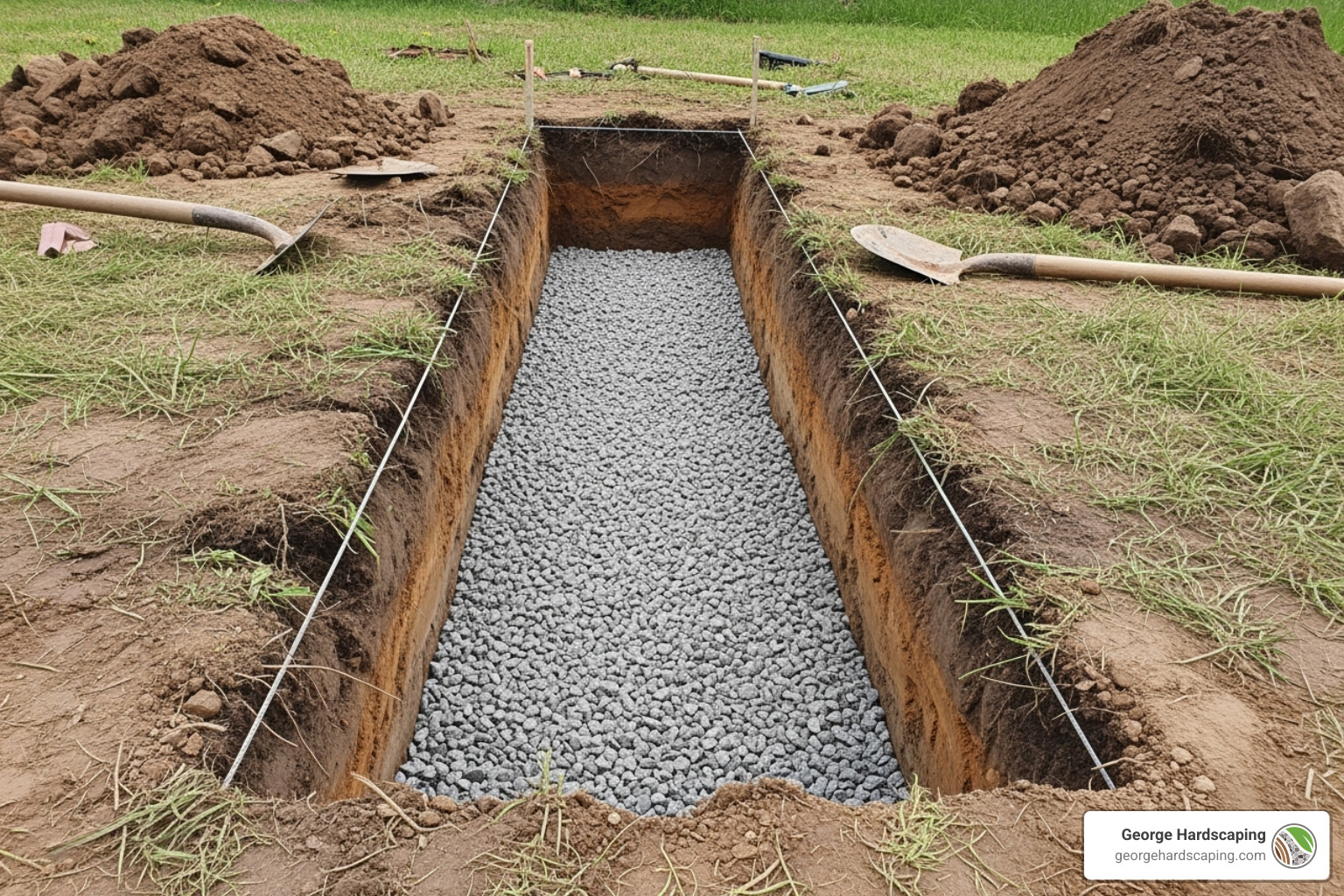
Site Assessment, Safety, and Layout
Before a single shovel of dirt is moved, a thorough site assessment is crucial. Analyze the soil conditions—is it sandy and well-drained, or heavy clay that retains water? Observe the natural drainage patterns across the slope. Mark the intended footprint of your steps using stakes and string lines, and double-check the total rise and run measurements from your plan. Safety First: Always call 811 (Dig Safe) a few days before you plan to excavate. This free service marks the location of underground utility lines, preventing a dangerous and costly accident. If your planned steps cross an area of concentrated water runoff, you must incorporate a plan to intercept and redirect that water (using swales or French drains) so it cannot erode your base.
Excavation: Clearing, Marking, and Digging Deep
Once the area is marked and cleared by Dig Safe, you can begin to build stone steps by first clearing all vegetation, rocks, and organic topsoil from the footprint. You must excavate down to a stable, undisturbed subgrade. The trench should be dug deep enough to accommodate your entire base structure plus the thickness of your first stone.
As a rule of thumb for New England, excavate a minimum of 8 to 12 inches below the finished grade of the bottom of the first step. For sites with poor, clay-heavy soils, a deeper base of 12-16 inches is recommended. The trench should also be excavated approximately 6 inches wider than the stones on each side to allow room for backfill material that will lock the edges in place.
This deep preparation is essential for mitigating frost action. As the University of Minnesota Extension explains regarding frost action in soils, when water in the soil freezes, it expands, pushing everything above it upwards (frost heave). A deep, well-drained gravel base replaces frost-susceptible soil with stable material, giving any residual moisture a place to go.
Creating a Stable, Well-Drained Base
- Geotextile Fabric: Line the entire excavated trench with a heavy-duty, non-woven geotextile fabric. This critical layer acts as a separator, preventing the native soil from mixing with your clean base aggregate. This preserves the drainage capacity of your base indefinitely.
- Base Aggregate: Add a 6- to 10-inch layer of well-graded, angular crushed stone (often called ‘crusher run’ or ‘3/4-inch dense grade’). It is crucial to use angular stone, as the sharp edges interlock under compaction to create a stable, solid mass. Do not use rounded pea gravel, which will act like marbles and never fully stabilize. Place the aggregate in 2- to 3-inch layers (lifts) at a time.
- Compaction: Using a heavy-duty plate compactor, compact each lift thoroughly. Make three to four overlapping passes over the entire surface. A properly compacted base is the key to preventing future settling. Lightly misting dry aggregate with a hose can help achieve optimal compaction, but do not saturate it.
- Bedding Layer: On top of the compacted base, add a uniform 1/2- to 1-inch layer of coarse sand or 1/4-inch stone dust. This layer is not structural; its purpose is to provide a medium for making fine adjustments when seating each heavy stone tread.
Ensuring Flawless Drainage
Proper drainage is what separates steps that last a lifetime from those that fail in five years. Without it, water will become trapped within the structure, leading to erosion, instability, and destructive frost heave. There are two primary drainage principles:
- Surface Drainage: Every stone tread must have a subtle forward pitch of about 1/4 inch per foot to actively shed rainwater away from the structure.
- Sub-surface Drainage: The voids around and behind each tread must be backfilled with free-draining, permeable material (like 3/4-inch clean crushed stone), not soil.
For steep slopes or sites with known water issues, installing a perforated drainpipe encased in washed stone behind the steps is a wise investment. This pipe should be daylighted to a safe discharge location away from the foundation of the steps and any nearby buildings.
Edge Containment and Tie-Ins
Consider how your steps will meet adjoining features. Where steps meet walkways, patios, or retaining walls, planning the transition before you start building is essential. Edge restraints, pinning the end of a tread into an adjacent wall, or extending the steps slightly into the side slopes all create crucial lateral resistance and provide a clean, finished look. Learn how we seamlessly integrate steps and walls on our landscape retaining walls page and see more cohesive design approaches in our walkways and stairs portfolio.
How to Build Stone Steps: A Step-by-Step Installation Guide
With your foundation meticulously prepared, you are ready to begin the rewarding process of placing the stone. The single most important rule when you build stone steps is to work from the bottom up. Each step you lay provides the foundation and reference point for the one that follows, creating an interlocking, stable, and functional structure that climbs the slope.
Laying the First Stone: The Cornerstone of Your Steps
The first step is the most critical. Choose your largest, flattest, and most stable stone for this bottom tread, as it will bear the load of the entire flight. Carefully place it on the prepared bedding layer and use a combination of wiggling and gentle persuasion with a rubber mallet to seat it firmly. Use a 4-foot level to check it meticulously. It must be perfectly level from side-to-side and have a slight forward pitch of approximately 1/4 inch per foot to ensure water sheds away from the steps.
If any adjustment is needed, use pry bars to carefully lift the stone and add or remove bedding material. Once the tread is perfectly positioned and does not rock or shift under your full weight, use a hand tamper to tightly pack crushed gravel along its sides and behind it. This confinement is crucial for locking it in place.
If your steps connect to an existing patio or walkway, this is the moment to confirm that your elevations are correct to ensure a seamless, trip-free transition. For inspiration on creating elegant tie-ins, browse our walkways and stairs and patio design & installation galleries.
Key Principles to Build Stone Steps Without Mortar (Dry-Stacking)
Dry-stacked steps are the preferred method for most landscape applications in New England. They rely on stone mass, friction, precise placement, and gravity rather than mortar. When built correctly, they are incredibly stable and have the flexibility to withstand minor ground movements.
- Overlap (The 2/3 Rule): Each tread must overlap the one beneath it. A minimum of 1-2 inches is required, but a better guideline is to ensure the front 2/3 of each stone is supported by the compacted base, while the back 1/3 rests on the stone below it. This provides maximum stability.
- Stability and Shimming: Every stone must be 100% stable. Eliminate any rocking or wobbling by using small, flat stone chips (called spawls or shims). Pack these chips tightly into any voids underneath the stone until it is completely solid. Re-check with your level after shimming.
- Tight Joints and Staggering: Fit stones as tightly as possible. When using multiple stones to form a single tread, stagger the joints from one course to the next (similar to a running bond in brickwork). This distributes weight and increases the overall strength of the staircase.
- Backfill As You Go: After each and every tread is set, leveled, and pitched, immediately backfill all voids behind and along the sides with free-draining gravel. Compact this backfill thoroughly to lock the stone in place before moving to the next step.
If your steps run alongside a retaining wall, embedding the ends of the tread stones directly into the wall structure provides exceptional stability and a highly integrated, professional appearance. We utilize this advanced technique in many of our landscape retaining wall projects.
Mortared Steps vs. Dry-Stacked: What’s the Difference?
Mortared steps are built on a rigid concrete footing and base, with each stone set in a bed of mortar. This creates a very formal, monolithic look. However, in a freeze-thaw climate like ours, this rigidity can be a liability. If water penetrates the structure and freezes, the expansion can crack mortar joints or even the stones themselves. If you choose this method, it is absolutely critical to use an appropriate exterior-grade, freeze-thaw-resistant mortar and to incorporate weep joints or other detailed drainage solutions to prevent trapped water.
Dry-stacked steps are more forgiving and often more durable in our climate. Their unmortared joints allow for subtle, microscopic movements with ground shifts and facilitate excellent drainage throughout the entire structure. The aesthetic is more organic and natural, and individual stones are far easier to adjust or reset years down the line if necessary. If you’re unsure which method best suits your site and desired style, request a free estimate and our experts can help you decide.
Curved Runs, Landings, and Complex Slopes
- Curves: For curved stair runs, select stones that have natural arcs or use a masonry saw to cut slight angles, allowing the steps to follow the desired radius smoothly.
- Landings: Landings are essential for breaking up long flights of stairs (more than 10-12 risers). They provide a comfortable resting spot and are a critical component of water management, acting as a large, level surface to catch and redirect runoff away from the steps below.
- Steep Slopes: On very steep slopes, the steps should be ‘benched’ into the hillside. This involves creating a series of level terraces into which the steps are built, providing much greater stability. Tying the steps directly into flanking retaining walls is often the best solution for these challenging sites. Our team regularly builds complex hillside stair systems across Essex County; see examples on our Stone Steps Installation page.
Cutting and Shaping Stone Safely
To refine the fit of a stone or adjust its depth, a wet-cut masonry saw provides the cleanest, most precise results while controlling hazardous silica dust. For a more rustic edge, traditional hammer and chisel techniques can be used to score and snap stone. Always wear safety glasses, hearing protection, heavy-duty gloves, and a NIOSH-approved respirator or dust mask when cutting or shaping stone.
Final Checks as You Build
- Continuously verify each tread’s side-to-side level and forward pitch.
- Use a tape measure to check that your riser heights remain consistent throughout the flight.
- Confirm adequate overlap and that each stone has solid bearing on the base below.
- Test each tread by walking on it firmly; re-bed and shim any stone that shifts or rocks.
For complex projects or when you want guaranteed, enduring results, trust our professional stone step installation services. We manage the entire process—from layout and heavy equipment to drainage engineering and finishing touches—so you can simply enjoy the final look without the back-breaking labor. Ready for safe, beautiful steps that last for decades? Contact George Hardscaping now for a tailored plan and clear pricing—start here: Request an Estimate.
Finishing Touches, Maintenance, and Common Mistakes
Once the final stone is placed and the heavy lifting is done, a few critical finishing details and a simple maintenance routine will ensure your new steps remain beautiful, safe, and functional for decades to come. These final touches are what separate a good project from a great one.
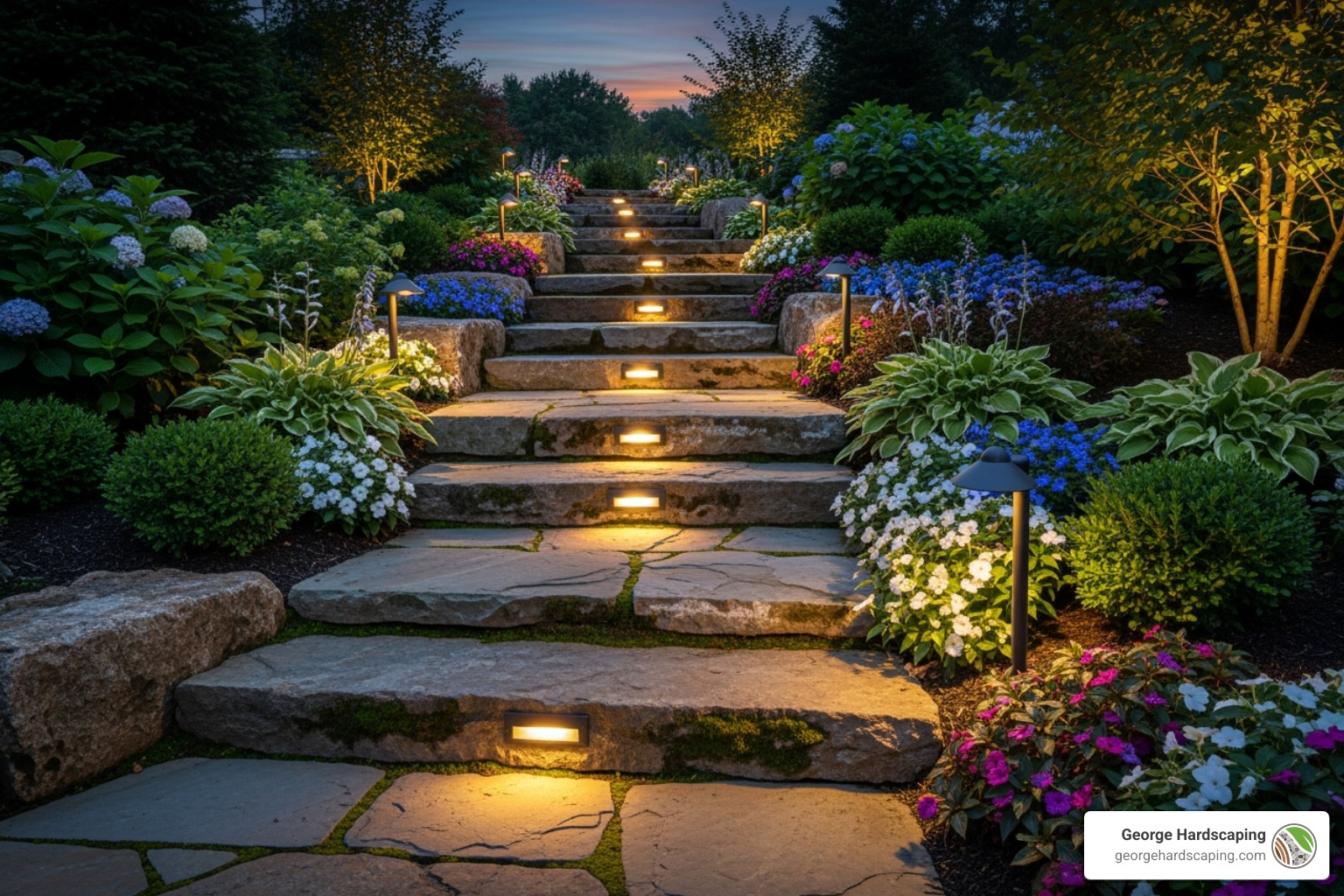
Finishing Touches for a Professional Look
- Lock in Joints and Edges: For dry-stacked steps, sweep stone dust or fine polymeric sand into the joints. Lightly mist with water to activate the binders (if using polymeric sand) or to help the stone dust settle and compact. This locks the stones together, discourages weeds, and preserves permeability.
- Soften and Stabilize with Plantings: Planting low-growing, hardy perennials along the flanks of the steps helps to control erosion, soften the hard lines of the stone, and visually integrate the structure into the garden. Good choices for Essex County include creeping thyme, sedum, creeping phlox, or ajuga. Apply mulch carefully to avoid burying the edges of the treads.
- Incorporate Landscape Lighting: Thoughtful lighting is crucial for safety after dark and dramatically enhances the beauty of your steps. Consider low-voltage LED options like lights installed under the lip of each tread, riser lights set into the face of the step, or path lights along the sides. When steps lead to a gathering space like a custom outdoor firepit or a patio, integrated lighting elevates the entire nighttime experience.
- Add Handrails (When Required or Desired): If your stair run has more than a few steps, is particularly steep, or will be used by individuals with mobility concerns, adding a sturdy, code-compliant handrail is a wise investment in safety. Wrought iron or powder-coated aluminum are durable, attractive options. For general stair provisions and handrail requirements, you can consult the ICC residential code portal.
Common (and Costly) Mistakes to Avoid When You Build Stone Steps
- Skimping on the Foundation: A shallow, poorly compacted base is the #1 cause of failure. In our climate, an 8-inch minimum depth of compacted base aggregate is essential for residential steps, and this should be increased on weak or clay-heavy soils.
- Inconsistent Riser Heights: Even a half-inch variation between steps can create a serious tripping hazard. Measure the height of every single riser as you build.
- Ignoring Water Management: Failing to pitch treads forward and backfill with permeable material is a recipe for disaster. Water will get trapped, and frost heave will destroy your work. Where runoff is a known issue, you must install a proper drain.
- Insufficient Overlap: In dry-stacked construction, failing to maintain at least 1–2 inches of overlap (and ideally more) between treads compromises the mechanical interlock and strength of the entire staircase.
- Forgetting Edge Confinement: Without proper backfilling and compaction along the sides, the steps have no lateral support. Over time, soil can erode, allowing the stones to creep outward and become loose.
- Ignoring Local Codes: Before starting, always check with your local building department to see if a permit is required for your project. You can find general guidance on the Massachusetts state building code website.
Long-Term Maintenance for Lasting Beauty
Natural stone is incredibly low-maintenance, but a little care goes a long way.
- Routine Cleaning: Sweep away leaves, pine needles, and other debris regularly to prevent staining and slippery buildup. A few times a year, a simple rinse with a garden hose is sufficient. If you must power wash, use a wide fan tip on a low-pressure setting and keep the wand moving to avoid dislodging joint material.
- Weed and Moss Control: Hand-pull any weeds that appear in joints as soon as you see them. For algae or moss in shady, damp areas, scrub the surface with a stiff brush and a mild solution of dish soap and water, then rinse thoroughly. Avoid using harsh, acid-based cleaners, which can permanently etch the surface of many types of natural stone.
- Seasonal Inspection: Each spring and fall, walk the steps and check for any shifted or rocking stones or any joints where the fill material has washed out. Minor issues can be addressed quickly before they become major problems.
- Winter Safety and Traction: Never use standard rock salt (sodium chloride) on natural stone steps. It can cause pitting and deterioration. For ice management, use sand, kitty litter, or a stone-safe de-icer like calcium magnesium acetate (CMA). Rinse away any residue in the spring.
- Sealing (Optional): Most dense stones like granite and bluestone do not require sealing. If you have a more porous stone or want extra stain resistance near a grill or dining area, use a high-quality, breathable, penetrating sealer designed for exterior natural stone. Always test in an inconspicuous area first and follow the manufacturer’s application instructions precisely.
Troubleshooting Common Issues
- A Single Settled or Rocking Stone: Carefully use pry bars to lift the affected stone. Add or remove bedding sand/dust to re-level the area, use stone shims to eliminate any wobble, and reset the stone, checking for proper level and pitch.
- Water Pooling on a Tread: The tread likely has an insufficient forward pitch. The best solution is to lift and reset the stone, adjusting the bedding material to increase the slope to ~1/4 inch per foot.
- Slippery Surfaces: The cause is usually organic buildup (algae/moss). A thorough cleaning with a brush and mild detergent will restore traction. If the stone itself is naturally smooth, consider having a professional re-finish the surface (e.g., thermal finishing) or apply a stone-safe, anti-slip treatment.
Frequently Asked Questions about Building Stone Steps
When homeowners in Essex County contact us about building stone steps, they often have similar questions about cost, durability, and the construction process. Here are detailed answers to the most common inquiries we receive.
How long do dry-stacked stone steps last?
Properly built dry-stacked stone steps can easily last for 20, 30, or even 50+ years, frequently outlasting mortared structures in our demanding freeze-thaw climate. Their incredible longevity comes from their design: they are built to be strong yet flexible. The unmortared joints allow for microscopic movements with the ground’s natural cycles, preventing the buildup of pressure that cracks rigid structures. The keys to this longevity are a deep, well-compacted foundation, generous overlap between treads, tight-fitting joinery, and excellent drainage throughout. Quality craftsmanship is what transforms a pile of rocks into a multi-generational landscape feature.
What is the average cost to build stone steps?
The cost of stone steps is highly variable and depends on three main factors: material choice, project size/complexity, and site conditions.
- Materials: The stone itself can range from $10 to $35 per square foot, depending on whether you choose a common fieldstone or a premium, thermally-treated granite. Base materials (gravel, sand, fabric) add to this cost.
- Project Cost: Based on aggregated internet data, simple projects (3-4 steps on a gentle slope) might range from $500 to $2,200. However, large or complex jobs that involve steep slopes, heavy machinery access, extensive landings, or integration with retaining walls can exceed $6,000. Note: These are industry averages and not George Hardscaping’s prices; we provide a detailed, fixed-price quote for every project.
- Site Conditions: Difficult site access, the need to navigate around mature tree roots, extremely rocky soils requiring hydraulic breaking, or very steep grades will all increase the labor and equipment time required.
For a precise, reliable quote tailored to your specific property, the best first step is to Request a Free Estimate from our team.
Can I build stone steps on a steep slope?
Absolutely. In fact, stone steps are one of the best and most beautiful solutions for taming a steep, unusable hillside and turning it into a safe, accessible, and attractive walkway. Building on steep grades requires advanced techniques, including creating ‘benches’ or terraces in the slope for a stable foundation, ensuring the base is even deeper than on a gentle slope, and almost always incorporating flanking Landscape Retaining Walls for essential lateral support. Advanced drainage, such as installing a French drain behind the steps, is also critical to manage the increased water runoff and protect the structure from erosion and hydrostatic pressure.
Do I need a permit or handrails for my stone steps?
This depends on your specific municipality and the location/function of the stairs. Generally, steps leading to a primary entrance of a home are more likely to require permits and code-compliant handrails than a small set of steps in a garden. The number of risers is also a factor (e.g., flights with more than 3 or 4 risers often trigger handrail requirements). It is always best to verify the specific rules with your local building department before beginning work.
Are mortared steps better than dry-stacked?
Neither method is universally “better”; they are simply different construction styles suited for different applications and aesthetics. Mortared steps offer a crisp, formal look and are completely rigid. They are best suited for formal entryways but demand expert installation to manage drainage and expansion in our climate. Dry-stacked steps excel in flexibility, natural drainage, and organic aesthetics, making them the superior choice for most garden and hillside applications in New England. We are experts in both methods; you can see examples of each on our Stone Steps Installation page.
What is the ideal width for stone steps?
For a main walkway, a width of 4 feet is comfortable, allowing two people to pass. For secondary garden paths, a width of 3 feet is generally sufficient for a single person. The key is to keep the width proportional to the scale of the house and surrounding landscape.
How do you ensure the steps aren’t slippery?
This is a critical safety consideration. We address it in three ways: 1) Material Selection: We recommend stones with a naturally textured surface, like a natural cleft or a thermal finish, which provide excellent traction. 2) Proper Pitch: Ensuring each tread has a positive forward pitch prevents water and ice from pooling on the surface. 3) Maintenance: Keeping treads clean of organic debris (algae, wet leaves) is essential. Good lighting also prevents missteps—we often integrate lighting into steps connected to patios or walkways.
How long does a professional installation take?
A small, straightforward project of 3–5 treads can often be completed in 1–2 days by a skilled crew. Larger, more complex runs with landings, curves, significant excavation, or wall tie-ins may take several days to two weeks, depending on the scope and weather conditions.
Can you reuse existing stones from my property?
Often, yes! Reusing existing stone is a great way to reduce material costs and create a look that is instantly at home in your landscape. During our site visit, we will evaluate your existing stones to ensure they are sound, sufficiently thick, and appropriately sized for use as treads or risers.
How do I get started?
The process is simple. Start by gathering a few photos of the area and thinking about the general style you prefer (e.g., rustic fieldstone vs. formal granite). Consider how the steps will connect to other parts of your yard, like walkways, walls, or patios. Then, contact us for a professional design consultation and a detailed quote. Get your custom plan and pricing today—start here: Request an Estimate.
Transform Your Landscape with Expertly Built Stone Steps
Building stone steps is a significant investment in your property’s long-term beauty, safety, and financial value. From the crucial engineering of the rise and run to the meticulous preparation of a deep, frost-resistant foundation and the artful placement of each heavy stone, every detail in the process matters. Well-built stone steps do more than just solve an accessibility problem on a slope—they elevate your entire landscape, creating elegant transitions, defining outdoor rooms, and adding a powerful statement of timeless craftsmanship and quality.
Throughout this guide, we’ve covered the essential principles for achieving longevity: deep base compaction, multi-faceted drainage strategies, absolute consistency in riser heights, and intelligent tie-ins with surrounding features like patios, walkways, and walls. While the process can be understood in theory, flawless and lasting execution requires deep experience, specialized heavy equipment, and a designer’s eye—all of which are especially critical when tackling the steep slopes and challenging freeze-thaw cycles of the New England climate.
If you want durable, code-aware, and breathtakingly beautiful results without the risk and back-breaking labor of a DIY attempt, partner with the seasoned experts at George Hardscaping. We bring the knowledge, tools, and passion needed to build steps that will serve your family for generations. Schedule your on-site assessment and receive a detailed, written estimate for your project today: Request Your Free Estimate.
Curious about how stone steps can integrate into a larger vision for your property? Explore our full range of hardscaping and masonry services, including our specialized stone steps installation, elegant walkways and stairs, robust landscape retaining walls, and inviting patio design & installation. We are proud to serve homeowners across Essex County, MA—see all the communities we work in on our Where We Work page.
Let’s build something beautiful and enduring together.
