
Laying Cobblestone Walkway: 7 Flawless Steps
The Enduring Charm and Unmatched Durability of Cobblestone
Laying cobblestone walkway is more than a home improvement project; it’s an investment in timeless beauty and enduring strength. These natural stone pathways have graced properties for centuries, offering a rustic, old-world charm and a level of longevity that modern materials can only attempt to replicate. The inherent irregularity and unique character of each stone ensure that every installation is a one-of-a-kind work of art, significantly boosting your property’s value and curb appeal.
Whether your home is a classic New England Colonial, a charming Cape Cod, or a modern farmhouse, a cobblestone path provides a perfect, authentic-feeling transition from the landscape to your front door. For a deeper dive into the material’s rich history and global use, the overview of cobblestones on Wikipedia is an excellent resource.
Antique cobblestones carry a proven track record, having survived centuries of heavy traffic on historic European and American streets. Today’s reclaimed and newly quarried cobblestones offer that same nearly indestructible quality, making them a wise investment that will last for generations. Unlike poured concrete that cracks or asphalt that degrades, cobblestones are incredibly stain-resistant, easy to maintain, and develop a beautiful patina over time. They are, in essence, a permanent upgrade.
While the process demands patience and attention to detail, most ambitious homeowners can successfully complete a cobblestone walkway using the dry-laid method. This traditional technique involves setting the stones in a bed of sand rather than rigid mortar. This flexible approach is not only more forgiving for DIYers but also superior for climates like ours.
It allows for easy repairs, prevents widespread cracking from frost damage, and offers the immense satisfaction of creating something beautiful and lasting with your own hands. In New England’s notorious freeze-thaw climate, a dry-laid assembly is especially resilient because it can flex and move with the ground instead of breaking, ensuring your walkway remains stable year after year.
In addition to their classic good looks, cobblestone paths bring a host of practical benefits:
- Generational Durability: Withstands all seasons, including the harsh freeze-thaw cycles typical of coastal Massachusetts.
- Natural Safety: The textured, irregular surface provides excellent slip resistance in wet or icy conditions.
- Simple Maintenance: Repairs are as easy as lifting a single stone, adjusting the base, and resetting it.
- Aesthetic Versatility: Complements both traditional and modern landscapes, from formal gardens to rustic woodland paths.
Quick Overview: Laying a Cobblestone Walkway
- Excavate: Dig a trench 9-10 inches deep to accommodate a robust foundation.
- Install Base Layers: Add and compact 4-6 inches of gravel, followed by a 1-2 inch sand setting bed.
- Place Cobblestones: Carefully set each stone, maintaining consistent 1/4- to 1/2-inch gaps.
- Level the Surface: Use a rubber mallet and a level to create a flat, walkable plane, adjusting sand as needed.
- Fill the Joints: Sweep polymeric sand into the gaps and compact the entire surface.
- Secure with Edging: Install restraints along the perimeter to prevent the stones from shifting over time.
Whether you’re creating a grand entrance from your driveway to your front door or a charming garden path, cobblestone offers unparalleled versatility. For more detailed guidance on general stone installation, see our guides on how to install stone walkway and preparing the proper base for flagstone walkway.
What follows is a detailed, step-by-step guide vetted by professional masons and customized for the specific soil and weather conditions we face here in New England. If you prefer a turn-key solution built by specialists who guarantee perfection, we also share how George Hardscaping can bring your vision to life at the end of this guide.
Planning Your Project: Materials, Tools, and Design
Success in laying cobblestone walkway is built on a foundation of thorough planning. This crucial first phase ensures you have the right materials in the right quantities, a clear and functional design, and a realistic budget to see the project through to completion without costly surprises.
Choosing Your Cobblestones
The stone you select is the heart of your walkway, defining its beauty, feel, and longevity. Each type has unique characteristics:
- Granite Cobblestones: Considered the gold standard for durability, granite is an igneous rock that withstands weather extremes, de-icing salts, and heavy traffic without chipping or degrading. It’s available in various colors (gray, pink, black) and finishes, such as tumbled for an aged look or thermal for a more uniform, slip-resistant texture.
- Sandstone Cobblestones: This sedimentary rock offers a softer, warmer color palette with beautiful earthy tones and natural stratification. It’s durable enough for residential walkways but is more porous than granite and may benefit from a sealant in high-moisture areas to prevent staining or moss growth.
- Bluestone Cobblestones: A type of sandstone or flagstone prized for its sophisticated blue-gray hues, bluestone is a versatile choice that fits well with both modern and classic designs. It provides a relatively flat surface for a cobblestone but still retains natural texture.
- Reclaimed Antique Cobblestones: Salvaged from historic streets in the US and Europe, these stones offer unparalleled character and proven durability. Each stone tells a story, but they come at a premium price and can have greater size and thickness variations, requiring more skill to install.
- Manufactured Pavers: Concrete pavers can mimic the look of cobblestones at a more budget-friendly price point. While they lack the unique character and longevity of natural stone, some come in interlocking sheets that can speed up installation for DIYers.
When choosing, prioritize durability for a path that lasts a lifetime. Cost varies significantly, from manufactured pavers on the low end to reclaimed antique stones at the top. Always factor in local availability to avoid high shipping costs. For more guidance, explore our comprehensive guide to natural stone pavers.
Sizing and Patterns:
Cobblestones come in various sizes, typically categorized as Regulation (approx. 4″x5″x9″), Jumbo (approx. 4″x7″x10″), and Cubes (approx. 4″x4″x4″). The size you choose affects the pattern and overall look. Common patterns include:
- Running Bond: A classic, simple pattern with staggered joints.
- Random or Irregular Layout: Creates an authentic, old-world feel but requires careful placement to avoid awkward gaps.
- Herringbone or Basketweave: More complex patterns that offer excellent interlocking strength and resistance to movement.
Essential Tools and Materials
Tools Checklist:
- Excavation: Heavy-duty shovel, pickaxe (for rocky soil), wheelbarrow, tape measure.
- Base Preparation: Hand tamper for small areas, or a plate compactor (highly recommended; rental costs ~$80/day) for superior compaction and a long-lasting base.
- Placement & Leveling: Rubber mallet, 4-foot level, stakes and string line, two 1-inch O.D. metal pipes to use as screed rails, and a straight 2×4 for screeding.
- Cutting: Mason’s hammer and chisel for rough splits, or an angle grinder/wet saw with a diamond blade for precise cuts.
- Safety Gear: Steel-toed boots, work gloves, knee pads, safety glasses, and hearing protection (when cutting).
Materials Checklist:
- Cobblestones: Calculate your square footage and order 10-15% extra to account for cuts, mistakes, and future repairs.
- Gravel Base: 3/4-inch minus crushed angular stone (also called processed gravel or crusher run).
- Sand Setting Bed: Coarse, washed construction sand (concrete sand).
- Joint Filler: Polymeric sand is strongly recommended for its durability and weed-deterring properties.
- Geotextile Fabric: A high-quality, non-woven landscape fabric to separate soil from gravel.
- Edging Restraints: Heavy-duty plastic, steel, aluminum, or stone edging with anchoring spikes.
Designing and Budgeting Your Walkway
Good design marries form and function. A 36-inch width is comfortable for single-person traffic, while 48 inches allows two people to walk side-by-side. Straight paths create formal, clean lines and are simpler to lay out. Curved paths offer a more organic, flowing feel but require more careful planning and cutting.
Consider these critical design details:
- Slope and Drainage: Ensure the path slopes away from your home’s foundation (a 1/4-inch drop per foot is standard).
- Border Course: A border of contrasting or differently oriented stones adds a professional, finished look and enhances stability.
- Transitions: Plan clean, safe transitions to driveways, patios, and steps.
- Lighting: If you plan to add path lighting, pre-plan the route and install conduit for low-voltage wiring before you build the base.
For a DIY project, your budget should include material costs, delivery fees, and tool rentals. To estimate materials, calculate the total volume needed for your base layers (Length x Width x Depth) and convert to cubic yards. Your local landscape supplier can help you with these calculations. For design inspiration, explore our gallery of paver walkway ideas.
Want professional design and installation? Get a no-hassle quote from our North Shore team. Request your free estimate and we’ll help you compare stone options and create a detailed budget.
Groundwork: Preparing a Stable and Level Foundation
The longevity, stability, and appearance of your cobblestone walkway depend almost entirely on the quality of its foundation. A solid, well-drained base is non-negotiable; it is the single most important factor in preventing shifting, sinking, and frost heave. Skipping or rushing these steps will guarantee failure.
Before you break ground, it is legally required and essential for your safety to have underground utilities marked. In Massachusetts, you can do this for free by calling 811 or visiting the Dig Safe website at least 72 hours before you plan to excavate.
Step 1: Excavation and Site Preparation
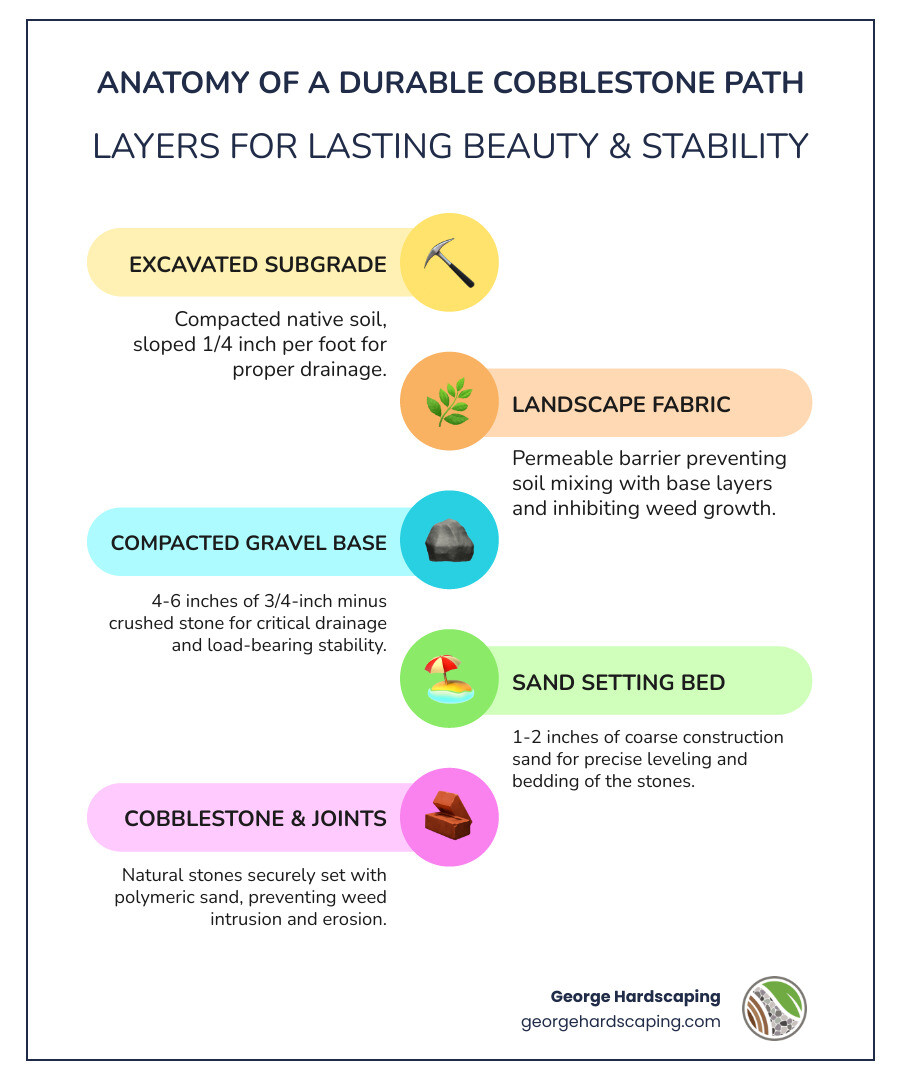
First, mark your path’s layout with stakes and a mason’s string line. For curves, a flexible garden hose can help you visualize and mark the shape. Once marked, excavate to a depth of 9-10 inches from your desired finished surface level. This depth is crucial and accommodates the full thickness of your cobblestones (e.g., 4-5 inches), the sand bed (1-2 inches), and the gravel base (4-6 inches).
As you excavate, it’s critical to establish a slight slope for drainage—aim for a drop of 1/4-inch per foot, directing water away from your house foundation or other structures. Use your level and tape measure frequently to check both the depth and the slope of the trench floor. Remove all grass, roots, large rocks, and organic matter from the excavated area. Once the trench is clear, compact the subgrade soil with a hand tamper or plate compactor. A firm subgrade is the starting point for a stable path.
Your local soil conditions will influence your approach:
- Clayey Soils: These soils hold water and are prone to frost heave. Consider increasing your gravel base to 6-8 inches for better drainage and stability.
- Sandy Soils: These drain well but can be loose. Compaction is key; water the soil lightly and compact it in thin layers (lifts) to achieve maximum density.
- Wet or Low-Lying Areas: If the area is persistently damp, you may need to install a French drain alongside the walkway to carry excess water away.
Step 2: Building the Foundation Layers
A proper foundation is a multi-layer system. Do not deviate from this process.
- Install Geotextile Fabric: Lay a high-quality, non-woven geotextile (landscape) fabric across the entire compacted subgrade. This layer is vital for separation—it prevents the gravel base from sinking into the soil over time while still allowing water to pass through. Overlap any seams by at least 12 inches.
- Add the Gravel Base: Spread a layer of 4-6 inches of 3/4-inch minus crushed angular gravel. It is critical to use angular, not rounded, stone because the sharp edges interlock under compaction to form a strong, stable base. Add the gravel in 2-inch lifts (layers), and use a plate compactor to thoroughly compact each lift before adding the next. This methodical compaction is the secret to preventing future settlement.
- Create the Sand Setting Bed: Spread 1-2 inches of coarse, washed construction sand over the fully compacted gravel base. This layer is not for structural support; its purpose is to create a perfectly smooth and level plane for setting the cobblestones. To level it, place two 1-inch outer-diameter metal pipes on the gravel, parallel to each other. Pour the sand between them and use a straight 2×4 to screed the sand, dragging the board along the pipes to create a perfectly flat surface. Remove the pipes and carefully fill in the voids with sand.
Once the sand is screeded, do not walk on it or disturb it. This meticulously prepared base is the key to success when laying cobblestone walkway. For additional insights into base preparation, a resource like This Old House’s guide on laying a stone patio provides excellent visuals of the screeding process. For complex projects involving slopes or drainage, George Hardscaping brings years of professional experience to every sidewalk construction project.
Quality Check Before Laying Stones:
- Confirm the gravel base has a uniform depth and is compacted rock-solid.
- Double-check the final slope of the screeded sand bed with a 4-foot level.
- Ensure the edges of your prepared base are straight and well-defined.
The Art of Laying Cobblestone Walkway
With the critical foundation work complete, the creative and rewarding process of laying cobblestone walkway can begin. This stage is where your path’s personality comes to life. Patience and a methodical approach are your best tools here.
Step 3: Techniques for Laying Cobblestone Walkway
Before you place a single stone, take a moment to prepare. If you’re using natural cobblestones, they will vary in thickness. Sort your stones by approximate thickness into different piles. This simple step makes it much easier to achieve a level surface later on. Always begin laying stones from a fixed edge, such as your porch, an existing patio, or the driveway. This provides a stable starting point to work from.
When setting the stones, place them straight down into the sand bed; do not slide or wiggle them into place. Sliding them will disrupt the carefully screeded sand surface. For straight sections, use a taut string line stretched between stakes as your guide to keep your courses perfectly aligned. Maintain a consistent joint spacing of approximately 1/4 to 1/2 inch. This not only looks professional but also ensures there is enough room for the jointing sand to lock the stones together effectively.
Your chosen pattern will guide your process:
- Running Bond: Lay a full row, then start the next row with a half-stone to stagger the joints. This is a strong, classic choice.
- Random Pattern: This requires more artistry. Mix different sizes and shapes, consciously avoiding long, continuous joint lines (which are weak points) and clusters of similarly sized stones. Step back frequently to assess the overall look.
- Border Course: Installing a border first can help contain the main field of stones and provides a clean, finished edge. It’s especially helpful for defining curves.
When creating curves, work in short, fanned-out segments. The joints on the outside of the curve will be slightly wider than the joints on the inside. For tight curves, you will need to use smaller stones or make precise cuts.
Cutting Cobblestones:
- Rough Cuts: For a rustic look or for splitting stones in half, use a mason’s hammer and a sharp bolster chisel. Score a line around the stone, then give it a firm strike.
- Precise Cuts: For clean edges against a border or structure, you’ll need a power tool. An angle grinder with a diamond blade is effective for making a few cuts, while a rented wet saw is the best choice for numerous or very precise cuts. Always wear safety glasses, a dust mask, and hearing protection when cutting stone.
Step 4: Achieving a Level Surface with Uneven Stones
One of the greatest challenges—and rewards—of working with natural cobblestones is creating a functionally flat, safe walking surface while preserving their beautiful, irregular character. The goal is a surface that is level overall, not perfectly flat like a sheet of glass.
Use a 4-foot level constantly, checking your progress across multiple stones at a time. A rubber mallet is your primary tool for fine adjustments. A few firm taps will settle a high stone deeper into the sand bed. If a stone sits too low, lift it out, add a small amount of sand underneath, and reset it. Never try to force a stone into place; let the sand and gravity do the work.
Work systematically from the stones you’ve already set, using them as a reference. Kneel on a piece of plywood placed over the laid stones to avoid disturbing your work. Periodically, stand back and view the walkway from a distance to check for any noticeable dips or high spots, and ensure the overall pitch for drainage is being maintained.
Embrace the natural imperfections that give cobblestone its unique charm. Your focus should be on eliminating any significant height differences that could become tripping hazards (‘lippage’), while allowing the subtle, rolling variations that define an authentic stone path. For more inspiration on how natural stone can be beautifully integrated into your landscape, see our flagstone walkway and stairs projects.
Tips for an Efficient Workflow:
- Lay out a few stones ahead of where you are working to plan your pattern.
- Keep your tools (mallet, level, trowel) within easy reach.
- Have a bucket of sand nearby for making small adjustments.
- Keep a damp sponge or brush handy to clean any sand or dust off the stone faces as you work.
Finishing Touches and Long-Term Care
The final steps in the installation process are what lock your hard work into place, ensuring your new walkway is durable, stable, and easy to maintain for decades to come.
Step 5: Installing Edging and Filling Joints
Installing proper edging is not an optional step; it is a critical structural component that prevents the lateral shift and spreading of your cobblestones over time. It acts as a frame, holding the entire system together. Options include:
- Plastic Edging: An affordable and flexible option, good for curves. Choose a heavy-duty commercial grade for best results.
- Metal Edging (Steel or Aluminum): More durable and less visible than plastic, providing a very clean, crisp line.
- Stone Edging: Using a border of larger stones (like granite curbing) or setting a soldier course of cobbles in concrete provides the most robust and aesthetically integrated edge.
Secure the edging firmly against the cobblestones, anchoring it with the provided spikes every 8-12 inches.
Next, you will fill the joints using polymeric sand. This specially formulated sand contains polymers that, when activated with water, harden to form a firm yet flexible bond. This is far superior to regular sand, as it locks the stones together, dramatically reduces weed growth, deters ants, and resists erosion from rain and wind.
Applying Polymeric Sand – A Step-by-Step Guide:
- Ensure the Surface is Dry: The cobblestones and joints must be completely dry before you begin.
- Spread the Sand: Pour the sand over the walkway and use a stiff-bristle push broom to sweep it into every gap and crevice. Work from multiple directions to ensure joints are filled to the top.
- Compact the Sand: Run a plate compactor over the entire walkway. This vibrates the sand deep into the joints, eliminating any air pockets. You will need to add more sand and sweep again, as the level will drop after compaction.
- Remove Excess Sand: Use a leaf blower on a low setting, held at a shallow angle, to blow all residual sand and dust off the surface of the stones. Any sand left on top will harden and create a hazy film.
- Activate with Water: Set your hose nozzle to a gentle ‘mist’ or ‘shower’ setting. Lightly mist a small section (e.g., 10’x10′) to pre-saturate the joints. Then, go back over the same area with a more thorough soaking, allowing the water to penetrate the full depth of the joint. Follow the manufacturer’s specific instructions for watering.
Allow the polymeric sand to cure for 24-48 hours (or as directed by the manufacturer) before walking on the path or allowing it to get rained on. A well-built walkway can beautifully connect to other hardscaped surfaces, as seen in our driveway paver ideas.
Step 6: Maintaining Your Cobblestone Walkway
Cobblestone walkways are remarkably low-maintenance, but a little care goes a long way:
- Regular Cleaning: Sweep weekly with a stiff broom to remove leaves and debris that can stain the stones or decompose in the joints.
- Washing: For heavier dirt, scrub with a mild detergent and a soft-bristle brush, or use a pressure washer on a low setting with a wide-angle nozzle, being careful not to blast out the joint sand.
- Stain Removal: Address oil or grease stains promptly with a specialized stone degreaser. Rust stains can be treated with commercial rust removers.
- Joint Touch-Ups: Inspect the joints annually. If you see any areas where the sand has settled or eroded, top them off with fresh polymeric sand.
- Stone Repair: The beauty of the dry-laid method is the ease of repair. If a stone ever settles or becomes unstable, simply use two screwdrivers to pry it up, add or remove sand underneath, and reset it.
- Winter Care: Use calcium chloride or other non-corrosive de-icers sparingly. Avoid rock salt (sodium chloride), which can damage the stone and surrounding plants. The natural texture of cobblestone often provides enough traction on its own.
Step 7: Enhancing Your Path with Landscaping and Lighting
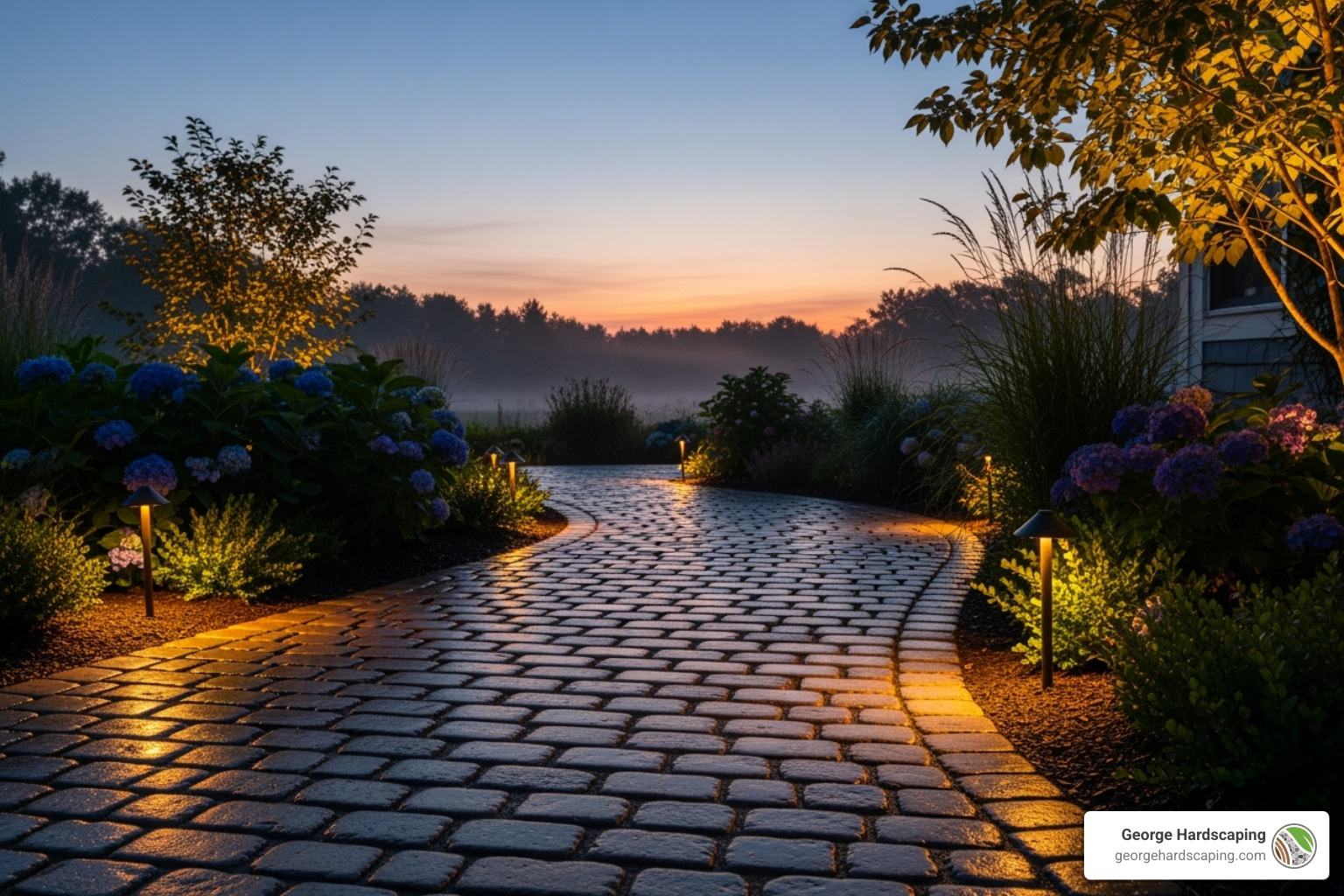
Elevate your new walkway from a simple path to a stunning landscape feature. Plant low-growing, durable groundcovers like creeping thyme, sedum, or Irish moss along the edges to soften the transition to your garden beds. Pathway lighting not only adds beautiful ambiance for evening enjoyment but also significantly improves safety. Simple solar-powered lights are easy to install, while a professionally installed low-voltage system offers greater control, durability, and a more polished look.
Prefer a professional installation from start to finish? Our crew builds premium walkways across the North Shore. Request your free estimate and we’ll craft a timeless path custom-designed for your home.
Frequently Asked Questions about Laying a Cobblestone Walkway
Over the years, we’ve helped countless homeowners with their laying cobblestone walkway projects, both as advisors and as professional installers. Here are detailed answers to the most common questions we hear, designed to help you approach your project with clarity and confidence.
How deep do you need to dig for a cobblestone walkway?
For a pedestrian walkway, you must excavate 9 to 10 inches deep from your desired finished surface level. This depth is not a suggestion; it is an absolute requirement for creating a stable, long-lasting foundation in a climate with frost. This space is precisely calculated to accommodate:
- 4-6 inches for the compacted gravel base, which provides drainage and structural support.
- 1-2 inches for the sand setting bed, which allows for precise leveling.
- The thickness of the cobblestones themselves (typically 3-5 inches).
A foundation built to this depth creates a frost-resistant base. In winter, water in the soil freezes and expands, pushing the ground upward (frost heave). A deep gravel base allows this water to drain away, preventing the freeze-thaw cycle from heaving, shifting, or sinking your path and saving you from costly and frustrating future repairs.
What is the best base for a cobblestone walkway?
The best and only correct base is a multi-layer system designed for maximum stability and drainage. It is built upon the compacted native soil (subgrade) and consists of three distinct layers:
- Geotextile Fabric: Laid directly over the compacted subgrade, this fabric acts as a separator. It prevents your expensive gravel base from mixing with the soil below while allowing water to drain through freely. It also provides an additional barrier against deep-rooted weeds.
- Compacted Gravel Base (4-6 inches): This is the structural core of your walkway. Use angular, crushed gravel (such as 3/4-inch processed gravel or ‘crusher run’) compacted in 2-inch lifts with a plate compactor. The angular shape is critical, as the stones interlock to form a solid, stable mass that distributes weight and resists movement.
- Sand Setting Bed (1-2 inches): This is a layer of coarse construction sand that is screeded perfectly level (with a slight pitch for drainage). Its purpose is not structural; it is a medium that allows you to easily set each individual cobblestone to the correct height.
Can you lay cobblestones directly on dirt?
Absolutely not. You should never lay cobblestones directly on dirt or topsoil. Attempting to do so is the most common and catastrophic mistake a DIYer can make. It is a guaranteed recipe for complete failure. Without a proper gravel and sand foundation, your walkway will immediately begin to suffer from numerous problems: the stones will shift and sink unevenly within weeks, creating a lumpy, unprofessional appearance and a dangerous tripping hazard.
Weeds will grow uncontrollably through the joints. Most critically, in a climate with freezing temperatures, frost heave will violently push the stones out of place each winter, completely destroying the path. Taking this shortcut will ultimately create far more work and expense when the entire walkway has to be torn up and reinstalled correctly from scratch.
What is the difference between a dry-laid and a wet-laid cobblestone walkway?
This is a crucial distinction. The method described in this guide is the dry-laid method, which is highly recommended for most residential applications, especially in New England.
- Dry-Laid: Stones are set on a base of compacted gravel and a sand bed, and the joints are filled with sand (preferably polymeric). This creates a strong but flexible pavement system that can move slightly with the ground during freeze-thaw cycles without cracking. It’s more forgiving for DIY installation and makes future repairs incredibly simple.
- Wet-Laid: Stones are set in a rigid mortar bed over a concrete slab, and the joints are filled with mortar. This creates a completely rigid, solid surface. While it can be appropriate for certain applications (like stair treads or areas needing heavy wash-downs), it is far more expensive, requires professional skill to install correctly, and is highly susceptible to cracking in cold climates if not built with extensive control joints and a deep, reinforced concrete base. For a walkway, the flexibility of a dry-laid system is almost always superior.
How much does a cobblestone walkway cost?
The cost can vary dramatically based on materials, site complexity, and whether you DIY or hire a professional.
- DIY Costs: Your main expenses will be materials. Cobblestones themselves can range from $8-$15 per square foot for new manufactured or imported stone, to over $25-$40 per square foot for reclaimed antique cobblestones. Base materials (gravel, sand, fabric) will add another $3-$5 per square foot. Don’t forget tool rentals (plate compactor, wet saw).
- Professional Installation: A professionally installed cobblestone walkway typically costs between $40 and $75+ per square foot. This all-inclusive price reflects not just the materials, but also the labor for excavation, hauling away soil, expert base preparation, precision stone setting and cutting, and a guarantee of quality workmanship. While the upfront cost is higher, it ensures the walkway is built to last a lifetime.
Do I need edging on a cobblestone walkway?
Yes, edging is essential. It acts as the frame that holds the picture together, preventing the outer stones from shifting and the joints from widening over time. Whether you choose affordable plastic edging, sleek metal edging, or a decorative stone border, it must be securely anchored to provide the necessary lateral support.
How do I handle curves without unsightly gaps?
For gentle, sweeping curves, you can accommodate the radius by slightly fanning the joints—making them wider on the outside of the curve and tighter on the inside. For tighter radii, you will need to use smaller stones or make tapered cuts to a few stones with a wet saw to keep the joints consistent and the curve smooth.
Should I seal a cobblestone walkway?
For dense stones like granite, sealing is generally unnecessary and many people prefer the natural, weathered patina. For more porous stones like sandstone, or if your walkway is under a tree that drops a lot of debris, a high-quality, breathable, penetrating sealer can make cleaning easier and prevent staining. Always test in an inconspicuous area first.
How long will a cobblestone walkway last?
With a properly installed foundation, a dry-laid cobblestone walkway can easily last for 100 years or more. The stones themselves are virtually indestructible. The dry-laid system allows for easy adjustments if minor settlement occurs over decades, further extending its functional service life. It is a true generational investment in your property.
Conclusion: Your Timeless Path Awaits
By following these detailed steps, you now have the comprehensive knowledge required to succeed in laying cobblestone walkway that will serve your home with beauty and function for generations. You’ve learned that the secret to a lasting path isn’t just in the stones themselves, but in the meticulous preparation of the foundation beneath them. The dry-laid method, when executed correctly, ensures that your walkway is not only stunning but also resilient, flexible, and easy to repair should a stone ever settle.
However, we understand that a project of this scale is a significant undertaking. Complex designs, steep slopes, poorly draining soil, or the need to integrate with existing structures often require professional expertise to guarantee a flawless, long-lasting result. If your project seems daunting, if you lack the time for such a labor-intensive job, or if you simply want to ensure a perfect outcome without the stress, turning to an expert is the wisest choice.
For a professional cobblestone walkway built to last a lifetime, trust the experienced masons at George Hardscaping. We have been transforming outdoor spaces across Essex County, MA, for years, specializing in all hardscaping services, from patios and retaining walls to custom stone steps and driveways. Our team possesses an intimate understanding of the unique challenges posed by New England weather, and we build foundations that are engineered to withstand countless freeze-thaw cycles, protecting your investment for the long term.
We are proud to serve homeowners throughout the North Shore of Massachusetts. Our service area includes:
- Beverly
- Boxford
- Danvers
- Essex
- Georgetown
- Gloucester
- Ipswich
- Lynnfield
- Manchester-by-the-Sea
- Marblehead
- Newburyport
- North Reading
- Peabody
- Rockport
- Rowley
- Salem
- Swampscott
- Topsfield
- Wenham
Don’t let another season pass with a cracked concrete path or a muddy trail to your door. It’s time to invest in the safety, beauty, and value of your home.
Ready to transform your outdoor space with a stunning, professionally installed cobblestone walkway?
Request your free, no-obligation estimate today! Let’s discuss how we can create a beautiful, functional path that perfectly complements your home and landscape.
