
How to install retaining wall: Flawless Guide 2025
Why Proper Retaining Wall Installation Transforms Your Property
Learning how to install retaining wall systems is more than a weekend project; it’s an investment in your property’s safety, functionality, and beauty. A well-constructed wall is an engineering feat that artfully tames a challenging landscape. The process demands meticulous planning, a robust foundation, and an unwavering focus on drainage. From digging a perfectly level trench and compacting a gravel base to laying staggered courses of blocks and backfilling correctly, every step is critical to success.
Quick Installation Overview:
- Plan and Excavate: Carefully plan your layout, check for utilities, and excavate a trench to the specified depth and width.
- Build a Solid Foundation: Install and compact a minimum 6-inch gravel base in layers until it is perfectly level and unyielding.
- Install the First Course: Place and level the first row of blocks with extreme precision, as it dictates the alignment for the entire wall.
- Install Comprehensive Drainage: Place a perforated drain pipe behind the first course, surrounded by clean gravel, and sloped to a discharge point.
- Build, Backfill, and Reinforce: Stack subsequent courses in a staggered pattern, backfilling with gravel and adding geogrid reinforcement as required for height.
- Finish with Capstones: Secure the final capstones with construction adhesive for a durable and polished look.
Whether you’re looking to manage a problematic slope, prevent destructive soil erosion, or create stunning terraced gardens, a properly installed retaining wall can fundamentally transform your Essex County property. These structures are not merely decorative; they create valuable, usable flat space and can significantly boost your home’s curb appeal and market value.
However, it’s crucial to respect the immense forces at play. A modest four-foot-high wall can be tasked with holding back as much as 20 tons of water-saturated soil. This constant battle against gravity and hydrostatic pressure means that any shortcuts or errors in construction will inevitably lead to failure, such as bulging, cracking, or a catastrophic collapse. With the right knowledge and a commitment to proper technique, you can build a retaining wall that will stand strong for decades. This guide provides the essential, in-depth steps to help you avoid common pitfalls and achieve a professional-quality result.
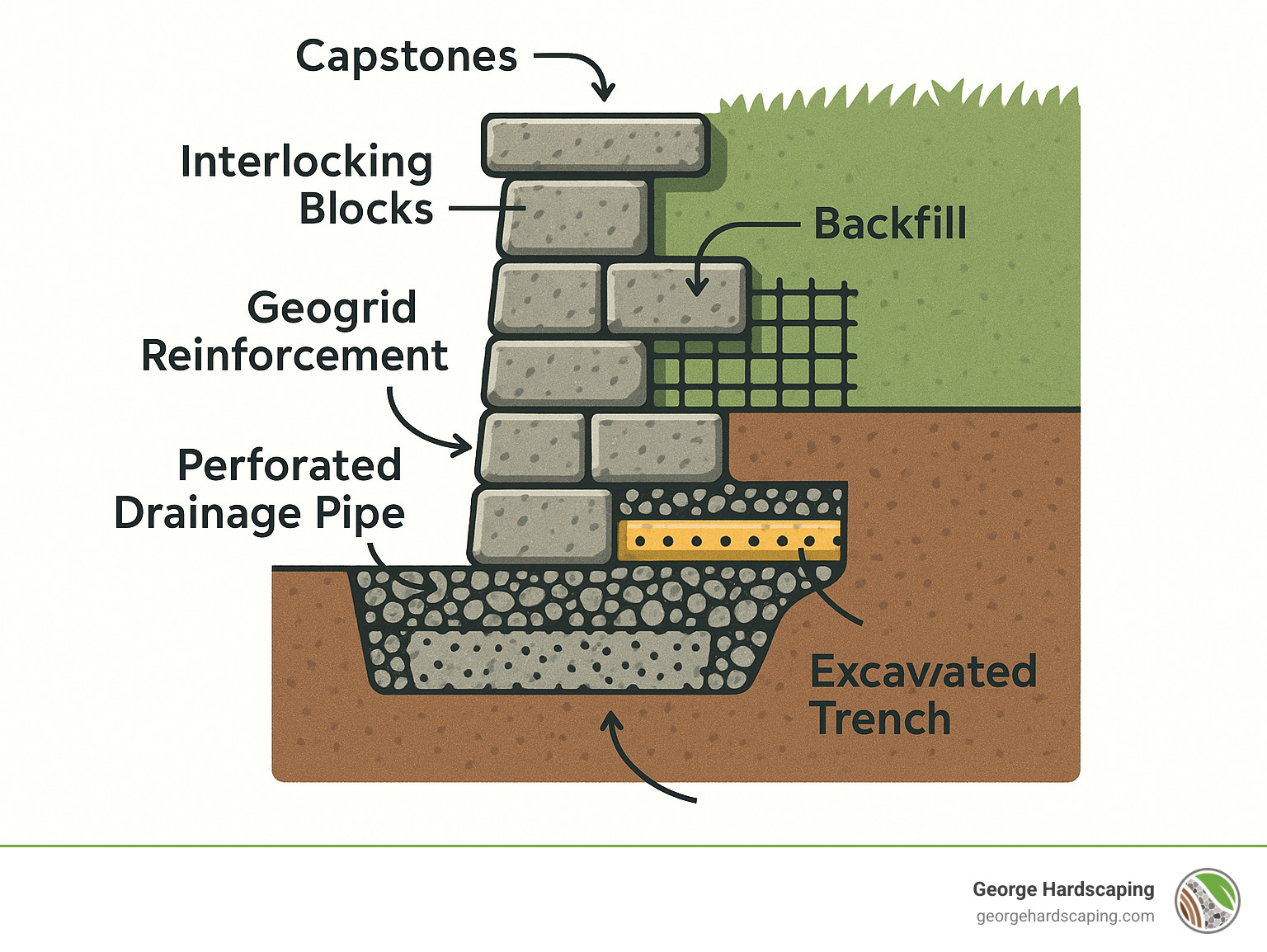
Find more about how to install retaining wall:
- retaining wall block options
- retaining wall drainage system
- retaining wall with seating
- USDA Engineering Field Handbook, Chapter 17 – Structural Design of Retaining Walls
- National Concrete Masonry Association – Segmental Retaining Wall Best Practices
Planning Your Project: The Foundation of Success
A successful retaining wall project begins long before the first shovel of dirt is moved. This critical planning phase is the blueprint for your entire build. Thoroughly understanding your site’s unique characteristics, choosing the right materials for your climate and goals, and gathering all necessary tools will prevent costly mistakes and ensure a smooth, efficient construction process.
Comprehensive Site Assessment
Before anything else, you must become an expert on your build site.
- Analyze the Slope: Is it a gentle grade or a steep hill? For significant grade changes, consider terraced walls—a series of shorter, stepped walls. This approach is often more stable, visually appealing, and easier to build than one single, towering wall.
- Understand Your Soil: The type of soil you have dramatically impacts drainage and stability. A simple test involves filling a mason jar one-third full of soil from your site, filling the rest with water, shaking vigorously, and letting it settle for 24 hours. Sandy soil settles quickly and drains well. Clay soil, which forms fine, dense layers, holds water and exerts immense pressure on a wall. Loam is a mix and is generally ideal. Knowing this helps you plan for the appropriate amount of drainage gravel.
- Check for Water Runoff: Observe where water flows on your property during a rainstorm. You must plan your wall and drainage system to manage this existing flow, not obstruct it.
Key Design and Material Considerations
With a site assessment complete, you can choose your materials. In Essex County, our New England weather, with its harsh freeze-thaw cycles and heavy precipitation, makes material selection paramount.
- Interlocking Concrete Blocks: These are the top choice for most DIY installations. Engineered for consistency and durability, they feature a rear lip or pin system that helps with alignment and setback. They are designed to withstand our climate and come in a vast array of retaining wall block options, from those that mimic natural stone to sleek, modern designs. Many systems are also designed to easily accommodate curves or corners, adding visual flair to your garden retaining wall.
- Natural Stone: Offering a timeless, high-end aesthetic, natural stone is beautiful but significantly more expensive and challenging to work with. It requires considerable skill to fit irregular shapes and ensure stability, making it a job often best left to professional masons.
- Pressure-Treated Timber: A wood retaining wall can offer a rustic look at a lower initial cost. However, even treated wood has a limited lifespan (typically 15-20 years) and is susceptible to rot and insect damage. It is best suited for shorter, non-critical garden walls.
Essential Tools and Materials Checklist
Gathering every item before you start is key to maintaining project momentum. Nothing is more frustrating than having to stop mid-project for a trip to the hardware store.
- Tools: Shovel (round and square point), pick axe, wheelbarrow, hand tamper or plate compactor (highly recommended), tape measure, stakes, mason’s line, string level, 4-foot level, rubber mallet, hammer, masonry chisel, circular saw with a masonry blade or an angle grinder, safety glasses, and heavy-duty gloves.
- Materials: Retaining wall blocks, capstones, 3/4-inch crushed angular gravel (often called paver base), 4-inch perforated drain pipe with a sock cover, landscape fabric, and high-strength construction adhesive. A crucial tip: order approximately 10-15% extra material to account for cuts, breakage, and mistakes.
Navigating Permits and Safety Protocols
Addressing regulations and safety from the outset is non-negotiable. Local building codes vary by town, but a universal rule of thumb is that most walls over 4 feet tall (measured from the bottom of the base) require a building permit and an engineered design. Always confirm the specific requirements with your local municipality, whether you’re in Topsfield, Gloucester, or elsewhere. Additionally, check your Homeowners’ Association (HOA) covenants for any restrictions on wall height, materials, or placement.
Most importantly, Call 811 before you dig. This free, mandatory service arranges for utility companies to mark the approximate location of underground lines like gas, electric, and communications. Digging without this clearance is illegal, extremely dangerous, and can have fatal consequences. A proper retaining wall design must integrate safety and legality to ensure a successful, lasting project.
A Step-by-Step Guide on How to Install a Retaining Wall
With your meticulous planning complete, it’s time to bring your vision to life. How to install retaining wall systems correctly is a game of precision and patience. Each phase builds directly upon the last, so any shortcut taken in an early step will compromise the entire structure. Follow these steps methodically for a strong, durable, and beautiful wall.
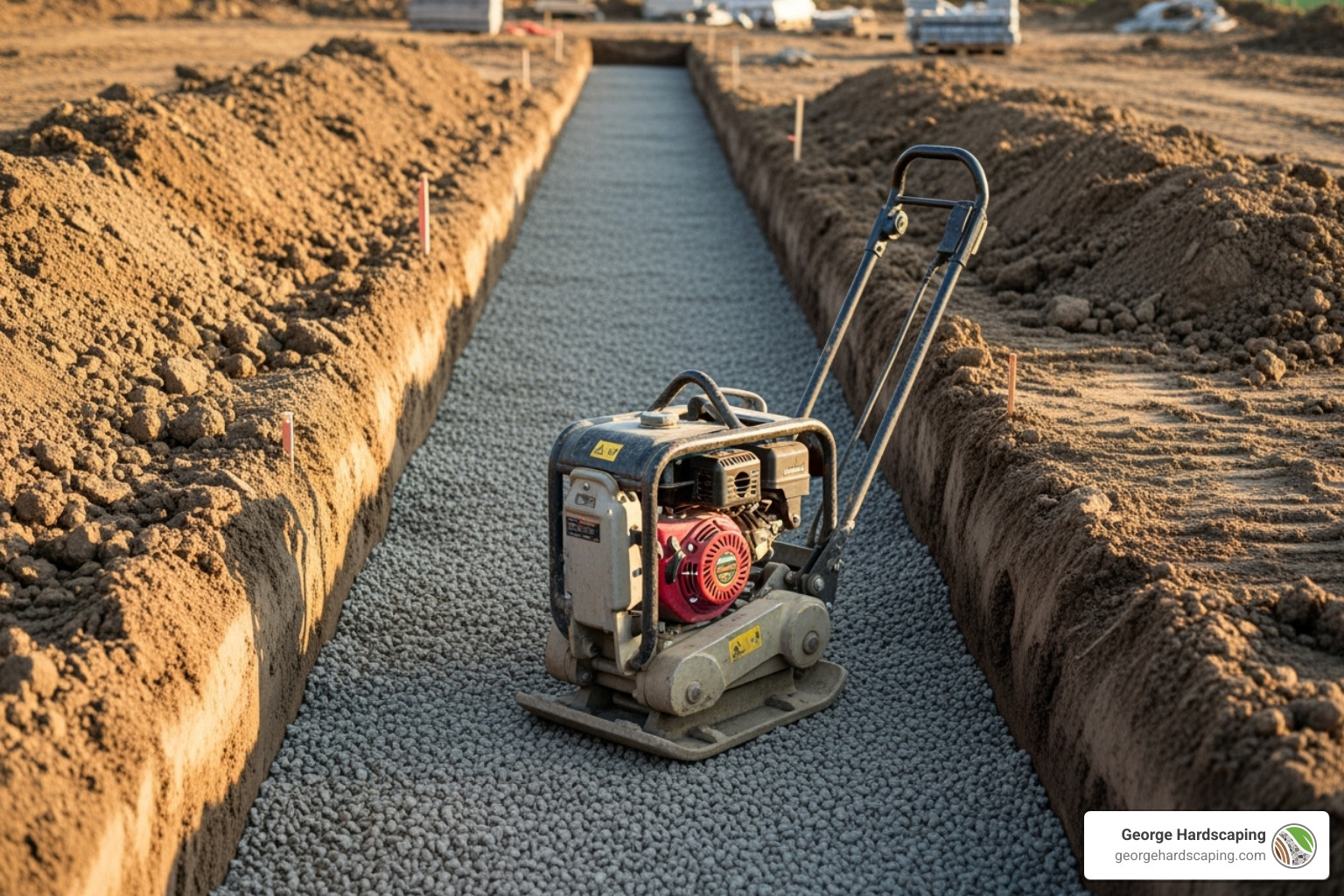
Step 1: Excavation and Trench Preparation
This is the most labor-intensive part of the project. Begin by marking the layout of your wall. Use stakes and a mason’s line for straight sections and a flexible garden hose or paint for curves. Now, you can begin digging the trench.
- Trench Depth: The depth is critical for stability. It must accommodate a minimum 6-inch compacted gravel base, plus enough depth to bury at least half of your first course of blocks. For a standard 8-inch-tall block, this means a total trench depth of roughly 10 inches (4 inches for the buried block + 6 inches for the gravel base). For colder climates or taller walls, a deeper base of up to 12 inches may be required.
- Trench Width: The trench should be wide enough to fit the block itself, plus a minimum of 12 inches behind the block for the drainage zone. Therefore, a trench width of about 24 inches is a good target for a standard 8-inch-deep block.
As you excavate, remove all topsoil, grass, roots, and any other organic material from the trench area. This material will decompose and settle over time, fatally compromising the wall’s foundation. Ensure the bottom of the trench is relatively flat and firm.
Step 2: Building a Rock-Solid Base
A perfectly level, unyielding base is the single most important factor in a retaining wall’s longevity. Any imperfection here will be magnified as you build upward.
- Fill the trench with 3/4-inch crushed angular stone. Do not use rounded pea gravel or river rock, as the smooth surfaces will not lock together under compaction and will act like marbles.
- Spread the gravel to a depth of 3 inches. Using a hand tamper or, preferably, a plate compactor, compact the gravel until it is solid and no longer depresses under your weight. This is the first “lift.”
- Add another 3-inch layer of gravel and compact it again. Continue this process until you have a minimum 6-inch base that is thoroughly compacted.
- Using a 4-foot level, check the base for levelness front-to-back and side-to-side. Scrape off high spots or add and tamp small amounts of gravel to fill low spots until the entire base is perfectly level. This step requires patience but is absolutely essential.
Step 3: Laying the Critical First Course
The first course, or base course, sets the alignment and stability for the entire wall. Take your time and get it perfect.
- Start at the lowest point along the trench if the ground is not perfectly level.
- Many interlocking blocks have a rear lip or flange for creating setback. For the first course to sit flat on the base, this lip must be removed. You can do this with a hammer and masonry chisel; a few sharp taps should shear it off cleanly.
- Place the first block on the prepared base. Use your level to check it side-to-side and front-to-back. Gently tap it with a rubber mallet to make fine adjustments until it is perfectly level.
- Place the next block, ensuring it is tightly against the first. Level this block individually and then use your 4-foot level across both blocks to ensure they are level with each other.
- Continue this process for the entire first course. Use a string line stretched along the back of the blocks as a guide to ensure the row is perfectly straight or follows your intended curve smoothly.
Step 4: Building Up and Backfilling
Once the first course is perfectly set, the subsequent layers go up much faster.
- Sweep the blocks clean of any dirt or gravel before starting a new course. Any debris will create a pivot point and destabilize the wall.
- Stagger the joints between courses in a running bond pattern, similar to a brick wall. This distributes weight and increases strength. You will need to start every other course with a half-block, which you can create using your chisel or masonry saw.
- Backfill as you build. This is a critical rule. Never stack the entire wall before backfilling. After each course is laid, fill the area behind the blocks with at least 12 inches of your 3/4-inch crushed stone. This creates the vital drainage zone.
- Compact the backfill in 8-inch lifts. Be careful not to use the heavy plate compactor too close to the wall, as it can push it out of alignment. A hand tamper is better for the area immediately behind the blocks. This systematic approach ensures the wall and the reinforced backfill work together as a single, stable system.
Advanced Techniques for Strength and Longevity
Mastering the basic installation steps is essential, but for walls that face significant loads or stand taller than a simple garden border, advanced techniques are required. Understanding how to install retaining wall systems that can withstand the immense, relentless pressures of soil and water is what separates a temporary fix from a permanent landscape solution.
When and How to Install Geogrid Reinforcement for Taller Walls
For any wall taller than 3 to 4 feet, simple block-on-block construction is not enough. The soil behind the wall exerts tremendous lateral earth pressure, constantly trying to push the wall over. Geogrid reinforcement is a high-strength synthetic mesh that acts like a seatbelt for your wall. It extends back into the slope, using the weight of the soil itself to anchor the wall, creating a unified, reinforced soil mass.
For any large retaining wall construction, geogrid is not just recommended; it is essential and almost always required by building codes.
Installation Process:
- Frequency: Check the block manufacturer’s specifications, but geogrid is typically installed every two to three courses (every 16-24 inches of height).
- Placement: Lay the geogrid mesh on top of a clean-swept course of blocks. The grid should extend from near the front face of the block back into the hillside.
- Length: The geogrid must extend behind the wall by a distance of at least 60-70% of the wall’s total finished height. For example, a 6-foot-tall wall requires a geogrid length of at least 3.6 to 4.2 feet behind the wall.
- Securing: Place the next course of blocks on top of the geogrid. The weight of the blocks, combined with the interlocking system, locks the grid in place. Pull the back of the geogrid taut and stake it temporarily to keep it flat and wrinkle-free as you place and compact the backfill on top of it.
For the most extreme conditions, such as very poor soil or immense loads, other engineered solutions like a helical anchors retaining wall may be necessary, which requires professional installation.
The Crucial Role of a Drainage System: How to Install Proper Drainage
Poor drainage is the number one cause of retaining wall failure. When soil becomes saturated with water, it becomes exponentially heavier and transforms into a fluid-like mass that generates immense hydrostatic pressure. This pressure can easily destroy even a well-built wall. A comprehensive drainage system is your wall’s only defense.
Components of an Effective System:
- Perforated Pipe: Install a 4-inch perforated drain pipe directly behind the first course of blocks, at the lowest point of the wall. To prevent clogging, use a pipe that is covered with a fabric “sock.” The pipe’s holes should face down to allow rising groundwater to enter and be carried away.
- Gravel Drainage Zone: The pipe must be embedded in a clean gravel drainage zone. This zone should consist of 3/4-inch crushed stone and extend at least 12 inches behind the wall, from the base up to within 6 inches of the top.
- Landscape Fabric: To prevent soil and silt from migrating into your gravel and clogging the system, it’s wise to separate the gravel zone from the native backfill soil with a layer of professional-grade, water-permeable landscape fabric.
- Daylighting the Pipe: The pipe must slope (about 1 inch of fall for every 8-10 feet of length) to an exit point, or “daylight,” where water can drain safely away from the wall’s foundation. This could be a simple outlet on a lower part of your lawn, a pop-up emitter connected to the end of the pipe, or a connection to a dry well. This complete retaining wall drainage system is absolutely non-negotiable.
Finishing Touches: Installing Capstones and Final Grading
The final steps protect your hard work and provide a polished, professional appearance.
- Secure Capstones: Use a high-quality, exterior-grade construction adhesive applied in two generous beads to the top course of blocks. Firmly press the capstones into place. This not only locks them down but also helps seal the hollow cores of the blocks below from water infiltration. Create a slight 1-2 inch overhang at the front of the wall for a classic look and to create a drip edge that directs water away from the wall’s face.
- Final Grading: Proper grading is a final, critical layer of water management. Grade the soil at the top of the wall to slope away from the capstones. At the bottom of the wall, ensure the ground also slopes away to prevent water from pooling at the foundation. Proper retaining wall landscaping can help stabilize the soil and complete the look, but ensure you are directing all surface water away from the structure.
Common Pitfalls and Long-Term Maintenance
Building a retaining wall is a significant accomplishment, but the job isn’t over once the last capstone is placed. Ensuring its longevity requires understanding the common reasons walls fail and performing simple, routine maintenance. Protecting your investment means being proactive, not reactive.
Why Retaining Walls Fail and How to Prevent It
Most retaining wall failures are not sudden events caused by a single storm; they are the result of critical steps being skipped during construction. Here are the most common culprits and how to ensure they don’t compromise your project:
- Catastrophic Drainage Failure: This is the cause of over 90% of all retaining wall failures. Without a path to escape, water saturates the soil, creating immense hydrostatic pressure that pushes the wall outward, causing it to bulge, crack, and eventually collapse.
Prevention: This is non-negotiable. Always install a complete drainage system, including a perforated pipe, a 12-inch-minimum gravel backfill zone, and a positive slope to a daylight exit point. - Inadequate Foundation: A weak, unlevel, or poorly compacted base is a fatal flaw. The wall will settle unevenly (differential settlement), causing blocks to shift, joints to open up, and the entire structure to lean and crack.
Prevention: Build a base of at least 6 inches of compacted, angular gravel. Compact it in 2-3 inch lifts until it is rock-solid and verify that it is perfectly level in all directions before laying the first block. - Lack of Reinforcement: Taller walls (generally over 3-4 feet) will inevitably bow or overturn if they are not anchored into the soil behind them. The weight of the blocks alone is insufficient to resist the lateral earth pressure.
Prevention: Use geogrid reinforcement at the intervals specified by the manufacturer for any wall exceeding the height limit. Ensure the grid extends far enough into the backfill to be effective. - Improper Backfill Material: Using the excavated native soil (especially clay-heavy soil) for backfill is a critical error. This soil traps water against the wall, negating the drainage system, and can expand and contract with moisture changes, putting stress on the structure.
Prevention: Use only clean, 3/4-inch crushed angular gravel for the drainage zone directly behind the wall. Use compacted native soil only behind this gravel zone. - Frost Heave: In climates like Massachusetts, water trapped in the soil can freeze, expand with incredible force, and lift or shift sections of the wall. This is known as frost heave.
Prevention: A deep, well-compacted base that extends below the frost line (if required by local code) and an effective drainage system are the best defenses. By removing water, you remove the fuel for frost heave.
Following proper construction techniques, like those outlined by resources for building a landscape retaining wall, is the best insurance against failure.
Simple Maintenance for a Lasting Wall
Segmental retaining walls are remarkably low-maintenance, but a small amount of annual attention can prevent major problems down the road.
- Annual Inspections: Each spring, after the ground has thawed, walk the entire length of your wall. Look closely for any signs of bulging, leaning, or new or expanding cracks in the blocks or mortar (if applicable).
- Clear Drainage Outlets: This is the single most important maintenance task. Ensure the exit point of your drain pipe is completely clear of leaves, grass clippings, dirt, and any other debris. A clogged outlet renders the entire drainage system useless.
- Manage Surface Water and Vegetation: Check that the grade at the top and bottom of the wall still directs water away. Avoid planting large trees with aggressive root systems near the wall, as growing roots can exert enough pressure to damage the structure. Small shrubs and perennials are generally fine.
- Clean the Wall Face: If you notice moss, algae, or a white, powdery substance called efflorescence, clean it off. Use a stiff brush and water, or a specialized masonry cleaner. This is mostly aesthetic but can help prevent moisture from being trapped against the block face.
Frequently Asked Questions about Retaining Wall Installation
When homeowners in Essex County begin to research how to install retaining wall systems, several important questions consistently come up. Getting clear answers to these common concerns is crucial for planning a successful and compliant project.
How deep should the base for a retaining wall be?
The trench for a retaining wall must be deep enough to accommodate two critical components: a minimum 6-inch compacted gravel base and enough depth to bury about half of the first course of blocks. For a standard 8-inch tall block, this translates to a total trench depth of approximately 10 inches (4 inches for the buried portion of the block + 6 inches for the gravel base). This buried course, known as a toe-in, is essential for anchoring the entire wall and preventing it from sliding forward under pressure.
Do all retaining walls need drainage?
Yes, absolutely. Virtually all retaining walls, regardless of their height or material, require a properly installed drainage system. The single greatest enemy of a retaining wall is hydrostatic pressure, which builds up as water saturates the soil behind it. This pressure can cause even the most robust walls to bulge, crack, or fail completely. A well-designed system featuring a perforated pipe and a clean gravel drainage zone is not an optional add-on; it is a fundamental component that safely channels water away, relieves this pressure, and prevents damage from New England’s notorious freeze-thaw cycles.
At what height does a retaining wall need reinforcement?
As a general rule of thumb, retaining walls taller than 3 to 4 feet require soil reinforcement, most commonly in the form of geogrid. However, this is not a hard-and-fast rule. The need for reinforcement is also dictated by other factors. Conditions that increase the load on the wall, such as poor soil quality (like heavy clay), a steep slope rising above the wall, or additional weight (a surcharge) on top like a patio, fence, or driveway, may necessitate reinforcement for even shorter walls. Always consult the block manufacturer’s specifications and your local building codes, as most municipalities in Massachusetts mandate engineered plans for any wall over 4 feet in height.
What is the best backfill for a retaining wall?
The ideal backfill material is 3/4-inch crushed angular gravel or stone. Do not use the native soil you excavated, especially if it contains clay or organic matter. The angular shape of the crushed stone allows the pieces to interlock, creating a stable, strong mass that resists compaction over time. Crucially, the gaps between the stones create a highly permeable drainage column, allowing water to flow freely down to the perforated pipe at the base. This prevents water from getting trapped and building up pressure against the wall.
How do I build a curved retaining wall?
Building smooth curves is very achievable with most segmental block systems. Many manufacturers offer specially designed tapered blocks that create curves naturally when laid side-by-side. For systems with standard rectangular blocks, you can create gentle curves by placing the blocks so the front edges touch and a small, V-shaped gap opens at the back. For tighter curves, you may need to make small cuts on the sides of the blocks with a masonry saw or chisel to allow them to fit together more snugly. The key is to ensure at least half of each upper block rests on the block below it.
Conclusion: Building with Confidence and for Longevity
Successfully completing a how to install retaining wall project is one of the most rewarding home improvement tasks you can undertake. You are not just stacking blocks; you are actively reshaping your environment, turning a challenging slope into a beautiful, stable, and functional landscape that adds lasting value and daily enjoyment to your outdoor living space. The success of this change hinges on an unwavering commitment to three foundational pillars: meticulous planning, a rock-solid foundation, and a comprehensive drainage system. Resisting the temptation to cut corners on these elements is the definitive difference between a wall that stands proudly for decades and one that fails within a few seasons.
While building your own wall is an empowering experience, it is equally important to recognize when a project’s complexity exceeds the scope of a DIY endeavor. Any project involving walls over 4 feet tall, those supporting critical structures like driveways or home foundations, sites with poor soil conditions or significant water issues, or complex terraced designs demand the expertise and specialized equipment of a professional. For homeowners across Essex County, from the coastal towns of Manchester-by-the-Sea to the inland communities of North Reading, partnering with an experienced contractor is often the wisest, safest, and most cost-effective choice in the long run.
When your project’s scope calls for professional skill and guaranteed results, the expert team at George Hardscaping brings decades of specialized knowledge to every installation. We possess an intimate understanding of the unique challenges posed by New England’s climate and soil types, ensuring every wall we construct is built upon a foundation of engineering principles, superior drainage, and the structural integrity required to last a lifetime. We are dedicated to creating retaining walls that not only solve a problem but also improve the beauty and functionality of your property.
A well-built retaining wall performs its critical duty quietly and dependably, year after year. Whether you are preparing to tackle a project yourself or seeking professional guidance, a thorough understanding of these fundamental principles is your first and most important step toward success.
Find a professional Retaining Wall Contractor
