
Should I Seal Travertine Pavers Pool Deck: Crucial 2025
Your Travertine Pool Deck Investment
Should I seal travertine pavers pool deck surfaces? It’s the number one question we hear after a new pool deck installation. The honest answer: sealing isn’t strictly mandatory, but for most pool decks it’s highly recommended to protect against stains, salt, moisture, algae growth, and seasonal freeze–thaw cycles.
Quick Answer:
- Yes, seal if: You have a saltwater pool, host frequently, want easier cleaning, or want protection from sunscreen, wine, leaves, and pool chemicals.
- Consider not sealing if: You prefer the natural look and are okay with more frequent deep cleaning.
- Best approach: Choose a breathable penetrating or enhancing sealer designed specifically for natural stone around pools.
Travertine’s beauty and practicality make it a favorite for luxury pool decks across Essex County. The stone’s micro-pore structure keeps it cooler underfoot and offers timeless texture. Those same pores, however, readily absorb liquids and debris. Without protection, pool decks can develop permanent stains or biological growth. Saltwater can accelerate pitting and surface deterioration. A well-chosen sealer mitigates these risks while maintaining the stone’s natural character.
For understanding stone porosity and maintenance, the Natural Stone Institute’s guidance on exterior stone care provides helpful independent reference for best practices in residential stonework.
Prefer to skip the learning curve? Call George Hardscaping for expert guidance on sealer selection and application for travertine pool decks, or request your free estimate online.
The Core Debate: Weighing the Pros and Cons of Sealing
The question of “should I seal travertine pavers pool deck” comes down to your priorities for aesthetics, maintenance, and longevity. Here’s a clear comparison:
| Feature | Sealed Travertine Pool Deck | Unsealed Travertine Pool Deck |
|---|---|---|
| Stain Resistance | High. Significantly reduces absorption of liquids like wine, oil, or sunscreen. | Low. Prone to permanent stains from spills and organic matter. |
| Maintenance | Easier cleaning. Requires periodic reapplication every 1-5 years. | More frequent cleaning needed. Stains harder to remove. |
| Appearance | Can improve natural colors, add “wet look” or sheen, prevents fading. | Natural, lighter appearance. Can look chalky over time. |
| Slip Resistance | Maintains natural traction with penetrating sealers. | Excellent natural traction. Mold/algae growth can create slippery spots. |
| Long-Term Cost | Initial cost plus reapplication. Protects against costly damage. | Lower upfront cost. Higher risk of repairs due to damage. |
| Mold/Mildew/Algae | Significantly reduced growth due to less moisture absorption. | Prone to growth in porous capillaries, especially in damp areas. |
| Saltwater Pools | Essential protection against salt attack. | Highly vulnerable to degradation from salt. |
The Case FOR Sealing: Protection and Improvement
- Stain resistance: Travertine’s porosity makes it act like a stone sponge. Common poolside substances like sunscreen lotions, tanning oils, and food grease can leave dark, difficult-to-remove marks. Beverages like red wine, coffee, or fruit punch contain acids and strong pigments (tannins) that can etch and permanently dye the stone. Even natural debris like wet leaves or flower petals can leave behind stubborn tannin stains. A quality penetrating sealer works by lining the pores of the stone, creating a hydrophobic (water-repellent) and oleophobic (oil-repellent) surface. This doesn’t make the stone stain-proof, but it dramatically increases the ‘dwell time,’ giving you minutes, rather than seconds, to wipe up a spill before it can soak in and become a permanent problem.
- Reduced biological growth: By limiting the amount of water that can soak into the stone, sealing creates an inhospitable environment for mold, mildew, and algae. These organisms thrive in the damp, porous capillaries of unsealed stone, especially in shaded or consistently damp areas of a pool deck. This growth is not only unsightly—presenting as green or black patches—but it can also become a significant slip hazard when wet. The EPA’s information on mold and moisture control explains why moisture control is the fundamental strategy for preventing biological growth on building materials.
- Saltwater defense: Saltwater pools are fantastic, but the dissolved salts (chlorides and sulfates) are aggressive toward carbonate-based stones like travertine. When salt water splashes onto the deck and evaporates, it leaves behind salt crystals within the stone’s pores. This process, known as subflorescence, exerts immense internal pressure that can cause microscopic fractures, leading to pitting, flaking, and spalling over time. A penetrating sealer acts as a barrier, significantly reducing the ingress of salt-laden water and protecting the stone’s structural integrity.
- Appearance improvement: If your travertine looks chalky or washed-out, an enhancing sealer can enrich its base color and emphasize the beautiful natural vein patterns without creating an artificial topical film.
- Easier cleaning: Because dirt, grime, and spills stay on the surface rather than soaking in, cleaning a sealed deck is much faster. Often, a simple rinse with a garden hose and occasional washing with a pH-neutral cleaner is all that’s needed, which is better for both the stone and the surrounding landscaping.
The Case AGAINST Sealing: Cost and Considerations
- Recurring maintenance: Sealers are not a one-and-done solution; they are sacrificial coatings that wear away over time due to UV exposure, foot traffic, and cleaning. This means you must commit to a reapplication schedule, typically every 1–3 years for high-use pool decks. The process involves thorough cleaning and drying before reapplication, representing an ongoing investment of time and money. Forgetting or delaying this maintenance can lead to uneven protection and potential staining.
- Application risks: Improper application is a significant risk. Applying sealer to a damp or incompletely cured surface can trap moisture, leading to a cloudy or hazy appearance under the surface that is very difficult to fix. Using the wrong type of sealer, such as a non-breathable topical coater, can also trap moisture and may lead to spalling in freeze-thaw climates. Over-application of a penetrating sealer without wiping off the excess will leave a sticky, shiny residue on the surface that attracts dirt and can be challenging to remove.
- Slip-resistance concerns: While the right penetrating sealer will not change the stone’s natural microtexture, an improperly applied or incorrect type of sealer can. Some topical sealers, in particular, become dangerously slick when wet, posing a serious safety hazard around a pool.
When Sealing Is Especially Smart
- Saltwater pool decks and splash zones
- High-use entertaining areas with frequent spills
- Shaded or damp microclimates prone to biological growth
- Freeze–thaw climates where water penetration causes damage
Our team handles both new installations and existing deck restoration. See our pool paver deck installation services for comprehensive build-and-protect solutions and our hardscaping maintenance programs for ongoing care.
Choosing Your Shield: A Guide to Travertine Sealer Types
Once you decide to seal your pool paver decks, picking the right chemistry is the key to getting protection without sacrificing safety or aesthetics. The primary categories are penetrating (impregnating) sealers, enhancing penetrating sealers, and topical (film-forming) sealers. Each behaves very differently on a porous carbonate stone like travertine.
Penetrating (Impregnating) Sealers: The Invisible Guardian
Penetrating sealers soak into the stone’s pore network and bond within the top few millimeters. Common chemistries include silane/siloxane blends and modern fluoropolymer systems.
- Natural appearance: These products typically leave no visible film. They maintain travertine’s color, texture, and open-pore look.
- Hydrophobic protection: Penetrating sealers reduce liquid absorption, so water, oils, and organic pigments bead up and are easier to remove before they stain.
- Breathability: Quality products allow moisture vapor to pass outward while resisting liquid water intrusion. In a freeze–thaw climate, this is crucial. For background on vapor transmission concepts, see the ASTM E96 standard, which is commonly used to discuss breathability in building materials.
- Maintains slip resistance: Because the surface microtexture isn’t coated, the stone retains its natural traction—an important safety consideration for pool surrounds.
Use this category when you want invisible protection and maximum traction. It’s our default recommendation for most travertine pool decks in New England.
Enhancing Penetrating Sealers: Color With Control
Enhancing penetrating sealers combine the protective behavior of penetrants with a controlled darkening effect that makes colors richer and veining more pronounced.
- Deepens color without a film: Enhancers create a “wet look” aesthetic while remaining inside the stone, not on top of it.
- UV and stain resistance: Many formulas incorporate UV stabilizers and oil/water repellents, which help preserve color and mitigate discoloration from leaves, sunscreen, and food spills.
- Great for tumbled or brushed finishes: The natural character of travertine reads beautifully with an enhancer, especially where the stone looks washed out from sun exposure.
If you like the appearance of a damp, freshly washed stone but want to avoid glossy films, enhancers deliver. For independent, non-commercial guidance on natural stone maintenance and the role of enhancing sealers, consult the Natural Stone Institute’s consumer resources on stone care and sealing best practices.
Topical (Film-Forming) Sealers: Coatings With Trade-Offs
Topical sealers sit “on top” of the surface and form a film. They can be acrylic, polyurethane, or epoxy-based.
- Strong surface barrier and sheen: These can deliver robust stain resistance and a noticeable gloss or semi-gloss.
- Slip risk in wet conditions: Films can reduce traction—especially problematic beside pools. The National Floor Safety Institute emphasizes the hazards of smooth, wet films in pedestrian areas.
- Higher maintenance: Films scuff and scratch, can whiten or haze if moisture gets underneath, and often require chemical stripping before reapplication.
Because of safety and maintenance trade-offs, we generally do not recommend topical coatings for travertine pool decks. If a sheen is desired, an enhancing penetrating sealer is the safer compromise.
A Note on Chemistry and Compatibility
- Silane/siloxane: Often excellent on porous masonry; good water repellency and breathability.
- Fluoropolymer: Strong oil and water repellency; commonly used where sunscreen and food oils are frequent.
- Solvent vs water-based: Solvent carriers may penetrate more deeply on dense surfaces; water-based products are often lower odor and easier cleanup. Both can be effective when designed for natural stone.
When in doubt, review technical data sheets and look for language noting compatibility with carbonate stones and pool environments. The Natural Stone Institute remains a helpful authority for non-biased guidance. And if you want help matching sealer chemistry to your stone finish, exposure, and cleaning routine, our hardscaping contractor team can specify and apply the right product for your deck.
The Sealing Process: A Step-by-Step DIY Guide
Deciding to seal your travertine pavers pool deck is a smart move. While professional application offers peace of mind, many homeowners can tackle this project with careful prep and patience. Below is a thorough, field-tested approach.
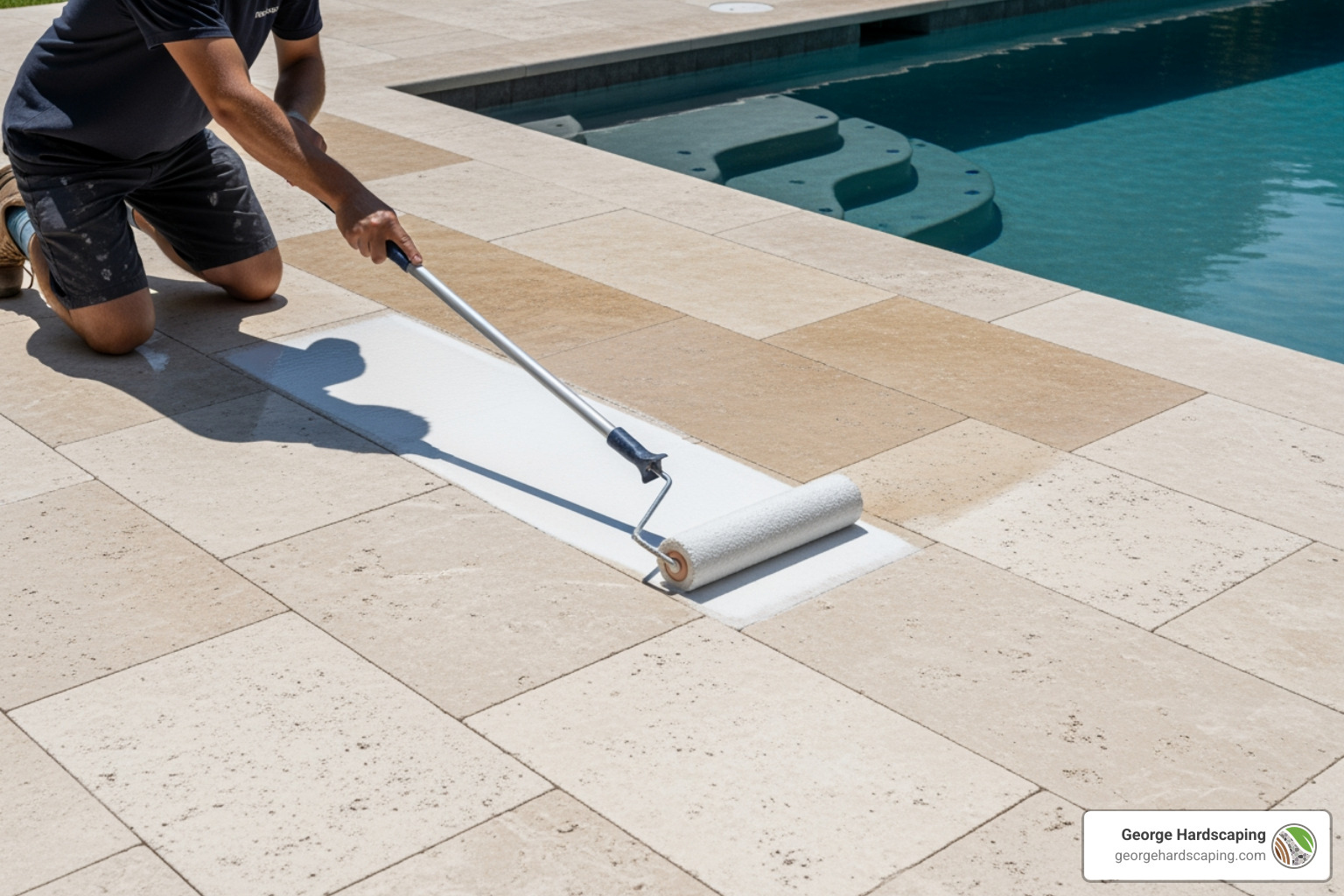
Image metadata: title: Applying a penetrating sealer with a roller, alt: A person using a roller to apply sealer evenly to a clean travertine pool deck, caption: Thin, even coats with prompt wipe-off of excess deliver uniform, breathable protection, source: George Hardscaping, license: Used with permission
Step 1: Preparation Is Everything
- Deep clean the surface: Start with a pH-neutral stone cleaner and soft-bristle agitation. For stubborn organics (algae, mildew), use a stone-safe cleaner labeled for natural stone, then rinse thoroughly. Avoid strong acids on travertine—they can etch and dull the surface.
- Low-pressure rinse: If using a pressure washer, keep pressure modest and the tip moving to avoid opening the stone or blowing out joint material.
- Remove oils early: Oily spots from sunscreen or food drips respond best to a poultice or a targeted degreaser. The sooner you address them, the better the outcome.
- Let it dry fully: Allow 24–72 hours of dry time depending on weather and humidity. Test with plastic: tape a small sheet of plastic to the surface; if condensation appears underneath after a few hours, wait longer.
- Protect adjacent elements: Mask pool water, coping, skimmers, walls, and plantings. Lay drop cloths or plastic sheeting along the pool edge to capture overspray.
- Check joints and repairs: Replace missing joint sand if applicable, address any loose stones, and repair chips before sealing. If you plan to use a joint-stabilizing product, confirm compatibility with your sealer choice.
Step 2: Application With Intention
- Pick the right window: Aim for mild temperatures (50–80°F), overcast or indirect sun, and low wind. No rain in the forecast for 24–48 hours.
- Read the label—twice: Coverage rates, dwell time, wipe-off requirements, and recoat windows vary. Follow the manufacturer’s instructions carefully.
- Test a discrete area: Apply to a small, inconspicuous zone to confirm appearance, absorption, and wipe-off behavior. This is especially important with enhancers.
- Work in manageable sections: Use a pump sprayer for even distribution, then back-roll with a microfiber or low-nap roller to level. Avoid puddling.
- Time your wipe-off: Penetrating sealers that do not absorb within the recommended dwell time should be wiped away to prevent residue. Buff with clean microfiber towels.
- Second coat? Only if needed: Some stones benefit from a second light coat while the first is still tack-free, but not fully cured. Test water beading after cure to decide.
For a quick visual overview of the general process, this helpful video on sealing pool decks shows preparation, application, and testing. Keep in mind that every product differs—rely on your product’s technical data sheet for specifics.
Step 3: Cure, Inspect, and Confirm Performance
- Respect cure time: Keep foot traffic, furniture, and water off the surface until the product has cured. Most penetrating sealers need 24–48 hours.
- Water test: After curing, mist a few areas. If water beads up and stays on the surface for several minutes, protection is active. If it soaks in quickly or darkens the stone, consider a maintenance coat.
- Tidy disposal: Dispose of rags and leftover materials per local household hazardous waste rules. The EPA’s household hazardous waste guidance is a good reference. Follow manufacturer advice for storage and disposal.
Safety and PPE
- Ventilation and PPE: Even water-based products may require gloves, safety glasses, and good airflow. For solvent-borne products, consult OSHA’s basic PPE guidance and the product SDS for respirator recommendations.
- Pool protection: Keep sealer out of pool water. If accidental overspray occurs, skim and consider a short-term filter clean.
Want a turnkey experience—and a warranty? Our hardscaping contractor team handles cleaning, stain lifting, sealer selection, and application in one coordinated visit. Ask about pairing sealing with our hardscaping maintenance services for annual inspections and reapplication on an optimal schedule.
Long-Term Care and Answering: “Should I Seal My Travertine Pavers Pool Deck?”
Sealing is a cornerstone in a broader care plan for natural stone. Routine maintenance plus periodic inspections will keep your deck looking pristine.
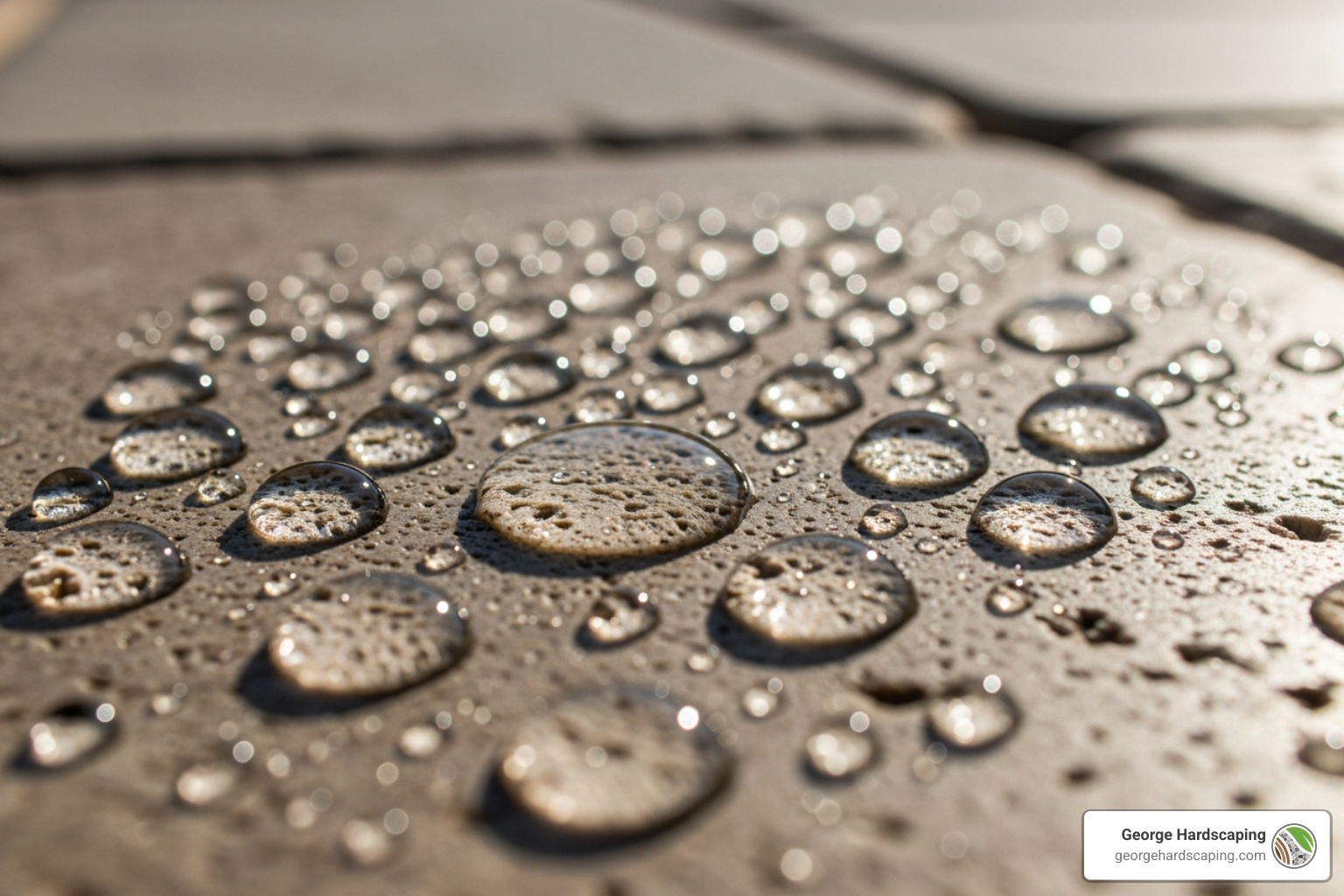
Image metadata: title: Water beading on a sealed travertine paver, alt: Water beading up on a perfectly sealed travertine paver, caption: If droplets bead and do not darken the stone quickly, your sealer is still protecting, source: George Hardscaping, license: Used with permission
How Often Should a Travertine Pool Deck Be Resealed?
Several factors determine lifespan: UV intensity, product quality, foot traffic, splash exposure, and cleaning habits. For busy pool decks, 1–3 years is common for reapplication. Premium products and shaded settings can stretch longer. The simplest check is a yearly water beading test in spring. If water darkens the stone quickly, it’s time to reseal.
Seasonal Care Tips
- Spring: Sweep, rinse, and perform beading test. Address stains before the season starts.
- Summer: Rinse frequently if hosting often; remove sunscreen drips and food spills promptly.
- Fall: Blow leaves and rinse to minimize tannin stains. Check shaded areas for algae.
- Winter: Avoid de-icing salts on travertine, which can damage carbonate stones.
Slip Resistance and Safety
Travertine’s tumbled or brushed finishes provide excellent traction; breathable penetrating sealers preserve that microtexture. If slip resistance is still a concern, certain penetrating products accept transparent anti-slip additives. The National Floor Safety Institute’s walkway safety guidelines offer useful background on maintaining traction in wet environments.
Pool Chemistry and Stone Care
Keep pool chemistry balanced and rinse splash zones periodically, especially with saltwater systems. Good practices around chemistry also protect adjacent building materials like natural stone.
Professional Help When You Want It
From deep cleaning and stain lifting to careful masking and application, professional service saves time and prevents costly errors. If your deck needs more than a simple recoat—widespread staining, efflorescence, or prior coating residue—our team can restore the surface and protect it with the right sealer. Explore our natural stone pavers page for materials and maintenance fundamentals, or talk with our hardscaping contractor team for a custom plan.
Ready to safeguard your deck for the season? Book a site visit today and we’ll evaluate your surface, recommend the right penetrating or enhancing sealer, and provide a clear proposal. Schedule your travertine pool deck sealing and protect your investment now.
Frequently Asked Questions about Sealing Travertine
We often hear similar questions from homeowners across Beverly and Danvers—here are straightforward answers and resources to help you decide what’s best for your deck.
Does sealing travertine pavers change their color?
- Penetrating sealers: Minimal to no visible change; retains a natural, matte look.
- Enhancing penetrating sealers: Intentionally deepen color and highlight veining for a permanent “wet look” without forming a film.
- Topical sealers: Add a visible film that can look glossy; we typically avoid these outdoors near pools due to traction and maintenance concerns.
For an independent primer on natural stone appearance changes and sealing effects, see the Natural Stone Institute’s consumer advice on stone care.
Can you seal old travertine pavers?
Absolutely. Older installations often benefit most from sealing after a thorough clean and dry. The keys are stain removal before sealing, verifying dryness, and choosing a breathable penetrant compatible with travertine. If a previous topical coating is present, it may need to be stripped first.
What happens if you don’t seal travertine pavers around a pool?
- Staining: Sunscreen, oils, and tannins can darken or discolor the stone permanently.
- Organic growth: Moisture in pores encourages algae and mildew, especially in shaded areas. The EPA’s overview of mold and mildew helps explain why lowering moisture in surfaces suppresses growth.
- Salt and chemical distress: Splash zones near saltwater systems are especially vulnerable to pitting and scaling over time.
- Harder cleaning: Dirt becomes embedded and requires more aggressive scrubbing or chemicals to remove.
Will sealing make my pool deck slippery?
A quality penetrating sealer will not materially alter the surface texture and is the safest option for pool decks. Avoid topical films that can become slick when wet. If you want extra peace of mind, ask about non-slip traction additives designed for use with penetrating products. The National Floor Safety Institute’s resources on walkway safety are useful for understanding traction management.
How long after installation should I seal?
Once the stone and bedding are dry and any efflorescence issues are resolved. In many cases, that’s a few weeks after installation, but timing varies with weather, base construction, and drainage. Your installer can advise based on site conditions. For new builds, consider bundling sealing with our pool paver deck installation to streamline the timeline.
Can I seal during humid weather?
You can, but allow extra dry time before and after application. High humidity slows evaporation and can extend cure times. Always follow your sealer’s specified temperature and humidity ranges and verify dryness with a plastic-sheet test.
How does the finish of my travertine (tumbled, honed, polished) affect sealing?
The finish of your travertine—such as tumbled, honed, or brushed—plays a significant role in both its appearance and porosity, which affects sealer choice. Tumbled travertine is the most common for pool decks; its rustic, highly porous surface readily accepts penetrating sealers. An enhancing sealer works beautifully on tumbled stone to bring out its character. Honed travertine has a smooth, matte finish and is less porous than tumbled. It still requires sealing, but may absorb less product.
Brushed travertine has a textured, matte surface that provides good traction and also absorbs sealer well. Polished travertine is rarely used for pool decks due to being extremely slippery when wet. In all cases, a breathable, penetrating sealer is the correct choice, but the absorption rate and final look will vary with the finish.
What is the difference between a sealer and a surface coating?
This is a crucial distinction. A penetrating sealer (or impregnator) works from within the stone. It soaks into the pores and chemically bonds to the mineral structure, creating a water and oil-repellent barrier without forming a film on top. It preserves the natural texture and breathability of the travertine. A surface coating (or topical sealer) forms a physical film on top of the stone, like a layer of paint or varnish. While coatings can offer high gloss and excellent initial stain protection, we strongly advise against them for outdoor travertine pool decks. They trap moisture, can become extremely slippery when wet, and are prone to scratching, peeling, and yellowing, requiring costly chemical stripping before reapplication.
Does sealing prevent efflorescence?
No sealer can eliminate efflorescence at the source, which is a moisture and mineral migration issue. However, breathable penetrating sealers help by reducing liquid water intrusion from the surface while allowing vapor to escape, minimizing the conditions that accentuate efflorescence. If you see powdery white deposits, clean them with a stone-safe product and address drainage.
How much does professional sealing cost?
Pricing depends on square footage, condition (stain removal, algae, prior coatings), sealer chemistry, and masking complexity around pools. Most projects are priced per square foot with a minimum service charge. To get a precise number for your site, request a free estimate and we’ll provide a written proposal with product details and a maintenance plan.
Which sealer chemistry is best for sunscreen and food oils?
Modern fluoropolymer-based penetrating sealers typically offer excellent oil repellency alongside water repellency. Always verify that the product is safe for carbonate stones like travertine and designed for exterior use in wet areas. The Natural Stone Institute’s maintenance resources offer neutral, brand-agnostic guidance to help frame your selection.
Do I need to strip old sealer?
Only if you have a film-forming coating, heavy residue, or incompatible product build-up. Penetrating sealers applied correctly generally wear away invisibly and do not require stripping—just cleaning and reapplication. If you suspect a topical coating, we can test and propose a safe stripping and restoration plan through our hardscaping maintenance service.
Have more questions specific to your layout, coping, or drainage? Our hardscaping contractor team is happy to inspect your site and provide recommendations tailored to your stone finish, pool type, and maintenance style.
Conclusion: Protecting Your Outdoor Oasis
The debate over “should I seal travertine pavers pool deck” usually resolves to a practical yes for most homeowners. Travertine’s porous nature, combined with poolside realities—splash zones, sunscreen, food and drink, salt, and seasons—makes a breathable penetrating or enhancing sealer a smart insurance policy. You’ll simplify cleaning, guard against stains and salt-related wear, and preserve the colors and textures that drew you to travertine.
Our recommendations:
- Choose breathable penetrating or enhancing penetrating sealers designed for natural stone around pools
- Avoid topical films outdoors in wet areas due to slip and maintenance trade-offs
- Clean thoroughly, verify dryness, apply in thin, even coats, and honor cure times
- Re-check annually with a water beading test and reapply as needed
If you’re ready to protect your deck, we can help at any stage—from deep cleaning and surface prep to expert application. Request your free estimate today and lock in a professional sealing plan before peak season. Want to pair protection with an upgrade or expansion? Explore our patio installation and pool paver deck installation services and let’s design, build, and protect your outdoor living space with one cohesive plan.
For additional information on natural stone care standards, the Marble Institute of America’s maintenance guidelines provide comprehensive industry best practices that align with our professional approach to travertine protection.
