
Repairing a rock retaining wall: Expert Guide 2025
Why Your Stone Retaining Wall Deserves Immediate Attention
Repairing a rock retaining wall might seem daunting, but catching problems early can save you thousands of dollars and prevent dangerous collapses. Whether you’re dealing with minor mortar cracks or major structural issues, understanding when to tackle repairs yourself versus calling professionals is crucial for protecting your Essex County property.
Quick Answer for Homeowners:
- Minor repairs (mortar cracks, small gaps): DIY-friendly, $100-$200 in materials
- Major issues (leaning, bowing, foundation problems): Professional help required, $1,000-$5,000+ average cost
- Emergency signs: Wall leaning over 2 inches, large cracks, water pooling behind wall
- Safety first: Walls over 4 feet high always need professional assessment
Stone retaining walls face constant pressure from soil, water, and weather. According to University of Minnesota Extension, poor drainage and inadequate footings cause most failures. The good news? Many problems start small and give you warning signs before becoming expensive disasters.
Common early warning signs include:
- White powdery residue (efflorescence) on stones
- Crumbling mortar between rocks
- Small cracks in joints
- Minor water seepage after heavy rain
More serious problems that need immediate professional attention:
- Wall leaning toward the street
- Bulging or bowing sections
- Large gaps between stones
- Standing water behind the wall
The average cost to repair retaining walls ranges dramatically—from $200 for minor DIY fixes to $70,000 for complete rebuilds. These are average costs based on internet research and not actual costs for George Hardscaping services.
Why small fixes matter now: Stone retaining walls don’t usually fail overnight. Instead, they reveal progressive stresses from soil expansion, frost action, and trapped water. By sealing cracks, repointing joints, and resolving drainage early, you reduce the forces acting on the wall and extend its life by years. In Essex County’s freeze-thaw climate, even hairline defects can widen quickly over winter.
How your wall was built affects your options. Dry-laid and mortared stone walls behave differently under load. Dry-laid walls tolerate small movements and drain freely; mortared walls can be stronger initially but more sensitive to water buildup. If you suspect poor drainage, consider an immediate evaluation. Learn the essentials of proper drainage design here: https://georgehardscaping.com/retaining-wall-drainage-system/.
If your wall forms part of a larger outdoor space—patios, steps, or terraces—coordinating repairs can reduce costs and disruption. Explore related services and craftsmanship standards across our masonry work: https://georgehardscaping.com/masonry-work/.
Smart homeowners know that a $500 repair today can prevent a $15,000 replacement tomorrow. Your retaining wall isn’t just functional—it’s protecting your property value and keeping your family safe.
Assessing the Damage: When to Repair vs. When to Rebuild
The moment you notice something’s off with your stone retaining wall, you’re facing a crucial decision. Repairing a rock retaining wall starts with understanding exactly what you’re dealing with—and whether you’re looking at a simple fix or a complete do-over.
Telltale Signs Your Wall Needs Attention
Your retaining wall gives you plenty of warning signs before major problems develop. Learning to spot them is key.
Minor issues are often manageable with DIY effort:
- Crumbling Mortar: Sandy, loose material between stones, especially after winter freeze-thaw cycles.
- Small Cracks: Hairline cracks in mortar joints from minor ground movement.
- Efflorescence: A white, chalky residue indicating moisture movement.
- Slight Surface Spalling: Thin flakes or chips on the stone surface.
Major issues requiring professional attention:
- Leaning: Any lean over 2 inches demands immediate professional attention.
- Bulging: Sections pushing outward from waterlogged soil pressure.
- Water Seepage: More than minor dampness indicates severe drainage problems.
- Foundation Failure: Sinking, shifting, or erosion at the wall’s base.
For homeowners dealing with various hardscape challenges, our comprehensive hardscape repair services can help: https://georgehardscaping.com/hardscape-repair-near-me/.
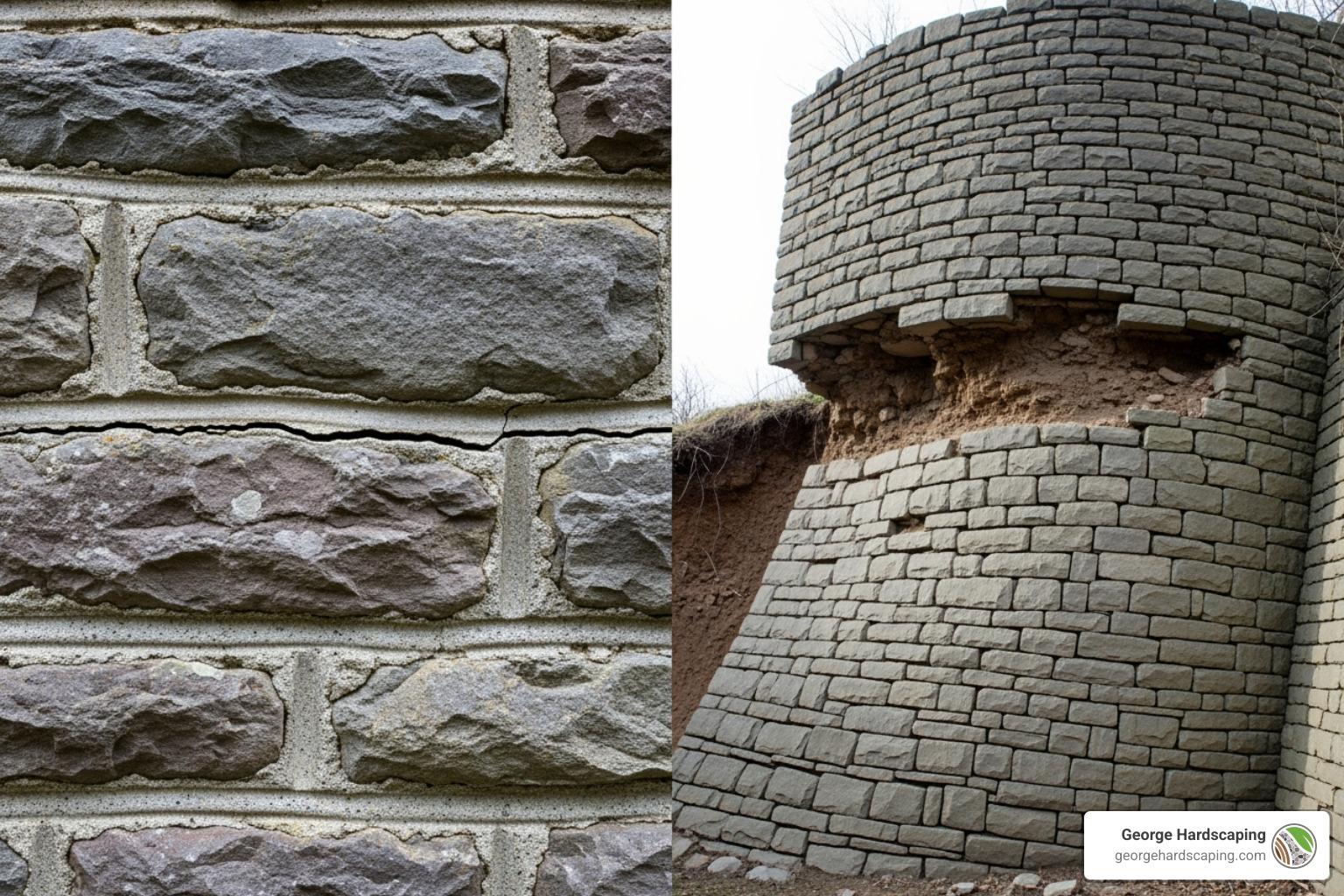
A Practical Field Checklist
- Establish Plumb: Hold a 4-foot level or hang a plumb bob from the top course to check lean.
- Photograph and Date: Take clear photos of problem areas today, then again after heavy rain.
- Mark Crack Ends: Use a pencil to date-stamp the ends of visible cracks.
- Probe the Base: Gently dig a few inches at the toe of the wall.
- Listen and Tap: Lightly tap stones with a hammer.
The Critical Difference: Repair or Rebuild?
Repair makes sense for surface-level problems that don’t compromise structural integrity. Localized damage, such as crumbled mortar or shifted stones, often responds well to targeted repairs.
Rebuilding becomes necessary when the wall has lost its ability to safely contain soil:
- Structural Failure: Leaning more than 10-15 degrees, dramatic bulging, or large cracks.
- Widespread Damage: More than 20-30% of your wall is compromised.
- Inadequate Construction: Built without proper foundation or drainage.
The financial reality shapes many decisions. Our detailed breakdown of retaining wall construction costs can help you plan: https://georgehardscaping.com/retaining-wall-construction-cost/.
| Scenario | Typical Cost Range | Timeline | Best For |
|---|---|---|---|
| Minor Repair | $100 – $500 | Hours to 1-2 Days | Cosmetic issues |
| Moderate Repair | $500 – $2,500 | 1-3 Days | Loose stones, water problems |
| Major Repair | $2,500 – $10,000 | 3-7 Days | Structural issues |
| Rebuild | $10,000 – $70,000+ | Weeks to Months | Structural failure |
These are average costs based on internet research and not actual costs for George Hardscaping services.
When to Call a Professional Masonry Contractor
Knowing when to call for professional masonry services prevents dangerous mistakes:
- Your wall is over 4 feet tall
- You see significant structural issues
- You have safety concerns
- Building permits are required
The Wisconsin Department of Transportation’s guide offers excellent technical insight into professional assessments.
Ready to get professional insight? Contact George Hardscaping today for a free assessment: https://georgehardscaping.com/request-estimate/.
Your DIY Guide to Minor Rock Retaining Wall Repairs
When you spot early warning signs, taking action quickly can save you thousands. Repairing a rock retaining wall yourself is absolutely doable for minor issues like crumbling mortar or small cracks. If you’re dealing with anything more serious, refer to our previous section about calling professionals.
Gathering Your Tools and Materials
Gather everything you need before you start to ensure a smooth workflow.
Essential Tools:
- Pointing trowel
- Cold chisel and small sledgehammer (or mason’s hammer)
- Wire brush
- Safety glasses and heavy-duty gloves (learn more about Personal Protective Equipment from OSHA’s official guide)
- Sturdy boots
- Spray bottle
- Mortar bag and caulking gun
- Margin trowel and mixing bucket
- Shop vacuum and dust brush
Necessary Materials:
- Type N or S mortar mix (Type N for most walls, Type S for higher strength)
- Clean masonry sand (if mixing from scratch)
- Potable water
- Quality polyurethane sealant (flexible and designed for masonry)
- Backer rod (foam rod for deep cracks)
- Mortar dye (for color matching)
- Geotextile patch or fabric (optional) for small behind-face voids
Pro tip: Work within the manufacturer’s recommended temperature range—typically 40°F–90°F for mortar. In hot, dry, or windy conditions, shade the area and lightly mist to slow curing.
How to Repoint Crumbling Mortar Joints
Repointing is a vital skill for maintaining a rock retaining wall. It’s labor-intensive but highly effective.
- Preparation: Ensure the wall is clean and completely dry. A gentle power wash can help, but be careful not to blast away more mortar. Allow the wall to dry thoroughly before proceeding.
- Remove Old Mortar: Carefully use your chisel and hammer to chip out all loose and crumbling mortar. Create a clean cavity at least 3/4 to 1 inch deep—about twice the joint width. A shallow repair will fail quickly.
- Clean Joints: Use a wire brush and a shop vacuum to remove all dust and debris. The joint must be spotless for the new mortar to bond properly.
- Mix New Mortar: Follow the manufacturer’s instructions, adding water gradually to achieve a thick, workable consistency—similar to peanut butter. Let the mix slake (sit) for 5–10 minutes, then remix before use.
- Match Mortar Color: The sand’s color has the biggest impact. Mix small test batches with different sands and powdered mortar dyes. Let them dry for 24–48 hours to see the true final color before committing.
- Pre-dampen Joints: Lightly mist the joint before packing. This reduces premature water loss from the fresh mortar and improves adhesion.
- Apply Mortar: Load your mortar bag and squeeze a steady bead into the joint, filling it completely from back to front to avoid air pockets.
- Pack and Tool: Use your pointing trowel to firmly compress the mortar. After it stiffens slightly (15–30 minutes), use the trowel or a joint tool to shape the joint, matching the existing profile (concave, flush, or raked).
- Clean Edges: Carefully brush away smears before the mortar fully hardens. Avoid over-wetting.
- Cure: Gently mist the new mortar with water for 2–3 days, especially in hot or windy weather. This slow curing process is crucial for achieving maximum strength.
For deeper insights into professional techniques, explore our guide on masonry work: https://georgehardscaping.com/masonry-work/.
Patching Cracks for a Lasting Fix
Proper crack repair prevents water intrusion and further damage.
- Clean the Crack: Use a wire brush or chisel to remove all loose debris. The area must be clean and bone dry.
- Use Backer Rod (for deep cracks): For cracks deeper than 1/2 inch, insert foam backer rod first. This saves sealant and allows it to stretch effectively.
- Apply Polyurethane Sealant: Use a caulking gun to apply a steady bead of flexible, masonry-grade sealant deep into the crack. Polyurethane accommodates the wall’s natural expansion and contraction.
- Smooth the Bead: Immediately after application, use a gloved finger or tooling tool to smooth the sealant, ensuring good contact with the crack edges.
- Monitor: Check the repair after the next heavy rain. If new cracks appear, reassess the wall’s drainage.
A properly sealed crack can last over a decade, making it a high-value repair. For more on the professional-grade materials we use, visit our stone masonry services page: https://georgehardscaping.com/stone-masonry-services/.
Resetting a Loose Stone (Small, Localized Areas)
- Remove: Carefully pry out the loose stone without disturbing adjacent courses.
- Bed Preparation: Scrape and vacuum out old mortar and soil. If voids exist behind the face, fill with compacted crushed stone.
- Set: Butter the stone with fresh mortar (Type N for most walls) and tap into place with a rubber mallet.
- Align and Support: Ensure consistent joint widths and temporarily brace if needed.
- Tool Joints: Once the mortar takes a set, finish joints to match existing profiles.
Drainage Touch-Ups You Can DIY
- Clear weep holes at the base of the wall. Use a stiff wire to remove debris.
- Regrade the topsoil so surface water sheds away from the wall rather than toward it.
- Replace organic mulch against the wall with decorative stone to reduce water retention.
For larger drainage improvements—like adding a perforated drain or replacing backfill—consult our retaining wall drainage system guidance: https://georgehardscaping.com/retaining-wall-drainage-system/.
Seasonal Timing and Weather Considerations
- Late Spring and Early Fall: Ideal for repointing and sealant work—moderate temperatures and lower evaporation.
- Winter: Avoid mortar work below 40°F unless you’re using cold-weather admixtures and can protect the area from freezing.
- Rain: Do not repoint if rain is forecast within 24 hours unless you can fully cover the area.
Common DIY Mistakes to Avoid
- Skipping Joint Depth: Shallow repointing fails quickly—go at least 3/4 inch deep.
- Using the Wrong Mortar: Type S is too stiff for many older walls and can damage softer stone. When in doubt, Type N is a safer choice for above-grade stone work.
- Overwashing: Excess water during finishing can weaken mortar and cause stains.
- Ignoring Drainage: Cosmetic fixes won’t last if water pressure remains.
If at any point a repair feels unsafe or you find signs of movement, stop work and get a professional evaluation through our masonry services: https://georgehardscaping.com/masonry-services/.
Understanding and Solving Major Structural Problems
When your retaining wall shows serious structural issues, you’re in professional territory. These problems stem from powerful forces that require robust, engineered solutions.
The Importance of Drainage and Backfill
Drainage issues cause more retaining wall failures than any other factor. It’s not the soil’s weight but the water trapped behind it that brings walls down. This hydrostatic pressure, combined with Essex County’s freeze-thaw climate, exerts immense force on your wall.
A proper drainage system includes:
- Weep Holes: Small openings at the wall’s base allowing water escape
- Perforated Drain Pipes: 4-inch corrugated pipe collecting and diverting water
- Geotextile Fabric: Filter fabric blocking soil while allowing water passage
- Proper Backfill: At least 12 inches of angular gravel behind the wall
- Surface Grading: 2% grade shedding water away from the wall
For comprehensive guidance, explore our resources on retaining wall drainage systems: https://georgehardscaping.com/retaining-wall-drainage-system/.
Correcting a Leaning or Bowing Wall
A leaning wall is a clear sign of failure. While slight backward lean (batter) is good engineering, forward lean means the wall can no longer resist forces behind it.
Professional solutions include:
- Tiebacks: Steel rods extending from wall face into stable soil
- Helical Anchors: Giant screws driven into stable soil, connected to wall face with steel plates
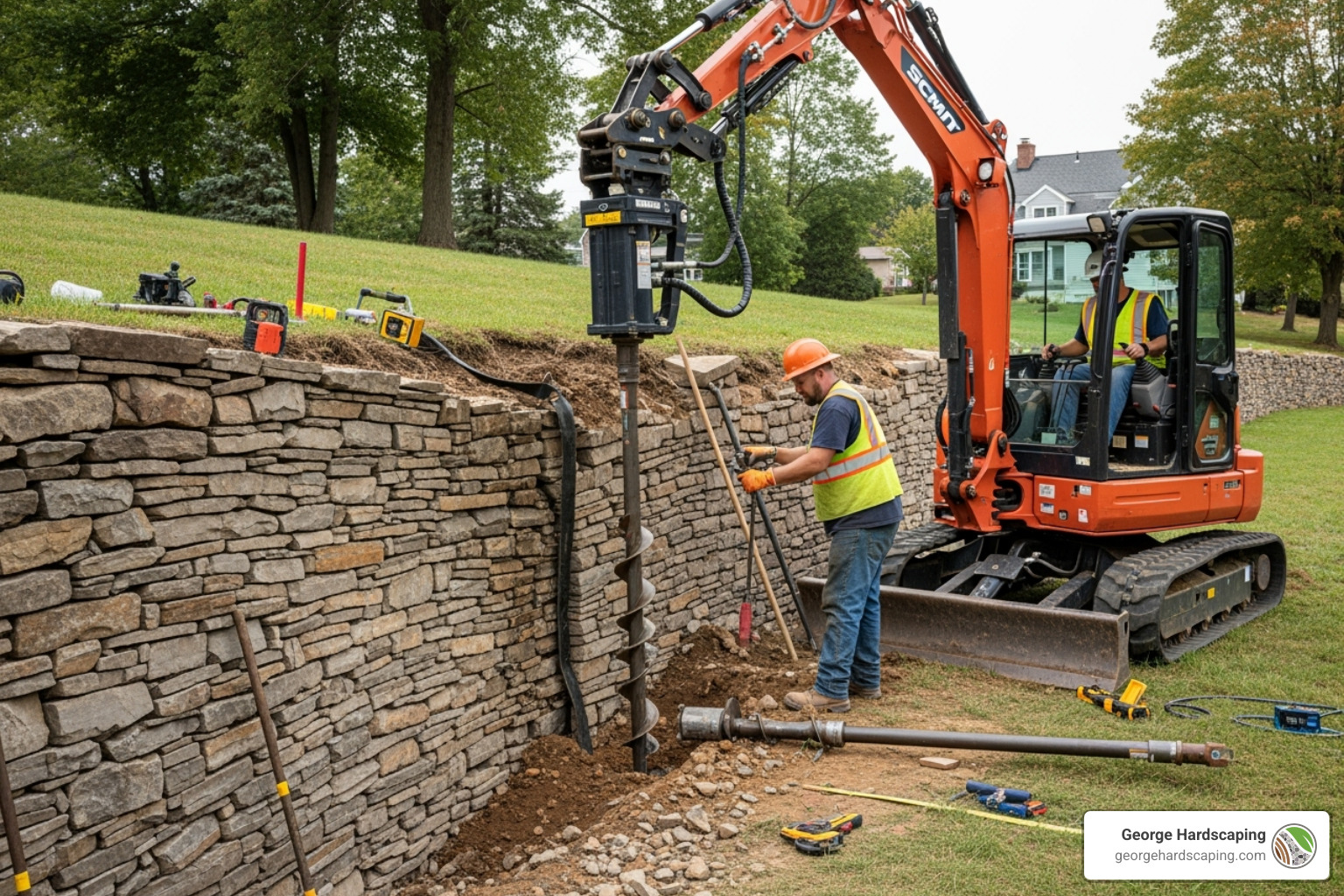
At George Hardscaping, our experience with helical anchors allows us to stabilize walls without complete rebuild disruption: https://georgehardscaping.com/helical-anchors-retaining-wall-repair/.
Foundations, Frost, and Footings
- Base Preparation: Compacted crushed-stone base provides uniform support
- Frost Depth: In New England, frost can penetrate over 4 feet
- Step Footings on Slopes: Keep courses level across grade changes
Engineering and Permits
Walls over 4 feet tall or supporting driveways typically require engineered design and permits. Adhering to permitting ensures a long-lasting fix.
Capping Your Wall for Long-Term Protection
A wall’s cap is its first defense against water infiltration. Well-designed caps prevent water from entering the wall’s core, where it causes freeze-thaw damage.
Mortar caps offer natural looks blending with stone, while concrete caps provide durability. The primary job is shedding water away from the wall. Our expertise with natural stone retaining walls ensures your cap provides both protection and beauty: https://georgehardscaping.com/natural-stone-retaining-walls/.
If your wall is leaning, bowing, or showing base failure signs, schedule a site visit now. Contact George Hardscaping for comprehensive assessment: https://georgehardscaping.com/request-estimate/.
Frequently Asked Questions
We hear the same concerns from homeowners across Essex County, MA. Your retaining wall is a significant investment, and when something goes wrong, you want straight answers.
How much does it cost to repair a rock retaining wall?
The cost of repairing a rock retaining wall varies widely based on the extent of the damage, materials needed, labor rates, and site accessibility. A wall on a steep, hard-to-reach slope will cost more to repair than one on flat, open ground.
Here are some general estimates:
- Minor DIY Fixes: $100 to $300 for materials like mortar and sealant.
- Professional Repairs: Typically $30–$90 per square foot, depending on complexity.
- Major Section Repairs: An 11×4-foot section needing significant work could average $4,000 to $12,000.
- Full Rebuilds: Can range from $50,000 to $150,000 or more.
These are average costs based on internet research and not actual costs for George Hardscaping services.
For a more detailed look at project costs, see our guide on how much a retaining wall costs: https://georgehardscaping.com/how-much-does-a-retaining-wall-cost/.
Do I need a permit to repair or rebuild my retaining wall?
Often, yes—especially if the wall is 4 feet or taller, retains a driveway or structure, or if you’re altering drainage patterns. Requirements vary by municipality, but engineered drawings may be needed for structural work. We can guide you through permitting as part of our masonry services: https://georgehardscaping.com/masonry-services/.
How can I match new mortar to my old, weathered mortar?
Mortar matching is an art. The final color is determined by the sand, cement, and any pigments used. Your old mortar also has decades of weathering that can’t be replicated instantly.
- Start with Sand: The sand’s color has the biggest impact. Get samples of different sands to test.
- Test Small Batches: Mix small test batches with different combinations of sand and powdered mortar pigments.
- Let it Cure: Apply test patches to an inconspicuous area and let them dry for at least 48 hours. Wet mortar looks very different from cured mortar. Patience is key to getting a close match.
Even with a perfect match, new mortar will take time to weather and blend in completely.
What are the key safety precautions for repairing a rock retaining wall?
Safety is non-negotiable when working with heavy stones and potentially unstable structures.
- Wear Personal Protective Equipment (PPE): Always wear safety glasses (especially when chiseling), heavy-duty gloves, and sturdy work boots with ankle support.
- Use Proper Lifting Techniques: Lift with your legs, not your back. Get help for any stone that feels too heavy. A single stone can weigh 60–80 pounds or more.
- Assess Wall Stability: Before starting, check the wall for signs of imminent collapse like severe leaning or bulging. If the wall seems unstable, secure the area and call a professional immediately.
- Electrical Safety: If using power tools, ensure they are connected to a GFCI-protected outlet and keep cords away from water.
What maintenance should I plan for each year?
- Spring: Clear debris from weep holes; inspect for new cracks or mortar loss; confirm top-of-wall grading sheds water away.
- Summer: Repoint small joints, seal cracks, and reset loose stones. Consider adding decorative stone mulch against the wall to discourage moisture retention.
- Fall: Trim vegetation and roots near the wall; redirect downspouts. Schedule professional drainage upgrades before winter if needed: https://georgehardscaping.com/retaining-wall-drainage-system/.
- Winter: Avoid piling snow against the wall and minimize de-icing salt contact with stone and mortar.
Can vegetation damage my retaining wall?
Yes. Roots from trees and large shrubs can penetrate backfill and pry stones apart. Use low-root groundcovers near the wall and keep woody plants a safe distance away. If roots are already present, consult a pro to remove them without destabilizing the wall.
How long will a repaired wall last?
When underlying issues like drainage are corrected, targeted structural repairs and repointing can add decades of service life. Without addressing the root cause (hydrostatic pressure, poor base, or surcharges), cosmetic fixes may only last a season or two.
How quickly can work begin, and how long will it take?
- Minor repairs: Often completed in a day or two, with minimal disturbance.
- Drainage retrofits: Typically 1–3 days, depending on access.
- Structural stabilization (anchors/tiebacks): Several days to a week.
- Rebuilds: From one to several weeks depending on length, height, access, and permitting.
Will my homeowners insurance cover a failing retaining wall?
Policies vary. Sudden damage from a covered peril might qualify, but gradual deterioration typically does not. Document conditions with dated photos and consult your carrier.
Have more questions or need a definitive plan? Request a free on-site assessment today: https://georgehardscaping.com/request-estimate/.
Conclusion: Protect Your Hardscape Investment
Your retaining wall is a hardworking guardian protecting your property. Throughout this guide on repairing a rock retaining wall, we’ve covered the essential steps to save you money and keep your property safe.
The key takeaways are simple but crucial:
- Assess Damage Early: Catching minor issues like crumbling mortar prevents major structural failures
- Handle Minor DIY Repairs Promptly: A weekend spent repointing joints can save you from a five-figure rebuild
- Prioritize Drainage: Water is the number one enemy of retaining walls
- Know When to Call a Professional: For walls over 4 feet tall or significant structural issues
A well-maintained retaining wall prevents erosion, creates usable outdoor space, and boosts your property’s curb appeal and value.
At George Hardscaping, we’ve been helping homeowners across Essex County’s North Shore communities maintain and repair their retaining walls for years. Whether you’re in Beverly, Boxford, Danvers, Essex, Georgetown, Gloucester, Ipswich, Lynnfield, Manchester-by-the-Sea, Marblehead, Newburyport, North Reading, Peabody, Rockport, Rowley, Salem, Swampscott, Topsfield, or Wenham, our experienced team understands the unique challenges New England weather poses to your natural stone retaining walls: https://georgehardscaping.com/natural-stone-retaining-walls/.
Don’t gamble with your family’s safety or your property’s value. Small problems can quickly become expensive emergencies. Whether you need professional assessment, expert masonry services for complex repairs, or advanced solutions like helical anchors, we are here to help.
Book your free, no-obligation on-site inspection now and get a clear, written plan to safeguard your wall and property: https://georgehardscaping.com/request-estimate/.
If you’re comparing repair vs. rebuild, get transparent guidance and budget ranges from our retaining wall construction cost resources: https://georgehardscaping.com/retaining-wall-construction-cost/.
