
Introduction: Why a Natural Stone Path is the Perfect DIY Upgrade

Laying a stone path is one of the most rewarding weekend projects you can tackle, dramatically changing your outdoor space while adding both enduring beauty and essential function to your property. Whether you’re creating a practical walkway from your driveway to your front door or designing a whimsical, winding garden path, a well-built stone walkway provides lasting value with surprisingly minimal maintenance.
Quick Answer: How to Lay a Stone Path
- Plan your path – Mark the layout, decide on width (36-48 inches is standard), and choose your stone type.
- Excavate – Dig a trench 5-7 inches deep, removing all grass, roots, and large rocks.
- Install base layers – Lay commercial-grade landscape fabric, add 3-4 inches of compacted crushed stone, followed by a 1-inch sand setting bed.
- Set the stones – Place stones into the sand bed, maintaining 1-2 inch gaps, and use a level to ensure a flat, stable surface.
- Fill gaps – Sweep sand, decorative gravel, or polymeric sand between stones to lock them securely in place.
- Finishing touches – Gently water the path to settle the joint materials, and consider adding edging or plants along the border.
Time Required: 1-2 days for a 20-foot path
Skill Level: Beginner to Intermediate
Average Cost: $5.00-$15.00+ per square foot for materials (based on internet data; actual costs vary significantly by location and materials chosen)
Natural stone paths offer benefits that go far beyond simple aesthetics. They create a solid, non-slip surface that provides safe footing even in wet New England weather, guide foot traffic to protect your lawn from wear, and add a rustic charm that complements any landscape style. Unlike poured concrete or asphalt, which can crack and look industrial, natural stone develops a beautiful character over time. The subtle shifts in color, the growth of moss in crevices, and the gentle patina of age add to its appeal rather than detracting from it.
The beauty of this project lies in its flexibility. You can complete a simple stepping stone path in a single afternoon or invest a weekend in a full flagstone walkway with professional-grade results. The materials are forgiving, the technique is straightforward, and the finished product will last for decades with minimal upkeep, adding tangible value to your home.
For homeowners in Essex County and across the North Shore of Massachusetts, a properly installed stone path also addresses common regional challenges. It is an effective tool for managing soil erosion on sloped properties and creating neat, durable connections between outdoor living spaces such as patios, driveways, and pool decks. The natural materials blend beautifully with classic New England landscapes while being robust enough to stand up to our demanding freeze-thaw cycles and seasonal weather changes.
Whether you’re a first-time DIYer eager for a challenge or an experienced weekend warrior looking for your next project, this guide walks you through the key steps. From initial planning and material selection to setting the stones and filling the joints, you’ll gain the confidence and know-how to create a beautiful, durable stone path that adds both value and delight to your property for years to come.
To get a clear mental picture of how everything fits together, imagine an infographic showing the layers of a quality stone path, from bottom to top: native soil, compacted subgrade, landscape fabric, gravel base, sand setting bed, natural stones, and finally your chosen joint filler material. Each layer plays a role in keeping your new walkway level, safe, and attractive over the long term.
Phase 1: Planning and Preparation for Your Stone Walkway
Before a single shovel of dirt is turned, a successful stone path is born in the planning phase. This is where your vision meets the practical realities of your landscape. Thorough preparation is the single most important factor in ensuring your stone walkway not only looks great on day one but also remains stable for years. For additional high-level insights, the experts at This Old House provide a helpful guide on how to lay a flagstone walkway.
Designing Your Path: Function, Flow, and Form
The first step in laying a stone path is to define its purpose. Ask yourself: what is the primary function of this path? Is it a high-traffic route from the back door to a custom outdoor firepit, requiring a solid and direct line? Or is it a meandering, decorative trail designed to encourage a slow stroll through a garden bed? The answer will dictate its width, shape, and materials.
For utilitarian paths, width is key. A 36-inch width is a comfortable minimum for a single person, but a 48-inch-wide walkway allows two people to walk side by side and provides a more generous, welcoming feel. If the path needs to accommodate a wheelbarrow or lawnmower, plan accordingly. For purely decorative paths, you have more freedom with narrower, more organic shapes.
Next, visualize the flow. Use a garden hose or brightly colored spray paint to outline the path’s shape directly on the ground. Live with it for a day or two and walk the proposed route. Does the curve feel natural? Does it create a pleasant journey? This is the time to make adjustments, identify potential obstacles like tree roots or irrigation heads, and ensure the path integrates smoothly with the rest of your landscape. Always call 811 before you dig. This free service marks the location of underground utility lines, preventing a dangerous and costly accident.
Drainage is a non-negotiable consideration, especially in the varied terrain of Essex County. Water is the enemy of a stable path. Incorporate a slight cross-slope to allow water to sheet off the surface. A gradient of 1:40 (about a 1/4-inch drop for every foot of width) is a commonly recommended standard. This helps water drain away from structures and prevents pooling, which can lead to ice patches in winter and destabilize the base. If building near your home’s foundation, ensure the finished path level is at least two brick courses (about 150 mm) below the damp-proof course to prevent moisture from wicking into your house.
Gathering Your Materials and Tools
Once your design is set, assemble your materials and tools. Having everything on-site before you begin keeps the project moving smoothly.
Choosing Your Stones:
The term “natural stone” covers a wide spectrum of options. Flagstone is a classic choice, prized for its flat, irregular shapes and durability. Many homeowners in Massachusetts choose slate, granite, or local bluestone, each offering unique colors, textures, and price points. When selecting stones, prioritize a thickness of at least 1.5 inches to reduce the chance of cracking underfoot; 2 to 3 inches is ideal for heavily trafficked areas or driveways. Choose stones with a natural, cleft surface, not a polished one, to ensure good traction when wet.
Calculating Quantity:
For flagstone, a ton typically covers between 80 and 120 square feet, depending on its thickness. To calculate your path’s area, multiply its length by its average width, then consult with your stone supplier for coverage rates. Rule of thumb: order 15-20% more stone than your calculation. This surplus accounts for breakage, allows you to be selective with shapes, and provides extra pieces for future repairs.
Base Materials:
A stable path requires a multi-layered foundation. You will need:
- Crushed Stone (also called processed gravel, item #4, or 3/4″ dense grade): This is the structural base. For a typical path, you’ll want a compacted 3- to 4-inch layer.
- Coarse Sand or Stone Dust: This forms the 1-inch setting bed your stones will rest in.
As a rough estimate, for every 100 square feet of path, plan for around 1.25 cubic yards of crushed stone and 0.3 cubic yards of sand, adjusting for your specific design and local supplier recommendations.
Other Essentials:
- Landscape Fabric: A heavy-duty, non-woven geotextile fabric separates your base from the soil below.
- Edging: Steel, aluminum, heavy-duty plastic, or stone pavers can all define the path’s borders and help contain the base materials.
- Joint Fillers: Options range from fine sand and polymeric sand (which hardens to resist weeds) to decorative gravel or soil for planting ground cover.
Essential Tools for Laying a Stone Path:
- Shovel (round-point for digging, flat for moving material)
- Wheelbarrow
- Hand Tamper (or a rented plate compactor for larger paths)
- Carpenter’s Level (a 4-foot level is ideal)
- Rubber Mallet
- Tape Measure
- Stonemason’s Hammer or a Hammer and Chisel (for shaping stones)
- Stiff-bristled Broom
- Rake (bow and leaf)
- Work Gloves and Safety Glasses
- Garden Hose and String Line with Stakes
- Screed Board (a straight 2×4)
Budgeting Your Project: Cost Considerations
Understanding the costs helps you decide whether to tackle laying a stone path yourself or bring in a professional crew.
DIY material costs can vary widely based on stone type, site conditions, and regional pricing. Many homeowners see total material costs in the range of $5 to $15 per square foot when using natural stone, crushed stone base, sand, landscape fabric, edging, and joint fillers. This does not include delivery fees, which can be substantial for heavy materials, or tool rental costs for items like a plate compactor.
Sample DIY Budget (100 sq. ft. path):
- Stone: 1 to 1.5 tons of mid-range flagstone
- Base and Sand: About 1.5 cubic yards total
- Landscape Fabric and Edging: Sized to match your layout
- Joint Filler and Miscellaneous Supplies: Sand, polymeric sand, or gravel, along with stakes, string, and safety gear
If you decide to hire a professional instead, labor typically adds a significant cost per square foot, reflecting the experience and equipment involved. Bringing in experts like George Hardscaping is a worthwhile investment, especially when your new path needs to tie seamlessly into other features such as patios, driveways, or retaining walls, or when you are working on sloped or drainage-challenged sites. Our team serves homeowners throughout Beverly, Danvers, Marblehead, Ipswich, and the wider North Shore with custom design and installation.
If you prefer to skip the logistics and heavy lifting, let our experts handle the planning and construction. Contact George Hardscaping for a free consultation and let us build the perfect walkway for you while you focus on enjoying the finished product.
Phase 2: The Ultimate Guide to Laying a Stone Path
This is where your planning pays off and the physical change begins. This phase combines hard work with a touch of artistry. Follow these steps carefully for a path that will stand up to New England weather and years of foot traffic.
Step 1: Excavation and Ground Preparation
Proper ground preparation is the unglamorous but absolutely essential foundation of a stable, long-lasting path.
- Confirm Utilities are Marked: Before you dig, double-check that the 811 utility marking service has visited and marked all underground lines.
- Define the Area: Using your hose or paint outline as a guide, drive stakes and run string lines to create a precise boundary for your excavation. This keeps lines straight and curves consistent.
- Excavate the Trench: Begin digging out the path area. Your target depth is the sum of your layers: typically 3 to 4 inches for the crushed stone base + 1 inch for the sand bed + the average thickness of your stones (for example, 2 inches) for a total of about 6 to 7 inches. Remove all grass, weeds, roots, and any rocks larger than a fist. A sod cutter, which can be rented, makes this task faster on longer paths.
- Compact the Subgrade: Once excavated, the soil at the bottom of the trench is your subgrade. It must be firm and stable. Use a hand tamper (or a plate compactor) to pound the entire area until it is hard and does not yield under your weight.
- Establish the Drainage Slope: Using your string lines and a level, ensure the entire excavated trench has a slight, consistent slope to one side (the 1/4-inch per foot gradient you planned). This is your chance to build in proper drainage from the bottom up.
- Install Edging: If you are using a manufactured edging material like steel, aluminum, or plastic, install it now along the perimeter of your trench and secure it with stakes. This creates a frame that contains your base materials and maintains the path’s shape.
Step 2: Building a Stable Foundation
The multi-layer foundation is what separates a professional-quality path from an amateur one. It provides load-bearing support, facilitates drainage, and helps the path resist freeze-thaw cycles.
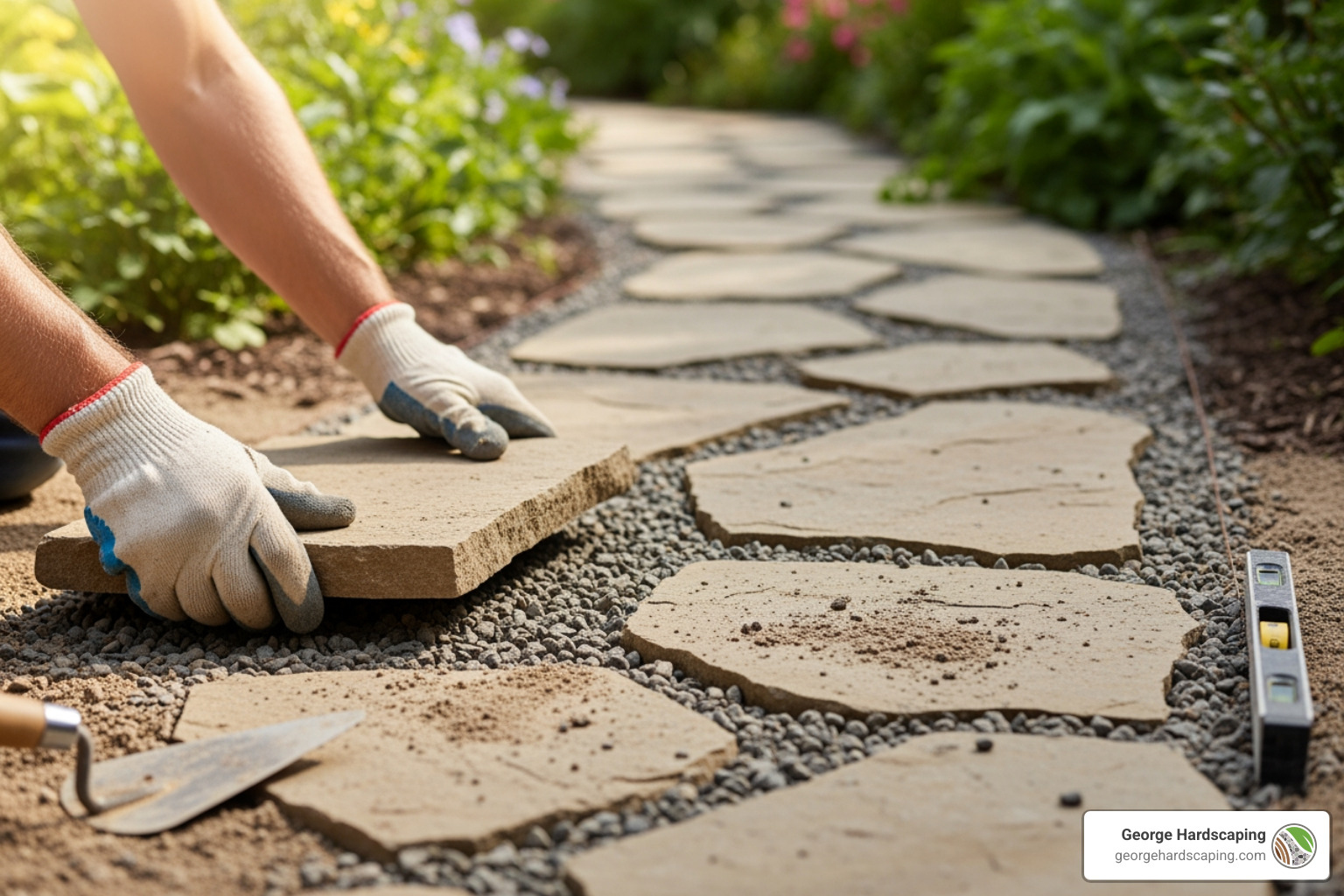
- Lay Landscape Fabric: Roll out a high-quality, non-woven geotextile fabric over the entire compacted subgrade. This critical layer separates the soil from your gravel base, helps reduce mixing of materials over time, and suppresses deep-rooted weeds. Overlap any seams by at least 12 inches.
- Add the Crushed Stone Base: Shovel 3/4-inch crushed stone into the trench, spreading it evenly over the landscape fabric. Add the material in 2-inch lifts (layers). After each lift, lightly moisten it with a hose and compact it thoroughly with your tamper or plate compactor. For a 4-inch base, repeat this process twice.
- Screed the Setting Bed: After the crushed stone base is compacted and solid, add a 1-inch layer of coarse sand or stone dust on top as the setting bed. To level it, place two 1-inch-diameter pipes on the base and pull a straight 2×4 (your screed board) across them. This removes excess sand and creates a smooth surface for your stones.
Step 3: The Art of Properly Installing the Stones
Now for the most satisfying part: creating your stone mosaic. This step is a puzzle that requires patience and an eye for pattern.
- Sort Your Stones: Before you begin, sort your stones by size and shape. Identify larger “key” stones and smaller filler pieces. This helps you build a balanced, visually pleasing pattern.
- Start Setting: Begin laying a stone path at a corner or a prominent edge. Place your first large stone onto the prepared sand bed.
- Set, Don’t Just Place: Give the stone a firm wiggle, pushing it down into the sand. Then, use a rubber mallet to tap it firmly into place. The goal is to embed the stone so it is stable and does not rock or wobble.
- Check Levels Frequently: Use your carpenter’s level often. Check each stone individually to ensure it is relatively flat, and place the level across adjacent stones to confirm they are even with each other. The surface of the path should feel smooth underfoot. If a stone is too high, remove it, scoop out a bit of sand, and reset it. If it is too low, add a small amount of sand underneath and reset.
- Maintain Consistent Gaps: Aim for reasonably consistent joint widths between your stones, typically between 1/2 inch and 2 inches. While some variation is expected and adds to the natural look, extremely wide or uneven gaps can be harder to fill and less comfortable to walk on.
- Work Methodically: Continue this process—placing, setting, and leveling each stone—working from your completed section outward. If a stone does not fit, use your stonemason’s hammer to carefully chip off an edge for a better fit, always wearing safety glasses.
This level of detail and heavy lifting comes naturally to an experienced crew. If you would rather enjoy the finished product without tackling every step yourself, you can explore the professional hardscaping and masonry services available from George Hardscaping. Our team builds stone paths, patios, and retaining walls designed to last in the North Shore climate.
Phase 3: Finishing Touches and Creative Design Ideas
The final phase of laying a stone path is where you lift it from a simple walkway to a defining feature of your landscape. These finishing details lock in your work, add personality, and support long-term performance.
Filling the Gaps: The Best Options for Your Walkway
Once all your stones are securely set and leveled, filling the joints is the crucial final step. This locks the stones together into a single, cohesive unit and helps reduce weed growth.
- Polymeric Sand: For low-maintenance joints, polymeric sand is a popular choice. This fine sand includes a binder that activates when moistened. Apply it dry, sweep it carefully into the joints, blow or brush all excess off the stone surfaces, and then gently mist with water according to the manufacturer’s instructions. A joint width of roughly 1/2 inch to 1 inch is ideal for polymeric sand to work effectively.
- Fine Sand or Stone Dust: This traditional method is simple and cost-effective. Sweep the material over the path until all joints are full, then lightly mist with water to settle the sand. After it dries, you may need to repeat the process to fully pack the joints. While effective at locking stones, this option offers less weed resistance and may need periodic topping off.
- Decorative Pebbles or Gravel: For a more textured, rustic look, small pebbles or fine gravel (such as 1/4-inch crushed stone) can be swept into wider gaps. This provides excellent drainage and creates pleasing contrast with larger flagstones.
- Soil Mix for Planting: If you want a soft, cottage-style “living path,” fill wider gaps (around 2 to 3 inches) with a high-quality soil mix, such as a blend of compost and sand. This prepares the joints for planting low-growing ground cover.
After placing your joint material, gently water the path to help it settle. Avoid heavy streams of water that can wash material out of the joints.
Popular Stepping Stone Walkway Ideas
The versatility of natural stone allows for endless creative expression.
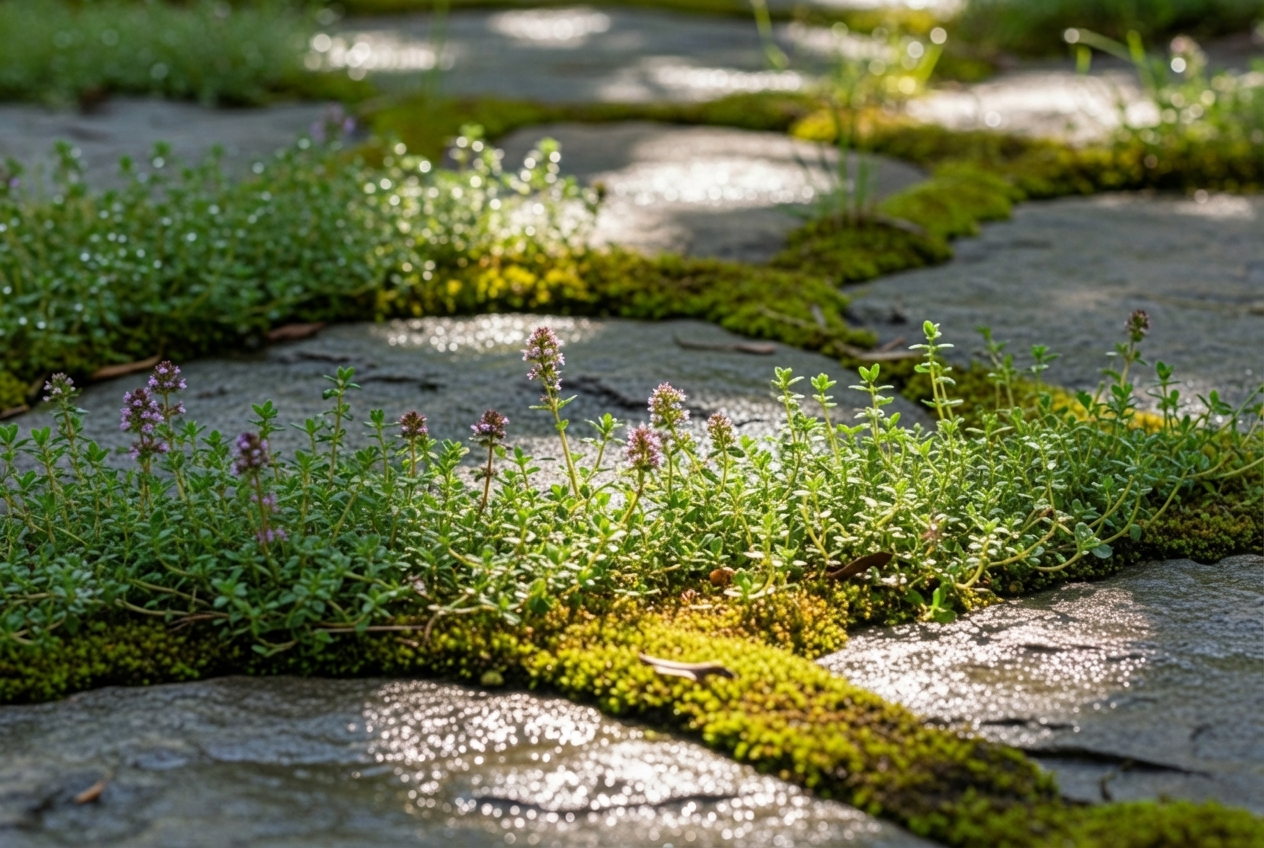
- Living Path with ‘Steppable’ Ground Covers: Plant resilient, low-growing plants in the joints to blend your path with surrounding beds. Choose plants that tolerate foot traffic and match your light conditions. Many New England homeowners favor creeping thyme, blue star creeper, and Irish moss for their color and texture.
- Modern Geometric Design: For a contemporary aesthetic, use stones cut into squares or rectangles (dimensional flagstone). Set them in a repeating pattern with tight, consistent joints filled with polymeric sand or fine gravel for a clean, modern look.
- Classic Rustic Charm: Accept the organic nature of stone by using irregular flagstones with varied shapes and sizes. Allow for somewhat wider, softened gaps and fill them with stone dust, decorative pebbles, or soil and ground cover.
- Winding Garden Walkways: A path does not have to be the shortest distance between two points. Design a path that gently curves and meanders through your garden, revealing planting beds, water features, or quiet seating areas as you walk.
For more design inspiration and planning tips, you can explore the design-focused article on questions to ask before laying stepping stones from Houzz, which offers additional layout ideas and considerations.
Long-Term Care and Avoiding Common Pitfalls
A well-built natural stone path is a long-term investment in your property. While it requires minimal maintenance, understanding how to care for it—and which mistakes to avoid during construction—helps it remain attractive and functional for decades.
Common Mistakes to Avoid When laying a stone path
Being aware of common pitfalls is the first step to avoiding them.
- Mistake #1: Inadequate Base Preparation
Why it’s a problem: A shallow or poorly compacted base can settle unevenly, leading to wobbly stones, tripping hazards, and premature failure. In a climate with freeze-thaw cycles, it also makes the path more susceptible to frost heave.
How to avoid it: Do not cut corners on excavation depth or compaction. Dig to the full recommended depth based on your stone thickness, compact the subgrade soil thoroughly, and add your crushed stone base in thin layers, compacting each one. - Mistake #2: Skipping the Landscape Fabric
Why it’s a problem: Without a geotextile fabric barrier, the crushed stone base can slowly migrate into the underlying soil, reducing support. Deep-rooted weeds also have an easier path upward.
How to avoid it: Use a quality non-woven geotextile fabric and overlap all seams by at least 12 inches. - Mistake #3: Poor Drainage Planning
Why it’s a problem: A flat or improperly sloped path can collect water, promoting slippery moss growth, potential ice patches, and saturation of the base material.
How to avoid it: Build a slight, consistent cross-slope (about 1/4 inch per foot) into the path from the excavation stage and direct water away from structures and planting beds that are sensitive to excess moisture. - Mistake #4: Using the Wrong Stones
Why it’s a problem: Stones that are too thin can break under load, and overly smooth or polished surfaces can be slippery when wet.
How to avoid it: Choose stones rated for exterior paving with a natural texture for traction and adequate thickness for the intended use.
How to Maintain Your Natural Stone Path: A Seasonal Guide
Once your path is installed, a little seasonal attention will help it stay in great shape.
- Spring Cleanup:
Walk the path and look for any stones that may have shifted over winter. Re-level any that rock or feel uneven by lifting them, adjusting the sand base, and resetting them. Check the joints and top off sand or gravel if it has settled. Clean the surface with a stiff brush and water, using a low-pressure spray if needed. - Summer Maintenance:
Sweep away leaves, grass clippings, and other debris regularly so organic matter does not accumulate in the joints. Pull any stray weeds by hand while they are small. - Fall Preparation:
Keep the path clear of fallen leaves. Wet leaves can stain stone and create slick spots. - Winter Care:
Avoid using rock salt or harsh de-icing chemicals on your natural stone path, as they can damage the surface or joints over time. For traction, use sand. If a de-icer is necessary, look for products specifically labeled as safe for natural stone and concrete.
By following these basic care steps, a well-constructed stone path should serve you for many years with only modest upkeep.
Conclusion: Enjoy Your New Handcrafted Walkway
By following these steps, you have done more than just lay a few stones—you have created a permanent feature that changes how you move through and enjoy your property. Laying a stone path is a rewarding project that boosts curb appeal, protects lawn areas from wear, and guides family and guests safely through your outdoor spaces.
Your new path can also be the first step in a larger outdoor renovation, tying together gathering spaces, gardens, and other hardscape features. The same principles of careful base preparation and thoughtful design apply to everything from a simple walkway to more involved projects such as patios, driveways, and retaining walls.
If your property in Beverly, Danvers, Ipswich, or anywhere on the North Shore includes slopes, tricky drainage, or tight spaces near your home, or if you simply prefer a guaranteed professional result, George Hardscaping is ready to help. Our team specializes in creating durable custom walkways and steps that complement your home and landscape.
Ready to transform your yard without managing excavation, base work, and stone setting on your own? Request your free, no-obligation estimate today! A member of the George Hardscaping team will review your goals, assess your site, and recommend a plan that fits your style and budget.
Whether you choose to DIY or partner with professionals, a well-designed stone path is an upgrade you will appreciate every time you step outside.
