
Helical anchors retaining wall: Ultimate 2025 Stability
a0� perfect for showcasing the effectiveness of hidden helical anchors. – helical anchors retaining wall” src=”https://images.pexels.com/photos/911738/pexels-photo-911738.jpeg?auto=compress&cs=tinysrgb&dpr=2&h=750&w=1260″/>
Keeping Your Retaining Wall Strong and Straight
When it comes to maintaining your property, especially on the sloped landscapes common in Essex County, MA, you might find yourself dealing with a common but serious issue: a failing retaining wall. These structures are engineered to hold back tons of soil, but over time, the immense pressure can cause them to bow, lean, or develop significant cracks. Telltale signs like a noticeable forward tilt, stair-step cracks in masonry, or gaps appearing between the wall and adjacent patios are all red flags. This is where helical anchors retaining wall systems come in as a powerful, modern solution to prevent a costly collapse.
What are Helical Anchors for Retaining Walls?
- Helical anchors: Also known as helical piles, these are essentially giant steel corkscrews. They are hydraulically drilled deep into the stable, load-bearing soil located well behind the retaining wall.
- Purpose: Their primary function is to provide robust lateral support. They act like a brace, actively pulling or holding a failing retaining wall back into its correct, vertical position and securing it against future movement.
- How they work: The anchor’s helical plates screw into the ground, which provides immense resistance to being pulled out. A high-strength steel rod then connects the buried anchor to a plate on the face of the wall, creating tension that counteracts the powerful forces pushing the wall outward.
- Why needed: They become necessary when external pressure, most often from hydrostatic pressure in water-saturated soil, causes retaining walls to lean, bow, or tip. These symptoms indicate a critical loss of structural stability that requires immediate and effective reinforcement.
This guide explains everything you need to know about these innovative anchors and how they can keep your retaining wall – and your landscape – stable and secure for years to come.
What Are Helical Tiebacks and Why Do Walls Need Them?
Retaining walls are the quiet workhorses of many North Shore landscapes. By holding back tons of soil, they create the level patios, safe walkways, and beautiful terraced gardens we all enjoy. The problem is that soil is not a static material. It exerts constant lateral pressure on the wall, a force that can increase dramatically with changes in moisture. When heavy rains saturate the ground, the soil becomes heavier and the hydrostatic pressure can multiply the force pushing on the wall.
This is especially true in our region, where clay-rich soils expand significantly when wet. Over time, this relentless pressure can overwhelm the wall’s original design, causing it to bow, lean, or crack. When that happens, the wall needs reinforcement to prevent a total failure.
Helical tieback anchors provide that essential reinforcement. Picture an oversized steel corkscrew: the helical plates are engineered to slice cleanly into the earth as the shaft is spun in with powerful hydraulic equipment. The goal is to bypass the unstable, wet soil immediately behind the wall and anchor deep into firm, load-bearing soil strata. Once the plates reach this competent soil, the anchor is connected to the wall with a threaded rod and a steel wall plate, placing the wall in tension and effectively counteracting the outward soil pressure.
The Installation Process: From Soil Analysis to Final Tensioning
Installing a helical anchors retaining wall system is a precise, engineered process, but the overall sequence is straightforward and efficient.
1. Site Assessment & Engineering Design
The first step is always a thorough site assessment. A professional soils report or boring log tells us whether we are dealing with clay, sand, or dense glacial till. Each soil type demands a different helical plate diameter and embedment depth to achieve the necessary holding capacity. Using that geotechnical data, engineers design the repair plan. They specify the anchor angle, spacing between anchors, and the required installation torque to ensure the finished system meets or exceeds the safety factors spelled out in local building codes and industry best practices, such as those outlined by the Deep Foundations Institute (DFI). (More detail is in our Retaining Wall Design guide.)
2. Drilling & Installation
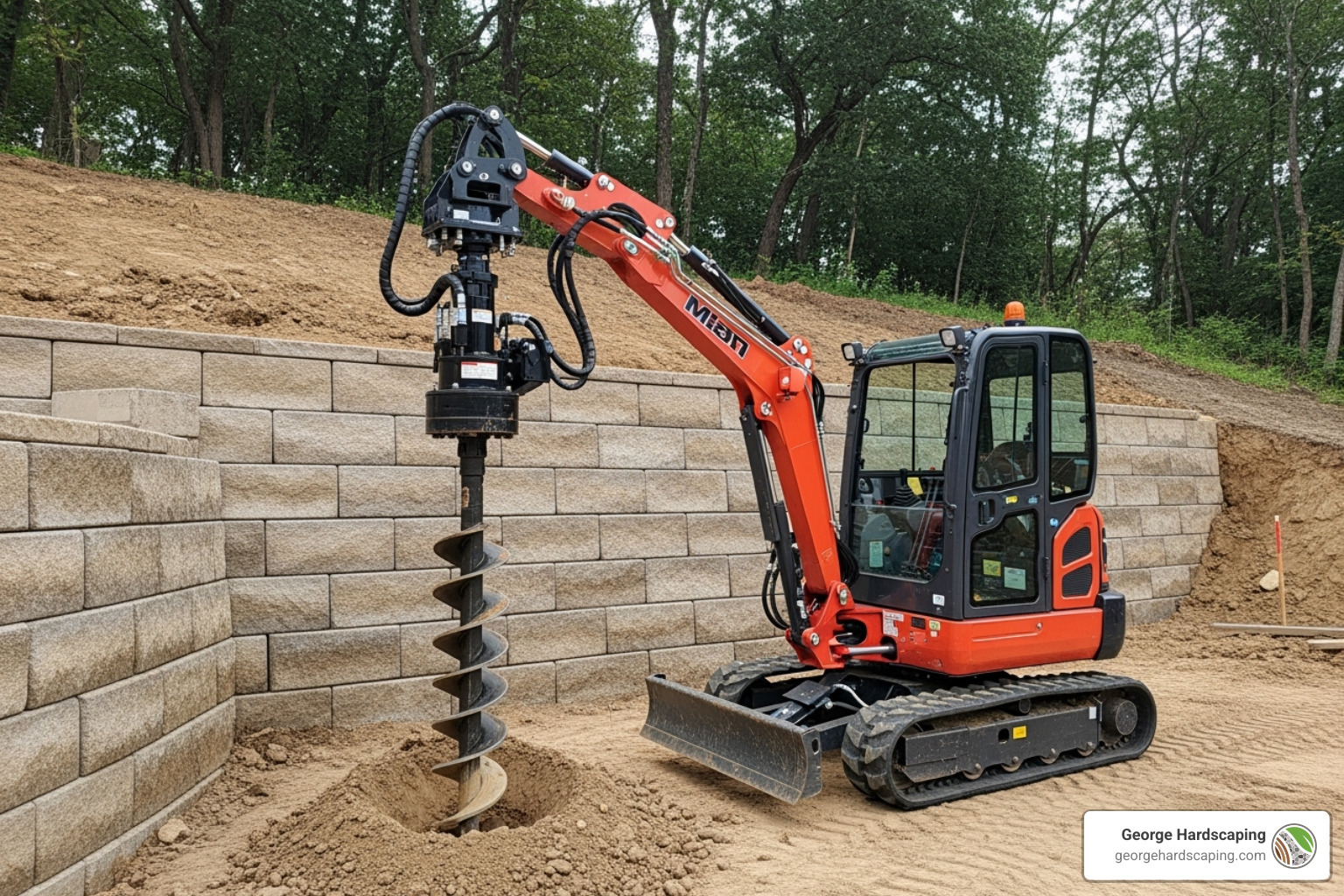
A compact rotary head, typically mounted on a mini-excavator, spins each anchor through a pre-drilled hole in the wall. The operator carefully monitors the hydraulic pressure, which correlates directly to the installation torque. Steel extensions are coupled and added as needed until the anchor reaches the target depth and the specified torque is achieved, often 20 to 40 feet deep on the North Shore. Because the machine has a tiny footprint and the process generates minimal spoils (excavated soil), nearby lawns, delicate plantings, and patios remain largely untouched.
3. Termination & Load-Locking
Once the anchor is installed, the exposed threaded rod passes through a heavy-duty steel wall plate. A calibrated torque wrench is used to tighten the nut against the plate. This step can often pull the wall back toward a plumb position and, most importantly, it instantly load-tests the anchor to verify its capacity. There is no waiting for concrete to cure. For a clean finish, the hardware can be recessed or concealed with matching stonework, seamlessly blending with existing Stone Masonry Services.
The Clear Advantages of Using Helical Anchors
Why do engineers and homeowners alike prefer helicals over other repair methods? The benefits are significant and address the primary concerns of any property owner: reliability, cost, and convenience.
- Predictable Capacity: The installation torque is continuously monitored, providing a real-time, on-site proof test of each anchor’s holding strength. This removes guesswork and ensures the repair is engineered correctly.
- Fast, Year-Round Installation: With no concrete to pour or cure, the system is ready to be loaded immediately. This allows for rapid project completion and makes installation possible in nearly any weather, including winter.
- Minimal Disturbance: The use of compact equipment, often small enough to fit through a standard 36-inch gate, means your lawn, gardens, and existing hardscapes are preserved. There is no need for large-scale excavation.
- Cost-Effective: By minimizing excavation, labor hours, and the need for spoil removal, helical anchors often result in a lower final invoice compared to more disruptive methods.
- Reusable on Temporary Work: For temporary shoring or support projects, the anchors can often be unscrewed, removed, and reused, offering excellent value.
These same benefits make helicals a smart choice for basement wall tiebacks, seawall reinforcement, or underpinning settlement-prone homes. Learn more about those options in our full list of Hardscaping Services.
Built to Last
To ensure longevity, all anchor shafts and plates are hot-dip galvanized for superior corrosion resistance. Optional epoxy coatings can be added for use in particularly aggressive soils. Once buried, they require virtually no maintenance and offer decades of reliable service – a perfect solution for the demanding North Shore climate with its salt air and freeze-thaw cycles.
Helical Anchors vs. the Old School Methods
When a retaining wall begins to fail, homeowners typically have three repair routes to consider. Here’s how they stack up against each other:
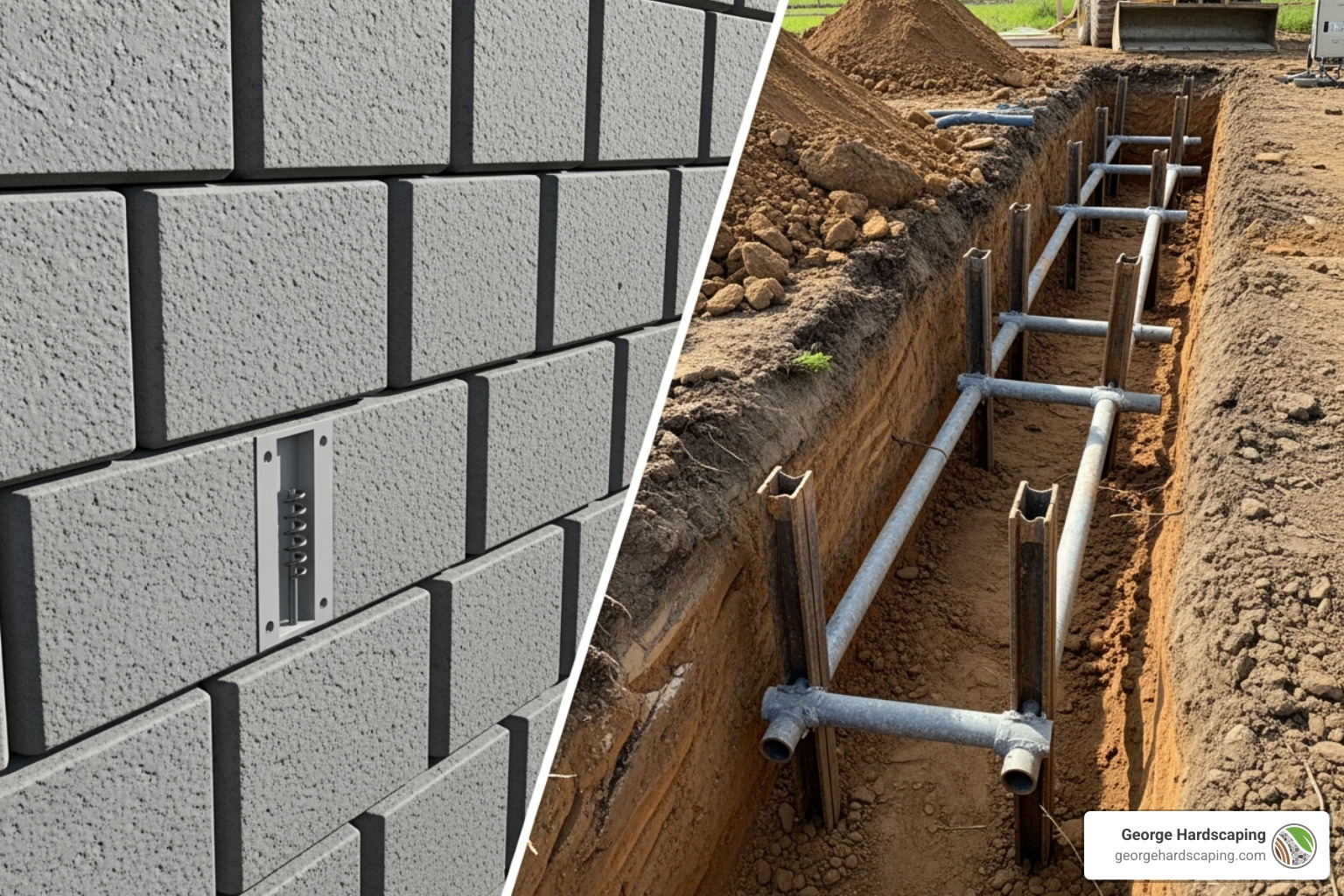
| Feature | Helical Anchors | Deadman Anchors | Grouted Tiebacks |
|---|---|---|---|
| Installation Speed | Fast – load-tested immediately | Slow – requires large excavation | Moderate – grout must cure |
| Site Disruption | Very low | High | Moderate |
| Cost Factor | Lower labor, less spoil removal | High labor & materials | Added grout and wait time |
| Load Verification | Instant (via torque) | Hard to gauge on site | After grout cures |
| Soil Suitability | Excellent in varied soils | Needs room for a large deadman | Some limits in wet/soft soils |
As the table shows, traditional “deadman” anchors are highly disruptive. They rely on burying a massive concrete block behind the wall, a technique that requires extensive excavation and devastates existing plantings and hardscapes. Grouted tiebacks are an improvement but still require specialized drilling rigs, messy grout pumps, and multi-day cure periods before the wall can be secured. Helical anchors accomplish the same structural goal with a fraction of the mess, equipment, and time, which is why our Concrete Retaining Wall Construction team leans on them whenever possible.
DIY vs. Professional Installation: A Word of Caution
While the internet is full of DIY tutorials for almost any project, installing helical anchors is one job that should be left exclusively to professionals. A few online videos might make it look straightforward, but the risks of an improper installation are incredibly high.
Consider these critical points:
- Specialized Equipment: The hydraulic drive heads and calibrated torque monitors needed for proper installation are expensive, professional-grade tools that are not available at a typical rental center.
- Complex Engineering: Anchor selection, spacing, and depth are not based on guesswork. They depend on rigorous geotechnical calculations that account for soil type, water tables, and the specific loads on the wall. Getting this wrong means the repair will fail.
- Critical Tolerances: There is a narrow window for correct installation. Under-torqued anchors will not have the required holding capacity and can pull out over time. Over-torqued anchors can be overstressed and snap, either during installation or later.
- Extreme Safety Hazards: Working alongside a structurally compromised retaining wall is inherently dangerous. An unstable wall can collapse without warning, posing a serious risk to anyone nearby.
- Permits and Inspections: In most municipalities, including those in Essex County, repairing a structural retaining wall is considered structural work that requires official permits and inspections to ensure it complies with building codes.
In short, attempting to install tiebacks without the right equipment, engineering knowledge, and comprehensive insurance can turn a $5,000 to $10,000 repair into a far costlier and more dangerous emergency. When comparing contractors, always confirm they are licensed, carry full liability and worker’s compensation coverage, and can provide you with references from recent, similar tieback projects. Our own Hardscaping Contractor portfolio spans Essex County and shows exactly how we keep walls straight for the long haul.
Understanding the Costs
Nationally sourced data place professionally installed helical tiebacks in the $1,800 to $7,500+ per anchor range. (It is important to note that this is an internet average; actual pricing for George Hardscaping projects is always site-specific and provided after a thorough evaluation.) The final cost for your project will depend on several key factors:
- Number of Anchors: This is determined by the wall’s height, length, and the severity of its movement. Taller walls or those with significant bowing will require more anchors spaced closer together.
- Soil Conditions: The geology of your property plays a big role. Softer soils may require longer anchors to reach a stable stratum, while dense glacial till or rocky ground can increase installation time and difficulty.
- Site Access: Can we get our equipment to the wall easily? Tight yards, steep slopes, or the presence of delicate landscaping may necessitate the use of smaller machinery or some hand-digging, which can affect the cost.
- Engineering and Permitting: A professional, turnkey quote will include the costs for the required geotechnical analysis, sealed engineering plans, and any municipal permits and inspections.
While the upfront investment can feel hefty, it is a bargain when compared to the astronomical cost of completely removing and rebuilding a collapsed wall, not to mention repairing any damage to your home’s foundation or the surrounding landscape. For a broader look at factors influencing pricing, see our page on Retaining Wall Cost.
Conclusion
Helical anchors provide a reliable, low-disruption way to bring bowing or cracked retaining walls back to full strength. Their predictable capacity, rapid installation, and long service life make them a smart, modern alternative to traditional deadman or grouted tieback methods.
While a video tutorial may make the process look easy, the reality is that safe, code-compliant installation demands specialized equipment and professional engineering. Partnering with an experienced, certified contractor is the only way to protect both your property and your budget.
If your retaining wall is leaning, or if you are planning a new landscape project that will need solid support, George Hardscaping is ready to help. Our team serves homeowners throughout Essex County, MA, including Beverly, Boxford, Danvers, Essex, Georgetown, Gloucester, Ipswich, Lynnfield, Manchester-by-the-Sea, Marblehead, Newburyport, North Reading, Peabody, Rockport, Rowley, Salem, Swampscott, Topsfield, and Wenham. Contact us today to discuss your project with a Retaining Walls Contractor who understands how to keep walls straight for decades.
