
Gas Fire Pit Installation: 3 Easy Steps
Why Gas Fire Pit Installation Is a Game-Changer for Your Outdoor Space
A gas fire pit installation does more than just add warmth to your backyard; it fundamentally transforms the space into a year-round gathering spot that combines ambiance, style, and unparalleled convenience. Imagine cozy evenings with family, sharing stories under the stars, or hosting friends on cool New England nights without the constant hassle of a wood fire. A professionally installed gas fire pit offers instant ignition, fully controllable flames, and clean-burning heat without the smoke, ash, and unpredictable nature of burning logs. It’s the luxury of a perfect fire, available at the push of a button.
Quick Answer: The Essential Steps for Gas Fire Pit Installation
- Plan Your Location: Choose a flat, level, non-combustible surface at least 15-25 feet from your home and other structures, ensuring proper overhead clearances.
- Select Your Fuel: Decide between natural gas for a permanent, continuous supply or liquid propane for greater flexibility and portability.
- Gather Components: Source the core parts, including a stainless steel burner and pan, a gas line kit, a control valve, an ignition system, and your choice of fire media.
- Build the Enclosure: Construct a sturdy, non-combustible base with mandatory ventilation (at least two vents on opposite sides) to ensure safety.
- Install Components: Carefully mount the burner, pan, and control valve system inside the completed enclosure according to manufacturer specifications.
- Connect Gas Line: Always hire a licensed and insured professional for this critical step. This is non-negotiable for safety and code compliance.
- Test for Leaks: Before the first use, apply a soapy water solution to all gas connections to check for bubbles, which indicate a leak.
- Add Fire Media: Fill the burner pan with fire glass or lava rock, ensuring the media covers the burner by about one inch but does not clog the gas ports.
The process involves several stages, and while some parts may seem straightforward, safety is the absolute priority. Gas connections carry serious risks, including fire hazards, explosions, and carbon monoxide poisoning if installed incorrectly. A professionally installed gas fire pit typically runs between $6,000 and $10,000. This range reflects the complexity of running gas lines, the cost of high-quality components, and the materials used for the custom enclosure. While this initial investment is higher than a simple wood-burning pit, the long-term value, convenience, and enhanced safety features make gas fire pits a worthwhile and lasting upgrade to your home.
For homeowners in Essex County and the North Shore of Massachusetts, a gas fire pit serves as the perfect centerpiece for sophisticated outdoor living. At George Hardscaping, we specialize in creating custom fire pit installations that are seamlessly integrated with your landscape design and meticulously built to exceed all local building codes. This guide will walk you through every phase of a gas fire pit installation—from initial planning and component selection to construction and final safety checks.
We’ll clarify which tasks a handy homeowner might tackle and, more importantly, when to bring in licensed professionals. By the end, you’ll have a comprehensive understanding of what it takes to create a stunning outdoor centerpiece that delivers warmth, style, and countless memorable evenings. Ready to explore our custom outdoor firepits and see what’s possible for your space?
Phase 1: Planning Your Perfect Gas Fire Pit
Before a single stone is laid or a pipe is fitted, meticulous planning is essential for a successful gas fire pit installation. The decisions made during this foundational phase will determine whether your project becomes a beloved, safe gathering spot or a source of costly and dangerous problems. From selecting the perfect location to choosing the right fuel, these steps are your blueprint for a beautiful, functional, and code-compliant outdoor feature.
Key Considerations for Your Gas Fire Pit Installation
Location, Clearances, and Site Preparation
Location is about much more than just aesthetics; it’s fundamentally about safety. Your fire pit must be built on a flat, level, and non-combustible surface, such as a paver patio or a properly prepared stone base. Installing directly on a lawn or bare earth is not an option, as the ground can shift, settle, and become saturated, creating an unstable and unsafe structure. Proper site preparation involves excavating the area, laying and compacting a gravel base, and ensuring the foundation is perfectly level.
Distance is critical. While specific regulations vary by municipality, a common requirement is to place the fire pit at least 15-25 feet away from your house, fences, sheds, or any other combustible structures. You must also consider overhead space. According to industry leaders like HPC Fire, fire pits with a heat output up to 200,000 BTU need a minimum of 84 inches (7 feet) of overhead clearance. For more powerful units exceeding 200,000 BTU, this requirement increases to 120 inches (10 feet). Always check for and clear away any low-hanging tree branches, power lines, or roof overhangs.
Building Codes and Permits
Building codes and permits are non-negotiable. Every town in Essex County has specific regulations governing fire pit placement, materials, ventilation, and gas line installation. Most jurisdictions require a permit for any permanent gas fire pit installation, especially when running new gas lines. Attempting to bypass this process can result in significant fines, orders to remove the structure, and denial of a homeowner’s insurance claim in the event of an accident. Before you begin, contact your local building department and consult the official Massachusetts State Building Code for statewide requirements.
Can you install on a deck or in a covered area?
Yes, but with strict precautions. Gas fire pits are inherently safer than wood-burning versions for these applications because they don’t produce floating embers. However, for a deck installation, the structure must be able to support the significant weight of the fire pit, and you must use a non-combustible base or heat shield under the unit. For covered spaces like pergolas or screened porches, proper ventilation is your primary concern to prevent the buildup of heat and carbon monoxide. Always follow the manufacturer’s specific clearance and ventilation requirements for these specialized installations.
To see how we integrate these safety features seamlessly, check out our custom outdoor firepits.
Choosing Your Fuel: Natural Gas vs. Liquid Propane
Your choice of fuel—Natural Gas (NG) or Liquid Propane (LP)—will have a major impact on the installation process, ongoing costs, and overall convenience. Both are excellent, clean-burning options, but one will likely be a better fit for your specific needs and property.
| Feature | Natural Gas (NG) | Liquid Propane (LP) |
|---|---|---|
| Fuel Source | Direct line from your home’s utility company | Portable 20 lb tanks or larger permanent tanks |
| Installation | Requires professional gas line installation from the source | Flexible; simple connection for portable tanks |
| Cost | Lower operational costs, higher initial setup fee | Higher fuel costs, lower initial setup cost |
| Convenience | Unlimited supply, never runs out or needs refilling | Tanks need to be refilled or swapped out |
| Gas Properties | Lighter than air (rises and dissipates) | Heavier than air (sinks and can pool) |
| Ventilation | Vents must be positioned high on the enclosure | Vents must be positioned low on the enclosure |
| Maintenance | Minimal; line is part of home’s system | Tanks require transport and refilling; valves can freeze |
Natural gas is the ultimate choice for convenience if your home already has a gas line. It’s cost-effective for long-term use, but extending a new line to your patio requires a licensed professional and can be a significant upfront cost depending on the distance and complexity.
Liquid propane offers flexibility and portability. You can use standard 20 lb tanks (the same used for BBQ grills) for mobility or have a larger bulk tank installed for a more permanent setup. The main advantage is a potentially lower initial cost and the ability to place the fire pit anywhere, but refilling tanks is an ongoing chore, and the fuel is generally more expensive per BTU than natural gas.
A crucial safety difference is that natural gas is lighter than air, while propane is heavier. This physical property dictates the placement of ventilation in your fire pit enclosure to prevent dangerous gas buildup—a topic we’ll cover in detail later.
Designing the Enclosure and Foundation
The enclosure is what gives your fire pit its unique character and style. Popular options include:
- Traditional Masonry: Built from stone, brick, or concrete blocks, this method offers a classic, permanent, and highly durable look.
- Paver Blocks: These are uniform in size, making them easier for DIY construction, and can be selected to perfectly match existing patios and walkways.
- Unfinished Enclosures: A steel frame with a cement board shell allows you to apply a custom finish like stone veneer, stucco, or tile, simplifying the core construction while allowing for a high-end look.
At George Hardscaping, we specialize in custom designs that create a true focal point. We consider traffic patterns, seating arrangements, and sightlines to ensure the fire pit integrates perfectly with your landscape. Explore our hardscaping and masonry services and browse our project gallery for inspiration.
DIY vs. Hiring a Professional for Your Gas Fire Pit Installation
While building the enclosure can be a rewarding DIY project for a handy homeowner with masonry skills, all gas line work requires a licensed professional. This is not a suggestion; it is a critical safety rule backed by law and building codes. Incorrect gas connections can lead to leaks, fires, explosions, and carbon monoxide poisoning.
Hire a licensed professional for:
- All gas line connections, from the main supply to the fire pit’s valve.
- Calculating the correct pipe diameter for the required gas flow.
- Pressure testing the entire system to guarantee it is leak-free.
- Any electrical work required for automatic ignition systems.
Professional installation provides peace of mind, ensures code compliance, and protects your homeowner’s insurance and manufacturer warranties. The cost for a complete professional gas fire pit installation typically ranges from $6,000 to $10,000, though complex projects can exceed this. The primary cost driver is often the length and difficulty of trenching and running the gas line. This investment ensures your fire pit is safe, legal, and built to last for decades.
Ready to start your project with confidence? Request your free estimate from George Hardscaping today!
Phase 2: Gathering Your Essential Components
Once you have a solid plan, it’s time to select the high-quality parts that will bring your fire pit to life. The components you choose will directly impact your fire pit’s performance, longevity, and safety. This section breaks down the key components, from the burner that creates the flame to the media that gives it a signature style.
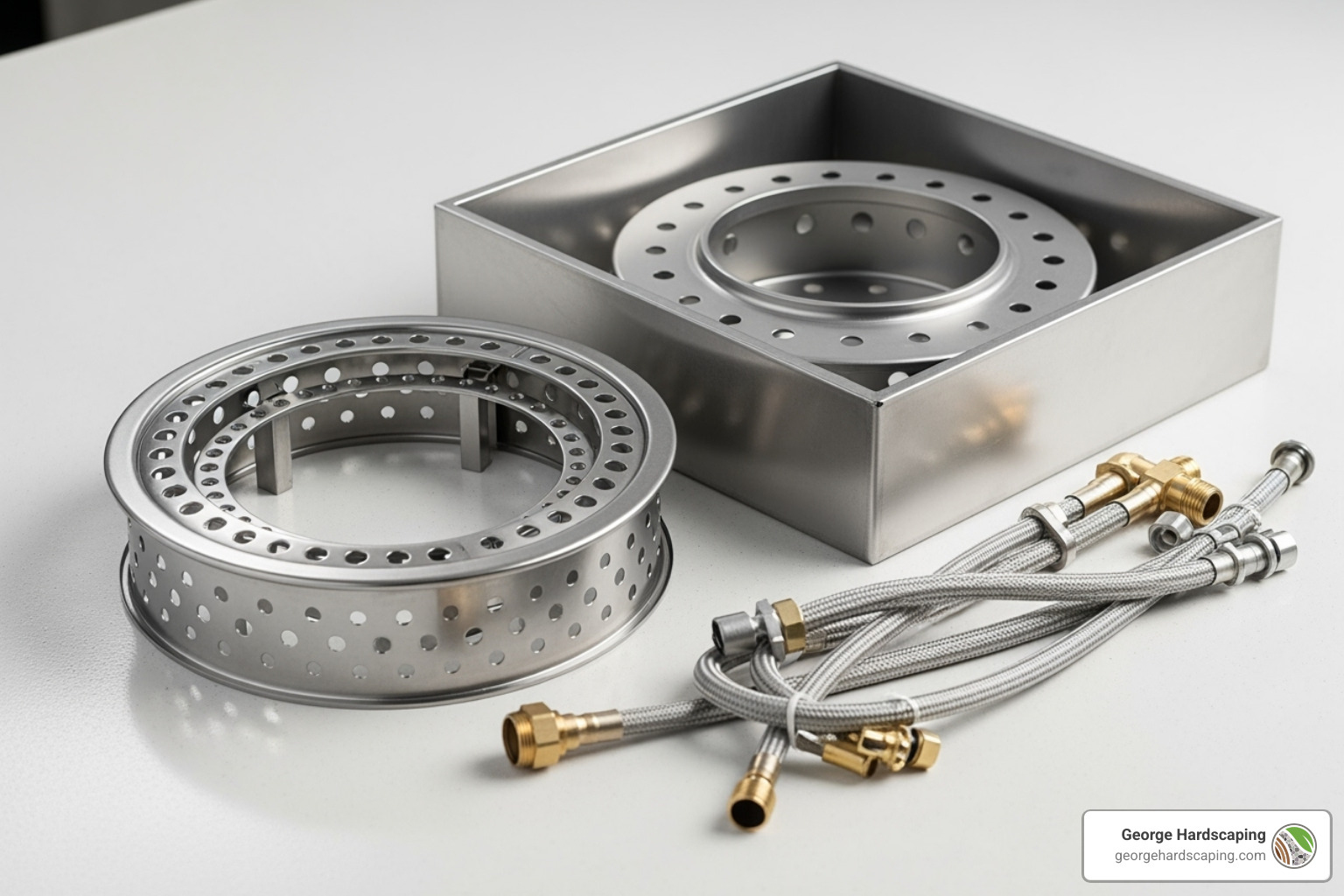
The Heart of the Fire: Burner, Pan, and BTU Rating
The burner and pan are the engine of your fire pit. For maximum longevity, especially in the harsh coastal New England climate with its salt air and moisture, always choose burners and pans made from high-grade 304 stainless steel. This material offers superior resistance to rust and corrosion, ensuring your investment lasts for years.
- Burner Types and Shapes: Burners come in various shapes to create different flame patterns. Round burner rings are classic, while linear burners offer a sleek, modern ribbon of flame perfect for rectangular fire pits. You can also find star and penta-shaped burners for unique effects. For ease of installation, consider a drop-in burner pan, which combines the burner and pan into a single, self-contained unit with a supportive lip that rests on your enclosure’s opening.
- BTU Rating: The British Thermal Unit (BTU) is a measure of heat output. A higher BTU rating means more heat and larger flames, but it also requires a greater gas supply and a larger diameter gas line. Residential fire pits typically range from 60,000 to 200,000 BTUs.
- Sizing: The burner must be proportional to the enclosure. A critical rule of thumb is to maintain at least 6 inches of clearance from the edge of the burner to the inside wall of your fire pit. This means a burner ring should be about 12 inches narrower than the inside diameter of a round fire pit. This clearance prevents the enclosure walls from overheating and cracking.
- Inlet Sizes: Most residential burners (under 30 inches) use a 1/2-inch gas inlet. Larger, high-capacity burners often require a 3/4-inch inlet to ensure adequate gas flow for impressive and efficient flames.
Ignition Systems and Control Options
How you light your fire pit affects its convenience, safety, and cost. Your options range from simple manual systems to fully automated solutions.
- Match-Lit Ignition: This is the simplest and most affordable system. You manually turn on a key valve to start the gas flow and light the burner with a long-stemmed lighter. It’s highly reliable due to its minimal number of parts.
- Push-Button (Spark) Ignition: A battery-powered igniter creates a spark at the push of a button, eliminating the need for matches. It’s a great middle-ground option that balances convenience and cost.
- Automatic (Electronic) Ignition: This is the premium choice for ultimate convenience and safety. These systems can be wired to a wall switch, a handheld remote, or even integrated into a smart home system. They include a crucial flame-sensing feature (a thermocouple or thermopile) that constantly monitors the flame. If the flame ever blows out, the system automatically shuts off the gas supply, preventing dangerous unburned gas from accumulating. This advanced system requires a 120V electrical connection installed by a professional.
Flame height is typically managed with a key valve mounted on the side of the enclosure, allowing you to manually adjust the gas flow.
Sizing Your Gas Line and Connection Kit
Proper gas flow is essential for achieving strong, consistent flames. This is one of the most technical aspects of a gas fire pit installation and should always be handled by a professional.
- Connection Kits: Pre-packaged kits are classified by their BTU capacity. Standard Capacity (SC) kits are suitable for most residential fire pits (typically up to 290,000 BTUs). High Capacity (HC) kits are required for very large units over 300,000 BTUs.
- Gas Line Diameter: The pipe must be large enough to deliver the required BTUs over the entire distance from the gas source (meter or tank) to the fire pit. A line that is too small will be “starved” for fuel, resulting in weak, disappointing flames. Professionals use detailed gas flow charts to make this critical calculation, factoring in both the length of the run and the burner’s BTU rating. For example, a 1/2-inch pipe might only be adequate for a 10-foot run, while a 50-foot run could require a 3/4-inch or even 1-inch pipe for the same BTU load.
- Gas Pressure: Natural gas systems operate at very low pressure (typically 3.5-7 inches of Water Column). A regulator is almost always needed to step down the pressure from your home’s main line before it reaches the fire pit.
- Whistle-Free Flex Lines: Always opt for “whistle-free” flexible gas lines for the final connection to the burner. These lines use varied rib spacing to disrupt airflow and eliminate the annoying high-pitched whistling sound that standard corrugated pipes can produce.
Finishing Touches: Fire Media Selection
Fire media does more than just look good; it distributes the flame for a more natural appearance, protects the burner from the elements, and helps radiate heat.
- Fire Glass: Made of specially tempered glass that won’t shatter, it offers a sleek, modern look and comes in a vast array of colors. It reflects the flames beautifully, creating a mesmerizing, liquid-fire effect.
- Lava Rock: This porous, natural volcanic rock provides a rustic, organic aesthetic and is excellent at absorbing and radiating heat. It’s often used as a cost-effective base layer beneath more expensive fire glass.
- Ceramic Logs & Shapes: For those who love the look of a traditional wood fire, these refractory ceramic logs, branches, and pinecones mimic that classic campfire feel without any of the smoke or mess.
Crucial Safety Rules:
- Cover the burner with about one inch of media. Too little won’t protect the burner, while too much can impede gas flow and cause poor combustion.
- Never use regular rocks, river stones, pea gravel, or other materials from your yard. They can contain trapped moisture, which can turn to steam and cause the rocks to explode violently when heated, sending sharp fragments flying.
Choosing the right media is the final step in personalizing your fire pit. For ideas on how a fire feature can elevate your outdoor space, see our work on patio design and installation.
Phase 3: The Step-by-Step Installation Process
This is where your vision and planning come to life. Following a systematic process is key to building a safe, durable, and beautiful fire pit. This phase covers the physical construction, paying close attention to the critical steps that require professional expertise.
Step 1: Building the Enclosure and Ensuring Proper Ventilation
The enclosure provides the structure and style for your fire pit, but its most critical function is ensuring safety through proper ventilation. If you’re building the enclosure yourself, start with a solid, level foundation of compacted gravel to prevent shifting and settling over time. When stacking your blocks or stones, use a high-strength, outdoor-rated construction adhesive or mortar between each layer for stability. Stagger the joints on each course, just like in a brick wall, to improve the structure’s overall integrity.
Ventilation is not optional—it is a mandatory safety feature. Vents serve three crucial purposes: they prevent the accumulation of unburned gas, provide a steady supply of oxygen for clean combustion, and allow heat to escape from the interior, protecting the gas lines and electronic components. You must install a minimum of two vents on opposite sides of the enclosure to create cross-ventilation. A common rule is to provide at least 18 square inches of ventilation on each of the two sides.
The placement of these vents is determined by your fuel type:
- Natural Gas (NG): Since NG is lighter than air, it will rise. Position vents high on the enclosure walls, just below the capstone, to allow any escaped gas to dissipate safely.
- Liquid Propane (LP): LP is heavier than air and will sink to the bottom of the enclosure. Position vents as low as possible to allow any pooled gas to drain out before it can accumulate to dangerous levels.
Incorrect vent placement is one of the most common and dangerous mistakes in a DIY installation. For examples of durable, properly designed structures, see our work on landscape retaining walls and custom structures.
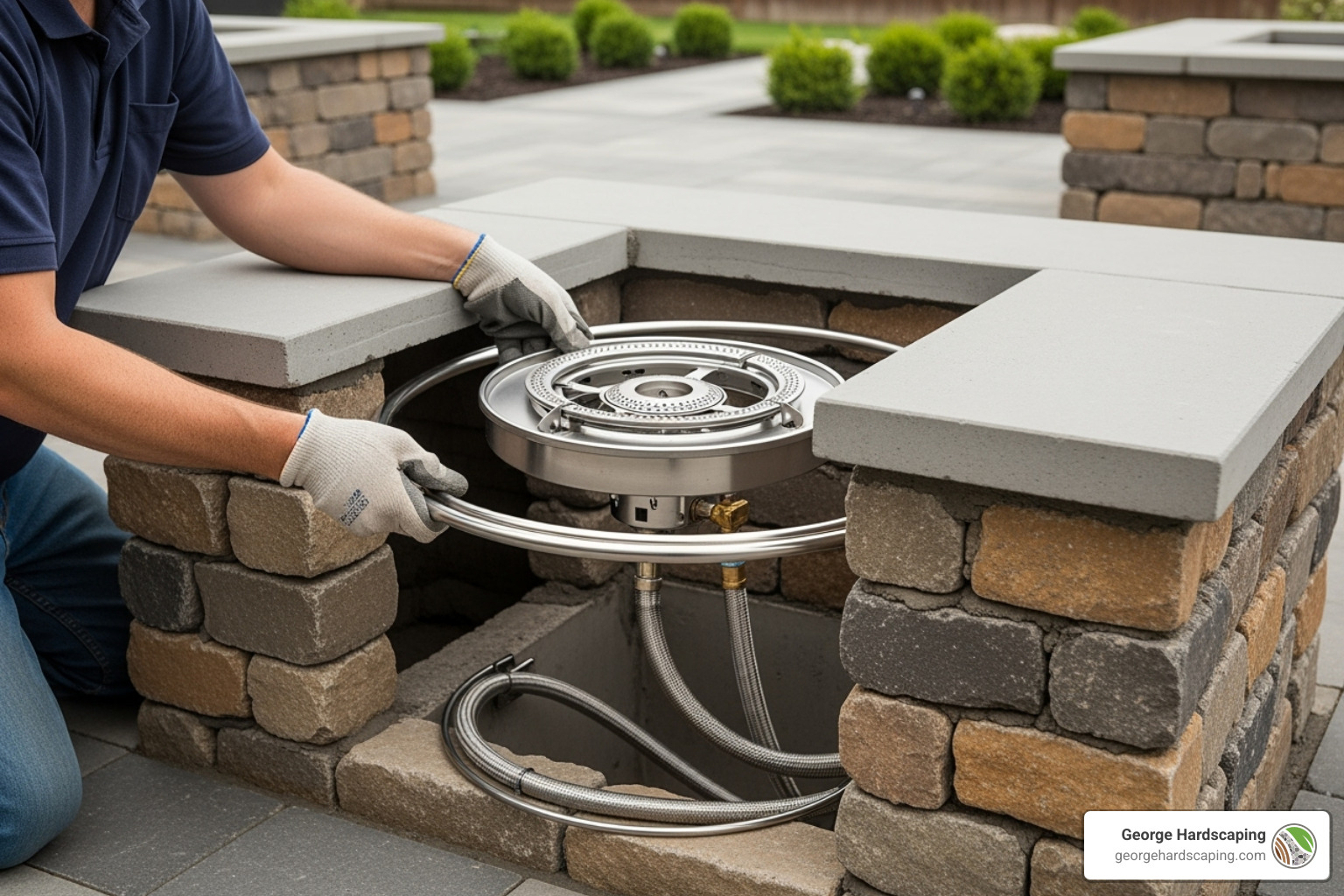
Step 2: Installing the Burner, Pan, and Control Valve
With the enclosure built, you can install the internal components. Mount the burner and pan on a level support structure inside the enclosure, such as the enclosure’s ledge or a custom-built frame, ensuring it’s centered and stable. An unlevel burner will produce lopsided, unnatural-looking flames.
Connect the flexible gas line from the burner’s inlet to your key valve. Use yellow, gas-rated Teflon tape or a gas-rated pipe sealant on all threaded male fittings. Apply it carefully, ensuring none gets inside the pipe where it could break off and clog the system. Hand-tighten the fittings, then give them one or two additional turns with a wrench. Do not overtighten, as this can damage the brass fittings and create a leak.
Mount the key valve on the exterior wall of the enclosure in a location that is easily accessible but not in the direct path of heat. Secure the valve flange firmly to the enclosure so it won’t loosen with repeated use.
Step 3: Connecting the Gas Line (Professional Required)
Disclaimer: All gas line connections, from the main supply to the fire pit’s control valve, must be performed by a licensed and insured professional.
This is the most critical step in the entire gas fire pit installation process. The risks associated with improper gas work—including fires, explosions, and deadly carbon monoxide poisoning—are severe and life-threatening. This is not a DIY task under any circumstances.
A licensed gas fitter or plumber is trained to perform this work safely and in accordance with all local and national codes. Hiring a true professional ensures:
- Proper Permitting: They will handle pulling the necessary permits and scheduling inspections with the local building department.
- Safe Procedures: They will shut off the main gas supply and safely depressurize the system before starting work.
- Correct Sizing: They will calculate the correct pipe size based on the fire pit’s BTU load and the distance from the source, guaranteeing strong performance.
- Code-Compliant Installation: They will install the gas line using the appropriate materials, such as black iron pipe for above-ground runs or polyethylene pipe for underground runs. For underground poly lines, they will also install a tracer wire, which is a conductive wire that allows the plastic pipe to be located from the surface in the future.
- Thorough Testing: After installation, they will perform a pressure test by filling the sealed line with compressed air and using a gauge to ensure there is no drop in pressure, which would indicate a leak. They will then conduct a final leak detection test on every connection with a specialized solution after the gas is turned back on.
In most areas, including throughout Essex County, this work requires inspections that only a licensed professional can manage. DIY gas work will void your homeowner’s insurance and all manufacturer warranties. We strongly recommend you find a qualified professional in your area or let us coordinate with our trusted, certified partners.
At George Hardscaping, we manage the entire project, ensuring the beautiful masonry and the critical gas work are both completed to the highest safety standards. Request your free estimate from George Hardscaping today for a seamless, worry-free installation.
Phase 4: Final Checks, Safety, and First Ignition
With the construction and professional gas connections complete, the final phase involves rigorous testing, understanding how to operate your new fire pit safely, and establishing a maintenance routine for years of enjoyment. This is where you transition from building your fire pit to living with it.
How to Safely Test for Gas Leaks
Even after your professional has pressure-tested the system, knowing how to perform a simple leak check is a valuable skill for ongoing safety and maintenance. The best method is the classic soapy water test.
- Create the Solution: In a spray bottle or small bowl, mix a solution of one part liquid dish soap to two parts water. You want it to be sudsy.
- Apply the Solution: After your professional has confirmed the system is ready and the gas is on, spray or brush the soapy water generously onto every gas connection point. This includes the fittings at the shut-off valve, the key valve, and the burner inlet.
- Watch for Bubbles: Carefully observe each connection. If you see bubbles forming, growing, or expanding, you have a gas leak. The gas pressure will cause the soap solution to bubble up at the source of the leak.
If you find a leak, immediately turn off the gas supply at the main shut-off valve. Do not attempt to light the fire pit or use any electronic devices nearby. Air out the area and contact your licensed gas professional immediately to address the issue. This simple test is a great periodic check-up but does not replace the comprehensive pressure testing performed by a professional during installation, as recommended by the National Fire Protection Association.
Ongoing Maintenance and Safe Operation
A complete gas fire pit installation is just the beginning. Proper care will ensure your fire pit remains a safe, beautiful, and reliable feature of your home.
First Ignition and Operation:
- Before lighting, perform a quick visual inspection to clear any leaves, twigs, or other debris from the fire pit area.
- Slowly open the gas valve, then activate your ignition system according to the manufacturer’s instructions. For match-lit systems, light your long-stemmed lighter and hold it over the burner before you turn the key.
- Adjust the flame to your desired height gradually using your control valve or remote.
Regular Maintenance Schedule:
- Before Each Use: Do a quick visual check for debris in the burner pan.
- Seasonally: Inspect all visible gas connections for signs of wear or corrosion. Perform a soapy water leak test if you have any concerns. Check burner ports for blockages from spider webs, insects, or dust, and clean them gently with a soft brush or compressed air.
- Annually: We strongly recommend having a licensed professional inspect the entire gas system, including the internal lines, valves, and ignition components.
Troubleshooting Common Problems:
- Weak Flame: This is often caused by an improperly sized gas line, low gas pressure, or a blockage in the burner ports. Clean the ports first; if the problem persists, call a professional.
- Whistling Noise: This is usually caused by a standard corrugated flex line. Replacing it with a “whistle-free” line will solve the problem.
- Pilot Light Won’t Stay Lit (Electronic Ignition): The thermocouple (flame sensor) may be dirty or positioned incorrectly. Ensure it is clean and engulfed by the pilot flame. If that doesn’t work, the part may need to be replaced by a technician.
Cleaning and Protection:
- Fire Media: Fire glass can be removed and rinsed with mild soap and water to restore its sparkle. Ensure it is completely dry before returning it to the pan. Lava rock can be shaken or rinsed to remove dust.
- Protective Cover: Use a high-quality, weatherproof cover whenever the fire pit is not in use. This is the single best thing you can do to protect components from rain, snow, and debris, preventing rust and extending the life of your investment.
Winterizing Your Fire Pit:
In Massachusetts, winterization is key. Before the first deep freeze, turn off the main gas supply to the fire pit. For propane systems, disconnect the tank and store it in a well-ventilated area (never indoors or in a garage). Clean the burner and media, ensure the interior is dry, and secure the cover for the season.
Following these guidelines will ensure your fire pit remains a cherished centerpiece of your outdoor living space. For expert installation that prioritizes beauty and safety, request your free estimate from George Hardscaping today.
Frequently Asked Questions about Gas Fire Pit Installation
Here are answers to some of the most common questions homeowners have about designing and installing a gas fire pit.
Can I install a gas fire pit on a wooden deck or in a covered area?
Yes, but with strict adherence to safety precautions. For wooden or composite decks, you must use a non-combustible base (like concrete board or a specialized heat shield) directly under the fire pit. The unit itself must also be manufacturer-approved for use on combustible surfaces. For covered areas like pergolas or screened porches, adequate ventilation is critical to prevent the buildup of heat and carbon monoxide. You must meet minimum overhead clearance requirements—HPC Fire recommends 84 inches (7 feet) for units up to 200,000 BTU and 120 inches (10 feet) for larger ones. Always consult the manufacturer’s manual and local codes.
How much ventilation does my fire pit enclosure need?
Proper ventilation is a non-negotiable safety requirement. You need a minimum of two vents installed on opposite sides of the enclosure to create cross-ventilation. A common guideline is to have at least 18 square inches of venting on each of the two sides. The placement depends on your fuel type:
- For Liquid Propane (LP): Propane is heavier than air, so vents must be installed as low as possible to allow any leaked gas to drain out.
- For Natural Gas (NG): Natural gas is lighter than air, so vents should be positioned as high as possible to allow gas to escape upwards.
This prevents dangerous gas accumulation and protects internal components from overheating.
Can I convert my existing wood-burning fire pit to gas?
Often, yes. Converting a masonry wood-burning fire pit to gas is a popular project. The key considerations are ensuring the existing structure is sound, non-combustible, and large enough to house the new components safely. You will need to drill holes for a gas line and a control valve. Most importantly, you must add drainage at the bottom of the pit (a simple hole is often sufficient) and install the proper ventilation vents in the side walls, as wood pits typically lack these essential safety features.
How much does it cost to run a gas fire pit per hour?
This depends on your fire pit’s BTU rating and local utility rates. Here’s a sample calculation:
- Natural Gas (NG): NG is sold by the therm (1 therm = 100,000 BTUs). If your fire pit is rated at 100,000 BTUs/hour and your NG cost is $1.50/therm, it will cost approximately $1.50 per hour to run on high.
- Liquid Propane (LP): A standard 20 lb propane tank holds about 4.7 gallons, which is equivalent to roughly 430,000 BTUs. If your fire pit is rated at 100,000 BTUs/hour, a single tank will last about 4.3 hours on high. If a tank refill costs $20, your hourly cost is approximately $4.65 per hour.
What are the main benefits of a gas fire pit over a wood-burning one?
Gas fire pits offer several compelling advantages that make them a popular choice for modern outdoor living:
- Convenience: Instant on/off control with a switch or remote. No wood to chop, stack, or embers to tend to.
- Cleaner Burning: No smoke, ash, or stray sparks. This is ideal for those sensitive to smoke and for use on decks or near the house.
- Improved Safety: A controllable flame height and automated shut-off features significantly reduce the risk of accidental fires.
- Less Cleanup: No ash or soot to clean up after each use.
- Wider Use: Often permitted in communities or during burn bans where wood-burning fires are restricted.
If you’re ready to enjoy these benefits, we can build the perfect custom fire pit for your space. Explore our services for fire pit installers in your area.
Conclusion: Enjoy Your New Outdoor Centerpiece
A professionally executed gas fire pit installation brings warmth, ambiance, and effortless conversation to your backyard with a level of convenience and safety that traditional wood-burning pits simply cannot match. With instant ignition, adjustable flames, and no smoke or sparks to worry about, you can enjoy the magic of a fire with the simple push of a button—transforming any evening into a special occasion.
Throughout this guide, we’ve emphasized the critical importance of careful planning, selecting high-quality components, and adhering to strict safety requirements. If there is one single takeaway, it is this: hiring a licensed and insured professional for all gas connections is non-negotiable. The severe risks associated with improper gas installation—fire, property damage, and personal injury—far outweigh any potential cost savings. A certified professional ensures your fire pit is safe, code-compliant, and built to provide lasting enjoyment.
For homeowners across Essex County and the North Shore of Massachusetts—from Beverly and Danvers to Marblehead and Newburyport—the team at George Hardscaping specializes in integrating stunning, durable fire pits into beautiful and functional landscape designs. We manage the entire process, from the custom masonry enclosure to coordinating with licensed gas and electrical professionals, ensuring every detail is handled with precision and care.
The investment in a professionally designed and installed gas fire pit is an investment in your home’s value and your family’s lifestyle. It creates a high-demand feature that enhances property value while providing a beautiful, safe space for making memories for years to come.
Ready to transform your backyard into the gathering place you’ve always imagined? Let’s make it happen together, safely and correctly. Contact George Hardscaping for a professional fire pit installation estimate today!
