
Why Steps Made of Stone Transform Your Outdoor Space
Steps made of stone are more than a practical way to steer slopes in your yard—they are a long-term investment that blends beauty, safety, and durability. Whether you are connecting a patio to a lawn, creating an inviting front entrance, or defining outdoor living areas, stone steps deliver longevity and timeless appeal that suit homes across Essex County and the North Shore of Massachusetts.
In a climate that sees everything from summer heat to Nor’easters, you need materials that will stand up to the elements without constant repairs. Natural stone answers that need while also elevating curb appeal and tying your home and landscape together.
Quick Answer: What Makes Stone Steps the Best Choice?
- Durability: Natural stone withstands freeze-thaw cycles and heavy foot traffic, lasting decades longer than many alternative materials.
- Beauty: Each stone has unique colors and textures that complement traditional New England architecture as well as contemporary designs.
- Safety: Properly installed stone steps with consistent rise heights and naturally grippy or textured surfaces provide secure footing year-round.
- Value: Stone steps increase property value, improve curb appeal, and require minimal maintenance over their lifetime.
- Versatility: They can be designed in straight, curved, or multi-level layouts to suit any landscape and terrain.
Stone steps serve as both functional pathways and dramatic focal points. They can welcome visitors, separate outdoor rooms like fire pit areas from seating spaces, or lead guests through terraced gardens with natural elegance.
The key to building stone steps that last is proper planning and installation. Choosing the right material, establishing a solid foundation, and maintaining consistent dimensions are all critical. For homeowners in Essex County and the North Shore of Massachusetts, where harsh winters demand durable solutions, understanding how to build stone steps correctly is essential. This guide walks you through the process, from site assessment to finishing touches, explaining the best practices that define professional-grade craftsmanship, whether you’re a DIY enthusiast or working with expert masonry services.
For additional background on why natural stone performs so well outdoors, resources like the Natural Stone Institute’s homeowner guides offer useful technical insights into durability, maintenance, and performance in exterior applications.
Planning Your Project: Key Considerations Before You Build
Careful planning is the foundation of a successful stone step project. This initial phase ensures your new steps will be a long-lasting, beautiful addition that integrates perfectly with your home and landscape, especially in regions like Essex County, MA, where varied terrain and weather demand thoughtful design.
First, a comprehensive landscape assessment is crucial. Evaluating the slope of your property helps determine the best placement, number of steps, and overall design. A professional will also analyze soil conditions and drainage patterns to prevent future water issues. Stone steps are an excellent solution for steep inclines, turning challenging areas into safe, accessible, and graceful pathways. Beyond access, steps made of stone can define outdoor rooms by creating transitions between different areas. Imagine steps leading from a raised patio down to a cozy fire pit area or connecting a primary walkway to a porch. They seamlessly tie your home’s architecture to the landscape, boosting curb appeal and functionality.
Budgeting is another key step, covering materials, labor, equipment rental, and potential permits. While a DIY approach is tempting, the physical demands of moving heavy stone and the precision required for a durable, safe installation often warrant professional help. An improperly built staircase can be a safety hazard and may fail prematurely. For a high-quality result that meets local building codes, consider our expert masonry services. Always check with your local municipality in towns like Beverly, Danvers, or Ipswich for specific regulations on outdoor steps, including height, width, and railing requirements, to avoid costly revisions.
Choosing the Right Material: Types of Natural Stone
The material you choose is the heart of your project. Natural stone offers unparalleled durability and character, ensuring your steps withstand the New England climate while developing a beautiful patina over time.
Here are some popular types of natural stone for steps:
- Granite: Known for its extreme hardness and density, granite is ideal for high-traffic areas and harsh weather. It resists water damage, chipping, and frost heave, making it a top choice for front entryways. Granite can be finished in several ways: a thermal (flamed) finish provides a textured, non-slip surface; a rock-faced edge offers a rugged, natural look; and a sawn or honed finish creates a more uniform, formal appearance.
- Bluestone: This dense sandstone features beautiful blue-gray hues and a naturally slip-resistant surface. It is highly versatile and can be used in both formal and informal designs. Natural cleft bluestone has a rustic, textured surface, while thermal bluestone is more uniform in color and texture, offering a cleaner, more contemporary look.
- Fieldstone: For a rustic, organic aesthetic that looks as if it has been part of the landscape for centuries, fieldstone is perfect. These irregularly shaped stones are gathered from fields and create a natural look ideal for garden paths and hillside stairways. Installing fieldstone requires significant skill to fit the pieces together tightly for stability and a consistent rise.
- Quartzite: Offering a unique blend of elegance and resilience, quartzite is a durable, heavily textured metamorphic rock. It comes in various colors, often with sparkling inclusions, and adds a touch of luxury to any landscape design while being highly resistant to weathering and foot traffic.
Sourcing quality stone with consistent thickness, size, and color is vital for a cohesive and structurally sound installation. A professional supplier can help ensure your material is graded for exterior use in a freeze-thaw climate.
| Stone Type | Durability | Cost (Avg.) | Maintenance | Appearance |
|---|---|---|---|---|
| Granite | Excellent (Hardest) | High | Low | Uniform, speckled, formal |
| Bluestone | Very Good | Medium-High | Low | Blue-gray, natural cleft, versatile |
| Fieldstone | Good | Medium | Low | Irregular, rustic, natural |
| Quartzite | Excellent | High | Low | Textured, varied colors, luxurious |
Designing Your Steps Made of Stone for Function and Beauty
The design of your steps made of stone is about creating an experience that improves your landscape’s flow and safety.
- Straight Stairways: Ideal for formal entrances or direct paths, straight steps offer a clean, structured look that complements traditional and contemporary homes, dramatically boosting curb appeal.
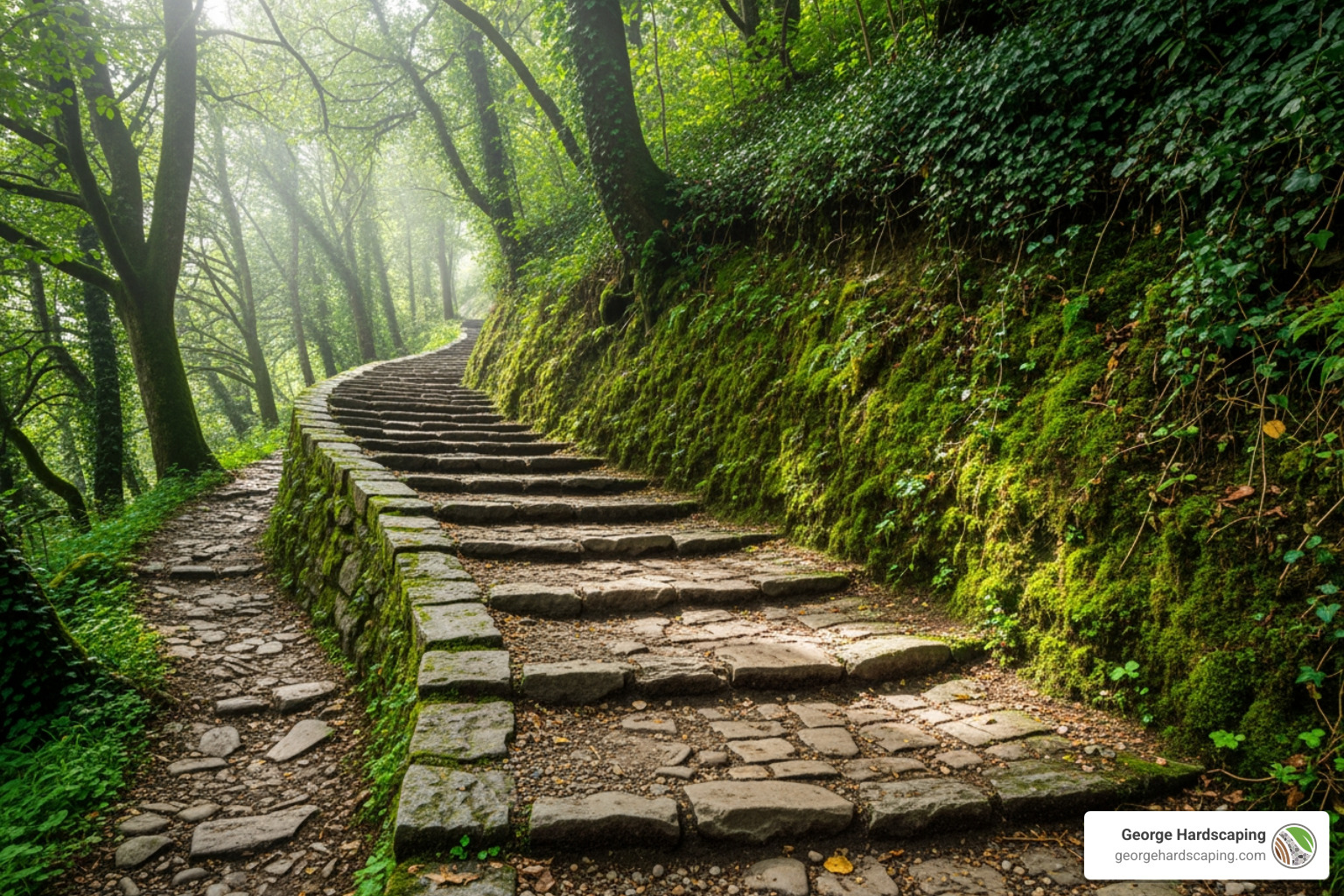
- Curved Stairways: For a more naturalistic flow, curved or winding designs soften a landscape’s hard edges. A gently sweeping staircase on a hillside can guide you neatly through a garden, creating a sense of journey and discovery.
- Multi-Level Configurations with Landings: Perfect for properties with significant grade changes, multi-level steps create distinct outdoor “rooms.” Landings are crucial for breaking up long runs of stairs (typically more than 10-12 steps), providing a safe place to pause and improving comfort. They can also serve as small patios or junctions for intersecting paths.
- Flared Stairways: Adding a flare to the bottom steps, where they become wider than the rest of the staircase, creates a grand, welcoming entrance. This design technique helps visually anchor the steps to the surrounding landscape or patio.
Safety is paramount. We adhere to strict rise and run standards for comfortable navigation. A consistent rise height (the vertical distance of each step, typically 5.5 to 7 inches) is critical to prevent tripping. An adequate tread depth (the horizontal walking surface, typically 12 inches or more) is also essential for secure footing. These dimensions are fundamental to creating steps that are safe and comfortable for everyone, from children to the elderly.
To see how different materials and designs can transform an outdoor space, explore our gallery of stone step design ideas.
The Step-by-Step Installation Process for Steps Made of Stone
Building durable steps made of stone is a craft that combines artistry with engineering, and their longevity hinges on a proper installation. The process begins with gathering safety equipment (gloves, safety glasses, steel-toed boots), essential tools (shovels, levels, tampers, masonry hammers, angle grinders), and all materials.
The first physical step is site preparation. Before any digging, it is legally required and essential for safety to call 811 (Dig Safe) to have underground utility lines marked. Once the area is cleared, we clear it of vegetation and debris, then use stakes and string lines to mark the precise layout. This ensures the steps align perfectly with your landscape design, nearby walkways, and any adjoining patio design and installation or outdoor living areas.
Step 1: Excavation and Building a Solid Foundation
The foundation is the most critical component for longevity. In our region, where the frost line can be several feet deep, a robust foundation is non-negotiable to prevent frost heave—the upward thrust of frozen soil that can destroy masonry. For landscape steps (“steps-in-grade”), we excavate a trench for a 6-12 inch deep gravel footing. This depth ensures the base extends below the most active soil layers. Before adding gravel, we often lay a geotextile fabric, which separates the gravel from the subsoil, preventing them from mixing over time and improving drainage and stability.
We calculate excavation depth by adding the thickness of the gravel base to the thickness of the first step stone, plus a small allowance for final leveling. After excavation, we compact the subgrade, then place processed gravel in lifts (typically 2-3 inches at a time), compacting each layer with a hand tamper or plate compactor to achieve maximum density. The finished base must be perfectly level side to side and pitched very slightly forward (about 1/8 inch per foot) to shed water away from the steps.
For front entryway steps that bear heavier loads and often tie into custom walkway and stair projects, we install a poured-in-place concrete footing that extends below the local frost line. This footing is often pinned with rebar to the home’s foundation for maximum stability, creating a monolithic structure that resists settling and winter heaving. We also integrate appropriate drainage measures—such as sloping the concrete away from the house and including gravel backfill with a perforated pipe—to avoid hydrostatic pressure from water accumulation.
Step 2: Laying the First Course and Setting the Risers
With the foundation prepared, we lay the first course of stone. For rustic settings, we often use a dry-stack method, fitting stones together without mortar and relying on their weight and careful placement for stability. For more formal applications, a mortared method provides a stronger, unified structure.
In either case, the base stone must be perfectly level front-to-back and side-to-side, as it dictates the alignment of all subsequent courses. We check this repeatedly with a 4-foot level and string lines stretched along the run of the steps.
As we stack the riser stones, we backfill behind each course with compacted gravel to provide lateral support and promote drainage. This is especially important on sloped sites common in towns like Gloucester, Rockport, and Manchester-by-the-Sea. For dry-stacked risers, we often build with a slight backward lean, or “batter,” which uses gravity to enhance the structure’s strength.
Large, heavy stones like solid granite are often pinned together with rebar or stainless-steel dowels to prevent shifting. We drill holes into adjoining stones, fill them with high-strength epoxy or bonding agents, and then carefully lower each stone into place with machinery. Throughout the process, we continuously check alignment and rise height to ensure every step is uniform and comfortable to walk on.
Step 3: Placing the Treads and Finishing Touches
The final construction stage is placing the treads—the horizontal walking surfaces. We set each tread securely on a bed of mortar or stone dust, ensuring it is level or has a slight forward slope for drainage. A small overhang, or “lip,” of about 1-1.5 inches can dramatically improve the step’s appearance and help shed water away from the riser face.
Depending on the design, we may use high-strength masonry adhesive or mortar to bond the treads to the risers. For wider stairs or those that will see frequent use, we pay particular attention to support under the front edge of the tread to prevent flexing or cracking over time.
Once the treads are set, we fill the joints. For dry-stacked steps, joints can be filled with soil for planting creeping groundcovers like thyme or sedum, creating a soft, natural look that pairs beautifully with nearby landscape retaining walls and garden beds. For mortared steps, we use polymeric sand or a specialized mortar mix to lock the stones in place. Polymeric sand is a popular choice as it hardens to resist weed growth and insect infestation while remaining flexible enough to accommodate minor movements. Mortar provides a more rigid, traditional finish.
Finally, we clean the stone surface to remove any debris, excess mortar, or dust and reveal its natural beauty. Once the steps are complete, we often integrate them with surrounding patio and outdoor living space designs so the entire area functions as one cohesive, accessible environment.
For more technical details on step layout, footing design, and tread sizing, professional builders often consult industry resources such as this technical design resource manual for stone steps. These kinds of references provide useful diagrams and engineering guidance that complement hands-on experience in the field.
Enhancing Safety, Longevity, and Aesthetics
Proper maintenance and thoughtful improvements are key to ensuring your steps made of stone remain safe and beautiful for decades.
Routine maintenance is surprisingly low. Periodic cleaning with a stiff brush, water, and a mild, pH-neutral cleaner is usually sufficient to remove dirt or moss. When choosing cleaning products, it is helpful to follow best practices from reliable sources such as the Natural Stone Institute’s care and maintenance recommendations. We advise against aggressive pressure washing, which can damage softer stones or erode joint material. In shady, damp areas, you may notice moss or algae growth; this can typically be scrubbed away or treated with a specialized, stone-safe algaecide. Occasionally, you may see a white, powdery residue called efflorescence, caused by salt migrating from within the stone or mortar. It is usually harmless and can be removed with a stiff brush and water.
While sealing can prevent staining on some stones, hard, dense materials like granite and bluestone often perform perfectly well unsealed. If you do opt to seal, choose a breathable, penetrating, exterior-grade stone sealer appropriate for your specific material and follow the manufacturer’s instructions carefully.
Winter care is crucial on the North Shore of Massachusetts. Avoid rock salt (sodium chloride), which can corrode stone surfaces and metal handrails. Safer alternatives include calcium chloride, calcium magnesium acetate (CMA), or sand for traction. Regularly inspect your steps for any signs of shifting, loose stones, or cracking so you can address minor issues before they worsen. For any concerns, our custom steps and stairs services are available to help with repairs, rebuilding, or complete redesigns.
If your stone steps are part of a larger outdoor upgrade—such as a new patio and entertainment area or retaining wall system—George Hardscaping can plan all elements together to maximize longevity, safety, and visual impact.
Integrating Lighting and Safety Features
Integrating lighting not only improves safety but also creates a dramatic ambiance. Low-voltage LED lighting is an energy-efficient and popular choice. Fixtures can be installed under the tread lips or caps to wash the step surface with a warm, indirect glow, guiding foot traffic at night and highlighting the stone’s texture. Other options include path lights installed in adjacent garden beds to illuminate the edges of the stairway or well lights at the base to dramatically uplight the entire structure. Solar-powered lights along adjacent stone walkways are another low-maintenance way to brighten your routes and reduce tripping hazards.

An anti-skid tread surface is also vital. Many natural stones like bluestone have inherent grip, but smoother stones may require texturing or a thermal finish to improve traction. On existing installations that feel slippery in winter, surface treatments or strategically placed traction strips can help improve safety.
For longer stairways, or for homes with children, elderly residents, or frequent guests, a well-designed handrail adds another layer of safety and style. Handrails can be crafted from powder-coated aluminum, wrought iron, stainless steel, or wood, and they should be designed in accordance with local building codes in communities such as Beverly, Lynnfield, and Salem.
Comparing Stone Steps to Wood and Concrete
When choosing a material for outdoor steps, natural stone consistently proves superior to wood and concrete, especially in the Massachusetts climate.
- Longevity and Durability: Stone steps can last 50-100 years or more, far surpassing wood (10-20 years) and concrete (20-40 years). Natural stone is exceptionally resistant to the freeze-thaw cycles, settling, and shifting that damage other materials.
- Cost-Effectiveness: While the initial cost is higher, stone’s longevity and minimal maintenance make it the most cost-effective choice over time. It largely eliminates the recurring expenses of staining, sealing, and replacing wood or repairing cracked concrete.
- Repairability: If a single stone step is damaged, it can often be replaced without disturbing the entire staircase. Repairing a cracked or spalled concrete staircase, by contrast, is difficult and often results in visible patches that don’t match the original color or texture.
- Environmental Impact: Natural stone is a long-lived material that often requires less frequent replacement and fewer chemical treatments over its lifetime than many alternatives. For homeowners interested in sustainable choices, organizations like the U.S. Green Building Council provide useful context on life-cycle impacts of construction materials.
- Maintenance and Aesthetics: Stone requires little more than occasional cleaning, whereas wood needs constant upkeep to prevent rot and splinters, and concrete can crack and spall. Aesthetically, the timeless, organic beauty of natural stone is hard to match, blending harmoniously with plantings, lawns, and neighboring hardscape features in a way that utilitarian concrete or weather-prone wood cannot.
For its weather resistance, durability, and timeless appeal, natural stone is the definitive choice for outdoor steps in Essex County. If you are ready to upgrade from aging wood or cracked concrete, reach out to George Hardscaping to explore design options and receive a custom plan for your property.
Frequently Asked Questions about Building Stone Steps
Investing in steps made of stone is a big decision. Here are answers to common questions from homeowners on the North Shore.
How much do steps made of stone cost?
The cost varies significantly based on the stone type, design complexity, number of steps, and site conditions. Material costs alone can range from $30 to over $80 per linear foot for the stone itself. A complete, professionally installed project with premium stone like granite or bluestone can range from $2,000 to over $15,000. (Note: These are general industry averages, not a quote from George Hardscaping). Factors that increase cost include difficult site access requiring manual labor instead of machinery, the need for extensive grading, the inclusion of landings or curved designs, and the type of foundation required (concrete footings are more expensive than gravel bases). While the upfront cost is higher than other materials, stone steps are a long-term investment that adds significant property value and requires minimal future spending.
When you work with a contractor like George Hardscaping, your estimate can also incorporate related features such as stone walkways and landings, small retaining walls for grade changes, and adjoining patio spaces, so you understand the full cost of a cohesive outdoor upgrade.
How long do natural stone steps last?
With proper installation on a solid foundation, natural stone steps can last for generations—often 50 to 100 years or more. Hard stones like granite and bluestone are incredibly resistant to the harsh freeze-thaw cycles in Massachusetts. This lifespan far exceeds that of wood (10-20 years) or poured concrete (20-40 years), making stone a truly permanent landscape feature.
Lifespan also depends on the quality of the base, drainage planning, and routine care. Professionally installed steps that are integrated with your overall hardscape design tend to perform better because the surrounding grading, walkways, and patios are planned to work together to manage water and prevent soil erosion around the structure.
Can you put stone over existing concrete steps?
Yes, this is a popular renovation method called veneering or overlaying, but it depends entirely on the condition of the existing concrete. The underlying concrete steps must be structurally sound, free of major cracks, and properly sloped for drainage. The process involves cleaning and preparing the concrete surface, then adhering thin stone treads and risers using a specialized polymer-modified mortar. This can be a cost-effective way to get the look of solid stone without the cost of full demolition and reconstruction. However, it’s crucial to have a professional assess the existing structure first, as covering up a failing concrete base will only lead to problems down the road.
Do I need a permit to build outdoor steps?
Most likely, yes. In many Essex County municipalities, a building permit is required for outdoor steps, especially if they are attached to your home, exceed a certain height (often 30 inches), or include more than a few risers. Landscape steps not attached to a structure may have different rules, but it is always best to check first.
Permits ensure your project meets local safety codes for rise, run, handrails, and guardrails. We strongly advise consulting your local building department in towns like Beverly, Gloucester, or Peabody before beginning work to avoid fines or other complications. Many local jurisdictions follow or adapt standards from the International Residential Code, which governs stair dimensions, guardrails, and handrails for safety.
If you prefer not to steer the permitting process alone, George Hardscaping can help you plan a code-compliant layout for your stone steps and coordinate installation so everything—from the foundation to the final tread—meets the expectations of both inspectors and homeowners.
Conclusion: Elevating Your Landscape with Lasting Craftsmanship
Steps made of stone are more than a utilitarian feature; they are a testament to timeless design and enduring craftsmanship. Throughout this guide, we have explored their benefits—from superior durability against New England winters to the natural beauty that improves traditional and modern homes alike.
When thoughtfully planned, stone steps do more than solve a grade-change problem. They can anchor a welcoming front entry, create graceful transitions between patios and lawns, and connect outdoor rooms such as fire pit areas, gardens, and seating nooks. Integrated with complementary features like custom walkways and stairs, patios and entertaining spaces, and retaining walls, they become a permanent, functional centerpiece of your landscape.
From foundation to finish, success comes down to a few core principles:
- A solid, well-drained base that can handle freeze-thaw cycles
- Careful material selection suited to your aesthetic and site conditions
- Precise layout with consistent rise and tread depth for safety and comfort
- Attention to long-term details like lighting, traction, and low-maintenance design
For homeowners in Essex County, MA seeking professional results, George Hardscaping provides expert masonry and hardscaping craftsmanship. Our team designs and builds durable steps made of stone that exceed expectations for beauty, safety, and longevity, serving communities including Beverly, Danvers, Ipswich, Gloucester, Marblehead, Peabody, and the surrounding North Shore.
If you are ready to upgrade your property with custom stone steps—or to integrate them into a broader outdoor living project—now is the perfect time to begin.
- Request a free estimate for your stone step project and receive a custom plan based on your home, terrain, and budget.
- Explore our portfolio of custom walkways and stairs to see real-world examples of the craftsmanship and attention to detail we bring to every project.
Transform your sloped or uneven yard into a safe, beautiful, and highly functional landscape with expertly crafted stone steps that will serve your home for decades to come.
