
Building an outdoor fireplace with cinder block: Ultimate 2025
Why Building an Outdoor Fireplace with Cinder Block is the Smart DIY Choice
Building an outdoor fireplace with cinder block, or Concrete Masonry Units (CMU), stands out as the most practical and cost-effective method for creating a stunning, durable, year-round focal point for your backyard. Unlike expensive pre-cast kits or labor-intensive full-custom masonry, a CMU core offers an unparalleled combination of benefits. Cinder blocks provide exceptional compressive strength, ensuring a structure that lasts for decades.
Their uniform, stable geometry makes precise stacking achievable even for an ambitious DIYer, while the hollow cores are perfect for adding steel reinforcement—a critical feature for tall chimneys or in regions with seismic activity or frost. Furthermore, the block surface is a blank canvas, ready to accept a vast range of finishes. Whether you envision a rustic stone veneer, a sleek modern stucco finish, or a simple coat of painted masonry, you can customize the look to perfectly match your patio, seating walls, and overall landscape design.
Beyond aesthetics, this construction method excels in pure practicality. The block core assembles quickly, significantly reducing labor time compared to brick or natural stone. This rigid structural shell provides the ideal substrate for a separate, refractory-lined firebox, creating a safe, heat-resistant interior designed for high-temperature wood burning. With a thoughtfully planned layout and a well-designed chimney, your fireplace will produce clean-burning, efficient fires with reliable draft and minimal smoke, ensuring comfortable and enjoyable evenings for your family and guests.
Strong CTA: Ready to turn your design into a reality? Request a fast, on-site estimate from George Hardscaping now: Request an estimate.
Quick Overview: Building an Outdoor Fireplace with Cinder Block
- Foundation: The essential base. Excavate the site, create forms, compact a gravel sub-base for drainage, and pour a 4–6 inch reinforced concrete slab. In frost zones, this requires deeper footings to prevent seasonal movement.
- Block Core: The structural skeleton. Lay cinder blocks in a staggered running-bond pattern using Type N or S mortar. Constantly check that each course is level, plumb, and square.
- Firebox: The heart of the fireplace. Construct an interior chamber using specialized firebrick and high-temperature refractory mortar. A heavy-gauge steel lintel must be installed to support the masonry above the opening.
- Smoke Chamber & Chimney: The engine for proper draft. Carefully shape a smooth, tapered smoke chamber above the firebox to funnel smoke into the flue. The flue must be sized correctly (about 10–15% of the firebox opening) and topped with a cap and spark arrestor.
- Finishing: The aesthetic layer. Apply your chosen exterior finish, such as stone veneer, stucco, or high-heat masonry paint. Install a durable capstone on top of the structure to protect it from weather.
- Curing & Tempering: The final, critical step. Allow all masonry to cure for a minimum of 72 hours. Then, build a series of small, short-duration fires to slowly drive out residual moisture and prevent thermal shock.
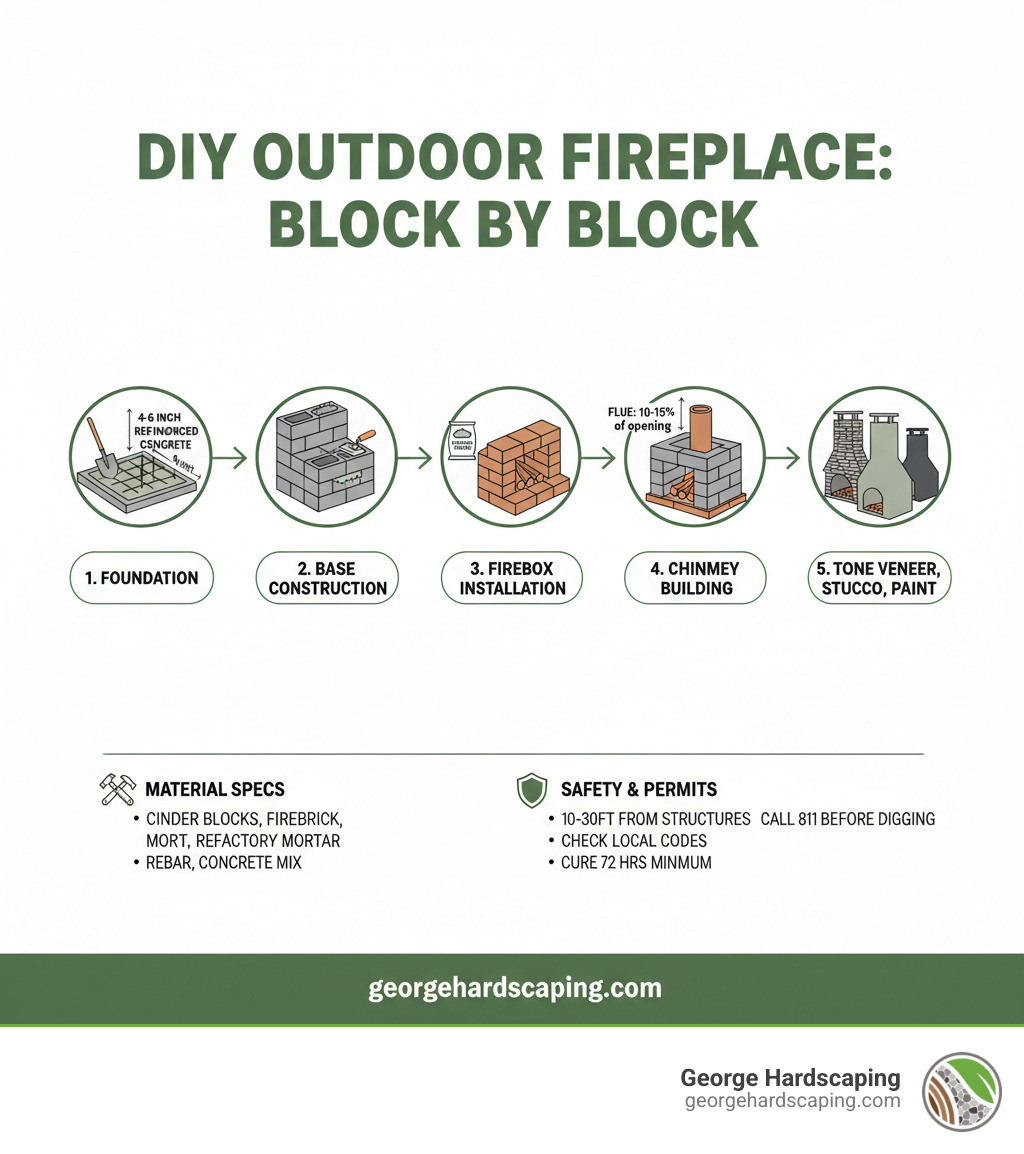
For a DIY project, expect material costs to range from approximately $1,300–$1,800. This estimate covers essential items like blocks, concrete mix, reinforcing steel, firebrick, various mortars, and basic finish materials. Professional builds vary significantly based on size, complexity, site access, and the chosen finish. If you desire a high-end, custom look without the challenge of heavy lifting and technical masonry, George Hardscaping offers comprehensive hardscaping masonry services throughout Essex County, MA.
Explore more about building an outdoor fireplace with cinder block:
- fireplace outside
- how to build an outdoor brick fireplace
- how to build an outdoor gas fireplace
Planning Your Project: Safety, Codes, and Design
A successful, long-lasting outdoor fireplace project is built on a foundation of meticulous planning. Before a single shovel of dirt is moved, you must verify local building codes, select a safe and strategic location, and finalize a design that aligns with your property’s aesthetic and your budget. Investing time in thorough planning is the single best way to avoid costly rework, ensure your fireplace performs efficiently with excellent draft, and guarantee it can withstand the demanding New England weather for years to come.
Critical Safety and Code Considerations
- Setbacks and Placement: This is non-negotiable. Most municipalities mandate a specific clearance, often between 10 and 30 feet, from any combustible structure (your house, deck, shed) and at least 10 feet from property lines. The reason is twofold: to prevent ignition from radiant heat and to ensure stray embers don’t pose a fire risk. Always get the exact requirements from your local building department and fire marshal before finalizing your location. The National Fire Protection Association provides essential overarching guidance on outdoor burning safety: NFPA.
- Permits: A permanent masonry fireplace is a significant structure, and most towns will require a building permit. This process ensures your design meets safety standards. When you contact your local building officials, be prepared with a site plan and a basic structural drawing. The International Code Council (ICC) publishes the model codes that many jurisdictions adopt or adapt, which can be a valuable reference.
- Utilities: This step is required by law and is critical for safety. Before any excavation, you must call 811. This free service arranges for all utility companies to mark the location of underground lines (gas, electric, water, sewer, cable) on your property, preventing a dangerous and expensive accident. Visit their site for more information: Call 811.
- Wind, Smoke, and Trees: Analyze your property’s microclimate. Note the direction of prevailing winds to orient the fireplace opening away from your seating area and your neighbors’ windows or patios. Check for overhanging tree branches that could pose a fire hazard. A well-designed chimney helps, but thoughtful placement is the first line of defense against smoke issues. For tips on minimizing smoke through proper wood burning, consult the EPA’s Burn Wise program: EPA Burn Wise.
- Fire Safety Features: Your design must include built-in safety elements. A spark arrestor (a metal screen at the top of the chimney) is crucial for containing embers. A noncombustible hearth extension in front of the firebox is also required to catch any sparks or rolling logs. Finally, always plan to have a fire extinguisher or a charged garden hose readily accessible during operation.
- Gas Option: If you’re considering a gas log set or a gas starter for convenience, the planning phase is the time to decide. All gas line installation is highly regulated and must be performed by a licensed professional in accordance with the National Fuel Gas Code, NFPA 54. Learn more about the requirements in our dedicated guide: how to build an outdoor gas fireplace.
Design, Budget, and Timeline
- Core Approach: The standard method involves a structural shell made of cinder block (CMU), which is then lined with heat-proof refractory materials to form the firebox. The exterior is then covered with a decorative finish layer (like stone, stucco, or paint) that provides both style and weather protection.
- Size and Layout: A popular DIY firebox opening size is around 30–36 inches wide and 24–28 inches tall. The depth is also critical for performance, typically between 20 and 24 inches. Consider incorporating functional elements into your design, such as built-in wood storage niches, a deep hearth that doubles as informal seating, or integrated side benches that connect to the main structure.
- Draft and Smoke Management: Achieving a good draft is a science. The cross-sectional area of your flue should be approximately 10–15% of the firebox opening’s area. A smooth, well-shaped smoke chamber is also essential to guide exhaust gases upward without turbulence. If your yard is prone to wind eddies, consider adding extra height to your chimney to get the opening above the turbulent air.
- Budget: A DIY project using standard materials will typically cost between $1,300 and $1,800. This can increase with premium finishes like natural stone veneer, custom-cast caps, or extensive hearths. Professional installations have a wider range, from $1,500 for a very basic unit to $8,000+ for large, complex designs with high-end finishes.
- Timeline: A realistic timeline for a DIY build is 1 to 1.5 weeks from start to finish. This includes 2–5 days for the concrete foundation to cure sufficiently before you can begin laying blocks. The actual hands-on work for the masonry and finishing phases often totals 8–12 hours, spread out over several days.
Materials and Tools Checklist
Materials:
- CMU blocks (standard 16x8x8 and half-blocks 8x8x8), bagged concrete mix, all-purpose gravel
- Steel reinforcement: #3 or #4 rebar for the slab and vertical cores, or wire mesh for the slab
- Mortar: Type N or S masonry mortar for blocks, high-heat refractory mortar for firebrick
- Firebrick (rated for high temperatures) for lining the firebox
- Heavy-gauge steel angle iron (lintel) for the firebox opening
- Flue liner: Clay flue tiles or a listed metal flue liner, sized appropriately for your design
- Chimney cap with an integrated spark arrestor
- Exterior finish materials: Stone veneer (with metal lath and scratch coat mix), stucco mix, or high-heat exterior masonry paint
- Sealer: Breathable, water-repellent masonry sealer for the final weather-proofing step
Tools:
- Excavation and Forming: Shovel, wheelbarrow, level, tamp, tape measure, 2x lumber for forms, circular saw
- Concrete and Masonry: Mixing tub or mechanical mixer, levels (4-foot and torpedo), mason’s line and line blocks, various trowels (pointing, brick), masonry hammer, masonry saw with a diamond blade
- Finishing: Rubber mallet, chisels, angle grinder (for detailed cuts), paint brushes/rollers
- Personal Protective Equipment (PPE): Safety glasses, heavy-duty gloves, dust mask, hearing protection
Internal links to help you plan finishes and integrate your fireplace with your outdoor living:
- Patio concepts and coordination: patio design & installation
- Durable seating walls and structure tie-ins: landscape retaining walls
- Pathways and access planning: walkways and stairs
- Full-scope stonework: hardscaping masonry services
Strong CTA: Prefer a turnkey solution? Book your design consult and site review today: Request an estimate.
The Foundation: Creating a Stable Base
A fireplace built from hundreds of pounds of block and mortar requires an absolutely stable foundation. A properly constructed concrete slab or footing is the only way to prevent settlement, cracking, and the destructive power of frost heave. In climates like New England, where the ground freezes and thaws repeatedly, a robust foundation isn’t just recommended—it’s essential for the structure’s longevity.
Site Prep and Slab/Footing Strategy
- Layout and Excavation: Begin by using stakes and mason’s line to precisely mark the outer dimensions of your foundation. This footprint should be slightly larger than the fireplace base itself, providing a stable work area and a small reveal. Excavate the entire area to a depth of 8–12 inches. In regions with a defined frost line, your local building code will require that the footings (the parts of the foundation bearing the most weight) extend below this depth. This can be achieved with a thickened-edge slab or with separate, deeper footings under the main walls of the fireplace. Always consult your local building official for specific depth requirements.
- Sub-base: The key to a stable slab is a well-drained sub-base. Fill the excavated area with 4–6 inches of compacted, well-graded crushed gravel. This layer provides a solid platform and, more importantly, allows water to drain away from the underside of the concrete, which is the primary defense against frost heave. Use a hand tamp or plate compactor to compact the gravel in layers for maximum density.
- Forms: Construct a perimeter form using 2×6 or 2×8 lumber, ensuring it is perfectly level and square. Brace the corners securely. To confirm your form is square, measure the diagonals—they should be identical.
- Reinforcement: Concrete is strong in compression but weak in tension. Steel reinforcement is required to prevent cracking. Lay a grid of #3 or #4 rebar, spaced 12–18 inches apart in both directions, or use a sheet of wire mesh. Use small plastic or concrete ‘chairs’ to elevate the reinforcement so it sits in the middle of the slab’s thickness, not on the bottom.
- Concrete Pour: Mix a quality concrete blend rated for at least 3,000 psi. Pour the concrete into the forms, using a shovel or rake to distribute it evenly. Use a long, straight 2×4 (a screed board) to level the surface. After screeding, use a bull float to smooth the surface and embed the coarse aggregate. Finally, use an edging tool to create a clean, rounded edge.
- Curing: Proper curing is a chemical process, not just drying. Protect the freshly poured slab from sun, wind, and rain for several days. Covering it with plastic sheeting or misting it with water periodically prevents the surface from drying too quickly, which can cause weakness and cracking. As a general rule, wait a minimum of 48 hours before removing forms and at least 4–5 days before starting any masonry work. For detailed guidance on residential concrete work, refer to the American Concrete Institute.
Tip: When finishing the concrete, create a very subtle slope (about 1/8 inch per foot) away from where the firebox will be. This ensures that any rainwater that lands on the hearth will shed away from the fireplace interior. You will later apply a breathable masonry sealer to the finished fireplace, but good initial water management is key.
The Core Construction: Building an Outdoor Fireplace with Cinder Block
With a fully cured and perfectly level concrete slab as your starting point, the next phase is to construct the CMU shell, build a durable refractory-lined firebox, and shape a chimney that draws smoke efficiently. This stage requires precision and patience. Work methodically, checking for level and plumb with every block you lay, as small errors can quickly compound.
Step 1: CMU Base and Walls
- Dry Layout: Before mixing any mortar, perform a dry run. Place the entire first course of blocks on the slab to confirm your dimensions, check joint spacing, and finalize the position of the firebox opening. This is your last chance to make easy adjustments to center the fireplace and align it with key sightlines from your patio or home.
- First Course, Perfectly Level: The success of the entire structure depends on the first course. Mix your Type N or S mortar to a thick, peanut-butter-like consistency that holds its shape on the trowel. Apply a full mortar bed to the slab, butter the head joints (the vertical ends) of each block, and firmly press it into place. Use your level and a rubber mallet to tap each block until it is perfectly level in both directions and plumb (perfectly vertical). Check, double-check, and triple-check this course.
- Running Bond and Reinforcement: Lay subsequent courses in a running-bond pattern, where the vertical joints are staggered by half a block. This pattern provides significant lateral strength. For added structural integrity, especially for taller structures or in frost-prone areas, incorporate vertical rebar. Place lengths of rebar into the hollow CMU cores at the corners and on either side of the firebox opening, then fill these specific cells with concrete or grout. This creates reinforced columns within the wall, acting like a ‘bond beam’ that ties the structure together.
- Openings and Niches: If your design includes wood storage cubbies or other openings, frame them out as you build the CMU walls. Use temporary wooden supports to hold the blocks in place until the mortar cures. For any span wider than a single block, you must install a steel lintel (angle iron) to carry the load of the blocks above.
Step 2: Firebox—Heat-Proof and Structural
Standard cinder blocks are not designed for high heat and will crack and degrade when exposed to direct flame. The firebox must be constructed as a separate, inner chamber using specialized materials.
- Firebrick Layout: The firebox is built from firebrick, which is denser and specifically formulated to withstand thermal cycling. Lay the firebrick on their narrowest edge (a ‘soldier’ course) or flat, depending on your desired interior dimensions. Use high-temperature refractory mortar, applying it in thin, consistent joints (about 1/16 to 1/8 inch). The smooth faces of the bricks should face inward for easier cleaning and better airflow.
- Thermal Break: It is critical to leave a 1-inch air gap between the outer face of the firebrick firebox and the inner face of the CMU structural shell. This gap acts as a thermal break, preventing the intense heat from the fire from transferring directly to the cinder blocks and causing stress or cracking. Some builders fill this gap with ceramic fiber insulation for even better performance.
- Lintel and Opening: A heavy-gauge steel lintel (typically 1/4″ to 3/8″ thick angle iron) must be placed across the top of the firebox opening to support the weight of the chimney. Ensure the lintel rests on at least 4-6 inches of masonry on each side.
- Hearth and Floor: The floor of the firebox should also be lined with firebrick set in refractory mortar. A perfectly level floor promotes even burning and simplifies ash removal.
Step 3: Throat, Smoke Chamber, and Flue for Proper Draft
An effective draft is the result of careful engineering. The shape of the components above the firebox is what pulls smoke up and out of the chimney.
- Throat and Smoke Chamber: The area directly above the firebox opening is the throat, which funnels into the smoke chamber. Here, you must taper the masonry inward (a technique called corbelling) to smoothly transition from the wide firebox to the narrow flue. The surfaces must be parged smooth with refractory mortar to prevent turbulence that can cause smoke to spill out of the front of the fireplace. A metal damper is optional for outdoor fireplaces but can be useful for controlling airflow on very windy days.
- Flue Sizing Rule of Thumb: The performance of your chimney is directly related to the flue’s size. The cross-sectional area of the flue liner should be roughly 10% to 15% of the firebox opening’s area. For example: a firebox opening is 36 inches wide by 24 inches tall, giving an area of 864 square inches. 10% of this is 86.4 sq. in. A standard 8×12 inch rectangular flue tile has an actual interior area of about 64 sq. in., which would be too small and likely result in a smoky fireplace. A 12×12 inch tile (approx. 108 sq. in. area) would be a much better choice.
- Height: The chimney should extend at least 3 feet above the firebox opening, and higher if it is near other structures that could cause wind turbulence. In open, windy locations, an extra foot or two of chimney height can significantly improve the draw.
- Liner and Cap: Stack clay flue tile sections or a listed metal liner as you build the chimney, ensuring each section is sealed with refractory mortar. The final touch is a chimney cap to keep out rain and animals, and a spark arrestor screen to contain embers. For material specifications on load-bearing CMU, consult standards like ASTM C90.
Step 4: Integrating Storage, Seating, and Accessories
- Wood Storage: Incorporate side cubbies or a niche below the hearth to keep firewood dry and accessible. Line the floor of the niche with pavers or leftover firebrick for durability.
- Mantel and Shelves: Any mantelpiece must be made of noncombustible material, such as a solid piece of natural stone or cast concrete. It should be securely anchored into a reinforced section of the CMU shell.
- Ash Management: For easier cleanup, consider designing the hearth to accommodate a removable metal ash pan.
If you’d rather skip the complexities of draft calculations and heavy masonry, George Hardscaping offers start-to-finish hardscaping masonry services and specializes in creating beautiful custom outdoor firepits.
Finishing and Curing Your Fireplace
With the structural core complete, the finishing phase transforms the utilitarian CMU shell into a permanent, architectural feature that defines your outdoor living space. The material you choose should not only be durable but also complement the style of your patio, walkways, and the broader landscape.
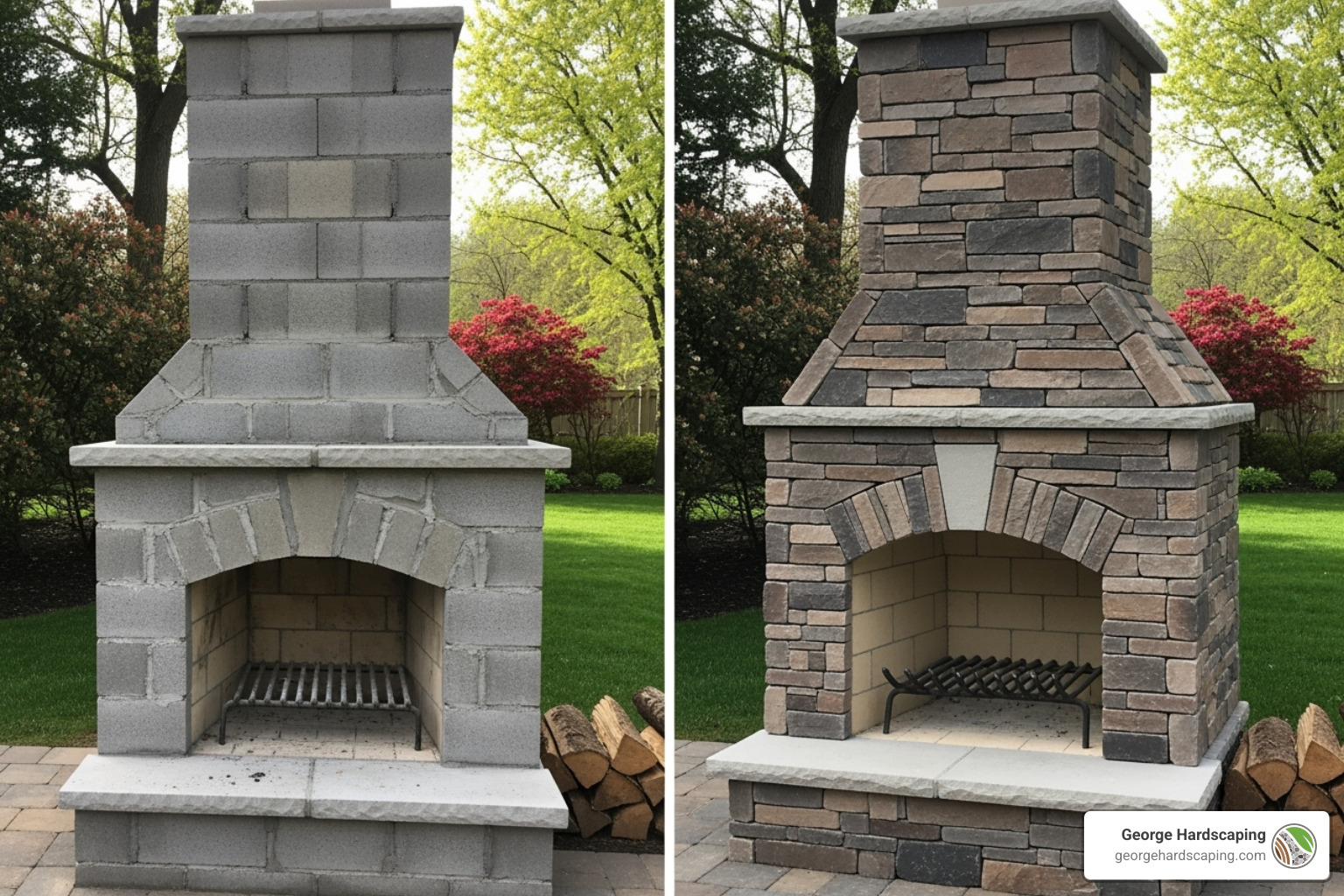
Popular Exterior Finishes
- Natural Stone Veneer (Premium Aesthetic): This option offers a timeless, high-end look. The process involves mechanically fastening a metal lath to the CMU surface, applying a ‘scratch coat’ of mortar over the lath, and then meticulously setting each piece of stone veneer with a polymer-modified mortar. The project should be topped with a solid capstone (like granite or bluestone) that overhangs the edges slightly to act as a drip edge, directing water away from the veneer face. This finish is ideal for coordinating with nearby landscape retaining walls and natural stone walkways and stairs.
- Stucco (Clean and Modern): For a smooth, monolithic appearance, stucco is an excellent choice. A proper application involves a multi-coat system over a metal lath. A base coat provides structure, followed by a finish coat that can be textured and colored as desired. Using a color-integral stucco mix is often preferred over painting later. Adding decorative bullnose edges at the corners can soften the look and improve durability.
- Heat-Resistant Masonry Paint (Budget-Friendly): The most straightforward finish is paint. To achieve a professional result, first apply a thin parge coat of mortar over the entire CMU surface to fill joints and hide imperfections. Once cured, apply a quality masonry primer followed by two coats of a high-heat exterior masonry paint. This provides a crisp, uniform look that can be easily updated in the future.
Regardless of the finish, it’s wise to apply a breathable, water-repellent masonry sealer after everything has fully cured. This sealer penetrates the surface to limit moisture absorption while still allowing any trapped water vapor to escape. Avoid film-forming, non-breathable sealers, which can trap moisture and lead to spalling or delamination, especially in freeze-thaw climates.
Curing and First Fires
- Cure Times: Patience is paramount. All new mortar—structural, refractory, and finishing coats—needs time to cure and gain strength. Allow a minimum of 72 hours in warm, dry weather; extend this to a full week in cool or damp conditions. Protect fresh work from heavy rain and intense, direct sun with a tarp, ensuring there is still airflow.
- Tempering Fires (Thermal Curing): The first fires you build are for the fireplace, not for you. This process, called tempering, drives out the residual moisture trapped deep within the masonry. Start with a very small fire (just a few pieces of kindling) for about an hour. Let the structure cool completely. Repeat this process 3-4 times over a few days, gradually increasing the size and duration of the fire each time. Rushing this step and building a large, roaring fire too soon can cause the trapped water to turn to steam, creating immense internal pressure that can lead to thermal shock and crack your new masonry.
- Ash and Ember Control: Always use a fire screen to contain sparks. Keep a metal shovel and a lidded metal bucket nearby for ash disposal. Never place hot ashes in a combustible container or on the lawn; let them cool completely for several days before disposal.
Tie your new fireplace into a cohesive outdoor living plan by coordinating its finish with your patio design & installation. For professional finishing and seamless integration, explore our comprehensive hardscaping masonry services.
Common Mistakes to Avoid When Building an Outdoor Fireplace with Cinder Block
Building a masonry fireplace is a rewarding but complex project. A single oversight in the planning or construction phase can compromise its safety, performance, and longevity. By understanding these common pitfalls, you can ensure your project is a lasting success.
- Failure to Build a Proper Foundation: Skimping on the foundation is the most catastrophic mistake. A thin, unreinforced slab on an unprepared base is a recipe for disaster. In frost-prone climates, moisture in the soil will freeze, expand, and lift the slab (frost heave), causing severe cracks. When the ground thaws, the structure will settle unevenly. This movement will crack the mortar joints and blocks, compromising the entire fireplace. Always follow local code for footing depth and use a thick, reinforced slab on a compacted gravel base.
- Using Standard Materials in the Firebox: Regular cinder blocks and standard Type S mortar are not designed to withstand the intense, sustained heat of a wood fire. They will rapidly crack, spall (flake apart), and degrade, creating a serious fire hazard and leading to structural failure. The firebox must always be constructed as a separate chamber using specialized firebrick and high-temperature refractory mortar.
- Incorrect Flue Sizing and Smoke Chamber Design: A fireplace that constantly belches smoke into your seating area is a failure. This is almost always caused by a flue that is too small for the firebox opening (the 10-15% rule is critical) or a poorly constructed smoke chamber with sharp edges and rough surfaces that create turbulence instead of a smooth upward flow. The path for the smoke must be smooth and properly proportioned.
- Omitting a Chimney Cap and Spark Arrestor: An open flue is an invitation for problems. Rain and snow will pour down the chimney, saturating the masonry and leading to rapid deterioration and mold growth. Animals will build nests, creating a dangerous blockage. Most importantly, a chimney without a spark arrestor screen can eject hot embers onto your roof, deck, or dry landscaping. Always install a listed, properly fitted cap with an integrated spark screen.
- Rushing the Curing and Tempering Process: Masonry cures through a chemical reaction, not just by drying. Building a large fire in a ‘green’ fireplace can force trapped moisture to turn to steam, creating enough pressure to crack blocks and joints. You must allow the mortar to cure for several days and then follow a patient tempering process of several small, escalating fires to safely drive out all residual moisture.
- Ignoring Local Codes and Clearances: Assuming you don’t need a permit or guessing at setback distances is a costly gamble. If your fireplace violates local zoning or building codes, you could be forced to tear it down. Before you begin, have a conversation with your local building department to confirm all requirements. For reference, you can review model codes via the ICC and general fire safety practices from the NFPA.
- Poor Veneer Application: Simply ‘sticking’ stone veneer to a block wall will lead to delamination and failure. A proper application requires a moisture barrier, a metal lath mechanically fastened to the wall, a solid scratch coat of mortar, and the correct polymer-modified setting mortar to bond the veneer. Skipping any of these steps compromises the finish.
- Neglecting Water Management Details: Water is the primary enemy of masonry. A fireplace without an overhanging capstone to shed water away from the walls will become saturated. Unsealed mortar joints will absorb water, which can then freeze and break the joints apart. Always include a drip edge and seal the entire finished structure with a breathable masonry sealer.
Want it done once and done right, avoiding these costly mistakes? George Hardscaping provides complete layout, code-compliant construction, and premium finishes. Start here: Request an estimate.
Frequently Asked Questions about Building an Outdoor Fireplace
How far does an outdoor fireplace need to be from a house?
This is a critical safety question with a location-specific answer. While a general guideline is often 10 to 30 feet from any combustible structure (house, deck, shed) and 10+ feet from property lines, you must confirm the exact requirements with your local building department and fire marshal. The required distance can be influenced by factors like your home’s siding material, roof overhangs, and local fire codes. For high-level safety principles, you can review guidance from the NFPA.
Do I need a permit to build an outdoor fireplace?
Almost certainly, yes. A permanent masonry fireplace is considered a significant structure, and most jurisdictions require a building permit to ensure it meets safety and construction standards. The process typically involves submitting a site plan showing the location and clearances, along with a basic structural drawing. Starting the conversation with your town’s building office is the correct first step. You can familiarize yourself with the model codes many towns use as a basis at the ICC.
Can I use regular cinder blocks for the firebox?
Absolutely not. This is one of the most dangerous mistakes a DIY builder can make. Standard CMU and mortar will crack, spall (flake apart), and fail when exposed to the high temperatures of a wood fire. The firebox must be constructed as a separate, inner chamber using specialized firebricks laid with high-temperature refractory mortar. There must also be an air gap between the firebox and the structural CMU shell.
How should I size the flue for good draft?
The most reliable guideline is the 10-to-1 rule, or more conservatively, the 10-15% rule. The cross-sectional area of your flue’s interior should be between 10% and 15% of the firebox opening’s area (width x height). For example, a 36″ wide by 24″ tall opening is 864 square inches. Your flue area should therefore be between 86 and 130 square inches. A 12″x12″ clay flue liner has an interior area of about 108 sq. in., making it a suitable choice. An undersized flue is the number one cause of a smoky fireplace.
What is the best wood to burn for clean, efficient fires?
For the best performance and least smoke, you should only burn seasoned, dry hardwoods. This includes dense woods like oak, maple, hickory, and ash that have been split and dried for at least 6-12 months. Avoid softwoods like pine or spruce for primary burning, as they produce more creosote and sparks. Never burn pressure-treated wood, painted wood, particleboard, or trash, as they release toxic chemicals. For more on best practices, see the EPA Burn Wise program.
How large should the hearth extension be?
Safety codes provide specific guidance here. As a rule, the noncombustible hearth should extend at least 16 inches in front of the firebox opening and at least 8 to 12 inches on each side of the opening. A larger hearth not only increases safety by catching more potential sparks but also provides a more functional and visually appealing base for your fireplace, often serving as informal seating.
Can I add a gas log set to my wood-burning fireplace later?
Yes, converting a wood-burning fireplace to gas is a common upgrade. You can add a vented gas log set or a gas starter to make lighting fires easier. However, any work involving gas lines is not a DIY project. The installation must be performed by a licensed and insured professional who will follow all local codes and the National Fuel Gas Code, NFPA 54. Learn more in our guide: how to build an outdoor gas fireplace.
How much does it really cost to build a cinder block fireplace?
For a DIY build of average size, material costs typically total $1,300–$1,800. This can fluctuate based on your location and choice of finish. Professional installations have a much wider cost range, generally from $1,500 for a very simple stucco unit to $8,000 or more for a large, custom fireplace with natural stone veneer and integrated features. The best way to get an accurate budget is to request a detailed, on-site estimate: Request an estimate.
What is a realistic project timeline for a DIY build?
Plan for the project to span 1 to 1.5 weeks. This is not all work time. The single biggest time block is waiting for the concrete foundation to cure (3-5 days). The actual hands-on work—forming, masonry, and finishing—typically amounts to 8-12 hours, which can be spread across two weekends.
How do I protect the fireplace during a harsh winter?
Proper protection starts with good construction. A durable chimney cap keeps precipitation out of the flue. Sealing the exterior with a breathable water repellent prevents moisture from soaking into the masonry. In winter, keep heavy snow from piling up against the base. It’s also important to ensure the interior is dry before the first hard freeze.
Is there a difference between cinder blocks and CMU?
While the terms are often used interchangeably, ‘cinder block’ is an older term for a block made with fly ash or cinders. Today, the blocks you buy are Concrete Masonry Units (CMU), which are engineered with a precise mix of Portland cement and aggregates for superior strength and dimensional consistency. They are the ideal material for this type of structural shell. For technical specifications, you can refer to the standard for load-bearing CMU, ASTM C90.
How do I integrate the fireplace with the rest of my yard?
A fireplace should feel like a natural extension of your landscape. Coordinate the finish materials and style with your other hardscaping elements:
- Patio layout and finishes: patio design & installation
- Seat walls and elevation transitions: landscape retaining walls
- Safe, attractive access: walkways and stairs
- Full-service stonework: hardscaping masonry services
What maintenance is required for a masonry fireplace?
Maintenance is straightforward. Brush out cool ashes after a few uses. Perform an annual inspection: check the firebrick for any cracked mortar joints and repair them with refractory mortar. Inspect the chimney cap and spark arrestor to ensure they are secure and clear of debris. Every few years, reapply a breathable masonry sealer to the exterior to maintain its water repellency.
Conclusion
Building an outdoor fireplace with cinder block is an empowering project that allows you to create a custom, durable, and truly beautiful centerpiece for four-season outdoor gatherings. The process, while detailed, is achievable for a determined DIYer. Success hinges on several key pillars: meticulous planning that respects local codes, a rock-solid reinforced foundation, a properly constructed dual-wall core with a refractory-lined firebox, and a chimney engineered for a perfect draft. Once the structure is sound, you can finish it with stone, stucco, or paint to seamlessly tie it into your existing patio, walkways, and retaining walls—transforming your entire outdoor living space from ordinary to extraordinary.
Whether you choose to take on the challenge yourself or entrust the project to seasoned professionals, the result is an investment in your home that will provide warmth, ambiance, and a cherished gathering spot for years to come.
Strong CTA: Ready to get started? Schedule your site visit and design consultation today: Request an estimate. Prefer a professional build from start to finish? Explore our expert hardscaping masonry services and see examples of our custom outdoor firepits.
