
Base for flagstone walkway: Ultimate Guide 2025
Why Your Base for Flagstone Walkway Determines Success or Failure
The base for flagstone walkway is the most critical component of your entire project. Get it wrong, and you’ll face shifting stones, trip hazards, and costly repairs within a few years. Get it right, and your walkway will last for decades.
Quick Answer – Best Base Options:
- Dry-Set Base: 4-inch compacted gravel + 1-2 inch sand/stone dust layer
- Wet-Set Base: 4-inch reinforced concrete slab + mortar setting bed
- Best for DIY: Dry-set method (easier, more forgiving)
- Best for Durability: Wet-set method (permanent, rigid)
- Best for Cold Climates: Dry-set (handles freeze-thaw cycles better)
Without a proper foundation, even the most beautiful flagstone will become a maintenance nightmare. Stones pop up when stepped on, gaps widen as materials wash away, and uneven surfaces create dangerous tripping hazards.
The good news? Building the right base isn’t rocket science. Whether you choose a flexible gravel base or a rigid concrete foundation, following proven methods will give you a walkway that improves your property for years to come.
In Essex County and throughout New England, our freeze-thaw cycles make base selection even more critical. The wrong foundation can crack and heave, destroying your investment in a single harsh winter.
Why the Right Base is Non-Negotiable for a Durable Walkway
Picture this: you spend a weekend laying gorgeous flagstone, only to find the stones rocking, pooling water, and turning into trip hazards after a couple of winters. What failed? Not the stone—the base for flagstone walkway underneath.
A proper foundation quietly performs five essential jobs:
- Stops shifting and settling so stones stay put.
- Drains water quickly to avoid frost damage.
- Spreads weight over a wide area, preventing sink-holes.
- Protects against New England’s brutal freeze-thaw cycles.
- Creates a level, comfortable surface you’re proud to walk on.
When these functions work together, your walkway can last decades. Skip even one and you’ll battle yearly repairs—exactly what we see when we’re called to fix failed paths in Beverly, Salem, and beyond.
A well-built base is the best insurance you’ll never see: fewer spring touch-ups, no wobbling stones, and higher curb appeal the day you decide to sell. It’s simply the smartest place to invest your time and budget.
More info about our Hardscaping Services
Drainage & Slope: The Silent Hero
Water is the #1 enemy of hardscape. Keep a gentle 1/4 inch per foot slope away from the house, and let a granular base act like a giant French drain. Do that and you eliminate 90 % of frost-heave problems before they start.
Comparing Primary Base Materials: Dry-Set vs. Wet-Set
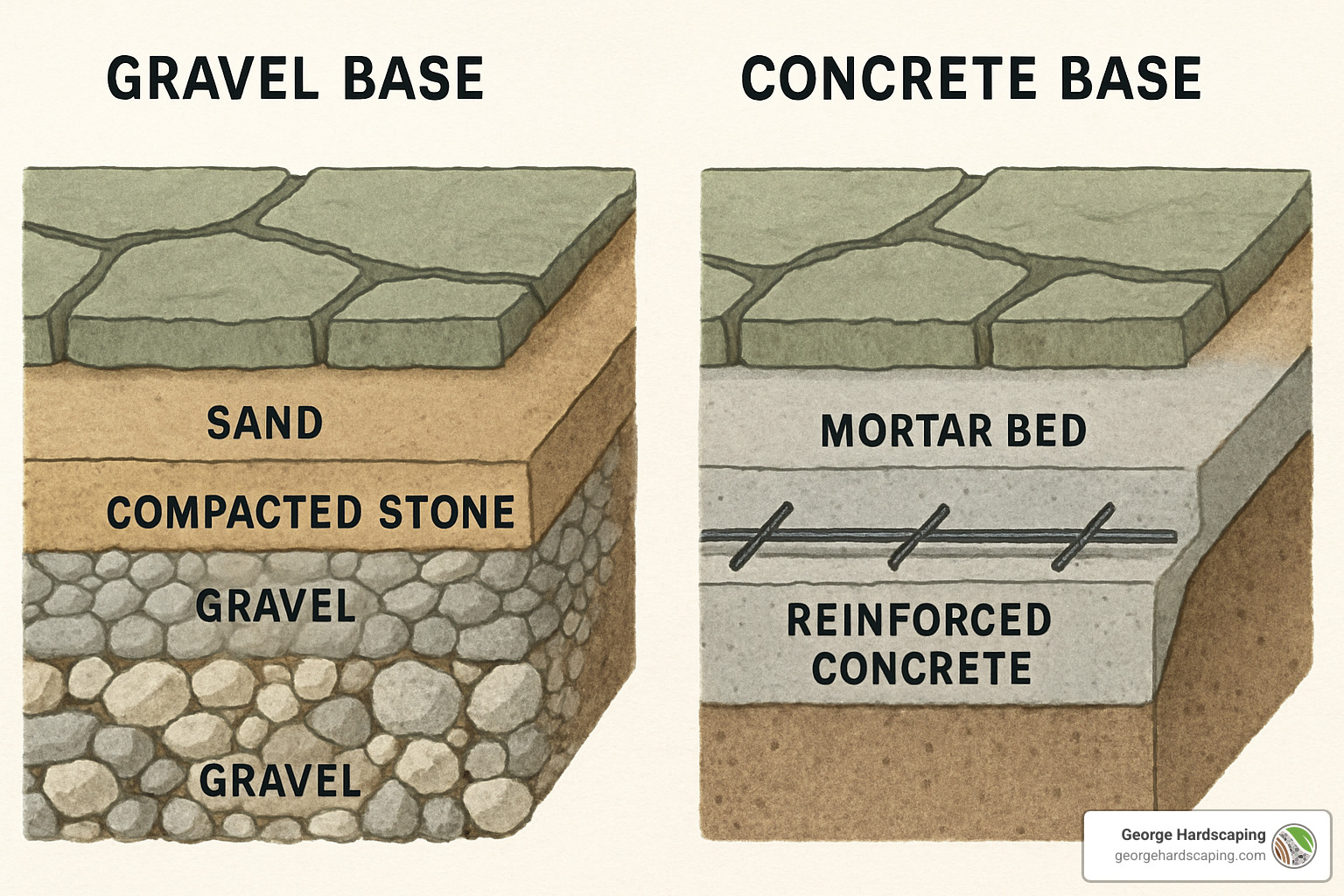
Flagstone can sit on a flexible gravel base (dry-set) or a rigid concrete slab (wet-set). One isn’t universally better—they’re different tools for different jobs.
Dry-Set: Flexible & DIY-Friendly
Typical build:
- 4 in. compacted 3/4\” crushed stone
- 1-2 in. coarse sand or stone dust
- Geotextile to separate soil and base
Pros
- Lower cost & easier for homeowners
- Handles freeze-thaw movement without cracking
- Permeable—great drainage
- Individual stones can be lifted and re-leveled
Cons
- Weeds can grow in joints unless maintained
- May need an occasional top-up of joint material
- Not suited to heavy vehicle traffic
Wet-Set: Maximum Rigidity
Typical build:
- 4 in. reinforced concrete slab
- 1 in. mortar setting bed
- Mortared joints
Pros
- Stones lock permanently in place
- Zero weed growth
- Easy to wash down; ideal for formal entrances
Cons
- Higher price and pro-level skill required
- Concrete can crack in New England freeze-thaw cycles
- Repairs mean breaking and re-pouring sections
- Impermeable, so drainage must be engineered
Rule of thumb in Essex County: choose dry-set for most residential paths and any site with clay or seasonal frost; reserve wet-set for small formal entries or warm-climate projects.
Learn more about building a walkway
Step-by-Step Guide: Building a Dry-Set Base
Below is the condensed roadmap most DIYers follow. Call 811 first, gear up with gloves and eye protection, then take your time—this part is invisible when you’re done, but it does all the work.
- Excavate & Grade
Mark the path; dig 6-7 in. plus stone thickness. Maintain 1/4 in. per foot slope. - Compact Subgrade
Remove roots and soft soil; tamp or plate-compact until firm. - Install Geotextile
Line the excavation, overlapping seams 6 in.; it stops soil migration. - Add Gravel in Two Lifts
Spread 2 in., compact, then another 2 in. and compact again. Check slope. - Screed Setting Bed
Place 1-2 in. of coarse sand/stone dust; screed level but don’t over-compact. - Set Flagstone
Wiggle each stone into place, tap with a rubber mallet, check with a level, leave 1/2-2 in. joints.
Wet-Set in 60 Seconds
- Excavate, build level forms, pour 4 in. reinforced slab.
- Cure 24 h, rake surface for bite.
- Butter 1 in. mortar bed, press stones, tool joints with soupy grout.
Unless you’re comfortable with concrete, hire a mason—mistakes are permanent.
Finishing Touches: Joints, Edging & Climate
Joint material and edging keep your new path looking sharp.
| Joint Material | Best Use | Maintenance | Longevity* |
|---|---|---|---|
| Stone dust / decomposed granite | Dry-set | Top-up yearly | 5-10 yrs |
| Polymeric sand | Tight joints <1 in. | Replace 3-5 yrs | Variable |
| Mortar | Wet-set | Minimal | 20 + yrs |
| Gravel / ground-cover | Wide, informal gaps | Seasonal | Ongoing |
*Average life spans depend on climate.
Edge options: hidden aluminum strips, natural stone borders, concrete curbing, or pressure-treated lumber. Whatever you choose, stake or set it firmly so the walkway doesn’t creep.
Why Depth Matters in Massachusetts
Clay soils and repeated freeze-thaw cycles demand a 5-6 in. compacted gravel base (not the 4 in. you’ll see recommended for warmer states). Extra depth places the gravel below frost, lets water drain, and spreads loads over soft subsoil—all cheap insurance against heaving stones.
View our project gallery for inspiration
Planning Your Project: Cost & Skill
Quality base work is 30-40 % of total cost and 60 % of the labor—skip it and you’ll pay twice. Below are wide national average cost ranges compiled from multiple public online sources and industry reports. These figures are NOT quotes from George Hardscaping; they’re simply averages pulled from public internet data.
| Installation Type | DIY Materials | Pro Installed |
|---|---|---|
| Dry-Set | $5 – $35 / sq ft | $15 – $90 / sq ft |
| Wet-Set | N/A* | $25 – $150 / sq ft |
*Wet-set requires concrete tools and masonry skill—most homeowners hire pros.
Seasonal note: late spring through early fall offers the best compaction and curing weather; contractors often discount late-season work.
DIY or Call the Pros?
Dry-set projects under 100 sq ft are realistic weekend endeavors if you enjoy physical work and rent a plate compactor. Anything larger, sloped, or with tricky drainage is usually faster—and ultimately cheaper—when handled by an insured hardscape crew. Professional installation also comes with warranties and the local know-how to handle Beverly’s sandy soils or Boxford’s heavy clay.
See our other walkway and stair projects
Conclusion: Building a Walkway That Lasts a Lifetime
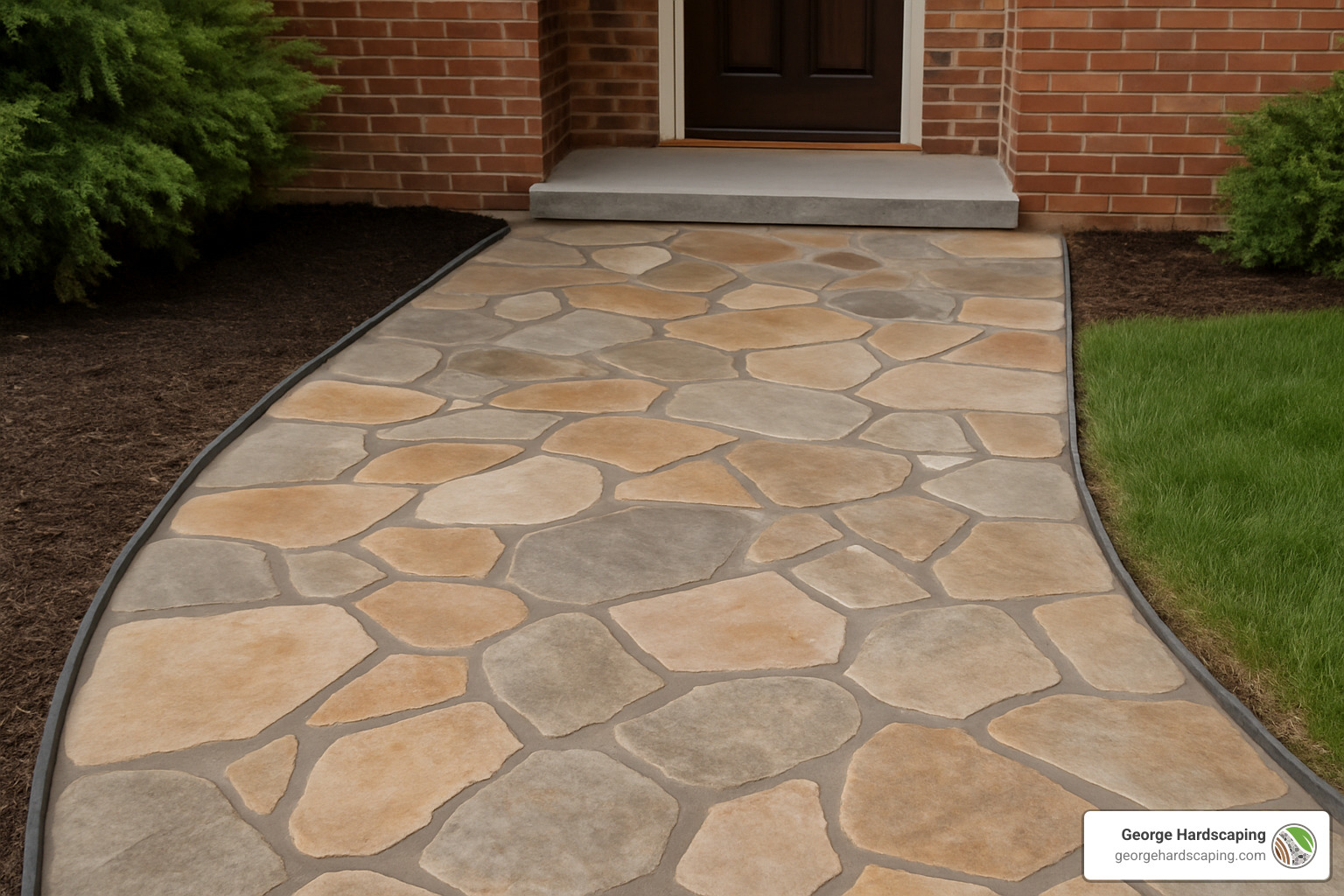
After walking through all the technical details, material choices, and installation methods, the truth about flagstone walkways comes down to one simple fact: the base for flagstone walkway construction determines everything. You can select the most beautiful stone, create the most neat pattern, and invest in premium materials, but without a solid foundation, your walkway will become a source of frustration rather than pride.
Think of it this way – you wouldn’t build a house on a shaky foundation, so why would you build a walkway on one? The stones you see and walk on are just the visible part of a much larger system working beneath your feet.
The foundation isn’t just important – it’s everything. When homeowners call us about walkway problems, the issue almost always traces back to inadequate base preparation. Stones that rock when stepped on, gaps that keep widening, weeds pushing through joints – these aren’t stone problems, they’re foundation problems.
Here’s what we’ve learned from decades of building walkways throughout Essex County: The base is the most critical component of your entire project. Never compromise on foundation quality to save a few dollars upfront. A properly built base costs more initially but saves thousands in repairs and replacements over the walkway’s lifetime.
Dry-set installation remains the best choice for DIY projects and cold climates like ours here in Massachusetts. The flexible nature of a gravel and sand base accommodates our freeze-thaw cycles without cracking or heaving. It’s forgiving of minor mistakes and allows for easy repairs when needed.
Wet-set installation offers ultimate rigidity but comes with higher costs and skill requirements. While concrete bases create incredibly stable walkways, they’re more vulnerable to our harsh New England winters and require professional installation for best results.
Proper drainage prevents 90% of walkway problems we see in the field. Water is the enemy of any hardscaping project, and managing it starts with your base design. That 1/4 inch per foot slope might seem minor, but it’s the difference between a walkway that lasts decades and one that fails in a few years.
Climate matters more than many homeowners realize. New England’s freeze-thaw cycles, heavy clay soils, and temperature swings create unique challenges that affect base selection. What works in warmer climates may fail spectacularly here in Massachusetts.
Whether you tackle this as a DIY project or hire professionals, success depends on understanding these fundamentals and not cutting corners where it matters most. The upfront investment in proper base preparation pays dividends through reduced maintenance, improved safety, and improved property value.
For homeowners throughout Essex County who want the confidence that comes with professional installation, George Hardscaping brings the experience and local knowledge that makes the difference. We understand the soil conditions from Beverly’s sandy coastal areas to Georgetown’s challenging clay. We know which drainage solutions work best in our coastal climate and which base designs perform through harsh Massachusetts winters.
A professionally designed and installed flagstone walkway becomes more than just a path – it becomes a permanent feature that improves your property for generations. The foundation you build today determines whether your walkway becomes a source of pride or a constant headache.
The choice is yours, but remember: you only get one chance to build the foundation right. Everything else can be adjusted, repaired, or improved later. The base is forever.
Learn more about building a walkway with us
