
Why Getting Your Andover Fire Pit Right Matters From the Start
Andover fire pit rules, design options, and installation choices can make or break your outdoor living project. Here’s a quick overview of what you need to know before you start:
Quick Answers for Andover, MA Homeowners:
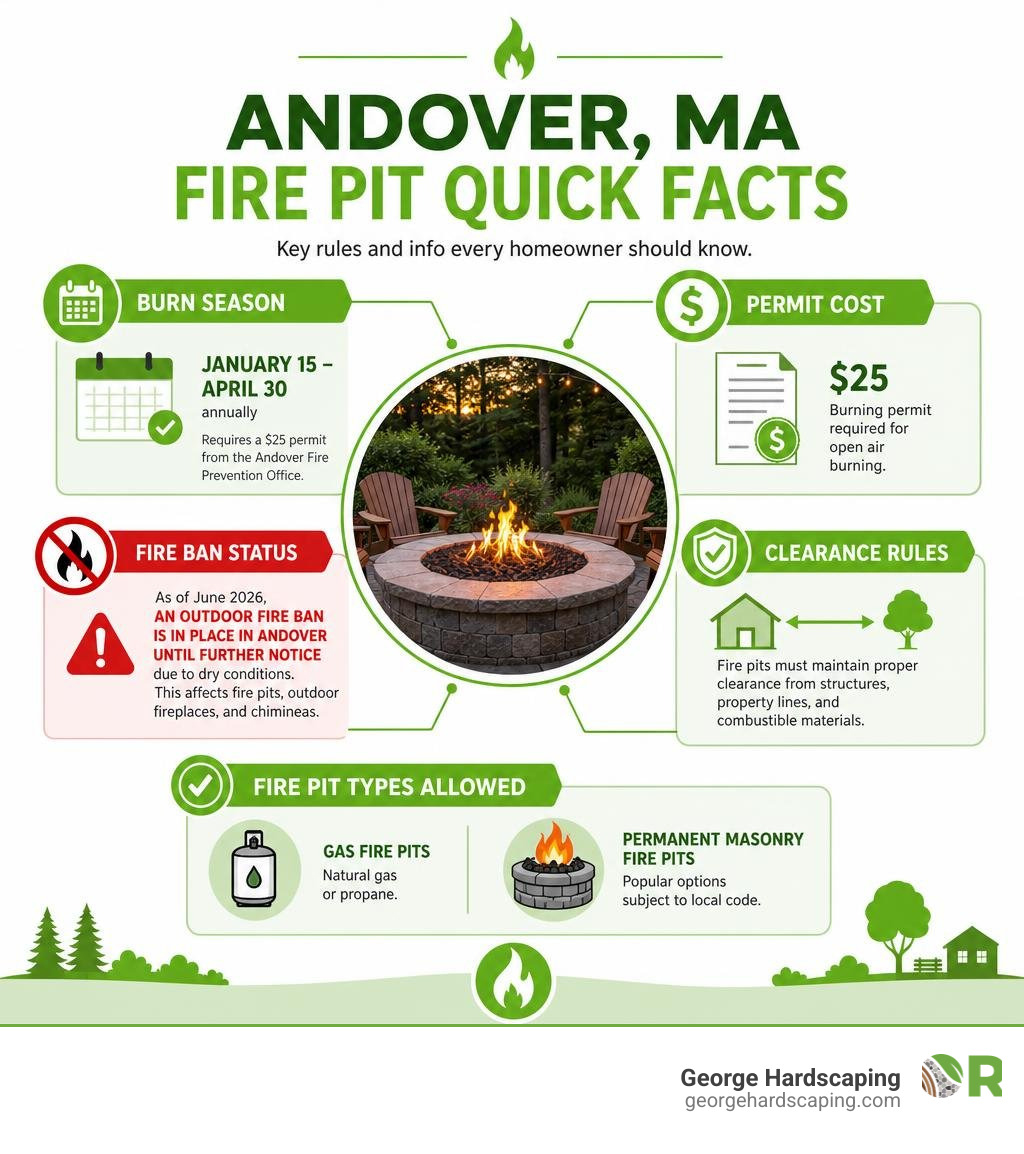
- Active fire ban: As of June 2026, an outdoor fire ban is in place in Andover until further notice due to dry conditions. This affects fire pits, outdoor fireplaces, and chimineas.
- Open air burning season: January 15 – April 30 annually (requires a $25 permit from the Andover Fire Prevention Office)
- Types allowed: Gas fire pits (natural gas or propane) and permanent masonry fire pits are popular options subject to local code
- Key safety rule: Fire pits must maintain proper clearance from structures, property lines, and combustible materials
- Permits: A burning permit is required for open air burning; gas line installations require additional permits and inspections
- Professional installation: Strongly recommended for permanent or gas fire pits to ensure code compliance and safety
New England summers are short, but our love for the outdoors is enduring. Homeowners across Essex County — from Beverly to Danvers and Peabody — know that a well-built fire pit can stretch the outdoor season well into fall. It turns a backyard patio into a place people actually use, transforming a simple lawn into an inviting outdoor living room. Whether you are roasting marshmallows with the kids on a crisp September evening or hosting a sophisticated cocktail party under the stars, a fire pit provides the perfect focal point.
But a fire pit isn’t just a hole in the ground with some rocks around it. In Andover, MA, there are real regulations, active seasonal restrictions, and safety requirements that affect what you can build, when you can use it, and how it needs to be installed. Getting those details wrong can mean fines, failed inspections, or worse. The town of Andover, with its beautiful historic homes and dense residential neighborhoods, requires a careful approach to fire safety. A poorly constructed fire pit can pose a significant risk to your property and your neighbors.
This guide walks you through everything — from current Andover fire codes and permit requirements to the best fire pit types and what professional hardscape integration actually looks like. By understanding these factors before you break ground, you can ensure your project is safe, legal, and built to last for decades.
Navigating Regulations for Your Andover Fire Pit
Before choosing materials or digging up your lawn, you must understand the local legal landscape. Andover, MA, maintains strict regulations regarding open burning, recreational fires, and outdoor heating appliances. These rules are designed to protect our community, our historic housing stock, and our beautiful natural resources from the devastating effects of uncontrolled fires.
Currently, as of June 2026, an active outdoor fire ban is in place for the Town of Andover due to prolonged dry conditions. This emergency ban, issued by the local fire department, strictly prohibits the use of all outdoor wood-burning fire pits, chimineas, and outdoor fireplaces. While temporary, these bans are common during dry New England spells and highlight why many homeowners are transitioning to gas-fueled options. When a ban is in place, violating it can result in significant fines and immediate shut-down orders from local authorities. Understanding these seasonal risks is a crucial part of being a responsible homeowner in Essex County.
To understand how local rules apply to your property, it helps to look at how different municipal departments define outdoor burning:
- Open Air Burning: This refers to burning brush, cane, driftwood, and forestry debris. In Andover, this season is strictly limited to January 15th through April 30th annually. It requires purchasing a $25 burning permit from the Fire Prevention Office. Burning must take place at least 75 feet from all dwellings and must be conducted between 10:00 AM and 4:00 PM.
- Recreational Fires and Fire Pits: These are smaller, controlled fires used for cooking, warmth, or social enjoyment. While they do not fall under the seasonal brush-burning rules, they are still heavily regulated. They must be attended at all times by a responsible adult, and a method of extinguishment (such as a garden hose or fire extinguisher) must be immediately available.
Local rules vary slightly by town across the North Shore. For instance, you can review the Open Burning Permits and Regulations – Beverly, MA to see how neighboring communities handle seasonal permits. Similarly, neighboring towns have established clear frameworks, such as the Fire Pit Regulations | North Andover, MA and the Town of Lynnfield Open Fire Pits guidelines, which outline structural clearances. If you live closer to the coast, the Fire Pit Guidelines | Ipswich, MA – Official Website provide excellent local safety baselines. These regional variations demonstrate that while the state of Massachusetts provides a general framework, individual municipalities have the authority to enforce stricter local codes based on their specific density and environmental factors.
For a broader perspective on fire safety, we can contrast our local Massachusetts rules with those in Andover, Kansas. In Andover, KS, the local fire code adopts the 2024 International Fire Code with specific local amendments. Their regulations require open burning to be located at least 50 feet from property lines, structures, or roadways, and never within two miles of an airport. Additionally, portable outdoor fireplaces in Andover, KS must be kept at least 15 feet from structures, used only on non-combustible surfaces, and completely extinguished if wind speeds exceed 15 mph. This comparison highlights how different geographic regions adapt their safety codes to match their unique landscapes, wind patterns, and municipal layouts.
Back home in Massachusetts, our dense neighborhoods in towns like Beverly, Ipswich, and Lynnfield require careful planning. Local fire departments generally enforce a minimum clearance of 15 to 25 feet from any combustible structures, vinyl siding, deck railings, or overhanging trees. To explore how we build compliant installations, see our detailed guide on Outdoor Fire Pits Andover MA.
Designing a Custom Gas Andover Fire Pit
If you want a fire feature that you can legally and safely use even when wood-burning bans are in place, a custom gas fire pit is the ideal solution. Clean-burning natural gas and liquid propane units are typically exempt from dry-weather wood bans, making them highly versatile for year-round entertainment. Because they do not produce sparks, embers, or heavy smoke, they present a significantly lower risk of accidental ignition.
Gas units offer unmatched convenience. With the flip of a switch, the press of a remote, or the turn of a key, you have an instant, smokeless flame. There are no sparks, no flying embers, and no smoky clothes. This makes them perfect for quick weekday evening use when you don’t have the time to build, monitor, and safely extinguish a wood fire.
When designing a gas fire pit, safety clearances are paramount. Because we are dealing with live fuel lines, professional installation is non-negotiable. Our team coordinates the necessary plumbing permits and works with licensed gas fitters to run underground lines safely to your patio. This involves trenching to the appropriate depth, installing safety shut-off valves, and ensuring all connections are pressure-tested. You can learn more about this specialized process by exploring our page on Gas Fire Pit Installation Near Me.
To elevate the design, many homeowners opt for a custom fire pit table, which provides a flat masonry ledger around the flame to place drinks or small plates. This dual-purpose design maximizes the utility of your patio space. Additionally, adding a custom fire pit wind guard made of tempered glass keeps the flame steady, improves fuel efficiency, and protects guests from sudden drafts.
Traditional Wood-Burning Andover Fire Pit Options
For many purists, nothing beats the crackle, aroma, and natural warmth of a real wood fire. The sensory experience of a wood fire is deeply rooted in New England tradition. If you choose a wood-burning model, building it with heavy-duty, fire-rated materials is essential for safety and longevity.
A professional wood-burning pit features a dual-walled design: an outer layer of beautiful natural stone or concrete pavers, and an inner lining of high-temperature firebrick joined with refractory mortar. This prevents the stone from cracking under intense heat. Standard concrete blocks or fieldstones contain moisture; when heated rapidly by a wood fire, this moisture can turn to steam, causing the stone to crack, spall, or even violently shatter.
To minimize safety risks, wood-burning models should always include a heavy-duty steel insert and a spark arrestor screen to catch flying embers. You can read more about selecting the right setup on our wood burning fire pit page. Additionally, utilizing custom fire rings for fire pits helps protect the surrounding masonry from direct flame contact, ensuring your investment lasts for decades. Proper wood storage is also key; keeping your firewood dry and seasoned ensures a cleaner burn with less smoke and fewer sparks.
Professional Installation and Hardscape Integration
A fire pit should never look like an afterthought. When we design custom outdoor spaces in towns like Ipswich, Lynnfield, Woburn, Beverly, and Reading, we focus on seamless hardscape integration. A well-integrated fire pit should look as though it was built in tandem with the rest of your home’s architecture and landscaping.
This means matching the stone or pavers of your fire pit to your existing patio, walkways, or retaining walls. It also means addressing key structural elements that amateur builders often overlook:
- Drainage: A stone or brick fire pit will collect rainwater. Without proper weep holes and gravel drainage bases, water will pool inside, damaging the burner or freezing and cracking the masonry during New England winters. Our installation process includes digging a deep gravel foundation below the frost line to allow water to drain away naturally.
- Ventilation: Gas fire pits require proper ventilation cavities built into the masonry base to prevent gas pocket buildup. Without these vents, unburned gas can accumulate inside the hollow structure, creating a serious explosion hazard when the pit is lit.
- Seating and Space: A comfortable fire pit area requires at least 3 to 4 feet of clearance around the structure for seating, allowing guests to sit back without feeling crowded. We carefully calculate the layout of your patio to ensure there is ample room for traffic flow, seating, and safety clearances.
Below is a comparison to help you weigh your options:
| Feature | Custom Masonry Fire Pit | Portable Store-Bought Fire Pit |
|---|---|---|
| Durability | Lifetime (built with stone, brick, and concrete) | 1 to 3 seasons (prone to rust and warping) |
| Safety | High (anchored, code-compliant, insulated) | Moderate (can tip over, lacks thermal barrier) |
| Property Value | Increases home equity and visual appeal | Neutral (temporary accessory) |
| Fuel Options | Natural Gas, Propane, or Wood | Wood or small Propane tanks |
| Integration | Custom-built to match patio design | Standalone unit |
To see how a custom build can transform your yard, check out our patio design and installation services, or browse our comprehensive custom fire pits page. For a complete look at our masonry capabilities, visit our hardscaping and masonry services page.
Average Industry Installation Costs
When planning your budget, it is helpful to look at general market pricing. Based on publicly available internet data, the average cost to install an outdoor fire pit varies widely depending on the materials, utility lines, and project scale:
- Basic Portable Units: $250 to $600 (simple metal bowls or pre-made kits purchased from big-box retailers)
- Mid-Size Masonry Installations: $1,500 to $4,500 (professionally built paver pits on existing patios using high-quality concrete blocks and steel inserts)
- Full-Scale Custom Builds: $4,500 to $17,500+ (custom natural stone, integrated seating walls, running natural gas lines, custom masonry work, and integrated lighting features)
Several factors drive these costs. Excavation and site preparation are major variables; if your yard is sloped or has poor soil conditions, additional grading and retaining walls may be required. Sourcing premium materials, such as local New England fieldstone or imported granite, will also increase the material cost but offers unmatched beauty and durability. Finally, running utility lines requires trenching through your yard, which must be done carefully to avoid existing irrigation, electrical, or plumbing systems.
Disclaimer: These figures represent wide average price ranges compiled from online industry data to account for extreme project variability. They do not reflect actual pricing, rates, or project guarantees for George Hardscaping.
Frequently Asked Questions About Andover Fire Pits
What are the clearance requirements for an outdoor fire pit in Andover, MA?
In Andover and surrounding North Shore communities, fire pits must be placed a minimum of 15 to 25 feet away from any structures, property lines, wood decks, vinyl siding, and low-hanging trees or combustible materials. This clearance ensures that radiant heat and stray embers do not pose a fire hazard to your home or neighboring properties. Always check with the local fire department before construction, as specific neighborhood densities can affect these requirements.
Is a permit required to install a permanent gas fire pit?
Yes. Installing a permanent natural gas or propane fire pit requires a gas fitting permit, which must be pulled by a licensed plumber or gas fitter. The installation must also pass a local plumbing inspector’s safety check before use. This process ensures that the gas lines are buried at the correct depth, properly insulated, and free of leaks, protecting your family and property.
Can I use my fire pit during an active outdoor fire ban?
No, if it is a wood-burning unit. During active fire bans (like the one in place as of June 2026), all wood-burning fire pits, chimineas, and outdoor fireplaces are strictly prohibited due to dry conditions. However, clean-burning natural gas or propane fire pits are typically allowed unless specified otherwise by the fire chief, as they do not produce sparks or embers that could ignite dry vegetation.
What are the best materials for building a long-lasting custom fire pit in New England?
For the exterior, natural stone like granite, fieldstone, or bluestone offers the best resistance to New England’s harsh freeze-thaw cycles. For the interior, high-duty firebrick joined with refractory mortar is essential. This combination ensures that the structure can withstand both the extreme heat of the fire and the freezing winter temperatures without cracking or shifting.
How do I properly maintain and winterize my custom gas fire pit?
To winterize your gas fire pit, start by turning off the main gas supply valve. Clear any leaves, dirt, or debris from the burner pan and the drainage weep holes. If your fire pit uses glass media or lava rocks, ensure they are dry. Finally, cover the entire structure with a high-quality, breathable, weatherproof cover to protect the masonry and burner components from snow and ice accumulation.
Can a custom fire pit be built directly on top of an existing wood deck?
Wood-burning fire pits should never be placed on a wood or composite deck due to the extreme risk of heat transfer and stray embers. However, a custom gas fire pit can sometimes be installed on a deck if it is specifically designed for that purpose, features a dedicated thermal barrier, and complies with all local building and fire codes. This always requires professional assessment and installation.
Conclusion
Investing in a professionally built Andover fire pit is one of the best ways to elevate your backyard, increase your property value, and create a warm gathering place for your family. By understanding the local regulations, choosing the right fuel type, and working with experienced local masons, you can enjoy a safe, stunning fire feature for years to come. A custom fire pit is more than just a hardscape feature; it is an investment in your lifestyle, providing a space where memories are made for decades.
At George Hardscaping, we bring decades of masonry expertise to homeowners across the North Shore, including Beverly, Ipswich, Lynnfield, Woburn, and Reading. We handle everything from initial design to permit coordination and final stone placement, ensuring your project is seamless, stress-free, and fully compliant with all local codes.
Ready to transform your backyard into an outdoor oasis? We offer two convenient ways to get started:
- Request a Free Estimate: Request a free estimate online today to schedule an on-site consultation with our design team. We will assess your space, discuss material options, and provide a detailed project proposal.
- Call Us Directly: Call us directly at +781-222-0805 to speak with our design team and get immediate answers to your questions.
Learn more about our craftsmanship, view our portfolio of completed projects, and discover how we can bring your vision to life by visiting George Hardscaping.
