
How to repair a stone retaining wall: 5 Easy Steps
Why Stone Retaining Wall Repair is Critical for Your Property
Learning how to repair a stone retaining wall is more than just a home improvement skill; it’s a crucial measure to protect your property’s value and structural integrity. A well-maintained stone wall is a beautiful asset, but a failing one can quickly become a dangerous and expensive liability. Understanding the forces at play—relentless soil pressure, hydrostatic water buildup, and the destructive power of freeze-thaw cycles—is the first step in appreciating why timely repairs are non-negotiable.
When water seeps behind a wall and can’t escape, it builds immense hydrostatic pressure, pushing outward with surprising force. In colder climates, this trapped water freezes and expands, a process that can break apart even the strongest mortar over time. The research is clear: addressing minor repairs promptly prevents these natural forces from turning small issues into catastrophic structural failures.
Quick Repair Steps:
- Assess the damage – Meticulously inspect for loose stones, cracked or crumbling mortar, and any signs of leaning or bulging.
- Remove old mortar – Carefully chisel out all damaged and deteriorated joints to a depth of at least 2 to 2.5 times the joint’s width.
- Mix proper mortar – Use the correct type for your application, typically Type N or Type S, for optimal strength and weather resistance.
- Repoint joints – Pack the new mortar firmly into the cleaned, dampened joints, ensuring there are no air pockets.
- Reset loose stones – If stones are displaced, set them firmly into a fresh bed of mortar.
- Cure properly – Keep the repaired areas moist for at least 48-72 hours to allow the mortar to cure slowly and reach maximum strength.
The financial argument for proactive repair is compelling. According to industry data, basic repointing and minor fixes might cost between $200-$1,000. However, neglecting these issues can lead to major reconstruction, with costs soaring from $3,000 to $15,000 or even more for extensive failures requiring engineering solutions. These are average costs based on internet data and not actual costs for George Hardscaping. A stone wall’s typical lifespan is 50-100 years, but with proper maintenance and timely repairs, it can easily last for generations.
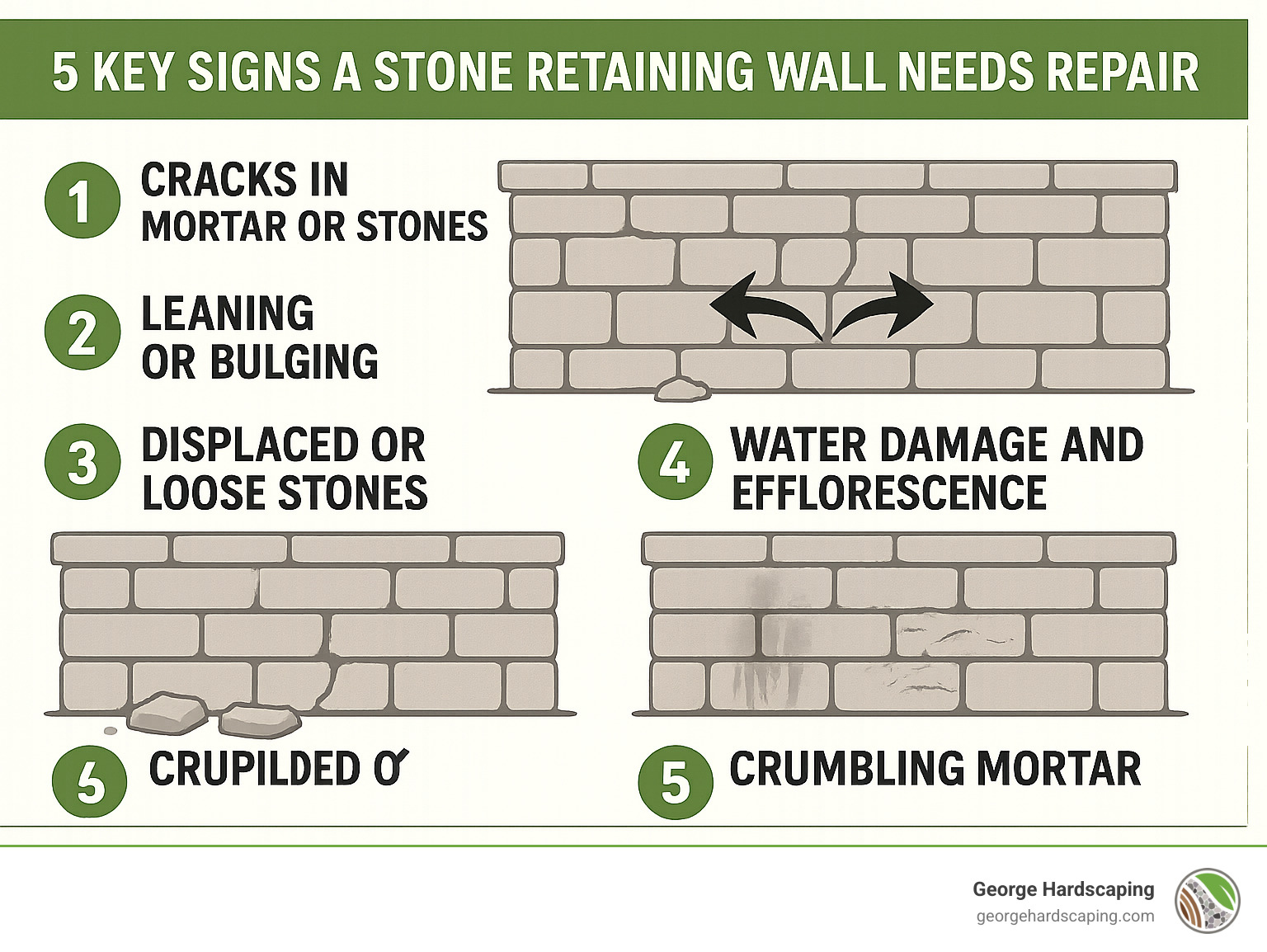
Common warning signs that demand immediate attention include:
- Loose or displaced stones that shift under pressure.
- Mortar joints that are visibly crumbling or have turned to sand.
- A white, chalky residue (efflorescence), indicating moisture problems.
- Any section of the wall that is leaning, bulging, or bowing outward.
- Water pooling at the base of the wall or signs of poor drainage.
The key to successful repairs lies in understanding the boundary between a manageable DIY project and a situation requiring professional intervention. For walls under 4 feet high with minor mortar decay, a DIY approach is often feasible. However, any signs of structural movement or issues with taller walls demand the expertise of a professional retaining wall contractor.
Quick how to repair a stone retaining wall definitions:
- cost of repairing retaining wall
- helical anchors retaining wall
- retaining wall anchors
When to Repair vs. When to Call a Professional
Understanding when you can tackle how to repair a stone retaining wall yourself versus when to call in the experts can save you both money and heartache. The difference between a successful weekend project and a costly disaster often comes down to an honest assessment of the damage and your own limitations.
Think of your retaining wall like your car – you might change the oil yourself, but you probably wouldn’t attempt to rebuild the engine. The same principle applies here. Some repairs are straightforward maintenance tasks, while others require specialized knowledge, heavy equipment, and an understanding of soil mechanics that only professionals possess.
Identifying Minor vs. Major Damage
The key to making the right decision lies in accurately assessing what you’re dealing with. Minor damage typically involves surface-level issues that don’t compromise the wall’s structural integrity. You’ll know you’re in DIY territory when you see:
- Crumbling Mortar: Isolated spots where the mortar between stones has become soft or sandy. You can easily scrape it out with a screwdriver, but the surrounding stones remain solid.
- Loose Stones: A single stone or a small cluster that can be wiggled by hand but hasn’t fallen out or caused a section to bulge.
- Hairline Cracks: Very thin cracks (less than 1/8 inch wide) that look like spiderwebs on the mortar surface. They don’t pass through the stones themselves or connect to form a larger pattern.
- Efflorescence: That white, chalky residue on your stones. While it signals moisture is moving through the wall, it’s often a cosmetic issue if the wall is otherwise stable. It can usually be cleaned off.
Major damage, on the other hand, sends clear warning signals that the wall’s structural stability is at risk. These are not suggestions; they are commands to stop and call a professional. Look for:
- Large or Expanding Cracks: Vertical or stairstep cracks that are wider than 1/8 inch, run through multiple stones, or seem to be getting larger over time. This indicates significant stress and potential failure.
- Wall Shifting: Any leaning, bulging, or bowing of the wall. Use a level to check for plumb. Even a slight lean can indicate that the forces behind the wall are overwhelming its design.
- Foundation Issues: The base of the wall is sinking, heaving, or has large gaps opening up beneath the first course of stones. A failing foundation means the entire wall is compromised.
- Systemic Failure: You see multiple problems at once—large cracks, leaning sections, and significant water damage all happening simultaneously. This points to a systemic issue, often related to failed drainage.
- Poor Drainage: Water consistently pools at the base of the wall after rain, or you see soil washing out from weep holes or joints. This is the number one cause of wall failure.
Understanding Repair Costs
The financial reality of stone wall repairs varies dramatically. For minor, DIY-friendly issues, you might spend as little as $50-$200 on a bag of mortar, a few trowels, and a brush. Simple repointing of crumbling mortar or resetting a few loose stones can often be accomplished with basic supplies and elbow grease.
However, costs escalate quickly when problems become more complex. Efflorescence treatment typically runs $220-$660, while addressing drainage issues with new pipes can cost $50-$240 per square foot. Crack repairs generally range from $150-$1,200, depending on severity and extent. These are average costs based on internet data and not actual costs for George Hardscaping.
When structural issues enter the picture, budgets need to accommodate professional-grade solutions. As an example from a reputable source, helical anchors for a retaining wall repair cost can be $60-$240 per linear foot. Major reconstruction projects can easily reach $3,000-$45,000 or more for extensive work that requires excavation, new footings, and engineered backfill.
The financial lesson is crystal clear: catching problems early almost always means spending less. That $100 weekend repair project becomes a $10,000 reconstruction if ignored long enough.
The 4-Foot Rule: When Professional Help is Non-Negotiable
Here’s where we draw a line in the sand—literally. The construction industry has established what’s commonly known as the “4-foot rule,” and it exists for very good reasons. If your retaining wall stands taller than 4 feet (measured from the bottom of the footing to the top of the wall), professional help becomes non-negotiable for any structural repair.
This isn’t just industry preference; it’s often written into local building codes and wall height regulations. Walls above this threshold are holding back exponentially greater soil pressure. The weight and force increase dramatically with height, and factors like soil type (heavy clay vs. light sand) and surcharge loads (the weight of a driveway, patio, or even a steep slope above the wall) must be calculated by an engineer.
The physics involved become complex quickly. Taller walls require engineered solutions, including robust footings, proper drainage systems (like French drains and weep holes), reinforced backfill, and sometimes specialized anchoring systems. The liability alone should give any DIY enthusiast pause—a failing retaining wall can cause catastrophic property damage, injury, or worse.
Most municipalities require engineering plans and permits for walls over a certain height, typically 3 to 5 feet. Attempting these repairs without proper expertise isn’t just risky; it could violate local codes, create legal headaches, and jeopardize your homeowner’s insurance.
At George Hardscaping, our hardscaping and masonry services are specifically designed to handle these complex structural challenges. We understand the engineering principles, local requirements, and safety protocols that ensure your wall doesn’t just look good—it performs reliably for decades.
Ready to make the right choice for your retaining wall? If you’re facing structural issues, dealing with a wall over 4 feet tall, or simply want the peace of mind that comes with professional expertise, contact George Hardscaping today. We’ll assess your situation honestly and help you determine the most cost-effective path forward.
Preparing for Your Stone Wall Repair
Think of stone wall repair like preparing for a camping trip – you wouldn’t head into the wilderness without checking your gear first, right? The same principle applies when learning how to repair a stone retaining wall. Proper preparation isn’t just about having the right tools; it’s about setting yourself up for a successful, safe, and long-lasting repair.
The difference between a repair that lasts decades and one that fails within a year often comes down to what happens before you even mix the mortar. This preparation phase might seem tedious, but it’s where you lay the groundwork for a professional-quality result.
Essential Tools and Materials
Walking into a stone wall repair without the right equipment is like trying to bake a cake with just a spoon. You’ll get frustrated quickly, and the results will be subpar. Here’s a comprehensive checklist to ensure your project goes smoothly.
For Safety:
- Safety Glasses: Non-negotiable. Mortar chips, stone dust, and wire brush bristles can cause serious eye injury.
- Work Gloves: Heavy-duty leather or rubber-coated gloves protect your hands from scrapes and the caustic, drying effects of cement-based mortar.
- Dust Mask: A NIOSH-approved N95 respirator is essential when chiseling or grinding mortar to prevent inhaling silica dust, which can cause long-term lung damage.
For Demolition and Cleaning:
- Hammer and Cold Chisel: Your primary tools for carefully removing old, failing mortar. A 3/4-inch chisel is a good all-purpose size.
- Stiff-Bristled Brush: For scrubbing loose debris and dust from the joints and stone faces.
- Wire Brush: For removing stubborn mortar residue and any efflorescence.
- Shop Vacuum or Compressed Air: The best way to ensure joints are completely free of dust before repointing.
For Mixing and Application:
- Mixing Bucket or Wheelbarrow: A 5-gallon bucket is fine for small batches, but a wheelbarrow is better for larger jobs.
- Mortar Mix: The appropriate type for your project (see below).
- Water Source: A hose with a spray nozzle is ideal.
- Mortar Hawk or Mortarboard: A flat board with a handle underneath that holds a small supply of mortar, making it easier to work from.
- Pointing Trowel: A small trowel designed specifically for pressing mortar into joints.
- Margin Trowel: A rectangular trowel useful for scooping mortar and cleaning up edges.
- Jointing Tool: A specialized tool used to shape and compact the mortar joint for a clean, water-shedding finish.
- Sponge and Bucket of Clean Water: For cleaning excess mortar off the stone faces before it dries.
Choosing the Right Mortar for the Job
Not all mortars are created equal, and choosing the wrong type is a common cause of repair failure. The goal is to use a mortar that is slightly softer than the stones themselves, allowing it to absorb stress and movement without damaging the stone. For most repairs, you’ll be choosing between pre-mixed bags of Type N or Type S mortar.
- Type N Mortar: This is the workhorse for most above-grade, exterior residential applications. It has a medium compressive strength (around 750 psi) and offers good flexibility, making it ideal for handling the expansion and contraction caused by temperature changes. For most DIY stone retaining wall repairs, Type N is the recommended choice.
- Type S Mortar: This mortar has a higher compressive strength (around 1800 psi) and is used for walls that are below grade, subject to heavy loads, or in areas with high winds or seismic activity. While stronger, it is also more brittle and less forgiving of movement. Using Type S where Type N is needed can cause the stones themselves to crack under pressure.
- Lime-Based Mortar: For historic stone walls (typically pre-1930s), the original mortar was likely lime-based, containing little to no Portland cement. Repairing these walls with modern, cement-heavy mortars can cause irreversible damage. Lime mortar is softer, more breathable, and allows moisture to escape. If you have an older wall, a custom mix of sand, hydrated lime, and a small amount of Portland cement might be necessary. A common ratio is 6 parts sand, 1 part cement, and 1 part lime.
- Pre-mixed vs. Custom Mix: Pre-mixed bags offer convenience and consistency, taking the guesswork out of proportions. They often contain additives that improve workability and water resistance. However, they may not perfectly match the color of your existing mortar. A custom mix gives you control over color (using pigments) and texture (by choosing specific sand).
Site Preparation and Safety
A well-prepared work site is a safe and efficient work site. Taking these steps will prevent accidents and protect your property.
- Clear the Area: Remove any furniture, planters, toys, or other obstacles from both sides of the wall. You need ample room to move and set up your materials.
- Protect Landscaping: Cover nearby grass, shrubs, and flower beds with heavy-duty tarps or plastic sheeting. Wet mortar can splash and will kill vegetation.
- Ensure Stable Footing: If the ground is soft or uneven, lay down plywood or sturdy boards to create a stable work platform. A slip or fall while holding tools or heavy stones can be dangerous.
- Check the Weather: The ideal conditions for mortar work are between 40°F and 90°F (4°C and 32°C). Avoid working in direct, hot sun, as it will dry the mortar too quickly, causing it to lose strength and crack. Rain can wash out fresh mortar, so ensure a clear forecast for at least 24-48 hours.
The Complete Step-by-Step Guide to Repointing a Stone Wall
With your site prepared and materials gathered, it’s time to begin the core task of learning how to repair a stone retaining wall. This process, known as repointing, involves carefully removing old, failed mortar and replacing it with new, durable material. Follow these steps methodically for a repair that will stand the test of time.
Step 1: Remove the Old Mortar
The goal is to remove all the crumbling, cracked, and deteriorated mortar without damaging the stones. Put on your safety glasses and gloves.
- Technique: Use a hammer and a cold chisel (or a narrower plugging chisel) angled away from the stone. Start with gentle taps to break up the mortar. Work from the center of the joint outwards. The aim is to create a clean, square-edged channel for the new mortar.
- Depth: You must remove the old mortar to a depth of at least 2 to 2.5 times the width of the joint. For a 1/2-inch joint, you need to go back at least 1 inch. This is critical; shallow repairs will pop out within a season.
- Caution: Be patient. Using excessive force can chip, crack, or loosen the stones you’re trying to save, creating a much bigger job.
Step 2: Clean the Joints Thoroughly
This is the most critical and often-skipped step. New mortar will not bond to a dusty, dirty surface.
- Brush: Use a stiff-bristled brush to sweep out all the loose debris and chunks from the chiseled-out joints.
- Vacuum: Use a shop vacuum with a crevice tool to suck out all remaining fine dust. Alternatively, a can of compressed air can blow the dust out effectively. The joint must be spotless.
- Rinse: Lightly mist the joints and surrounding stones with water from a spray bottle or hose nozzle. You want the surface to be damp, but not soaking wet. This prevents the dry, porous stone from instantly sucking all the moisture out of your new mortar, which would lead to a weak, crumbly bond.
Step 3: Mix Your Mortar
Follow the manufacturer’s instructions on the bag precisely. The right consistency is key.
- Measure: Start by adding the dry pre-mix to your bucket or wheelbarrow.
- Add Water: Create a small well in the center of the dry mix and add about 2/3 of the recommended amount of water. Begin mixing with a trowel or hoe.
- Adjust: Gradually add the remaining water until you reach the desired consistency. The ideal mortar should be like smooth peanut butter—stiff enough to hold its shape on a trowel held sideways, but wet enough to be workable.
- Slake (Temper): Let the mixed mortar sit undisturbed for 5-10 minutes. This process, called slaking, allows the chemicals to fully hydrate. After slaking, give it a final, quick remix without adding more water.
Step 4: Pack the Joints with New Mortar

Work in small, manageable sections. Only mix as much mortar as you can use in about 30-60 minutes.
- Load Your Hawk: Place a good amount of mortar onto your mortar hawk or board.
- Apply: Using your pointing trowel, pick up a small amount of mortar and press it firmly into the back of the dampened joint. It’s crucial to fill the joint from the back to the front to avoid creating air pockets, which trap water.
- Layer: Apply the mortar in layers, typically no more than 3/4 inch thick at a time, pressing each layer firmly to ensure a solid fill. Overfill the joint slightly, with mortar protruding just past the face of the stones.
- Be Clean: Try to keep the mortar off the faces of the stones as much as possible. Scrape away any large spills immediately with your trowel.
Step 5: Tool and Finish the Joints
Timing is everything for this step. You must wait for the mortar to become “thumbprint hard.” This means when you press your thumb into it, it leaves a print but doesn’t stick to your finger. This can take anywhere from 30 to 90 minutes depending on the weather.
- Strike the Joints: Use a jointing tool (or a piece of pipe or a spoon in a pinch) to press and smooth the mortar. This compacts the material, making it denser and more water-resistant, and creates a clean, professional look.
- Match the Style: Try to match the style of the original joints. A concave joint is most common and excellent at shedding water.
- Trim Excess: As you tool the joint, it will shave off excess mortar. Let these shavings fall onto a tarp below.
Step 6: Final Cleaning and Curing
Curing is a chemical process, not a drying process. Proper curing is essential for the mortar to reach its full design strength.
- Initial Clean: After tooling all the joints in your work section, use a soft-bristled brush to gently sweep away the mortar shavings and any loose crumbs from the wall face.
- Damp Curing: For the next 3 to 4 days, lightly mist the repaired areas with water 2-3 times a day. This slows down the curing process, preventing the mortar from drying out too quickly and cracking. This is the single best thing you can do to ensure a durable repair.
- Final Wash: After about a week, if there is a light haze (efflorescence) on the stones, you can scrub it off with a stiff brush and water. Avoid using harsh acids unless absolutely necessary, as they can damage both the stone and the new mortar.
Addressing Structural Failures: Beyond Simple Mortar Repair
While repointing can solve many surface-level issues, it’s crucial to recognize when the problem runs deeper. If your retaining wall is showing signs of structural distress, such as leaning, bulging, or foundation failure, mortar repair is like putting a bandage on a broken bone. These situations require more advanced solutions and, in almost all cases, the expertise of a professional masonry or hardscaping contractor.
Attempting these advanced repairs without the proper knowledge and equipment can not only lead to a failed project but can also be extremely dangerous. A collapsing wall can cause severe property damage and serious injury.
How to Reset Large or Displaced Stones
If a stone has become completely dislodged or is pushed significantly out of alignment, it must be reset. This is a more involved process than simple repointing.
- Careful Removal: The stone must be carefully wiggled and pried out of its position. For larger stones, this may require levers or even lifting equipment.
- Clean the Cavity: All old mortar must be chiseled out from the cavity where the stone sat, as well as off the stone itself. The cavity must be cleaned meticulously.
- Apply a Mortar Bed: A thick bed of fresh mortar is applied to the bottom and back of the cavity.
- Set the Stone: The cleaned stone is pressed firmly into the mortar bed. It should be tapped with a rubber mallet to set it to the correct height and alignment with the surrounding stones.
- Shim and Support: Small stone chips or plastic shims may be needed to hold the stone in the correct position while the mortar cures. The surrounding joints are then packed with mortar as described in the repointing guide.
The Critical Role of Drainage
More than 90% of retaining wall failures are caused by water. Hydrostatic pressure from water trapped in the soil behind the wall is the single most destructive force it faces. If you see signs of major water issues—like a persistent bulge after heavy rains or water pouring from the face of the wall—the problem is behind the wall, not in the joints.
- Weep Holes: These are small pipes or gaps left in the lower courses of the wall to allow trapped water to escape. If they are clogged, they must be cleaned out. If the wall has none, a professional may need to drill and install them.
- Gravel Backfill & French Drains: A properly constructed wall has a column of clean gravel directly behind it, and often a perforated pipe (a French drain) at the base to collect water and carry it away. If this system has failed or was never installed, the only permanent solution is to excavate behind the wall, install a proper drainage system, and backfill correctly. This is a major undertaking.
When Anchors Are the Only Answer
For walls that are leaning or bowing significantly due to immense soil pressure, sometimes the only way to save them without a complete rebuild is with structural anchors. This is exclusively a professional job that requires engineering calculations.
- Helical Anchors Retaining Wall: These are essentially giant steel screws that are drilled deep into the stable soil behind the wall’s failure plane. A plate is attached to the face of the wall, and the anchor is tensioned to pull the wall back into alignment or, more commonly, to stabilize it and prevent further movement.
- Tiebacks: Similar to helical anchors, these are rods that anchor the wall face to a stable element, such as a concrete deadman buried further back in the soil.
These retaining wall anchors are highly effective but must be installed correctly to work. They are a key part of the professional toolkit for saving failing walls.
Don’t Ignore the Problem – Get an Expert Opinion
If your wall is leaning, bulging, or has foundation problems, the time for DIY has passed. The risks are too high, and the solutions are too complex. Investing in a professional assessment is the most cost-effective decision you can make.
At George Hardscaping, our team specializes in diagnosing and executing complex structural repairs. We provide comprehensive hardscaping and masonry services that address the root cause of the problem, not just the symptoms. If you see any signs of structural failure, request a professional estimate today. We’ll provide an honest evaluation and a clear plan to restore the safety and beauty of your landscape.
Proactive Maintenance: How to Prevent Future Retaining Wall Damage
Once you’ve completed your repair, the work isn’t truly over. The key to ensuring your stone retaining wall lasts for decades to come is proactive, preventative maintenance. Just like any other major component of your home, your wall requires regular attention to catch small problems before they escalate. A few hours of inspection and upkeep each year can save you thousands of dollars and countless hours of difficult repairs down the road.
Think of maintenance as an investment in the longevity of your property. By managing water, controlling vegetation, and performing regular check-ups, you can significantly extend the life of your wall and protect its structural integrity.
The Annual Inspection Checklist
At least twice a year—once in the spring after the winter thaw and once in the fall before the first frost—take a slow walk along your wall with a critical eye. Here’s what to look for:
- New Cracks or Growth: Look for any new cracks in the mortar joints, no matter how small. Note their location and monitor them for any changes.
- Crumbling Mortar: Probe suspicious-looking joints with a screwdriver. If the mortar is soft, sandy, or crumbles easily, it’s a candidate for repointing.
- Signs of Shifting: Check for any new signs of leaning or bulging. Look at the top of the wall against a fixed background like a house or fence to spot subtle changes in alignment.
- Drainage Performance: After a heavy rain, check how the area around your wall is draining. Are weep holes clear and flowing? Is water pooling at the base? Are there any new sinkholes or areas of erosion behind the wall?
- Efflorescence: Note any new white, chalky stains. While often cosmetic, new or expanding efflorescence can indicate a new moisture problem.
Managing Water: The Root of All Evil
As we’ve established, uncontrolled water is the number one enemy of retaining walls. Your maintenance plan should be heavily focused on water management.
- Gutters and Downspouts: Ensure all roof runoff is directed far away from the top and base of your retaining wall. A downspout that discharges at the top of a wall is a recipe for failure.
- Grading: The soil on the high side of the wall should be graded to slope away from the wall, encouraging surface water to run off rather than percolate down behind it.
- Keep Weep Holes Clear: Regularly check that your wall’s weep holes are free of dirt, leaves, and debris. Use a small rod or a blast of water to clear any blockages.
For a deeper understanding of landscape drainage principles, this guide from the University of Maryland Extension provides excellent, unbiased information.
Control Vegetation
While plants can look beautiful near a stone wall, they can also cause significant damage.
- Remove Seedlings: Pull any small trees or shrubs that sprout in or near the wall’s joints. Their roots can grow into the tiniest cracks and exert incredible pressure, breaking apart mortar and dislodging stones.
- Avoid Large Trees: Don’t plant large trees too close to a retaining wall. As they mature, their root systems can heave the soil and damage the wall’s foundation and structure.
- Manage Vines: While ivy can look charming, it should generally be kept off stone walls. The tendrils hold moisture against the surface, accelerating mortar decay, and can work their way into joints, causing damage.
The Sealer Debate: To Seal or Not to Seal?
Applying a sealer to a stone wall is a topic of much debate. A high-quality, breathable, penetrating sealer (silane/siloxane based) can help reduce water absorption without trapping moisture. This can be beneficial in very wet climates or for porous types of stone. However, applying a non-breathable, film-forming sealer (like an acrylic) is almost always a bad idea. It can trap moisture inside the wall, leading to spalling (flaking of the stone face) during freeze-thaw cycles.
Before sealing your wall, it’s best to consult with a professional. The decision depends on your climate, the type of stone, and the wall’s condition.
By adopting a proactive maintenance mindset, you transform from someone who simply fixes problems to someone who prevents them. If you need help creating a long-term care plan or want a professional eye to inspect your wall, the team at George Hardscaping is here to help. Our expertise as a leading retaining wall contractor ensures your landscape investment remains safe, stable, and beautiful for a lifetime.
